Category Archives: Recreation

CPA meeting 12/10 at 7pm

Adopting the Community Preservation Act is a way for Medfield to save money on our property taxes – it saves us money because of the state  matching money.  This year Medway is getting a state match at over 40% of what they paid in to their CPA fund, because they do the CPA at 3%, like we should be doing.  Medfield is already paying in to the money being distributed to the CPA towns, but we do not share in the payout because we have not yet adopted the CPA.

The letter below is from the newly formed town committee exploring the CPA for Medfield.

cpa


Dear Community Member,

Care about preserving Medfield’s unique character?  We urge you to join us at *7 p.m. on Dec. 10 at the Zullo Gallery* for conversation, wine, beer and bites to eat so you can learn more about the Community Preservation Act (see attached flyer for basic points).

We’ve all witnessed rapid changes taking place in Medfield over the years. Numerous historic structures have disappeared or are at great risk of disappearing; open space is  threatened by development pressures; affordable housing for our seniors is desperately needed; and a costly recreation project will be proposed to Medfield taxpayers at the 2016 Town Meeting.

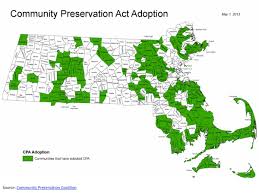
At the same time, it was recently announced that $36 million in funding will be distributed to 156 towns across the Commonwealth specifically earmarked for preservation of open space, historic structures, affordable housing, and recreation, but Medfield will not be among the towns receiving any funding. Why? Because we have yet to adopt the Community Preservation Act (CPA).

In towns that have adopted the CPA, taxpayers will be receiving an almost 30% return on their investment this year alone.

So what can you do?  Join us at the Zullo Gallery on Dec. 10!  This is an opportunity to be among a group of concerned citizens working to educate fellow residents about the Community Preservation Act, and to see who might want to play a role in getting it adopted in the town of Medfield. If you’d like to attend, please just click on the registration form below (not mandatory, but helpful for planning purposes).

http://events.constantcontact.com/register/event?llr=l6t4gcdab&oeidk=a07ebv18ggm8b822a8a

Sincerely,

Chris McCue Potts
Dan Bibel
Russ Hallisey

CPA information 12/10 at 7pm

This from the newly formed CPA group –

Peak House Gateway Tilden Village

WHAT IS THE
COMMUNITY PRESERVATION ACT (CPA)?

Could it benefit Medfield?

Join us to learn more and take action:

7-8:30 p.m. – Thurs., Dec. 10 – Zullo Gallery
Wine, beer, nibbles

Signed into law in 2000 by Gov. Paul Cellucci and Lt. Gov. Jane Swift, the CPA is a smart-growth tool that helps communities:

  • Preserve open space
  • Protect historic sites
  • Create affordable housing
  • Develop outdoor recreational facilities

A local Community Preservation Fund is fueled by a surcharge of 1%, 2% or 3% of property tax bills (not an increase in the tax rate), with the percentage amount decided by voters. Exclusions, (such as low-income residents, certain types of businesses, etc.) are also decided by voters.

In addition to local funds collected, communities receive annual distributions from the state Community Preservation Trust Fund, administered by the Department of Revenue. It’s like putting that 1-3% surcharge in a savings account that earns high interest.

It was recently announced that for 2015 alone, 156 communities together will receive $36 million from the CPA Trust Fund thanks to a 29.7% state contribution*. Medfield was not among them since we have yet to adopt the CPA. (*Source: www.communitypreservation.org)

Norfolk, Medway, Millis, Holliston and Needham are some of the nearby towns that have benefited from the CPA.

Many of the proposed projects at the Medfield State Hospital site could qualify for CPA funding.

Angel Run – Online registration is open

Angel Run

Greetings Angel Run Friends

Join us for the 10th running (or walking) of the Angel Run on Sunday, December 6th at 2pm!

Registration for the MFi Angel Run is officially open. This year registration is exclusively online at www.medfieldfoundation.org and runs through October 31st. Register by this date to receive the always popular commemorative Angel Run t-shirt. After October 31st online registration will close and sign ups will be limited to the day of the event only, with no t-shirt option. New this year will be bib tag timing and an option to purchase a special 10th anniversary Angel Run keepsake when you register online.

Cheers,

The MFi Angel Run Team

Register by Clicking Here!

Concussions in Elementary School

This came from HVMA today, and was information I would like to have had when I was coaching girls soccer and basketball, so I am passing it along –


Concussions in Elementary School: What you need to know

boy with soccer ball.concussionImagine you’re seated at work when you receive a call from the school nurse who tells you your son hit his head during recess. Thankfully, he didn’t lose consciousness, so no concussion, right?

Not necessarily.

Elementary-aged students do not lose consciousness as easily as teens or adults do. They also may not yet have the language skills necessary to convey the pain or symptoms they are experiencing. They might simply say they don’t feel “good.” With children participating in contact sports at younger ages it is crucial for parents, coaches, teachers and school nurses to be aware of the signs of a concussion and diligent about any changes in behavior that could signal the need for treatment.

Changes in behavior in children with concussion may include:

  • Appearing dazed or stunned
  • Being unsure of game, score or opponent
  • Moving clumsily
  • Showing behavior or personality changes
  • Having difficulty organizing tasks or shifting between tasks
  • Displaying inappropriate or impulsive behavior
  • Exhibiting greater irritability
  • Behaving more emotional than usual
  • Experiencing fatigue
  • Having difficulty handling a stimulating school environment (lights, noise, etc.)
  • Experiencing other physical symptoms (headache, nausea, dizziness)

If you observe any of the above symptoms you should contact a healthcare professional immediately. They can help you set up a plan for treatment and recovery. It is important to work with your healthcare provider as concussions affect people differently. Younger children can experience symptoms lasting anywhere from a few days up to a week. While children often appear to bounce back from everyday injuries, they actually take longer to recover from concussions than adults.

The best treatment for concussions – regardless of age—is rest, both physically as well as mentally, as this helps the brain heal. Restricting strenuous physical activity and getting plenty of sleep are very important for a steady recovery, but rest also involves cognitive rest, which means limiting mental tasks that require concentration or focused thinking. This includes no or limited screen time (phone, TV, computer) as the screen can worsen symptoms. Lighter mental activities, such as listening to audio books or drawing, are usually acceptable. However, it is important to continue monitoring for increased pain or behavioral changes. School work and reading are to be reintroduced gradually, stopping if symptoms reappear. Regardless of a child’s seeming recovery, students need to be evaluated and cleared by a doctor before returning to school or sports.

Because children who play sports are at greater risk for concussion, Harvard Vanguard offers ImPACT testing, a computerized concussion evaluation tool. We perform baseline testing – done before a child has a concussion – for kids 10-19, which can then be used as a point of comparison for tracking recovery if a child experiences a head injury in the future.

– See more at: http://blog.harvardvanguard.org/2015/08/concussions-in-elementary-school-what-you-need-to-know/#sthash.Uwk17zWQ.dpuf

Thoughts on MSH as planning begins

Sarah Raposa, our Town Planner, sent out the agenda for the first meeting on Wednesday with the town’s master planning consultant, VHB, for the former Medfield State Hospital site.  As part of her email, Sarah suggested that people jot down thoughts, and below are mine:


Medfield State Hospital Site – Issues to Consider at Outset of the Planning Process

1.    Clean Slate – The past discussions and the visioning session created an interesting list of ideas, but should in no way limit options going forward.

2.    Infrastructure – lots needed, and best if developers instead of town can be made to pay

3.    Natural Resources – exist in abundance, and will continue to exist in abundance even if the town opts for a dense development

4.    Environmental – site has been mainly cleaned of known hazards, except the lead paint and asbestos in the buildings

5.    Transportation – none available – shuttle to downtown and train would be ideal

6.    Historic Resources – buildings are beautiful, but likely too far gone to be preserved

7.    Arts & Culture – it would serve the town well to spend to make such uses happen

8.    Housing – will be the economic engine of any development, and if planned well, even if dense, need not be feared in terms of municipal costs and impacts

9.    Open Space & Recreation – exist in abundance, and will continue to exist in abundance even if the town opts for a dense development

CPA – Medfield is missing out

This week I got the letter below from the Register of Deeds, Bill O’Donnell, which highlights how Medfield loses twice by not having adopted the Massachusetts Community Preservation Act (CPA):

  • first because our residents paid $45,290 in 2014 in Registry of Deeds surcharges to support the CPA, money that then got distributed to other towns, and, then
  • second because Medfield has not adopted the CPA it does not share in the matching state monies given to communities that do participate.

The CPA is akin to a town savings account for three specified areas:

  • historic preservation,
  • affordable housing, and
  • open spaces or recreational uses.

Once a town adopts the CPA, it taxes itself 1-3% extra each year, and the state provides matching monies.  The match started at 100%, but as more towns opted in the match has dropped to around 30% – still free state monies.  A town committee would decide on what to spend the CPA monies.  I heard about lots of uses for CPA funds in other towns at the MMA annual meeting last weekend

For me it is crazy not to pick up the free state monies, if we think/know that we will be spending monies on the three covered areas any time in the future.  It is one clear way to save on our property taxes. The only reason for someone not to want to adopt the CPA is if they do not intend to continue living in Medfield.

Therefore, I will ask that a warrant article be placed on the warrant for the Annual Town Meeting about adopting the CPA.

For more information on the CPA click through to http://www.communitypreservation.org/


COUNTY OF NORFOLK
COUNTY OF PRESIDENTS
REGISTRY OF DEEDS
NORFOLK REGISTRY DISTRICT OF THE LAND COURTWILLIAM P. O’DONNELL
REGISTER OF DEEDS
ASSISTANT RECORDER OF THE
LAND COURT

January 2015

Medfield Board of Selectmen Osier L. Peterson 10 Copperwood Rd. Medfield, MA 02052

Dear Selectman Peterson.

As Register of the Norfolk County Registry of Deeds. I thought the reverse side chart that illustrates the amount of funds generated from the Community Preservation Act (CPA) would be of interest to you. This revenue is based on recorded real estate filings from your community in calendar year 2014.

The Registry, at no cost to the Commonwealth or local communities, collects these revenues for the state when a document is recorded. These monies are then forwarded to the Massachusetts Department of Revenue on a monthly basis. The funds collected by the Commonwealth are then redistributed to communities that have adopted the CPA through a variety of formulas.

The Norfolk County Registry of Deeds which is located at 649 High Street, Dedham. is the principal office for real property in Norfolk County. The Registry is a resource for homeowners, title examiners. mortgage lenders, municipalities and others with a need for secure, accurate, accessible land record information. For assistance please contact our Customer Service Center at (781) 461-6101. or visit our website at http://www.norfolkdeeds.org.

I hope you find this information informative and useful. If I can ever be of assistance to you, please do not hesitate to contact me at 781-461-6116 or by email at registerodonnell@norfolkdeeds.org.

Sincerely yours.
William P. O’Donnell
Norfolk County Register of Deeds
WPO/aag
649 HIGH STREET. DEDHAM. MASSACHUSETTS 02026 TELEPHONE: 781-461-6116 FAX: 781-326-4246
EMAIL: registerodonnell@norfolkdeeds.org
http://www.norfolkdeeds.org
You
facebook.com/NorfolkDeeds
twitter.com/NorfolkDeeds □ youtube.com/NorfolkDeeds linkedin.com/company/Norfolk-County-Registry-of-Deeds


NORFOLK COUNTY REGISTRY OF DEEDS
COMMUNITY PRESERVATION ACT (CPA) SURCHARGES BY TOWN FOR CALENDAR YEAR 2014

TOWN TOTAL
AVON $14,950.00
BELUNGHAM $58,070.00
BRAINTREE $116,160.00
BROOEUNE $163,040.00
CANTON $83,640.00
COHASSET $38,980.00
DEDHAM $80,070.00
DOVER $26,170.00
FOXBOROUGH $53,420.00
FRANKLIN $101,410.00
HOLBROOK $37,250.00
MEDFIELD $45,290.00
MEDWAY $44,910.00
MTU IS $26,370.00
MILTON $85,270.00
NEEDHAM $109,060.00
NORFOLK $39,010.00
NORWOOD $79,800.00
PIATNVILLE $26,610.00
QUINCY $244,340.00
RANDOLPH $90,080.00
SHARON $59,550.00
STOUGHTON $94,330.00
WALPOLE $81,880.00
WELLESELY $95,300.00
WESTWOOD $53,710.00
WEYMOUTH $172,260.00
WRENTHAM $44,500.00


Angel Run

The preregistration for the Angel Run that ended yesterday included about 25% more runners than a year ago.  Over 1,000 runners registered in time to get the lower entry fee and T-shirts, versus about 800 last year.

More runners means

  • more families having holiday fun, and
  • more monies to distribute to Medfield families in need.

The Angel Run is Medfield’s family fun holiday tradition, and this year –

  • 2PM on Sunday, December 7
  • starts and ends at MHS
  • after party is in the BMS cafeteria
  • entries are available up until race time

MFi_AngelRun

CPA update

This summary update on the Community Preservation Act from the state Department of Revenue’s Division of Local Services’ e-newsletter:


CPA: Past, Present and Future
Zack Blake – Director of Technical Assistance

Nearly two years ago, Governor Patrick signed into law a number of changes to the Community Preservation Act (CPA). These amendments expanded the acceptable uses for CPA funds and offered communities more flexibility in how these funds are raised. Reflecting back, we thought we would reintroduce readers to CPA by briefly highlighting some of those changes and ways in which communities are taking advantage of them. We also delve into recent collection trends at the state level that impact the distribution of matching funds.

Enacted in 2000 as MGL c. 44B, the CPA enables adopting cities and towns to raise additional revenue beyond the tax levy for community preservation purposes that include providing community affordable housing, protecting open space, preserving historic resources and developing outdoor recreational opportunities.

Under the CPA an adopting city or town elects to implement up to a three percent surcharge on its real estate tax bills. The revenue is deposited into a special revenue fund along with an annual distribution of matching funds from a state trust derived from a surcharge on Registry of Deed recordings. At a minimum, the city or town must spend or reserve ten percent of its annual CPA revenue towards each of the community preservation purposes of open space, historic resources and community housing. Revenue can also be appropriated to a discretionary budgeted reserve, providing the flexibility to fund any CPA purpose until the end of the fiscal year.

Once the CPA is adopted, the community must establish a Community Preservation Committee (CPC). Whether elected or appointed, CPC members are selected from the community’s conservation, historical, planning, park and housing authority boards. The city or town can also choose up to four additional at-large members for a maximum total of nine. Overall, the committee’s role in administering the program locally involves studying the community’s needs, possibilities and resources as they relate to community preservation; accepting and reviewing project proposals; and making recommendations to the legislative body for spending, citing the reasoning behind each choice. Both an affirmative recommendation of the CPC and a legislative body appropriation vote are required to expend CPA funds on a project.

Throughout the last 14 years, CPA has been amended eight times. Early changes largely clarified various aspects of the law or added minor modifications. More recently, however, Chapter 139 of the Acts of 2012, Sections 69-83, contained several significant changes, including an expansion of the allowable CPA spending purposes and the creation of a new option for local CPA funding.

Before the 2012 amendment, communities could use CPA funding to rehabilitate recreational lands only if the recreational land was acquired or created with CPA funding. Today, however, because of the 2012 amendment, communities have the ability to appropriate funds towards previously prohibited recreational-related projects. In expanding the program, these new CPA funding purposes allow cities and towns to rehab existing outdoor recreational spaces and invest in capital improvements to make them more functional for the intended recreational use, including the replacement of playground equipment. Changes in the law also now credit spending on recreational projects towards meeting the annual ten percent open space spending (or reservation) requirements.

In exploring ways in which these changes are expanding CPA spending, we found funds being appropriated to purchase ADA accessible playground equipment, construct a new skate park, resurface outdoor basketball courts, install lighting for a multipurpose athletic field, rebuild a dock landing and create community gardens.

The second significant change in the law offers communities an alternative funding method to supplement the surcharge on real estate tax bills. A community may now adopt CPA, pursuant to MGL c. 44B, s. 3(b1/2), which allows it to approve at least a one percent surcharge on the levy and to appropriate additional revenues up to two percent of the levy from other general fund sources, such as meal and room occupancy taxes. The total surcharge and additional revenue cannot exceed three percent. To date, Somerville and Salem have adopted the CPA through Section 3(b1/2), sometimes referred to as the “blended” method. Quincy and Littleton recently amended its original CPA acceptance by adopting Section 3(b1/2) so that it can appropriate other local revenue into the Community Preservation Fund. Communities that have already adopted CPA, but wish to appropriate other general fund revenues to CPA as described above, must amend their CPA acceptance under MGL c. 44B, s. 16(a) and seek voter approval at a town-wide referendum.

Lastly, a new provision in the law added an optional surcharge exemption for commercial and industrial properties on the first $100k of property value to mirror the existing exclusion for residential property. To add this exemption, an existing CPA community must follow the CPA amendment process, MGL c. 44B, s. 16(a). The law also now requires that preservation restrictions be recorded as separate instruments regarding property acquired with CPA funds to better protect CPA long-term interests, MGL c. 44B, s. 12.

Future Outlook

As of May 2014, 155 communities have accepted CPA with over a billion dollars appropriated to more than 6,000 projects. It is also worth noting that CPA funds have allowed communities to leverage funds from other outside sources that might not otherwise have been available.

This year also marks a point where a larger number of communities are scheduled to vote on whether to adopt CPA than in the past. Several communities are even seeking to increase their levy surcharge, with at least one looking to reduce it. This renewed interest may be the result of the $25 million infusion of surplus state revenue from the Legislature last year along with the potential for more this year. Another motive could be the recent changes in the law expanding the recreational-related purposes cities and towns can fund.

Ria Knapp, Communications Director for the Community Preservation Coalition, says the combination of these two factors sparked the interest of communities that otherwise might not have considered CPA in the past. She adds that “many communities are embracing the new provision in the CPA legislation allowing the rehabilitation of existing parks, playgrounds, and athletic fields,” with “over $40 million in such projects approved recently, and many more proposals being voted on during this spring’s municipal budget process.”

Despite amendments to the law and renewed interest, local advocates are concerned that this year’s state match could be significantly less. Current Registry of Deed collection trends reported by the Department of Revenue are lagging collections of the previous three years. Concern in the real estate market over high home prices and low inventory levels could also continue to hamper buying over the coming months, creating further uncertainty. The rising number of new communities participating in the program also further dilutes the initial distribution of state matching funds.

CPA Trust Fund Collections as of May 2014
.
.
In FY2014, 148 participating communities were eligible for a state match that totaled $54.9 million. Funded through Registry of Deed revenue collections and a one-time infusion of $25 million in state budget surplus, these combined sources allowed for a first round state match of 52.2 percent. Without the additional $25 million appropriation added to the trust fund, cities and towns in the program would have received a first round match of less than 31 percent based on total state funding of $32.7 million.

Although the recent drop in collections at the state level is cause for concern, CPA advocates are applauding the Legislature’s inclusion and the Governor’s signing of the FY2015 budget, which transfers $25 million in state budget surplus to the CPA Trust Fund. Because this additional funding is coming from the state budget surplus, the amount will not be known until the state closes its books on October 31st.


 

Medfield trails maps

Rob Gregg pointed out to me the trail maps (click here) put together by David LaFreniere, formerly of Medfield, for his group, Friends of Medfield Forest and Trails.  Dave has moved from Medfield, but Medfield still has the benefit of his nice website with the maps he put together.   Thanks Rob for that information.

ATM warrant articles

The town is in the process of getting the warrant articles prepared for the annual town meeting (ATM) on April 28.  Click here for the attached is the current iteration of the warrant articles for the ATM.   Some of the articles –

  • authorize leasing the Holmquist land for farming
  • funds to complete the design and pricing of the new public safety building
  •   funds to build the new water tower at the former Medfield State Hospital site
  • whether to regulate public consumption of marijuana
  • whether to use lot 3 on Ice House Road for fields by Medfield Park & Recreation Commission or to lease to a private party to build a Forekicks type facility (Council on Aging has also expressed interest in having housing for 55+ individuals build there as well)
  • whether to fund the Medfield Cultural Council with $4,250 (matching its state grant monies)
  • create a solar photovoltaic zoning district in the existing Industrial Extensive district
  • whether to adopt the stretch building code, so as to allow Medfield to become a Green Community (and get a grant of $148,000)
  • whether to accept a gift of land that would allow for a path from Wild Holly Lane to the Holquist land and Wheelock School
  • whether to adopt the local option meals tax of 0.75%, in order to provide property tax relief

Please also schedule the special town meeting (STM) on March 10 on your calendar, at which time the town will be asked to make the biggest decision of its history, whether to buy the Medfield State Hospital site for the $3.1 m. price the state has offered it.