FDA: e-cigarettes and children

From today’s American Association for Justice’s TRIAL magazine, FDA focusing on e-cigarette use by minors (see blue text below)


Trial

Top Story

FDA releases new action plans for medical devices, e-cigarettes

May 2018 – Kate Halloran

a stamper that stamps the word "HEALTH"

The FDA recently announced action plans for medical device safety and reducing sales and marketing of e-cigarettes to children under 18. The “Medical Device Safety Action Plan: Protecting Patients, Promoting Public Health” outlines the agency’s priorities for addressing safety for the more than 190,000 devices that it regulates, and its Youth Tobacco Prevention Plan aims to hold manufacturers and distributors accountable for illegally selling these devices to children.

The FDA recently announced action plans for medical device safety and reducing sales and marketing of e-cigarettes to children under 18. The “Medical Device Safety Action Plan: Protecting Patients, Promoting Public Health” outlines the agency’s priorities for addressing safety for the more than 190,000 devices that it regulates, and its Youth Tobacco Prevention Plan aims to hold manufacturers and distributors accountable for illegally selling these devices to children.

The medical device action plan highlights five areas: creating a patient safety net, improving the postmarket process for safety-related changes, encouraging development of safer devices, improving device cybersecurity, and enhancing the “total product life cycle” approach to device safety within the FDA.

Many of the plan’s objectives illustrate the role that technology will play in medical device oversight. For example, the patient safety net will rely on the National Evaluation System for Health Technology (NEST), which is run by the nonprofit Medical Device Innovation Consortium. NEST’s goal is to collect electronic health data from a variety of sources—such as medical records, device registries, and patient complaints—to share real-time data among providers and the agency to expose adverse events and safety issues more quickly. As part of its action plan, the FDA intends to devote more resources to its role in NEST and to seek additional funding for the system.

Another example is device cybersecurity, which has garnered increased scrutiny as more medical devices integrate internet-based features that place the device and the patient at risk when there are software vulnerabilities. The FDA’s plan includes possibly adding premarket cybersecurity requirements for medical device manufacturers, such as having to build into devices the ability to update software and address cybersecurity threats and having to disclose to the agency an inventory of the software in a device as part of the premarket submission process—information which also must be made available to the public. Other potential changes include updates to premarket guidance on protecting against cybersecurity risks that pose a danger to patients, developing standards for timely disclosing risks, and creating a separate entity that would oversee device cybersecurity and the response process with manufacturers when a risk is identified.

The agency also announced steps it is taking to address marketing and sales of electronic nicotine delivery systems (ENDS)—often called e-cigarettes—to minors. As part of a ramped-up Youth Tobacco Prevention Plan, the FDA is targeting e-cigarette use among minors to reduce nicotine addiction and to reduce the transition to traditional tobacco products in the next generation. The use of e-cigarettes—known as vaping—has become especially popular with teenagers, partly due to the discreet nature of the devices, which can resemble a USB drive, and the fruit and candy flavors of the liquid used in the devices.

A critical component of the FDA’s plan is increasing enforcement actions against companies that improperly market and sell e-cigarettes to children. One company, JUUL, has become a particular focus: Since March, the agency has sent JUUL 40 warning letters over its sales to minors and has requested documents about the company’s marketing tactics, health and behavioral research that it has conducted on its products, and information about whether design features or ingredients appeal to certain demographics.

Lawrenceville, N.J., attorney Domenic Sanginiti, who handles e-cigarette cases, noted that regulatory efforts initiated when e-cigarettes became popular left a loophole that has impacted minors. “When the FDA extended its tobacco regulation arm to include e-cigarettes, the industry was put on notice that selling and marketing to children under 18 would be banned. The FDA did not, however, issue a similar ban regarding the use of flavors known to appeal to children and young adults—as it did for cigarettes in 2009.” Sanginiti explained that as a result, products that would appeal especially to children “flooded” the marketplace. “JUUL has a sleek design like a flash drive, is easy to hide, and comes in cool colors and fruity flavors. This has caused its popularity in school-age children to skyrocket, prompting some schools to ban flash drives and doctors and educators to condemn JUUL as a major teen health threat,” he said.

Other elements of the FDA’s initiative include collaborating with online retailers such as eBay to remove listings that target children, requesting information from and increasing enforcement against additional manufacturers, and running an online e-cigarette prevention advertising campaign. Sanginiti noted that although these efforts are a step in the right direction, the agency should treat e-cigarettes more aggressively, as it does traditional cigarettes—from banning flavors that appeal to children to lowering and eventually removing nicotine from e-cigarettes.

Sanginiti also pointed out that regulatory rollbacks of the FDA’s “deeming rule” to include ENDS products in its tobacco-regulating authority have exacerbated the situation. “The original deeming rule would have already required e-cigarette companies to file FDA applications for existing and new tobacco products. . . . However, after a comment period, the FDA pushed that requirement out to 2022. Had it not done so, it’s possible that the JUUL product and others would not have been approved without modifications.”

LCB restart

LCB

The permitting for the proposed LCB assisted living facility behind the Clark Tavern on Main Street with the Zoning Board of Appeals and the Planning Board is starting up again with a Zoning Board of Appeals hearing on 5/23 at 7PM at the Blake Middle School auditorium.  In advance of that ZBA hearing Town Planner, Sarah Raposa circulated the most recent peer review by the town’s engineering consultants, BETA Engineering, dated 4/19/2016, which gives a summary of where things stand.

20160419-BETA-Medfield Senior Living Peer Review (002)


Also, I believe that there are still two outstanding and as yet unresolved apeals by LCB of the wetlands determination issues by the Town of Medfield Conservation Commission.  I understand those appeals are pending with the state DEP and at the Norfolk Superior Court.  The ConCom determined that Vine Brook is a “perennial stream” (i.e. it flows year round) and as a result that building setbacks are subject to the 200′ Rivers Act requirements.  I believe that LCB takes the position that Vine Brook is only “intermittent,” and that therefore the Rivers Act setback do not control.


Below is Sarah’s transmission email to town department heads –

===============================================================

LCB is coming back from continuance-hiatus next Wednesday night (5/23) with the ZBA. I wanted to refresh your memories on the project and where Beta is at with the reviews. The application and plans may be viewed here: Dropbox Link

Attached is the most recent civil and traffic engineering review from Beta.


For some departments, your predecessors submitted comments on the project. Previously submitted comments are HERE. You may wish to update departmental comments, if so, please provide written comments by next Wednesday at 10 am.


Looking closely, I don’t having anything from the Fire Department (though I know Chief Kingsbury reviewed the plan).


I did not include the COA and School Dept. in 2015 but feel free to submit if you have any comments for the ZBA.


I do have several documents from the Historical Commission that I didn’t attach here but are online. I know you’ll be at the meeting on Wednesday to submit comments in person.


All are welcome to the public hearing session: Wednesday, May 23, 2017 at 7:00 pm at the Blake Middle School Auditorium.


Thank you,

Sarah


Sarah Raposa, AICP

Town Planner
459 Main Street
Medfield, MA  02052
(508) 906-3027
sraposa@medfield.net


6/11 ballot

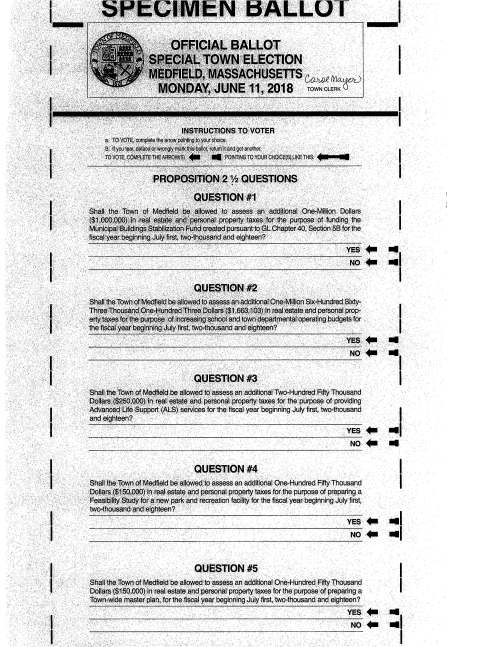
Town Clerk, Carol Mayer, posted this specimen ballot for the 6/11/18 over ride election –

20180611-specimen ballot

Interface

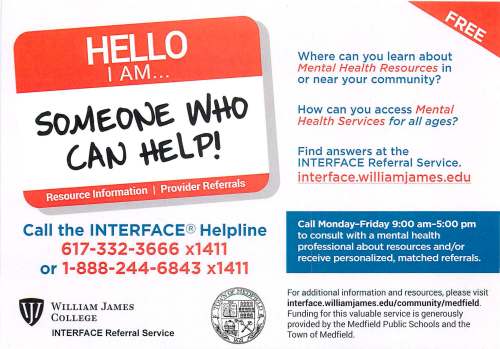
Call the INTERFACE® Helpline 617-332-3666 x1411 or 1-888-244-6843 x1411 WILLIAM JAMES COLLEGE INTERFACE Referral Service Where can you learn about Mental Health Resources in or near your community? How can you access Mental Health Services for all ages? Find answers at the INTERFACE Referral Service. interface.williamjames.edu Call Monday-Friday 9:00 am-5:00 pm to consult with a mental health professional about resources and/or receive personalized, matched referrals. For additional information and resources, please visit interface. wil liam james .edu/ community /medfield. Funding for this valuable service is generously provided by the Medfield Public Schools and the Town of Medfield.

Interface cards_Page_2

What is INTERFACE?

INTERFACE is a Mental Health Service Resource & Referral Helpline.  

Be on the lookout for new postcards promoting William James College INTERFACE Referral Service, a Mental Health Resource & Referral Helpline available Monday through Friday between the hours of 9-5 by calling 617-332-3666, ext 1. INTERFACE matches callers from subscribing communities with appropriate outpatient mental health resources and referrals in their area.

This FREE service is new to Medfield since November 1, 2017. 

Dr. Jeffrey Marsden, Superintendent of Schools, purchased this service in collaboration with the Town of Medfield, for all of Medfield’s residents, in response to reports that residents were having difficulty finding outpatient mental health providers in a timely fashion.

Seeking mental health care on one’s own has become more difficult than ever in today’s ever changing healthcare market. Providers who are on lists from referral sources such as primary care offices or insurance companies may not be taking new clients/patients, be the right match for the insurance plan of the client/patient, or have the expertise in the mental health service being sought. Residents were reporting that when they sought care for themselves or a loved one, it often took multiple phone calls, endless waiting, and much wasted time in securing an appropriate provider.

INTERFACE is free for ALL Medfield residents and is a tool in accessing mental health care by providing a service that matches a person seeking outpatient mental health care with specialized providers from a large data base of licensed and vetted mental health providers, thereby reducing the burden on residents seeking to connect with outpatient mental health treatment.

As of March over 32 Medfield residents have received assistance in securing an outpatient mental health provider through Interface.  INTERFACE resource and referral counselors work hard to secure an appropriate match and if for any reason the match is not successful; they will continue to work with the caller until the right fit between caller and provider is in place.

Medfield Coalition for Suicide Prevention (MCSP) has created postcards to inform Medfield residents about the INTERFACE service and local mental health support services as part of their mission to inform every resident of this important service.  With leadership from Medfield resident Carol Read, a prevention specialist in a nearby community and Medfield Board of Health member, the cards were designed and completed by the MCSP publicity committee and are now being distributed throughout various locations in the community.

Find them at the Public Safety building, The Center at Medfield (Council on Aging), Medfield Youth Outreach, Town Hall and Medfield School Dept, 3rd floor, Town Hall, Medfield Public Library, schools, medical professional’s offices, and at various businesses.

 If you wish to host the cards at your organization, reach out to MCSP through the Medfield Youth Outreach office at 508-359-7121.

For additional information and resources, please visit interface.williamjames.edu/community/medfield.

Cherry Sheet for FY19

Historically, for the 18 years that I have been a selectman and therefore watching with interest the state budgets unfold, so I can learn what Medfield will get in state aide, I have noticed that we have always received more monies from the state Senate than in either proposals from the Governor or the House, but not this year.

It looks like our increase in state aide over last year will be about $62K.  Hardly enough to help with all our cost increases – the state continues to transfer to our property taxes the cost of running our town, by virtue of the state’s declining financial support of towns over time.

Below is the Cherry Sheet projection of where we will end up on state aid for the next fiscal year.

fy19-senate-20180511

Medfield awarded state cultural planning grant

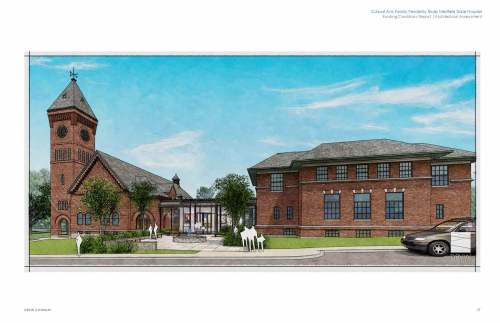
The town received a notice this week that it had been awarded a state planning grant for developing a cultural arts facility at the former Medfield State Hospital site. A rendering of one possibility is shown below.

This from Jean Mineo –

DBVW Architrects-cultural arts center

Medfield has been awarded a $30,000 planning grant from the Massachusetts Cultural Facilities Fund, a state program that fosters the growth of the creative economy by supporting building projects in the nonprofit arts, humanities and sciences. Medfield received one of 35 planning grants across the state. The grants require a 1:1 match. There were also 63 capital grants for a total of $9.3 million in awards that will generate at least another $9.3 million in private investment in cultural facilities.

The Town approved $25,000 toward the required grant match at the Annual Town Meeting last week. The Cultural Alliance of Medfield has committed to raising the balance for the $115,000 project to complete schematics and apply for historic tax credits. If you’d like to help, you can make a donation at their website www.MedfieldCulture.org or read more about their exciting plans on their link to the Medfield State Hospital. Contact Jean Mineo at 617-877-5158 or JeanMineo@aol.com with any questions.

To see the grants:
http://www.massculturalcouncil.org/facilities/facilities_fundinglist.htm#Boston


Medfield High School #7 in state per US News&WR


Medfield Senior High

88r South Street, Medfield, Massachusetts 02052 | (508) 359-8385

#259 in National Rankings

Overview

Leaflet | Map data © OpenStreetMap contributors

Explore Map

Medfield Senior High is ranked 7th within Massachusetts. Students have the opportunity to take Advanced Placement® course work and exams. The AP® participation rate at Medfield Senior High is 81 percent. The student body makeup is 50 percent male and 50 percent female, and the total minority enrollment is 10 percent. Medfield Senior High is the only high school in the Medfield Public Schools.

Quick Stats

9-12

Grades

867

Total Enrollment

13:1

Student-Teacher Ratio

2018 Rankings

Medfield Senior High is ranked #259 in the National Rankings and earned a gold medal. Schools are ranked based on their performance on state-required tests and how well they prepare students for college. Read more about how we rank the Best High Schools.

All rankings:

Scorecard

  • College Readiness Index
    69.0
  • AP® Tested
    81%
  • AP® Passed
    80%
  • Mathematics Proficiency
    97%
  • Reading Proficiency
    99%

Senate budget recommendations out

The Massachusetts Senate has issued its budget recommendations, which this year are lower that the House numbers (usually they are higher from my memory).  Unfortunately for Medfield, state revenue sharing with cities and towns continues on a downward trajectory, so that more of municipal costs msut be paid for off our property taxes.  This alert this afternoon from the Massachusetts Municipal Association with its summary –

MMA-2

SENATE BUDGET COMMITTEE FILES $41.4 B FY19 STATE BUDGET THAT ADDS MUNICIPAL AND SCHOOL AID

• INCLUDES THE FULL $37M INCREASE IN UNRESTRICTED MUNICIPAL AID (UGGA)

• INCREASES CHAPTER 70 BY $148M TO FUND MINIMUM AID AT $30 PER STUDENT

• ADDS $38M FOR SPECIAL EDUCATION CIRCUIT BREAKER

• ADDS $20M FOR CHARTER SCHOOL IMPACT PAYMENTS

• ADDS $1.7 MILLION FOR PILOT PAYMENTS TO ENSURE NO FY19 AID LOSS

May 10, 2018

Dear Osler Peterson,

Earlier today, the Senate Ways & Means Committee reported out a $41.4 billion FY19 state budget plan to increase overall state expenditures by 3 percent. The SW&M plan is $61 million more than the budget filed by the Governor in January and $97 million less than the budget voted by the House last month. The full Senate will debate the FY19 spending plan starting May 22.

S. 4, the S W&M budget bill, provides significant progress on many important local priorities, including the full $37 million increase in Unrestricted General Government Aid that the Governor proposed and cities and towns are counting on. The SW&M budget would increase funding for other major aid programs by adding $38 million for the Special Education Circuit Breaker, adding $20 million for charter school impact mitigation payments, adding $1 million to Regional School Transportation, and increasing Chapter 70 aid by $148 million more than the FY18 level.

Please Click this Link Now to See the Chapter 70 and Unrestricted Municipal Aid Numbers for Your Community

Later Today or Early Tomorrow – Click on this Link to See Your Community’s Local Aid and Preliminary Cherry Sheet Numbers in the House Ways & Means Budget, as Posted by the Division of Local Services

$37.2 MILLION INCREASE IN UNRESTRICTED MUNICIPAL AID

In a continuing good news story for cities and towns, the SW&M budget plan would provide $1.1 billion for UGGA, a $37.2 million increase over current funding – the same increase proposed by Governor Baker and voted by the House. The $37.2 million would increase UGGA funding by 3.5 percent, which matches the projected growth in state tax collections next year. Every city and town would see their UGGA funding increase by 3.5 percent.

SW&M BUDGET BUILDS ON PROGRESS IN HOUSE BUDGET, WITH $23.5M MORE FOR CHAPTER 70 ($44.1M MORE THAN GOV’S BUDGET), MINIMUM AID WOULD MATCH HOUSE’S $30 PER STUDENT

The Senate budget committee is proposing to increase Chapter 70 education aid by $147.7 million above current fiscal 2018 levels. This is $44.1 million higher than the increase in the Governor’s recommendation, and $23.5 million more than the budget passed by the House in April), with a provision that every city, town and school district receive an increase of at least $30 per student (compared to the $20-per-student amount in the Governor’s budget). The SW&M budget would continue to implement the target share provisions enacted in 2006 and would do so on a more accelerated schedule than proposed by the Governor and voted by the House. Further, the SW&M proposal would build on formula changes proposed by Governor and voted by the House to start addressing shortfalls in the foundation budget framework, by increasing the cost factors for school employee health benefits and for English Language Learners (ELL).

Please ask your Legislators to support a funding increase for Chapter 70 school aid that ensures that all schools receive a suitable and appropriate increase in fiscal 2019, which the MMA targets at $100 per student. The MMA also strongly supports implementation of all of the recommendations of the Foundation Budget Review Commission to update the Chapter 70 “foundation budget” minimum spending standards for special education and employee health insurance, and to add to the spending standard a measure of recognition for the cost of services for low-income, English Language Learner (ELL) and other students who would benefit from more intensive services. The Commission recommended phasing in the changes over a four-year period, a position the MMA supports as well. Increasing minimum aid and fixing the inadequacies in the foundation formula are essential.

$37.7 MILLION INCREASE FOR SPECIAL EDUCATION CIRCUIT BREAKER

In S. 4, Senate leaders have made clear that they support increased funding for the Special Education Circuit Breaker program with the intent to reach full funding next year. The SW&M plan would provide $318.9 million, a $27.7 million increase above the Governor’s proposed FY19 level of $291.1 million, and $37.7 million more than the $281.2 million FY18 level. This is a vital program that every city, town and school district relies on to fund state-mandated services.

ADDS $1 MILLION TO REGIONAL SCHOOL TRANSPORTATION

The Senate Ways and Means Committee budget would add $1 million to bring regional transportation reimbursements up to $62.5 million. The MMA will work to continue building on this increase to get to full funding.

CHARTER SCHOOL REIMBURSEMENTS WOULD BE FUNDED AT $100 MILLION

The SW&M budget would provide $100 million to cover charter school impact mitigation payments, compared to the Governor’s recommendation to level fund the program at $80.5 million and the House plan to increase funding to $90 million. While the SW&M increase is certainly welcome and appreciated, both legislative proposals remain below the amount necessary to fully fund the statutory formula that was originally established to offset a portion of the funding that communities are required to transfer to charter schools. The FY18 funding level is currently $73.4 million below what is necessary to fund the reimbursement formula that is written into state law. An expanding shortfall would lead to the continued and growing diversion of Chapter 70 funds away from municipally operated school districts, and place greater strain on the districts that serve 96 percent of public school children. Solving the charter school funding problem must be a major priority during the budget debate.

PAYMENTS-IN-LIEU-OF-TAXES (PILOT), LIBRARY AID ACCOUNTS, METCO, AND SHANNON ANTI-GANG GRANTS

The Senate budget committee’s proposal would increase PILOT payments by $1.7 million to ensure that no city or town loses PILOT aid next year, add $540,000 to library grant programs, add $500,000 to METCO, and level fund McKinney-Vento reimbursements at $8.1 million.The SW&M budget would level fund Shannon Anti-Gang Grants at $6 million.

Please Call Your Senator Today to Thank Them for the Local Aid Investments in the Senate Ways and Means Committee Budget – Which Increases Direct Municipal and School Aid Accounts by More Than the Governor’s Budget

Please Explain How the Senate Ways and Means Budget Impacts Your Community, and Ask Your Senators to Build on this Progress During Budget Debate in the Senate

Thank You!

MFC collecting via postal carriers tomorrow

From Jacqui Doe –

Jacqui Doe Please help the Medfield Food Cupboard "Stamp Out Hunger” SATURDAY, MAY 12th Please leave unopened, non-perishable, non-expired food donations in your mailbox for postal carriers to collect. Donations go directly to Medfield families in need. Donations may include, but are not limited to: Peanut butter; Jelly; Raisins; Juice (large & boxes); Applesauce (6-packs); Canned Fruit (in juice preferred); Cookies; Crackers; Tuna (white preferred); & Spaghetti Thank you

Clarified ballot questions

Evelyn circulated this clarifying vote this afternoon for this evening’s meeting, that will make the June 11 ballot questions somewhat clearer  –

BoS

VOTE CLARIFYING AND RATIFYING MAY 3, 2018
VOTE, RE; PROPOSITION 2 1/2 BALLOT QUESTIONS

WHEREAS, voters at the 2018 Annual Town Meeting held on April 30 and May
1 voted to approve five (5) articles: Articles #43, 45, 16, 14 and 13, each subject to
passage of an override question pursuant to one or another paragraph of G.L. Ch. 59, Section 21 C, so-called Proposition 2 1/2, and

WHEREAS, the Board of Selectmen held a meeting on May 3, 2018 and voted
to place the five Proposition 2 1/2 override questions on a ballot and to hold a special election on June 11, 2018, and

WHEREAS, Proposition 2 1/2 mandates the form of each ballot question and
limits the information which can be contained therein, and

WHEREAS, the Board of Selectmen desires to provide guidance to future
members of its Board, as well as other Town officials involved with managing the Town’s finances,

NOW, THEREFORE, the Board of Selectmen does hereby clarify and ratify its
May 3, 2018 vote placing five (5) override questions on the ballot for a special election to be held on June 11, 2018 as follows:

Ballot Question #1 relates to vote on 2018 ATM Article #43 and constitutes a dedicated permanent operational override to fund a capital stabilization fund specified in the article, as provided on G.L. Ch. 59, Section 21C, Par. g.

Ballot Question #2 relates to vote on 2018 ATM Article #45 and constitutes a
permanent operational override to increase school and departmental operating
budgets specified in the article, as provided in G.L. Ch. 59, Section 21 C, Par. g.

Ballot Question #3 relates to vote on 2018 Article #16 and constitutes a permanent operational override to provide funding for the provision of Advanced Life Support (ALS) services, as specified in the article, as provided in G.L. Ch. 59, Section 21 C, Par. g.

Ballot Question #4 relates to vote on 2018 ATM Article #14 and constitutes a one-year capital outlay override to fund a feasibility study for a new park and recreation facility, as specified in the article, as provided in G.L. Ch. 59, Section 21 C, Par. i 1/2.

Ballot Question #5 relates to vote on 2018 ATM Article #13 and constitutes a one-year capital outlay override to fund the preparation of a town wide master plan, as specified in the article, as provided in G.L. Ch. 59, Section 21C, par. i 1/2.

So-Voted this 8th day of May, 2018.

Medfield Board of Selectmen
Michael T. Marcucci, Chair
Gustave Murby, Clerk
Osler L. Peterson, Member
2