The Baker-Polito administration announced today that Massachusetts will return to Step 2 of Phase 3 of the state’s four-phase reopening plan on Monday, March 1, and will transition to Step 1 of Phase 4 three weeks later, on March 22.
Gov. Charlie Baker said the steps to further reopen the Commonwealth’s economy were being taken because public health metrics continue to trend in a positive direction, including drops in average daily COVID-19 cases and hospitalizations, while vaccination rates continue to increase.
The administration released its reopening plan on May 18, 2020, conditioning any progress on sustained improvements in public health data. The state had advanced to Step 2 of Phase 3 last October, but returned to the previous step on Dec. 13 in response to an increase in new COVID infections and hospitalizations following the Thanksgiving holiday. The step back reduced capacities across a broad range of sectors and tightened several other workplace restrictions. …
Posted onFebruary 5, 2021|Comments Off on Massachusetts Community Preservation Act (CPA)
From:
Richard DeSorgher (first),
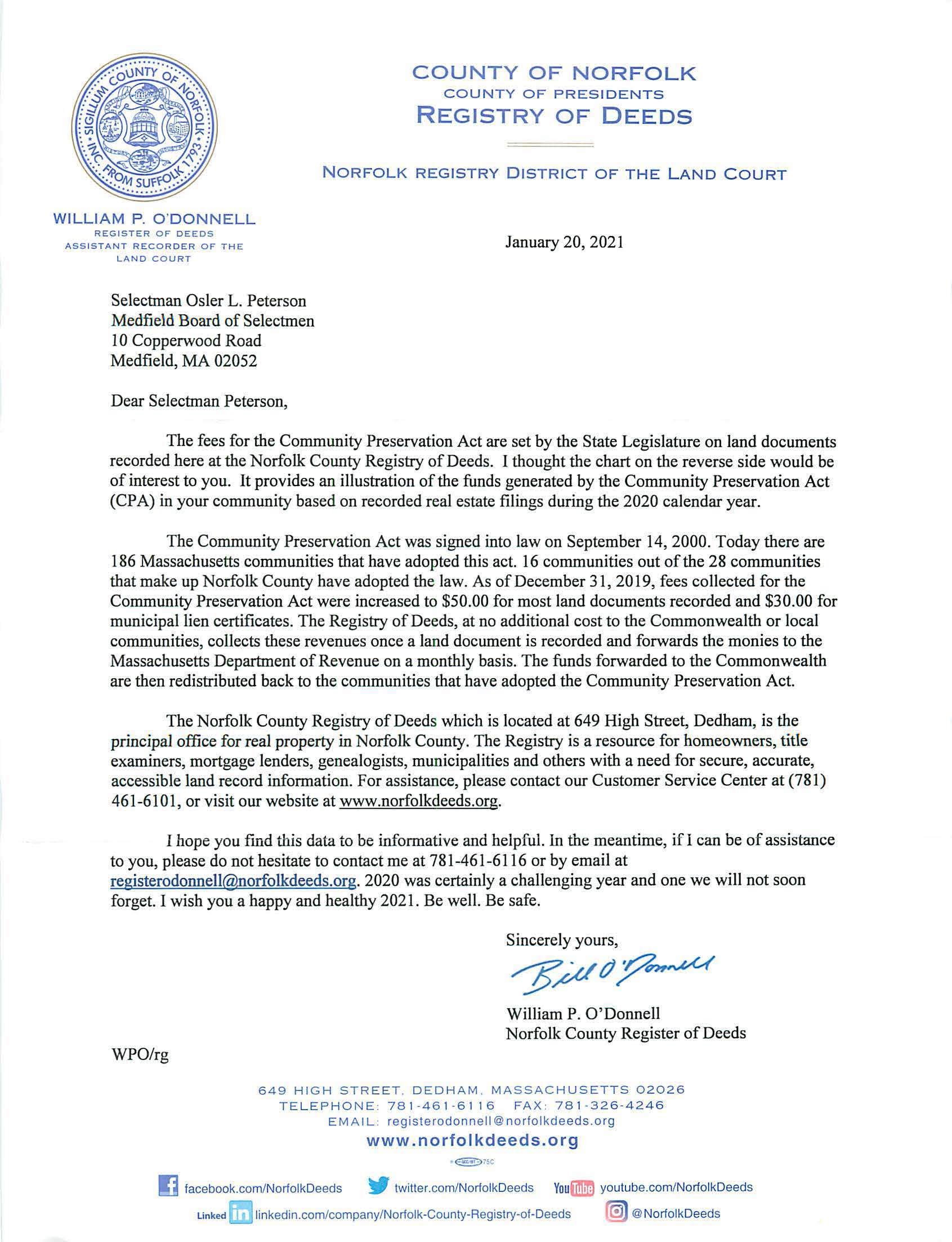
Norfolk Registrar of Deeds (second – Medfield paid in $166,440.00), and
the Division of Local Services (DLS) newsletter this week –
===============================================
From: Richard DeSorgher Sent: Monday, February 1, 2021 5:03 PM To: Osler Peterson Subject: Community Preservation Funds
Hi Pete,
Hope you are well and staying safe during this most trying of times, especially as a town selectmen. I know you and I talked about the importance and common sense tax-saving ability adopting the Community Preservation Act would be for Medfield, so I am attaching the notice sent to me from the Registry of Deeds about the land document surcharges Medfield has forwarded to the Community Preservation fund; that sadly Medfield is missing out on but of which 186 other communities are taking advantage.
I was appointed to the Historical Committee down here in Mashpee and I have seen the advantage of those funds. Mashpee originally contributed 3% to the CPC funds. We have since reduced it by one percent, having a one percent surcharge instead go towards waste-water treatment in the town.
We have approved through the Community Preservation funds a new war memorial for the town veterans, a community garden, a playground, a dog park, a pickleball court (a sport I had never heard of before moving here),funding for low-income housing, money to preserve the Mashpee Parsonage, one of the oldest structures in town, preserving early town records, purchasing conservation land (a former bog), just to name a few in the short time I have been down here.
It is such an important and money saving act that the town has adapted.
Towns, like Medfield, are contributing to the system but are not receiving any of the benefits and instead must fund town projects at 100% instead of having the CPC funds to help lessen the taxpayers’ load.
I know I am preaching to the choir but just wanted to send along the Registry of Deeds letter in case you did not receive one and to give some re-enforcing support now that I have actually seen it in action.
Stay well and thanks for all you and the town government does for the citizens of Medfield.
Richard
===============================================
Ask DLS: Community Preservation Act – Part 8
This month’s Ask DLS features Part 8 of frequently asked questions concerning the Community Preservation Act (CPA) and CPA funding for eligible open space projects. Additional questions about the CPA will be featured in future editions of City & Town. For Part 7 of the series, see the January 7, 2021 edition of City & Town. For additional information on the Community Preservation Act see Informational Guideline Release (IGR) 19-14. Please let us know if you have other areas of interest or send a question to cityandtown@dor.state.ma.us. We would like to hear from you.
In general, what community preservation projects are eligible for funding under the CPA?
There are three community preservation project or asset categories: (1) open space (including land for recreational use); (2) historic resources; and (3) community housing. These FAQs will discuss CPA funding for projects relating to open space.
What is the definition of “open space?”
“Open space” is defined in G.L. c. 44B, § 2 to “include, but not be limited to, land to protect existing and future well fields, aquifers and recharge areas, watershed land, agricultural land, grasslands, fields, forest land, fresh and salt water marshes and other wetlands, ocean, river, stream, lake and pond frontage, beaches, dunes and other coastal lands, lands to protect scenic vistas, land for wildlife or nature preserve and land for recreational use.”
For what purposes may CPA funds be spent regarding open space?
The CPA clarifies allowable community preservation project expenditures through its definitions which are found in G.L. c. 44B, § 2. As a result, the CPA definitions should always be reviewed when determining if an expenditure is allowable.
Acquisition, creation, and preservation – CPA funds may be spent for the acquisition, creation, and preservation of open space.
“Acquisition” is defined in G.L. c. 44B, § 2 as “obtain[ing] by gift, purchase, devise, grant, rental, rental purchase, lease or otherwise.” ”Acquire” does not include a taking by eminent domain, except as provided under c. 44B.
“Creation” – There is not a specific definition of “creation” under the CPA; however, “creation” was defined by the court for CPA purposes in the case of Seideman v. City of Newton, 452 Mass. 472 (2008) to mean “to bring into being or to cause to exist.”
“Preservation” is defined under G.L. c. 44B, § 2 as “protection of personal or real property from injury, harm or destruction.”
Rehabilitation or restoration of open space – CPA funds may also be spent for the rehabilitation or restoration of open space; provided the open space was acquired or created with community preservation funds.
”Rehabilitation” is defined under G.L. c. 44B, § 2 as “capital improvements, or the making of extraordinary repairs, to historic resources, open spaces, lands for recreational use and community housing for the purpose of making such historic resources, open spaces, lands for recreational use and community housing functional for their intended uses including, but not limited to, improvements to comply with the Americans with Disabilities Act and other federal, state or local building or access codes; provided, that with respect to historic resources, ”rehabilitation” shall comply with the Standards for Rehabilitation stated in the United States Secretary of the Interior’s Standards for the Treatment of Historic Properties codified in 36 C.P.R. Part 68; and provided further, that with respect to land for recreational use, ”rehabilitation” shall include the replacement of playground equipment and other capital improvements to the land or the facilities thereon which make the land or the related facilities more functional for the intended recreational use.
“Restoration” is not defined under the CPA and we are not aware of any cases defining “restoration” in the CPA context. In the absence of such an interpretation, we look to the usual and generally understood meaning of words from sources known to the legislature, such as use in other legal contexts and dictionary definitions. See Seideman v. Newton, 452 Mass. 472, 477-478 (2008). At webster-dictionary.org, “restoration” is defined as “the act of restoring or bringing back to a former place, station, or condition.”
What are some examples of allowable CPA open space projects?
Acquisition of open space – Acquisition of real property or an interest in real property is allowable for open space purposes, including the acquisition of agricultural land, grasslands, fields, forest land, watershed land, fresh and salt water marshes and other wetlands, ocean, river, stream, lake and pond frontage, beaches, dunes and other coastal lands, land to protect scenic vistas, land for wildlife or a nature preserve, land for recreational use and land to protect existing and future well fields, aquifers and recharge areas. Again, one must look to G.L. c. 44B, § 2, to determine the definitions of “real property” and “real property interest” for CPA expenditure purposes. Under G.L. c. 44B, § 5(f), the price of an acquisition must not exceed the value of the property as determined through “procedures customarily accepted by the appraising profession as valid.” And, under G.L. c. 44B, § 12, real property interests financed in whole or in part with CP Fund monies must be bound by a permanent restriction which conforms to the requirements of G.L. c. 184, §§ 31-34 and the city or town must own any real property interest acquired with community preservation monies. Management of the properties may be delegated by the legislative body to the conservation commission, park commission or to a nonprofit corporation created under G.L. c. 180 or nonprofit trust created under G.L. c. 203.
Acquisition of open space – Appropriation of CP funds to a conservation fund established by G.L. c. 40 § 8C is allowable; however, any expenditure of such funds remains subject to the restrictions imposed by the CPA, including the requirement that any land acquired must be bound by the restriction described in G.L. c. 44B, § 12. Therefore, the conservation commission may spend CPA funds only for those purposes that are authorized by both G.L. c. 40 § 8C and the CPA, for example, acquisition of land for open space purposes. To ensure that these requirements are carried out, the CPC recommendation and any legislative body appropriation vote should expressly include these conditions.
Rehabilitation of open space – Expenditures for rehabilitation and restoration of open space (not including lands for recreational use) are not allowable unless the open space was acquired or created using CPA funds pursuant to G.L. c. 44B, § 5(b)(2). For example, funding is allowable for “rehabilitation” of municipal forest land only if the forest land was acquired with community preservation funds. CP funds cannot be used, however, to fund any expenditure that would fall within the CPA definition of “maintenance,” even if the expenditure is required by a forest management plan. G.L. c. 44B, §§ 2 and 5(b)(2). See Part 6 of these FAQs for more information on prohibited CPA expenditures, published in the December 3, 2020 edition of City & Town.
Stay tuned for next month’s City & Town for Part 9 in our FAQ series on the CPA when we will discuss allowable CPA land for recreational use projects. For more information, see Informational Guideline Release (IGR) 19-14.
Comments Off on Massachusetts Community Preservation Act (CPA)
Posted onJanuary 28, 2021|Comments Off on Medfield’s cherry sheet numbers
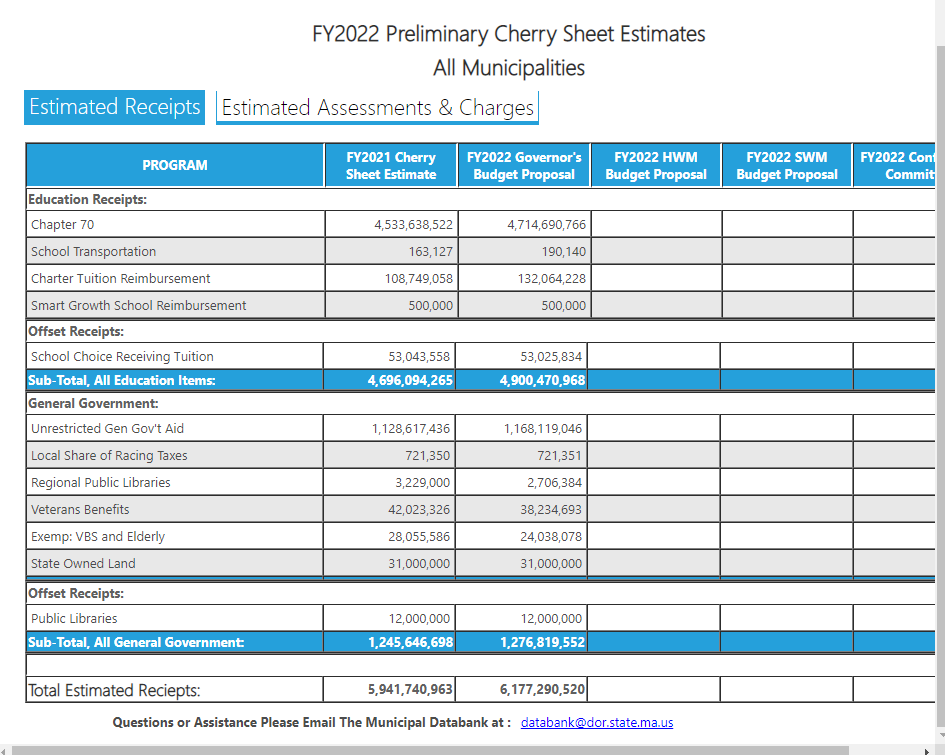
Below are Medfield’s cherry sheet numbers in the Governor’s budget released by Division of Local Services (DLS) this week. The town’s state monies will be up $335K or 3.96% over last year per these numbers.
The town’s state revenue numbers are called “cherry sheet” numbers because historically these budget numbers were issued on red paper – back when things were still done on paper.
Next in the annual state budget process the House will produce its budget numbers, followed by the Senate version, the consensus version of the two, the Governor’s vetos, any legislative veto overrides, which is what will then be next year’s budget. That process usually takes until April.
GOV. BAKER FILES $45.6 BILLION FY 2022 SPENDING PLAN
• $39.5M INCREASE IN UNRESTRICTED MUNICIPAL AID (3.5%)
• GOV’S CH. 70 PLAN WOULD INCREASE FY 2022 SCHOOL AID BY $197.7M (3.7%)
• CHARTER SCHOOL & SPECIAL ED REIMBURSEMENTS INCREASE
• MIXED RESULTS FOR OTHER MUNICIPAL AND SCHOOL ACCOUNTS
January 27, 2021
Today at noon, Gov. Charlie Baker submitted a $45.6 billion fiscal 2022 state budget plan with the Legislature, proposing to reduce overall state expenditures by almost 1 percent next year as the Administration plans a sustainable recovery from the fiscal and service delivery disruptions caused by the ongoing coronavirus public health emergency and the related economic recession. Similar to the recently finalized fiscal 2021 budget, the Governor’s spending plan for next year relies on temporary and one-time revenues, including emergency federal funds related to the pandemic and up to $1.6 billion from the state’s Stabilization Fund.
UNRESTRICTED MUNICIPAL AID INCREASED BY $31.6 MILLION
As Gov. Baker pledged to local officials at the beginning of his administration, his budget includes a $39.5 million increase in Unrestricted General Government Aid, tracking the expected 3.5% increase in state tax revenues. Implementing this state-local revenue sharing framework is good news in a very challenging time for state and local finances.
OVERALL CHAPTER 70 SCHOOL AID WOULD GO UP BY $197.7 MILLION, A 3.7% INCREASE – ALTHOUGH A LARGE NUMBER OF DISTRICTS ARE EXPECTED TO REMAIN AT MINIMUM AID ONLY
The Governor’s budget recommendation re-starts implementation of the funding schedules in the 2019 Student Opportunity Act (SOA) that were delayed last year after the coronavirus recession upset the original first year funding plan.
Fulfilling the commitments in the new Student Opportunity Act, the Governor’s fiscal 2022 budget submission would bring Chapter 70 school aid up to $5.48 billion, a $197.7 million increase in school aid. This would fund the first year of the 7-year plan to add $1.5 billion in new state funding for K-12 education. The majority of the funds would implement the improvements to the foundation budget, adding weight for low-income students, English Language Learners, special education costs, and school employee health benefits. While this is important progress, an initial look at the budget indicates that a large percentage of cities, towns and school districts would remain minimum-aid-only, and receive the minimum $30 per-student increase in the Act. The MMA will continue to strongly advocate for significantly higher minimum aid throughout the budget process.
The Governor’s Chapter 70 recommendation would make a significant change in how cities and towns can meet their required local contributions for fiscal 2022. Municipalities may use up to 75% of the total grant awarded to the local school district through the Elementary and Secondary Education Emergency Relief (ESSER) program enacted by Congress last month (also known as ESSER II) to fund a part of the increase in its local contribution requirement under Chapter 70, but not more than the increase in required local contribution in FY2022 relative to FY2021. This is a new temporary provision that is explained in the narrative and slides on the DESE school finance website provided below.
This landing page will also include the preliminary fiscal 2022 charter school assessments and reimbursements.
CHARTER SCHOOL REIMBURSEMENTS WOULD INCREASE TO $143.5M – CHARTER FUNDING REMAINS A SERIOUS PROBLEM TO BE SOLVED
The Governor’s budget would increase the charter school reimbursement account up to $143.5 million, intended to meet the commitment in the Student Opportunity Act to fund 75% of the state’s 100-60-40 statutory obligation to mitigate Chapter 70 losses to charter schools.
The Student Opportunity Act pledges to phase in full funding of the statutory reimbursement formula over three years, and while this plan may meet that requirement, it would not fix the serious flaws in the charter school finance system. Charter schools will continue to divert a high percentage of Chapter 70 funds away from many municipally operated school districts, and place greater strain on the districts that serve the vast majority of public school children. Major problems will continue unless a true resolution of the charter school funding problem is achieved, a top MMA priority.
SPECIAL EDUCATION CIRCUIT BREAKER INCREASED TO $367.7M
The Governor’s budget would add $22.5 million to fund the Special Education Circuit Breaker program at $367.7 million, an increase of 6.5%. The Student Opportunity Act expanded the special education circuit breaker by including out-of-district transportation, an important enhancement for cities and towns.
REGIONAL SCHOOL TRANSPORTATION REIMBURSEMENTS REDUCED
Gov. Baker’s budget submission would reduce funding for regional transportation reimbursements from $82.2 million this year to $75.9 million. This will be a hardship for virtually all communities in regional districts. Reimbursements for transportation of out-of-district vocational students remains significantly underfunded at $250K. Increasing these accounts is a priority for cities and towns and the MMA.
McKINNEY-VENTO REIMBURSEMENTS REDUCED
The Governor’s budget would reduce reimbursements for the transportation of homeless students from $13.5 million this year to $11.1 million in fiscal 2022. The impact of this funding level will vary from community-to-community depending on the number of homeless families that remain sheltered in local hotels and motels. The Administration has been successful in reducing the number of homeless students who are dislocated from their original district, but those communities that continue to provide transportation to many students may continue to see shortfalls.
PAYMENTS-IN-LIEU-OF-TAXES (PILOT) LEVEL FUNDED
The Governor’s budget would level fund PILOT payments at $31 million, which would be a significant hardship for many smaller, rural communities with large amounts of state-owned land. This is a key account due to the major impact that PILOT payments have on budgets in very small communities.
Please contact your legislators today and ask them to support the $39.5M increase in municipal aid and the $197.7M increase in Chapter 70 aid.
Please ask your legislators to address the serious flaws in charter school funding, increase minimum Ch. 70 aid to $100 per student, and increase funding for school transportation, PILOT payments, and ensure full funding for the Special Education Circuit Breaker
As vaccines become available to people, my mind necessarily turned to when can I get it. The NN Chamber of Commerce newsletter today (a copy of the email appears below) had a good explanation of vaccines and when we might be eligible. I especially found this “new searchable map” helpful, as it connects to the state’s website with all the vaccine data and explanation.
Good morning friends,
Every action has an equal and opposite reaction.
So when Gov. Charlie Baker announced yesterday that he was moving residents 65 or older up on the COVID vaccination priority list, it meant pushing back workers in grocery, restaurants, transit, sanitation, public works, public health workers and K-12 teachers who had been next in line.
Just how much of a delay that creates for those who thought they were next depends on how much vaccine is in the federal pipeline.
Starting Monday (Feb. 1), residents 75 and older are eligible to be vaccinated as the second phase opens; followed by those 65-plus; then those listed above and in the vocations listed here; and then individuals with one comorbidity.
Everyone else is in phase 3, scheduled to start in April, although that’s subject to change.
Baker also promised to accelerate the state’s distribution infrastructure in the coming weeks, adding dozens of new vaccine sites by mid-February, for a total of seven mass vaccination sites and 165 overall.
Massachusetts ranks in the bottom half of the 50 states when it comes to number of vaccine doses administered per capita according to federal data, and lags behind all other New England states, despite having what the state often touts as the best healthcare system in the world, notes Sarah Betancourt at CommonWealth.
Just over 360,000 of the state’s 5.8 million adults have been given at least a first-dose, leaving 5.44 million more.
The email below is from the Massachusetts School Building Authority today.
One of the next steps is for the town to evaluate using the MSBA’s Model School approach. Assistant Town Administrator, Nick Milano, reports that employing a Model School approach saved the City of Marlborough around $11m. on construction of a new school when he worked there, before coming to Medfield.
A subcommittee of the School Building Committee is also looking into whether the town can make the new school a net zero building. Lexington reported to the Select Board that its last new school was a net zero school that saved the town money from the first year, while also being better facility for the students, teachers, and the environment.
Unfortunately, the MSBA has yet to adopt a net zero Model School.
RE: MSBA/Medfield: Dale Street Elementary School: Facilities Assessment Subcommittee Meeting
Good afternoon, Mr. Peterson:
I would like to thank the Town of Medfield (the “District”) and its consultants for their presentation on the proposed Dale Street Elementary School project (the “Proposed Project”) at the Facilities Assessment Subcommittee (“FAS”) meeting on January 20, 2021.
In addition to the comments which were discussed as part of the District’s FAS presentation, Christina Forde, MSBA Project Manager, included the following comments in her opening statements:
· The academic organization of the proposed building;
· Site circulation; and
· Opportunities for outdoor learning.
The following items were topics of discussion:
· Appreciation of the Educational Program;
· Inclusion and location of outdoor learning spaces
· Appreciation of the Main Street concept
· Appreciation of a campus approach
The MSBA will be forwarding a formal Model School Evaluation to the District under separate cover shortly.
Should you have any questions or concerns, please do not hesitate to contact me or Christina Forde
Posted onJanuary 19, 2021|Comments Off on DLS comparison data for towns
This Division of Local Services (DLS) dashboard has really interesting data on comparing towns, one to another, however, it is just a little hard to use because of the small size of the map and the need to roll your cursor over the town on the map to get its data.
New DLS Data Visualization Tool Now Available
The Division of Local Services has a new tool available for quickly finding key financial and demographic information for all 351 Massachusetts cities and towns. The Municipal Finance Snapshot Dashboard uses Tableau visualizations to display data in 14 financial categories including Average Single Family Tax Bill, Local Receipts, New Growth and much more. Selecting a city or town from the map provides a wealth of data about that community. Please visit the Municipal Finance Snapshot Dashboard to explore all the information DLS has to offer in a new, easy-to-use way!
Please contact the Data Analytics & Resources Bureau at databank@dor.state.ma.us with questions or feedback. You are receiving this message through the Massachusetts Department of Revenue’s Division of Local Services DLS Alerts system. These periodic notices include our City & Town e-newsletter, IGRs, Bulletins, Cherry Sheets and other municipal finance-related information. To unsubscribe to DLS Alerts and the City & Town e-newsletter, please email dls_alerts@dor.state.ma.us.
Posted onDecember 17, 2020|Comments Off on $50K MassDevelopment grant for RFP assistance re MSH
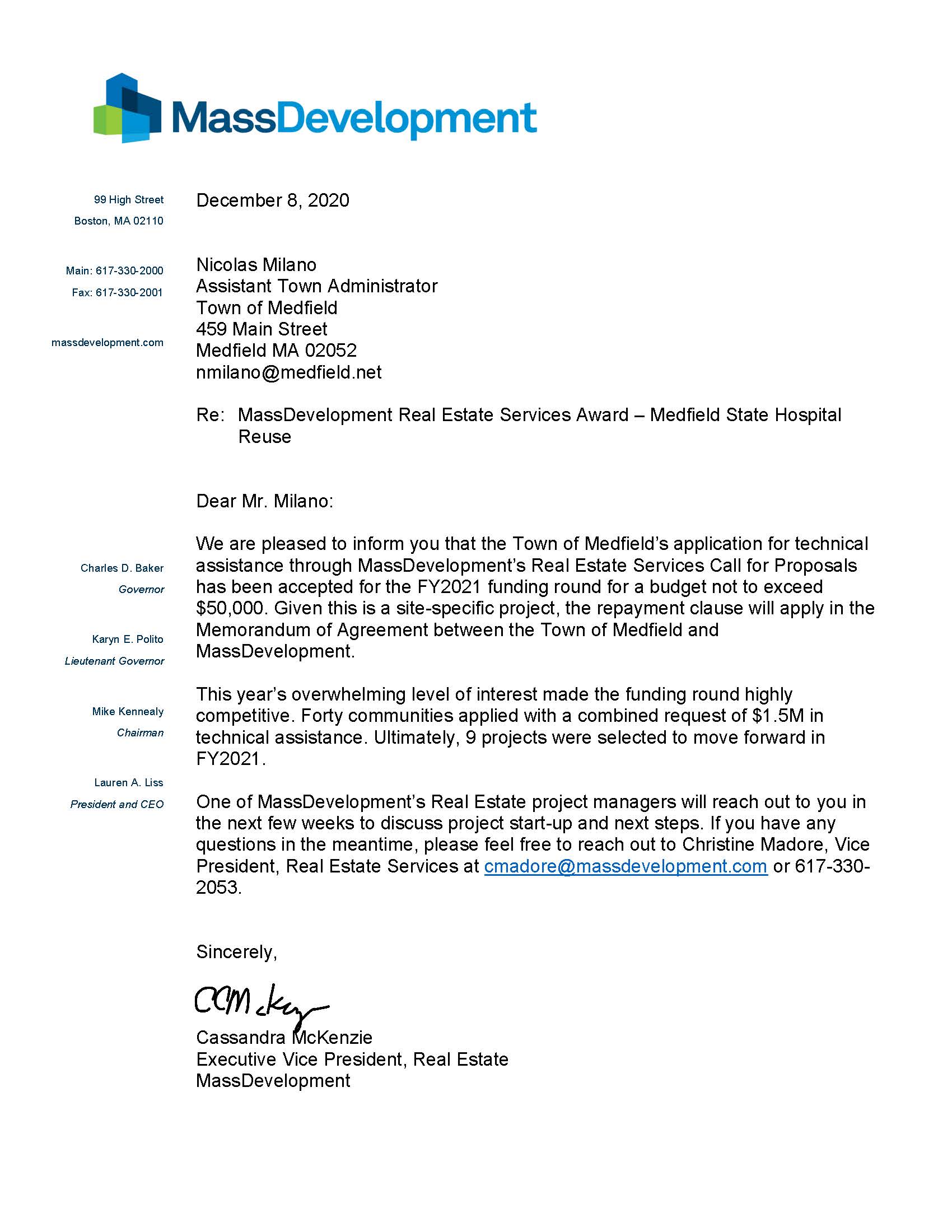
The town received a $50,000 state grant to assist with the RFP for the former Medfield State Hospital site. Here is the announcement letter that came yesterday, despiteits date. –
Comments Off on $50K MassDevelopment grant for RFP assistance re MSH
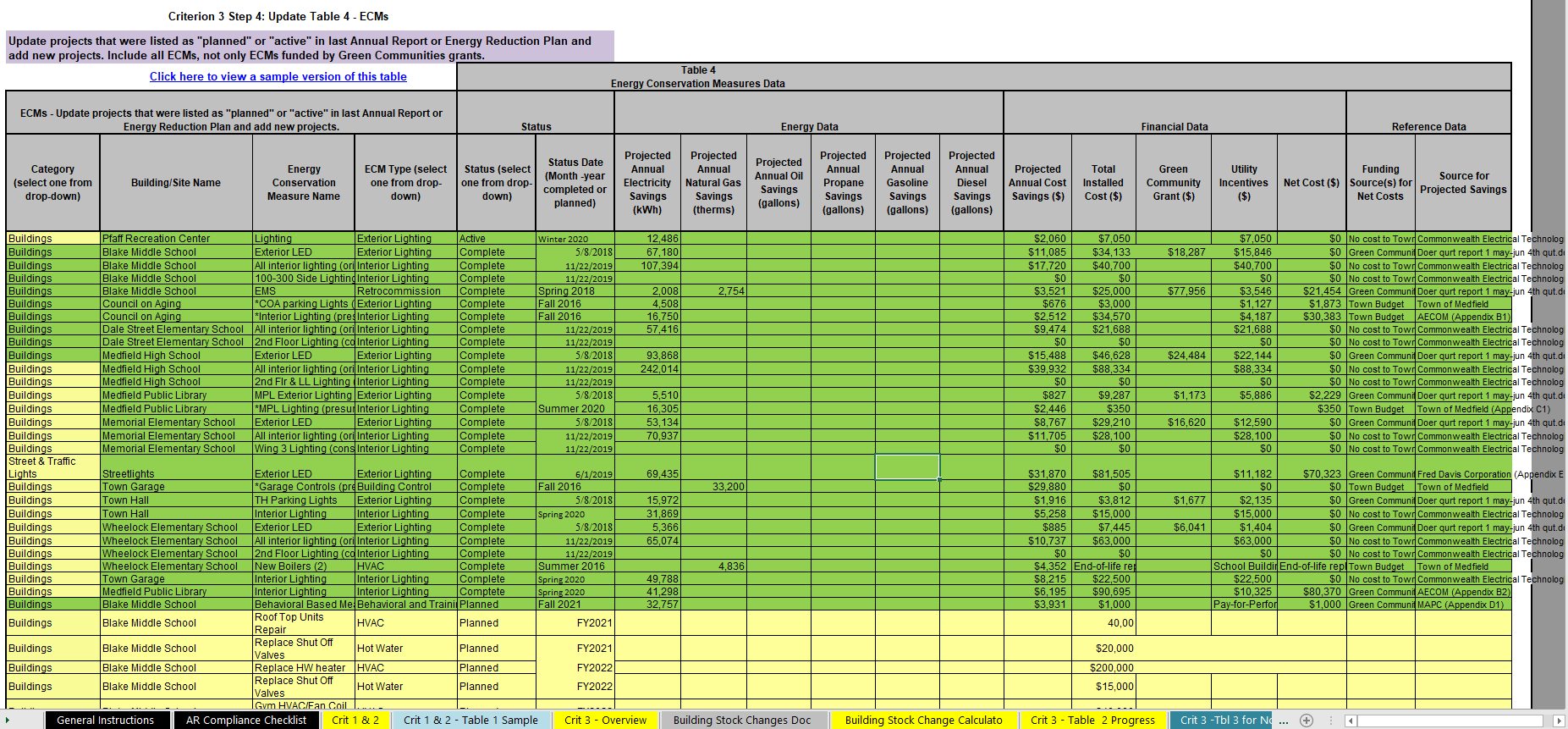
The Green Communities Act requires the town to submit an annual report of what energy conservation measures (ECM’s) have been done and what are planned to be done. Yesterday I reviewed and signed off on the final report for this year. Filing the annual report is a prerequisite to getting the generous Department of Energy Resources (DOER) annual grants, so an important annual step. The Medfield Energy Committee and Amy Colleran, Facilities Director have championed getting the report prepared and filed, this year with the assistance of an Metropolitan Area Planning Council (MAPC) consultant obtained with grant monies.
I found this spreadsheet (partial copy below) listing about 100 ECM’s the most interesting (lots has already been accomplished and lots is still planned). Note how much of what is planned will be paid for by the DOER grant monies.
I started this blog to share the interesting and useful information that I saw while doing my job as a Medfield select board member. I thought that my fellow Medfield residents would also find that information interesting and useful as well. This blog is my effort to assist in creating a system to push the information out from the Town House to residents. Let me know if you have any thoughts on how it can be done better.
For information on my other job as an attorney (personal injury, civil litigation, estate planning and administration, and real estate), please feel free to contact me at 617-969-1500 or Osler.Peterson@OslerPeterson.com.



![WILLIAM P. O 'DONNELL
REGISTER OF DEEDS
ASSISTANT RECORDER OF THE
LAND COURT
Selectman Osler L. Peterson
Medfield Board of Selectmen
10 Copperwood Road
Medfield, MA 02052
Dear Selectman Peterson,
COUNTY OF NORFOLK
COUNTY O F PRESIDENTS
REGISTRY OF DEEDS
NORFOLK REGISTRY DISTRICT OF THE LAND COURT
January 20, 2021
The fees for the Community Preservation Act are set by the State Legislature on land documents
recorded here at the Norfolk County Registry of Deeds. I thought the chart on the reverse side would be
of interest to you. It provides an illustration of the funds generated by the Community Preservation Act
(CPA) in your community based on recorded real estate filings during the 2020 calendar year.
The Community Preservation Act was signed into law on September 14, 2000. Today there are
186 Massachusetts communities that have adopted this act. 16 communities out of the 28 communities
that make up Norfolk County have adopted the law. As of December 31, 2019, fees collected for the
Community Preservation Act were increased to $50.00 for most land documents recorded and $30.00 for
municipal lien certificates. The Registry of Deeds, at no additional cost to the Commonwealth or local
communities, collects these revenues once a land document is recorded and forwards the monies to the
Massachusetts Department of Revenue on a monthly basis. The funds forwarded to the Commonwealth
are then redistributed back to the communities that have adopted the Community Preservation Act.
The Norfolk County Registry of Deeds which is located at 649 High Street, Dedham, is the
principal office for real property in Norfolk County. The Registry is a resource for homeowners, title
examiners, mortgage lenders, genealogists, municipalities and others with a need for secure, accurate,
accessible land record information. For assistance, please contact our Customer Service Center at (781)
461-6101 , or visit our website at www .norfolkdeeds.org.
1 hope you find this data to be informative and helpful. In the meantime, if I can be of assistance
to you, please do not hesitate to contact me at 781-461-6116 or by email at
registerodonnell@norfolkdeeds.org. 2020 was certainly a challenging year and one we will not soon
forget. I wish you a happy and healthy 2021. Be well. Be safe.
WPO/rg
Sincerely yours,
~//frJP~
William P. O'Donnell
Norfolk County Register of Deeds
649 HIGH STREET. DEDHAM . MASSACHUSETTS 02026
TE L EPHONE : 781 -461-6 11 6 FAX : 781-326-4246
EM Al L : registerodonnell@norfolkdeeds.org
www.norfolkdeeds.org
I] facebook.com/NorfolkDeeds ~ twitter.com/NorfolkDeeds You(g youtube.com/NorfolkDeeds
linked fm linkedin.com/company/Norfolk-County-Registry-of-Deeds ~ @NorfolkDeeds
NORFOLK COUNTY REGISTRY OF DEEDS
COMMUNITY PRESERVATION ACT (CPA)
SURCHARGES BY TOWN FOR CALENDAR YEAR 2020
TOWN TOTAL
AVON $60,260.00
BELLINGHAM $219,660.00
BRAINTREE $400,235.00
BROOKLINE $478,050.00
CANTON $269,455.00
COHASSET $147,775.00
DEDHAM $288,320.00
DOVER $86,525.00
FOXBOROUGH $199,605.00
FRANKLIN $393,210.00
HOLBROOK $125,170.00
MEDFIELD $166,440.00
MEDWAY $158,550.00
MIUJS $117,615.00
MILTON $329,310.00
NEEDHAM $389,610.00
NORFOLK $155,295.00
NORWOOD $266,565.00
PIAINVILLE $102,095.00
QUINCY $731,850.00
RANDOLPH $279,160.00
SHARON $230,840.00
STOUGHTON $288,795.00
WALPOLE $314,670.00
WELLESLEY $312,495.00
WESTWOOD $189,110.00
WEYMOUTH $620,970.00
WRENTHAM $171,120.00](https://medfield02052.blog/wp-content/uploads/2021/02/20210120-norfolk-registry-of-deeds-ltr-from_page_2.jpg)




 New DLS Data Visualization Tool Now Available


 Medfield02052's Blog