From the Massachusetts Municipal Association this afternoon –



GOV. BAKER FILES $48.5 BILLION FY23 SPENDING PLAN
FILES A COMPANION $693M TAX RELIEF BILL
• $31.5M INCREASE IN UNRESTRICTED MUNICIPAL AID (2.7%)
• CH. 70 PLAN WOULD INCREASE FY23 SCHOOL AID BY $485M (8.8%)
• 43% OF SCHOOL DISTRICTS WOULD RECEIVE NEW AID OF ONLY $30/STUDENT
• CHARTER SCHOOL & SPECIAL ED REIMBURSEMENTS INCREASE
• MIXED RESULTS FOR OTHER MUNICIPAL AND SCHOOL ACCOUNTS
At 2 p.m. today, Gov. Charlie Baker submitted a $48.5 billion fiscal 2023 state budget plan, House 2, with the Legislature.
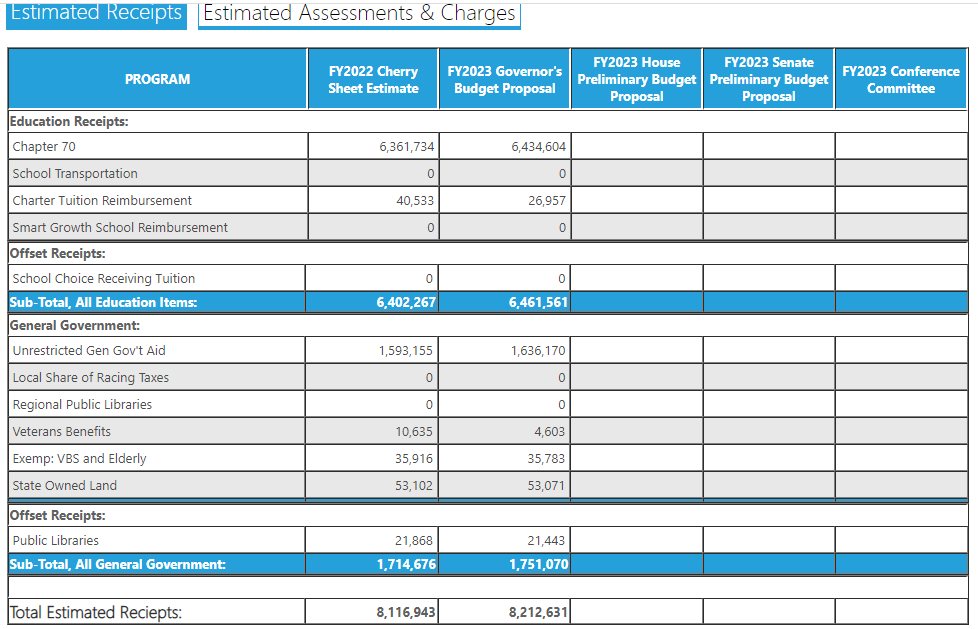
UNRESTRICTED GENERAL GOVERNMENT AID WOULD INCREASE BY $31.5 MILLION
Gov. Baker’s budget includes a $31.5 million increase in the Unrestricted General Government Aid account, a 2.7% increase over fiscal 2022 levels. As the MMA stated during our Annual Meeting this past weekend, a 2.7% increase is too low, and we will be working with local leaders and lawmakers to advocate for an increase that reflects the actual growth in revenues that the state is receiving. With capped property taxes and inflation running higher than 2.7%, cities and towns need a much higher level of UGGA aid to maintain essential services.
The Administration is calculating revenue growth using a methodology that omits a large portion of the record-setting revenue collections that the state has experienced during the past year. This way of benchmarking growth works to the disadvantage of cities and towns, and minimizes revenue sharing amounts. Fiscal 2023 state tax collections will be $2.5 billion higher (7.3%) than the tax base that was used to pass the fiscal 2022 budget last July, and $6.8 billion higher (22%) than the original FY22 projection from a year ago. The Administration is using the highest possible revenue estimate for fiscal 2022 ($35.95 billion, set less than two weeks ago), which would tie UGGA to an artificially low growth projection, even though actual growth will be much higher.
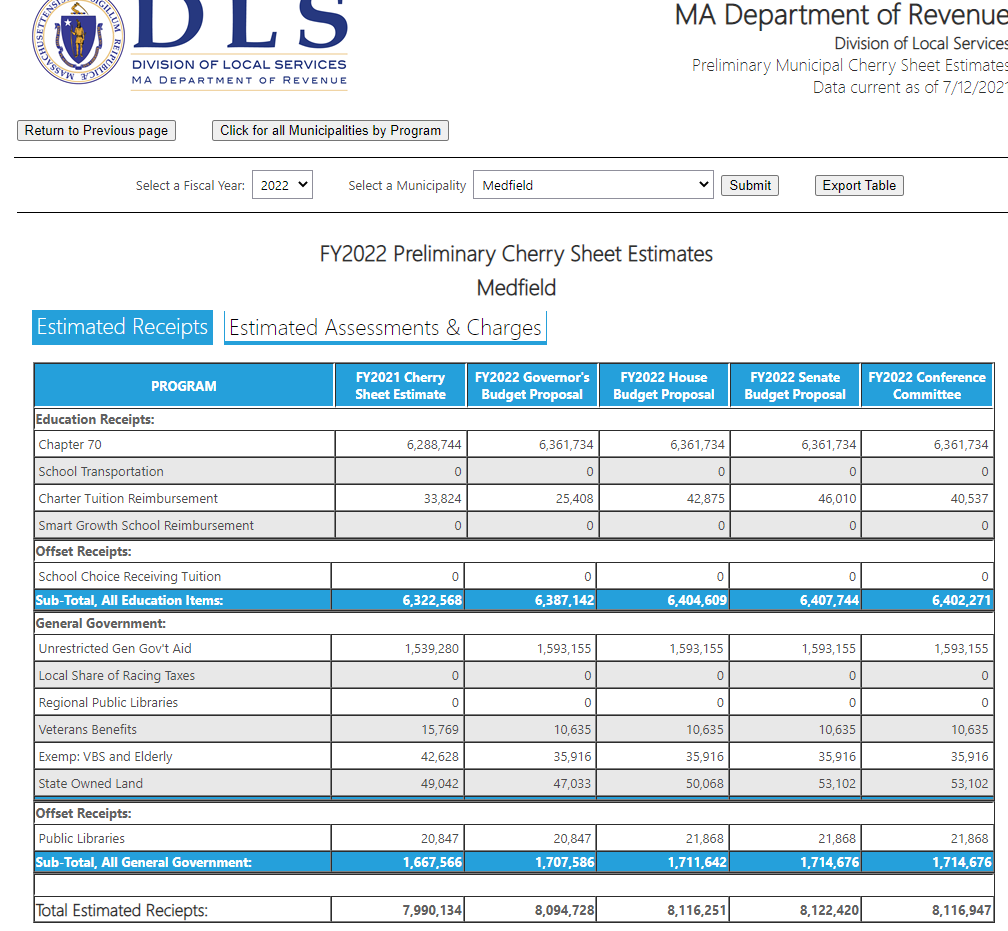
Click here to see the Division of Local Services preliminary fiscal 2023 Cherry Sheet aid amounts for your city or town
Click here to see the Division of Local Services preliminary fiscal 2023 Cherry Sheet aid amounts for regional school districts
OVERALL CHAPTER 70 SCHOOL AID WOULD GO UP BY $485 MILLION, AN 8.8% INCREASE – ALTHOUGH 43% OF DISTRICTS WOUD REMAIN AT MINIMUM AID ONLY
The Governor’s budget recommendation continues implementation of the funding schedules in the 2019 Student Opportunity Act (SOA) that were delayed in fiscal 2021 and then funded at a rate of one-sixth, rather than one-seventh, in fiscal 2022 to stay on track with the law’s intended implementation schedule. House 2 represents funding the Student Opportunity Act at a rate of two-sixths.
Fulfilling the commitments in the Student Opportunity Act, the Governor’s fiscal 2023 budget submission would bring Chapter 70 school aid up to $5.98 billion, a $485 million increase in school aid. The majority of the funds would implement the improvements to the foundation budget, adding weight for low-income students, English Language Learners, special education costs, and school employee health benefits. While this is important progress, an initial examination of the budget indicates that 136 of 318 operating districts (43%) would remain minimum-aid-only, and receive the minimum $30 per-student increase in the Act. These 136 districts would receive a total increase of $9.3 million, and the remaining districts would receive $475.8 million more. The MMA will continue to strongly advocate for minimum aid of $100 per student to ensure that all districts can at least keep pace with inflation and maintain their school services.
Click here to see DESE’s calculation of fiscal 2023 Chapter 70 aid and Net School Spending requirements for your city, town, or regional school district,
based on the Governor’s proposed budget and legislation.
This landing page will also include the preliminary fiscal 2023 charter school assessments and reimbursements.
CHARTER SCHOOL REIMBURSEMENTS WOULD INCREASE TO $219M – CHARTER FUNDING REMAINS A SERIOUS PROBLEM TO BE SOLVED
The Governor’s budget would increase the charter school reimbursement account up to $219 million, intended to meet the commitment in the Student Opportunity Act to fund 90% of the state’s 100-60-40 statutory obligation to mitigate Chapter 70 losses to charter schools. A portion of this $64.8 million increase would simply be a pass-through to charter schools by funding an increase in the per-student facilities amount that charter schools receive.
The Student Opportunity Act pledges to phase in full funding of the statutory reimbursement formula over three years, and while this plan may continue to meet that requirement, it would not fix the serious flaws in the charter school finance system. Charter schools will continue to divert a high percentage of Chapter 70 funds away from many municipally operated school districts, and place greater strain on the districts that serve the vast majority of public school children. Major problems will continue unless a true resolution of the charter school funding problem is achieved, which is a top MMA priority.
SPECIAL EDUCATION CIRCUIT BREAKER INCREASED TO $414M
The Governor’s budget would add $41.2 million to fund the Special Education Circuit Breaker program at $414 million, an increase of 11%. The Student Opportunity Act expanded the special education circuit breaker by including out-of-district transportation, an important enhancement for cities and towns.
REGIONAL SCHOOL TRANSPORTATION REIMBURSEMENTS CUT BY 5.3%
Gov. Baker’s budget submission would reduce funding for regional transportation reimbursements from $82.1 million this fiscal year to $77.8 million. This would be a hardship for virtually all communities in regional districts. Reimbursements for transportation of out-of-district vocational students remains significantly underfunded at $250,000. Increasing these accounts is a priority for cities and towns and the MMA.
McKINNEY-VENTO REIMBURSEMENTS INCREASED
The Governor’s budget would increase reimbursements for the transportation of homeless students from $14.4 million this year to $22.9 million in fiscal 2023. The impact of this funding level will vary from community-to-community depending on the number of homeless families that remain sheltered in local hotels and motels. The Administration has been successful in reducing the number of homeless students who are dislocated from their original district, but those communities that continue to provide transportation to many students rely on this account.
PAYMENTS-IN-LIEU-OF-TAXES (PILOT) LEVEL-FUNDED
The Governor’s budget would level-fund PILOT payments at $35 million, which would be a significant hardship for many smaller, rural communities with large amounts of state-owned land. This is a key account due to the major impact that PILOT payments have on budgets in very small communities, and level-funding falls short of the Legislature’s goal of phasing in full funding by fiscal 2024.
THE GOVERNOR IS PROPOSING APPROXIMATELY $700 MILLION TO FUND TAX CUTS
As Gov. Baker announced at his State of the Commonwealth address last night, and when he released his budget proposal today, he is proposing a series of tax cuts, many targeted for struggling residents, and others targeted toward wealthier individuals. These provisions would permanently reduce state revenues, essentially opting for tax reductions over funding for existing or new state programs. The Legislature is expected to examine these closely before making commitments. These are the main items (cost estimates are very preliminary):
– Doubling the tax credits for dependent care ($167 million)
– Increasing the cap on the income tax deduction for rent from $3,000 to $5,000 ($77 million)
– Doubling the maximum Senior Property Tax Circuit Breaker tax credit ($60 million)
– Reducing the estate tax ($277 million)
– Reducing the short-term capital gains tax rate to 5% ($117 million)
– Increasing the no-tax threshold for lower-wage taxpayers ($41 million)
PLEASE CONTACT YOUR LEGISLATORS TODAY AND LET THEM KNOW THAT CITIES AND TOWNS NEED UNRESTRICTED GENERAL GOVERNMENT AID TO INCREASE BY MORE THAN 2.7%. WITH RECORD STATE REVENUE COLLECTIONS, LOCAL AID NEEDS A HIGHER INCREASE TO FUND ESSENTIAL SERVICES IN OUR COMMUNITIES.
WHEN TALKING WITH YOUR LEGISLATORS, EXPLAIN THE NEED FOR ADEQUATE FUNDING FOR KEY ACCOUNTS, INCLUDING HIGHER MINIMUM EDUCATION AID AND FULL FUNDING FOR REGIONAL SCHOOL TRANSPORTATION, PAYMENTS-IN-LIEU-OF-TAXES, AND CHARTER SCHOOL REIMBURSEMENTS
THANK YOU!
Massachusetts Municipal Association
3 Center Plaza
Suite 610
Boston, MA 02108
(617) 426-7272 | Email Us | View our website

Unsubscribe from MMA Legislative Alert Emails
 Breaking News from the MMA