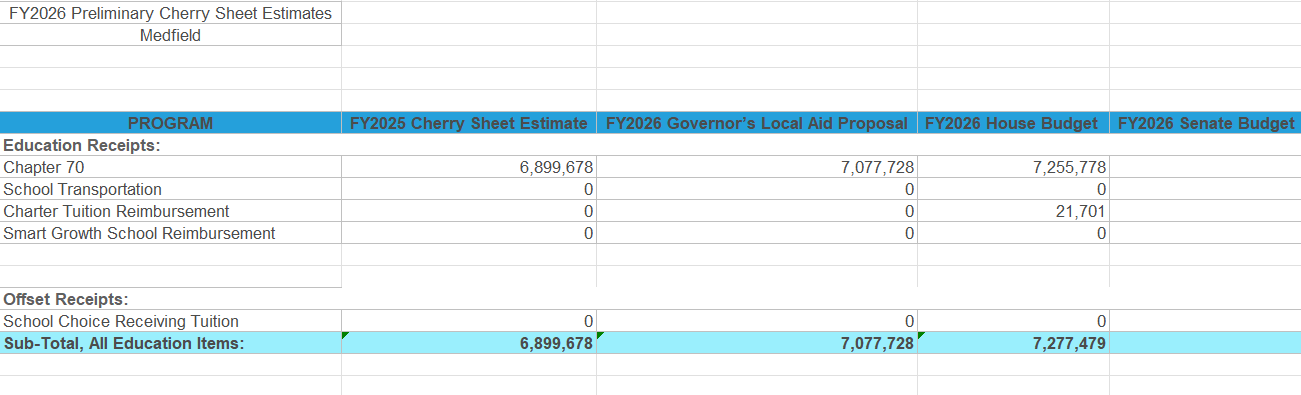
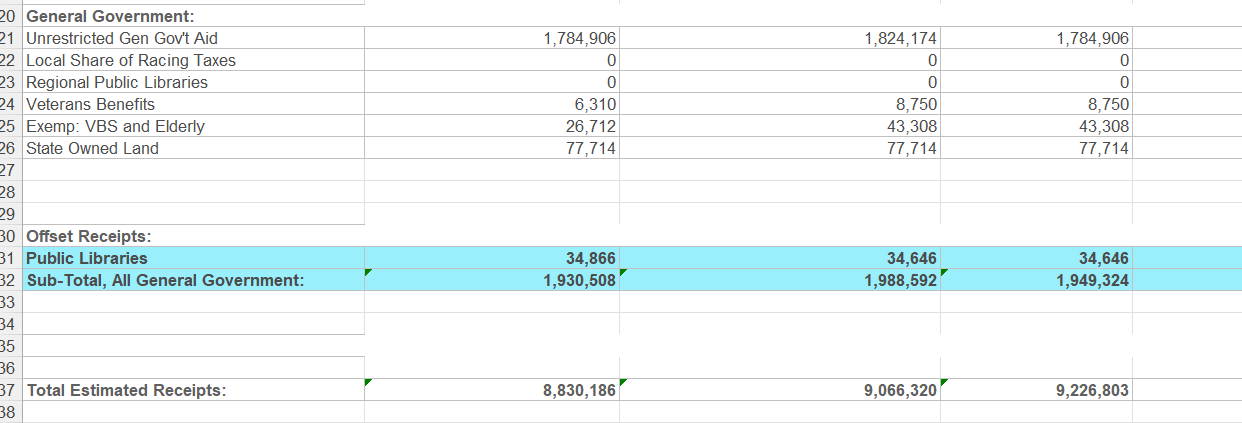
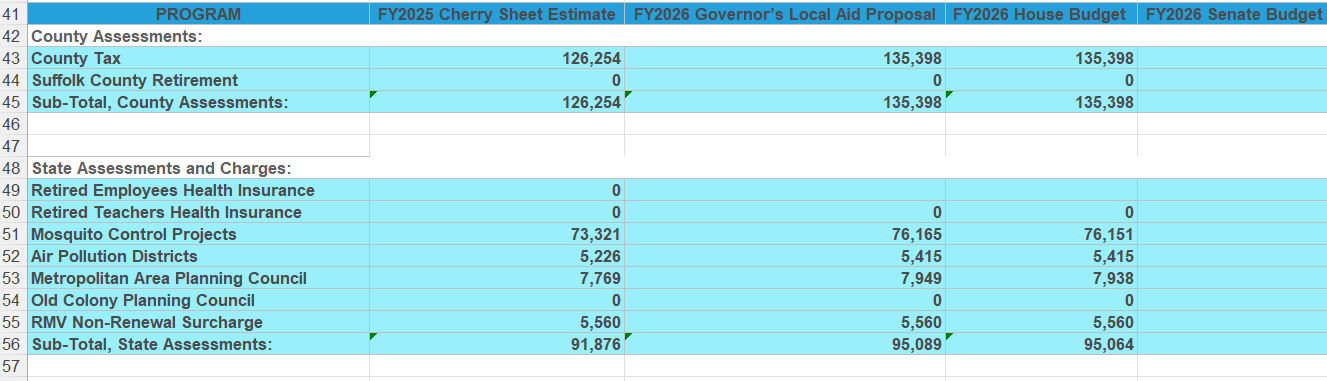
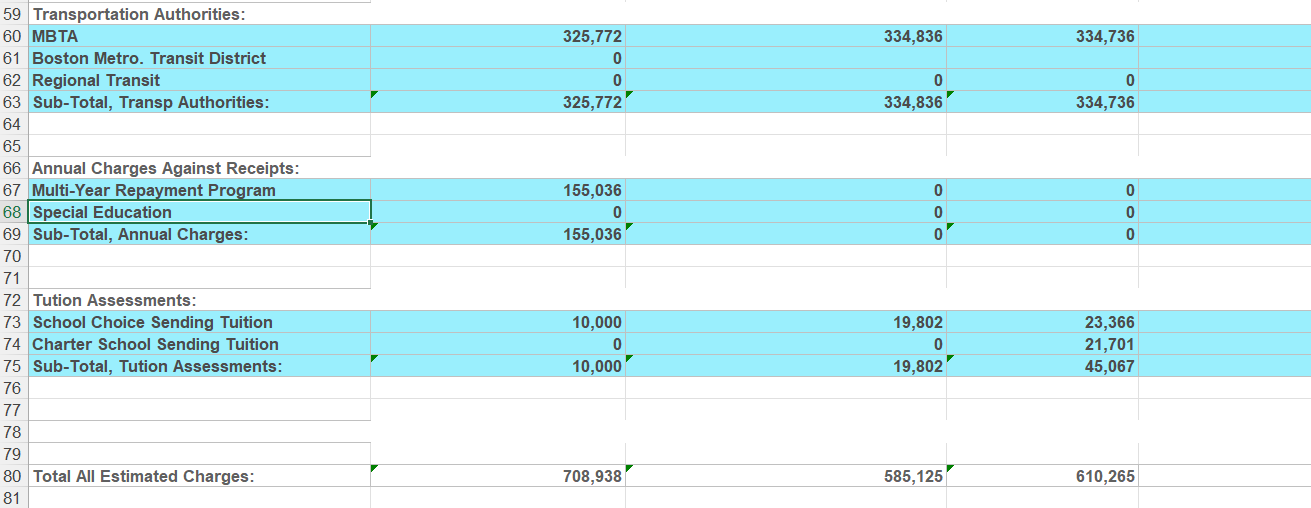
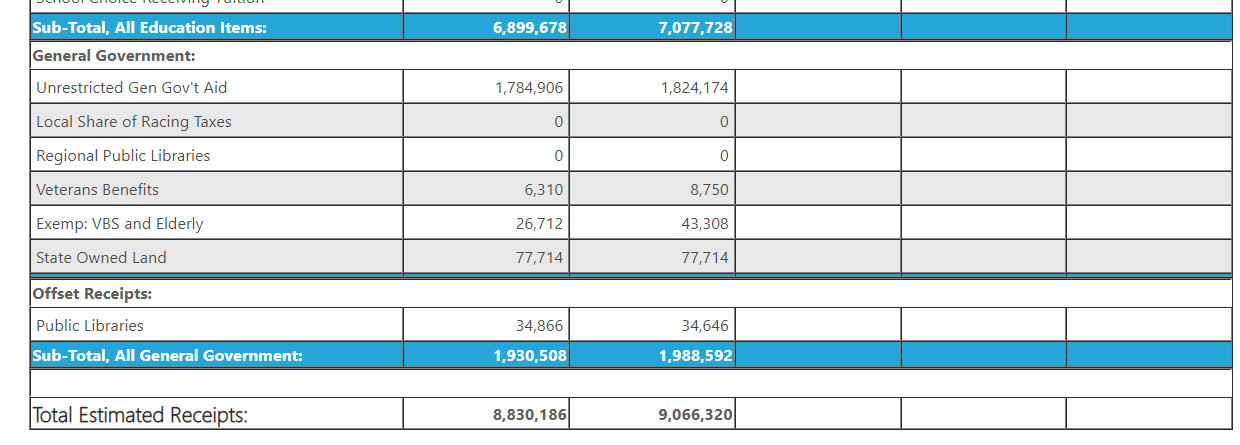
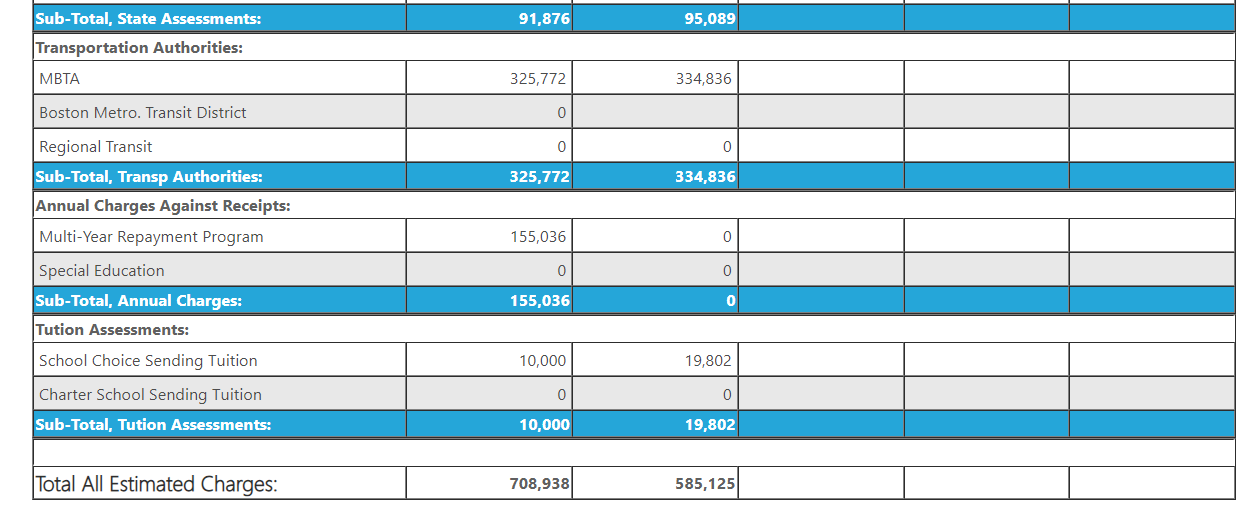
The Senate released its cherry sheet budget numbers today, and the Senate’s money for Medfield tracks the House and Governor’s budget amounts fairly closely – meaning that the town will not likely see much increase in state aid next year.
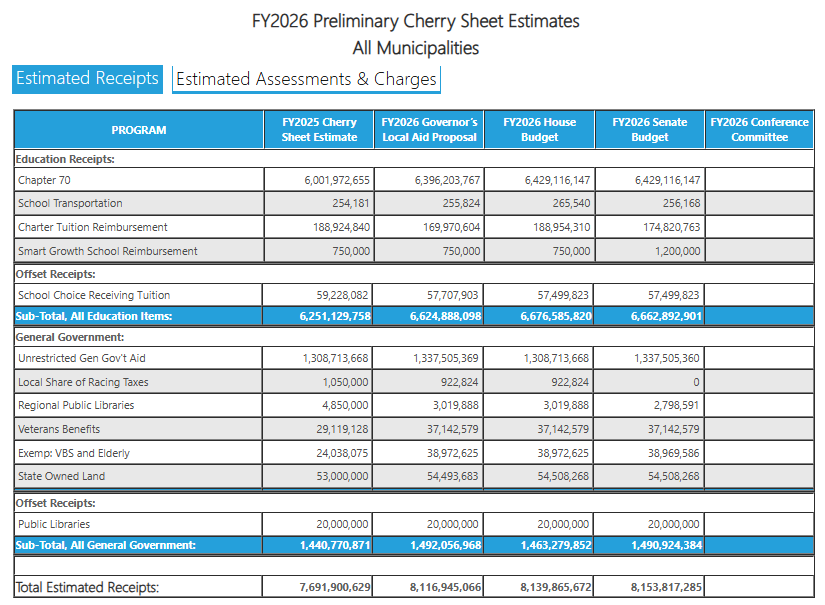
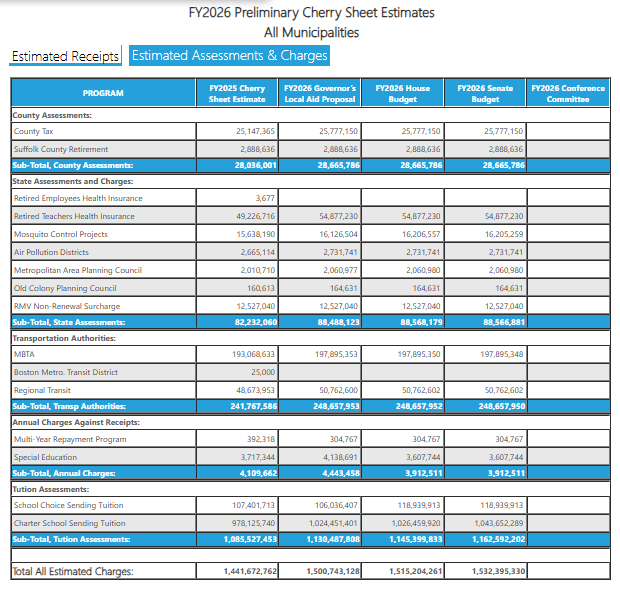

The Senate released its cherry sheet budget numbers today, and the Senate’s money for Medfield tracks the House and Governor’s budget amounts fairly closely – meaning that the town will not likely see much increase in state aid next year.
Comments Off on Senate Budget #s – similar to House & Gov
Posted in Budgets, Legislature, State
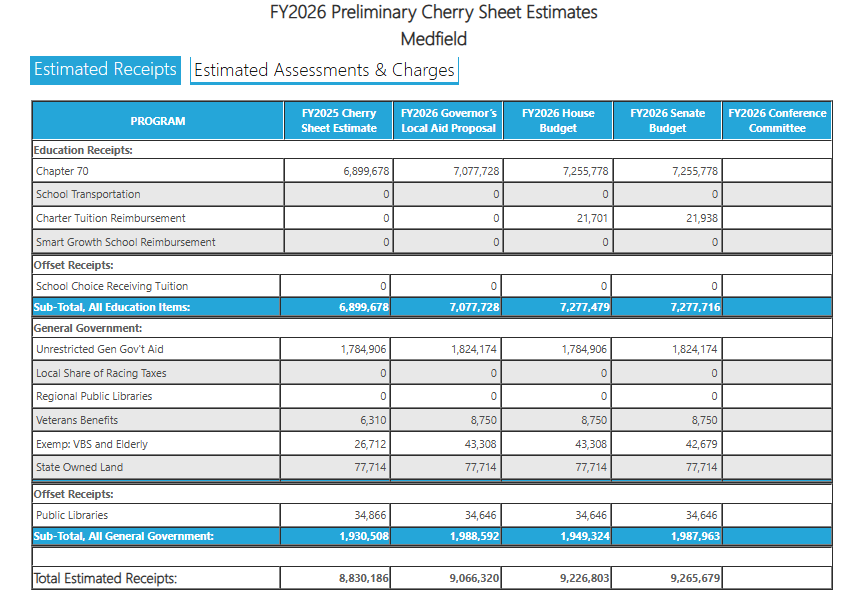
Looks to be a lean year for Medfield’s state aid, as the Senate Ways & Means Committee added less than $40K to the House budget numbers for Medfield, which were already only small increases. All the state $ must be going for the $25m. parking garage in the Speaker’s district:
Comments Off on Senate Ways & Means adds less than $40K for Medfield
Posted in Budgets, Legislature, State
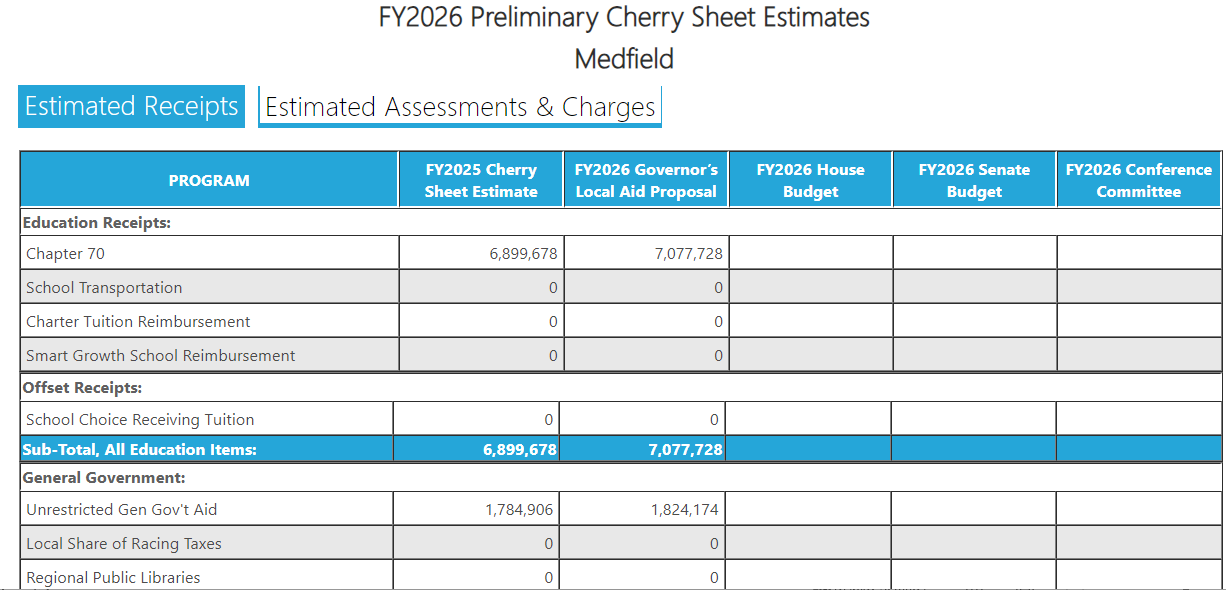
While the Gov’s proposed budget seems to allocate scant new monies for the town, we appear to have paid for the former Medfield State Hospital project on our ten year payment plan, so our assessment is down $155K.
For a detailed view of the updated information the cherry sheet websites:
Municipal estimates receipts and charges

Shared today by Penni Conner, Chair of the Medfield Energy Committee –
Healey-Driscoll Administration Awards $1.75 Million in Energy Efficiency and Conservation Block Grants
45 Communities Across Massachusetts Awarded Funds for Clean Energy Projects that Reduce Emissions, Advance Energy Equity
BOSTON – The Healey-Driscoll Administration today awarded $1.75 million in Energy Efficiency and Conservation Block Grant (EECBG) competitive subgrants to 45 municipalities across Massachusetts to fund 29 clean energy initiatives that help municipalities meet their own climate goals and share the benefits of climate action equitably.
The Energy Efficiency and Conservation Block Grant (EECBG) Program is a $550 million grant program funded through the Bipartisan Infrastructure Law. The program is designed to help states, local governments and Tribes cut costs, reduce energy use, lower fossil fuel emissions, and advance environmental justice.
| Medfield | Central | Town House (Town Hall) Window Replacement | $61,739.00 |
Comments Off on Medfield awarded $61K EECBG for windows upgrade at Town House
Posted in Energy Committee, State

Having met with Kevin several times over the last two years, I’ve found him to be well aware of our municipal issues, knowledgeable about the roadblocks we face to address them, and insightful in his rationale for tangible solutions. His experience as a Select Board Chair in Norfolk as well as his body of work on the Planning Board, County Advisory Board, and MBTA Advisory Board all contribute to his locally-focused approach to public service. Most importantly, I have come to understand that Kevin truly cares about making our towns work better for our residents. He’s approachable, he listens, and makes himself available whenever asked. Based on all this, I am confident that he would represent Medfield’s interests well in the legislature and I hope you will join me in supporting Kevin Kalkut for 9th Norfolk State Representative. – Osler Peterson, Medfield Select Board
#LocalEndorsement#MedfieldMA#9thNorfolk#KalkutCrew#48DaysToGo#Kalkut4Change#Kalkut4Rep
Comments Off on Please Vote for Kevin Kalkut for State Rep.
Posted in Elections, Legislature, Political, State, Uncategorized

Town Administrator, Kristine Trierweiler shared her Summer 2024 TOWN ADMINISTRATOR UPDATE with Select Board at our meeting on Tuesday, and I especially wanted to share the part below in blue font which is a follow up about the planned improvements to the West Street and RTE 27 intersection. At the Select Board meeting, Kris shared that in her meeting with MASSDOT that the state said that if Medfield builds the roundabout, as the state wants, that the state would find the town all of the monies to construct the roundabout. Whereas if we opt to install a traffic light, we will have to pay the entire $1.9m. cost on out own dime, as we will lose the $1.3m. Federal earmark.
To be clear, this Select Board member preferred the roundabout from the outset. It was the other two Select Board members who said they preferred the traffic light and who asked to have Kris pursue the traffic light option with the state.
The town now has the roundabout, which the MASSDOT traffic engineers say is the safest alternative, available to the town at no cost, versus a less safe traffic light option that will cost the town $1.9m. – should be an easy choice. If the town builds the traffic lights, your family’s share would be $4-5,000.
Maurice Goulet, Director of Public Works and I met with Beta Engineering and the MADOT engineering team to discuss the two different paths forward for the project as requested by the Select Board. For the first path, MADOT has confirmed that if we would like to utilize the 1.3 million dollar earmark we would have to continue with the MADOT process and that would include the consideration of a roundabout for this location. The total cost of that project is $1.9, however, MADOT indicated they would assist the Town in securing the remaining funding. MADOT believes that this location would benefit from a roundabout design. The next step if the Select Board elects this option is to go to the 25% design threshold.
Posted in Development, DPW, Federal Government, Planning, Safety, State, Transportation
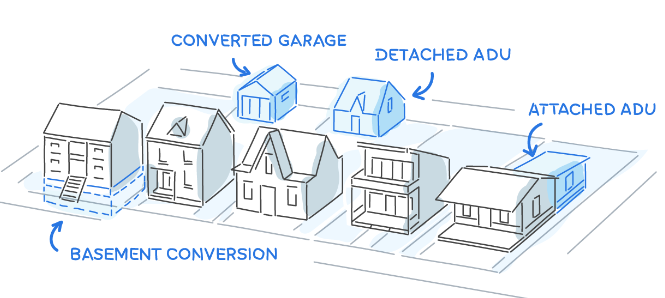
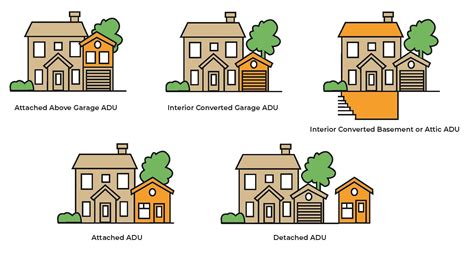
Accessory Dwelling Units (ADU’s), or small homes of up to 900 sq. ft., become permitted as of right in Massachusetts starting 2/2/2025 on any single family lot, subject only to “reasonable regulations.” The recently enacted Affordable Homes Act (AHA) stated the new rules, adding ADU’s onto the exemptions from local zoning that already exist for educational, religious, and agricultural uses. The permitted reasonable regulations cited are “dimensional setbacks and the bulk and height of structures and . . . short-term rental.”
The Affordable Homes Act, Chapter 150 of the Acts 2024
SECTION 7. Section 1A of chapter 40A of the General Laws, as appearing in the 2022 Official Edition, is hereby amended by striking out the definition “Accessory dwelling unit” and inserting in place thereof the following definition:-
“Accessory dwelling unit”, a self-contained housing unit, inclusive of sleeping, cooking and sanitary facilities on the same lot as a principal dwelling, subject to otherwise applicable dimensional and parking requirements, that: (i) maintains a separate entrance, either directly from the outside or through an entry hall or corridor shared with the principal dwelling sufficient to meet the requirements of the state building code for safe egress; (ii) is not larger in gross floor area than 1/2 the gross floor area of the principal dwelling or 900 square feet, whichever is smaller; and (iii) is subject to such additional restrictions as may be imposed by a municipality, including, but not limited to, additional size restrictions and restrictions or prohibitions on short-term rental, as defined in section 1 of chapter 64G; provided, however, that no municipality shall unreasonably restrict the creation or rental of an accessory dwelling unit that is not a short-term rental.
SECTION 8. Section 3 of said chapter 40A, as so appearing, is hereby amended by adding the following paragraph:-
No zoning ordinance or by-law shall prohibit, unreasonably restrict or require a special permit or other discretionary zoning approval for the use of land or structures for a single accessory dwelling unit, or the rental thereof, in a single-family residential zoning district; provided, that the use of land or structures for such accessory dwelling unit under this paragraph may be subject to reasonable regulations, including, but not limited to, 310 CMR 15.000 et seq., if applicable, site plan review, regulations concerning dimensional setbacks and the bulk and height of structures and may be subject to restrictions and prohibitions on short-term rental, as defined in section 1 of chapter 64G. The use of land or structures for an accessory dwelling unit under this paragraph shall not require owner occupancy of either the accessory dwelling unit or the principal dwelling; provided, that not more than 1 additional parking space shall be required for an accessory dwelling unit; and provided further, that no additional parking space shall be required for an accessory dwelling located not more than 0.5 miles from a commuter rail station, subway station, ferry terminal or bus station. For more than 1 accessory dwelling unit, or rental thereof, in a single-family residential zoning district there shall be a special permit for the use of land or structures for an accessory dwelling unit. The executive office of housing and livable communities may issue guidelines or promulgate regulations to administer this paragraph.
The law firm Mirrick O’Connell last week sent out an emailed update that summarized the legislative change that permits ADU’s as follows:
The AHA amends the Zoning Act by prohibiting towns and cities from restricting accessory dwelling units (ADUs) in single-family zoning districts. ADUs, sometimes known as in-law apartments, now fall under the protection of M.G.L. c. 40A, Section 3, which exempts religious, educational, and other uses from local zoning.
One ADU is now allowed by-right on each lot in a single-family zoning district, subject to “reasonable regulations”, which may include non-discretionary site plan review, certain dimensional controls, Title 5 septic regulations, and restrictions on short-term rentals.
The AHA provides that an accessory dwelling unit must have a separate entrance (interior or exterior) that complies with the State Building Code and may not be larger than half the gross floor area of the principal dwelling or 900 square feet, whichever is smaller. The AHA prohibits restrictions on owner-occupancy and rentals of ADUs, eliminating the requirement in many towns and cities that in-law apartments may only be used by an owner’s close relative.
In addition, towns and cities must allow additional ADUs in single-family zones through a special permit process.
The ADU provisions take effect on February 2, 2025, so municipalities have a few months to consider zoning amendments consistent with the AHA.
Comments Off on ADU’s – coming to a Medfield yard near you in February
Posted in Buildings, Legislature, State, Zoning
The email below is from David Temple to follow up on his Tuesday Select Board meeting comments in support of installing a roundabout at RTE 27 and West Street instead of new traffic lights and to share his data sources (NB- David did not include a reference to the Roman philosopher Cicero materials he cited). David noted that all who study the issue seem to agree that roundabouts are safer and significant improvements over lights for multiple reasons.
MassDOT prefers we install a roundabout thereso much that we would lose our Federal earmark for $1.3m. and it would cost the town over a $1m. more to install traffic lights instead.:
I spoke in support of installing roundabouts instead of traffic lights in Medfield, and I presented documents from the Insurance Institute for Highway Safety, the Massachusetts Dept, of Transportation, and the North Carolina Dept. of Transportation. They asked for electronic copies, for which I have attached links. Please forward them to the board and Kristine. Thanks.
Posted in DPW, Safety, State, Transportation

Chris Potts kindly shared with me her notes from listening to the MTV version of Maurice Goulet, Director DPW presenting to the Select Board last week about the MassDOT preference that the RTE 27 and West Street intersection be improved with a roundabout instead of new traffic lights and the link below to the MTV recording.
“Here’s a link to the recording that starts at the point in the discussion when costs were noted: https://youtu.be/VemA9lcCRhQ?t=1903” I see that the presentation on the intersection begins at 27:00.
Chris’ input got me to listen to the MTV video of the meeting about what Moe said, and I now supply a more accurate account. Moe said:
Posted in DPW, State, Transportation
Medfield Select Board member
I started this blog to share the interesting and useful information that I saw while doing my job as a Medfield select board member. I thought that my fellow Medfield residents would also find that information interesting and useful as well. This blog is my effort to assist in creating a system to push the information out from the Town House to residents. Let me know if you have any thoughts on how it can be done better.
For information on my other job as an attorney (personal injury, civil litigation, estate planning and administration, and real estate), please feel free to contact me at 617-969-1500 or Osler.Peterson@OslerPeterson.com.
 | pmdunner on Crosswalks & Sidewalks at… |
 | EILEEN DESORGHER on Vote Djuna Perkins for DA |
 | Amy Cohen on Delineator Flexposts – t… |
 | Zach on Warrant Committee’s slid… |
 | Donna Knott on Reading for “Read Across… |