Category Archives: State

State explains Gov’s first budget

This came today in my e-newletter from the Division of Local Services (DLS) at the Massachusetts Department of Revenue to explain what the Gov’s administration thinks are the highlights of her first budget.

Partnering with our Cities and Towns – FY24 Funding Updates
Secretary Matthew J. Gorzkowicz – Executive Office for Administration & Finance

FY24 Budget

On Wednesday, August 9, Governor Healey signed the FY24 budget, representing $55.98 billion in historic investments in schools, child care, workforce development, public transit, housing, climate resiliency and other key areas that will help make Massachusetts more affordable, competitive, and equitable.

In collaboration with our partners in the Legislature, the budget includes hallmark proposals from Governor Healey, including making community college free for students aged 25 and older through MassReconnect, expanding Commonwealth Cares for Children (C3) grants for early education and care providers, increasing funding for Early College, Innovation Career Pathways, apprenticeships and other workforce development programs, and dedicating 1 percent of the budget to energy and the environment for the first time.

Through the FY24 budget, the Healey-Driscoll Administration is reaffirming our commitment to the state’s partnership with cities and towns, making historic investments in Chapter 70 school aid, unrestricted government aid, and student transportation. This spending plan fully funds another year of the Student Opportunity Act and dedicates resources to help cities and towns redevelop and revitalize their downtowns.

In total, cherry sheet aid to municipalities across the Commonwealth is increasing $648 million, or 8.4%, over FY23, totaling $8.37 billion.

With this being the administration’s first budget, we are excited to share some of the details on our support for cities and towns.

Unrestricted General Government Aid (UGGA)

A cornerstone of the administration’s commitment to partnering with municipalities is the expansion of Unrestricted General Government Aid, supporting essential local government services, including public safety, public works, and economic development. In FY24, UGGA is increasing by $39 million, or 3.2%, over FY23, totaling $1.27 billion.

Education: Fully Funding the Student Opportunity Act

The administration is focused on ensuring that all students have access to a high-quality public education. In FY24, Chapter 70 aid is increasing by $594 million, or 9.9%, over FY23, totaling $6.59 billion. This represents full funding of the Student Opportunity Act, the largest nominal increase in the history of the program, and the largest percentage increase in more than two decades.

The budget also funds major increases in school transportation reimbursement ($21.3 million, 20%) and rural school aid ($9.5 million, 173%). It includes full funding for Special Education Circuit Breaker.

FY24 also includes funding to make universal school meals permanent, ensuring every student across the Commonwealth has access to healthy nutrition during the school day.

For school buildings, the FY24 budget includes $50 million for the new Green School Works program, providing grants to school districts for clean energy infrastructure, $100 million in supplemental grants to mitigate cost increases at school construction projects previously funded by the MSBA and an increase in the MSBA’s statutory cap to $1.2 billion.

Municipal Partnerships

The FY24 budget also includes funding for critical partnership programs between municipalities and the state. Some examples include: Increasing payments in lieu of taxes (PILOT) for state-owned land by $6.5 M (14%).
  Increasing funding for public libraries by $3.8 million (12%).
  $100 million in supplemental aid for municipal road and bridges, funded by Fair Share surtax revenues.
  $16.3 million in funding for the Municipal Regionalization and Efficiencies Incentive Reserve, which funds programs including the Community Compact’s Best Practice ($2.1 million) and Efficiency and Regionalization Grant ($600,000) programs.
  $600,000 for the Massachusetts Downtown Initiative for municipalities looking to revitalize their downtowns. FY24-FY28 Capital Investment Plan

On June 22, the Healey-Driscoll Administration released its first five-year Capital Investment Plan (CIP), outlining more than $14 billion in investments over five years to build a more affordable, competitive, and equitable future for Massachusetts.

The investments in the FY24-FY28 CIP complement and build on the funding proposed in the administration’s inaugural operating budget, with a particular emphasis on advancing climate, economic development, and housing goals – including the creation of a new $97 million HousingWorks program.

For municipalities, the CIP includes significant funding for transportation, economic development, climate initiatives, technology infrastructure, and more.

Transportation

FY24 investments in transportation infrastructure across our cities and towns include: $200 million for Chapter 90 local transportation projects
  $25 million for the Municipal Pavement Program
  $15 million for the Municipal Small Bridge Program
  $15 million for the Complete Streets Program
  $8.5 million for the Shared Streets and Spaces Program
  $6 million for the Local Bottleneck Reduction Program Economic Development

The Healey-Driscoll Administration is committed to working with local leaders to build vibrant communities, revitalize downtowns, and create economic opportunity for all Massachusetts residents. In FY24, investments through the CIP include: $96 million for MassWorks infrastructure grants
  $16.6 million for Revitalizing Underutilized Properties
  $5 million for the Rural and Small Town Development Fund Climate

Withstanding the climate crisis and protecting our environment requires a strong partnership between the state and local communities. The FY24 CIP continues investments in EEA’s programs that support communities as they plan for the future, including: $41.2 million for the Clean Water Trust Revolving Fund
  $23.7 million for the Municipal Vulnerability Program (MVP)
  $21 million for Community Investment Grants
  $12 million for Inland Dams and Seawalls
  $10 million for MassTrails grants to municipalities Technology

Ensuring that all municipalities have the necessary technological infrastructure is critical for growth throughout Massachusetts. The FY24 CIP invests: $6.5 million for the Broadband Middle Mile Program
  $5 million for the Community Compact Municipal Fiber Grant Program
  $5 million for Community Compact Information Technology Grants
  $1 million for the Broadband Last Mile Program Other Municipal Funding $25 million for Library Construction Grants
  $10 million for Cultural Facilities Fund Grants
  $4 million for Municipal ADA Improvement Grants
  $1.6 million for Historic Preservation Grants We remain committed to working with our municipal partners in support of your efforts to make our Commonwealth stronger for all. Thank you for your dedication and hard work!

For more information on the FY24 budget, please visit www.mass.gov/gaa.

For more information on the FY24-FY28 Capital Investment Plan, please visit www.mass.gov/capital.   Register Today for the 2023 “What’s New in Municipal Law” Seminars

The Division of Local Services Municipal Finance Law Bureau will offer its annual “What’s New in Municipal Law” seminars for local officials on Thursday, September 21, 2023 at the Bentley University Conference Center in Waltham and Thursday, September 28, 2023 at the Log Cabin Banquet & Meeting House in Holyoke. The seminars will be held in-person and run from 9am to 3pm.

The registration fee is $100. Payment must be received by Friday, September 15th. Event check-in opens at 8:15am. Lunch will be provided.

To view the registration form, please click here. Any questions regarding the seminars should be directed to dlsregistration@dor.state.ma.us.   Highly Recommended: Formal Financial Policies

The DLS Financial Management Resource Bureau (FMRB) provides tailored consultative services to municipalities across the state. Articles in this series highlight a particular financial management best practice that we frequently recommend.

The adoption of formal financial policies is a best practice that serves many important purposes. Among the most crucial of these is the directive guidance that fiscally prudent policies provide for achieving sound, long-term budgeting practices. Along with a capital improvement plan and long-range forecast, financial policies constitute one of the three key tools that DLS encourages all communities to employ to shape the development of annual budgets that are balanced and sustainable into the future.


At a basic level, a policy constitutes a high-level plan for achieving certain goals within a defined topic area. In municipal government, financial policies can be divided into two broad categories. Fiscal planning policies present a roadmap to guide short- and long-term budget decisions. When they are well-reasoned, such policies help mitigate the risk of developing any structural imbalances while also providing a framework for sustaining and enhancing services. As the other category, financial operations policies promote accountability and enhanced coordination of services by defining procedural objectives and the related responsibilities assigned to applicable municipal officials and employees.

Financial policies should be understood as a foundational component of the government’s larger system of internal controls and are themselves a form of internal control of the directive variety. It is because of this vital function that credit rating agencies such as Moody’s and Standard & Poor’s look favorably upon the presence of strong formalized policies when determining a community’s bond rating, which has a significant impact on the cost of borrowing.

The effort to research, discuss, write, review, and finally adopt policies can seem a daunting task. As a result, many communities, especially smaller towns, have only informal and often unwritten guidelines that might only be passed along in an ad hoc fashion as local officeholders enter and leave municipal service. Such municipalities have a more tenuous hold on institutional knowledge and are also liable to be relatively myopic or disjointed in the pursuit of their goals. Hence, a prime objective for adopting formal, written policies is to serve as an educational tool that can foster long-term consistency and continuity in operational and budgeting practices.

Furthermore, enhanced transparency in fiscal governance can be achieved through policy adoption, and we encourage cities and towns to incorporate fiscal policy text into their budget documents and presentations. While remaining more flexible and easier to modify than bylaws and ordinances, policies should provide instructive guidance to steer officials and employees toward objectives. To assure effectiveness, city and town officials must be thoughtful and proactive in promoting policy awareness within the organization. We also recommend communities to periodically review and revise their policies to address evolving goals and circumstances.

From the financial management reviews and other municipal project work that FMRB has done over the years, the bureau has identified a minimum set of core policies we believe every city or town should adopt to manage the most significant areas of budgetary and operational risk. These are listed in the table below.


FMRB has drafted 30+ policy manuals for cities and towns, each of which incorporates the above topics, as well as others desired by the client community. Any municipality that is conducting research to create or revise a policy manual may access them here.
 

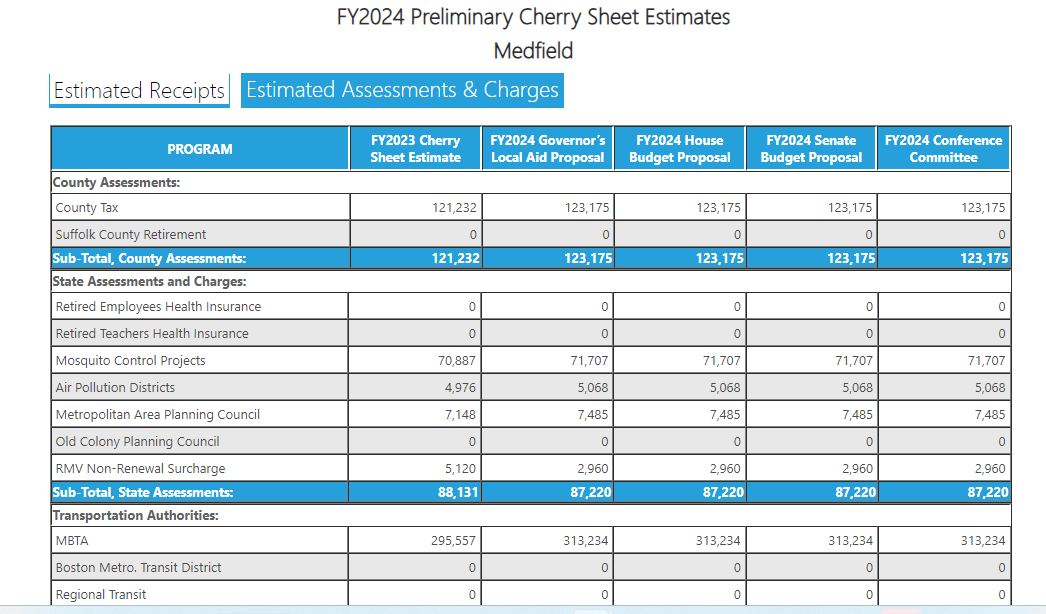
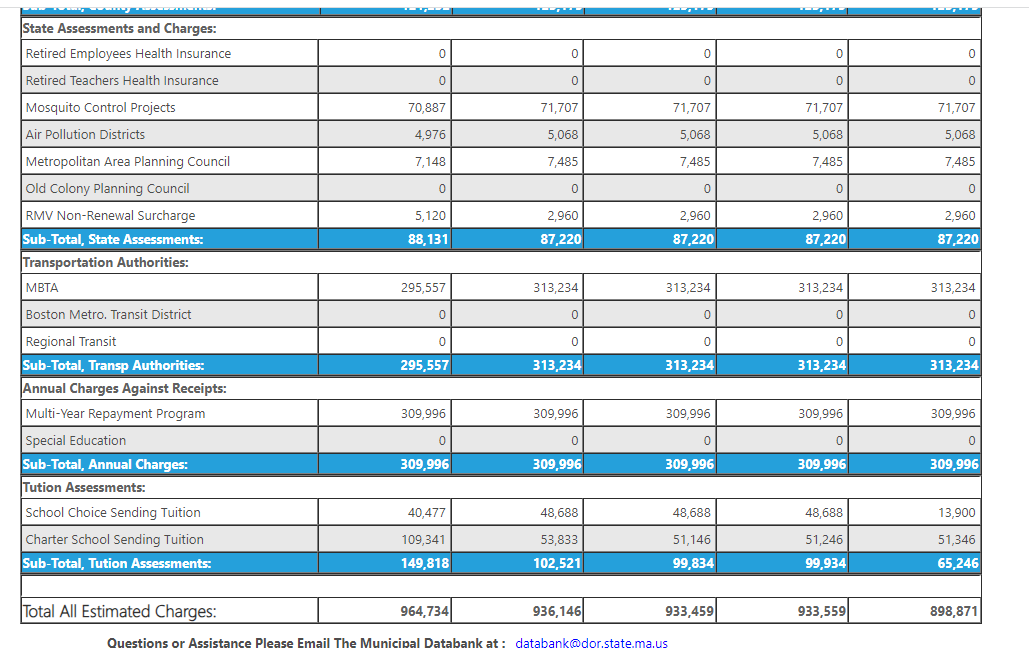
State updated our FY24 aid by $2K

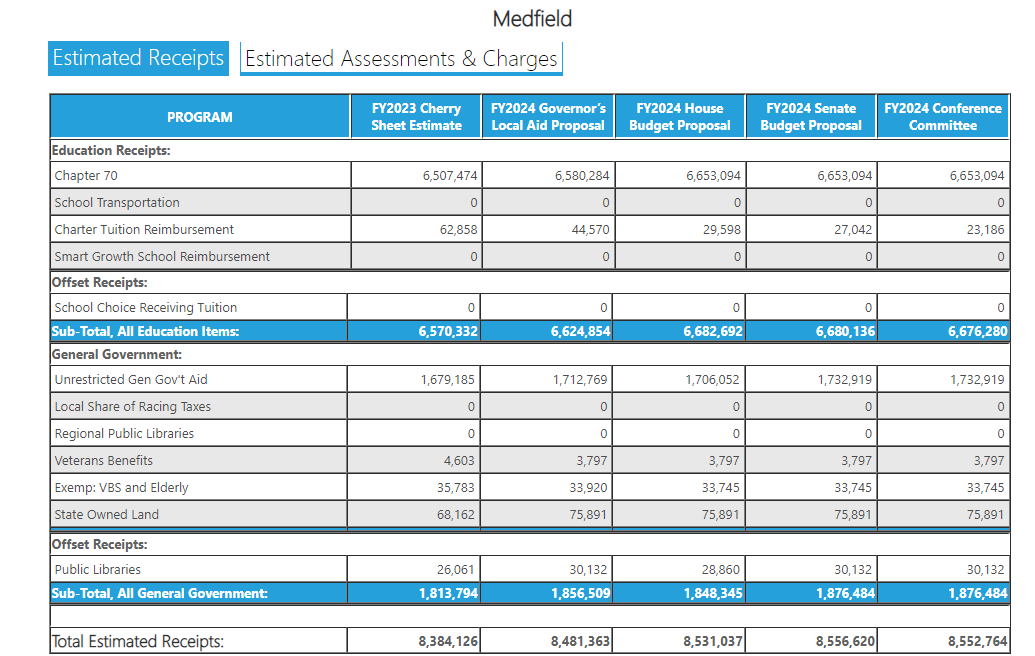
Revised cherry sheet figures today on the Town of Medfield state aid:

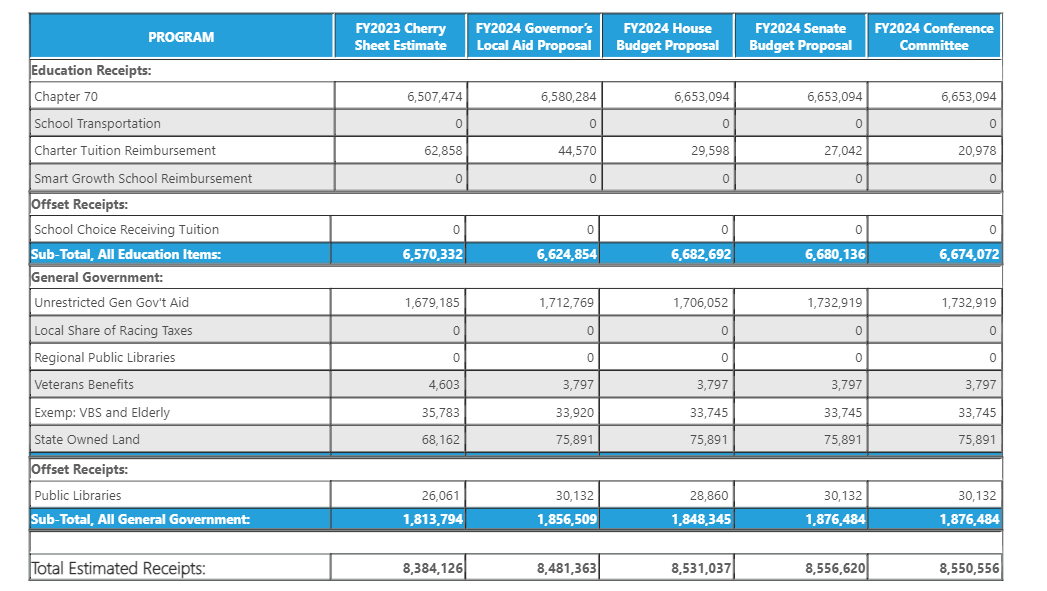
State aid to Medfield up $166K (2%)

The state budget was finally agreed upon by the legislature this week (a month into the fiscal year and long after the town had to set its own budgets at the annual town meeting (ATM) at the beginning of May).

The following are the Town of Medfield state aid amounts for FY24 that were just released – our state aid is $8,550,556, up $166,430 over FY23 (the last fiscal year):

Senate adds about $20K to Medfield’s state budget $

Received today from Division of Local Services (DLS) at Massachusetts Department of Revenue. The Senate Ways and Means Committee added about $20K to the Governor and House budget version for Medfield (copy attached below) –

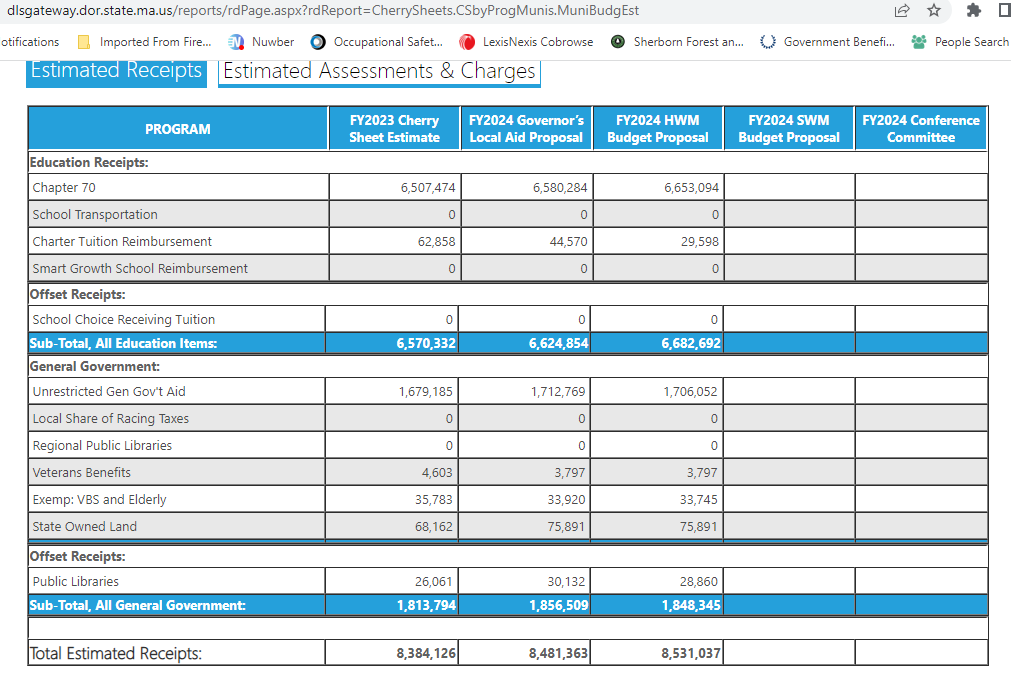
Initial Cherry Sheet estimates have our state $ up about $147K

From Division of Local Services (DLS) –

FY2024 Preliminary Cherry Sheet Estimates 

On Wednesday April 12th the House Ways & Means Committee (HWM) released their version of the FY2024 budget proposal. The Division has posted updated preliminary cherry sheets on the DLS website.  

Click here for Preliminary Municipal Cherry Sheet Estimates or here for Preliminary Regional Cherry Sheet Estimates. Cherry sheet estimates for charter school tuition and reimbursements are based on estimated tuition rates and projected enrollments under charters previously issued by the Board of Elementary and Secondary Education. Please be advised that charter school assessments and reimbursements will change as updated tuition rates and enrollments become available. Estimates for the school choice assessments may also change significantly when updated to reflect final tuition rates and enrollments. It is important for local officials to remember that these estimates are preliminary and are subject to change as the legislative process unfolds. If you have any questions about the preliminary estimates, please contact the Data Analytics and Resources Bureau at databank@dor.state.ma.us.

Town of Medfield

State again extends, instead of enacting, remote and hybrid meeting

From the Massachusetts Municipal Association –

View this email in your browser  


Breaking News from the MMA


Gov. signs supplemental budget with pandemic-era extensions, key investments

Gov. Maura Healey this afternoon signed a supplemental 2023 budget bill that includes a majority of her proposed “immediate needs” bond bill as well as extensions of pandemic-related authorizations related to public meetings and outdoor dining.

The final compromise bill was enacted by the House and Senate on March 23.

The new law extends to pandemic-related authorizations that were set to expire on March 31 and April 1, thereby:
• Allowing remote and hybrid meeting options for public bodies through March 31, 2025
• Allowing remote and hybrid participation options for representative town meetings through March 31, 2025
• Permitting reduced quorums for open town meetings through March 31, 2025
• Extending the expedited outdoor dining permit process and allowing restaurants to offer to-go cocktails through April 1, 2024

Twitter Facebook Website    

Copyright © 2023 Massachusetts Municipal Association, All rights reserved.
You are receiving this email because you opted in via our website.

Our mailing address is: Massachusetts Municipal Association 3 Center Plaza Suite 610 Boston, MA 02108
Add us to your address book

Want to change how you receive these emails?
You can update your preferences or unsubscribe from this list.

State budget writers announce consensus revenue growth forecast of 1.6% for FY24

From the Massachusetts Municipal Association. NB, the state budget process will likely be slower to unfold this year due to the gubernatorial change –

View this email in your browser  

Breaking News from the MMA


State budget writers announce consensus revenue growth forecast of 1.6% for FY24

The state’s budget writers announced yesterday that state tax collections are expected to grow by 1.6% in fiscal 2024 over a recently adjusted projection for fiscal 2023 revenue.

Administration and Finance Secretary Matthew Gorzkowicz, Senate Ways and Means Chair Michael Rodrigues and House Ways and Means Chair Aaron Michlewitz announced a consensus state tax revenue forecast of $40.41 billion for the fiscal year that will begin on July 1.

The increase does not include an additional $1 billion in projected revenue from the state’s new surtax on annual incomes over $1 million, which was adopted by voters in November. Dispensing funds generated from the surtax will be subject to appropriation, but the ballot measure stipulated that funds must be spent only in areas of transportation and education. Including the surtax, estimated revenue would increase the total budget projection for fiscal 2024 by 4.1% over the adjusted fiscal 2023 revenue estimate.

Twitter Facebook Website    

Copyright © 2023 Massachusetts Municipal Association, All rights reserved.

You are receiving this email because you opted in via our website.

Our mailing address is: Massachusetts Municipal Association 3 Center Plaza Suite 610 Boston, MA 02108
Add us to your address book

Want to change how you receive these emails?
You can update your preferences or unsubscribe from this list.

AG Approved the SBC Bylaw

Email from the Town Administrator, Kristine Trierweiler this afternoon –

Atty Gen Approved the SBC Bylaw –


THE COMMONWEALTH OF MASSACHUSETTS
OFFICE OF THE ATTORNEY GENERAL
CENTRAL MASSACHUSETTS DIVISION
10 MECHANIC STREET, SUITE 301
WORCESTER, MA 01608
(508) 792-7600
(508) 795-1991 fax
www.mass.gov/ago
October 13, 2022
Marion Bonoldi, Town Clerk
Town of Medfield
459 Main Street
Medfield, MA 02052
Re: Medfield Annual Town Meeting of May 2, 2022 -- Case # 10545
Warrant Articles # 16 and 17 (Zoning)
Warrant Articles # 14 and 20 (General)
Dear Ms. Bonoldi:
Article 14 - We approve Article 14 from the May 2, 2022 Medfield Annual Town
Meeting.
Article 16 - We will issue our decision on Article 16 on or before our deadline of
November 16, 2022 (extended deadline by agreement with Town Counsel as authorized by G.L.
c. 40, § 32).1
Note: Pursuant to G.L. c. 40, § 32, neither general nor zoning by-laws take effect unless the Town
has first satisfied the posting/publishing requirements of that statute. Once this statutory
duty is fulfilled, (1) general by-laws and amendments take effect on the date these posting
and publishing requirements are satisfied unless a later effective date is prescribed in the
by-law, and (2) zoning by-laws and amendments are deemed to have taken effect from the
date they were approved by the Town Meeting, unless a later effective date is prescribed in
the by-law.
Very truly yours,
MAURA HEALEY
ATTORNEY GENERAL
Nicole B. Caprioli
By: Nicole B. Caprioli
Assistant Attorney General
Municipal Law Unit
10 Mechanic Street, Suite 301
Worcester, MA 01608
cc: Town Counsel Mark Cerel
1
In a decision issued October 1, 2022, we approved Articles 17 and 20.Town Administrator, Kristine Trierweiler

State 62F tax refunds likely to be proportional to what you paid in

From the State House News Service today –


Budget Chief: Tax Relief Expected In “Proportion Paid In”
Heffernan Says Relief Timeline Is “As Quickly As Possible”


Chris Lisinski
9/14/22 10:58 AM

SEPT. 14, 2022…..Massachusetts taxpayers struggling with sky-high inflation should expect to get their chunk of a nearly $3 billion state surplus pot “in the proportion that they paid in,” a top Baker administration official said Tuesday.

However, details about when and how money will flow back to Bay Staters remain unclear one week before the Sept. 20 deadline for Auditor Suzanne Bump to certify the Baker administration’s estimate of $2.94 billion in excess tax revenue that must be returned under the 1986 voter-approved law known as Chapter 62F.

Addressing municipal officials at a meeting, Administration and Finance Secretary Michael Heffernan did not shed any light Tuesday on whether the relief would take the form of credits, rebates or something else.

Drought now Level 3-Critical – We are told to stop watering!

From: Burney, Danielle (EEA)
Sent: Tuesday, August 9, 2022 3:03 PM
Subject: FOR IMMEDIATE RELEASE: Drought Conditions Worsen in CT River Valley, Southeast, and Cape Cod Regions

Drought Conditions Worsen in CT River Valley, Southeast, and Cape Cod Regions

Public is Asked to Continue to Practice Water Conservation Methods

BOSTON —  Energy and Environmental Affairs (EEA) Secretary Beth Card today declared the Connecticut River Valley and Southeast Regions will join the Northeast and Central Regions as a Level 3-Critical Drought. The Cape Cod Region will elevate to a Level 2-Significant Drought, and the Islands and Western Regions will remain at a Level 1-Mild Drought. As outlined in the Massachusetts Drought Management Plan, a Level-3 Critical Drought and a Level 2-Significant Drought calls for the convening of an inter-agency Mission Group, which has already began to meet, to more closely coordinate on drought assessments, impacts, and response within the government. Additionally, a Level 1-Mild Drought recommends detailed monitoring of drought conditions, close coordination among state and federal agencies, and technical outreach and assistance to the affected municipalities.

“With the majority of the state now experiencing a Level-3-Critical Drought, it is incredibly important that we all practice water conservation and adhere to local requirements and recommendations in order avoid over stressing our water resources,” said Energy and Environmental Affairs Secretary Beth Card. “Efforts to minimize water usage now will help our water systems to rebound more quickly, and ensure that essential public health, safety and environmental needs continue to be met.”

“The continued dry, hot weather has increased drought-related hazards for much of Massachusetts including the risk for fires,” said Massachusetts Emergency Management Agency (MEMA) Acting Director Dawn Brantley. “We need the public to be especially careful during this time by adhering to local water use restrictions, and exercising caution around any outdoor activities that increase the risk of brush and forest fires such as barbecues, campfires, and safe disposal of smoking materials.”

The month of July 2022 experienced minimal precipitation and high temperatures throughout the state. Rainfall was the lowest across eastern Massachusetts, particularly within Cape Cod and Martha’s Vineyard reporting less than an inch of rain, less than 50% of normal precipitation. Within eastern Massachusetts, rainfall totals ranked within the top 15 driest Julys on record with Boston and the Blue Hills experiencing the 4th driest. However, slightly higher rainfall totals occurred across much of central and western Massachusetts, ranging from 50 to 100 percent of normal, as well as on Nantucket. Totals ranged mostly between two and four inches, while some locations in the Springfield area and southern Berkshire County experienced higher totals of four to five inches.

Additionally, the Commonwealth is also experiencing decreasing levels in some reservoirs, dry streambeds, ponding, and diminished extent of streams in many watersheds leading to lack of flow, increased turbidity, higher water temperature, and increase in growth of plants and algae in the water. Groundwater, which is a slow reacting index, is starting to be impacted in many regions. Caution is also advised as fire activity has increased across the state as drought conditions have set in, and wildfires in remote areas with delayed response are now burning deep into the organic soil layers. Drought induced fire behavior can result in suppression challenges for fire resources and result in extended incidents so residents are asked to exercise caution while working with open flames, and to completely drown all campfires out cold.

The agricultural sector continues to also experience drought impacts, such as some depletion of water sources, and production acreage and are irrigating crops on a more consistent basis due to current precipitation deficits, high temperatures, and low soil moisture. Consumers are encouraged to purchase fresh fruits, vegetables, and other products at local farm stands and retail stores throughout the Commonwealth.

The Massachusetts Water Resources Authority (MWRA) water supply system is not experiencing drought conditions, as defined within its individual plan. Private wells, local streams, wetlands, vernal pools, and other water-dependent habitats located within MWRA-serviced areas are being impacted by drought conditions while water quality in ponds can deteriorate due to lowering of levels and stagnation.

Below are recommendations for communities and individuals living and working within a Level 3 – Critical Drought, Level 2 – Significant Drought and Level 1 – Mild Drought region, including those utilizing a private well. Residents and businesses are also asked to check with their local water system in case more stringent watering restrictions are in place.

For Regions in Level 3 – Critical Drought

Residents and Businesses:

  • Minimize overall water use.
  • Stop all non-essential outdoor watering.


Immediate Steps for Communities:

  • Adopt and implement the state’s nonessential outdoor water use restrictions for drought; Level 3 restriction calls for a ban on all nonessential outdoor water use.
  • Provide timely information on the drought and on water conservation tips to local residents and businesses.
  • Enforce water use restrictions with increasingly stringent penalties.
  • Strongly discourage or prohibit installation of new sod, seeding, and/or landscaping; washing of hard surfaces (sidewalks, patios, driveways, siding); personal vehicle or boat washing; filling of swimming pools.
  • Establish or enhance water-use reduction targets for all water users and identify top water users and conduct targeted outreach to help curb their use.

Short- and Medium-Term Steps for Communities:

  • Establish a year-round water conservation program that includes public education and communication.
  • Implement or establish drought surcharge or seasonal water rates.
  • Prepare to activate emergency inter-connections for water supply.
  • Develop or refine your local drought management plan using guidance outlined in the state Drought Management Plan.

For Regions in Level 2 – Significant Drought

Residents and Businesses:

  • Minimize overall water use;
  • Limit outdoor watering to hand-held hoses or watering cans, to be used only after 5 p.m. or before 9 a.m.
  • Follow local water use restrictions, if more stringent.

Immediate Steps for Communities:

  • Adopt and implement the state’s nonessential outdoor water use restrictions for drought; Level 2 restriction calls for limiting outdoor watering to hand-held hoses or watering cans, to be used only after 5 p.m. or before 9 a.m. If local restrictions are more stringent, continue to keep them in place during the course of the drought.
  • Limit or prohibit installation of new sod, seeding, and/or landscaping; watering during or within 48 hours after measurable rainfall; washing of hard surfaces (sidewalks, patios, driveways, siding); personal vehicle or boat washing; filling of swimming pools.
  • Establish water-use reduction targets for all water users and identify top water users and conduct targeted outreach to help curb their use.

Short- and Medium-Term Steps for Communities:

  • Establish a year-round water conservation program that includes public education and communication.
  • Provide timely information to local residents and businesses.
  • Implement or establish drought surcharge or seasonal water rates.
  • Check emergency inter-connections for water supply.
  • Develop or refine your local drought management plan using guidance outlined in the state Drought Management Plan.

For Regions in Level 1 – Mild Drought

Residents and Businesses:

  • Toilets, faucets and showers are more than 60% of indoor use.  Make sure yours are WaterSense efficient.
  • Limit outdoor watering to one day a week (only from 5:00 pm – 9:00 am), or less frequently if required by your water supplier

Immediate Steps for Communities:

  • Adopt and implement the state’s nonessential outdoor water use restrictions for drought.
  • Limit or prohibit installation of new sod, seeding, and/or landscaping; watering during or within 48 hours after measurable rainfall; washing of hard surfaces (sidewalks, patios, driveways, siding); personal vehicle or boat washing; filling of swimming pools.
  • Establish water-use reduction targets for all water users and identify top water users and conduct targeted outreach to help curb their use.
     

Short- and Medium-Term Steps for Communities:

  • Establish a year-round water conservation program that includes public education and communication.
  • Provide timely information to local residents and businesses.
  • Implement or establish drought surcharge or seasonal water rates.
  • Check emergency inter-connections for water supply.
  • Develop a local drought management plan using guidance outlined in the state Drought Management Plan.

Practicing water conservation now will greatly help reduce water use to ensure essential needs, such as drinking water and fire protection, are being met, habitats have enough water to support their natural functions, and to sustain the Commonwealth’s water supplies in the long-term. State agencies will continue to monitor and assess current conditions and any associated environmental and agricultural impacts, coordinate any needed dissemination of information to the public, and help state, federal and local agencies prepare additional responses that may be needed in the future. Furthermore, the Massachusetts Department of Environmental Protection (MassDEP) will continue to provide technical assistance to communities on managing systems, including emergency connections and water supplies assistance.

“Under current drought conditions, it is critically important that all residents heed their water suppliers’ requests to cut back on nonessential water use,” said MassDEP Commissioner Martin Suuberg. “Cutting back on outdoor water use and following local conservation requirements will help sustain our water sources until precipitation rates can rebound.”

The Drought Management Task Force will meet again on Tuesday, August 23, 2022, at 10:00AM. For further information on water conservation and what residents can do, please visit EEA’s drought page and water conservation page. To get the most up-to-date information on the drought indices, go to the state’s drought dashboard page.