Category Archives: People

Ken & Bob retire – 104 years of service

Today is Robert Kennedy, Sr. Day in the Town of Medfield, honoring 64 years of service to the town through its DPW.  Tomorrow is Kenneth Feeney Day, honoring 40 years of service to the town through its DPW, most as Supeintendent – Medfield’s longest serving Superintendent by more than ten years over Billy McCarthy.

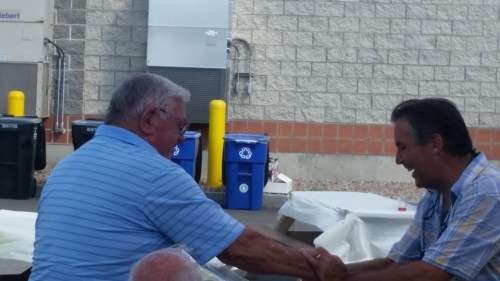
This afternoon at the DPW Garage both Ken and Bob were celebrated by a retirement party with a BBQ provided by Medfield’s own Kent Summers and his partner in MOAB.  Ken and Bob received citations from the Board of Selectmen, plaques, miniature models of the Medfield town clocks made by Electric Time, flowers for their wives, a mystery present from the Transfer Station & Recycling Committee,  and Bobby Junior arranged for his Dad to receive the 1946 Chevy pickup, pictured below, because Bobby Senior reportedly joked that was all the DPW had for equipment when he started work for them in 1952.

Ken & Bob retire-20160804Ken & Bob retire-20160804-21946 Chevy pickup

Personnel changes

Maurice Goulet

Maurice Goulet is new DPW Director

Mo Goulet takes over the Medfield DPW starting August 1.  Mo has been with the Town of Easton’s DPW since 1995, and its Operations Manager since 2006.  For the ten years before the Easton DPW, he ran his own surveying and drafting business in Franklin, and prior to that he worked for fifteen years at Trucchi’s Supermarkets in Taunton.  He obtained a BS from Bridgewater State University in 2003, and is a long term resident of Franklin, where he has had many coaching and volunteer involvements.

A Century of Service to Medfield Ends

Ken Feeney

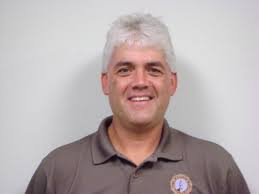
Ken Feeney already retired after almost 38 years with the DPW, most recently as the Town’s long serving Superintendent.  Since March Ken has been working 25 hours a week to bridge over to the new Director starting.

Robert Kennedy, Sr.

Mr. Kennedy will be retiring from a 62 year career with the Medfield DPW this summer.  He is one of the longest serving municipal employees in all of Norfolk County.  Between these two DPW employees the town is losing almost a century of experience.

Justin Hinkley

Mr. Hinkley was a mechanic for the DPW for 6 years, and left July 1 for a job at Caterpillar and to be closer to his daughter.

Alan Peterson

Alan Peterson is leaving his Facilities Manager position with the schools.  Alan also served as an active member of the Medfield Energy Committee, as well as serving on  his own hometown’s energy committee in Pembroke.

Andrew Seaman

Andrew Seaman is leaving his relatively new position as the town’s Energy Manager, to follow his wife and new daughter, Emily, to new adventures in Philadelphia, where Andrew’s doctor wife has employment with the University of Pennsylvania.

My Dad

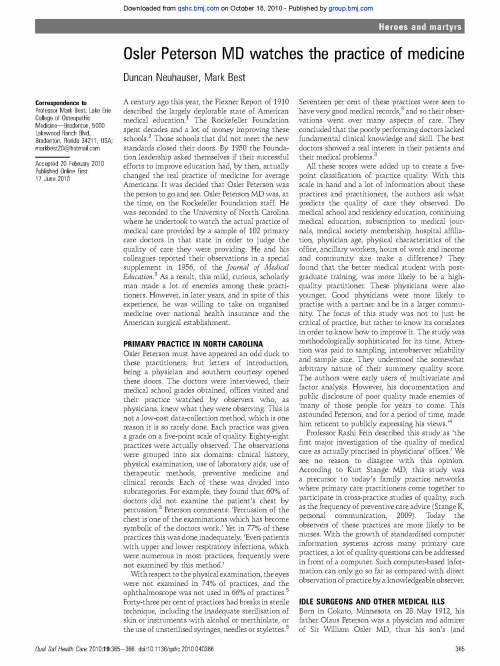
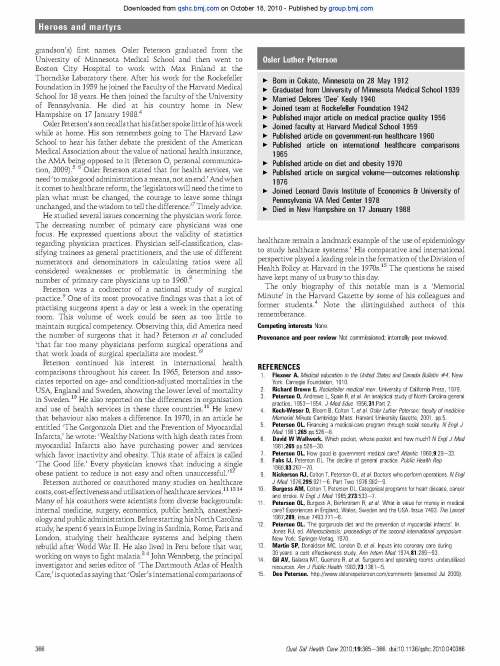
Below is a really nice article about my father that I came across today, which was written more than twenty years after his death by a couple of his colleagues (students I think).  I especially like that it appeared in a section called “Heroes and martyrs,” as he is a hero to me too.

Osler Peterson MD watches the practice of medicine 20100617_Page_1Osler Peterson MD watches the practice of medicine 20100617_Page_2doi: 10.1136/qshc.2010.040386 2010 Qual Saf Health Care 2010 19: 365-366 originally published online June 17, Duncan Neuhauser and Mark Best medicine Osler Peterson MD watches the practice of http://qshc.bmj.com/content/19/4/365.full.html Updated information and services can be found at: These include: References http://qshc.bmj.com/content/19/4/365.full.html#ref-list-1 This article cites 9 articles, 2 of which can be accessed free at: service Email alerting box at the top right corner of the online article. Receive free email alerts when new articles cite this article. Sign up in the Notes http://group.bmj.com/group/rights-licensing/permissions To request permissions go to: http://journals.bmj.com/cgi/reprintform To order reprints go to: http://journals.bmj.com/cgi/ep To subscribe to BMJ go to: Downloaded from qshc.bmj.com on October 18, 2010 - Published by group.bmj.com Osler Peterson MD watches the practice of medicine Duncan Neuhauser, Mark Best A century ago this year, the Flexner Report of 1910 described the largely deplorable state of American medical education.1 The Rockefeller Foundation spent decades and a lot of money improving these schools.2 Those schools that did not meet the new standards closed their doors. By 1950 the Foundation leadership asked themselves if their successful efforts to improve education had, by then, actually changed the real practice of medicine for average Americans. It was decided that Osler Peterson was the person to go and see. Osler Peterson MD was, at the time, on the Rockefeller Foundation staff. He was seconded to the University of North Carolina where he undertook to watch the actual practice of medical care provided by a sample of 102 primary care doctors in that state in order to judge the quality of care they were providing. He and his colleagues reported their observations in a special supplement in 1956, of the Journal of Medical Education.3 As a result, this mild, curious, scholarly man made a lot of enemies among these practitioners. However, in later years, and in spite of this experience, he was willing to take on organised medicine over national health insurance and the American surgical establishment. PRIMARY PRACTICE IN NORTH CAROLINA Osler Peterson must have appeared an odd duck to these practitioners, but letters of introduction, being a physician and southern courtesy opened these doors. The doctors were interviewed, their medical school grades obtained, offices visited and their practice watched by observers who, as physicians, knew what they were observing. This is not a low-cost data-collection method, which is one reason it is so rarely done. Each practice was given a grade on a five-point scale of quality. Eighty-eight practices were actually observed. The observations were grouped into six domains: clinical history, physical examination, use of laboratory aids, use of therapeutic methods, preventive medicine and clinical records. Each of these was divided into subcategories. For example, they found that 60% of doctors did not examine the patient’s chest by percussion.3 Peterson comments: ‘Percussion of the chest is one of the examinations which has become symbolic of the doctors work.’ Yet in 77% of these practices this was done inadequately. ‘Even patients with upper and lower respiratory infections, which were numerous in most practices, frequently were not examined by this method.’ With respect to the physical examination, the eyes were not examined in 74% of practices, and the ophthalmoscope was not used in 66% of practices.3 Forty-three per cent of practices had breaks in sterile technique, including the inadequate sterilisation of skin or instruments with alcohol or merthiolate, or the use of unsterilised syringes, needles or stylettes.3 Seventeen per cent of these practices were seen to have very good medical records,3 and so their observations went over many aspects of care. They concluded that the poorly performing doctors lacked fundamental clinical knowledge and skill. The best doctors showed a real interest in their patients and their medical problems.3 All these scores were added up to create a fivepoint classification of practice quality. With this scale in hand and a lot of information about these practices and practitioners, the authors ask what predicts the quality of care they observed. Do medical school and residency education, continuing medical education, subscription to medical journals, medical society membership, hospital affiliation, physician age, physical characteristics of the office, ancillary workers, hours of work and income and community size make a difference? They found that the better medical student with postgraduate training, was more likely to be a highquality practitioner. These physicians were also younger. Good physicians were more likely to practise with a partner and be in a larger community. The focus of this study was not to just be critical of practice, but rather to know its correlates in order to know how to improve it. The study was methodologically sophisticated for its time. Attention was paid to sampling, interobserver reliability and sample size. They understood the somewhat arbitrary nature of their summery quality score. The authors were early users of multivariate and factor analysis. However, his documentation and public disclosure of poor quality made enemies of ‘many of those people for years to come. This astounded Peterson, and for a period of time, made him reticent to publicly expressing his views.’4 Professor Rashi Fein described this study as ‘the first major investigation of the quality of medical care as actually practised in physicians’ offices.’ We see no reason to disagree with this opinion. According to Kurt Stange MD, this study was a precursor to today’s family practice networks where primary care practitioners come together to participate in cross-practice studies of quality, such as the frequency of preventive care advice (Stange K, personal communication, 2009). Today the observers of these practices are more likely to be nurses. With the growth of standardised computer information systems across many primary care practices, a lot of quality questions can be addressed in front of a computer. Such computer-based information can only go so far as compared with direct observation of practice by a knowledgeable observer. IDLE SURGEONS AND OTHER MEDICAL ILLS Born in Cokato, Minnesota on 28 May 1912, his father Olaus Peterson was a physician and admirer of Sir William Osler MD, thus his son’s (and Correspondence to Professor Mark Best, Lake Erie College of Osteopathic MedicinedBradenton, 5000 Lakewood Ranch Blvd, Bradenton, Florida 34211, USA; markbest20@hotmail.com Accepted 20 February 2010 Published Online First 17 June 2010 Qual Saf Health Care 2010;19:365e366. doi:10.1136/qshc.2010.040386 365 Heroes and martyrs Downloaded from qshc.bmj.com on October 18, 2010 - Published by group.bmj.com grandson’s) first names. Osler Peterson graduated from the University of Minnesota Medical School and then went to Boston City Hospital to work with Max Finland at the Thorndike Laboratory there. After his work for the Rockefeller Foundation in 1959 he joined the Faculty of the Harvard Medical School for 18 years. He then joined the faculty of the University of Pennsylvania. He died at his country home in New Hampshire on 17 January 1988.4 Osler Peterson’s son recalls that his father spoke little of hiswork while at home. His son remembers going to The Harvard Law School to hear his father debate the president of the American Medical Association about the value of national health insurance, the AMA being opposed to it (Peterson O, personal communication, 2009).5 6 Osler Peterson stated that for health services, we need ‘tomake goodadministration ameans, not an end.’Andwhen it comes to healthcare reform, the ‘legislators will need the time to plan what must be changed, the courage to leave some things unchanged, and the wisdom to tell the difference.’7 Timely advice. He studied several issues concerning the physician work force. The decreasing number of primary care physicians was one focus. He expressed questions about the validity of statistics regarding physician practices. Physician self-classification, classifying trainees as general practitioners, and the use of different numerators and denominators in calculating ratios were all considered weaknesses or problematic in determining the number of primary care physicians up to 1960.8 Peterson was a codirector of a national study of surgical practice.9 One of its most provocative findings was that a lot of practising surgeons spent a day or less a week in the operating room. This volume of work could be seen as too little to maintain surgical competency. Observing this, did America need the number of surgeons that it had? Peterson et al concluded ‘that far too many physicians perform surgical operations and that work loads of surgical specialists are modest.’9 Peterson continued his interest in international health comparisons throughout his career. In 1965, Peterson and associates reported on age- and condition-adjusted mortalities in the USA, England and Sweden, showing the lower level of mortality in Sweden.10 He also reported on the differences in organisation and use of health services in these three countries.11 He knew that behaviour also makes a difference. In 1970, in an article he entitled ‘The Gorgonzola Diet and the Prevention of Myocardial Infarcts,’ he wrote: ‘Wealthy Nations with high death rates from myocardial Infarcts also have purchasing power and services which favor inactivity and obesity. This state of affairs is called ‘The Good life.’ Every physician knows that inducing a single obese patient to reduce is not easy and often unsuccessful.’12 Peterson authored or coauthored many studies on healthcare costs, cost-effectiveness and utilisation of healthcare services.11 13 14 Many of his coauthors were scientists from diverse backgrounds: internal medicine, surgery, economics, public health, anaesthesiology and public administration. Before starting his North Carolina study, he spent 6 years in Europe living in Sardinia, Rome, Paris and London, studying their healthcare systems and helping them rebuild after World War II. He also lived in Peru before that war, working on ways to fight malaria.3 4 JohnWennberg, the principal investigator and series editor of ‘The Dartmouth Atlas of Health Care,’ is quoted as saying that ‘Osler’s international comparisons of healthcare remain a landmark example of the use of epidemiology to study healthcare systems.’ His comparative and international perspective played a leading role in the formation of the Division of Health Policy at Harvard in the 1970s.15 The questions he raised have kept many of us busy to this day. The only biography of this notable man is a ‘Memorial Minute’ in the Harvard Gazette by some of his colleagues and former students.4 Note the distinguished authors of this rememberance. Competing interests None. Provenance and peer review Not commissioned; internally peer reviewed. REFERENCES 1. Flexner A. Medical education in the United States and Canada Bulletin #4. New York: Carnegie Foundation, 1910. 2. Richard Brown E. Rockefeller medical men. University of California Press, 1979. 3. Peterson O, Andrews L, Spain R, et al. An analytical study of North Carolina general practice, 1953e1954. J Med Educ 1956;31:Part 2. 4. Koch-Weser D, Bloom B, Colton T, et al. Osler Luther Peterson: faculty of medicine Memorial Minute Cambridge Mass: Harvard University Gazette, 2001. pp.5. 5. Peterson OL. Financing a medical-care program through social security. N Engl J Med 1961;265:pp.526e8. 6. David W Wallwork. Which pocket, whose pocket and how much? N Engl J Med 1961;265 pp.528e30. 7. Peterson OL. How good is government medical care? Atlantic 1960;9:29e33. 8. Fahs IJ, Peterson OL. The decline of general practice. Public Health Rep 1968;83:267e70. 9. Nickerson RJ, Colton T, Peterson OL, et al. Doctors who perform operations. N Engl J Med 1976;295:921e6. Part Two 1976:982e9. 10. Burgess AM, Colton T, Peterson OL. Categorical programs for heart disease, cancer and stroke. N Engl J Med 1965;273:533e7. 11. Peterson OL, Burgess A, Berfenstam R, et al. What is value for money in medical care? Experiences in England, Wales, Sweden and the USA. Issue 7493. The Lancet 1967;289, issue 7493:771e6. 12. Peterson OL. ‘The gorgonzola diet and the prevention of myocardial infarcts’. In: Jones RJ, ed. Atherosclerosis: proceedings of the second international symposium. New York: Springer-Verlag, 1970. 13. Martin SP, Donaldson MC, London D, et al. Inputs into coronary care during 30 years: a cost effectiveness study. Ann Intern Med 1974;81:289e93. 14. Gil AV, Galarza MT, Guerrero R, et al. Surgeons and operating rooms: underutilized resources. Am J Public Health 1983;73:1361e5. 15. Dee Peterson. http://www.delorespeterson.com/comments (assessed Jul 2009). Osler Luther Peterson < Born in Cokato, Minnesota on 28 May 1912 < Graduated from University of Minnesota Medical School 1939 < Married Delores ‘Dee’ Kealy 1940 < Joined team at Rockefeller Foundation 1942 < Published major article on medical practice quality 1956 < Joined faculty at Harvard Medical School 1959 < Published article on government-run healthcare 1960 < Published article on international healthcare comparisons 1965 < Published article on diet and obesity 1970 < Published article on surgical volumedoutcomes relationship 1976 < Joined Leonard Davis Institute of Economics & University of Pennsylvania VA Med Center 1978 < Died in New Hampshire on 17 January 1988 366 Qual Saf Health Care 2010;19:365e366. doi:10.1136/qshc.2010.040386 Heroes and martyrs Downloaded from qshc.bmj.com on October 18, 2010 - Published by group.bmj.com

Gold Award & Ambassador Bridging Ceremony

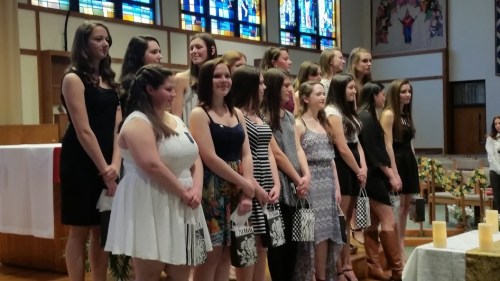
20160319-GS-Gold Awards

At St. Edward’s this afternoon, above are the 17 MHS seniors in Girl Scouts, who as Ambassador Scouts bridged over to Adult Scouts.  7 of them also got Gold Awards.

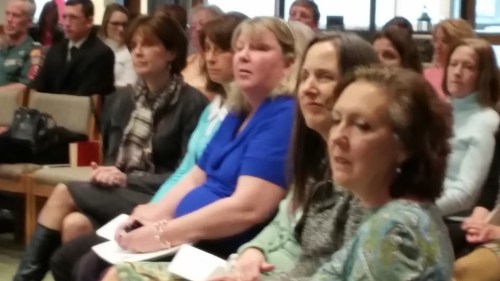
Below are some of the Mom’s of the Gold Award scouts who made it all possible.

20160319GS-Gold Award-Moms

Katherine Steeger and Linda Frawley have been leading a remarkably strong resurgence of Girl Scouting in town for many years,  and both of their daughters were among those being honored.

Gold Award projects were impressive, covering poverty, poetry, bats, bridges, tutoring, and volunteerism.  See the longer descriptions I posted before.

Richard’s book events: 12/10 at 7PM, 12/12 at 10 & 2

Arriving in time for Christmas and the Holidays

The second This Old Town,

by Richard DeSorgher


Richard book cover 2015


Last year the book “This Old Town, Remembering Medfield” was published. It included 74 stories about Medfield; its history and its people, most of which were published first in The Hometown Weekly. This second book “This Old Town, FLeetwood 9” features 63 different stories about Medfield and its people: It includes stories on Medfield’s history, Medfield during time of war, worst Medfield fires and crime in Medfield. It includes sports and school days, the Frances Café, the Manor Inn, Noon Hill, the Norfolk Hunt Club, the State Hospital Cemetery, The KKK in Medfield and the history of all of Medfield’s churches. Chapters on the Palumbos, Dr. Nickerson, the Standleys, Officer Bob Naughton, Roger Hardy, Ken Childs and the indomitable Colonel Mitchell will give one a flavor that is Medfield.

To order your copy(s), please send $15.00 (includes tax) to:

This Old Town

13 Lawrence Circle

Medfield, MA 02052   (make checks out to: This Old Town)


  • Include any requests for personalized signing by author
  • Books available starting December 2, 2015.
  • Free delivery within the town of Medfield; for all mailing, please add $5.00 shipping charge.


A special program about the stories contained within the book will take place on Thursday December 10 at the Memorial Public Library from 7-8 pm, followed by book sale and signing. Additional book signings will be on Saturday December 12 from 10-12 at the Historical Society Building, 6 Pleasant Street and from 2-4 pm at Park Street Books.

MCAP’s new website

MCAP Logo_1C_300

Medfield Cares About Prevention (MCAP) has a brand spanking new website.   Check it out at www.MedfieldCares.org.

  • looks great,
  • works great,
  • great content to help Medfield residents and youth find assistance.

Thanks to Medfield’s own Evan Weisenfeld for the website.

Hunt Club history lecture next Monday

This from Gil Rodgers of the Norfolk Hunt Club –


David Lewis, Jr., ex-MFH, to Speak on the History of the Norfolk Hunt Club

The featured speaker at the Medfield Historical Society meeting on Monday, November 3, 2014 will be David W. Lewis, Jr. , ex-Master of the Fox Hounds (MFH) (1973 – 1980) and member of the Norfolk Hunt Club.   The narrated slide presentation will be held in the basement of First Parish Unitarian Universalist Church, 26 North Street, Medfield beginning at 7:30 PM.

David is the editor of the definitive book on the history of Norfolk Hunt Club, “The Norfolk Hunt: One Hundred Years of Sport,” 1995. He will talk about the history of (drag) fox hunting with the Norfolk Hunt Club since its origins in 1895 interjecting entertaining stories about some of its prominent members — such as Henry Vaughn (MFH) and Miss Amelia Peabody, and notable events of the Club over the last 100 years — such as annual Farmer’s Day celebration and the traditional Thanksgiving Day hunt.

This is an opportunity to learn first-hand about a tradition that is emblematic of the rich and distinctive culture of Medfield, Dover, Sherborn, and surrounding towns.

Ed Hinkley retired

Edward Hinkley was born, raised, and educated in Medfield, and then Ed worked for the DPW, for almost fifty years when he retired last week from his positions as foreman in the Water Department and tree warden.  The DPW held a retirement party for Ed a week ago, at which he collected numerous citations, and a neat looking lamp made out of a water valve with a hard hat for a shade.

I met Ed when as a new selectman he lead the then Board of Selectmen to perambulate the bounds of the town, which turned out to involve visiting the granite markers that delineate the actual town boundaries.  As we left the Town House, Ed first taught me the short cut from the town hall parking lot out to Rte 109, and then amazed me when he lead us to a myriad of granite markers, most standing the the middle of woods.  My immediate reaction at the time was that those markers were so remotely sited that Ed was probably the only person who knew where all those markers were actually located.  At Ed’s retirement party, Selectman DeSorgher mentioned that while walking the Medfield State Hospital grounds with Ed, Ed had told someone to find the water valve they were seeking behind some brush, and sure enough that is where it was.

Ed has a detailed and encyclopedic knowledge of the infrastructure details of the Town of Medfield, and the town will be poorer for his departure.

Town of Medfield owes Ed Hinkley a huge thank you for fifty years of service.  We wish him well on his visit to Yellowstone.

$50K state grant to fund Energy Manager

The letter below from DOER announcing the town’s receipt of a $50,000 state grant to fund a full time Energy Manager for the town starting after 7/1/14 was shared today by the Medfield Energy Committee.  A second year of grant funding is available to the town at a reduced level, and the town then has to take over full payment of the energy manager.

The town administration’s thinking was that the town would be well served to have a facilities professional on board going forward, given how sophisticated the new town buildings have become, and where a big part of that job will be the energy management of those buildings, this grant covers a lot of the start up costs for that new town position. –

EXECUTIVE OFFICE OF
ENERGY AND ENVIRONMENTAL AFFAIRS
DEPARTMENT OF ENERGY RESOURCES
100 CAMBRIDGE ST., SUITE 1020
BOSTON, MA 02114

May 1, 2014

Michael J. Sullivan, Town Administrator
Town of Medfield
459 Main Street
Medfield, MA 2052

Dear Town Administrator Sullivan,

I am pleased to inform you that the Department of Energy Resources (DOER) Green Communities Division has approved an award of $50,000 for a Full-time Energy Manager for the Town of Medfield. Please note that funding is provided for one year beginning in fiscal year 2015. A second year of funding is contingent upon performance in year one. In addition, the Town is committed to providing the cost share specified in its grant application.

In the next few weeks, Paul Carey, Green Communities Grants Coordinator, will follow up with the designated contact listed in your grant application to discuss next steps, including coordination of the grant contract process.

The Green Communities Division looks forward to working with you and your Energy Manager. We congratulate you on this grant award, and applaud your efforts to create a cleaner energy future for your community and the Commonwealth as a whole.

Please do not hesitate to contact me at 617-626-7364 or by email at meg.lusardi@state.ma.us with any questions you may have regarding your grant award.

Sincerely,
Meg Lusardi, Director
Green Communities Division

Cc: Marie Nolan, Member of Energy

New Patch editor

I met the new Medfield.Patch editor, Mary MacDonald, after the Board of Selectmen meeting last night.  From our conversation, I am happy to report that I sensed that she will be a good editor for the Medfield.Patch, as she struck me as being really serious about her role as a journalist.