Category Archives: Marijuana

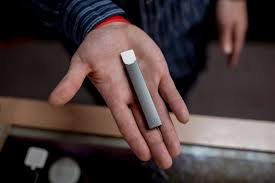
Mass AG investigates vaping company

From my American Association for Justice daily e-newsletter –

juul

Massachusetts AG investigating whether Juul Labs took adequate steps to prevent sales to minors.

Reuters (7/24, Raymond) reports Massachusetts Attorney General Maura Healey said at a press briefing that her office has opened an investigation into Juul Labs Inc. and online retailers Direct Eliquid LLC and Eonsmoke LLC to determine if they broke state law by “failing to prevent minors from buying their products.” The investigation intends to evaluate the effectiveness of Juul underage sales prevention efforts and what it does, “if anything” to stop its products from being sold by online retailers without age verification. The office said it was sending cease-and-desist letters to the online retailers to stop sales of Juul and e-cigarettes to Massachusetts residents “without adequate age verification systems.”

CNBC (7/24, LaVito, 4.81M) reports Healey said, “I want to be clear with the public. This isn’t about getting adults to stop smoking cigarettes. This is about getting kids to start vaping. That’s what these companies are up to. They’re engaged in an effort to get kids addicted, get them hooked so they will have customers for the rest of their lives.” Healey’s office will investigate whether the Massachusetts consumer protection statute or state e-cigarette regulations were violated.

The Hill (7/24, Wheeler, 2.71M) reports Healey “said Tuesday morning her office has sent Juul Labs subpoenas for information.” The Verge (7/24, Becker, 1.55M) reports the investigation is part of “a statewide push to end youth vaping and nicotine addiction.”

Also reporting are the Associated Press (7/24), Boston Globe (7/24, Campbell, 945K), and the Springfield (MA) Republican (7/24, 412K).


MMA on marijuana law problems

MMA-2

MMA letter to governor and legislative leaders calls for changes to recreational marijuana law

Printer-friendly versionSend by email

His Excellency Charles D. Baker
Governor of the Commonwealth
State House, Boston

The Hon. Robert A. DeLeo
Speaker of the House
State House, Boston

The Hon. Stanley C. Rosenberg
Senate President
State House, Boston

Dear Governor Baker, Speaker DeLeo, and President Rosenberg,

With the passage of Question 4, Massachusetts became one of just eight states that have legalized the recreational use of marijuana. Because of our population and our prime location in the center of a compact geographic region, our state will soon become the commercial marijuana industry’s East Coast base. The growing industry will certainly use Massachusetts as the retail platform for Rhode Island, Connecticut, New York, Vermont and New Hampshire.

Cities and towns have a responsibility to ensure that the new law is implemented locally in a manner that protects the public interest, including addressing public health and public safety concerns, and ensuring that the roll-out does not negatively impact residents, other businesses, neighborhoods, economic development plans, or other important considerations. As such, municipal officials are scrambling to get information and plan their own policy responses. This will be very difficult in the short term, as there are many unanswered questions and many significant flaws in the new law.

It is important to recognize that Question 4 prevailed and the issue of whether to legalize the recreational use of marijuana has been settled. Yet it is also clear that the new law has several significant drafting flaws that require fixing in order to prevent negative outcomes. Just as the Legislature and governor acted in 1981 to amend Proposition 2½ to make it workable, we believe it is both appropriate and necessary for state lawmakers to take action to address the shortcomings in Question 4. Doing so would benefit the public interest and every community.

While there are many smaller details that warrant attention, the major problems that must be fixed are: 1) deadlines that are too short to give state and local officials enough time to prepare for and administer the law; 2) the preemption and loss of local control; 3) the unregulated “home grow” provisions that could foster a new black market for marijuana sales; and 4) the inadequate tax revenues written into the statute.

An Unrealistic Timeline
Question 4 sets an unrealistic deadline, instructing the state to construct the entire regulatory framework for the commercial marijuana industry by January 1, 2018. That is too little time to recruit and appoint a first-ever, three-person Cannabis Control Commission (CCC) and give the rookie commissioners the time to build a brand-new state agency, recruit and hire agency staff, draft initial versions of all regulations, solicit input from all stakeholders, promulgate final regulations, and provide enough lead-time for a rational roll-out that protects the public interest. If the state fails to meet the January 1 deadline, the industry has written Question 4 in such a way that the commercial industry would arise in a mostly unregulated environment, because medical marijuana operators would automatically be licensed as commercial agents for recreational marijuana, giving them a near-monopoly in the marketplace.

We respectfully ask you to act swiftly to extend these deadlines and give the state and municipalities more time to get the regulatory framework in place and adopt reasonable rules to govern this new commercial industry.

In the meantime, we request passage of statutory authority to allow cities and towns to enact a moratorium on new commercial marijuana facilities until the Cannabis Control Commission has promulgated regulations governing the industry. Because the deadline for regulations comes after the CCC is instructed to begin processing applications and licenses for commercial facilities, local governments will begin to see applications for commercial facilities before they know the full extent of the regulations under which those facilities will be operating.

Unwise Preemption of Local Control
A second major concern is the preemption of local control. The new law prevents cities and towns from making local decisions on whether to allow commercial retail sales in their municipalities. Here it is clear that the marijuana industry lobbyists learned a lesson from Colorado, the first state to legalize recreational use. The Colorado law allows local governing bodies to ban retail sales in their communities – and 70 percent of their cities and towns have enacted such a ban. Question 4 makes it impossible for selectmen, mayors, councils or town meetings to make this decision. Instead, communities are only allowed to enact a ban if 10 percent of local residents who voted in the last state election sign a petition to place a question on the ballot, and voters approve the question at a state general election in 2018 or later. This means the earliest that communities can even consider a ban will be nearly a year after commercial sales become legal – it is hard to imagine that this industry-friendly loophole was unintentional.

Further, Question 4 includes language that would allow the CCC to preempt or disallow any local zoning rule, ordinance or regulation that is inconsistent with their wishes – a concern made even more serious because the “advisory board” in the law is actually a pro-industry panel dominated by commercial marijuana interests.

We respectfully ask you to act swiftly to restore decision-making authority to municipal governing bodies on the question of commercial bans, and clarify that the CCC cannot override local zoning decisions and ordinances on the location and operation of locally permitted commercial facilities, including recreational marijuana. The broad preemption language must be eliminated.

An Unregulated Non-Commercial Market
Starting on December 15, the home cultivation of marijuana will be allowed through a totally unregulated “home grow” provision, which will allow individuals to cultivate up to 12 plants at any one time. Calculating the street value, that’s $60,000 worth of marijuana, and based on reasonable processing estimates, the 12 plants could yield approximately 12,000 joints, or thousands of “servings” of marijuana-infused edibles.

Local and state law enforcement officials are gravely concerned about the home grow language in the new law. The sheer volume of home grown marijuana will certainly incentivize a burgeoning black market that will hit the street at least a year before official, regulated commercial sales become lawful, creating a source of sales that could easily reach school-aged children and teenagers.

We respectfully ask you to delay the home grow provisions, and develop a structure to appropriately regulate and monitor this activity to safeguard public safety and health, and protect neighborhoods, residents and youth.

Inadequate Revenues
Another major concern is the rock-bottom excise revenue that would be generated by Question 4, where it is again clear that the marijuana industry learned a lesson from earlier experiences in Colorado and Washington state. In addition to state sales taxes, the Colorado law imposes a 25 percent tax on marijuana, and cities and towns can enact their own local sales taxes of up to 8 percent. The state of Washington imposes a 37 percent excise tax, and cities and towns can collect their own local sales tax of up to 3.4 percent.

Here in Massachusetts, the commercial interests behind Question 4 set the state marijuana excise tax at just 3.75 percent, and capped the local-option marijuana excise tax at only 2 percent. These would be the lowest rates in the nation.

Given the significant new burden of regulating and monitoring a new commercial industry (which will deal in a controlled substance that is still illegal under federal law), the state and local revenue rates are unreasonably low and damaging to public budgets. The state excise will clearly fall short, and we urge you to increase the state tax so that, at a minimum, resources will be available to provide statewide training of police officers and fund the CCC and other state agency needs. Further, cities and towns will have new responsibilities in areas of public safety, public health, zoning, permitting and licensing. At 2 percent, the local revenue in Question 4 will fall far short of local needs.

We respectfully ask you to increase the allowable state and local tax rates to bring them in line with Colorado and Washington and other “first-wave” legalization states. We recommend that cities and towns be authorized to implement, on a local-option basis, an excise of between 2 to 6 percent, to be determined by vote of the local governing body.

An Independent Advisory Board is Necessary
We urge you to improve the makeup of the Cannabis Advisory Board to make it a truly independent entity, instead of the industry-dominated panel that it is under Question 4. It is striking that the ballot question was written to give commercial marijuana interests control of a board that will be so heavily involved in regulating the industry. We respectfully ask that a municipal representative be added to the board, as well as a representative from municipal police chiefs and a seat representing local boards of health. We believe the addition of these perspectives is vital to ensure that local public safety and health concerns are considered when crafting the regulations.

Summary
Cities and towns have a responsibility to implement the new law in a manner that protects the public interest, yet communities will not be able to fulfill this responsibility unless the significant flaws detailed in this letter are addressed. Just as the Legislature and governor acted in 1981 to amend Proposition 2½ to make it workable, we respectfully ask the Commonwealth to take action to address the shortcomings in Question 4. Doing so would benefit the public interest and every community.
Thank you very much for your consideration. If you have any questions or wish to receive additional information, please do not hesitate to have your offices contact me or MMA Legislative Director John Robertson at (617) 426-7272 at any time.

Sincerely,

Geoffrey C. Beckwith
MMA Executive Director & CEO

MCAP’s parent info night

The Medfield Press reports on the Medfield Cares About Prevention (MCAP) (www.MedfieldCares.org) parent information evening at Medfield High Schoola week ago.  Be a Parent Not a Pal

For me the major take away facts I have learned at MCAP are

  • how much more likely our kids are to have later in life substance abuse problems, the younger they are when they start to use alcohol or marijuana, and
  • that human brain development is not completed until the mid-twenties, and both alcohol and marijuana use can have disproportionately detrimental effects on those not fully formed brains.

ATM warrant articles

The town is in the process of getting the warrant articles prepared for the annual town meeting (ATM) on April 28.  Click here for the attached is the current iteration of the warrant articles for the ATM.   Some of the articles –

  • authorize leasing the Holmquist land for farming
  • funds to complete the design and pricing of the new public safety building
  •   funds to build the new water tower at the former Medfield State Hospital site
  • whether to regulate public consumption of marijuana
  • whether to use lot 3 on Ice House Road for fields by Medfield Park & Recreation Commission or to lease to a private party to build a Forekicks type facility (Council on Aging has also expressed interest in having housing for 55+ individuals build there as well)
  • whether to fund the Medfield Cultural Council with $4,250 (matching its state grant monies)
  • create a solar photovoltaic zoning district in the existing Industrial Extensive district
  • whether to adopt the stretch building code, so as to allow Medfield to become a Green Community (and get a grant of $148,000)
  • whether to accept a gift of land that would allow for a path from Wild Holly Lane to the Holquist land and Wheelock School
  • whether to adopt the local option meals tax of 0.75%, in order to provide property tax relief

Please also schedule the special town meeting (STM) on March 10 on your calendar, at which time the town will be asked to make the biggest decision of its history, whether to buy the Medfield State Hospital site for the $3.1 m. price the state has offered it.

Marijuana dispensary downtown

A group is looking to site a marijuana dispensary in the downtown, at the former Strata Bank site.  The annual town meeting (ATM) last year only zoned the Industrial Extensive (IE) areas of town for such marijuana dispensaries.  The IE districts are all located around the intersection of Rte 27 and West Street (NB – I originally mistakenly put in the intersection of Rtes 109 & 27 – sorry).

Medical marijuana was a topic covered at the Massachusetts Municipal Association fall meeting for selectmen that I attended last Saturday.  In the status update remarks by the MMA’s executive director, Geoff Beckwith, he said that – –

  1. the Massachusetts Municipal Association was instrumental in getting the Board of Selectmen  instead of the Board of Health to be the responsible municipal entity who would weigh in on proposed locations to the state Department of Public Health, and
  2. the Board of Selectmen support and/or non-opposition is an important enough factor to the state Department of Public Health, so the Board of Selectmen can use that support and/or non-opposition to achieve concessions from the proponents.
  3. the Massachusetts Municipal Association has a point person we can contact for assistance on dealing with with marijuana dispensaries.

Lead poisoning & marijuana – similar drops in IQ

Chris Thurstone, M.D. is a Colorado child psychiatrist who studies adolescent addiction and writes about the problems he witnesses of our youth using marijuana.  In a recent article, he notes the similar 8 point decline in children’s IQ that has been documented for both lead exposure and marijuana use by youth, and our society’s quite different response to the two causes

See Dr. Thurstone’scomments

About Dr. Thurstone (from his website) –

Dr. Christian Thurstone is one of fewer than three dozen physicians in the United States who are board certified in general, child and adolescent and addictions psychiatry. He is medical director of one of Colorado’s largest youth substance-abuse-treatment clinics and an associate professor of psychiatry at the University of Colorado Denver, where he conducts research on youth substance use and addiction. Dr. Thurstone has completed medical training at the University of Chicago, Northwestern University and UCD. In 2010, he completed five years of mentored research training through the National Institute on Drug Abuse/American Academy of Child and Adolescent Psychiatry K12 Research Program in Substance Abuse.

Marijuana to West Street

Attorneys have inquired of Town of Medfield officials about their clients’ plans to open a marijuana cultivation facility at 99 West Street.  From the attorney’s email to the town official –

“As of now their plan is to put a cultivation center only at that location.

“There would be no signage and the outside of the building would look almost identical to its existing face.  Our clients are well funded Mass. residents that run multi-million dollar private equity firms.”

Marijuana use by kids probs

Three bullet points about problems related to marijuana use by our adolescents, from email from SAM – www.learnaboutsam.org.
Prevention of Substance Abuse and Mental Illness
Key Facts:

* By 2020, mental and substance use disorders will surpass all physical diseases as a  major cause of disability worldwide
— presentation: “Current and Future Directions for Prevention in Higher Education”, SAMHSA, CADCA’s Mid-Year Training Institute, July 22, 2013.  Richard Lucey, Jr., Special Assistant to the Director, SAMHSA’s  Center for Substance Abuse Prevention. 

* Marijuana Use Disorder is on the rise – one in six adolescents who have ever used it experiences marijuana dependency or addiction.
— Anthony, D.C., Warner, L.A., Kessler, R.C. (1994). Comparative epidemiology of dependance on tabacco, alcohol, controlled substances, and inhalants:  Basic findings from the National Comorbidity Survey.  Experiential and Clinical Psycho-pharmacology, 2. 244.

Surveys of drug-treament centers now find that more youth are in treatment for marijuana abuse or dependence than for the use of alcohol and all other drugs combined.
— SAMHSA, Office of Applied Studies. (2009) Treatment episode data set (TEDS): 2009 discharges from substance abuse treatment services, DASIS. 

SAM Massachusetts launched

From SAM Massachusetts –

PATRICK KENNEDY’S ‘PROJECT SAM’ LAUNCHES IN MASSACHUSETTS TO EDUCATE AND RAISE AWARENESS ON MARIJUANA ISSUES

BOSTON– Project SAM (Smart Approaches to Marijuana) has come to Massachusetts as part of its new national dialogue on policy issues related to marijuana use and legalization. The organization is launching a statewide affiliate, SAM Massachusetts, a project of the Massachusetts Prevention Alliance (MAPA), to facilitate a discussion on marijuana use, the potential impact it has on health, and policy solutions that will protect the welfare of all people, families and children.

“Misconceptions about marijuana are becoming more and more prevalent, especially in Massachusetts, a state with some of the highest levels of youth marijuana use in the nation” said former U.S. Congressman Patrick Kennedy, Project SAM chairman. “It’s time to clear the smoke and get the facts out about this drug.”

“We are thrilled to launch Project SAM,” said Heidi Heilman, coordinator of SAM Massachusetts and president of MAPA.“This is not about demonizing or legalizing marijuana, but rather educating the public about the most misunderstood drug in the country and the industry promoting it.”

Project SAM, has four main goals:

• To inform public policy with the science of today’s marijuana.

• To prevent the establishment of “Big Marijuana” — and a 21st-Century tobacco industry that would market marijuana to children.

• To promote research of marijuana’s medical properties and produce, non-smoked, non-psychoactive pharmacy-attainable medications.

• To have an adult conversation about reducing the unintended consequences of current marijuana policies, such as lifelong stigma due to arrest.

Kennedy and Heilman said an increase in marijuana use in the Commonwealthwould have major consequences for young people.

In Massachusetts, with the passage of decriminalization in 2008 and medical marijuana in 2012, children think marijuana use is no big deal. And legalization proponents who have their eye on 2016 are capitalizing on that through a well-funded national media and lobbying campaign. Marijuana is the number one drug of abuse among ourkids and the top reason Massachusetts teens are in treatment.

“Massachusetts’ rates of youth marijuana use are significantly higher than in the rest of the country,” Kennedy said. “And fewer kids in Massachusetts think smoking marijuana is harmful compared to the past. I have seen first hand the debilitating effects of marijuana addiction. It’s more than just the addict, it’s the families who suffer too.”

Kennedy said teens who smoke marijuana have a 1 in 6 chance of becoming addicted and have significantly lower levels of IQ later in life.

“We are here to educate,” said Heilman.“Our biggest concern is that the marijuana industry will pursue our children as their next lifelong customer base.  We saw this happened with Big Tobacco.  We don’t want to create a new American Public Health Crisis, and then spend another half century working furiously to repair the damage to American public and mental health. We must pay much closer attention to what the marijuana industry and pro-pot lobby is orchestrating if we want to protect our next generation.”

“We support new legislation that holds the marijuana industry accountable and delivers what Massachusetts’ citizens understood they were voting on last November – compassionate and safe access for profoundly ill people.” Heilman remarked.

About Project SAM

Project SAM is a nonpartisan alliance of lawmakers, scientists and other concerned citizens who want to move beyond simplistic discussions of “incarceration versus legalization” when discussing marijuana use and instead focus on practical changes in marijuana policy that neither demonizes users nor legalizes the drug. Project SAM has taken its initiative to other parts of the United States including Vermont, Hawaii and Colorado. (www.learnaboutsam.org)

SAM on public health problems related to marijuana

Smart Approaches to Marijuana (SAM) in Massachusetts has a page at their website that describes the reasons why marijuana use by young people is not good for their health – http://learnaboutsam.com/public-health/