Posted onJuly 25, 2018|Comments Off on Mass AG investigates vaping company
From my American Association for Justice daily e-newsletter –
Massachusetts AG investigating whether Juul Labs took adequate steps to prevent sales to minors.
Reuters (7/24, Raymond) reports Massachusetts Attorney General Maura Healey said at a press briefing that her office has opened an investigation into Juul Labs Inc. and online retailers Direct Eliquid LLC and Eonsmoke LLC to determine if they broke state law by “failing to prevent minors from buying their products.” The investigation intends to evaluate the effectiveness of Juul underage sales prevention efforts and what it does, “if anything” to stop its products from being sold by online retailers without age verification. The office said it was sending cease-and-desist letters to the online retailers to stop sales of Juul and e-cigarettes to Massachusetts residents “without adequate age verification systems.”
CNBC (7/24, LaVito, 4.81M) reports Healey said, “I want to be clear with the public. This isn’t about getting adults to stop smoking cigarettes. This is about getting kids to start vaping. That’s what these companies are up to. They’re engaged in an effort to get kids addicted, get them hooked so they will have customers for the rest of their lives.” Healey’s office will investigate whether the Massachusetts consumer protection statute or state e-cigarette regulations were violated.
The Hill (7/24, Wheeler, 2.71M) reports Healey “said Tuesday morning her office has sent Juul Labs subpoenas for information.” The Verge (7/24, Becker, 1.55M) reports the investigation is part of “a statewide push to end youth vaping and nicotine addiction.”
Posted onJuly 18, 2018|Comments Off on Substance abuse issue
Interesting article from a Boston Globe email today. 20% of Massachusetts adults drink excessively, which makes it a major societal issue, as lots of societal costs result from that behavior. –
Perspective | Magazine
The legal drug we should be worried about isn’t marijuana
Alcohol is a far more dangerous substance. Yet the state of Massachusetts is thinking about making it easier to get.
Richard Clark/iStock
By Gianmarco Raddi
Massachusetts recently issued its first recreational marijuana license, bringing pot more fully into the ranks of regulated substances. Bravo! Decriminalizing drugs is a tactic that has been demonstrated to reduce their harm, notably in Portugal. And legalizing pot in Colorado and other states has not led to a surge in usage and related crime — or indeed even that collective societal zombification predicted by legalization opponents. But regulation is not a panacea, as we’re seeing with a substance that’s been legal for much longer: alcohol.
Almost 1 in 5 adults in Massachusetts drinks excessively, according to the Centers for Disease Control and Prevention, one of the higher rates in the United States. Consumption comes with substantial costs. For instance, the Massachusetts economy lost more than $5.6 billion in 2010, according to a 2015 study, from lost productivity, health care expenses, and other costs, including those from accidents caused by drunken driving. About 31 percent of driving deaths in the state in 2016 were alcohol-related. Nationally there are more than 88,000 alcohol-related deaths every year.
Beyond the statistics is the tragic personal impact of alcohol abuse: broken families, physical and sexual assaults, and infants born with physical abnormalities and mental disabilities when expectant mothers consume. Heavy alcohol consumption causes other serious illnesses, too. Liver disease and strokes are the two big killers, but as a medical student on rounds, I saw one patient whose drinking had caused issues leading to the removal of several abdominal organs. I was startled when that patient told me, “I would still drink if I could.” Also, people addicted to alcohol can die if they’re deprived of it, which is not the case with pot or even cocaine. Alcohol withdrawal syndrome claims the lives of between 5 and 10 percent of those who suffer from it.
Yet, we are bombarded with ads selling us on alcohol’s magical properties. Commercials seduce us with the promise that drinking will bring us happy, active social lives featuring sensual, fit men and women. Alcohol is indeed life altering; in 2010, British researchers ranked alcohol as the most harmful drug, legal or illegal, beating out heroin and crack cocaine.
The American approach to drinking is irrational, and must change. Two years ago, public health officials in the United Kingdom cut their recommended alcohol consumption limits to no more than seven 6-ounce glasses of wine or six pints of beer a week, for both men and women. A recent study by scientists at the University of Cambridge made the startling find that after five drinks a week, each one lowers life expectancy by 30 minutes. This is comparable to the life expectancy smokers are expected to lose per cigarette.
Care to guess what the recommended alcohol consumption limit is in the United States? The Department of Health and Human Services dietary guidelines allow men two drinks a day, or about 77 percent more alcohol per week than the United Kingdom does (suggested limits for US women are slightly lower than those in the UK).
From a public health perspective, the answer is crystal clear: We must immediately lower recommended drinking levels in the United States and then strive to reduce alcohol consumption. Following the model used for cigarettes, we should add strongly worded public health warnings on alcoholic beverages, ban alcohol advertisements, and decrease product visibility.
This will not be easy. The alcohol industry is a behemoth — the global alcoholic beverages market was valued at $1.34 trillion in 2015 — and is sure to fight back against attempts to enforce drinking guidelines. But we know it can be done. Tens of millions of people have quit smoking. If you are among them, never even touched a cigarette, or feel under siege for your habit, you are living proof that decades of coordinated assaults by public health experts on tobacco have worked. These efforts are estimated to have saved 8 million American lives over the last 50 years. Turning the public against the Marlboro Man shows societal attitudes toward drugs can change.
This is not a moral call, nor a cry for abstinence: The results of the American experiment with Prohibition were clear. And, drinking wine within recommended guidelines may reduce heart attack risk (sorry, beer and spirits drinkers, the same does not apply to you).
Instead of dogmatic approaches, we need a public conversation on why we drink to stupor, on the damage alcohol can cause, and on how to best regulate its consumption. All the controversy about where to let pot dispensaries open obscures the truth that we already patronize establishments dedicated to the consumption of legal narcotics: bars. Massachusetts is ridiculed for abolishing happy hour, but bringing it back would play into the hands of the liquor industry, which is known to target heavy drinkers, “super consumers” who are highly profitable for the industry. This is irresponsible if not immoral, and it ought to be illegal.
Late last year, the state’s Alcohol Task Force called for major changes in Massachusetts liquor laws, including relaxing some restrictions, which could increase drinking, while also recommending measures that will raise prices, which should lower consumption. The Legislature has since taken little action. You can help counter the power of industry lobbyists: Contact your state legislators and urge them to make sure any revisions to the law rein in cheap alcohol, help reduce binge drinking, and safeguard us from the worst effects of liquor.
Gianmarco Raddi is an MD/PHD student at the University of Cambridge and the University of California at Los Angeles. Send comments to magazine@globe.com. Get the best of the magazine’s award-winning stories and features right in your e-mail inbox every Sunday.Sign up here.
The FDA recently announced action plans for medical device safety and reducing sales and marketing of e-cigarettes to children under 18. The “Medical Device Safety Action Plan: Protecting Patients, Promoting Public Health” outlines the agency’s priorities for addressing safety for the more than 190,000 devices that it regulates, and its Youth Tobacco Prevention Plan aims to hold manufacturers and distributors accountable for illegally selling these devices to children.
The FDA recently announced action plans for medical device safety and reducing sales and marketing of e-cigarettes to children under 18. The “Medical Device Safety Action Plan: Protecting Patients, Promoting Public Health” outlines the agency’s priorities for addressing safety for the more than 190,000 devices that it regulates, and its Youth Tobacco Prevention Plan aims to hold manufacturers and distributors accountable for illegally selling these devices to children.
The medical device action plan highlights five areas: creating a patient safety net, improving the postmarket process for safety-related changes, encouraging development of safer devices, improving device cybersecurity, and enhancing the “total product life cycle” approach to device safety within the FDA.
Many of the plan’s objectives illustrate the role that technology will play in medical device oversight. For example, the patient safety net will rely on the National Evaluation System for Health Technology (NEST), which is run by the nonprofit Medical Device Innovation Consortium. NEST’s goal is to collect electronic health data from a variety of sources—such as medical records, device registries, and patient complaints—to share real-time data among providers and the agency to expose adverse events and safety issues more quickly. As part of its action plan, the FDA intends to devote more resources to its role in NEST and to seek additional funding for the system.
Another example is device cybersecurity, which has garnered increased scrutiny as more medical devices integrate internet-based features that place the device and the patient at risk when there are software vulnerabilities. The FDA’s plan includes possibly adding premarket cybersecurity requirements for medical device manufacturers, such as having to build into devices the ability to update software and address cybersecurity threats and having to disclose to the agency an inventory of the software in a device as part of the premarket submission process—information which also must be made available to the public. Other potential changes include updates to premarket guidance on protecting against cybersecurity risks that pose a danger to patients, developing standards for timely disclosing risks, and creating a separate entity that would oversee device cybersecurity and the response process with manufacturers when a risk is identified.
The agency also announced steps it is taking to address marketing and sales of electronic nicotine delivery systems (ENDS)—often called e-cigarettes—to minors. As part of a ramped-up Youth Tobacco Prevention Plan, the FDA is targeting e-cigarette use among minors to reduce nicotine addiction and to reduce the transition to traditional tobacco products in the next generation. The use of e-cigarettes—known as vaping—has become especially popular with teenagers, partly due to the discreet nature of the devices, which can resemble a USB drive, and the fruit and candy flavors of the liquid used in the devices.
A critical component of the FDA’s plan is increasing enforcement actions against companies that improperly market and sell e-cigarettes to children. One company, JUUL, has become a particular focus: Since March, the agency has sent JUUL 40 warning letters over its sales to minors and has requested documents about the company’s marketing tactics, health and behavioral research that it has conducted on its products, and information about whether design features or ingredients appeal to certain demographics.
Lawrenceville, N.J., attorney Domenic Sanginiti, who handles e-cigarette cases, noted that regulatory efforts initiated when e-cigarettes became popular left a loophole that has impacted minors. “When the FDA extended its tobacco regulation arm to include e-cigarettes, the industry was put on notice that selling and marketing to children under 18 would be banned. The FDA did not, however, issue a similar ban regarding the use of flavors known to appeal to children and young adults—as it did for cigarettes in 2009.” Sanginiti explained that as a result, products that would appeal especially to children “flooded” the marketplace. “JUUL has a sleek design like a flash drive, is easy to hide, and comes in cool colors and fruity flavors. This has caused its popularity in school-age children to skyrocket, prompting some schools to ban flash drives and doctors and educators to condemn JUUL as a major teen health threat,” he said.
Other elements of the FDA’s initiative include collaborating with online retailers such as eBay to remove listings that target children, requesting information from and increasing enforcement against additional manufacturers, and running an online e-cigarette prevention advertising campaign. Sanginiti noted that although these efforts are a step in the right direction, the agency should treat e-cigarettes more aggressively, as it does traditional cigarettes—from banning flavors that appeal to children to lowering and eventually removing nicotine from e-cigarettes.
Sanginiti also pointed out that regulatory rollbacks of the FDA’s “deeming rule” to include ENDS products in its tobacco-regulating authority have exacerbated the situation. “The original deeming rule would have already required e-cigarette companies to file FDA applications for existing and new tobacco products. . . . However, after a comment period, the FDA pushed that requirement out to 2022. Had it not done so, it’s possible that the JUUL product and others would not have been approved without modifications.”
INTERFACE is a Mental Health Service Resource & Referral Helpline.
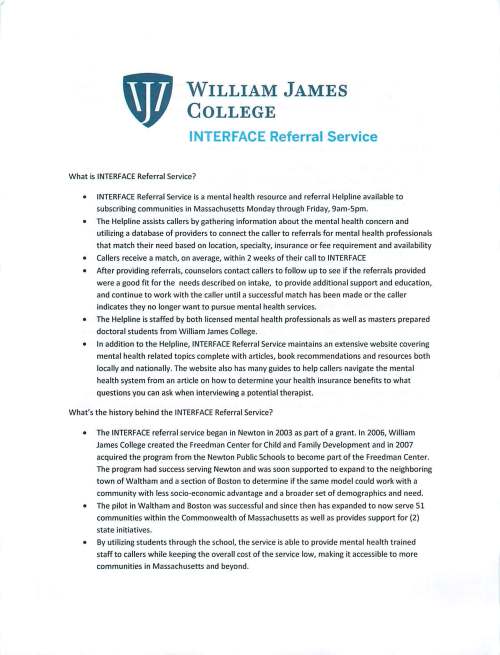
Be on the lookout for new postcards promoting William James College INTERFACE Referral Service, a Mental Health Resource & Referral Helpline available Monday through Friday between the hours of 9-5 by calling 617-332-3666, ext 1. INTERFACE matches callers from subscribing communities with appropriate outpatient mental health resources and referrals in their area.
This FREE service is new to Medfield since November 1, 2017.
Dr. Jeffrey Marsden, Superintendent of Schools, purchased this service in collaboration with the Town of Medfield, for all of Medfield’s residents, in response to reports that residents were having difficulty finding outpatient mental health providers in a timely fashion.
Seeking mental health care on one’s own has become more difficult than ever in today’s ever changing healthcare market. Providers who are on lists from referral sources such as primary care offices or insurance companies may not be taking new clients/patients, be the right match for the insurance plan of the client/patient, or have the expertise in the mental health service being sought. Residents were reporting that when they sought care for themselves or a loved one, it often took multiple phone calls, endless waiting, and much wasted time in securing an appropriate provider.
INTERFACE is free for ALL Medfield residents and is a tool in accessing mental health care by providing a service that matches a person seeking outpatient mental health care with specialized providers from a large data base of licensed and vetted mental health providers, thereby reducing the burden on residents seeking to connect with outpatient mental health treatment.
As of March over 32 Medfield residents have received assistance in securing an outpatient mental health provider through Interface. INTERFACE resource and referral counselors work hard to secure an appropriate match and if for any reason the match is not successful; they will continue to work with the caller until the right fit between caller and provider is in place.
Medfield Coalition for Suicide Prevention (MCSP) has created postcards to inform Medfield residents about the INTERFACE service and local mental health support services as part of their mission to inform every resident of this important service. With leadership from Medfield resident Carol Read, a prevention specialist in a nearby community and Medfield Board of Health member, the cards were designed and completed by the MCSP publicity committee and are now being distributed throughout various locations in the community.
Find them at the Public Safety building, The Center at Medfield (Council on Aging), Medfield Youth Outreach, Town Hall and Medfield School Dept, 3rd floor, Town Hall, Medfield Public Library, schools, medical professional’s offices, and at various businesses.
If you wish to host the cards at your organization, reach out to MCSP through the Medfield Youth Outreach office at 508-359-7121.
Posted onApril 10, 2018|Comments Off on Mental health information
Last night while attending the Warrant Committee meeting at the Public Safety Building, I picked up one of the relatively new INTERFACE referral cards (a copy of the card appears below). The Town of Medfield signed on with INTERFACE starting in November, and since then any resident can INTERFACE to get a referral to a mental health professional. The back of the card lists other mental health resources.
The algorithm could allow doctors to predict cardiovascular risk more simply by using scans of the retina.Stock photo by Scott Olson/Getty Images
Scientists from Google and its health-tech subsidiary Verily have discovered a new way to assess a person’s risk of heart disease using machine learning. By analyzing scans of the back of a patient’s eye, the company’s software is able to accurately deduce data, including an individual’s age, blood pressure, and whether or not they smoke. This can then be used to predict their risk of suffering a major cardiac event — such as a heart attack — with roughly the same accuracy as current leading methods.
Several months ago, I was invited to give a presentation about heart failure to a group of physicians who meet every month for a lunch meeting.
Don’t worry. No company sponsored the talk, and I did not receive any payment. I accepted the invitation, because it seemed like to good thing to do.
However, the audience was a bit unusual for me. Among the 25 physicians in the room, nearly all were in their 70s and 80s. All were retired, and none were actively involved in patient care. I guess that explains why they had time in the middle of the day for an hour-long presentation.
I gave my talk, but there were no questions.
I had a few moments afterwards to speak to my audience. Since the physicians were not involved in patient care, I wondered why they wanted to hear a talk about new advances in heart failure.
The response surprised me: “We no longer care for patients, but we care about what’s going on. You see, most of us are employed by insurance companies to do preauthorization for drugs and medical procedures.”
My jaw dropped: “I just gave a talk about new drugs for heart failure. Are you responsible for preauthorizing their use for individual patients?” The answer was yes.
I was really curious now. “So did I say anything today that was helpful? I talked about many new treatments. Did I say anything that you might use to inform your preauthorization responsibilities?”
Their answer hit me hard. “Oh, we’ve heard about those drugs before. We’re asked to approve their use for patients all the time. But we don’t approve most of the requests. Nearly all of them are outside of the guidelines that we are given.”
I stammered. “I just showed you evidence that these new drugs and devices make a real positive difference in people’s lives. People who get them feel better and live longer.”
The physicians agreed. “Yes, you were very convincing. But the drugs are too expensive. So we typically reject requests, at least the first time. We figure that, if doctors are really serious, then they should be willing to make the request again and again.”
I was astonished. “If the drugs will help people, how can you say no?”
Then I got the answer I did not expect. “You see, if it weren’t for us, the system would go broke. Every time we say yes, healthcare becomes more expensive, and that isn’t a good thing. So when we say no, we are keeping the system in balance. Our job is to save our system of healthcare.”
I responded quickly. “But you are not saving our healthcare system. You are simply making money for the company that you work for. And patients aren’t getting the drugs that they need.”
One physician looked at me as if I were from a different planet. “You really don’t understand, do you? If we approve expensive drugs, then the system goes broke. Then no one gets healthcare.”
Before I had a chance to respond, he continued: “Plus, if I approve too many expensive drugs, I won’t get my bonus at the end of the month. So giving out too many approvals wouldn’t be a smart thing for me to do. Would it?”
I walked out of the room slowly. Although I had been invited to share my knowledge, it turned out that — this time — I was the real student.
The physicians in the audience taught me a valuable lesson. And amazingly, none of them showed a single slide.
Packer has recently consulted for Amgen, Boehringer Ingelhim, Cardiorentis and Sanofi. He was one of the two co-principal investigators for the PARADIGM-HF trial (sacubitril/valsartan) and currently chairs the Executive Committee for the EMPEROR trial program (empagliflozin).
Posted onNovember 30, 2017|Comments Off on Mental health referral service
The William James Interface Referral Service
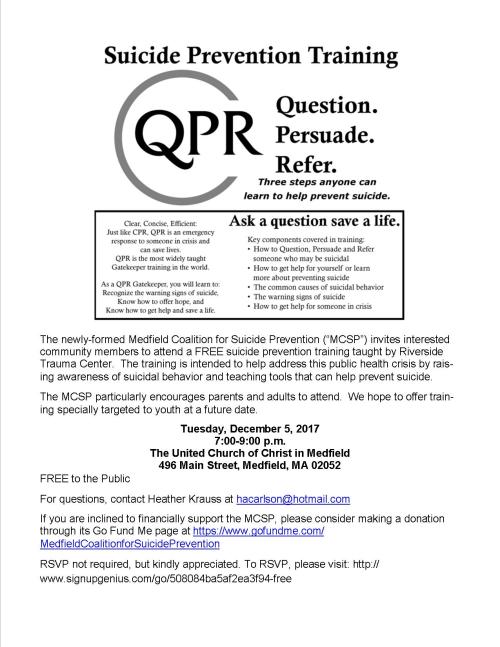
The School Department and the town signed up with The William James Interface Referral Service, which is a mental health referral service for any resident. Interface phones are answered by mental health professionals, and they match callers with appropriate clinical staff. Interface does the legwork, and makes referrals based on the variables. The service became available for Medfield residents November 1. See the Interface website for other resources – William James Interface Referral Service
I started this blog to share the interesting and useful information that I saw while doing my job as a Medfield select board member. I thought that my fellow Medfield residents would also find that information interesting and useful as well. This blog is my effort to assist in creating a system to push the information out from the Town House to residents. Let me know if you have any thoughts on how it can be done better.
For information on my other job as an attorney (personal injury, civil litigation, estate planning and administration, and real estate), please feel free to contact me at 617-969-1500 or Osler.Peterson@OslerPeterson.com.





/cdn.vox-cdn.com/uploads/chorus_image/image/58743741/480302297.jpg.0.jpg)






 Medfield02052's Blog