Category Archives: health

Suicide prevention training 7PM Tuesday

Learn in two hours how to be comfortable talking to loved ones about self harm.

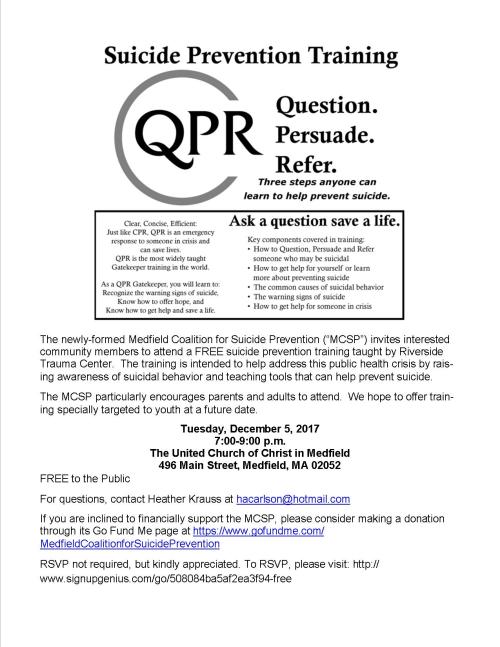
The newly-formed Medfield Coalition for Suicide Prevention (“MCSP”) invites interested community members to attend a FREE suicide prevention training taught by Riverside Trauma Center. The training is intended to help address this public health crisis by rais-ing awareness of suicidal behavior and teaching tools that can help prevent suicide. The MCSP particularly encourages parents and adults to attend. We hope to offer train-ing specially targeted to youth at a future date. Tuesday, December 5, 2017 7:00-9:00 p.m. The United Church of Christ in Medfield 496 Main Street, Medfield, MA 02052 FREE to the Public For questions, contact Heather Krauss at hacarlson@hotmail.com If you are inclined to financially support the MCSP, please consider making a donation through its Go Fund Me page at https://www.gofundme.com/MedfieldCoalitionforSuicidePrevention RSVP not required, but kindly appreciated. To RSVP, please visit: http://www.signupgenius.com/go/508084ba5af2ea3f94-free


Screen time and depression correlate

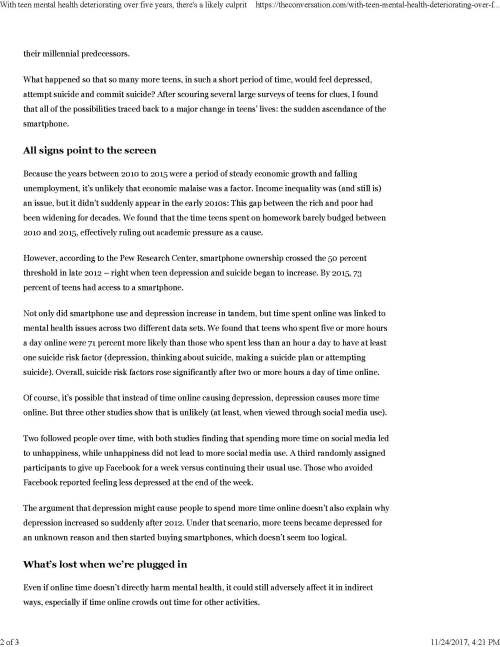
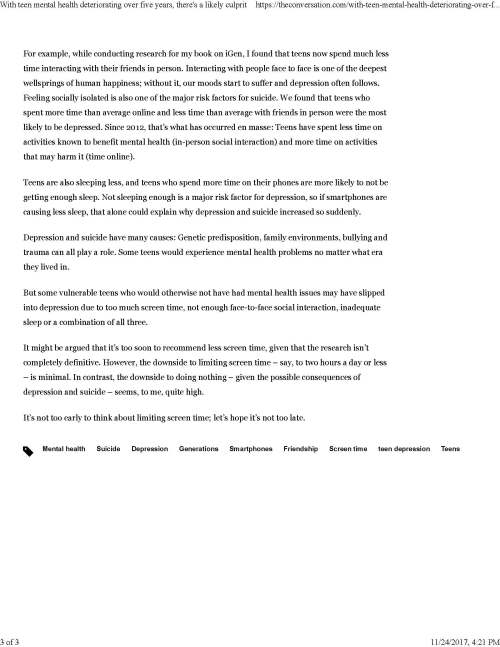
Author Jean Twenge Professor of Psychology, San Diego State University Academic rigor, journalistic flair Around 2012, something started going wrong in the lives of teens. In just the five years between 2010 and 2015, the number of U.S. teens who felt useless and joyless – classic symptoms of depression – surged 33 percent in large national surveys. Teen suicide attempts increased 23 percent. Even more troubling, the number of 13- to 18-year-olds who committed suicide jumped 31 percent. In a new paper published in Clinical Psychological Science, my colleagues and I found that the increases in depression, suicide attempts and suicide appeared among teens from every background – more privileged and less privileged, across all races and ethnicities and in every region of the country. All told, our analysis found that the generation of teens I call “iGen” – those born after 1995 – is much more likely to experience mental health issues than pimchawee November 14, 2017 9.36am EST With teen mental health deteriorating over five years, there's a likely culprit https://theconversation.com/with-teen-mental-health-deteriorating-over-f... 1 of 3 11/24/2017, 4:21 PM their millennial predecessors. What happened so that so many more teens, in such a short period of time, would feel depressed, attempt suicide and commit suicide? After scouring several large surveys of teens for clues, I found that all of the possibilities traced back to a major change in teens’ lives: the sudden ascendance of the smartphone. All signs point to the screen Because the years between 2010 to 2015 were a period of steady economic growth and falling unemployment, it’s unlikely that economic malaise was a factor. Income inequality was (and still is) an issue, but it didn’t suddenly appear in the early 2010s: This gap between the rich and poor had been widening for decades. We found that the time teens spent on homework barely budged between 2010 and 2015, effectively ruling out academic pressure as a cause. However, according to the Pew Research Center, smartphone ownership crossed the 50 percent threshold in late 2012 – right when teen depression and suicide began to increase. By 2015, 73 percent of teens had access to a smartphone. Not only did smartphone use and depression increase in tandem, but time spent online was linked to mental health issues across two different data sets. We found that teens who spent five or more hours a day online were 71 percent more likely than those who spent less than an hour a day to have at least one suicide risk factor (depression, thinking about suicide, making a suicide plan or attempting suicide). Overall, suicide risk factors rose significantly after two or more hours a day of time online. Of course, it’s possible that instead of time online causing depression, depression causes more time online. But three other studies show that is unlikely (at least, when viewed through social media use). Two followed people over time, with both studies finding that spending more time on social media led to unhappiness, while unhappiness did not lead to more social media use. A third randomly assigned participants to give up Facebook for a week versus continuing their usual use. Those who avoided Facebook reported feeling less depressed at the end of the week. The argument that depression might cause people to spend more time online doesn’t also explain why depression increased so suddenly after 2012. Under that scenario, more teens became depressed for an unknown reason and then started buying smartphones, which doesn’t seem too logical. What’s lost when we’re plugged in Even if online time doesn’t directly harm mental health, it could still adversely affect it in indirect ways, especially if time online crowds out time for other activities. With teen mental health deteriorating over five years, there's a likely culprit https://theconversation.com/with-teen-mental-health-deteriorating-over-f... 2 of 3 11/24/2017, 4:21 PM Mental health Suicide Depression Generations Smartphones Friendship Screen time teen depression Teens For example, while conducting research for my book on iGen, I found that teens now spend much less time interacting with their friends in person. Interacting with people face to face is one of the deepest wellsprings of human happiness; without it, our moods start to suffer and depression often follows. Feeling socially isolated is also one of the major risk factors for suicide. We found that teens who spent more time than average online and less time than average with friends in person were the most likely to be depressed. Since 2012, that’s what has occurred en masse: Teens have spent less time on activities known to benefit mental health (in-person social interaction) and more time on activities that may harm it (time online). Teens are also sleeping less, and teens who spend more time on their phones are more likely to not be getting enough sleep. Not sleeping enough is a major risk factor for depression, so if smartphones are causing less sleep, that alone could explain why depression and suicide increased so suddenly. Depression and suicide have many causes: Genetic predisposition, family environments, bullying and trauma can all play a role. Some teens would experience mental health problems no matter what era they lived in. But some vulnerable teens who would otherwise not have had mental health issues may have slipped into depression due to too much screen time, not enough face-to-face social interaction, inadequate sleep or a combination of all three. It might be argued that it’s too soon to recommend less screen time, given that the research isn’t completely definitive. However, the downside to limiting screen time – say, to two hours a day or less – is minimal. In contrast, the downside to doing nothing – given the possible consequences of depression and suicide – seems, to me, quite high. It’s not too early to think about limiting screen time; let’s hope it’s not too late. With teen mental health deteriorating over five years, there's a likely culprit https://theconversation.com/with-teen-mental-health-deteriorating-over-f... 3 of 3 11/24/2017, 4:21 PMWith teen mental health deteriorating over five years, there's a likely culprit_Page_2With teen mental health deteriorating over five years, there's a likely culprit_Page_3

MetroWest Adolescent Health Survey Report

MHS sigh

The full MetroWest Adolescent Health Survey Report has been put on-line by the schools.  I am not sure if this is the first year the full report has been made available, as I know in the past only summaries were distributed.  Great to see the actual data.

A few things I noticed from scanning it:

  • fair amount of alcohol and marijuana use
  • lots and lots of stress
  • some pressured to provide sex
  • few parents control and/or discuss on-line use and time

http://medfield.net/district-information/mwahs.html

I was interested to learn at a recent Medfield Cares About Prevention (MCAP) (www.MedfieldCares.org) meeting that the kids generally do not believe the data about alcohol and drug use affecting their brains, based on their push back to Dr. Ruth Potee when she was presenting the facts to them at her recent talk at Medfield High School.

Medfield Coalition for Suicide Prevention

Medfield sign

The Medfield Coalition for Suicide Prevention, is a newly formed steering-committee (created September 2017) of community members/professionals who desire to create a coalition that promotes mental health resources.  We recognize that a public health crisis has touched our town and by coming together, we can form an initiative that raises awareness and has the potential to save lives . The MCSP has created this GoFundMe account in order to raise funds that will:

  • hire a consultant to effectively guide our development of a strategic plan for suicide prevention among all ages in Medfield
  • create and disseminate printed resources
  • fund future QPR trainings
[The Medfield Coalition for Suicide Prevention is a program of Medfield Cares About Prevention (MCAP).]
Funds raised will benefit:
Medfield Foundation, Inc.

  Certified Charity
Medfield, MA

Interface is live

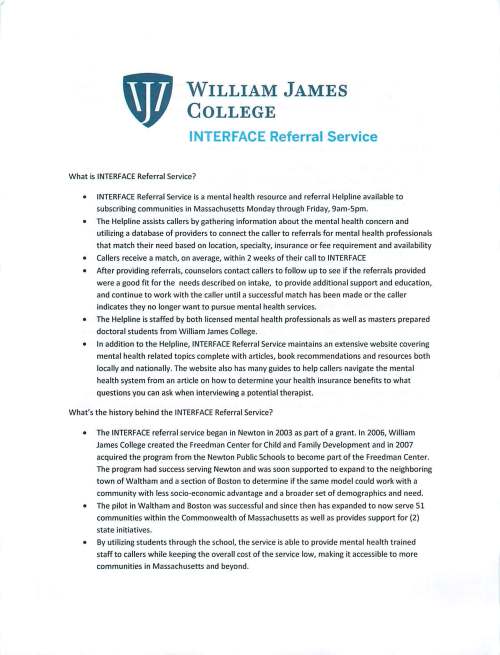
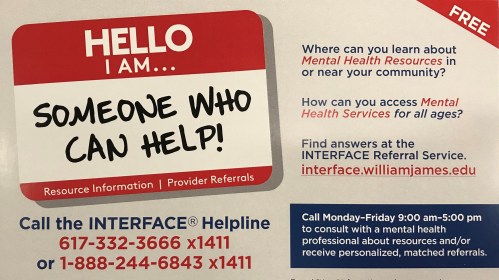
Interface, the mental health referral service brought to town by the combined efforts of the schools and police is now operational, and residents can get services.

Interface

The following is from the Superintendent’s blog  –

This post will highlight our new partnership with Interface Referral Service

Medfield Public Schools and Town of Medfield Collaborate to Fund Interface


We are pleased to announce a new referral service for all students and residents of Medfield. The Medfield Public Schools and the Town of Medfield have teamed up with William James College to provide a referral service that provides a wide range of valuable resources related to mental health and wellness for the benefit of children, adults and families, as well as educators and mental health professionals.

In addition to the resources on their website, the William James Interface Referral Service maintains a mental health and wellness referral helpline Monday through Friday, 9 am-5 pm, at 888-244-6843 (toll free). This is a free, confidential referral service for individuals across the lifespan living in Medfield. Callers are matched with licensed mental health providers from their extensive database. Each referral meets the location, insurance, and specialty needs of the caller. More information about the service and terms of confidentiality can be found here on the new Interface- Medfield page.


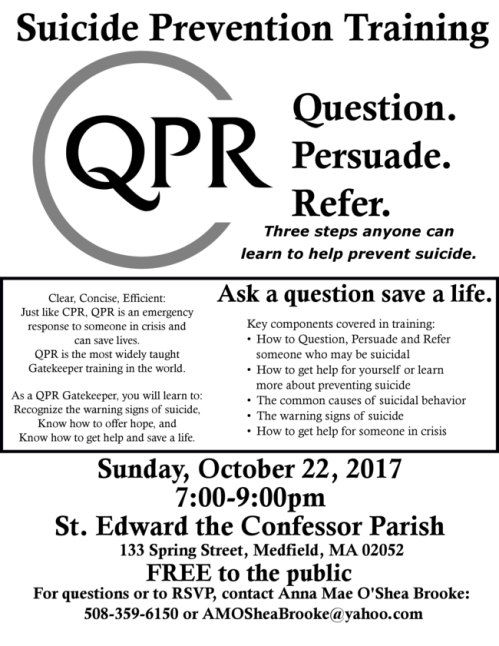
QPR Training: Suicide Prevention this Sunday 7-9pm

From Anna Mae O’Shea Brooke –

===============================================================

Dear Medfield Community Member,

Suicide is difficult to discuss and most of the time simply unimaginable, but the reality is that it can happen to people we know and love. This training is an effort to empower us to build awareness and prevent this from happening.

The training is FREE to EVERYONE in our community:

Sunday, October 22 from 7-9pm

RSVP here

“Just like CPR, QPR is an emergency response to someone in crisis and can save lives.”

QPR

=================================================================

Pete personal note – I volunteered on a telephone crisis line and ran its training program for several years, incorporated and then served on the board of Riverside Community Care (our local community mental health center) for 20 years, and I recently took a QPR training – and I found the QPR training useful.

Drugs are best treatment for opioid abuse

I have been wondering what the best solution was for opioid addiction, and this article makes a good argument for using methadone, Suboxone, and one other drug as the most successful method.

CW

                     10.15.17


THE UPLOAD


Drugs are best treatment for opioid abuse


Edward M. Murphy


The opioid addiction crisis in the United States has prompted leaders at the state and federal level to promise more money, new laws, and greater focus on the problem. That focus is needed but so far the policy goals lack clear definition. Even as attention on the problem has ramped up, we have continued to treat addiction in ways that have historically not worked well. Doing more of something that’s not working will not correct the problem. If the policy goal is to create treatment interventions that reduce abuse, lower the rate of remission, and restore patients as much as possible to normal living, there is extensive medical research and practical clinical experience suggesting medication-assisted treatment, or MAT, is the way to go.


Aside from emergencies, traditional addiction treatment in the United States is often not medical in nature but guided by the principles derived from 12-step programs. The goal of these programs, which are characterized by admirable spiritual and moral ideals, is complete abstinence driven by self-discipline and support from peer groups. This approach does not work well for people with opioid dependence. As long ago as 1997, National Institutes of Health experts concluded that “opioid addiction is a treatable medical disorder and explicitly rejected notions that addiction is self-induced or a failure of willpower.” The approach recommended by the National Institutes of Health and virtually all other medical and scientific sources is medication-assisted treatment.


Medication-assisted treatment means using one or more pharmacological agents to relieve the symptoms and risks of addiction, enabling patients to begin returning to normal life and to benefit from other behavioral therapies. The treatment is not a magic bullet and MAT does not guarantee success, but it has a substantially higher rate of positive outcomes than traditional non-medical treatment programs. A team of physicians writing in the New England Journal of Medicine likened medication-assisted treatment to the care needed for “other chronic diseases such as diabetes and hypertension,” where “effective treatment and functional recovery are possible.”


Because of the stigma associated with drug abuse and the traditional stereotype of the addict, some people find it counter-intuitive to use medication to treat addiction. But when scientists explain how the brain responds to the excessive use of heroin or pain pills, the logic of addressing the pathology with an appropriate medication is persuasive.


Opioids attach themselves to receptors in the brain and artificially generate excessive quantities of the neurotransmitter dopamine, producing feelings of euphoria. Addiction is the result of the brain “learning” this new behavior through excessive repetition until it becomes dependent on the artificial effect and craves more.


The argument that experts make for medication-assisted treatment is that managing the brain’s new habit and mitigating the effects of withdrawal will not happen just because a person wants to stop abusing opioids. The process requires a kind of neurological reverse-engineering that can relieve the brain’s urgent need for more drugs. In the absence of appropriate medication, a significant majority of addicts who go through short-term detox will relapse, often multiple times.


There are three medications used in treating opioid addiction. The best known is methadone, which was initially developed in the 1940s as a pain reliever. Because it works by changing the way the brain perceives physical and psychological pain, methadone was soon used to provide people dependent on heroin with a way to manage their withdrawal and to stabilize their lives. Methadone is a synthetic opioid although it does not produce the same high as abused opioids. It is effective but often poorly perceived in the wider community because of its long association with heroin and because people suffering from an addiction disorder normally must go to a registered clinic daily to receive their dosage.


A second medication, buprenorphine, is now gaining wider acceptance among experts. Buprenorphine is called a “partial agonist,” which means that it activates the same receptors as abused opioids but produces a much weaker effect. Essentially the brain is fooled into believing that its opioid craving is met but this happens without the pattern of withdrawal and euphoria that is typical of addiction. The medication is delivered via a daily pill or a strip placed under the tongue and can be prescribed by physicians who have special authorization and training. Patients normally have a month’s supply to take at home. The most common form of this medication, sold under the trade name Suboxone, has a second element that causes unpleasant symptoms in a patient who relapses and takes another opioid.


The third current option is called naltrexone, sold under the trade name Vivitrol. This is an “antagonist” medication that works in a different way than buprenorphine. Instead of fooling the brain receptors, it blocks them so that a patient who relapses cannot trigger those receptors and experience a high. It is administered by monthly injection and can only be given to patients who are already completely detoxed. Vivitrol is increasingly used in criminal justice settings, particularly for previously addicted inmates who will shortly return to their communities.


Each medication has various dosages, side-effects, advantages, and disadvantages depending on the condition of the patient and the arc of his or her addiction history. Only a physician who fully understands the patient’s needs, matches them to the characteristics of the medications, and carefully monitors the ongoing results should make the decision about how best to exploit medication-assisted treatment for the benefit of individuals who need it. Many patients also need to receive psychosocial counseling to help them build on the opportunity provided by the medication.


The National Institute on Drug Abuse summarizes the available research by concluding that medication-assisted treatment has multiple advantages over other forms of treatment and “decreases opioid use, opioid-related overdose deaths, criminal activity, and infectious disease transmission.” Further, MAT “increases social functioning and retention in treatment.” One important study, a randomized, controlled trial published in 2015 by a researcher associated with Harvard Medical School and McLean Hospital, demonstrated that MAT “at least doubles rates of opioid-abstinence” compared with other forms of treatment.


Unfortunately, the treatment endorsed by experts as offering the highest probability of success in moderating the impact of the opioid crisis is not widely available. A health care system normally driven by evidence of clinical efficacy has not organized itself to deliver the care needed by the millions of Americans who suffer from opioid-use disorder. A report issued by the Pew Charitable Trust found a “treatment gap” in which only 23 percent of publicly funded addiction treatment programs and less than half of private sector programs offer MAT. This lack of availability was attributed to inadequate funding and a dearth of qualified providers.


There are additional reasons for the gap. One is the persistent opinion that relying on medication to treat addiction is a morally compromised approach. A psychologist writing last year in Psychology Today articulated this view by saying that “recovery should be about breaking free from all substances.” He also raised the so-called crutch argument, asking if MAT isn’t simply “transferring from one drug to another.” According to this line of thinking, using any drug to aid in treatment is simply switching dependency from one substance to another and is a sign of weakness. This perspective rejects the analogy that using medication to treat addiction is like using insulin to treat diabetes.


It is a sad commentary on our approach to opioids that addicts have easy access to quality medical care when they overdose but not before. According to the Centers for Disease Control and Prevention, more than 1,000 people are treated in US emergency rooms every day for misuse of prescription opioids. Many more are treated in emergency rooms for the use of such drugs as heroin and fentanyl. The trend is strong in Massachusetts, which ranks at the top among states when measured by opioid-related emergency room visits. Approximately 64,000 Americans, including 1,933 in Massachusetts, died from overdoses in 2016. Hundreds of thousands more were saved by the intervention of clinical professionals. Our health care system is improving at helping people dependent on opioids to survive emergencies, but it is still weak in helping them to recover and live normal lives.


As important as it is to save people’s lives, we will not have a successful policy responding to the opioid crisis until we mitigate the psychological, economic, and societal consequences suffered by living victims of opioid use disorders, their families, and their communities. That requires a highly organized system for quick and comprehensive delivery of the best clinical interventions available.


Some people receiving medication-assisted treatment will fail to comply with the recommendations of their physicians, just as some diabetics do when they consume too much sugar or neglect to take their insulin. The correct response is not to punish them by denying medication and thereby subjecting them to the torment of their disease. The best antidote is sustained availability of high-quality care designed to bring each patient as close as possible to normalcy.


Edward M. Murphy was head of three state agencies between 1979 and 1995—the Department of Youth Services, the Depart-ment of Mental Health, and the Health and Educational Facilities Authority. He subsequently ran several health care companies in the private sector before retiring. 


Mass. citizens point the way on climate change


— Jamie Eldridge and Emily Norton


You get what you pay for


Louis Antonellis


Pipeline gas report is inaccurate, misleading


Thomas Kiley


First lesson this school year must be civility


Todd Gazda


Are homes only for the upper class?


– Tim Sullivan


Colleges can’t be bystanders on opioids


Janie L. Kritzman


The Upload is a newsletter of commentary from CommonWealth. We welcome opinion pieces.

Please submit them to either Bruce Mohl, at bmohl@massinc.org, or Michael Jonas, at mjonas@massinc.org. Include your contact information.


MassINC | 11 Beacon Street, Suite 500, Boston, MA 02108
Unsubscribe osler.peterson@verizon.net
Update Profile | About our service provider
Sent by amiddle@massinc.org

Parental skills training tonight

From Medfield Cares About Prevention (MCAP) yesterday –

All parents welcome

You are welcome to attend and bring other parents/adults who care about Medfield youth with you.  If you could tweet about this, post to your facebook pages, blogs, share from Medfield Youth Outreach’s facebook page or MCAP’s it would be so very helpful.  This is coming together quickly due to the needs of hurting parents in the community and literally just gained final approval this evening.  This rose organically from the community. Let’s get behind it and spread the word!

Medfield Youth Outreach


Open Invitation For All Parents:

St. Edward Church of Medfield warmly welcomes Jim McCauley, LICSW, from Riverside Trauma Center for an evening where parents can develop their skills in navigating conversations with youth about depression and feelings of hopelessness. The Regional MetroWest data supports that youth are reporting more stress and that some have reported depressive symptoms and thoughts of suicide (MWAHS, 2016).  Parents have been reaching out community wide for ways to have meaningful conversations with their youth about these issues and to find pathways to build greater support in the community.

This evening is sure to be a dialogue to empower Medfield families in navigating these discussions and finding resources for the future.


Please join us on TUESDAY, JUNE 20TH AT 7PM AT ST. EDWARD CHURCH.  For more information please contact St. Edward Church: 508-359-6150 or amosheabrooke@stedward-ma.org.

Childcare available for ages 4+.


RSVP here


All community parents are welcome.


Dr. Ruth Potee tomorrow night

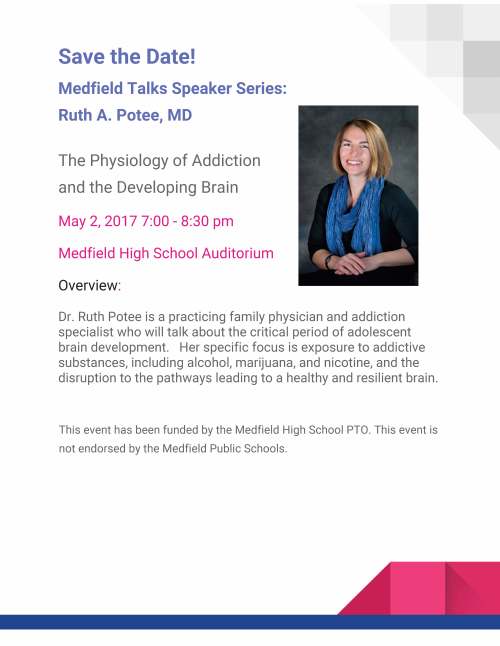
I heard Dr. Potee speak over a year ago, and she is really good.  This is the flyer –

Save the Date! Medfield Talks Speaker Series: Ruth A. Potee, MD The Physiology of Addiction and the Developing Brain May 2, 2017 7:00 - 8:30 pm Medfield High School Auditorium Overview: Dr. Ruth Potee is a practicing family physician and addiction specialist who will talk about the critical period of adolescent brain development. Her specific focus is exposure to addictive substances, including alcohol, marijuana, and nicotine, and the disruption to the pathways leading to a healthy and resilient brain. This event has been funded by the Medfield High School PTO. This event is not endorsed by the Medfield Public Schools.

E-cigarettes

aaj

This article is from my American Association for Justice monthly magazine –


Trial

Theme Article

E-cigarettes spark litigation

November 2016 – Annesley H. DeGaris

Since hitting the market several years ago, e-cigarettes have rapidly become a popular alternative to cigarettes. But they raise safety questions—from product defects to chemical exposure.

E-cigarette use has surged among all age groups, with proponents hailing the devices as a safer alternative to cigarettes. But continuing research raises increasing safety concerns. As more cases alleging product defects and other claims are being filed, it is important to have a basic understanding of ­e-cigarettes and their safety issues.

An e-cigarette is a device that releases vaporized nicotine that is then inhaled—a process known as “vaping.” Typical e-cigarettes include a battery, atomizer, nicotine cartridge, LED light, and sensor. The sensor determines when the consumer starts to inhale and causes the battery to power the atomizer, which heats up the “e-liquid” and turns it into a vapor. The nicotine cartridge holds the e-liquid, a fluid that typically consists of nicotine, a diluent such as propylene glycol or vegetable glycerin, and a flavoring.1

E-liquids come in many flavors, with names targeted to appeal to children, such as “Strawberry Fields” and “Smurfberry.” E-liquid manufacturers also offer tobacco- and menthol-flavored e-liquids to help market the device for smoking cessation.

In 2008, e-cigarette companies raked in $20 million in sales.2 The 2016 e-cigarette­ market is projected to be worth more than $4 billion.3 And experts believe that e-cigarette sales will eclipse cigarette sales within 10 years.4

Between 2010 and 2013, the percentage of adults using e-cigarettes more than doubled.5 Between 2013 and 2014, the percentage of teens in middle school and high school using e-cigarettes tripled.6 One study found that 24.6 percent of high school students surveyed reported current use of a tobacco product, with e-cigarettes being the most common.7

E-cigarettes have become so widespread that the U.S. Department of Housing and Urban Development has considered banning their use in public housing units,8 the U.S. Department of Transportation treats the devices as cigarettes and prohibits vaping on airplanes, and the FDA recently issued new regulations.9

Hazards: Known and Unknown

Several safety hazards have been associated with e-cigarettes, including exploding devices and potential toxic chemical exposure. Although the FDA recognizes some particles in e-vapor as generally safe for ingestion, no studies have determined the particles’ effects when inhaled.10 But reports of adverse health events include hospitalization for pneumonia, congestive heart failure, disorientation­, seizure, hypotension, and nicotine poisoning.11 Early studies suggested that vaping is as safe as breathing normal air,12 but more recent studies show that the cancer risks are similar to those of traditional cigarettes.13

E-cigarettes with variable voltage pose an additional risk. Vaping at a high voltage has an estimated cancer risk five to 15 times as high as the risk associated with long-term cigarette smoking.14 Most variable-voltage e-cigarettes use 3.7 volt batteries, as do standard e-cigarettes. The difference is that a variable-voltage e-cigarette has a circuit that stores and regulates power from the battery, delivering it to the atomizer tank at the voltage the consumer chooses.

The higher the voltage, the greater the nicotine kick—but also a greater exposure to certain chemicals.15 Specifically, the e-cigarette’s battery heats the propylene glycol and glycerin in the e-liquid to the point of decomposition, causing the formation of carcinogens such as formaldehyde.16

Diacetyl is another concerning chemical. It is used to flavor e-cigarettes and has been found in more than 75 percent of the devices and their refill liquids.17 Diacetyl is linked to severe respiratory disease such as bronchiolitis obliterans—also known as “popcorn lung” because of its diagnosis in workers at microwave-popcorn-processing factories who inhaled the chemical, used in artificial butter flavoring.18

Recent research has called attention to other health concerns: e-cigarettes may lead to tumor growth;19 high levels of inhaled nanoparticles can cause inflammation and are linked to asthma, stroke, heart disease, and diabetes;20 and accidentally ingesting the e-liquid may lead to nicotine poisoning. This year, poison control centers have received more than 1,000 reports of potential liquid nicotine poisoning.21 In 2014, more than 50 percent of liquid nicotine poisoning calls involved children under age six.22

Another source of injury is exploding devices. The culprit is the lithium-ion battery. Similar to problems seen in laptops and cellphones, the batteries are prone to overheating. Extreme temperatures can cause the batteries to malfunction.23 When overheated, the cylindrical shape of e-cigarettes may propel the device, contributing to the risk of explosion and fire.24

FDA Regulations

Although e-cigarettes have been on the market for several years, the FDA only introduced regulations earlier this year; they became final on Aug. 8, 2016.25

The regulations already placed on traditional cigarettes—such as disclosing all ingredients, including health warnings on product packages, and requiring that all purchasers (online and in stores) be at least 18—are now applicable to all e-cigarettes.26 As part of the regulations, the agency must approve all tobacco products, which includes e-cigarettes, that were not commercially marketed by Feb. 15, 2007.27

The regulations apply to all manufacturers, distributors, sellers, and anyone else involved with the e-cigarette industry. Manufacturers will have to register with the FDA and provide a list of ingredients that the agency will review for approval. Manufacturers have argued that only those few businesses that can afford to comply will survive.28 At least one manufacturer lawsuit has been filed against the FDA seeking to have the rules vacated and declared unlawful.29

Emerging Litigation

E-cigarette litigation is varied and still in the early stages. Plaintiffs have brought cases alleging false advertising, lack of health warnings, and personal injuries—including lung disease, nicotine poisoning, and combustion of devices and batteries that caused severe burns.

Some causes of action, such as consumer fraud and deceptive trade practices, depend on the vagaries of state law, with some states—such as California—being more advanced in the nature and range of applicable consumer protection statutes. Products liability actions include claims for defective design and inadequate warnings.30

The first e-cigarette explosion lawsuit was tried in September 2015. The jury awarded the plaintiff nearly $1.9 million after the device exploded in her car, causing second-degree burns.31 Other cases involve an e-cigarette exploding in the plaintiff’s mouth, requiring doctors to surgically repair the plaintiff’s tongue and amputate a finger;32 and an e-cigarette that exploded and set a room on fire, creating a large hole in the plaintiff’s cheek.33

Several class actions also have been filed, including one in California alleging dangerous levels of diacetyl and other chemicals34 and lack of warning labels about the known links to popcorn lung, emphysema, and chronic obstructive pulmonary disease.35 Other class actions have alleged false advertising and marketing claims about e-cigarettes’ ability to help users quit smoking, failure to warn or inform consumers of associated health risks, and misleading consumers about e-liquid ingredients and their safety.36

Although litigation is still developing, when screening a potential case, plaintiff attorneys should consider issues that are common to products liability cases. Preservation of the device—including the battery and charger, which are sometimes sold separately from the device—and establishing a proper chain of custody in an explosion case, for instance, must be scrupulous. The early and careful gathering of all of a plaintiff’s medical records will be key, regardless of whether the plaintiff was injured by an exploding device or from exposure to chemicals.

As in any case, client screening is crucial. Ask potential clients about any modifications they made to the device. Selecting causation experts will require careful research—especially in exposure cases given the emerging science of e-cigarette toxins and the strictures of Daubert. Although device manufacturers are obvious defendants, many are located outside the United States. You should look into bringing defective design and inadequate warning claims against local retailers and distributors.

The e-cigarette is a nicotine-delivery device, and its growing popularity has revealed major products liability issues. Although FDA regulation of these devices should be applauded, history shows that the civil justice system often can create the necessary change faster than government regulation. With this device, both are needed.


Annesley H. DeGaris is a partner at DeGaris & Rogers in Birmingham, Ala. He can be reached at adegaris@degarislaw.com.