Monthly Archives: December 2017

Teachout leads Chamber

Medfield’s own Chris Teachout of Needham Bank to lead the Newton-Needham Regional Chamber – this from the Newton-Needham Regional Chamber today –

NNC logo

Teachout elected chair of chamber’s board 


The Newton-Needham Regional Chamber’s Board of Directors has elected Chris Teachout, vice president for Business Development at Needham Bank, as its new chair, effective Jan. 1.

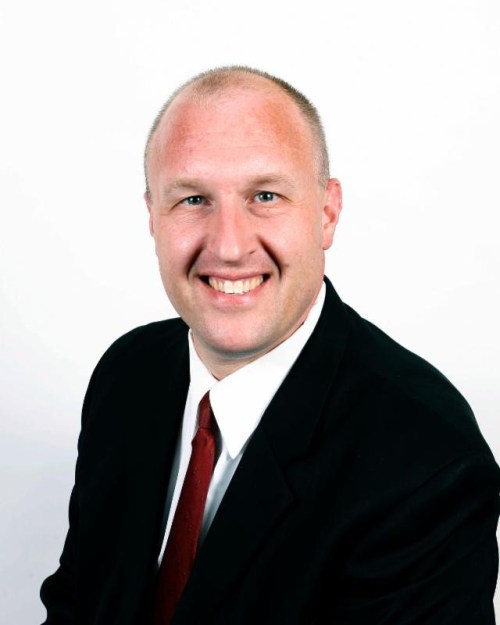
Teachout

Teachout replaces Rachel Hillman Foy who has completed her two-year term and will remain on the board as immediate past chair.


“My  election as Chair of the Newton-Needham Regional Chamber is really significant as I am the fourth generation of my family to be raised in Needham,” said Teachout. “My fond memories of what it was like as a child growing up in this town are everlasting.


“Just as is the case with Newton, much has changed in my hometown and, in my opinion, for the better. The chamber has played a significant role in this evolution and I look forward, as the new chair, to continue with the progress we’ve made. It’s a very proud moment for me. I know my grandfather, who worked at Needham Bank, would be especially proud. I look forward to serving.”


The chamber board reelected Barry Brown, president at Mount Ida College as a vice chair and elected Samantha Sherman, chief development and external relations officer for Beth Israel Deaconess Hospital Needham and John Spino, a founding partner at Dwyer, Ruggieri, Spino and Goncalves to serve as vice chairs. Allison Yee, director of retail incubation at WS Development will serve on the executive committee as clerk and Bruce A. Gold, CPA, principal at ALL CPAs will serve as the chamber’s treasurer.


“I’m very grateful to Rachel for her leadership as our board chair for the past two years and am looking forward to working with Chris and our new executive board members as we continue our efforts to take this chamber to the next level,” said Greg Reibman, the chamber’s president.

Meetings yesterday

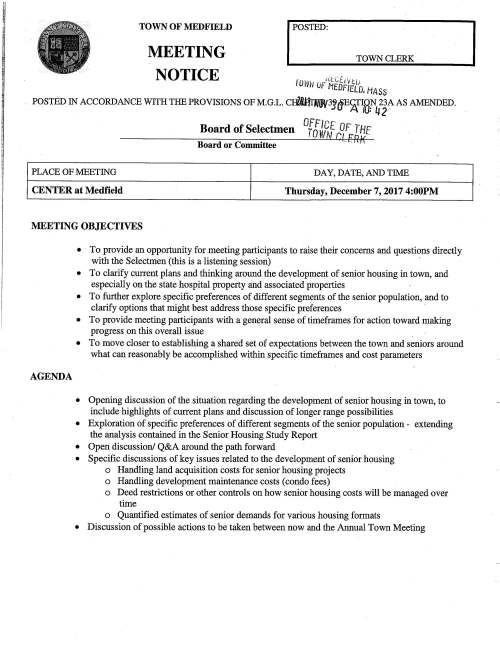
The Board of Selectmen held a meeting yesterday afternoon with seniors at The Center, for a no holds barred discussion of the options, status, and timing for senior housing.  I learned a lot.  Selectmen were supported by members of the Medfield State Hospital Master Planning Committee, who did the heavy carrying about explaining the status of that committee’s huge amount of work with respect to the redevelopment of the former MSH site.

Then Gus and I attended an evening regional selectmen meeting in Millis, attended by selectmen from six towns (see Medfield Press article below), where we discussed how each town is dealing with 40B, marijuana, and the new Federal stormwater rules.  I learned a lot there too.

20171207-BoS-Senior housing meeting

Region’s selectmen convene

MILLIS – Local officials from several towns led a discussion Thursday on the deficiencies and possible reform of affordable housing rules.

Selectmen from Medway, Ashland, Hopkinton, Holliston, Medfield and Millis – convened in Millis to discuss a number of issues of regional importance, such as stormwater management, retail marijuana regulation and the voting process at town meetings. The towns have met several times over the past year.

Medway Town Administrator Michael Boynton noted that the “40B” affordable housing legislation – which allows developers to circumvent certain local zoning bylaws if their project has an affordable housing component and the town falls below a 10 percent affordable housing threshold – first went into effect in 1969.

“It’s not going anywhere,” he said, noting that a ballot initiative to repeal the rule in 2010 had failed. He added that many towns, when they reach the 10 percent threshold, lose interest in reform.

Boynton said the town had experienced – in the last 18 months – both friendly and unfriendly 40B developments.

Medway Selectman Glenn Trindade said the legislation, as currently written, does not solve the affordable housing problem in the most efficient way. He said apartments are most in demand, but developers want to build houses. With apartments, he noted, the residents’ incomes are reviewed after a period of time to ensure they still quality; the same does not occur with houses or condos.

“What we’ve got with this system is someone hits the lottery (and is awarded an affordable house or condo), and you help one person,” he said.

Fellow Selectman Dennis Crowley said he was concerned about what happened to affordable housing units. He said the town had seen instances in which condo owners had bought their units, refinanced at the market value of the condo, pocketed the difference and left. He also cited incidents in which people owned the units, but moved out and rented them to other people.

“Nobody’s monitoring these units,” he said.

Boynton suggested several reforms to the law. One change would allow towns to prioritize senior housing, while another would tie developments to a municipality’s master plan.

State Rep. Shawn Dooley, R-Norfolk, noted the difficulty of changing the legislation. He said he was pursuing reforms that would allow a slightly higher-priced unit to count as a percentage of an affordable housing unity. He pointed at his hometown of Norfolk as an example of where such housing is needed.

“We’re losing teachers, firefighters and police officers – they can’t afford to live in town,” he said. “We have (affordable housing) at $130,000, and the next house up is $500,000.”

Mike Gleason can be reached at 508-634-7546 or mgleason@wickedlocal.com. For news throughout the day, follow him on Twitter @MGleason_MDN.

Election

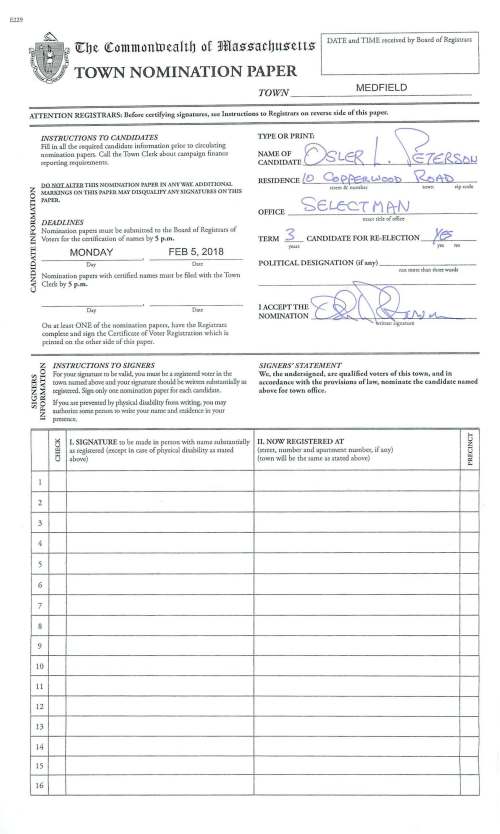
I started my re-election campaign this morning by pulling the nomination papers.  More soon –

Nomination papers_Page_1

75 High Street


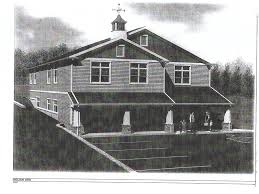
Medfield Children's Center bld

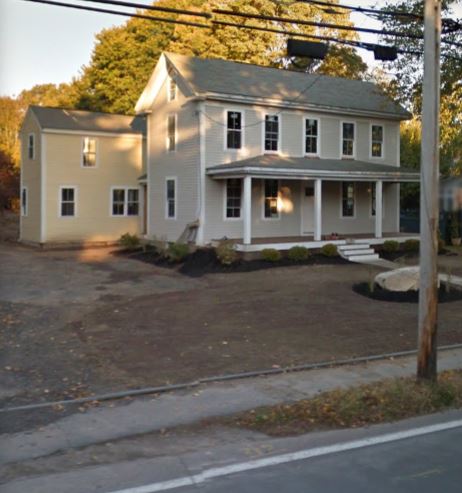
I was informed at the Board of Selectmen meeting last night that the owners of the Medfield Children’s Center may be abandoning their planned use of the 75 High Street site (rendering shown above), for which they have been seeking site plan approval from the planning board.  I was told that the owners have located a preferred location for the Medfield Children’s Center that is on Rte. 27, but at the other side of town.

93-95 North Street 40B update

93-95 North street

Caitlin Dufault asked for an update in a comment to an earlier post, and I thought that there would be more general interest in my response, so I will include it here as well.

****************************************************

Tuesday evening at the 6:30 PM joint meeting of the Affordable Housing Trust Committee and the Board of Selectmen, there was a presentation by the developers of the 93-95 North Street 40B proposal, Dave and Rob MacCready. Because there is not agreement over the density (among other factors) of that proposal, and also because the Affordable Housing Trust has other proposals that are not as controversial, the Affordable Housing Trust voted to table the MacCready proposal.

Since that proposal is being put forward as a Local Initiative Program (LIP), it needs approval from the Board of Selectmen to proceed, which it does not now have. Where the Town of Medfield is currently in a safe harbor with respect to unfriendly 40B projects, if the developer opted to proceed while the town is in the safe harbor, the Zoning Board of Appeals could just deny the developer’s application for an unfriendly 40B comprehensive permit, so it could not proceed.

It is my expectation that the developers will next be trying to work out a more amicable proposal with the neighbors, which could then return to the Affordable Housing Trust Committee and the Board of Selectmen for their consideration.

MEC on 11/2/17

MEC

Medfield Energy Committee

Nov. 2, 2017


Attending: Gerry McCarty, Lee Alinsky, Cynthia Greene, Marie Nolan, Pete Peterson, Fred Davis

Minutes by FD, MN


Green Communities Funds


Total GC grant of $148,000: $110,723 is the RISE quote for retro commissioning of Mid. Sch. & HS (Gerry will re-send that detail). We applied in May; in September, Kelly Brown at DOER asked various q’s; including how we’re going to deal with the rebate program, and what will be identified during retro-commissioning. Within a week, RISE responded; re the latter: excess ventilation, set-points, scheduling. Now we’re waiting for DOER again.


In the meantime, Kelly asked on 10/31: what else do we propose to do with the grant funds?


GM: since we’ve gotten clarification that an audit is not necessary to replace the Blake water heater,  looked at Table 4, and suggested the outdoor lighting work at Blake and Memorial School parking lots, respectively $18,287 and $16,620; totaling $34,907. RISE provided details on 10/31 for those measures, they match the values in Table 4. FD offered to scrutinize the specs; offhand recommended that the latest thinking in LEDs is to utilize dimming/controls as much as possible; this may include dimming down or turning off in a parking lot, and tuning to desired light levels.


This would leave $2300. The full $148,000 must be spent down before applying for next round.

  1. as to when the deadline might be for next round of funds.


Google Drive

LA: still un-workable; Marie: will work on it


Solar on Roof at DPW

Solar roof loading analysis for DPW defined as parts A, B, and C: we now have a stamped engineering report from Solect’s engineer, EAH Structural Consulting dated 11/29/17, saying “existing roof framing systems are judged to be adequate to withstand the loadings imposed by the installation of the solar panels.” Cost for this was in range of $1000. (HMTB should have done this.)


Solar on DPW: original design by Solar Design Associates needs to be re-done; originally it was design-bid-build, a performance specification. There were only two bidders, one didn’t meet DCAM Cert., other was very high, above the budgeted amount. Now we would ask SDA to do firm specs, and ask for base bid and design alternates to cover parts of the roof, to help ensure that we meet the budgeted amount (allotted from DPW budget _____________).


[At this point, Marie Nolan took over from Fred Davis recording the meeting’s minutes as Fred now began a discussion regarding the LED STREET LIGHTS project.]


11.2.17 continuation of notes ….


Light Smart Energy Consulting (George Woodbury) has offered to meet with MEC, present its report, and walk through the next steps.  FD cannot be at a fixture selection meeting so we may need Woodbury’s help for that.


MEC questions posed:

  • How do we reconcile the numbers between the DPRS assessment (utility report) and Woodbury’s field count?
  • Does it affect the $1 price?  No.  George is checking with Eversource on the agreement.
  • Does it change the figures we are going to get? Woodbury will take the counts and recommend substitution.  Ask Light Smart to recommend approach to deciding what wattage to choose if there is a street with several wattages (e.g. lowest or average?)


Bottom line – not much change in terms of energy, 11 fewer but higher wattages shown on DPRS (347 on DPRS and 333 in field).  Correct when on S2 rate (town rate), but we are on S1 (Eversource rate).

$20,000 is the maintenance.


Questions for Woodbury:

  • Provide an estimate for maintenance contract.
  • Where are other streetlights needed in Town such as at the Pfaff Center, Public Safety building, DPW?
  • Are you going to provide a GIS map of where the lights are?
  • What is the timeline for taking possession of the streetlights?
  • Are old documents still valid?
  • How do we tell Eversource that the count is incorrect?
  • How do we negotiate a change in our bill?   (Need to go to Selectmen when we want to enter into a contract.)
  • How do you choose light color?  Why did Wellesley choose 2,700?
  • How do you correct for glare?  (Often biggest complaint)


First step is to set up Woodbury attending MEC meeting. We do not want to own the lights and maintain them before the retrofit. Needs to happen together.


Are we doing test lights to decide on color?? Six years ago – 5,000 was norm. Since then, always been 4,000. The past year, some lights are available at 3,000 kelvins and they are still efficient as the higher ones.  Wellesley is choosing 2,700 kelvins (they found efficiency drops between 3,000 to 2,700)


We may end up with 4 wattages and 2 types.

Must keep good records and rules of thumb for dial settings at certain locations.


Personal preference – Westwood has lights that are 4,000 kelvins.  Newburyport has 3,000.


LED – colors will be better under lamps.


Lighting has to be SMART control ready.  Do not add it now as expensive .  Woodbury would not recommend controls now because of our size.


NEXT MEETING: DEC. 7

 

Housing report

This report is for the whole Greater Boston area, and has good news for the demand for any housing that gets built at the former Medfield State Hospital site.  There is pent up demand, especially for small units suitable for one to two people, which are perfect for housing either millenials or seniors.  This matches precisely what the speaker from the Smart Growth Alliance told the Medfield State Hospital Master Planning Committee about a year and a half ago – build small units of 900-1,000 sq. ft. and those units will suit either group.

20170615-Senior Housing Study Committee-draft report

2017 HousingReportCard(1)

Senior Housing Study Committee Report

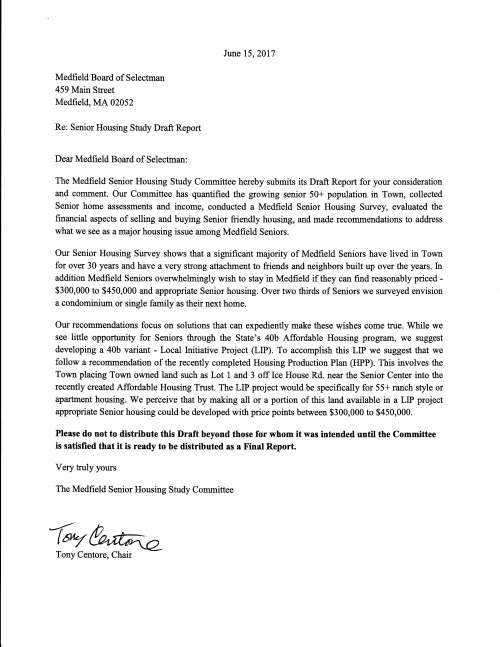
Given the meeting about senior housing this Thursday, people may want to see the Senior Housing Study Committee Report via the link below.

20170615-Senior Housing Study Committee-draft report

Medfield Board of Selectman 459 Main Street Medfield, MA 02052 Re: Senior Housing Study Draft Report Dear Medfield Board of Selectman: June 15, 2017 The Medfield Senior Housing Study Committee hereby submits its Draft Report for your consideration and comment. Our Committee has quantified the growing senior 50+ population in Town, collected Senior home assessments and income, conducted a Medfield Senior Housing Survey, evaluated the financial aspects of selling and buying Senior friendly housing, and made recommendations to address what we see as a major housing issue among Medfield Seniors. Our Senior Housing Survey shows that a significant majority of Medfield Seniors have lived in Town for over 30 years and have a very strong attachment to friends and neighbors built up over the years. fu addition Medfield Seniors overwhelmingly wish to stay in Medfield if they can find reasonably priced - $300,000 to $450,000 and appropriate Senior housing. Over two thirds of Seniors we surveyed envision a condominium or single family as their next home. Our recommendations focus on solutions that can expediently make these wishes come true. While we see little opportunity for Seniors through the State's 40b Affordable Housing program, we suggest developing a 40b variant - Local fuitiative Project (LIP). To accomplish this LIP we suggest that we follow a recommendation of the recently completed Housing Production Plan (HPP). This involves the Town placing Town owned land such as Lot 1 and 3 off Ice House Rd. near the Senior Center into the recently created Affordable Housing Trust. The LIP project would be specifically for 55+ ranch style or apartment housing. We perceive that by making all or a portion of this land available in a LIP project appropriate Senior housing could be developed with price points between $300,000 to $450,000. Please do not to distribute this Draft beyond those for whom it was intended until the Committee is satisfied that it is ready to be distributed as a Final Report. Very truly yours The Medfield Senior Housing Study Committee ~~ Tony Centore, Chair

Image

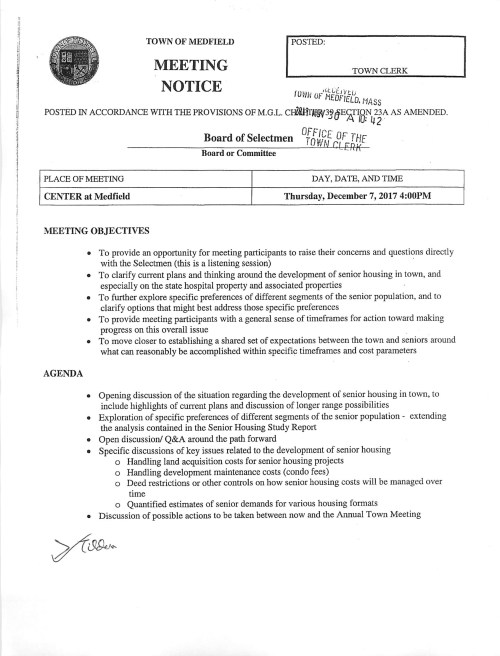
BoS Senior housing meeting 12/7

TOWN OF MEDFIELD MEETING NOTICE I POSTED: TOWN CLERK fOWJJ ·r'lf:U.i'ttu I u MEDFIELD. NASS POSTED IN ACCORDANCE WITH THE PROVISIONS OF M.G.L. cliaftrRJN3JfjE

Disturbing medical news

From Medpage Today

https://www.medpagetoday.com/blogs/revolutionandrevelation/69125

*********************************************************************


Who Actually Is Reviewing All Those Preauthorization Requests?

Milton Packer thinks you should know how the system works

  • by Milton Packer MD

Several months ago, I was invited to give a presentation about heart failure to a group of physicians who meet every month for a lunch meeting.

Don’t worry. No company sponsored the talk, and I did not receive any payment. I accepted the invitation, because it seemed like to good thing to do.

However, the audience was a bit unusual for me. Among the 25 physicians in the room, nearly all were in their 70s and 80s. All were retired, and none were actively involved in patient care. I guess that explains why they had time in the middle of the day for an hour-long presentation.

I gave my talk, but there were no questions.

I had a few moments afterwards to speak to my audience. Since the physicians were not involved in patient care, I wondered why they wanted to hear a talk about new advances in heart failure.

The response surprised me: “We no longer care for patients, but we care about what’s going on. You see, most of us are employed by insurance companies to do preauthorization for drugs and medical procedures.”

My jaw dropped: “I just gave a talk about new drugs for heart failure. Are you responsible for preauthorizing their use for individual patients?” The answer was yes.

I was really curious now. “So did I say anything today that was helpful? I talked about many new treatments. Did I say anything that you might use to inform your preauthorization responsibilities?”

Their answer hit me hard. “Oh, we’ve heard about those drugs before. We’re asked to approve their use for patients all the time. But we don’t approve most of the requests. Nearly all of them are outside of the guidelines that we are given.”

I stammered. “I just showed you evidence that these new drugs and devices make a real positive difference in people’s lives. People who get them feel better and live longer.”

The physicians agreed. “Yes, you were very convincing. But the drugs are too expensive. So we typically reject requests, at least the first time. We figure that, if doctors are really serious, then they should be willing to make the request again and again.”

I was astonished. “If the drugs will help people, how can you say no?”

Then I got the answer I did not expect. “You see, if it weren’t for us, the system would go broke. Every time we say yes, healthcare becomes more expensive, and that isn’t a good thing. So when we say no, we are keeping the system in balance. Our job is to save our system of healthcare.”

I responded quickly. “But you are not saving our healthcare system. You are simply making money for the company that you work for. And patients aren’t getting the drugs that they need.”

One physician looked at me as if I were from a different planet. “You really don’t understand, do you? If we approve expensive drugs, then the system goes broke. Then no one gets healthcare.”

Before I had a chance to respond, he continued: “Plus, if I approve too many expensive drugs, I won’t get my bonus at the end of the month. So giving out too many approvals wouldn’t be a smart thing for me to do. Would it?”

I walked out of the room slowly. Although I had been invited to share my knowledge, it turned out that — this time — I was the real student.

The physicians in the audience taught me a valuable lesson. And amazingly, none of them showed a single slide.

Packer has recently consulted for Amgen, Boehringer Ingelhim, Cardiorentis and Sanofi. He was one of the two co-principal investigators for the PARADIGM-HF trial (sacubitril/valsartan) and currently chairs the Executive Committee for the EMPEROR trial program (empagliflozin).

last updated

117 Comments