Category Archives: Planning

Townwide Master Planning Committee choses consultant

At its meeting last week the Townwide Master Planning  Committee selected the Community Circle group as the committee’s consultants for what is expected to be a year long process of creating a master plan for Town of Medfield.  Community Circle was one of two finalists that were interviewed that evening, and the committee’s vote was 11-1 to hire Community Circle over Horsley Witten.

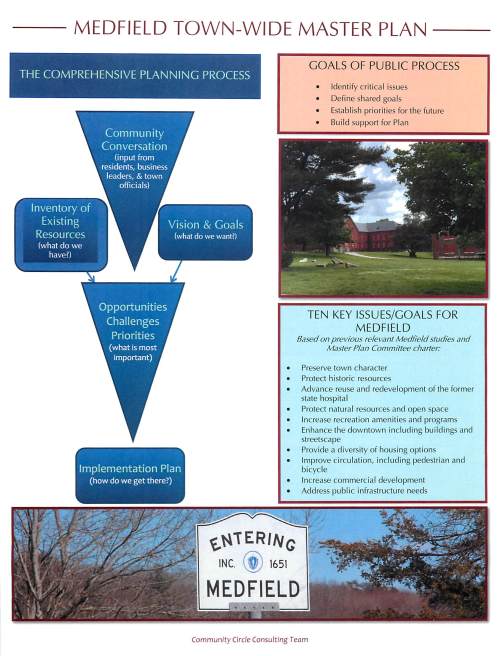
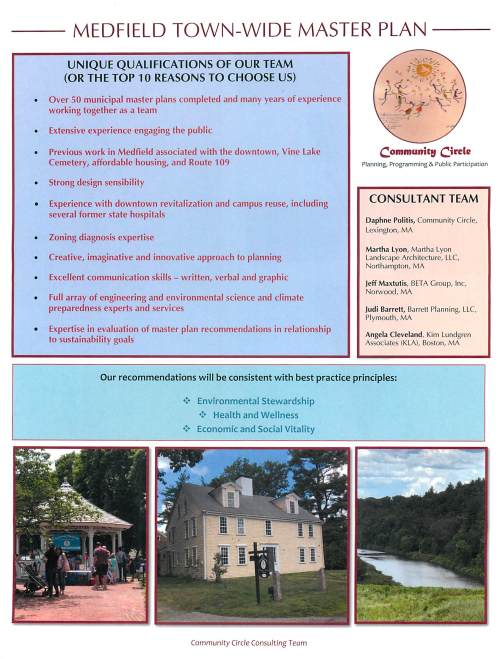
Community Circle shared the hand out below at the end of its presentation.  Start jotting down your issues and questions to incorporate into the Master Plan, as you will be asked to share them as the process evolves.

Community Circle Consulting Team20190627-Community Circle_Page_2


RFP issued for Townwide Master Planning Committee consultant


From the Townwide Master Planning  Committee – a tweet today by the Town of Medfield announcing our TWMPC’s RFP – Sarah said six firms were already on her distribution list –
Town of Medfield
@TownofMedfield


The Town of Medfield is seeking proposals for assistance in preparing a townwide master plan pursuant to MGL Ch 41 §81D with community participation. Proposals are due on Friday, May 24, 2019: town.medfield.net/DocumentCenter…

Image

MAPC’s MetroCommon 2050

MACP asked to have the following shared –

spark


There are some things your Metro Boston city or town can’t do on its own. Those issues are bigger than any one place, and working on them will take a plan. MetroCommon 2050 is just that: Metro Boston’s next regional plan. Your city or town is already involved. We want you to be in on it, too! This is Spark, a publication of MetroCommon 2050. Every month or so, Spark will bring you big ideas about the future  – and ask you to weigh in!


Find Out

What is MetroCommon 2050?

Watch our video to find out!


spark video


Weigh in

What do you want for the region’s future?

Tell us what you think of our draft goals.


Did you like Spark? Share it now!

The more people like you who get involved, the better the plan will be!

  • Forward this email
  • Share on Facebook by clicking here​.
  • Share on Twitter by clicking here.

Master Planning recommends demolition of town hall

Not a late April Fools joke, rather one of the recommendations from the 1964 Master Plan, that I am reviewing as part of work on the current Townwide Master Planning  Committee.  120 citizens participated on 9 subcommittees.

Other recommendations included:

  • moving both Routes 109 and 27.  Rte 109 was alternately recommended to follow either what we now call the Bay Colony Rail line or to go through Noon Hill.  Rte 27 was in fact built later where we know it, so as to bypass the heart of the downtown.
  • building a Waste Water Treatment Plant so as to avoid more of the bad odors from the town sewer beds as occurred in the summer of 1963.

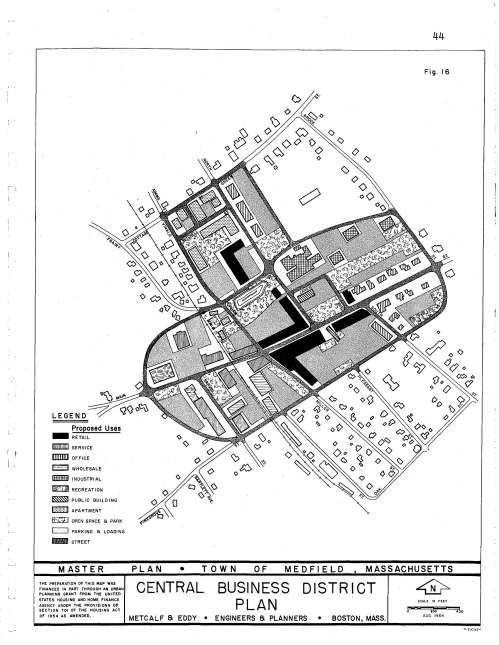
1964 Vision for Downtown

Downtown - from Master Plan Study Report No. 8 - 1964

See the typed 1964 Master Plan Study Report and a trove of historic planning documents that Sarah Raposa has put on-line at http://ma-medfield.civicplus.com/DocumentCenter/Index/114


Tear down this town hall – from the 1964 report:

Town Buildings and Lands

The town owns an excellent fire station and public
library but its other buildings (town hall, police station
and equipment garage) are in a poor condition. The refuse
disposal area is a subject of constant controversy.
As indicated by Fig. 12, we recommend the conversion
of North Street School to town offices and either the demolition
or sale of the present town hall. A new equipment
garage should be built in the vicinity of the existing sewage
beds. The police station should be first combined with the
town offices in the North Street building and at a later date
added as a wing to the present fire station. A second story
for use as a firemen’s dormitory will be needed on the fire
station when full-time personnel are required. An additional
fire station will be needed after 1975 in the southern portion
of the town. The present refuse disposal area should be converted
into a sanitary land fill operation, but consideration
should be given to moving the facility at a later date to a
site near the Charles River. The Kingsbury House area combined
with the Rhodendron Reservation presents a unique potential
opportunity for the town to create an Historical Center comparable
to either Sturbridge, Massachusetts, or Williamsburg,
Virginia.

Townwide Master Planning Committee

TMPC-20190227

Townwide Master Planning Committee
Committee Members

Member                            Representing 

Teresa James                    Planning Board
Jessica Reilly                     School Committee
Mary McCarthy                Conservation Commission
Tom Erb                             Permanent Planning and Building
Roberta Lynch                  Council on Aging
Kevin Ryder                      Park and Recreation
William Harvey               Water and Sewer Board
Michael Pastore               Warrant Committee
Jay Duncan, Chair            Citizen at Large
Jerry Potts                          Citizen at Large
Philip Stashenko               Citizen at Large
Laurel Scotti                      Citizen at Large
Sean Kay                             Citizen at Large
Cynthia Greene                 Citizen at Large
Matt Triest                          Citizen at Large
Osler L. Peterson               Board of Selectmen
Sarah Raposa, Ex Officio  Town Planner
Kristine Trierweiler, Ex Officio  Town Administrator

TMPC begins

First meeting of the Townwide Master Planning  Committee took place last night.  Impressive and talented group of residents volunteered, and will try to produce a master plan within the next year (if possible).  The emails below are from Town Planner, Sarah Raposa, who ran the meeting, and both explained how to launch a new town committee and how to do master planning.
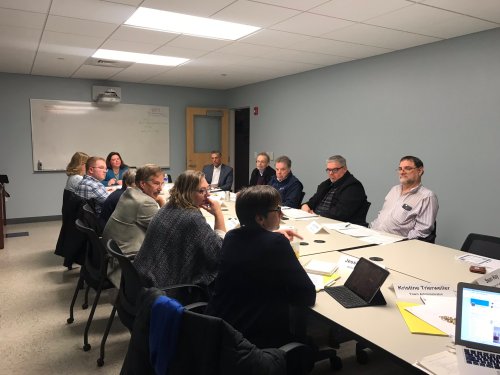
TMPC-20190227

Photo by Kristine Trierweiler


Hi – thank you all for completing the doodle poll. It took a little while because the committee is so big but we were able to get a quorum for the first two meeting dates. Please mark you calendars for the following:


The first meeting is scheduled for: Tuesday, February 26th at 7 pm at the Town Garage Training Room (55 North Meadows Road). Please park and enter on the Dale Street side of the building, not the salt shed side.


Agenda:

    • Introductions
    • Committee Charter
    • Process/Expectations
    • Schedule (bring your calendars!)
    • Draft RFP (Jay reviewing draft now, will send out soon)
    • CPTC Training


The second meeting is scheduled for: Tuesday, March 12th at 7 pm at the Town Garage Training Room (55 North Meadows Road).


Unfortunately not everyone will be able to attend every meeting so I urge folks to get in touch with me or a co-committee member for a debrief after a missed meeting.


In general meeting agendas will be emailed out in advance of the meetings but they may also be viewed HERE when they are posted with the town clerk (minutes are posted there as well.


A collection of recent master plans may be viewed HERE.

MAPC’s Community Engagement Guide HERE

Various Medfield Plans & Studies HERE (please take a look and if you think anything is missing, please let me know)


A MASTER PLAN:

  • Documents and illustrates what a community looks like today and what direction it has decided it wants to go for the future; it includes assessments of existing resources and issues, projections of future conditions and needs, and consideration of collective goals and desires.
  • Is a policy guide and provides a framework for future land use decision-making and the physical development of the municipality. It will not only address buildings and infrastructure, it will also include the important social, natural resource and economic values of the community. The Master Plan is a method of translating the community’s values into specific actions.
  • Covers an approximate time frame of 20 years; it is assumed that shorter-term reviews will keep it current with the changing needs of the community.
  • Is closely integrated with other municipal documents and initiatives.

The Master Plan is NOT a zoning ordinance, a subdivision regulation, a budget, a capital improvement program or other regulatory document. It is meant to provide the framework for the development of these implementation tools.

MGLChapter 41 Section 81D: Master plan; economic developmentsupplement

Section 81D. A planning board established in any city or town under section eighty-one A shall make a master plan of such city or town or such part or parts thereof as said board may deem advisable and from time to time may extend or perfect such plan.

Such plan shall be a statement, through text, maps, illustrations or other forms of communication, that is designed to provide a basis for decision making regarding the long-term physical development of the municipality. The comprehensive plan shall be internally consistent in its policies, forecasts and standards, and shall include the following elements:

(1) Goals and policies statement which identifies the goals and policies of the municipality for its future growth and development. Each community shall conduct an interactive public process, to determine community values, goals and to identify patterns of development that will be consistent with these goals.

(2) Land use plan element which identifies present land use and designates the proposed distribution, location and inter-relationship of public and private land uses. This element shall relate the proposed standards of population density and building intensity to the capacity of land available or planned facilities and services. A land use plan map illustrating the land use policies of the municipality shall be included.

(3) Housing element which identifies and analyzes existing and forecasted housing needs and objectives including programs for the preservation, improvement and development of housing. This element shall identify policies and strategies to provide a balance of local housing opportunities for all citizens.

  • HPP (2016)

(4) Economic development element which identifies policies and strategies for the expansion or stabilization of the local economic base and the promotion of employment opportunities.

(5) Natural and cultural resources element which provides an inventory of the significant natural, cultural and historic resource areas of the municipality, and policies and strategies for the protection and management of such areas.

  • Existing from OSPR

(6) Open space and recreation element which provides an inventory of recreational and resources and open space areas of the municipality, and policies and strategies for the management and protection of such resources and areas.

  • Conditionally approved OSRP

(7) Services and facilities element which identifies and analyzes existing and forecasted needs for facilities and services used by the public.

(8) Circulation element which provides an inventory of existing and proposed circulation and transportation systems.

(9) Implementation program element which defines and schedules the specific municipal actions necessary to achieve the objectives of each element of the master or study plan. Scheduled expansion or replacement of public facilities or circulation system components and the anticipated costs and revenues associated with accomplishment of such activities shall be detailed in this element. This element shall specify the process by which the municipality’s regulatory structures shall be amended so as to be consistent with the master plan.

Such plan shall be made, and may be added to or changed from time to time, by a majority vote of such planning board and shall be public record. The planning board shall, upon completion of any plan or report, or any change or amendment to a plan or report produced under this section, furnish a copy of such plan or report or amendment thereto, to the department of housing and community development.

A city or town which has an established master or study plan under section eighty-one A and applies for a state grant from the commonwealth shall prepare and keep on file within such city or town an economic development supplement; provided, however, that such city or town shall not be required to prepare such supplement if such city or town has a supplement on file. Such supplement shall be at least one page in length and shall contain the goals of the city or town with respect to industrial or commercial development, affordable housing, and preservation of parks and open space.


Sarah Raposa, AICP

Town Planner
459 Main Street
Medfield, MA  02052
(508) 906-3027
sraposa@medfield.net

www.town.medfield.net



On Wed, Feb 13, 2019 at 10:28 AM Sarah Raposa <sraposa@medfield.net> wrote:

Hi all – Thank you for agreeing to participate in the Townwide Master Planning Committee!

By now, you should have received your appointment slips from the Selectmen’s office. If not, please let me or Evelyn know. Carol Mayer, Town Clerk, will swear you in at your convenience – always best to phone ahead – and give you the appropriate forms to fill out (more about this at the end of the email).


HERE is the link to your committee webpage with current list of members and charter.


On behalf of chair pro tem, Jay Duncan, I wanted to get the first couple of meetings scheduled. The first meeting will be primarily introductory but we also want to schedule a master plan “training” for you. The training is sponsored by the Citizen Planner Training Collaborative (an extension of UMass Amherst) and it is geared towards folks like yourselves who serve on local planning boards, ZBA’s, master planning committees, etc. They will provide an experienced master planner to give a presentation and answer any questions that you may have.


Our initial hurdle is going to be aligning all of our schedules. Jay proposed the following dates on this Doodle Poll:

  • 2/19 (this one will be hard to schedule given Open Meeting Law requirements)
  • 2/25-28 (first meeting)
  • 3/11-14 (CPTC training)

Please indicate your availability to meet and provide notes on other regular obligations that we should try to avoid. Choices are yes, no or ‘if-need-be’. I added a traditional 7-9 pm time slot but also added a 6-8 pm option because sometime folks may have a 7 pm obligation but could meet for the first part of the meeting. It might not work given work schedules but I’m throwing it out there.


I’ve started drafting an RFP which we will send out with some additional master planning info shortly.


Those of you who serve on other committees will probably have done the online ethics training in the past but we need to get everyone’s certificates updated by April 5th. If you can find some time, please take the online training (please see email below for computer settings suggestions):  http://www.muniprog.eth.state.ma.us/

The entire online training takes approximately 60 minutes. If you’ve taken it before, you may be able to complete the quiz more quickly. Please print and submit your certificate to me via email or at an upcoming meeting.


Many thanks!
Sarah


Notice to All Municipalities Concerning the Conflict of Interest Law Education Requirements


Dear Municipal Clerks:


The annual conflict of interest law education and training requirements are again upon us.  The current compliance period runs December 2018 through April 5, 2019, unless your municipality has adopted a different compliance schedule.  For this compliance period, the following is required:


  1. The summary of the conflict of interest law for municipal employees should be distributed to all employees and written acknowledgments collected from the employees within 30 days; and
  2. All employees must again complete the online training program.


Summary of the conflict of interest law – Not attached; Carol will give you this info at your swearing in.

The summary of the conflict of interest law is attached to this notice.  Note that it was revised in November 2016 to clarify that town meeting members and charter commission members are not municipal employees subject to the conflict of interest law.  Summaries of the conflict of interest law are also available on the Commission’s website in Spanish and Portuguese translations  Remember that you may distribute the summary and collect the acknowledgments via email or through some other electronic means.


Online training program for municipal employees

All municipal employees should complete the Online Training Program for Municipal Employees and provide a completion certificate to their municipal employer.  The program can be found at http://www.muniprog.eth.state.ma.us/.  Please remember to inform your employees to disable pop-up blockers in their web browser before completing the online program or they may have difficulty printing a completion certificate.  Also, the program cannot be completed using a mobile device.  We ask that you provide your employees with the attached Notice to Municipal Employees which explains this and other computer settings requirements so that employees can complete the program and print a completion certificate.  The deadline to complete the online program is April 5, 2019.


If you have questions, please review the Education and Training Guidelines available on the Commission’s website, www.mass.gov/orgs/state-ethics-commission.  The guidelines provide helpful information about who is required to comply with these statutory requirements, record-keeping requirements, and the process to exempt certain municipal positions from these requirements.


Please note:  Charter schools are considered state agencies for the purposes of the conflict of interest law.  Charter school employees should complete the state/county online training program and acknowledge receipt of the summary of the conflict of interest law for state employees.


Thank you for your time and attention to this important matter.  If you have any questions, please call me at 617-371-9505 or email me at David.Giannotti@mass.gov.


Sincerely,


David


___________________________________________
David Giannotti

Public Education and Communications Division Chief

State Ethics Commission

One Ashburton Place, Room 619

Boston, MA  02108

617-371-9505

email: David.Giannotti@mass.gov

www.mass.gov/orgs/state-ethics-commission


Please note that my email address has changed to David.Giannotti@mass.gov.


Sarah Raposa, AICP

Town Planner
459 Main Street
Medfield, MA  02052
(508) 906-3027
sraposa@medfield.net

www.town.medfield.net
Volunteer on a Town of Medfield committee

town seal

Resolve in 2019 to get more involved in your community

The following Town of Medfield committees are looking for new members:

  • Medfield Energy Committee 
  • Conservation Committee
  • Council on Aging 
  • Master Planning Committee
  • Transfer Station and Recycling Committee


The Master Planning Committee is only just forming, so joining now gets you in from its first meeting – then lay out for the rest of us how the town should both develop and look in the future.

Climate Community Resilience Building Workshop – 1/31

This email from Town Planner, Sarah Raposa –

planning


Dear Medfield Residents, Board/Committee Members, and Colleagues –

The fall of 2018 was the wettest meteorological rainfall on record according to data collected at the Blue Hills Observatory since the 1800s and 2014-2017 were the hottest years on record. This combined with more unpredictable and severe weather events such as the four Nor’Easters in March 2018, our community may be at greater risk to climate change.

The Town of Medfield and the Metropolitan Area Planning Council (MAPC) cordially invite you to participate in preparing and protecting our community though a Community Resilience Building Workshop.

Climate Community Resilience Building Workshop
When:  Thursday, January 31, 2019

(Snow Date: Tuesday, February 5, 2019)
Where: Medfield High School, Room 125
88R South Street

Medfield, MA 02052
Time:    9:30 AM to 3:00 PM

Lunch and refreshments will be served.

The Workshop will bring together community members like you to reduce risk and improve climate resilience.  It is a participatory event where your local knowledge and expertise will:

  • Evaluate strengths and vulnerabilities of residents, infrastructure, and natural resources.
  • Create an action plan to protect citizens, neighborhoods, and businesses.
  • Prioritize climate actions most important to you and Medfield.

Please RSVP for the Workshop by January 28, 2019 to Sarah Raposa sraposa@medfield.net

I hope you can join me at this important workshop.
Thank you for your consideration!
Sarah


PS: Staff & Committee Chairs, please forward to your boards/committee members.

Apologies for duplicate notices.


Sarah Raposa, AICP

Town Planner
459 Main Street
Medfield, MA  02052
(508) 906-3027
sraposa@medfield.net

www.town.medfield.net
 

MAPC seeks input on planning 1/30

MAPC

MAPC Invites Residents to Planning Meeting

Wednesday, January 30, 2019, from 3:00 PM to 8:00 PM, at Castle Island Brewing Co., 31 Astor Ave, Norwood, MA 02062.

Dear Mr. Peterson:

On behalf of MAPC, thank you for coming to the first TRIC/MetroCommon 2050 gathering on November 30th in Dedham.

During both the breakfast and lunch sessions, MAPC staff noted everyone’s comments and concerns, which are now being cataloged, categorized, and analyzed. This input, along with what we’re hearing from local officials and representatives from across the region, will be woven into the MetroCommon vision.

PLEASE SAVE THE DATE:  Briefly referenced at the gathering, the next event where your community’s voice can be heard is planned for Wednesday, January 30, 2019, from 3:00 PM to 8:00 PM, at Castle Island Brewing Co., 31 Astor Ave, Norwood, MA 02062.  The event will be an open-house-style listening session for everyone: residents, the business community, non-profit organizations, etc.  Please spread the word to your networks.

Additionally, as a local representative, please consider attending the first event in our MetroCommon Speaker Series: an invigorating lecture and discussion with the nationally-renowned Richard Rothstein, author of The Color of Law, on Thursday, January 24, 2019, from 7:00 PM to 9:00 PM This should be of particular interest to local officials, as this topic is how government-imposed segregation laid the groundwork for today’s racial divisions in cities and suburbs, alike. Register here.

My best regards, and wishing you a Happy New Year,

Laurie

mapc email signature for laurie zivkovich

Plan to address our lack of a commercial tax base

I just responded to a great comment from Nic Scalfarotto, and since my general sense is that such comments and my replies are not likely seem by many, and sense Nic raised a big issue, I thought I would post both his comment and my reply here so more can see them.

Nic, I added a little more on as well.

========================================================

Nic Scalfarotto

User Info

Accepting that developing differential tax rates would not provide benefit to home owners because there is a small industrial base, a plan to address the lack of such a base needs to be developed and communicated to residents.

==============================================================

Plan to address our lack of a commercial tax base

As a new selectman, my first search was for businesses that wanted to locate in town, and when that did not seem a likely result, I have turned to having a town policy of building housing that is revenue positive to the town.

We know that people want to live in town, but mainly not build businesses here. The can make tax money and reduce our current residents’ taxes by building the kind of housing that is more profitable, such as Old Village Square (42 units paying over $600K/year in taxes, with one school child the last time I heard) or the two Larkin brothers projects (Glover Place off North Street and Chapel Hill on Hospital Road, again, both with few school children).

See the analysis that Kathy McCabe, the consultant to the Medfield State Hospital Master Planning Committee, did of the potential taxes to the town from leasing the lot 3 land the town owns on Ice House Road to build 42 units of senior housing versus leasing to a commercial facility, and the town netted either more than double or more that triple the taxes from the residential use over the sports complex, depending on whether the  housing was either 100% or 25% affordable, respectively.  Those results were summarized in Steve Nolan’s 1/2/2018 memo to the Board of Selectmen available here –20180102-SN-Memo to MSHMPC re HinkleyIce House Road v2 – final sent to BoS and inserted below as well.

I think that many of the friendly 40B projects that we are currently allowing in order to be in safe harbor, will be revenue positive. Statistically, we are told that we will likely average about 1.5 school children per in single family houses, while we will likely average 0.15 school children per unit in multifamily housing. So multifamily housing may well be revenue positive for the town, even if not age restricted.

Additionally, the town is already mainly single family homes, so we really do not need any more single family homes options, while we do not have a sufficient variety of other housing opportunities for residents, especially for seniors. Current proposals in the pipeline will assist at filling in that gap:
8 units on North Street (two developments)
36 units on Dale Street
16 units on Adams Street, age restricted
42 units at the Rosebay, age restricted
56 units (from memory) at The Legion site

However, such diversification of the tax base can only accomplish so much with respect to reducing our individual tax bills. The other issue with which we need to deal is the town’s willing to spend, witness our vote at the last annual town meeting (ATM) to increase our tax bills by about 10%, over the objections of the Board of Selectmen and the Warrant Committee.

===============================================

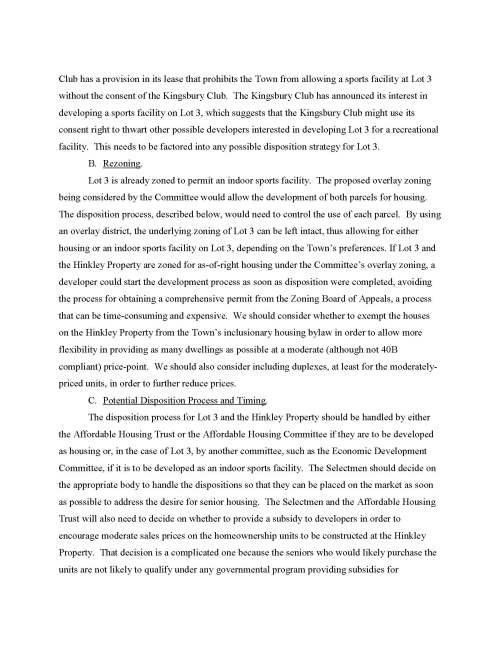
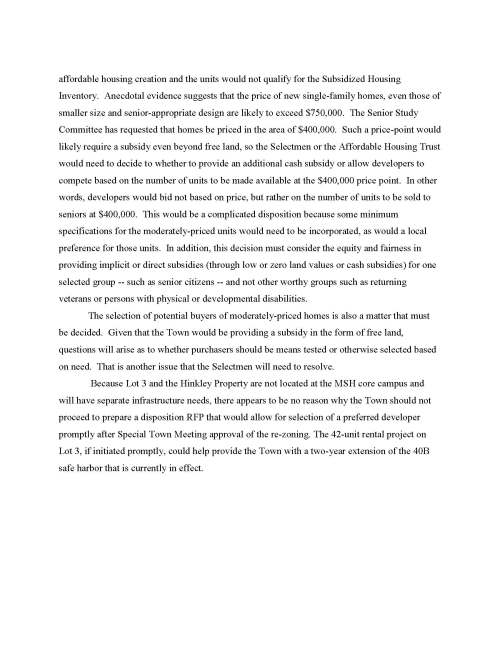
MEMORANDUM TO: Medfield State Hospital Master Planning Committee FROM: Stephen M. Nolan, Chair Medfield State Hospital Master Planning Committee RE: Hinkley Property and Lot 3, Ice House Road DATE: January 2, 2018 The original charge from the Board of Selectmen to the Medfield State Hospital Master Planning Committee (the "Committee") included Lot 3 on Ice House Road (“Lot 3”) and the adjacent Hinkley property (the “Hinkley Property”). It was our understanding that we were to take a fresh look at Lot 3 and the Hinkley Property in order to decide the most appropriate use for each parcel and how they might best be coordinated with the re-use plan for the Medfield State Hospital (“MSH”) core campus. It has since become clear that at least one of member of the Board of Selectmen believes that the best use for Lot 3 is an indoor sports facility, so that preference should be accommodated if possible in our final plan. A. Possible Uses of Lot 3 and the Hinkley Property. The consensus that has emerged from our public sessions, our meetings with the Council on Aging and the Senior Housing Study Committee and Committee deliberations is that the most desirable use for Lot 3 and the Hinkley Property is senior housing. The principal reasons for this are twofold: access to The Center and the possibility that a senior housing development could happen on a more expedited basis than the re-development of the MSH core campus because infrastructure is more readily available and the properties could be disposed of on an expedited track. The Council on Aging has expressed potential willingness to cede a small portion of the land at the corner of The Center adjacent to the Hinkley Property for purposes of enhancing the development potential of the Hinkley Property. The possible use of Lot 3 as an indoor sports facility on the other hand would respect a past Town Meeting vote to devote Lot 3 to an indoor sports facility and would increase the commercial tax base of the Town. On the latter point, our consultant, Kathy McCabe, did some research on the likely tax revenue from such a facility. Since the developable area of Lot 3 is only approximately 4.8 acres, the lot cannot support a large facility. Based on a survey of indoor sports facilities in MetroWest, it appears that a site of approximately 5 acres can likely support a facility of 100,000 square feet or less. The Forekicks facility in Norfolk is approximately 83,000 square feet and has a tax valuation of $5,000,000. Using that valuation as a basis for comparison, a 100,000 square foot facility would have a valuation of approximately $6,000,000, which would produce annual tax revenue of approximately $100,000. Kathy McCabe estimates that a 100% affordable senior rental housing project with 42 units would produce annual tax revenue of approximately $240,000 and the same project with only 25% of the units affordable (which would still qualify as 42 affordable units on DHCD’s Subsidized Housing Inventory) would produce annual tax revenue of approximately $320,000. So the revenue to the Town from a senior housing project would likely be significantly greater than the tax revenue of an indoor sports complex. This revenue must be off-set, however, by municipal expenses, which for 42 units of housing would be approximately $108,000 (assuming no school children). We have not been able to quantify the additional municipal services (traffic control, emergency services, road maintenance, snow-plowing) from a sports facility, but they should be factored into the cost-benefit analysis at some point. Even ignoring those costs, the net impact of a 100% affordable senior rental project would be at least $30,000 greater than an indoor sports facility while a 25% affordable senior rental project would be at least $110,000 more favorable to the Town budget than an indoor sports complex. Other possible impacts to be considered include traffic. Our consultant has advised that a sports facility on Lot 3 would create considerably greater traffic and possible over-flow parking than a 42-unit senior rental housing project, which could negatively impact The Center and a possible senior-appropriate homeownership development at the Hinkley Property. For example, parking at Forekicks in Norfolk requires about 1.7 acres, roughly equivalent to the size of the facility itself. Ingress and egress to and from the Norfolk Forekicks parking lots is a very serious problem during change-over times when cars are both entering and exiting the facility. In inclement weather conditions with snow and ice the traffic impacts are even worse. One other factor to be considered in deciding the possible use of Lot 3 is the Town’s disposition process. The difficulty in disposing of Lot 3 for a sports facility is that the Kingsbury Club has a provision in its lease that prohibits the Town from allowing a sports facility at Lot 3 without the consent of the Kingsbury Club. The Kingsbury Club has announced its interest in developing a sports facility on Lot 3, which suggests that the Kingsbury Club might use its consent right to thwart other possible developers interested in developing Lot 3 for a recreational facility. This needs to be factored into any possible disposition strategy for Lot 3. B. Rezoning. Lot 3 is already zoned to permit an indoor sports facility. The proposed overlay zoning being considered by the Committee would allow the development of both parcels for housing. The disposition process, described below, would need to control the use of each parcel. By using an overlay district, the underlying zoning of Lot 3 can be left intact, thus allowing for either housing or an indoor sports facility on Lot 3, depending on the Town’s preferences. If Lot 3 and the Hinkley Property are zoned for as-of-right housing under the Committee’s overlay zoning, a developer could start the development process as soon as disposition were completed, avoiding the process for obtaining a comprehensive permit from the Zoning Board of Appeals, a process that can be time-consuming and expensive. We should consider whether to exempt the houses on the Hinkley Property from the Town’s inclusionary housing bylaw in order to allow more flexibility in providing as many dwellings as possible at a moderate (although not 40B compliant) price-point. We should also consider including duplexes, at least for the moderately-priced units, in order to further reduce prices. C. Potential Disposition Process and Timing. The disposition process for Lot 3 and the Hinkley Property should be handled by either the Affordable Housing Trust or the Affordable Housing Committee if they are to be developed as housing or, in the case of Lot 3, by another committee, such as the Economic Development Committee, if it is to be developed as an indoor sports facility. The Selectmen should decide on the appropriate body to handle the dispositions so that they can be placed on the market as soon as possible to address the desire for senior housing. The Selectmen and the Affordable Housing Trust will also need to decide on whether to provide a subsidy to developers in order to encourage moderate sales prices on the homeownership units to be constructed at the Hinkley Property. That decision is a complicated one because the seniors who would likely purchase the units are not likely to qualify under any governmental program providing subsidies for affordable housing creation and the units would not qualify for the Subsidized Housing Inventory. Anecdotal evidence suggests that the price of new single-family homes, even those of smaller size and senior-appropriate design are likely to exceed $750,000. The Senior Study Committee has requested that homes be priced in the area of $400,000. Such a price-point would likely require a subsidy even beyond free land, so the Selectmen or the Affordable Housing Trust would need to decide to whether to provide an additional cash subsidy or allow developers to compete based on the number of units to be made available at the $400,000 price point. In other words, developers would bid not based on price, but rather on the number of units to be sold to seniors at $400,000. This would be a complicated disposition because some minimum specifications for the moderately-priced units would need to be incorporated, as would a local preference for those units. In addition, this decision must consider the equity and fairness in providing implicit or direct subsidies (through low or zero land values or cash subsidies) for one selected group -- such as senior citizens -- and not other worthy groups such as returning veterans or persons with physical or developmental disabilities. The selection of potential buyers of moderately-priced homes is also a matter that must be decided. Given that the Town would be providing a subsidy in the form of free land, questions will arise as to whether purchasers should be means tested or otherwise selected based on need. That is another issue that the Selectmen will need to resolve. Because Lot 3 and the Hinkley Property are not located at the MSH core campus and will have separate infrastructure needs, there appears to be no reason why the Town should not proceed to prepare a disposition RFP that would allow for selection of a preferred developer promptly after Special Town Meeting approval of the re-zoning. The 42-unit rental project on Lot 3, if initiated promptly, could help provide the Town with a two-year extension of the 40B safe harbor that is currently in effect.20180102-SN-Memo to MSHMPC re HinkleyIce House Road v2 - final sent to BoS_Page_220180102-SN-Memo to MSHMPC re HinkleyIce House Road v2 - final sent to BoS_Page_320180102-SN-Memo to MSHMPC re HinkleyIce House Road v2 - final sent to BoS_Page_4