Category Archives: health

Interface is live

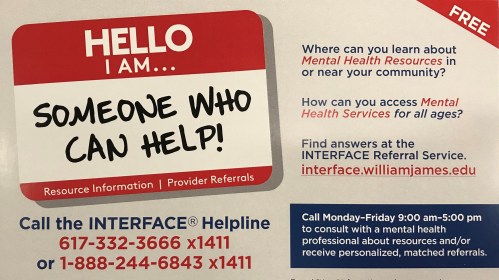
Interface, the mental health referral service brought to town by the combined efforts of the schools and police is now operational, and residents can get services.

Interface

The following is from the Superintendent’s blog  –

This post will highlight our new partnership with Interface Referral Service

Medfield Public Schools and Town of Medfield Collaborate to Fund Interface


We are pleased to announce a new referral service for all students and residents of Medfield. The Medfield Public Schools and the Town of Medfield have teamed up with William James College to provide a referral service that provides a wide range of valuable resources related to mental health and wellness for the benefit of children, adults and families, as well as educators and mental health professionals.

In addition to the resources on their website, the William James Interface Referral Service maintains a mental health and wellness referral helpline Monday through Friday, 9 am-5 pm, at 888-244-6843 (toll free). This is a free, confidential referral service for individuals across the lifespan living in Medfield. Callers are matched with licensed mental health providers from their extensive database. Each referral meets the location, insurance, and specialty needs of the caller. More information about the service and terms of confidentiality can be found here on the new Interface- Medfield page.


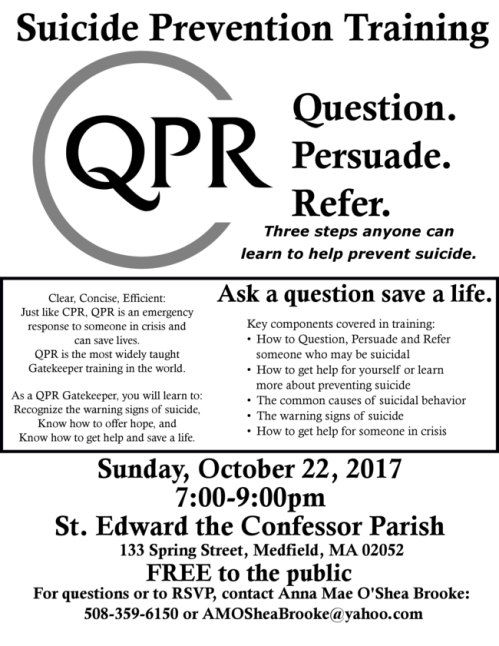
QPR Training: Suicide Prevention this Sunday 7-9pm

From Anna Mae O’Shea Brooke –

===============================================================

Dear Medfield Community Member,

Suicide is difficult to discuss and most of the time simply unimaginable, but the reality is that it can happen to people we know and love. This training is an effort to empower us to build awareness and prevent this from happening.

The training is FREE to EVERYONE in our community:

Sunday, October 22 from 7-9pm

RSVP here

“Just like CPR, QPR is an emergency response to someone in crisis and can save lives.”

QPR

=================================================================

Pete personal note – I volunteered on a telephone crisis line and ran its training program for several years, incorporated and then served on the board of Riverside Community Care (our local community mental health center) for 20 years, and I recently took a QPR training – and I found the QPR training useful.

Drugs are best treatment for opioid abuse

I have been wondering what the best solution was for opioid addiction, and this article makes a good argument for using methadone, Suboxone, and one other drug as the most successful method.

CW

                     10.15.17


THE UPLOAD


Drugs are best treatment for opioid abuse


Edward M. Murphy


The opioid addiction crisis in the United States has prompted leaders at the state and federal level to promise more money, new laws, and greater focus on the problem. That focus is needed but so far the policy goals lack clear definition. Even as attention on the problem has ramped up, we have continued to treat addiction in ways that have historically not worked well. Doing more of something that’s not working will not correct the problem. If the policy goal is to create treatment interventions that reduce abuse, lower the rate of remission, and restore patients as much as possible to normal living, there is extensive medical research and practical clinical experience suggesting medication-assisted treatment, or MAT, is the way to go.


Aside from emergencies, traditional addiction treatment in the United States is often not medical in nature but guided by the principles derived from 12-step programs. The goal of these programs, which are characterized by admirable spiritual and moral ideals, is complete abstinence driven by self-discipline and support from peer groups. This approach does not work well for people with opioid dependence. As long ago as 1997, National Institutes of Health experts concluded that “opioid addiction is a treatable medical disorder and explicitly rejected notions that addiction is self-induced or a failure of willpower.” The approach recommended by the National Institutes of Health and virtually all other medical and scientific sources is medication-assisted treatment.


Medication-assisted treatment means using one or more pharmacological agents to relieve the symptoms and risks of addiction, enabling patients to begin returning to normal life and to benefit from other behavioral therapies. The treatment is not a magic bullet and MAT does not guarantee success, but it has a substantially higher rate of positive outcomes than traditional non-medical treatment programs. A team of physicians writing in the New England Journal of Medicine likened medication-assisted treatment to the care needed for “other chronic diseases such as diabetes and hypertension,” where “effective treatment and functional recovery are possible.”


Because of the stigma associated with drug abuse and the traditional stereotype of the addict, some people find it counter-intuitive to use medication to treat addiction. But when scientists explain how the brain responds to the excessive use of heroin or pain pills, the logic of addressing the pathology with an appropriate medication is persuasive.


Opioids attach themselves to receptors in the brain and artificially generate excessive quantities of the neurotransmitter dopamine, producing feelings of euphoria. Addiction is the result of the brain “learning” this new behavior through excessive repetition until it becomes dependent on the artificial effect and craves more.


The argument that experts make for medication-assisted treatment is that managing the brain’s new habit and mitigating the effects of withdrawal will not happen just because a person wants to stop abusing opioids. The process requires a kind of neurological reverse-engineering that can relieve the brain’s urgent need for more drugs. In the absence of appropriate medication, a significant majority of addicts who go through short-term detox will relapse, often multiple times.


There are three medications used in treating opioid addiction. The best known is methadone, which was initially developed in the 1940s as a pain reliever. Because it works by changing the way the brain perceives physical and psychological pain, methadone was soon used to provide people dependent on heroin with a way to manage their withdrawal and to stabilize their lives. Methadone is a synthetic opioid although it does not produce the same high as abused opioids. It is effective but often poorly perceived in the wider community because of its long association with heroin and because people suffering from an addiction disorder normally must go to a registered clinic daily to receive their dosage.


A second medication, buprenorphine, is now gaining wider acceptance among experts. Buprenorphine is called a “partial agonist,” which means that it activates the same receptors as abused opioids but produces a much weaker effect. Essentially the brain is fooled into believing that its opioid craving is met but this happens without the pattern of withdrawal and euphoria that is typical of addiction. The medication is delivered via a daily pill or a strip placed under the tongue and can be prescribed by physicians who have special authorization and training. Patients normally have a month’s supply to take at home. The most common form of this medication, sold under the trade name Suboxone, has a second element that causes unpleasant symptoms in a patient who relapses and takes another opioid.


The third current option is called naltrexone, sold under the trade name Vivitrol. This is an “antagonist” medication that works in a different way than buprenorphine. Instead of fooling the brain receptors, it blocks them so that a patient who relapses cannot trigger those receptors and experience a high. It is administered by monthly injection and can only be given to patients who are already completely detoxed. Vivitrol is increasingly used in criminal justice settings, particularly for previously addicted inmates who will shortly return to their communities.


Each medication has various dosages, side-effects, advantages, and disadvantages depending on the condition of the patient and the arc of his or her addiction history. Only a physician who fully understands the patient’s needs, matches them to the characteristics of the medications, and carefully monitors the ongoing results should make the decision about how best to exploit medication-assisted treatment for the benefit of individuals who need it. Many patients also need to receive psychosocial counseling to help them build on the opportunity provided by the medication.


The National Institute on Drug Abuse summarizes the available research by concluding that medication-assisted treatment has multiple advantages over other forms of treatment and “decreases opioid use, opioid-related overdose deaths, criminal activity, and infectious disease transmission.” Further, MAT “increases social functioning and retention in treatment.” One important study, a randomized, controlled trial published in 2015 by a researcher associated with Harvard Medical School and McLean Hospital, demonstrated that MAT “at least doubles rates of opioid-abstinence” compared with other forms of treatment.


Unfortunately, the treatment endorsed by experts as offering the highest probability of success in moderating the impact of the opioid crisis is not widely available. A health care system normally driven by evidence of clinical efficacy has not organized itself to deliver the care needed by the millions of Americans who suffer from opioid-use disorder. A report issued by the Pew Charitable Trust found a “treatment gap” in which only 23 percent of publicly funded addiction treatment programs and less than half of private sector programs offer MAT. This lack of availability was attributed to inadequate funding and a dearth of qualified providers.


There are additional reasons for the gap. One is the persistent opinion that relying on medication to treat addiction is a morally compromised approach. A psychologist writing last year in Psychology Today articulated this view by saying that “recovery should be about breaking free from all substances.” He also raised the so-called crutch argument, asking if MAT isn’t simply “transferring from one drug to another.” According to this line of thinking, using any drug to aid in treatment is simply switching dependency from one substance to another and is a sign of weakness. This perspective rejects the analogy that using medication to treat addiction is like using insulin to treat diabetes.


It is a sad commentary on our approach to opioids that addicts have easy access to quality medical care when they overdose but not before. According to the Centers for Disease Control and Prevention, more than 1,000 people are treated in US emergency rooms every day for misuse of prescription opioids. Many more are treated in emergency rooms for the use of such drugs as heroin and fentanyl. The trend is strong in Massachusetts, which ranks at the top among states when measured by opioid-related emergency room visits. Approximately 64,000 Americans, including 1,933 in Massachusetts, died from overdoses in 2016. Hundreds of thousands more were saved by the intervention of clinical professionals. Our health care system is improving at helping people dependent on opioids to survive emergencies, but it is still weak in helping them to recover and live normal lives.


As important as it is to save people’s lives, we will not have a successful policy responding to the opioid crisis until we mitigate the psychological, economic, and societal consequences suffered by living victims of opioid use disorders, their families, and their communities. That requires a highly organized system for quick and comprehensive delivery of the best clinical interventions available.


Some people receiving medication-assisted treatment will fail to comply with the recommendations of their physicians, just as some diabetics do when they consume too much sugar or neglect to take their insulin. The correct response is not to punish them by denying medication and thereby subjecting them to the torment of their disease. The best antidote is sustained availability of high-quality care designed to bring each patient as close as possible to normalcy.


Edward M. Murphy was head of three state agencies between 1979 and 1995—the Department of Youth Services, the Depart-ment of Mental Health, and the Health and Educational Facilities Authority. He subsequently ran several health care companies in the private sector before retiring. 


Mass. citizens point the way on climate change


— Jamie Eldridge and Emily Norton


You get what you pay for


Louis Antonellis


Pipeline gas report is inaccurate, misleading


Thomas Kiley


First lesson this school year must be civility


Todd Gazda


Are homes only for the upper class?


– Tim Sullivan


Colleges can’t be bystanders on opioids


Janie L. Kritzman


The Upload is a newsletter of commentary from CommonWealth. We welcome opinion pieces.

Please submit them to either Bruce Mohl, at bmohl@massinc.org, or Michael Jonas, at mjonas@massinc.org. Include your contact information.


MassINC | 11 Beacon Street, Suite 500, Boston, MA 02108
Unsubscribe osler.peterson@verizon.net
Update Profile | About our service provider
Sent by amiddle@massinc.org

Parental skills training tonight

From Medfield Cares About Prevention (MCAP) yesterday –

All parents welcome

You are welcome to attend and bring other parents/adults who care about Medfield youth with you.  If you could tweet about this, post to your facebook pages, blogs, share from Medfield Youth Outreach’s facebook page or MCAP’s it would be so very helpful.  This is coming together quickly due to the needs of hurting parents in the community and literally just gained final approval this evening.  This rose organically from the community. Let’s get behind it and spread the word!

Medfield Youth Outreach


Open Invitation For All Parents:

St. Edward Church of Medfield warmly welcomes Jim McCauley, LICSW, from Riverside Trauma Center for an evening where parents can develop their skills in navigating conversations with youth about depression and feelings of hopelessness. The Regional MetroWest data supports that youth are reporting more stress and that some have reported depressive symptoms and thoughts of suicide (MWAHS, 2016).  Parents have been reaching out community wide for ways to have meaningful conversations with their youth about these issues and to find pathways to build greater support in the community.

This evening is sure to be a dialogue to empower Medfield families in navigating these discussions and finding resources for the future.


Please join us on TUESDAY, JUNE 20TH AT 7PM AT ST. EDWARD CHURCH.  For more information please contact St. Edward Church: 508-359-6150 or amosheabrooke@stedward-ma.org.

Childcare available for ages 4+.


RSVP here


All community parents are welcome.


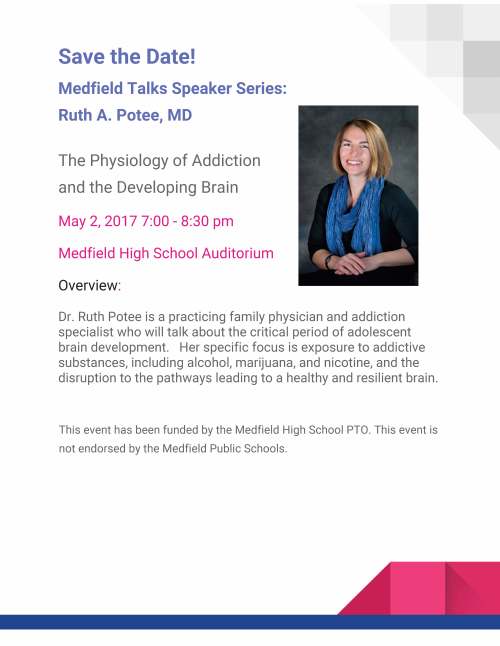
Dr. Ruth Potee tomorrow night

I heard Dr. Potee speak over a year ago, and she is really good.  This is the flyer –

Save the Date! Medfield Talks Speaker Series: Ruth A. Potee, MD The Physiology of Addiction and the Developing Brain May 2, 2017 7:00 - 8:30 pm Medfield High School Auditorium Overview: Dr. Ruth Potee is a practicing family physician and addiction specialist who will talk about the critical period of adolescent brain development. Her specific focus is exposure to addictive substances, including alcohol, marijuana, and nicotine, and the disruption to the pathways leading to a healthy and resilient brain. This event has been funded by the Medfield High School PTO. This event is not endorsed by the Medfield Public Schools.

E-cigarettes

aaj

This article is from my American Association for Justice monthly magazine –


Trial

Theme Article

E-cigarettes spark litigation

November 2016 – Annesley H. DeGaris

Since hitting the market several years ago, e-cigarettes have rapidly become a popular alternative to cigarettes. But they raise safety questions—from product defects to chemical exposure.

E-cigarette use has surged among all age groups, with proponents hailing the devices as a safer alternative to cigarettes. But continuing research raises increasing safety concerns. As more cases alleging product defects and other claims are being filed, it is important to have a basic understanding of ­e-cigarettes and their safety issues.

An e-cigarette is a device that releases vaporized nicotine that is then inhaled—a process known as “vaping.” Typical e-cigarettes include a battery, atomizer, nicotine cartridge, LED light, and sensor. The sensor determines when the consumer starts to inhale and causes the battery to power the atomizer, which heats up the “e-liquid” and turns it into a vapor. The nicotine cartridge holds the e-liquid, a fluid that typically consists of nicotine, a diluent such as propylene glycol or vegetable glycerin, and a flavoring.1

E-liquids come in many flavors, with names targeted to appeal to children, such as “Strawberry Fields” and “Smurfberry.” E-liquid manufacturers also offer tobacco- and menthol-flavored e-liquids to help market the device for smoking cessation.

In 2008, e-cigarette companies raked in $20 million in sales.2 The 2016 e-cigarette­ market is projected to be worth more than $4 billion.3 And experts believe that e-cigarette sales will eclipse cigarette sales within 10 years.4

Between 2010 and 2013, the percentage of adults using e-cigarettes more than doubled.5 Between 2013 and 2014, the percentage of teens in middle school and high school using e-cigarettes tripled.6 One study found that 24.6 percent of high school students surveyed reported current use of a tobacco product, with e-cigarettes being the most common.7

E-cigarettes have become so widespread that the U.S. Department of Housing and Urban Development has considered banning their use in public housing units,8 the U.S. Department of Transportation treats the devices as cigarettes and prohibits vaping on airplanes, and the FDA recently issued new regulations.9

Hazards: Known and Unknown

Several safety hazards have been associated with e-cigarettes, including exploding devices and potential toxic chemical exposure. Although the FDA recognizes some particles in e-vapor as generally safe for ingestion, no studies have determined the particles’ effects when inhaled.10 But reports of adverse health events include hospitalization for pneumonia, congestive heart failure, disorientation­, seizure, hypotension, and nicotine poisoning.11 Early studies suggested that vaping is as safe as breathing normal air,12 but more recent studies show that the cancer risks are similar to those of traditional cigarettes.13

E-cigarettes with variable voltage pose an additional risk. Vaping at a high voltage has an estimated cancer risk five to 15 times as high as the risk associated with long-term cigarette smoking.14 Most variable-voltage e-cigarettes use 3.7 volt batteries, as do standard e-cigarettes. The difference is that a variable-voltage e-cigarette has a circuit that stores and regulates power from the battery, delivering it to the atomizer tank at the voltage the consumer chooses.

The higher the voltage, the greater the nicotine kick—but also a greater exposure to certain chemicals.15 Specifically, the e-cigarette’s battery heats the propylene glycol and glycerin in the e-liquid to the point of decomposition, causing the formation of carcinogens such as formaldehyde.16

Diacetyl is another concerning chemical. It is used to flavor e-cigarettes and has been found in more than 75 percent of the devices and their refill liquids.17 Diacetyl is linked to severe respiratory disease such as bronchiolitis obliterans—also known as “popcorn lung” because of its diagnosis in workers at microwave-popcorn-processing factories who inhaled the chemical, used in artificial butter flavoring.18

Recent research has called attention to other health concerns: e-cigarettes may lead to tumor growth;19 high levels of inhaled nanoparticles can cause inflammation and are linked to asthma, stroke, heart disease, and diabetes;20 and accidentally ingesting the e-liquid may lead to nicotine poisoning. This year, poison control centers have received more than 1,000 reports of potential liquid nicotine poisoning.21 In 2014, more than 50 percent of liquid nicotine poisoning calls involved children under age six.22

Another source of injury is exploding devices. The culprit is the lithium-ion battery. Similar to problems seen in laptops and cellphones, the batteries are prone to overheating. Extreme temperatures can cause the batteries to malfunction.23 When overheated, the cylindrical shape of e-cigarettes may propel the device, contributing to the risk of explosion and fire.24

FDA Regulations

Although e-cigarettes have been on the market for several years, the FDA only introduced regulations earlier this year; they became final on Aug. 8, 2016.25

The regulations already placed on traditional cigarettes—such as disclosing all ingredients, including health warnings on product packages, and requiring that all purchasers (online and in stores) be at least 18—are now applicable to all e-cigarettes.26 As part of the regulations, the agency must approve all tobacco products, which includes e-cigarettes, that were not commercially marketed by Feb. 15, 2007.27

The regulations apply to all manufacturers, distributors, sellers, and anyone else involved with the e-cigarette industry. Manufacturers will have to register with the FDA and provide a list of ingredients that the agency will review for approval. Manufacturers have argued that only those few businesses that can afford to comply will survive.28 At least one manufacturer lawsuit has been filed against the FDA seeking to have the rules vacated and declared unlawful.29

Emerging Litigation

E-cigarette litigation is varied and still in the early stages. Plaintiffs have brought cases alleging false advertising, lack of health warnings, and personal injuries—including lung disease, nicotine poisoning, and combustion of devices and batteries that caused severe burns.

Some causes of action, such as consumer fraud and deceptive trade practices, depend on the vagaries of state law, with some states—such as California—being more advanced in the nature and range of applicable consumer protection statutes. Products liability actions include claims for defective design and inadequate warnings.30

The first e-cigarette explosion lawsuit was tried in September 2015. The jury awarded the plaintiff nearly $1.9 million after the device exploded in her car, causing second-degree burns.31 Other cases involve an e-cigarette exploding in the plaintiff’s mouth, requiring doctors to surgically repair the plaintiff’s tongue and amputate a finger;32 and an e-cigarette that exploded and set a room on fire, creating a large hole in the plaintiff’s cheek.33

Several class actions also have been filed, including one in California alleging dangerous levels of diacetyl and other chemicals34 and lack of warning labels about the known links to popcorn lung, emphysema, and chronic obstructive pulmonary disease.35 Other class actions have alleged false advertising and marketing claims about e-cigarettes’ ability to help users quit smoking, failure to warn or inform consumers of associated health risks, and misleading consumers about e-liquid ingredients and their safety.36

Although litigation is still developing, when screening a potential case, plaintiff attorneys should consider issues that are common to products liability cases. Preservation of the device—including the battery and charger, which are sometimes sold separately from the device—and establishing a proper chain of custody in an explosion case, for instance, must be scrupulous. The early and careful gathering of all of a plaintiff’s medical records will be key, regardless of whether the plaintiff was injured by an exploding device or from exposure to chemicals.

As in any case, client screening is crucial. Ask potential clients about any modifications they made to the device. Selecting causation experts will require careful research—especially in exposure cases given the emerging science of e-cigarette toxins and the strictures of Daubert. Although device manufacturers are obvious defendants, many are located outside the United States. You should look into bringing defective design and inadequate warning claims against local retailers and distributors.

The e-cigarette is a nicotine-delivery device, and its growing popularity has revealed major products liability issues. Although FDA regulation of these devices should be applauded, history shows that the civil justice system often can create the necessary change faster than government regulation. With this device, both are needed.


Annesley H. DeGaris is a partner at DeGaris & Rogers in Birmingham, Ala. He can be reached at adegaris@degarislaw.com.

No ALS in town

ambulance

The Medfield Fire Department runs an Emergency Medical Service (EMS), staffed by EMT’s (Emergency Medical Technicians), who are also firefighters.  We have historically utilized Advanced Life Support (paramedic) intercepts  – i.e. the MFD EMT’s will begin the patient transport and transfer the patient to the ALS ambulance when the ALS ambulance intercepts the MFD ambulance on the way to the hospital.  However, within the past two months, two ALS services have cancelled their ALS intercept services with Medfield, because the intercepts were not making enough money, and as a result we currently have no ALS intercept service,.  And we are told,  with the economies making it unlikely that there will be any new ALS offers.

Our EMT’s now transport patients all the way to the hospital.  So what is the difference?  MFD ambulance EMT’s offer fewer services to someone than a paramedic could supply.  As I understand the differences, it is mainly in the ability of paramedics to administer medications, provide shots, and insert IV’s.

Like the author of the email below, I personally met a young Medfield man, at a BSA event, who I was told is alive today, after his heart stopped, only because he was revived by paramedics.

The town will need to make the decision whether it values having a paramedic service enough to pay for it, and if so, how it wants to achieve that change.  One resident who works in another town’s fire department suggested to me several years ago that the town could give its current EMT’s three years to become paramedics.  Becoming a paramedic requires a 1,400 hour training process:  600 hours of classroom work, 400 hours of clinical, and 400 hours of field work.  Such a work change would have to go through the collective bargaining process.  Alternately, the writer below suggest hiring eight new paramedics and having them run the town’s ambulance service, and having the current EMT’s remain as just firefighters.  The MFD would thereby double its size.


Paul Enos <paul.c.enos@gmail.com>
To: eclarke@medfield.net
Dear Medfield Selectmen,
Evelyn Clarke <eclarke@medfield.net>
Mon, Oct 31, 2016 at 12:52 PM
I am writing to formally request the hiring of 8 firefighter/paramedics and the implementation of an Advanced Life Support ambulance be implemented to the Medfield Fire Department services. Many residents I have spoken with would like this matter added to the November 1st Town Meeting Agenda. It is a dangerous gap in our towns services and absolutely must be rectified immediately.

I would like to provide you a personal example of how ALS can impact the survival of a 911 patient. Seven years ago my father and I were working to replace some windows of his Needham home. After about an hour of work in the sun, my father collapsed. He immediately woke and told me he felt dizzy. I called 911 and moved him into a shaded area where I took his blood pressure, which fell to 50/null. How helpless I felt in the moments leading to that point – being a paramedic myself and having no equipment or manpower to help me find out what had gone wrong with my father. Every second felt like eternity, as it does when you are in a crisis. My father soon again went unresponsive when Needham Fire Department Paramedics arrived and began treatment. Within two minutes of patient contact, my father was properly assessed, placed on ECG monitoring, had an IV line established, and fluids initiated to bring his pressure up. It was discovered that his body reacted poorly to being placed on HCTZ (a diuretic) and when coupled with a hot day in the sun, lead to dangerously low blood pressure due to dehydration. If Needham paramedics had not responded and treated my father on site, I believe he would have died that day as his pressure was so low he was subject to cardiac arrest. My father, again, just this past year, required the Needham ALS ambulance when he fell and broke his forearm in 2 places, dislocated his elbow, and fractured his spine. The paramedics could not have moved him without administering narcotics to manage the immense pain he was in that day. ***Every stated skill that was performed on my father in these two instances, are ALS skills, and would not have been provided in the town of Medfield.*** Knowing my family has required these services in the past, and likely will again in the future, I would never recommend my parents move to Medfield. Not until the town adds ALS service to its fire department.

Having the experience of having worked as a paramedic for and along side private services over the past 8 years has given me a definitive perspective that every municipality is better seNed having public sector EMS service. Pr ivate services, as this town has learned recently, has one true interest – Profit. We are without ALS coverage, once again, because these services find our towns service area not to be profitable. They will emphasize how important patient care is to them and tell you what you need to hear to get the contract, but if you get inside those walls and experience how these services operate on a day to day basis, you and much of the public would be horrified to find how these services jeopardize the health and well being of the communities they service in order to turn a profit.

One glaring example I can provide is an incident where I took a transfer patient with my partner to a hospital more than 30 miles outside of our service area. While a competing ambulance service had more localized operating ambulances in several neighboring communities to that service area, my partner and I were still dispatched to an ALS response back in the town as we finished our transfer. We stated back to dispatch our distance from address, but we were told  to continue in to the call. There were likely dozens of ambulances closer to that patient than we were, but they were not dispatched since they were working for a different company. This is how private ems functions. Services will not give up calls to competing ambulance services even if those units are significantly closer to the patient, as this forfeits the profits of that call to the competitor.

Additionally, Private EMS services are a continuous revolving door of personnel. In the world of private ems,  staff are constantly switching companies, service areas, and career fields, leaving little if any continuity over the years. This is for many reasons – poor work conditions, poor pay, lack of quality leadership, and lack of benefits. This leads to massive problems with familiarity with a community, which in truth is half the battle working in a 911 service. Knowing where you are going. Knowing your surroundings and structures. Knowing which hospitals have which capabilities, and which would be the best point of entry for which patients. These logistical skills take great time and effort to ascertain and maintain and go well beyond using a GPS system. Having the same personnel working within your community and system for the length of their career offers enormous benefits relating to response times, community outreach, and continuity of care to town residents who frequently require these services due to chronic health problems. And who are those folks with chronic health problems? Children with special health concerns such as diabetes, asthma, allergies, and other ongoing medical conditions. Residents with disabilities, history of heart disease, and stroke. People who have had to experience medical emergencies first hand are fully aware of this gap in our towns capabilities.

When hired via civil service, employees typically remain with their departments for 30+ years, servicing the same community, working the same streets, and staying current with the changes in the community. They stay committed to their craft as they are provided a stable paying job with strong town benefits, and are integrated into the strong leadership a para-military structure provides in the fire department. They form strong relationships with their community and add the strength of continuity those private sector services lack. Most importantly, their number one priority is the health and well being of their patients. Profit is no longer a factor in clinical and logistical decision making.

Some residents may wonder, “Don’t we already have an ambulance on our fire department?” We do, but we do not have paramedics. A paramedic is a 911 responder who has undergone extensive training on the application of emergency medicine. ALS stands for Advanced Life Support, which is what a paramedic provides to it’s patients. Paramedics carry life saving medications and medical interventions that dramatically impact the survival of the patients they respond to.  These services for Medfield have been covered via a regional contract provided by private ambulance services, which have now abandoned our town for the second time this year as we have been deemed by them to be a poor investment. This leaves us without coverage and relying on borrowing extended response times for ALS service from Walpole and Westwood.

Currently, Medfield has a BLS ambulance. BLS stands for Basic Life Support. It is operated by basic level Emergency Medical Technicians. While these staff members are also vital to a medical response, they do not carry the majority of the life saving medications and interventions that an ALS unit carries. The level of training for a BLS staff member is significantly less than is for ALS. BLS ambulances are essentially transport units that  provide minimal measures in medical intervention. I will outline a two examples of vital differences is how BLS staff treat common medical emergencies versus how ALS treats them.

WHAT IS THE DIFFERENCE IN TREATMENT OF A HEART ATTACK?
If your town offers BLS, the BLS ambulance can provide Aspirin and Oxygen. They will always then call for an ALS Unit and hope one is available to meet them.

If your town offers ALS, they would administer the Aspirin and Oxygen. ALS would them provide a 12-lead ECG. This assists with pinpointing where in the heart the damage is taking place. Based of where the problem is in the heart, Paramedics typically administer Nitroglycerine. This medication opens the coronary arteries to help circumvent blood flow around a blockage in the heart, protecting the heart from cell death and minimizing the damage from a heart attack. ALS also provides IV access to administer narcotics for pain relief as chest discomfort from a heart attack can be significant, and alleviates the anxiety that further progresses damage to the heart. They can also provide blood pressure support with fluids through the IV if needed. These interventions are all time sensitive as with each passing minute, the heart incurs more damage ultimately resulting in disability and death. The sooner ALS reaches you, the more effective these treatments are and the greater chance you have for long term survivability.

WHAT IS THE DIFFERENCE IN TREATMENT OF CARDIAC ARREST?
If your town offer BLS, the BLS ambulance can provide CPR and an Automated Defibrillator. They will always then call for an ALS Unit and hope one is available to meet them.
If your town offers ALS, they would administer CPR and connect to an ECG monitor. With an ECG monitor, a Paramedic is trained to read what arrhythmia has caused the cardiac arrest, and administer the appropriate charge of electricity to treat that arrhythmia. Paramedics will also administer an IV to administer life saving medications that assist in restarting the heart into a normal rhythm. If an IV can not be started, which is the case in many sick patients with poor IV access, paramedics can also drill into the patients bone to administer these medications into the bone marrow. Paramedics will also intubate these patients for a controlled airway and monitor blood gas levels to ensure respiration are being provided as the patient needs them.
These differences in level of care continue through out all medical and traumatic protocols, and I would be happy to outline the difference in care in any medical or traumatic emergency you would like information on. Here is a reference link if you would like to read more treatment differences yourself.

http: //www.mass.gov/eohhs/provider/guidelines/resources/clinical-treatment/public-health-oems-treatment-protocols.html

It is easy to dismiss these differences in care until it is you or a loved one who is in need of these services. A medical emergency comes immediately and without warning, and is not an event a family can appropriately plan for. This is why you hire skilled responders – it is their job to be as prepared as possible for these emergencies. Every second matters when it comes to vital structures of the body. Having a responding public sector ALS services within our community is critical to our towns safety and well being. In addition to providing advanced life support to our community, these first  responders would be cross trained as firefighters, as is typical of this addition, boosting our fire department to 4 members on shift instead of just 2.

Attempting to force our current firefighters to upgrade to ALS is unacceptable and not a viable option. Being a paramedic is a different job with different requirements. It is a decision that should be made by the individual. To be an effective paramedic, it is a training you must want fo obtain and maintain, and while our current fire department members are effective as Firefighter’s and EMT’s, being a paramedic does not translate for all in the field. Additionally, our two firefighters per shift are outnumbered in operating the three different typical responding apparatus – that is an engine company (which supplies water to a fire), a ladder company (which supplies an aerial ladder and ground ladders), and an EMS/Rescue unit. The NFPA (National Fire Protection Association) requires four personnel be staffed to each company for safe and effective operation. Therefore, our fire department should be advancing it’s staffing numbers, not bombarding it’s current members with more tasks when they are already undermanned. Hiring 8 Firefighter/Paramedics would bring our staffing per shift to 4 members, allowing them to at least safely operate any one responding company at one time. The distribution of that staffing and the logistics of how those apparatus respond is surely in great hands with our current fire department members under the leadership of Chief Kingsbury. Please see the NFPA staffing requirement outlined below:

“NFPA 1710 outlines the following minimum requirements for staffing fire suppression The activities involved in
controlling and extinguishing fires. services (based upon operations for a 2000 square-foot, two-story, single-family occupancy with no basement, exposures or unusual hazards):
“A minimum of four fire fighters per engine company. Fire companies whose primary functions are to pump and deliver water and perform basic fire fighting at fires, including search and rescue. or truck company. Fire companies whose primary functions are to perform the variety of services associated with truck work, such as forcible entry, ventilation, search and rescue, aerial operations for water delivery and rescue, utility control, illumination, overhaul, and salvage work. (§ 5.2.2.1.1).”

Though I have not conducted the research to confirm any financial figures, I read one statement by one selectman to be a $1.6 million startup cost. However the billing for the services of an ALS ambulance can help to offset some of the operation costs. Though those profits have proven not to be strong enough to hold a private service in place, the billing income would certainly be a strong contribution towards offsetting the expenses. We cannot go on having these gaps in service, and we cannot go on taking these services from our neighboring communities. I suggest to you that this is no longer a choice, but a necessity. Hiring another private service will only lead to another dropped contract, another gap in coverage, in addition to all the other stated problems that accompany a private service. It would continue leaving our valued fire department understaffed to perform their job. The citizens of Walpole and Westwood have been responsible enough to spend their tax dollars on an ALS ambulance, and every time we need them, we are robbing their community
of the services they pay to keep in place. We need to provide this service for ourselves, and to get our fire department to safe staffing levels. It is our responsibility to provide our emergency departments with the funding to operate their equipment at an emergency scene with safe levels of staffing. They are there to protect us, let’s do what we can to protect them.

It is time for us to act. The longer we wait, the more we invite a tragic outcome. It is time for us to upgrade our fire department and ems services to ALS by hiring 8 Full Time Firefighter/Paramedics to supplement the current hard working department.

Paul Enos
Firefighter/Paramedic
Cambridge Fire Department
Medfield Resident
paul. c. enos@gmail.com

Please vote “NO” on legal marijuana

Reasons legal marijuana is not good:

  • Marijuana’s long-term negative impact on youth. Use by adolescents can impair brain development, reduce academic success, and lower IQ. Marijuana is also associated with susceptibility to long-term mental health issues (e.g., paranoia, depression, suicidal thoughts, and schizophrenia) and heart attacks.3,4,5,6,7,8,9,10
  • Marijuana can be addictive. The earlier someone begins using marijuana, the higher their risk of addiction –one in six users who start under age 18 become dependent; 25-50% of teen heavy users become addicted.1
  • Marijuana’s potency is greater than in the 1970s. Marijuana products available today range from 5% to85% THC (the psychoactive part of marijuana). This includes edibles (candies, cookies, sodas). Highly concentrated marijuana is more likely to be associated with addiction and the negative health consequences in young people seen in recent years.2
  • Marijuana dependency is associated with addiction to other drugs. In a prospective study, marijuana use was linked to a 6.2 times higher risk of developing a substance use disorder. The younger marijuana is used, the higher the rates of addiction to marijuana and to other drugs, including opioids.11,12
  • Where marijuana is legal, young people are more likely to use it. Since becoming the first state to legalize, Colorado has also become the #1 state in the nation for teen marijuana use. Teen use jumped 20% in Colorado in the two years since legalization, even as that rate has declined nationally.13,14, 17
  • Colorado saw a 49% increase in marijuana-related emergency room visits during the two years after marijuana was legalized (2013-14) compared with the prior two years. 14, 15, 16, 17
  • Increased accidental marijuana use by young children. Marijuana infused products such as gummy bears, candy bars and “cannabis cola” are often indistinguishable from traditional products and attractive to children, placing them at significant risk of accidental use. 14,16, 17

Footnotes:

1Comparative Epidemiology of Dependence on Tobacco, Alcohol, Controlled Substances, and Inhalants: Basic Findings From the National Comorbidity Survey,”
Experimental and Clinical Psychopharmacology, 1994;

2Potency trends of Δ9-THC and other cannabinoids in confiscated cannabis preparations from 1993 to 2008. J Forensic Sci., 2010.

3Persistent cannabis users show neuropsychological decline from childhood to midlife. Proc Natl Acad Sci U S A., 2012.

4“Impact of adolescent marijuana use on intelligence: Results from two longitudinal twin studies,” Proceedings of the National Academy of Science of the United States of America;

5Cannabis use and depression: a longitudinal study of a national cohort of Swedish conscripts. BMC Psychiatry, 2012.

6Marijuana Use and High School Dropout: The Influence of Unobservables. Health Econ., 2010.

7Proportion of patients in south London with first-episode psychosis attributable to use of high potency cannabis: a case-control study. The Lancet Psychiatry, 2015.

8Daily use, especially of high-potency cannabis, drives the earlier onset of psychosis in cannabis users. Schizophrenia Bulletin., 2014.

9Marijuana use in the immediate 5-year premorbid period is associated with increased risk of onset of schizophrenia and related psychotic disorders. Schizophrenia
Research, 2015.

10Adverse cardiovascular, cerebrovascular, and peripheral vascular effects of marijuana inhalation: what cardiologists need to know. Am J Cardiol.,
2014.

11Cannabis Use and Risk of Psychiatric Disorders: Prospective Evidence From a US National Longitudinal Study. JAMA Psychiatry, 2016.

12Young adult sequelae of adolescent cannabis use: an integrative analysis. 2014.

13“20 percent increase in youth marijuana use,” WSAV, 1/13/2016; SAMHSA National Survey on Drug Use and Health, December 17, 2015;

14“The Legalization of marijuana in Colorado: The Impact,” Rocky Mountain High Intensity Drug Trafficking Area, September 2015.

15“Marijuana Tourism and Emergency Department Visits in Colorado,” The New England Journal of Medicine, 2/25/2016.

16The Implications of Marijuana Legalization in Colorado. Journal of the American Medical Association. 2015.

17“The Legalization of marijuana in Colorado: The Impact,” Rocky Mountain High Intensity Drug Trafficking Area, Vol. 4, September 2016.

www.mapreventionalliance.org

MARIJUANA LEGALIZATION: What Does Ballot Question 4 Mean?

  • Sets no limits on potency of marijuana products. Ballot question 4 specifically authorizes marijuana edibles (products like candy bars, gummy bears, “cannabis cola,” etc.), oils and concentrates.
  • Severely limits municipalities’ (and the state’s) ability to limit the nature and presence of the marijuana industry in their communities. Ballot question 4 potentially invalidates any state or local rule deemed “unreasonably impracticable.” Municipality must allow marijuana retail businesses in an amount at least 20% of the number of alcohol package stores – unless voters pass an ordinance or bylaw by majority vote. 94G, s. 3(a)(2)(ii).
  • Sets no limit on the number of stores that can sell marijuana statewide or number of operations to grow or manufacture marijuana and marijuana products. As written, ballot question 4 prohibits communities from enacting meaningful numerical caps on the number of marijuana stores (or types of marijuana businesses) except if explicitly authorized by special city/town referendum.
  • Mandates that communities must allow retail marijuana stores to open in any “area” that already has a medical marijuana dispensary. Additionally, it grants existing medical marijuana facilities the right to enter the recreational market at the same location—i.e. convert their dispensary into a “pot shop.” If ballot initiative is enacted in November, then any existing or future medical dispensary is guaranteed cultivation, manufacturing and retail licenses for recreational sales until a 75 quota is reached. Ballot initiative SECTION 10 and 11.
  • Bars communities from restricting “home grows.”
  • Sets the tax rate very low, meaning little or no net revenue benefit. Ballot question 4, prohibits host agreements that require marijuana businesses to pay anything over and above whatever costs are directly attributable to their operation. This would limit the amount of money a community could collect from “pot shops”.
  • No protections against drugged driving. Evidence shows that marijuana use impairs driving but there is no standard test to clearly identify a person under the influence of marijuana.
  • No provisions for data collection and research. This would limit the ability of Massachusetts to determine the impact of commercialization of recreational marijuana on our communities and our state without significant costs to taxpayers.

**Commercialization of marijuana will result in increased access to marijuana by our young people. This coupled with decreased perception of harm associated with marijuana use as a result of the “normalization” of marijuana products, including candies, cookies, and sodas, will increase the likelihood that MA adolescents will use marijuana.**

Sources: “What legal marijuana in Mass. would mean for your town,” Boston.com, 4/22/2016; “Medical pot dispensaries get first crack at licenses, exemptions under referendum,” CommonWealth, 5/24/2016; http://www.mass.gov/ago/docs/government/2015-petitions/15-27.pdf
www.mapreventionalliance.org

HHAN Alert re: WNV Mosquito

Board of Health email this afternoon about West Nile Virus mosquitoes found in Dedham and Norfolk.  HHAN stands for Health & Homeland Alert Network System, part of our Commonwealth of Massachusetts state government.

mosquito

Alert Detail

View History

Top of Form

Alert Information
Alert Identifier: PTLV3_IX6RXSZSV4OQW7DUWPPCA6Z5AO
Alert Title: WNV Positive Mosquito Samples have been identified in your area
Alert Severity: Moderate
Alert Sensitivity: Yes
Work Email Only: No
Voice Call Delay: 0
Voice PIN Required: No
Confirmation Required: Yes
Confirmed: Yes
Alert Owner Name: Elizabeth Traphagen
Organization: MDPH
 
Created Time: 09/13/2016 12:30:11
Message for Web Page: The following cities and towns have had WNV positive mosquito sample(s): Dartmouth, Dedham, Easton, Fairhaven and Norfolk. Please click on this link to access details on today’s positive results: http://www.mosquitoresults.com/additional_results/. If you have difficulty accessing this information please call Elizabeth Traphagen (617) 983-6787.
Alert Message: West Nile virus positive mosquito samples in your area. Check the HHAN for detailed information.
Uploaded File(s): There are no uploaded files

Bottom of Form

Copyright © 2007-2016 http://mass.gov/hhan All Rights Reserved
Massachusetts Department of Public Health Contact Us Web Accessibility Statement
Developed in collaboration with the Children’s Hospital Informatics Program
at the Harvard-MIT Division of Health Sciences and Technology.


Mosquito spraying ceasing

mosquito

This from Mike, in turn from Nancy Bennotti of the Board of Health this morning –


Good Morning,

Please be advised that due to the low mosquito counts in the traps along with the on-going drought; the final spray application will be on Thursday (night), September 1, 2016.  Trapping for virus will continue through September into October.


If you have any questions, please contact the office.  Thank you.


Elizabeth Donnell

Norfolk County Mosquito Control District

61 Endicott Street, Suite 66

Norwood, MA  02062


781-762-3681

781-769-6436