Per email today forwarded by Mike Sullivan –

From: Joy Ricciuto
Date: Thu, Jun 7, 2018 at 12:37 PM
Subject: Final snow deficit
$122,664.58

Per email today forwarded by Mike Sullivan –
From: Joy Ricciuto
Date: Thu, Jun 7, 2018 at 12:37 PM
Subject: Final snow deficit
$122,664.58
This today from the Massachusetts Municipal Association, with a good summary of the state budget issues –

June 7, 2018
Dear Osler Peterson,
Now that the House and Senate have each passed their own versions of next year’s fiscal 2019 state budget, the next step is for a conference committee to iron out the differences and present a balanced budget for adoption by July 1.
While both budgets would increase municipal and school aid, there are significant differences between the branches, especially in funding for essential K-12 education accounts. It is imperative that you contact your legislators today and ask them to support the full appropriations, and make municipal and education aid a top priority.
Earlier this morning, the MMA delivered a detailed letter to the conference committee emphasizing the key local aid accounts that need to be funded at the highest possible level. Please call your legislators today and ask them to support the highest possible funding amounts for these municipal and school aid programs.
The House and Senate budgets would both add to the municipal and school aid recommendations made by the governor in January, which is good news. When you talk with your local legislators, please thank them for making local aid a priority during the budget process this year, and ask that they contact conference committee members in support of the highest possible funding for municipal and school aid.
Millions of dollars are at stake: if the conference committee agrees on full funding by adopting the higher number for municipal and school aid accounts, this would return over $75 million more to cities and towns, compared to the funding that would result from adopting the lower number.
Here is a summary of the key priorities for cities and towns:
Unrestricted General Government Aid (UGGA)
The House and Senate both appropriated $1.099 billion for the Unrestricted General Government Aid (UGGA) account, an increase of $37.2 million over the fiscal 2018 level of funding. The 3.5 percent increase reflects the policy of increasing general municipal aid at the rate of growth in state tax collections reflected in the consensus tax forecast. This policy has been adopted by the Governor and the House and Senate since fiscal 2016, and is supported by the MMA. The good news is that the $37.2 million UGGA increase has already been agreed to by the House and Senate!
Chapter 70 School Aid and Local Contributions
The House funds the basic requirements of Chapter 70 education aid (7061-0008 and section 3), adopts provisions to continue to implement the recommendations of the Foundation Budget Review Commission, phases in target share funding for those communities where the local contribution exceeds the target share amount, and funds minimum aid at $30 per student. This would provide a Chapter 70 increase of $124.6M – which is significantly higher than the $103.6M increase in the governor’s budget proposal.
The Senate budget builds on the House approach by closing 100% of the target share gap and establishing an enhanced English language learner (ELL) foundation budget factor. These two changes would provide a Chapter 70 increase of $160.6M, or $36M more than the House. The MMA is supporting the Senate funding level.
Both the House and Senate would supplement Chapter 70 by providing $12.5 million to provide assistance to communities impacted by changes in how low-income students are counted. They do this in different accounts. What matters is that the final budget maintain the $12.5 million.
Special Education Circuit Breaker
Please ask your legislators to support the Senate’s full funding of the Special Education Circuit Breaker Program at $319.3 million, through which the state provides a measure of support for services provided to high-cost special education students. This is critically important.
Charter School Impact Mitigation Payments
Please ask your legislators to support the Senate appropriation of $100 million for Charter School Impact Mitigation Payments (7061-9010). This reflects an increase of $19.5 million above the current fiscal 2018 level of funding. This is a vital account for those communities impacted by charter schools.
Charter School Impact Analysis and Accountability
Please ask your legislators to support sections 61 and 62 in the Senate bill, which would bring a much-needed level of accountability related to state decisions to approve new and expanded charter schools that would include an assessment of the impact on local public schools.
Regional School District Student Transportation
Please ask your legislators to support the Senate appropriation of $68.9 million to reimburse regional school districts for a portion of the cost of transporting students.
McKinney-Vento Homeless Student Transportation
Please ask your legislators to support the House appropriation of $9.1 million for this account to reimburse municipalities and school districts for a portion of the cost of transporting homeless students as required under state and federal rules.
Payment in Lieu of Taxes on State-owned Land
Please support the Senate appropriation of $28.5 million to pay a portion of the payment-in-lieu-of taxes amount due to cities and towns to offset the property tax exemption for state-owned land. We support the additional $1.7 million set aside in the Senate appropriation language to ensure that Cherry Sheet PILOT payments next year are not reduced below the fiscal 2018 level due to the revaluation of state-owned land that takes effect next year.
Shannon Anti-Gang Grant Program
Please support the Senate level of funding of $8 million for the highly effective and valuable Shannon Anti-Gang Grant Program that has helped cities and towns respond to and suppress gang-related activities.
Reserve Fund for Municipal Improvements
Please support the House appropriation that would provide $2.8 million for the District Local Technical Assistance Fund (DLTA) that helps support local efforts to regionalize local government services. Please support the Senate appropriation that includes $2 million to support the Community Compact Cabinet program to facilitate the adoption of municipal best practices in cities and towns.
Community Preservation Act
Please support sections 45, 46, 47, 142, 143 and 196 of the Senate bill which would strengthen the Community Preservation Act (CPA) by updating the Registry of Deeds fee schedule to provide adequate revenue to restore the state match to an estimated 30 percent.
Municipal Police Training Fund
Please support sections 13, 14, and 70 in the Senate bill that would create a $2 surcharge on each rental car transaction in the Commonwealth to help fund an expanded police training program.
If you have any questions or need additional information, please contact MMA Legislative Director John Robertson at 617-426-7272 ext. 122 or jrobertson@mma.org.
Thank you very much!
Comments Off on MMA on state budget
Posted in Budgets, Financial, Legislature, Massachusetts Municipal Association, State
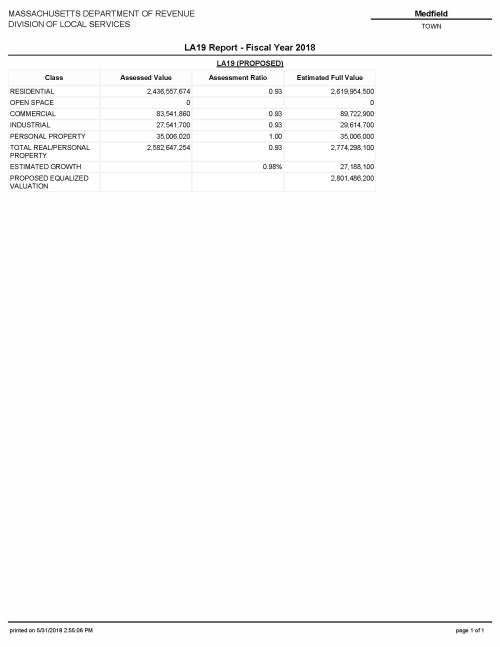
The state’s Division of Local Services (DLS) in the DOR emailed today about their having set the Estimated Full Value for the Equalized Valuations (EQVs) for all 351 cities and town. Medfield is worth $2.8b. That amount is used to say how much state money we get (a copy of the DLS email appears below).
|
|||
|

This is the first time that I have heard of this particular state revenue sharing. The state is sending the Town of Medfield our $0.20 per rides with Transportation Network Companies that originated in town. Below is an email from Mike Sullivan and the forwarded email from the state DPU. I see that Boston is getting about $3.5m.
=========================================================
Just received this. Medfield’s distribution amount is $734.70. this might just cover the overhead administrative costs to comply with the reporting requirements. If any left over, maybe we can use it to put 109 underground through the center. Mike
———- Forwarded message ———-
From: O’Connor, Angie (DPU) <Angie.Oconnor@massmail.state.ma.us>
Date: Fri, May 25, 2018 at 10:56 AM
Subject: Municipal Disbursement
To: “O’Connor, Angie (DPU)” <angie.oconnor@state.ma.us>
Cc: “Lubitz, Katherine (DPU)” <katherine.lubitz@state.ma.us>, “Hawkins, Ryan M (DPU)” <ryan.m.hawkins@state.ma.us>
Dear Municipal Official:
I write in regards to trips conducted by Transportation Network Companies (“TNCs”) in Massachusetts for the 2017 calendar year and the requirement of a $0.20 per‑ride assessment. St. 2016, c. 187, § 8. The Transportation Network Company Division (“Division”) of the Department of Public Utilities (“Department”), as the oversight authority for TNCs, has recently collected assessments from all TNCs and will be proportionately distributing the funds to municipalities. A spreadsheet of municipal disbursements is attached to this email. In addition, the Division has recently collected and analyzed TNC trip data across Massachusetts, and has made this information publically available. The purpose of my writing to you is to provide information regarding municipal use of funds received from the assessment, as well as the published information on TNC trip data.
Chapter 187 of the Acts of 2016 established a Commonwealth Transportation Infrastructure Fund (“Fund”). St. 2016, c. 187, § 8(a). As required, each TNC has submitted to the Division the number of rides from the previous calendar year that originated within each city or town and a per‑ride assessment of $0.20, which has been credited to the Fund. St. 2016, c. 187, § 8(a). One‑half (½) of the amount received from the Fund will be distributed proportionately to each city and town based on the number of rides that originated in that city or town. St. 2016, c. 187, § 8(c)(i). In addition, one fourth (¼) will be distributed to the Massachusetts Development Finance Agency, established in G.L. c. 23G, § 2, in order to provide financial assistance to small businesses operating in the taxicab, livery, or hackney industries and to encourage the adoption of new technologies and advanced service, safety, and operational capabilities and to support workforce development; and one fourth (¼) to the Commonwealth Transportation Fund, established in G.L. c. 29, § 2ZZZ. St. 2016, c. 187, §§ 8(c)(ii) and (iii).
We expect to disburse these funds within the coming weeks.
The distributed funds are special revenue without further appropriation. The funds must be used “to address the impact of transportation network services on municipal roads, bridges and other transportation infrastructure or any other public purpose substantially related to the operation of transportation network services in the city or town including, but not limited to, the complete streets program established in [G.L. c. 90I, § 1] and other programs that support alternative modes of transportation.” St. 2016, c. 187, § 8(c)(i). Each city or town receiving distribution from the Fund must submit a report to the Division not later than December 31, 2018, detailing the projects and the amount used or planned to be used for transportation-related projects, as described above. St. 2016, c. 187, § 8(d). The Division is required to compile the reports and post the projects and amounts of money used on its website, located at https://www.mass.gov/orgs/department-of-public-utilities-transportation-network-company-division. St. 2016, c. 187, § 8(d).
In addition, as required by regulation, the Division has recently collected data regarding TNC trips throughout Massachusetts, such as data on ride origination and destination, and average time and distance of trips. 220 CMR 274.12(2)(a). The Division has published this information, along with preliminary analyses, which can be located at https://tnc.sites.digital.mass.gov/. Lastly, the Department intends to continue working with TNCs to obtain and publish further information regarding their contribution to the Commonwealth’s transportation landscape.
I hope that you find this information beneficial.
Sincerely,
Angela M. O’Connor
Chairman
Massachusetts Department of Public Utilities
One South Station
Boston, Massachusetts 02110
Comments Off on Anomalous state programs – entry #1
Posted in Budgets, Financial, Humor, State, Transportation
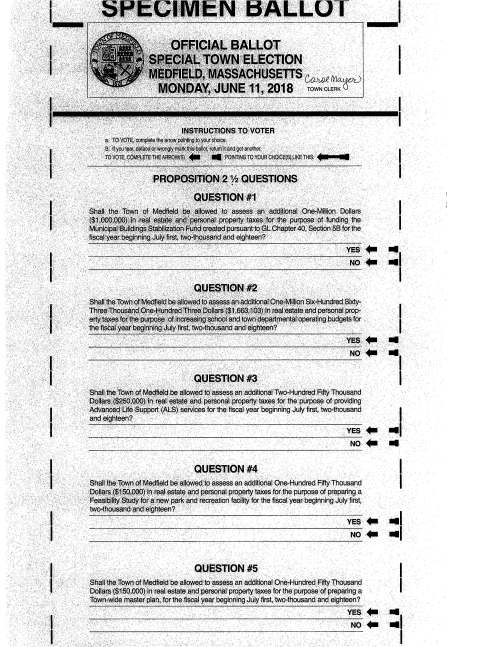
Town Clerk, Carol Mayer, posted this specimen ballot for the 6/11/18 over ride election –
Comments Off on 6/11 ballot
Posted in Budgets, Elections, Financial, Uncategorized
Historically, for the 18 years that I have been a selectman and therefore watching with interest the state budgets unfold, so I can learn what Medfield will get in state aide, I have noticed that we have always received more monies from the state Senate than in either proposals from the Governor or the House, but not this year.
It looks like our increase in state aide over last year will be about $62K. Hardly enough to help with all our cost increases – the state continues to transfer to our property taxes the cost of running our town, by virtue of the state’s declining financial support of towns over time.
Below is the Cherry Sheet projection of where we will end up on state aid for the next fiscal year.

Comments Off on Cherry Sheet for FY19
Posted in Budgets, Financial, Legislature, State
The town received a notice this week that it had been awarded a state planning grant for developing a cultural arts facility at the former Medfield State Hospital site. A rendering of one possibility is shown below.
This from Jean Mineo –
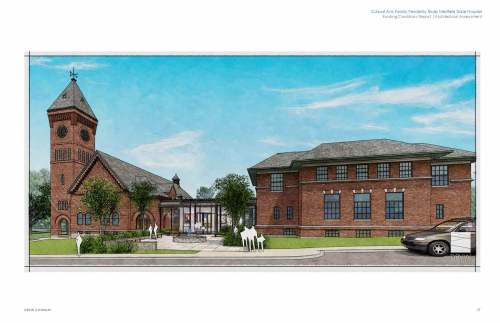
Medfield has been awarded a $30,000 planning grant from the Massachusetts Cultural Facilities Fund, a state program that fosters the growth of the creative economy by supporting building projects in the nonprofit arts, humanities and sciences. Medfield received one of 35 planning grants across the state. The grants require a 1:1 match. There were also 63 capital grants for a total of $9.3 million in awards that will generate at least another $9.3 million in private investment in cultural facilities.
The Town approved $25,000 toward the required grant match at the Annual Town Meeting last week. The Cultural Alliance of Medfield has committed to raising the balance for the $115,000 project to complete schematics and apply for historic tax credits. If you’d like to help, you can make a donation at their website www.MedfieldCulture.org or read more about their exciting plans on their link to the Medfield State Hospital. Contact Jean Mineo at 617-877-5158 or JeanMineo@aol.com with any questions.
To see the grants:
http://www.massculturalcouncil.org/facilities/facilities_fundinglist.htm#Boston
Comments Off on Medfield awarded state cultural planning grant
Posted in Art, Budgets, Cultural, Cultural Alliance of Medfield, Financial, Medfield State Hospital, State
The Massachusetts Senate has issued its budget recommendations, which this year are lower that the House numbers (usually they are higher from my memory). Unfortunately for Medfield, state revenue sharing with cities and towns continues on a downward trajectory, so that more of municipal costs msut be paid for off our property taxes. This alert this afternoon from the Massachusetts Municipal Association with its summary –
May 10, 2018
Dear Osler Peterson,
Earlier today, the Senate Ways & Means Committee reported out a $41.4 billion FY19 state budget plan to increase overall state expenditures by 3 percent. The SW&M plan is $61 million more than the budget filed by the Governor in January and $97 million less than the budget voted by the House last month. The full Senate will debate the FY19 spending plan starting May 22.
S. 4, the S W&M budget bill, provides significant progress on many important local priorities, including the full $37 million increase in Unrestricted General Government Aid that the Governor proposed and cities and towns are counting on. The SW&M budget would increase funding for other major aid programs by adding $38 million for the Special Education Circuit Breaker, adding $20 million for charter school impact mitigation payments, adding $1 million to Regional School Transportation, and increasing Chapter 70 aid by $148 million more than the FY18 level.
$37.2 MILLION INCREASE IN UNRESTRICTED MUNICIPAL AID
In a continuing good news story for cities and towns, the SW&M budget plan would provide $1.1 billion for UGGA, a $37.2 million increase over current funding – the same increase proposed by Governor Baker and voted by the House. The $37.2 million would increase UGGA funding by 3.5 percent, which matches the projected growth in state tax collections next year. Every city and town would see their UGGA funding increase by 3.5 percent.
SW&M BUDGET BUILDS ON PROGRESS IN HOUSE BUDGET, WITH $23.5M MORE FOR CHAPTER 70 ($44.1M MORE THAN GOV’S BUDGET), MINIMUM AID WOULD MATCH HOUSE’S $30 PER STUDENT
The Senate budget committee is proposing to increase Chapter 70 education aid by $147.7 million above current fiscal 2018 levels. This is $44.1 million higher than the increase in the Governor’s recommendation, and $23.5 million more than the budget passed by the House in April), with a provision that every city, town and school district receive an increase of at least $30 per student (compared to the $20-per-student amount in the Governor’s budget). The SW&M budget would continue to implement the target share provisions enacted in 2006 and would do so on a more accelerated schedule than proposed by the Governor and voted by the House. Further, the SW&M proposal would build on formula changes proposed by Governor and voted by the House to start addressing shortfalls in the foundation budget framework, by increasing the cost factors for school employee health benefits and for English Language Learners (ELL).
Please ask your Legislators to support a funding increase for Chapter 70 school aid that ensures that all schools receive a suitable and appropriate increase in fiscal 2019, which the MMA targets at $100 per student. The MMA also strongly supports implementation of all of the recommendations of the Foundation Budget Review Commission to update the Chapter 70 “foundation budget” minimum spending standards for special education and employee health insurance, and to add to the spending standard a measure of recognition for the cost of services for low-income, English Language Learner (ELL) and other students who would benefit from more intensive services. The Commission recommended phasing in the changes over a four-year period, a position the MMA supports as well. Increasing minimum aid and fixing the inadequacies in the foundation formula are essential.
$37.7 MILLION INCREASE FOR SPECIAL EDUCATION CIRCUIT BREAKER
In S. 4, Senate leaders have made clear that they support increased funding for the Special Education Circuit Breaker program with the intent to reach full funding next year. The SW&M plan would provide $318.9 million, a $27.7 million increase above the Governor’s proposed FY19 level of $291.1 million, and $37.7 million more than the $281.2 million FY18 level. This is a vital program that every city, town and school district relies on to fund state-mandated services.
ADDS $1 MILLION TO REGIONAL SCHOOL TRANSPORTATION
The Senate Ways and Means Committee budget would add $1 million to bring regional transportation reimbursements up to $62.5 million. The MMA will work to continue building on this increase to get to full funding.
CHARTER SCHOOL REIMBURSEMENTS WOULD BE FUNDED AT $100 MILLION
The SW&M budget would provide $100 million to cover charter school impact mitigation payments, compared to the Governor’s recommendation to level fund the program at $80.5 million and the House plan to increase funding to $90 million. While the SW&M increase is certainly welcome and appreciated, both legislative proposals remain below the amount necessary to fully fund the statutory formula that was originally established to offset a portion of the funding that communities are required to transfer to charter schools. The FY18 funding level is currently $73.4 million below what is necessary to fund the reimbursement formula that is written into state law. An expanding shortfall would lead to the continued and growing diversion of Chapter 70 funds away from municipally operated school districts, and place greater strain on the districts that serve 96 percent of public school children. Solving the charter school funding problem must be a major priority during the budget debate.
PAYMENTS-IN-LIEU-OF-TAXES (PILOT), LIBRARY AID ACCOUNTS, METCO, AND SHANNON ANTI-GANG GRANTS
The Senate budget committee’s proposal would increase PILOT payments by $1.7 million to ensure that no city or town loses PILOT aid next year, add $540,000 to library grant programs, add $500,000 to METCO, and level fund McKinney-Vento reimbursements at $8.1 million.The SW&M budget would level fund Shannon Anti-Gang Grants at $6 million.
Please Call Your Senator Today to Thank Them for the Local Aid Investments in the Senate Ways and Means Committee Budget – Which Increases Direct Municipal and School Aid Accounts by More Than the Governor’s Budget
Please Explain How the Senate Ways and Means Budget Impacts Your Community, and Ask Your Senators to Build on this Progress During Budget Debate in the Senate
Thank You!
Comments Off on Senate budget recommendations out
Posted in Budgets, Financial, Legislature, State
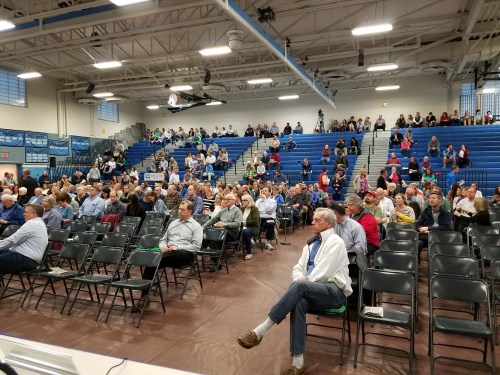
This was the start of night two of the annual town meeting (ATM) – more residents did show up, but it was still a much smaller crowd than night one. I ballparked the attendance on night one at about 900.
Given all the votes, taxes will be up about 10%.
This posted by the Carol Mayer, Town Clerk –
If not already registered, the deadline is Tuesday, May 22nd. The Town Clerk’s office will be open 8:30 AM – 8:00 PM. You can check your registration status on line at
http://www.sec.state.ma.us >ELECTIONS AND VOTING
Posted in Budgets, Financial, Select Board matters, Town Meeting
From Anna Mae O’Shea Brooke –
Posted in Budgets, Financial, Schools, Uncategorized
Medfield Select Board member
I started this blog to share the interesting and useful information that I saw while doing my job as a Medfield select board member. I thought that my fellow Medfield residents would also find that information interesting and useful as well. This blog is my effort to assist in creating a system to push the information out from the Town House to residents. Let me know if you have any thoughts on how it can be done better.
For information on my other job as an attorney (personal injury, civil litigation, estate planning and administration, and real estate), please feel free to contact me at 617-969-1500 or Osler.Peterson@OslerPeterson.com.
 | Zach on Warrant Committee’s slid… |
 | Donna Knott on Reading for “Read Across… |
 | Lester Cohen on Town’s Buildings Require… |
 | Select Board member… on Black Out at Budget Works… |
| Lester Cohen on Black Out at Budget Works… |

 Medfield02052's Blog