DOR is providing us these local aid figures for Medfield based on the Governor’s budget proposal (NB, the sum appears to be incorrect on the assessments):
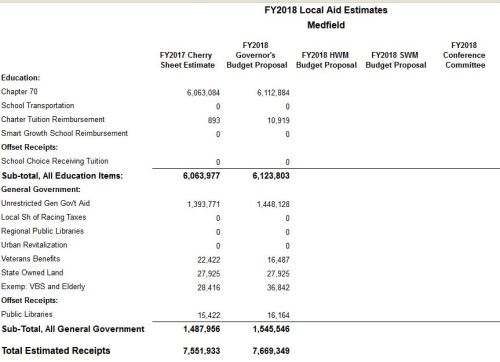
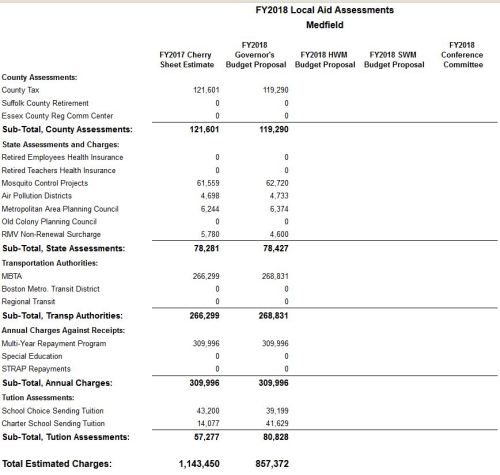

DOR is providing us these local aid figures for Medfield based on the Governor’s budget proposal (NB, the sum appears to be incorrect on the assessments):
Comments Off on First state local aid
Posted in Budgets, Financial, State, Uncategorized
The state budget starts with the Governor’s proposal, moves on to the House’s proposal, to the Senate’s proposal, and then finally a House-Senate reconciliation committee to iron out the differences. The Governor has just filed his proposed budget, and he is keeping to his plan to have municipal aid track the percentage revenue increases. The analysis of the Governor’s proposed budget that follows was provided to me by the Massachusetts Municipal Association.

|
Comments Off on State budget
Posted in Budgets, Financial, State, Uncategorized

Yesterday afternoon from 6-7 PM before the regular meeting of the Board of Selectmen there was a well attended session that was billed as a working meeting of the Board of Selectmen with Chief Kingsbury and Lieutenant Bennotti of the Medfield Fire Department to discuss the possible solutions for the town to the provision of Advanced Life Support (ALS) services to town residents. The MFD currently only provides intermediate basic life support (EMT) ambulance services to residents, and only one of the current seven full time firefighters is a paramedic.
One firefighter recently resigned, and will be replaced with a paramedic, however, until the whole service is staffed with paramedics, the two paramedics will not be able to provide paramedic services.
The ALS session was not covered by Medfield.TV – I do not know why not, as I was not involved in making that decision. Personally, I would have put it on TV.
Basically the Chief and the Lieutenant
Whether to hire the paramedics will be a decision for residents to make at at the annual town meeting (ATM).
Below are the Chief’s cost projections:
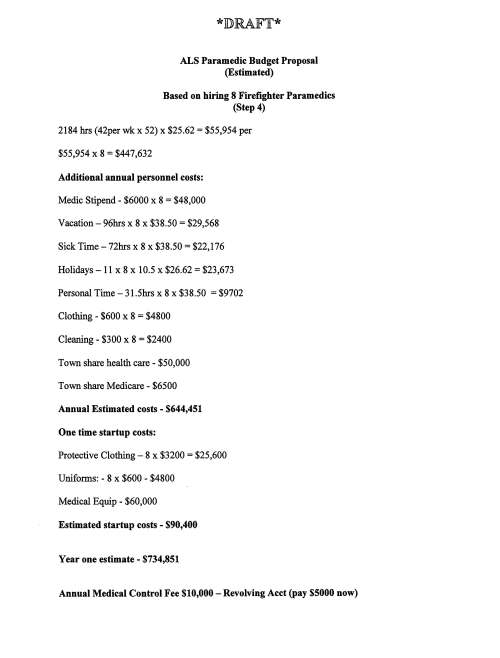
I suggest that these figures do not reflect the true cost to the town of the additional employees, as these estimates do not include the present value of the future retirement benefits the town will ultimately have to pay. Those retirement benefits (i.e. pension and health care) are called Other Post Employment Benefits (OPEB). To truly tell us the cost, the estimates should include the present value of the actuarial costs we incur each year to pay future retirement benefits to such employees.
The town was only recently required to figure out the value of its OPEB liability. Currently the unfunded actuarial cost for the town’s OPEB is over $40m. OPEB costs currently cost the town about $1.5m. per year, and the town only just recently (a couple of years ago) started to budget $400,000 a year to pay into a trust fund to partially cover the future OPEB as they come due. Therefore the town is still adding over $1m. a year to its OPEB liability, which is basically pushing off current town costs to be paid by future residents.
OPEB benefits to retired former town employees were until relatively recently not funded at all while those retirees were working, and even now the town is not fully funding its future OPEB liability. As we add new town employees, we may want to include the OPEB liabilities in our cost estimates.
Posted in Budgets, Financial, Fire Department, Town Meeting, Uncategorized
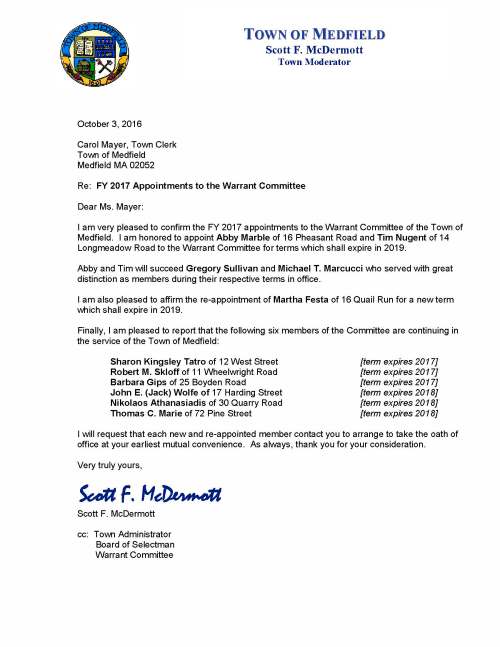
Town Moderator, Scott McDermott, today announced that he has appointed both Abby Marble and Tim Nugent to the Warrant Committee – see below.
![October 3, 2016 Carol Mayer, Town Clerk Town of Medfield Medfield MA 02052 Re: FY 2017 Appointments to the Warrant Committee Dear Ms. Mayer: I am very pleased to confirm the FY 2017 appointments to the Warrant Committee of the Town of Medfield. I am honored to appoint Abby Marble of 16 Pheasant Road and Tim Nugent of 14 Longmeadow Road to the Warrant Committee for terms which shall expire in 2019. Abby and Tim will succeed Gregory Sullivan and Michael T. Marcucci who served with great distinction as members during their respective terms in office. I am also pleased to affirm the re-appointment of Martha Festa of 16 Quail Run for a new term which shall expire in 2019. Finally, I am pleased to report that the following six members of the Committee are continuing in the service of the Town of Medfield: Sharon Kingsley Tatro of 12 West Street [term expires 2017] Robert M. Skloff of 11 Wheelwright Road [term expires 2017] Barbara Gips of 25 Boyden Road [term expires 2017] John E. (Jack) Wolfe of 17 Harding Street [term expires 2018] Nikolaos Athanasiadis of 30 Quarry Road [term expires 2018] Thomas C. Marie of 72 Pine Street [term expires 2018] I will request that each new and re-appointed member contact you to arrange to take the oath of office at your earliest mutual convenience. As always, thank you for your consideration. Very truly yours, Scott F. McDermott Scott F. McDermott cc: Town Administrator Board of Selectman Warrant Committee TOWN OF MEDFIELD Scott F. McDermott Town Moderator FY 2017 Warrant Committee Barbara Gips of 25 Boyden Road [term expires 2017] Sharon Kingsley Tatro of 12 West Street [term expires 2017] Robert M. Skloff of 11 Wheelwright Road [term expires 2017] John E. (Jack) Wolfe of 17 Harding Street [term expires 2018] Nikolaos Athanasiadis of 30 Quarry Road [term expires 2018] Thomas C. Marie of 72 Pine Street [term expires 2018] Abby Marble of 16 Pheasant Road [term expires 2019] Tim Nugent of 14 Longmeadow Road [term expires 2019] Martha Festa of 16 Quail Run [term expires 2019] Martha Festa shall serve as Chairwoman of the committee. TOWN OF MEDFIELD Scott F. McDermott Town Moderator APPOINTMENTS TO THE MEDFIELD WARRANT COMMITTEE 2003-2016 In accordance with the Medfield Town Charter, the Moderator has the duty and privilege of appointing the members to the Warrant Committee. The Warrant Committee plays an exceptionally important role in the legislative, administrative, and financial activities of the Town of Medfield. The committee reviews, evaluates, and makes recommendations to the town meeting regarding all warrant articles including the annual town operating and capital budgets. The Warrant Committee further fulfills all the duties and responsibilities of a finance committee as stipulated in the Massachusetts General Laws. Medfield’s Warrant Committee has a proud and dedicated heritage of service to Medfield based upon collaborative deliberation, open dialogue, study and attention, and experience and insights. The following is a list of Warrant Committee members I have proudly appointed or re-appointed in my fourteen (14) terms as Medfield’s Moderator. I thank all of them for their special service and commitment. Nikolaos Athanasiadis Joanne Bragg Stephen S. Curran Edward P. Doherty Martha Festa David Fischer Mark Fisher Barbara Gips Richard E. Gordet Diane Hallisey Joanna Hilvert William Johnson Abby Marble Michael T. Marcucci Thomas C. Marie Robert Morrill Debbie Mozer Gustave H. Murby Tim Nugent Stephen Pelosi Randy Rogers Victoria Schepps Thomas J. Schlesinger James O’Shaughnessy James Shannon Robert M. Skloff Caroline Standley Catherine Steever Gregory Sullivan Sharon KinglseyTatro Maryalice Whalen Mary Wilson John (Jack) Wolfe TOWN OF MEDFIELD Scott F. McDermott Town Moderator Respectfully submitted: Scott F. McDermott](https://medfield02052.blog/wp-content/uploads/2016/10/20161003-smcd-medmod-warrant-committee-appointments-2016-2017_page_2.jpg?w=500)

Comments Off on Abby Marble and Tim Nugent join WC
Posted in Appointments, Financial, Uncategorized, Warrant Committee
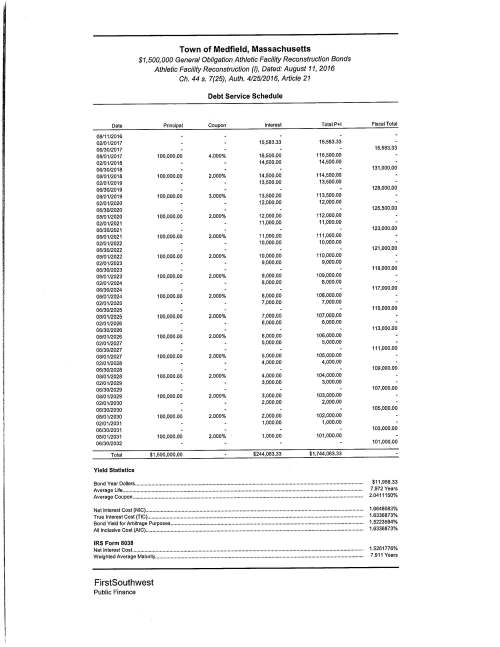
Mike Sullivan today shared the information on the July 25 bond sale for the new MHS field –
The debt schedule for the high school field and track renovation is attached. Georgia will be at Tuesday’s Selectmen’s meeting with the votes you need to make and the documents you need to sign. Please note that the Treasurer elected to go with a 15 year bond, which will result in annual principal payments of $100,000/year. Also, the net interest cost is 1.63 %, while the annual coupon rates range from 2% to 4%. The reason for this is that the low bid included a $45,000 premium payment, which will reduce the net interest cost. The issue was sold on the 25th of July, rather than the 27th to try to lock in a lower rate in case the Federal Reserve Board announced it’s intention to raise interest rates this year. Mike S
Comments Off on Bond sale for MHS field
Posted in Financial, Medfield High School, Uncategorized

ClearGov put our general financial data from the Massachusetts Department of Revenue on-line for us as a promotion, seeking to sell us more services.
http://www.cleargov.com/massachusetts/norfolk/town/medfield/2014
If residents want access to the details of the town’s finances, it too can be put on-line for them. The state and the City of Boston have both put their checkbooks online.
Comments Off on Financial data online
Posted in Budgets, Financial, Uncategorized

Medfield was scheduled to get only one earmark in the FY17 state budget, $150,000 for the state to build a new road to the Charles River Overlook on state land, so that the easement over the town’s former MSH property could be eliminated. Per John Nunnari’s email this morning, Governor Baker vetoed that money. Many such vetoes are overridden by the legislature.
John closely follows the legislature for the architects, and always knows what is happening.
All,
Just fyi, but as part of the Governor’s veto message, the following has been eliminated:
2810-0100 For the operation of the division of state parks and recreation;…. provided further, that not less than $150,000 shall be expended for the creation of a roadway at the former Medfield State Hospital property in the town of Medfield
I’m hearing that the House/Senate intend to take up the Governors vetoes during Formal Sessions on Thursday – with the potential for it to extend into a rare Friday Formal Session.
House and Senate leadership are upset with the Gov’s $256M in reductions over 303 line items (which included approx.. $60M in earmarks – which the Medfield State Hospital roadway project would be considered).
More to come.
john
Comments Off on Medfield’s one earmark vetoed by Governor
Posted in Budgets, Financial, Legislature, Medfield State Hospital, State, Uncategorized

MMA alert today –
Tuesday, June 28, 2016
STATE BUDGET WOES DEEPEN, STATE FACING FISCAL 2017 REVENUE GAP OF UP TO $950 MILLION
PLEASE CALL YOUR LEGISLATORS TODAY TO ENSURE THAT CITIES AND TOWNS ARE PROTECTED AS LAWMAKERS SEEK TO CLOSE WIDENING FISCAL 2017 DEFICIT
Brexit Vote Destabilizes World Economy, State Leaders Predict Further Loss of Tax Revenue for Fiscal 2017
As we reported in an MMA Action Alert yesterday (Monday), deliberations on the fiscal 2017 state budget have been thrown into disarray by a major slump in state tax collections. Unfortunately, the state’s fiscal picture has darkened even more.
Late yesterday afternoon, Governor Baker announced that the revenue shortfall for fiscal 2017 is likely to be $200 million worse than the gloomy projections made less than two weeks ago, mostly as a result of widespread unrest and financial volatility stemming from the Brexit vote, combined with lower-than-expected tax collections as the state closes fiscal year 2016.
The new estimate is that fiscal 2017 tax revenues will be $650 million to $950 million lower than originally thought.
This is bad news, because a revenue loss of this magnitude will force deep cuts across all aspects of the new state budget. The three separate fiscal 2017 budgets set by the Governor, House and Senate were all based on the original, higher revenue projection, which means all of the plans are out of balance.
The Legislature has passed a temporary 1-month budget to cover state obligations through the end of July and provide some breathing room for legislators while they dramatically scale back their fiscal 2017 budget.
It is imperative to remind your legislators that cities and towns have already set their budgets based on reasonable estimates of local aid and education funding. Any cuts to municipal or school accounts would trigger major budget problems in all 351 cities and towns. Any local aid reductions at this point would be incredibly disruptive, and would force communities to reopen their already-passed budgets and impose mid-year cuts.
Please call your legislators today to oppose cuts to Cherry Sheet Unrestricted General Government Aid (UGGA), Chapter 70 school aid and other municipal and school aid accounts that are included in your local spending plans. Reliance on the property tax to fund municipal and school services is at a 30-year high, and it is too late to pursue tax overrides to replace lost local aid. Any local aid reduction would translate into cuts in essential services and programs that are necessary for our economic growth and stability.
Please Call Your Legislators Today and Ask Them to Protect Local Aid
Comments Off on Brexit to cost Medfield $
Posted in Budgets, Financial, Massachusetts Municipal Association, Uncategorized
Tuesday, May 17, 2016
SENATE BUDGET COMMITTEE OFFERS $39.5B FY 2017 STATE BUDGET THAT MAKES KEY INVESTMENTS IN MUNICIPAL AND SCHOOL AID
• INCLUDES THE FULL $42M INCREASE IN UNRESTRICTED MUNICIPAL AID (UGGA)
• INCREASES CHAPTER 70 BY $44M ABOVE THE GOVERNOR’S BUDGET TO PROVIDE MINIMUM AID OF $55 PER STUDENT, INCREASE TARGET SHARE FUNDING, AND HELP ADDRESS THE LOW-INCOME STUDENT FACTOR
• ADDS $9.3M TO FULLY FUND THE SPECIAL EDUCATION CIRCUIT BREAKER
• LEVEL-FUNDS MOST OTHER MUNICIPAL AND SCHOOL ACCOUNTS
• BUT THE SW&M BUDGET CUTS $16.6M FROM KINDERGARTEN DEVELOPMENT GRANTS, WHICH WOULD CREATE SHORTFALLS IN 164 SCHOOL DISTRICTS
Earlier today, the Senate Ways and Means Committee reported out a tight $39.5 billion fiscal 2017 state budget plan to increase overall state expenditures by approximately 3.5 percent. The Senate Ways and Means budget is slightly smaller than the budget passed by the House in April and the version filed by the Governor in March, yet it would offer the largest increase in Chapter 70 aid. The full Senate will debate the fiscal 2017 state budget beginning on Tuesday, May 24.
S. 4, the Senate Ways & Means budget, provides strong progress on many important local aid priorities, including the full $42 million increase in Unrestricted General Government Aid that the Governor and House have agreed on. The SW&M Committee would increase funding for several major aid programs, by adding $9.3 million to the Special Education Circuit Breaker, increasing Chapter 70 minimum aid to $55 per student, and by adding funds in the Chapter 70 distribution to help address the low-income student calculation (the House budget has a separate $10 million reserve account for this issue), and to accelerate implementation of the so-called target share provisions in Chapter 70.
$42 MILLION INCREASE IN UNRESTRICTED MUNICIPAL AID
In a major victory for cities and towns, S. 4 (the SW&M fiscal 2017 budget plan) would provide $1.021 billion for UGGA, a $42 million increase over current funding – the same increase proposed by Governor Baker and the House of Representatives. The $42 million would increase UGGA funding by 4.3 percent, which matches the growth in state tax collections next year. This would be the largest increase in discretionary municipal aid in nearly a decade. Every city and town would see their UGGA funding increase by 4.3 percent.
CHAPTER 70 MINIMUM AID WOULD INCREASE TO $55 PER STUDENT
The Senate budget committee is proposing a $116 million increase in Chapter 70 education aid above fiscal 2016 levels, providing every city, town and school district with an increase of at least $55 per student. In addition to the minimum aid increase, which matches the House-passed level, the SW&M Committee would add additional funds to aid communities impacted by changes in the calculations used to account for low-income students. (The House included a $10 million reserve account for this issue instead of incorporating the funds into the Chapter 70 distribution). Further, the SW&M budget would accelerate the implementation of the 2007 target share provisions (the Senate proposal is to fund 85% of the target share goal, compared to the House’s 70% funding level). Overall, the SW&M budget would provide $44 million more in direct Chapter 70 distributions than the Governor’s budget, and $20 million more than the House (or $10 million more after recognizing the House’s $10 million reserve for low-income students).
$9.3 MILLION INCREASE INTENDED TO FULLY FUND SPECIAL EDUCATION CIRCUIT BREAKER
In another victory for cities and towns, Senate leaders have announced that they support full funding for the Special Education Circuit Breaker program. Their budget plan would provide $281.1 million, a $9.3 million increase above fiscal 2016, with the intention of fully funding the account. The Governor level funded the circuit-breaker program, and the House provided a $5 million increase. This is a vital program that every city, town and school district relies on to fund state-mandated services.
BUT THE SW&M BUDGET WOULD CUT $16.6 MILLION FROM KINDERGARTEN DEVELOPMENT GRANTS, AN 89% REDUCTION THAT WOULD HIT 164 DISTRICTS
In a troubling development, S. 4 would cut $16.6 million from Kindergarten Development Grants, leaving only $2 million in this program that funds Kindergarten programs in 164 school districts. The Governor and House level-funded the program at $18.6 million. Restoring these funds will be a major priority during the budget debate, and local officials will want to talk with their Senators about this program right away. Please click here to see if your community is receiving these grants in fiscal 2016. These funds are in jeopardy if the S. 4 appropriation remains in place.
FUNDING FOR CHARTER SCHOOL REIMBURSEMENTS INCREASED BY $7 MILLION, BUT STILL UNDERFUNDED
Under state law, cities and towns that host or send students to charter schools are entitled to be reimbursed for a portion of their lost Chapter 70 aid. The state fully funded the reimbursement program in fiscal years 2013 and 2014, but is underfunding reimbursements by approximately $46.5 million this year. The Senate Ways and Means budget would increase funding for charter school reimbursements to $87.5 million, a $7 million boost. This is $2 million more than the House proposed and $15 million less than the amount recommended by Gov. Baker. The program is underfunded in all three budget proposals, and increasing this account will be a top priority during the Senate budget debate.
REGIONAL SCHOOL TRANSPORTATION, PAYMENTS-IN-LIEU-OF-TAXES (PILOT), LIBRARY AID ACCOUNTS, METCO, McKINNEY-VENTO, AND SHANNON ANTI-GANG GRANTS
The Senate budget committee’s proposal would level-fund Regional School Transportation Reimbursements at $59 million ($1 million less than the House budget), level fund PILOT payments at $26.77 million (the same as the House and Governor), level-fund METCO at $20.1 million, and level-fund McKinney-Vento reimbursements at $8.35 million. S. 4 would fund library grant programs at $18.9 million ($70K less than fiscal 2016 and $750K less than the House). The SW&M budget would reduce Shannon Anti-Gang Grants to $5 million (a $2 million reduction below fiscal 2016, and $1 million below the House).
Please Call Your Senators Today to Thank Them for the Strong Municipal Aid and Chapter 70 Investments in the Senate Ways and Means Committee Budget, Including the $42 Million Increase in Unrestricted Local Aid, Providing Chapter 70 Minimum Aid at $55 Per Student, and Full Funding for the Special Education Circuit Breaker
Please Let Your Senators Know if You Are Affected by Underfunding in Charter School Reimbursements and Kindergarten Development Grants
Please Explain How the Senate Ways and Means Budget Impacts Your Community, and Ask Your Senators to Build on this Progress During Budget Debate in the Senate
Comments Off on MMA on Senate budget
Posted in Budgets, Financial, Massachusetts Municipal Association, State, Uncategorized
The Senate budget numbers for FY17 are now out, and they are the same as the House numbers. We are looking at about a $200K increase over last year. John Nunnari provided the following proposed state funding for Medfield numbers.
Just in case you hadn’t seen it, the Senate budget came out today.
Here is where Medfield stands in terms of Chapter 70 allocations.
john
| Municipality/Regional District | 7061-0008 Chapter 70 | Unrestricted General Government Aid | Annual Formula Local Aide |
| FY ’15 Actual Appropriation | $5,862,409.00 | $1,289,875.00 | $0.00 |
| FY ’16 Actual Appropriation | $5,925,859.00 | $1,336,310.00 | |
| Governors FY ’17 Proposal | $5,975,759.00 | $1,393,771.00 | $0.00 |
| Medfield (House FY ’17 Proposed Numbers) | $6,063,084.00 | $1,393,771.00 | $0.00 |
| Medfield (Senate FY 17 Proposed Numbers) | $6,063,084.00 | $1,393,771.00 | $0.00 |
| FY ’17 Conference Committee Report July +/- | $0.00 | $0.00 | $0.00 |
John Nunnari, Assoc AIA
Executive Director, AIA MA
Comments Off on $200K more in FY17 state aide proposed
Posted in Buildings, Financial, State, Uncategorized
Medfield Select Board member
I started this blog to share the interesting and useful information that I saw while doing my job as a Medfield select board member. I thought that my fellow Medfield residents would also find that information interesting and useful as well. This blog is my effort to assist in creating a system to push the information out from the Town House to residents. Let me know if you have any thoughts on how it can be done better.
For information on my other job as an attorney (personal injury, civil litigation, estate planning and administration, and real estate), please feel free to contact me at 617-969-1500 or Osler.Peterson@OslerPeterson.com.
 | Zach on Warrant Committee’s slid… |
 | Donna Knott on Reading for “Read Across… |
 | Lester Cohen on Town’s Buildings Require… |
 | Select Board member… on Black Out at Budget Works… |
| Lester Cohen on Black Out at Budget Works… |

 Medfield02052's Blog