From the Town of Medfield Climate Action Plan (TOMCAP), working group of the Medfield Energy Committee –
After reading the fact sheet below you can access the questionnaire at https://tinyurl.com/23tnp6vv.

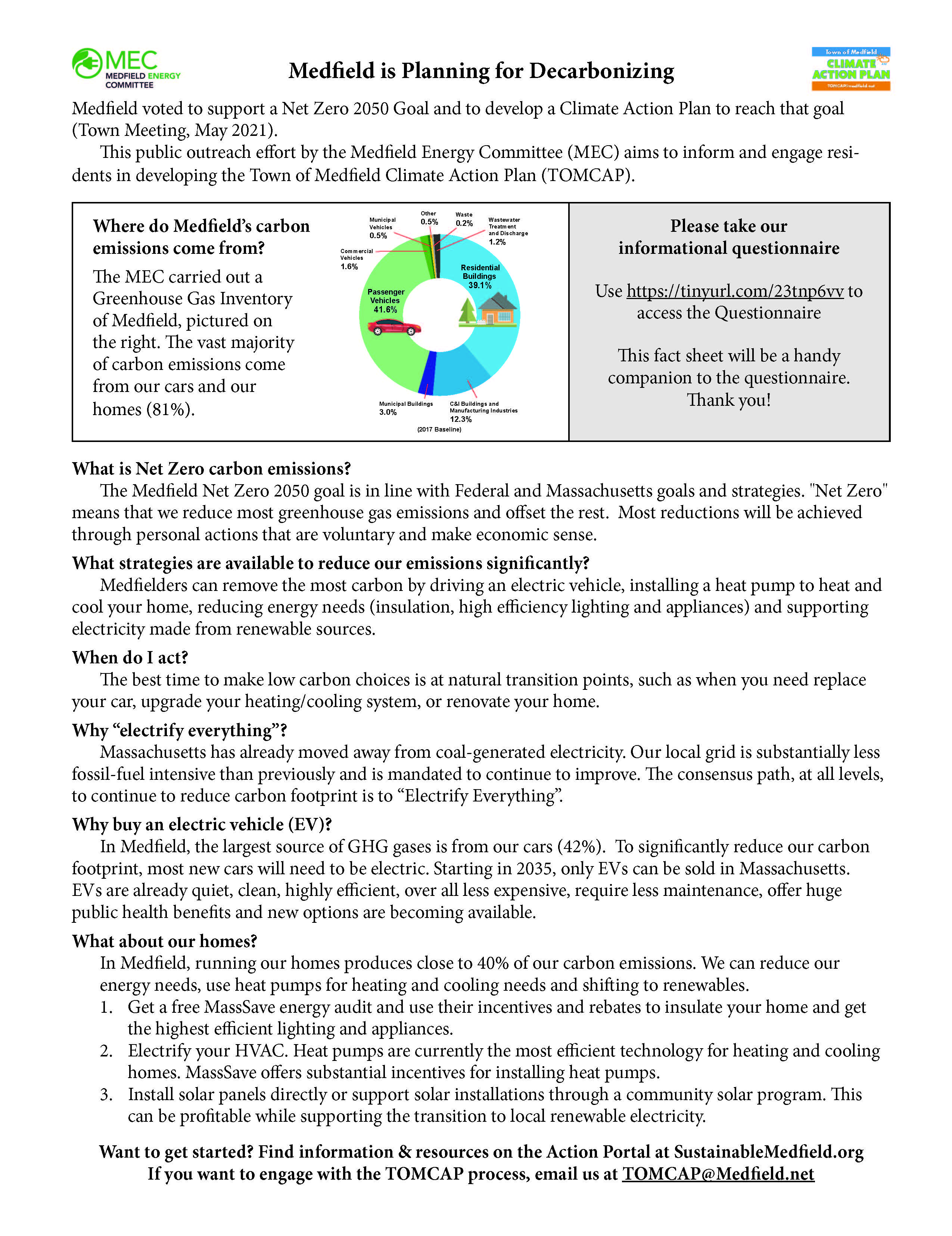

From the Town of Medfield Climate Action Plan (TOMCAP), working group of the Medfield Energy Committee –
After reading the fact sheet below you can access the questionnaire at https://tinyurl.com/23tnp6vv.
Comments Off on TOMCAP information and survey
Posted in Climate, Energy Committee, Planning
From Helen Dewey of Medfield Environment Action –
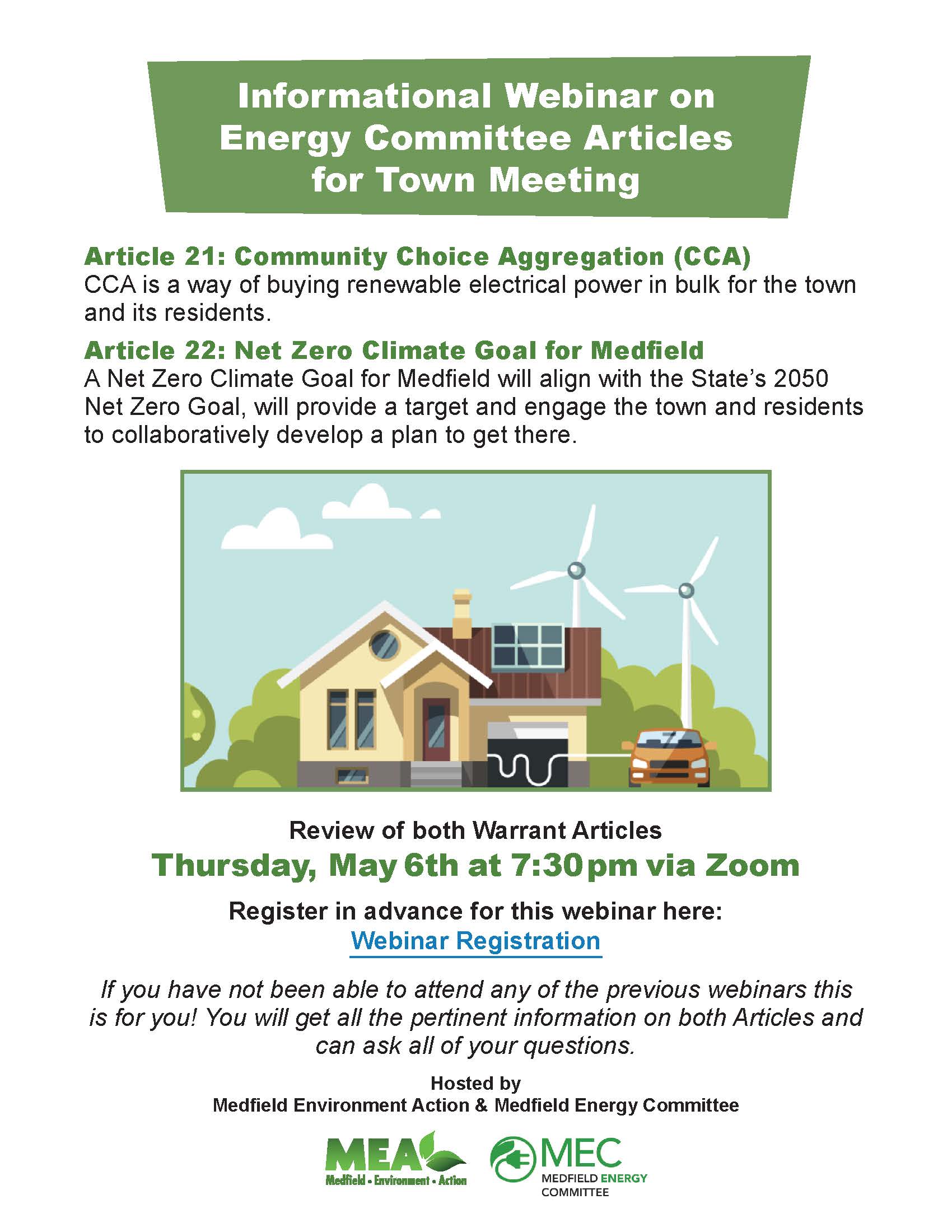
Comments Off on MEA/MEC forum on warrant articles – 7:30PM on 5/6
Posted in Energy Committee, Environmental, Events, Information, Medfield Environmental Action, Town Meeting

As part of the celebration of Earth Day, I asked to have my signature as a Town of Medfield Select Board member added to the letter below, going to the MSBA tomorrow. Medfield Energy Committee members and other may join too. –
+++++++++++++++++++++++++++++++++++++++++++
April 22, 2021
Deborah Goldberg, Chair
Anne Brockelman
Sean R. Cronin
Matt Deninger
Terry Kwan
Greg Sullivan
Sheila Vanderhoef
Via email to ______
Dear Treasurer Goldberg and members of the MSBA Board,
We are writing to encourage the MSBA to require that all school building projects funded by MSBA be fully electrified, and climate resilient.
The MSBA is to be commended for its track record of helping cities and towns replace or
renovate school buildings in an environmentally sustainable manner.
As your website notes,
The MSBA’s Green Schools Program provides incentives to a district to increase the
energy efficiency and sustainability for new construction and major renovation/addition
projects, by exceeding Massachusetts Energy base code by 20% for 2 additional
reimbursement points. All projects are required to register for the most recent version of
LEED-S or NE-CHPS and exceed Massachusetts Energy base code by 10%.
The MSBA’s updated Accelerated Repair Program provides a new opportunity to apply
sustainable standards to specific building systems such as roofs, boilers and window
systems. The MSBA’s green programs aim to encourage a high standard of
sustainability for all MSBA-funded projects. The MSBA continues to monitor the
effectiveness of its sustainable policies and make recommendations for
improvement, with an emphasis on energy and cost savings, resulting in direct
operational savings for school districts. [bold added]
As municipal leaders interested in speeding the transition away from fossil fuel dependency, we were particularly pleased to see the highlighted above, as it demonstrates an interest in continuous improvement in the area of sustainability and carbon emissions reduction. We are following up on your interest in improvement to encourage you to tie school building funding to the following requirements for all new or renovated schools:
How do these recommendations fit into the Commonwealth’s climate goals?
• Massachusetts has a greenhouse gas reduction mandate of 80% reduction of greenhouse gas emissions by 2050 and a commitment to be net zero by 2050; many cities and towns have more aggressive goals. The IPCC issued a report in 2018 noting that to keep global temperatures from rising more than 1.5 degrees Celsius — a goal of the Paris climate agreement — anthropogenic carbon dioxide emissions would have to be on a path to fall by about 45 percent by around 2030.
• Massachusetts also has a goal of 300,000 EVs on the road by 2025.œ As HVAC systems are built to last for at least 20-30 years, that means we must act now to eliminate this significant source of fossil fuel energy.
• The National Climate Assessment projects that the Northeast will see dramatic increases in precipitation and flooding.
Why is all-electric the more environmentally beneficial choice? Under state law, the electric grid is powered by an increasing amount of renewable energy every year. In contrast, an oil or gas boiler is running on fossil fuels from day one until the day it is retired.
School building electrification is not a new concept. In fact, schools across the state are
converting to 100% clean electricity to save money, improve air quality for students, teachers and staff, and advance climate goals.
• Lincoln is about to break ground on a Net Zero K-8 renovation school project.
• Wellesley has one net zero ready elementary school in the design phase and is in the feasibility phase of a second.
• Brookline passed a Warrant Article in May 2019 requiring that all new school buildings be fossil fuel free.
• Westborough has approved and is moving forward with a net-positive energy elementary school.
• Arlington is about to break ground on a new all-electric high school where heating and cooling systems will utilize heat pumps.
• Several Cambridge schools have been rebuilt all-electric: Martin Luther King School, King Open School and the Cambridge Street Upper School, as well as the Valente Branch Library and a new administrative building for the entire school department; the Tobin/Vassal-lane school will be rebuilt all-electric.
• Construction is underway on the new Belmont Middle and High School which will be net zero and all-electric with heating and cooling by a geothermal heat pump system.
• Amherst passed a bylaw in 2017 requiring zero energy new municipal and school buildings.
• Concord is at the end of Feasibility for a net zero design for a new middle school and expects to start Schematic Design in the next few months (there was a CV-related delay).
• Lexington’s Select Board and School Committee adopted a building policy calling for construction of all-electric buildings, maximizing onsite renewable energy, and setting high standards for indoor air quality. Lexington’s Hastings Elementary School and Lexington Children’s Place pre-school are both expected to be net positive buildings when the solar energy systems that have been approved are completed later this year.
Energy efficient all electric schools are cost-effective to build and operate, while providing a healthier and safer learning environment for students and teachers alike.
Schools built on wetlands are more likely to suffer from mold and poor air quality, and need expensive repairs, especially as our region sees more frequent and intense rainfall.
Thank you for your consideration of our views. From the Green Communities Program to the Municipal Vulnerability Preparedness Program to the Complete Streets grants and more, we are so appreciative of the Commonwealth’s partnership in supporting cities and towns efforts to advance our transition to a clean economy and make our communities more resilient as we face a changing climate. We would welcome the opportunity to speak with you in more detail about these recommendations and help you build support to enact them.
Sincerely,
Amherst
Darcy Dumont, Town Council, District 5
Dorothy S. Pam, Town Council, District 3
Patricia De Angelis, Town Councilor
Andover
Maria Bartlett, Member of Green Advisory Board
Arlington
Joseph A. Curro, Jr., Select Board Member
Adam Chapdelaine, Town Manager
Ashland
Robert Scherer, Select Board Member
Barnstable
Gordon Starr, Town Councilor, Precinct 1
Becket
Alvin Blake, Planning Board
Bolton
Jonathan Keep, Select Board Member
Boston
Kenzie Bok, City Councilor
Annissa Essaibi-George, City Councilor (At-Large)
Ed Flynn, City Councilor
Matt O’Malley, City Councilor
Braintree
Julia Flaherty, Town Council, District 1
Kelly J. Cobb-Lemire, School Committee Member
Brookline
Raul Fernandez, Select Board Member
Werner Lohe, Climate Action Committee (co-chair)
Burlington
Martha Simon, School Committee Member
Cambridge
Patricia Nolan, City Councilor
Quinton Zondervan, City Councilor
Concord
Charles Parker, Middle School Building Committee Member
Dalton
Robert Bishop, Select Board Chair
Cheryl Rose, Conservation Commission
Henry Rose, Commissioner, Conservation Commission
Joseph Fish, Chair, Green Dalton Committee
Dedham
Jessica Portee, Planning Board Member
Framingham
Geoff Epstein, School Committee Member, District 6
Gloucester
Jennifer Holmgren, Councilor-at-Large
Hopkinton
Jeffrey S Barnes, Conservation Commission (Chair)
Lakeville
Jesse L. Medford, Open Space Committee (Chair)
Lawrence
Jonathan Guzman, School Committee Member – District F
Lexington
Mark Sandeen, Select Board Member
Marlborough
Samantha Perlman, City Councilor
Medford
Zac Bears, City Councilor
Nicole Morell, City Councilor
Paul Ruseau, School Committee Member
Jenny Graham, School Committee
Newton
Susan Albright, City Council President
Alicia Bowman, City Councilor
Deb Crossley, City Councilor
Andreae Downs, City Councilor
Maria Scibelli Greenberg, City Councilor
Bill Humphrey, City Councilor
David Kalis, City Councilor
Josh Krintzman, City Councilor
Marc Laredo, City Councilor
Rick Lipof, City Council Vice President
Julia Malakie, City Councilor
Chris Markiewicz, City Councilor
Emily Norton, City Councilor
John Oliver, City Councilor
Holly Ryan, City Councilor
Northampton
Bill Dwight, City Councilor at Large
Alex Jarrett, City Councilor
Karen Foster, City Councilor, Ward 2
Susan Voss, School Committee Member
Chris Mason, Energy & Sustainability Officer
Pittsfield
Mary Stucklen, Commissioner – Green Commission
Reading
Vanessa Alvarado, Select Board Member
Somerville
Will Mbah, City Councilor
Ben Ewen-Campen, City Councilor
Katjana Ballantyne, City Councilor
Kristen Strezo, City Councilor-at-Large
Taunton
Phillip Duarte, City Councilor
Wakefield
Mehreen N. Butt, Town Councilor
Julie Smith-Galvin, Town Councilor
Susan Veilleux, School Committee Member
Rob Darnell, Environmental Sustainability Committee (Chair)
Mary Hajjar, Environmental Sustainability Committee (Vice Chair)
Robin Greenberg, Environmental Sustainability Committee
Jennifer Kallay, Gas & Light Board Commissioner
Elizabeth Sheridan, ESC Student Liaison
Watertown
Caroline Bays, Town Councilor
Angeline B. Kounelis, Town Councilor
Tony Palomba, Councilor-at-Large
Wellesley
Lise Olney, Select Board Member
Williamstown
Anne O’Connor, Select Board Member
Winchester
Michael Bettencourt, Select Board (Chair)
Posted in Energy Committee, Green, Schools, State
Fellow Medfielders,
As we recognize Earth Day 2021, global responsibility is clearer than ever, and local action more urgent than ever.
Some Medfielders have already made the transition, but now all households need to go EV, HP, PV:Subscribe
For each of these decarbonizing steps, yes, there are considerations, as with any change. But, the transition is not usually particularly burdensome, and often is surprisingly advantageous.
The three steps are the transition to low-carbon that is needed. Beyond them, there are indeed many other wonderful things Medfielders can and should do to benefit the environment. But
taking any of these three steps, by far, will have the largest climate impact. These steps are also absolutely essential to meeting local, state, national, and global climate goals. And, no
one is likely going to force anyone to take them.
Literally, it is up to us.
Medfield Energy Committee (MEC) and Medfield Environment Action (MEA) are recommending passage of a number of key Warrant Articles at Town Meeting aimed to responsibly help accelerate the decarbonization transition locally. Your support will be appreciated.https://f58f435f01693e6841d462c24030fa4b.safeframe.googlesyndication.com/safeframe/1-0-38/html/container.html
It should also be mentioned that an unexpected outcome, after a year of Covid quarantining, is that we each now have a better idea of what other carbon-reducing efforts will work for us, in our
post-pandemic lives. Awful as it has been, we have learned what might help us come-back-carbon-better.
Medfielders making these careful and caring consumer choices is exactly what is necessary to prevent the worst climate cataclysm for our children and grandchildren.
It’s what will make for a great Earth Day.
Sincerely,
Fred Davis, Chair – Medfield Energy Committee
Comments Off on Earth Day letter from MEC
Posted in Energy Committee
| Zoom Link: https://medfield-net.zoom.us/j/83347163639?pwd=N0phSWk0ZlViS3BPQlQ2TlhkdXBrdz09Hear from Arrowstreet, the new Elementary School Project architect, about the design considerations to be made over the next two months related to energy efficiency and net zero emissions:What is it?Why do it?Where is MA headed?Case StudiesOther Agenda Items:Utility incentives New Elementary School ProcessOther Building Types & Net Zero/Energy Efficiency Incentives for residential users Q&A/Break-out discussions A net zero building uses only as much energy as it can generate and being able to achieve that is a function of the building design. Please join us to learn more on Thursday! Sponsored by the the Sustainability Subcommittee of the Dale Street School Building Committee and the Medfield Energy Committee. Please follow and share our Facebook page and visit our Elementary School Project website for updates. Any questions: email DaleStreetSchoolProject@gmail.com.  |
Posted in Buildings, Energy Committee, Green, Schools
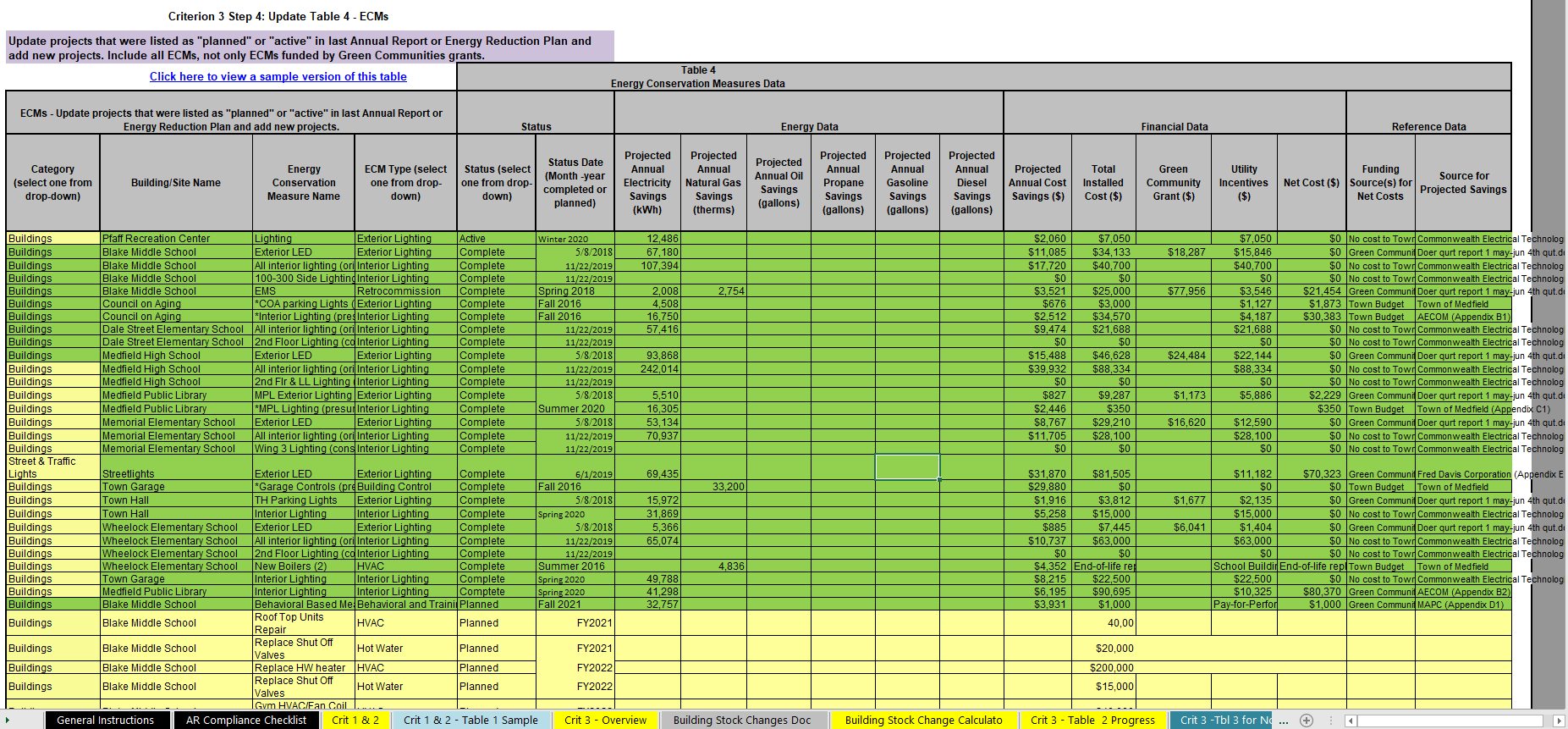
The Green Communities Act requires the town to submit an annual report of what energy conservation measures (ECM’s) have been done and what are planned to be done. Yesterday I reviewed and signed off on the final report for this year. Filing the annual report is a prerequisite to getting the generous Department of Energy Resources (DOER) annual grants, so an important annual step. The Medfield Energy Committee and Amy Colleran, Facilities Director have championed getting the report prepared and filed, this year with the assistance of an Metropolitan Area Planning Council (MAPC) consultant obtained with grant monies.
The full report can be found here
I found this spreadsheet (partial copy below) listing about 100 ECM’s the most interesting (lots has already been accomplished and lots is still planned). Note how much of what is planned will be paid for by the DOER grant monies.
Comments Off on GCAR submitted today
Posted in Energy Committee, Green, State
Eversource press release announces energy saving assistance for our town’s businesses –

09/15/2020 | 02:55pm EDT
Energy company helps business owners identify specific ways to save on building’s operating costs now and in the future
BOSTON September 14, 2020 – Eversource is working with Medfield next month on the Main Streets energy efficiency initiative to help local, small businesses reduce their energy costs, save money and have a positive impact on the environment. From September 14th until September 18th, energy experts from Eversource-approved contractor, Rise, will be in the community meeting with businesses, scheduling no-cost energy assessments and answering questions about energy-efficient equipment upgrades and improvements.
‘Energy efficiency provides businesses of all sizes with a competitive edge and directly impacts their bottom line through energy savings,’ said Eversource Vice President of Energy Efficiency Tilak Subrahmanian, ‘Many small businesses are facing financial hardships right now, and this effort will help connect small business owners with ways to save on their energy costs.’
Medfield is one of 15 communities chosen for this initiative in 2020. In 2019, Eversource visited nine communities and helped small business owners reduce their energy use by more than 2.7 million kWh and save more than $400,000 as a result of this initiative.
The Main Streets energy efficiency program begins with a no-cost, no-obligation energy assessment identifying energy-saving opportunities for small businesses, such as new lighting, occupancy sensors, programmable thermostats, refrigeration controls, insulation and more. Some of the improvements, such as installing aerators and spray valves, happen on the spot at no cost to the customer. Larger improvement projects, like HVAC equipment upgrades or the installation of energy-efficient motor controls, are scheduled for a future date. For a limited time, Eversource has increased incentives for a range of energy-efficiency improvements to further offset the cost of upgrades, and interest-free financing is available for any remaining costs.
Local, licensed electricians contracted by Eversource will complete approved projects, ensuring minimal disruption to daily business operations. All contractors are required to follow state-of-the-art health and safety guidelines to minimize the spread of COVID-19, and all high-efficiency products installed as part of the program will include warranties for both materials and labor.
Eversource has delivered postcards with more information about the program to Medfield businesses. For more information about the program and to schedule a free assessment at a convenient time, businesses should contact Eversource’s contractor, Rise, directly at 401-784-3700 x 6158.
Comments Off on Small businesses get energy saving opportunity
Posted in Business, Downtown, Energy Committee, Green, Uncategorized
Email from the Medfield Energy Committee Chair, Fred Davis –
Announced today: Medfield is being awarded $139,316 in Green Communities funding from the Massachusetts Dept. of Energy Resources.
Congratulations and appreciation to Director of Facilities Amy Colleran, and MEC members for all the work the grant application entailed.
Leveraged with expected utility incentives of $28,858, the effort will result in a total funding of $168,174 for energy-efficiency projects.
All the work will be done at no cost to the Town.
This is the first Green Communities funding that Medfield has applied for since its initial funding as a Green Community. The initial round of projects involved upgrading to LED lighting in Town buildings, along with upgrade of the Blake Middle School controls system.
Most of this next work will involve upgrading two other control systems in the schools. Additional measures involve lighting, gas traps, weatherization, hot water.
The projects are expected to bring about reductions in greenhouse gases: gas and electricity consumption to decline by 2,107 MBtu/year, with about 3/4 of that being reduction in gas heating.
Dollar savings are projected at $41, 286 each year.
In addition, $13,490 of the funding is allocated for professional development and administrative support.
— Fred Davis
Chair, Medfield Energy Committee
——– Forwarded Message ——–
| Subject: | FOR IMMEDIATE RELEASE: Baker-Polito Administration Awards $13 Million in Green Communities Grants |
|---|---|
| Date: | Thu, 27 Aug 2020 14:39:16 +0000 |
| From: | Brown, Kelly (ENE) <kelly.brown@state.ma.us> |
Good morning Green Communities,
Below is the Competitive Grant 2020 press release announcing $13 Million in grant awards to 103 communities. Over the next week you will receive more information from the Green Communities Division on next steps. Congrats to all the awardees!
August 27, 2020CONTACT Eric Noreen Eric.Noreen@mass.gov Baker-Polito Administration Awards $13 Million in Green Communities Grants103 Communities Receive Funds for Energy Efficiency and Clean Energy Projects BOSTON – The Baker-Polito Administration today awarded $13,000,558 in Green Communities competitive grants to 103 municipalities across Massachusetts to fund clean energy projects. With today’s announcement, the Department of Energy Resources (DOER) has awarded over $136 million to Green Communities in Designation Grants and Competitive Grants since 2010. “The Green Communities program continues to make significant progress in helping municipalities reduce their carbon footprint and save on energy costs,” said Governor Charlie Baker. “Our administration is committed to supporting clean energy and energy efficiency efforts that make the Commonwealth’s cities and towns cleaner, healthier, and more affordable places to live.” “As we work to meet our net zero by 2050 emissions goals, the Green Communities program gives our dedicated municipal partners the resources they need to continue making progress in increasing energy efficiency and lowering energy costs,” said Lieutenant Governor Karyn Polito. “We look forward to seeing the continued growth in energy innovation and energy savings that these grants will enable in towns and cities across the Commonwealth.” Under the Green Communities Act, cities and towns must meet five criteria to be designated a Green Community and receive funding. 271 Massachusetts cities and towns have earned the Green Communities designation, which accounts for 84 percent of the Commonwealth’s population. This ninth annual round of DOER Green Communities competitive grants is awarded to existing Green Communities that have successfully invested their initial designation grants and previous competitive grant awards. The grants provide financial support for energy efficiency and renewable energy projects that further the designated communities’ clean energy goals. Grants are capped at $200,000 per municipality. Funding for these grants is available through proceeds from carbon allowance auctions under the Regional Greenhouse Gas Initiative (RGGI). “The Green Communities program helps cities and towns make important investments at the local level to combat climate change by reducing emissions,” said Energy and Environmental Affairs Secretary Kathleen Theoharides. “Air-source heat pumps, ventilation system upgrades, and electric vehicle charging stations are just some of the exciting new projects that these grants will fund in order to increase energy efficiency and clean energy innovation in municipalities across the state.” “Municipalities play a crucial role in achieving the Governor’s ambitious net zero by 2050 emissions target,” said Department of Energy Resources Commissioner Patrick Woodcock. “Today’s announcement is a testament to the hard work and dedication of both the Green Communities team and the many hardworking and dedicated municipal partners across the state who successfully implement these projects that lower energy costs and provide long-term greenhouse gas savings.” The grants announced today fund a range of projects from ventilation system upgrades and high efficiency lighting to the installation of insulation and energy management systems at municipal buildings and facilities. Also included are the installations of air-source heat pumps, hybrid police cruisers, and electric vehicle charging stations. The following municipalities received grant awards: . . . Medfield $139,316 . . . All Green Communities commit to reducing municipal energy consumption by 20 percent over five years. These commitments amount to collective savings of 2,534,787 MMBtu, energy use equivalent to heating and powering nearly 20,000 homes and reducing greenhouse gas (GHG) emissions by 233,640 tons, equivalent to taking over 45,000 cars off the road. For additional information on awarded projects and funding amounts, please see here. |
Comments Off on Medfield awarded $139,316 in GCA grant
Posted in Energy Committee, Environmental, Green, State
Your Medfield Energy Committee has tons of irons in our local fires – Zoom in next Monday at 7 PM to hear and see what is happening
The agenda and Zoom link are below:



Comments Off on MEC 8/24
Posted in Buildings, Energy Committee, Green, Medfield State Hospital, Schools
From Helen Dewey of Medfield Environment Action –

Comments Off on Medfield climate goals forum at 7:30 on 8/17
Posted in Energy Committee, Environmental, Green
Medfield Select Board member
I started this blog to share the interesting and useful information that I saw while doing my job as a Medfield select board member. I thought that my fellow Medfield residents would also find that information interesting and useful as well. This blog is my effort to assist in creating a system to push the information out from the Town House to residents. Let me know if you have any thoughts on how it can be done better.
For information on my other job as an attorney (personal injury, civil litigation, estate planning and administration, and real estate), please feel free to contact me at 617-969-1500 or Osler.Peterson@OslerPeterson.com.
 | Zach on Warrant Committee’s slid… |
 | Donna Knott on Reading for “Read Across… |
 | Lester Cohen on Town’s Buildings Require… |
 | Select Board member… on Black Out at Budget Works… |
| Lester Cohen on Black Out at Budget Works… |

 Medfield02052's Blog