Category Archives: Buildings

$14m. for WPD

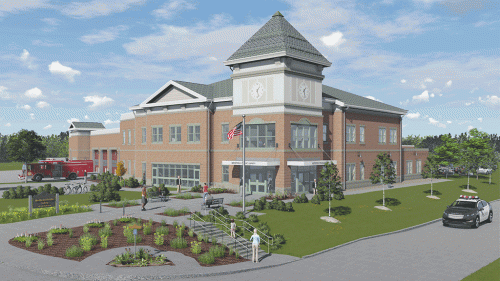
Westwood is reportedly about to spend $14-15m. to build a new police station, using the same builder Medfield used for our public safety building, according to a Westwood Press newspaper article.  Westwood’s projected cost of $14-15m. makes the $19m. Medfield is spending to build our combined fire and police, public safety building look like a great deal.  Our public safety building should be opening in the fall.

Public Safety Building

Medfield is planning

planning

The following memo, about the various planning efforts that are underway and will get addressed in various ways at the annual town meeting on April 25, was circulated this afternoon by Kristine Trierweiler.  After a 50+ year hiatus we are initiating lots of planning –

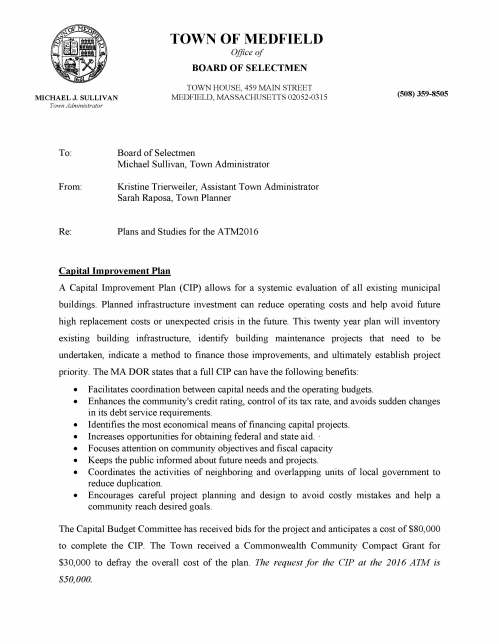
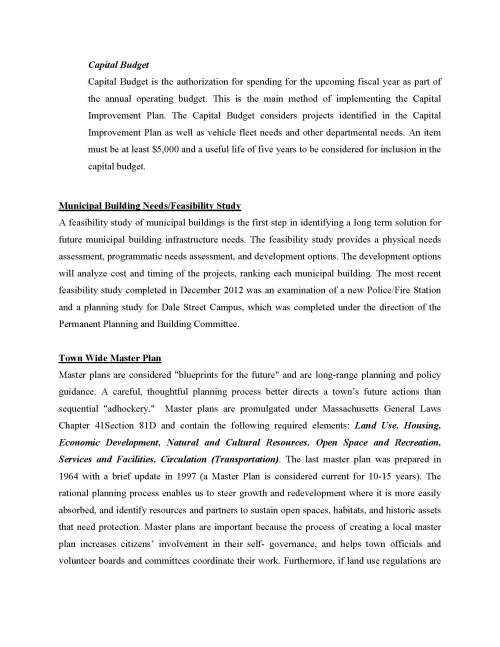
20160229-KT&SR-Proposed Studies for ATM2016_Page_1MICHAEL J. SULLIVAN Town Administrator TOWN OF MEDFIELD Office of BOARD OF SELECTMEN TOWN HOUSE, 459 MAIN STREET MEDFIELD, MASSACHUSETTS 02052-0315 (508) 359-8505 To: Board of Selectmen Michael Sullivan, Town Administrator From: Kristine Trierweiler, Assistant Town Administrator Sarah Raposa, Town Planner Re: Plans and Studies for the ATM2016 Capital Improvement Plan A Capital Improvement Plan (CIP) allows for a systemic evaluation of all existing municipal buildings. Planned infrastructure investment can reduce operating costs and help avoid future high replacement costs or unexpected crisis in the future. This twenty year plan will inventory existing building infrastructure, identify building maintenance projects that need to be undertaken, indicate a method to finance those improvements, and ultimately establish project priority. The MA DOR states that a full CIP can have the following benefits:  Facilitates coordination between capital needs and the operating budgets.  Enhances the community's credit rating, control of its tax rate, and avoids sudden changes in its debt service requirements.  Identifies the most economical means of financing capital projects.  Increases opportunities for obtaining federal and state aid. ·  Focuses attention on community objectives and fiscal capacity  Keeps the public informed about future needs and projects.  Coordinates the activities of neighboring and overlapping units of local government to reduce duplication.  Encourages careful project planning and design to avoid costly mistakes and help a community reach desired goals. The Capital Budget Committee has received bids for the project and anticipates a cost of $80,000 to complete the CIP. The Town received a Commonwealth Community Compact Grant for $30,000 to defray the overall cost of the plan. The request for the CIP at the 2016 ATM is $50,000. Capital Budget Capital Budget is the authorization for spending for the upcoming fiscal year as part of the annual operating budget. This is the main method of implementing the Capital Improvement Plan. The Capital Budget considers projects identified in the Capital Improvement Plan as well as vehicle fleet needs and other departmental needs. An item must be at least $5,000 and a useful life of five years to be considered for inclusion in the capital budget. Municipal Building Needs/Feasibility Study A feasibility study of municipal buildings is the first step in identifying a long term solution for future municipal building infrastructure needs. The feasibility study provides a physical needs assessment, programmatic needs assessment, and development options. The development options will analyze cost and timing of the projects, ranking each municipal building. The most recent feasibility study completed in December 2012 was an examination of a new Police/Fire Station and a planning study for Dale Street Campus, which was completed under the direction of the Permanent Planning and Building Committee. Town Wide Master Plan Master plans are considered "blueprints for the future" and are long-range planning and policy guidance. A careful, thoughtful planning process better directs a town’s future actions than sequential "adhockery." Master plans are promulgated under Massachusetts General Laws Chapter 41Section 81D and contain the following required elements: Land Use, Housing, Economic Development, Natural and Cultural Resources, Open Space and Recreation, Services and Facilities, Circulation (Transportation). The last master plan was prepared in 1964 with a brief update in 1997 (a Master Plan is considered current for 10-15 years). The rational planning process enables us to steer growth and redevelopment where it is more easily absorbed, and identify resources and partners to sustain open spaces, habitats, and historic assets that need protection. Master plans are important because the process of creating a local master plan increases citizens’ involvement in their self- governance, and helps town officials and volunteer boards and committees coordinate their work. Furthermore, if land use regulations are challenged, a consistent master plan can help in court. Master plans ensure eligibility for state grants and also allow for better bond ratings. Medfield State Hospital Master Plan The Medfield State Hospital Master Plan Committee (MSHMPC) is currently engaged in a planning process for a strategic reuse plan for the Medfield State Hospital property. The MSHMPC is working with a consultant to facilitate the creation of a conceptual use scenario(s) for the MSH property as well as adjacent properties. The strategic reuse plan will include identification of best uses relative to the Town’s objectives, economic analysis, implementation plans, design and zoning guidance, as well as assistance with disposition for redevelopment if necessary. The MSHMPC is currently in Phase I of a proposed three phase plan:  Phase I - Create Conceptual Plans & Economic Analysis for the Land Reuse  Phase II - Develop Zoning Modifications and Design Guidelines  Phase III - Disposition Plan20160229-KT&SR-Proposed Studies for ATM2016_Page_3

LCB’s proposed assisted living

Peak House & Clark Tavern

LCB of Norwood is proposing to build a 78 unit assisted living facility on a large tract of land zoned for residential use on Rte. 109 behind the Peak House and the Clark Tavern.  The land is actually U shaped and so large that it fronts on Rte. 109 in two places on both sides of those and the other intervening properties.

As the first step in the required permitting process, LCB has applied to the Conservation Commission for needed permissions to do work near the wetlands.  I asked to have that LCB application put on-line, because I figured there would be lots of interest.  Deb had a hard copy from being on the ConCom, so I was able to review that one.

The on-line version is at the town website under the ConCom section (look under the heading on the right captioned FORMS & PUBLICATIONS, there seem to be three PDF files) –

http://www.town.medfield.net/index.cfm/page/Land-and-Property/pid/21353

When this proposal first surfaced, I reviewed the current zoning bylaw and its recent amendment at the 2012 town meeting, when the town added assisted living facilities as permitted uses, and I concluded that there is a serious legal question as to whether assisted living facilities are in fact a permitted use in residential zones in Medfield.  I assume that issue will get fully vetted and sorted out when the permitting gets before the ZBA.

Bond sales

This email came Wednesday from Mike Sullivan, but I was on trial at the time so I am only now catching up.  Read Mike’s email before looking at the PDF to make better sense of the PDF.  20150512-public safety & solar PV bond sales


Sale of Bonds for Public Safety and Solar Array

We opened the bids yesterday for the $18,700,000 of bonds authorized by the Special Town Meeting in March. We did well, although last week the bond market was reflecting rising interest rates, so it’s good we sold them quickly. The results were very confusing as the public safety issue was reduced to $16,375,000 and the Solar array issue was reduced to $610,000. The reason for the reduction in the public safety issue was that the low bid included about $1.8 million in premiums, so we used most of that premium to reduce the amount of bonds issued from $18 million to $16.375 million. The rest of the premium on this particular issue will be used to cover the cost of the bond issuance costs. As for the solar array issue, the cost estimates has gone down because of the falling prices for solar panels and, also, bond counsel wanted us to reflect the fact that we had already received $90,000 in grant funds from the state for this project. What really confuses this issue is that we then received a premium of about $89,000 on this issue, which is almost the same as the $90,000 reduction in the amount of bonds issued. After covering its share of the bond issuance cost, the remaining $80,000 will be used to pay a portion of the annual debt services costs for this issue or about $8,000 per year in premium amortization funds.


We received six bids, which was low and a bit of a surprise, considering the last bond sale we had. we received 11 bids. I think this reflected the uncertainty in the bond market this week. The low bidder was Janney Montgomery Scott LLC, Philadelphia PA. The interest rate on the public safety bonds (twenty years) was 3.055% and the interest rate on the solar array (ten years) was 2.015 for a combined interest rate of 3.033. These rates are below what we projected at the town meeting so we’re in good shape as far as not underestimating our borrowing costs. I’m scanning the debt schedules for the two projects, along with the bid results and sending them in a separate email.


Hopefully Georgia will make sense of all of this when she comes to the Selectmen’s meeting on the 19th.


Mike Sullivan

20150512-public safety & solar PV bond sales

Moody’s says we’re Aa1

New Issue: Moody’s assigns Aa1 to Medfield, MA’s $18.7M GO Bonds
Global Credit Research – 07 May 2015
Affirms Aa1, affecting $62.3M of parity debt, post-sale

MEDFIELD (TOWN OF) MA
Cities (including Towns, Villages and Townships) MA
Moody’s Rating
ISSUE                                                                  RATING
General Obligation Municipal Purpose Loan of 2015 Bonds  Aa1
Sale Amount                  $18,700,000
Expected Sale Date        05/12/15
Rating Description        General Obligation

Moody’s Outlook NOO
NEW YORK, May 07, 2015 –Moody’s Investors Service has assigned a Aa1 rating to the Town of
Medfield’s (MA)
$18.7 million General Obligation Municipal Purpose Loan of 2015 Bonds. Concurrently, Moody’s has
affirmed the Aa1 rating on the town’s outstanding GO debt. Post-sale, the town will have $62.3
million of GO debt.
SUMMARY RATING RATIONALE
The Aa1 rating reflects the town’s sound financial position, stable residential tax base with
strong wealth levels and a manageable debt and pension burden.
OUTLOOK
Outlooks are usually not assigned to local government credits with this amount of debt outstanding.
WHAT COULD MAKE THE RATING GO UP
-Increased budget capacity and flexibility
-Material increase in available fund balance
-Large increase in the tax base
WHAT COULD MAKE THE RATING GO DOWN
-Prolonged operating imbalance resulting in a decline in available reserves
-Material decline in tax base or demographic profile
-Significant increase in debt burden
STRENGTHS
-Sound financial position with healthy reserve levels
-Stable tax base with strong wealth levels
-History of voter approvals for overrides and exclusions of Proposition 2 ½

CHALLENGES
-Limited levy capacity and budget flexibility due to Proposition 2 ½
-Planned appropriation of reserves RECENT DEVELOPMENTS
The fiscal 2014 audited financials reflect continued stability in the town’s financial position.
The $1.2 million drawdown of General Fund balance in fiscal 2014 reflects the ongoing planned use
of a restricted debt service reserve. Net of this draw, the town ran a surplus of $709,000 with
little change to available fund balance. Please see the Detailed Ratings Rationale for further
details.
DETAILED RATING RATIONALE
ECONOMY AND TAX BASE: STABLE RESIDENTIAL TAX BASE WITH STRONG WEALTH LEVELS
Medfield is a primarily residential community (95% of the 2015 assessed valuation) with a
population of 12,024, located approximately 20 miles southwest of Boston (Aaa stable). The town’s
$2.4 billion tax base is expected to remain stable with limited growth, reflecting a turnaround in
the regional real estate market. Assessed value increased 4.5% in 2015, bringing the five-year
compound annual growth to 0.6%. The town’s equalized value per capita remains strong at $199,561,
reflecting the strength of the residential sector. In addition, the town has a number of
residential developments underway, including new construction of high-end homes and condos, and a
new apartment complex which will continue to provide annual new growth revenue. Wealth levels are
also substantially higher than state and national averages, with median family income well over two
times the national average. Also, the town’s unemployment rate of 3.7% (January 2015) continues to
fall below the state (5.6%) and US (6.1%).
FINANCIAL OPERATIONS AND RESERVES: SOUND OPERATIONS WITH PLANNED USE OF RESERVES; FUND BALANCE
REMAINS HEALTHY
Medfield will maintain a healthy financial position over the near term given conservative budget
practices and limited, planned draws on reserves. Since 2008, the town’s financial statements
reflect annual use of reserves due to the drawdown of a large grant of $18.1 million from the
Massachusetts School Building Authority (MSBA) to cover school-related debt service. The current
balance of the grant is $10.8 million and is classified as restricted fund balance. The annual
drawdown averages $1.2 to $1.3 million and will continue to be reflected in the town’s annual
operations through 2023, the anticipated final draw date.
The fiscal 2014 operating results when netting out the use of $1.3 million of debt service reserve
appropriations reflects an operating surplus of $708,000, attributable to positive variance in
revenues and expenditures. Available fund balance remained relatively unchanged from the prior year
at $7.3 million, or 13.4% of revenues.
The fiscal 2015 budget increased by 3.9%, or $2.2 million from the prior year, driven by education,
health insurance and employee benefits. The budget was balanced with a 1.4% increase to the tax
levy and free cash appropriations of $1.3 million and $1.2 million from the debt service reserve,
covering both operating and capital needs. As of March, revenues are ahead of budget projections
while expenditures are on budget.
The fiscal 2016 budget increased by 6% from 2015 due to the debt exclusion, education, and employee
benefits. The budget is balanced with a 7.9% tax levy increase, free cash appropriation of $898,000
and $1.2 million from the debt service reserve.
Medfield derives the majority of its revenues from property taxes (67% of 2014 revenues) and
continues to benefit from a strong collection rate of 99% within the fiscal year. Positively, the
town benefits from a history of voter- approved general overrides to the Proposition 2 ½ tax levy
limit. In each of 2008, 2009 and 2012, the town passed a override to aid in general operations of
the town and education expenses, providing some additional revenue flexibility. Our ongoing
assessment of the town’s credit quality will factor in management’s ability to continue to maintain
a nominally balanced budget with sound fund balance levels.
Liquidity
Medfield’s net cash position at the end of fiscal 2014 was $23.2 million, or a healthy 42.4% of
revenues. DEBT AND OTHER LIABILITIES

Medfield’s net direct debt burden of 2.3% of equalized value will remain above average, but
manageable, given average amortization of principal and voter support for debt exclusions. The town
currently has no authorized, but unissued debt, and future debt plans are limited to an elementary
school project with an estimated cost of $30 million and expected no sooner than 2020. Given its
history, approval of future projects will likely include debt exclusions from Proposition 2 ½.
Debt Structure
The town’s principal amortization is average with 78% retired in ten years. Fiscal 2014 annual debt
service represented 8.4% of expenditures and the entire debt portfolio consists of fixed rate debt.
Debt-Related Derivatives Medfield has no derivatives. Pensions and OPEB
The town participates in the Norfolk County Contributory Retirement System, a multi-employer,
defined benefit retirement plan. The town’s annual required contribution (ARC) for the plan was
$1.6 million in fiscal 2014, or 2.9% of General Fund expenditures. The town’s 2013 adjusted net
pension liability, under Moody’s methodology for adjusting reported pension data, is $44.7 million,
or a moderate 0.84 times General Fund revenues. Moody’s uses the adjusted net pension liability to
improve comparability of reported pension liabilities. The adjustments are not intended to replace
the town’s reported liability information, but to improve comparability with other rated entities.
Medfield also makes pay-as-you-go contributions to OPEB in the amount of $1.5 million in 2014,
representing 41% of the ARC. The UAAL is $43 million and the town has established an OPEB trust and
recently began making annual deposits of $400,000. The 2014 total fixed costs for pension, OPEB and
debt service represented $7.8 million or 14% of expenditures.
MANAGEMENT AND GOVERNANCE
Massachusetts cities have an institutional framework score of ‘Aa’ or strong. The primary revenue
source for Massachusetts municipalities is property taxes which are highly predictable and can be
increased annually as allowed under the Proposition 2 ½ levy limit. Expenditures are largely
predictable and cities have the ability to reduce expenditures.
The town’s management team has shown a long term trend of consistent and conservative fiscal
management with multi-year capital planning.
KEY STATISTICS
-2015 Equalized Valuation: $2.4 billion
-2015 Equalized Value Per Capita: $199,561
-Median Family Income as % of US Median: 208.69%
-Fiscal 2014 operating fund balance as a % of revenues: 13.46%
-5-Year Dollar Change in Fund Balance as % of Revenues (2010-2014): 4.58%
-Fiscal 2014 Cash Balance as % of Revenues: 42.56%
-5-Year Dollar Change in Cash Balance as % of Revenues (2010-2014): 0.55%
-Institutional Framework: “Aa”
-5-Year Average Operating Revenues / Operating Expenditures (2010-2014): 0.98x
-Net Direct Debt as % of Full Value: 2.29%
-Net Direct Debt / Operating Revenues: 1.0x
-3-Year Average of Moody’s ANPL as % of Full Value: 1.35%

-3-Year Average of Moody’s ANPL / Operating Revenues: 0.6x OBLIGOR PROFILE
Medfield is a primarily residential community with a population of 12,024, located approximately 20
miles southwest of Boston.
LEGAL SECURITY
Of the current issue, $18 million is secured by the town’s general obligation unlimited tax pledge
as debt service has been excluded from the levy limitations of Proposition 2 ½. The balance is
secured by the town’s general obligation limited tax pledge as debt service has not been excluded
from the levy limit.
Of the town’s $45 million of outstanding debt, $31.7 million is secured by the town’s general
obligation unlimited tax pledge as debt service has been excluded from the levy limitations of
Proposition 2 ½. The balance is secured by the town’s general obligation limited tax pledge as debt
service has not been excluded from the levy limit.
USE OF PROCEEDS
Bond proceeds will be used to finance a public safety building project and solar project. RATING
METHODOLOGY
The principal methodology used in this rating was US Local Government General Obligation Debt
published in January 2014. Please see the Credit Policy page on http://www.moodys.com for a copy of this
methodology.
REGULATORY DISCLOSURES
For ratings issued on a program, series or category/class of debt, this announcement provides
certain regulatory disclosures in relation to each rating of a subsequently issued bond or note of
the same series or category/class of debt or pursuant to a program for which the ratings are
derived exclusively from existing ratings in accordance with Moody’s rating practices. For ratings
issued on a support provider, this announcement provides certain
regulatory disclosures in relation to the rating action on the support provider and in relation to
each particular rating action for securities that derive their credit ratings from the support
provider’s credit rating. For provisional ratings, this announcement provides certain regulatory
disclosures in relation to the provisional rating assigned, and in relation to a definitive rating
that may be assigned subsequent to the final issuance of the debt, in each case where the
transaction structure and terms have not changed prior to the assignment of the definitive rating
in a manner that would have affected the rating. For further information please see the ratings tab
on the issuer/entity page for the respective issuer on http://www.moodys.com.
Regulatory disclosures contained in this press release apply to the credit rating and, if
applicable, the related rating outlook or rating review.
Please see http://www.moodys.com for any updates on changes to the lead rating analyst and to the Moody’s
legal entity that has issued the rating.
Please see the ratings tab on the issuer/entity page on http://www.moodys.com for additional regulatory
disclosures for each credit rating.
Analysts
Nicholas Lehman Lead Analyst
Public Finance Group Moody’s Investors Service
Thomas Compton Backup Analyst Public Finance Group
Moody’s Investors Service
Geordie Thompson Additional Contact Public Finance Group

Moody’s Investors Service
Contacts
Journalists: (212) 553-0376
Research Clients: (212) 553-1653

Moody’s Investors Service, Inc. 250 Greenwich Street
New
New
USA

Thoughts on MSH as planning begins

Sarah Raposa, our Town Planner, sent out the agenda for the first meeting on Wednesday with the town’s master planning consultant, VHB, for the former Medfield State Hospital site.  As part of her email, Sarah suggested that people jot down thoughts, and below are mine:


Medfield State Hospital Site – Issues to Consider at Outset of the Planning Process

1.    Clean Slate – The past discussions and the visioning session created an interesting list of ideas, but should in no way limit options going forward.

2.    Infrastructure – lots needed, and best if developers instead of town can be made to pay

3.    Natural Resources – exist in abundance, and will continue to exist in abundance even if the town opts for a dense development

4.    Environmental – site has been mainly cleaned of known hazards, except the lead paint and asbestos in the buildings

5.    Transportation – none available – shuttle to downtown and train would be ideal

6.    Historic Resources – buildings are beautiful, but likely too far gone to be preserved

7.    Arts & Culture – it would serve the town well to spend to make such uses happen

8.    Housing – will be the economic engine of any development, and if planned well, even if dense, need not be feared in terms of municipal costs and impacts

9.    Open Space & Recreation – exist in abundance, and will continue to exist in abundance even if the town opts for a dense development

STM says yes and yes again

Both articles passed last night at the Special Town Meeting (STM) by overwhelming majorities, that were with one close to being unanimous, and with the other was unanimous.  The public safety building must still get a majority vote at the regular municipal election next Monday, March 30, to proceed.

The first STM vote, to fund the $700,000 construction costs of a money making solar photovoltaic installation behind the Waste Water Treatment Plant (WWTP), was unanimous.  As soon as the town’s new Energy and Facilities Manager, Andrew Seaman, who was presenting on behalf of the Energy Committee, mentioned that the array will be revenue positive starting in its first year, the Moderator jokingly interrupted to call for a fast vote.  The presentation may have continued, but the wisdom of a money making project was clear in the unanimity of the ultimate vote.  The array is projected to save the town $726,509 in electricity charges at the WWTP over 20 years.

Conversations with Energy Committee member Fred Davis after the meeting disclosed that the MEC’s solar consultant is already recommending to the town to proceed as fast as possible with other installations before the state subsidies for solar end in the next couple of years, which will change the economics dramatically.  The roof of the Highway Garage has already been recommended, but the old landfill is also being eyed.  Few old landfills remain without solar arrays, and there is even grant money to support such an installation.  Medfield never properly closed the landfill, so the closure may need to be revisited, but the economics may still make the project attractive.

Vote 2 to fund the almost $19m. construction costs of a new public safety building seemed to find the vast majority of attendees grudgingly, if realistically  accepting of the need for us to pay more in property taxes to allow for the new building.  This observer guesses that perhaps 20-40 people voted against proceeding.  There is no disagreement over the inadequacy of the old facility, and only minor issues verbalized over the size and scope of the new building and the lack of options presented.

Selectmen meet again this evening, to hear from all three of our legislators.

STM tonight – my top 10 reasons

The Special town meeting (STM) takes place this evening at the MHS gym at 7:30 PM to decide upon:

  1. The new public safety building; and
  2. A solar photovoltaic array next to the Waste Water Treatment Plant.

Top ten reasons that I favor the new public safety building:

  1. The new public safety building has been designed and vetted by the Building Committee right from the very beginning.
  2. The Building Committee is comprised of a group of extremely knowledgeable,  talented and diligent people.
  3. As a result of my attending many of the Building Committee’s meetings, I have come to trust the judgment of the Building Committee, and to feel secure with what they recommend.
  4. The public safety building has been designed with specific input from both chiefs, to meet both current and future needs of police and fire.
  5. I do not have the expertise to question whether the size and build out of the public safety building is appropriate, but I have faith in those who have vetted the design.
  6. There are extra spaces designed into the public safety building to accommodate future growth, but it is not of such an amount as to me to make the total design questionable, even if one were to disagree with those assumptions about future needs.
  7. The marginal costs of those extra spaces designed into the public safety building is not substantial when compared to the cost of the building without that space.
  8. Alternately, it would be extremely costly to have to add onto the public safety building later if we designed it too small now.
  9. The town has asked the police and fire to work in substandard space for too long.
  10. The police and fire have been exceedingly gracious about accommodating the town need to postpone any consideration of a new facility for them for many years beyond the time when we knew the current facilities needed to be replaced.

Public safety building

Chief Meaney today responded to questions that had been asked of me by a resident last week (which I in turn forwarded to the Chief and others in the know about the proposed public safety building) –


Mr. McKeown, Pete and others,

Here is what I have on the questions. Hopefully some of this was answered with the recent mailing as well as documents and presentations that have been placed on the Permanent Building Committee website medfieldpbc.org .

Here are some more specific answers:

What is the funding plan?
The project will be funded through a 20 year municipal bond which we anticipate will come in at a rate of 4%. This rate is based on opinions from Town Administrator and Town Treasurer.

Justification for the facility size/number of vehicles/personnel.

The size is based on anticipated needs over the next 50-70 years. Chief Kingsbury and I have spent many hours going over the space needs with professional consultants based on how Medfield handles public safety now and in the future. This process began several years ago but most recently over the past two years. One point that is very clear is that the current method of staffing the Fire Department is changing and has been changing over the past 10-15 years. The department currently has a chief and 8 firefighter/EMTs. The main goal is to staff the ambulance. When there is need for more assistance or there is an alarm of fire; part time, call firefighters are summoned to the station by way of a radio system that alerts the personnel of the need. These individuals then respond to the station from their homes or jobs to staff the vehicles and fight the fire or assist the ambulance. This manner of firefighting is disappearing in all parts of the country and not just Medfield. At some point in the future a decision will be made by the townspeople that more full time personnel are needed. That recommendation will come from the Fire Chief and proposed to the Board of Selectmen. Funding for this would then be proposed at Town Meeting where the voters can approve or reject the request. The transition to a full time Fire Department will be over a period of many years. The idea is to have sufficient capacity in the building to accommodate this need which is definitely coming, it is simply a matter of when.

The apparatus bay is designed to house only the current equipment with the addition of one ambulance. The apparatus bay is designed so that it will not be necessary to have equipment custom built in order to fit in the building, as is the current state of affairs. The most recent piece of apparatus was designed to fit into the garage under the police station and was built to tolerances of only a few inches, since that is all the room that exists. As a result, you can see that it is not anticipated that Medfield will require additional pieces of equipment but as the current equipment is replaced, it needs to have space to fit in. The additional ambulance will eliminate the need to rely on mutual aid from other towns when our ambulance is out of service due to routine maintenance or mechanical failure. This just happened earlier this month, so that while the EMS personnel respond to the scene in a fire vehicle, they cannot transport until another town arrives with their ambulance. It should be noted that this additional ambulance is obtained by simply not trading in the current ambulance (for which a very minor trade in amount is received) The new ambulance is financed by a revolving account that is supported by fees collected from insurance companies when individuals are treated and transported to the hospital.

On the police side, any expansion in personnel is accomplished through the same funding process mentioned above. My need for additional personnel is different than the Fire Department. The next year or so will hopefully see the addition of a School Resource Officer and the restoration of a half Detective position. We currently have 4 full time dispatchers and I can see this increasing by one over the next few years. Increases in housing (West Street and the unknown potential at the former State Hospital) may increase the need for additional personnel. But that is not anticipated to be a major factor such as what Westwood is going through with the addition of University Avenue Station project. An additional factor is that sooner rather than later, the building that the auxiliary police use at the former State Hospital will be dealt with; most likely taken down. It has no water, sewer or heat but serves the minimal purpose of housing radios and is used as a meeting location. These personnel (10-15) will also be absorbed into the proposed public safety building. They will be able to use the EOC (Emergency Operations Center)/training room for meetings and training, have room to store equipment and the person in charge of the unit will have a desk to operate from in the second floor open office area.

The proposed building will also house the Town’s computer infrastructure. The IT is currently in a couple of locations with less than ideal security and emergency power supply. This will put it in one secure space with generator back up to allow for continuous operation.

Future growth

As mentioned, we have spent considerable time exploring this. Even if the former State Hospital were to be replaced with 1500 additional residents, this would add a small number of ambulance runs per month. As far as police services; this would certainly increase somewhat. I do not anticipate it to change call volume such that the Town will need to hire several additional personnel. At this point we do not know what the area will end up looking like but I feel comfortable that the proposed building can handle it. The reason I say this is that on the police side, the limiting factor for patrol personnel is the amount of locker space for employees to store equipment. Once an officer arrives for duty they are on patrol, for the most part. So I need to have space for their equipment, to have roll call, type reports, eat, and do training. As far as support services, I need spaces for dispatch, an office for the sergeants to share, an area for detectives, prosecutor and general investigative services. I also need areas to process and hold prisoners, process and store evidence, an area to store weapons and store the volumes of records that we maintain. Computers have not decreased the need for paper records, it has actually increased it. The building also provides for some growth in administration and a small fitness room that equates to what you would find at a Holiday Inn, (room for perhaps 3 aerobic machines and some limited weightlifting equipment, such as hand weights). There are also areas to conduct interviews, unsecure detention for juveniles (as required) and process firearm permits and other licenses. These rooms also have other functions as we have tried to make best use of the space we have. On the second floor, we have designed an open office type concept that can be used by the School Resource Officer, Animal Control Officer, Auxiliary Police Supervisor and others not currently anticipated. So we also have flexibility in the building with appropriate room for growth.

Hope this all helps explain things from our point of view…..Chief Bob Meaney


Chief Robert E. Meaney, Jr.
Medfield Police Department
110 North Street
Medfield, MA 02052
508-359-2315 (Dispatch)
508-359-6926 (Fax)

This e-mail and any files transmitted with it are confidential and intended solely for the use of the individual or entity to whom they are addressed. If you have received this e-mail in error please notify the originator of this message. Town of Medfield


Public safety building

This email today from Mike Quinlan, co-chair of our Building Committee –


As some of you know, for the past few years, I have served as Co-Chair of the Medfield Permanent Building Committee.  Our committee oversees design and construction of all town facilities.  I wanted to reach out to you all to make sure you’re aware of some important upcoming town events as they will influence the future of Medfield and I believe it’s important that we all participate in shaping that.

In 2008 due to severely deteriorating facilities the town created a Capital Investment Plan that included four major building project organized by priority.  The first of which was the DPW Garage which was approved in 2013 and completed in the fall of last year.  The second major facility in need of replacement is the Police/Fire facility that we are now calling the Public Safety Building.  This month, the town will be holding a Special Town Meeting to decide whether or not to authorize the town to borrow funds to build a new Public Safety Building.  Subsequent to that, at the annual town election, there will be a ballot question requesting the approval of the town to borrow those funds.

The Permanent Building Committee has been working with architects and engineers for 2 years to design the facility and bids to build the facility are due this week.  This will give us an exact amount that the building will cost.  Currently, we are estimating the project to cost $20,350,000 of which the town has already allocated $1,350,000 at previous Town Meetings.  Thus we will likely be seeking $19,000,000 at this Town Meeting in 3 weeks.  This amount would add between $200-$500 to your annual tax bill depending on the value of your home.  This email seeks only to inform you of the details and not to advocate for either position.

There will be a Public Informational Forum held next Saturday to provide more detailed information about the proposed facility and there will also be tours of the existing facility so that people can see why the need exists.

Below is the schedule of important dates and I hope that you all are able to participate in some way.  You also should’ve received a mailer in your mailbox yesterday or today.

March 7th, 10AM, Dale Street School Auditorium – Public Information Forum

  • March 23rd, 7:30pm Medfield High School Gym – Special Town Meeting
  • March 30th, All Day, Medfield Council on Aging – Annual Town Election

Please forward to any neighbors, friends, spouses or other Medfield residents that may be interested.  Also, don’t hesitate to reach out with any questions…

Best regards…

Mike