Climate Community Resilience Building Workshop – 1/31

This email from Town Planner, Sarah Raposa –

planning


Dear Medfield Residents, Board/Committee Members, and Colleagues –

The fall of 2018 was the wettest meteorological rainfall on record according to data collected at the Blue Hills Observatory since the 1800s and 2014-2017 were the hottest years on record. This combined with more unpredictable and severe weather events such as the four Nor’Easters in March 2018, our community may be at greater risk to climate change.

The Town of Medfield and the Metropolitan Area Planning Council (MAPC) cordially invite you to participate in preparing and protecting our community though a Community Resilience Building Workshop.

Climate Community Resilience Building Workshop
When:  Thursday, January 31, 2019

(Snow Date: Tuesday, February 5, 2019)
Where: Medfield High School, Room 125
88R South Street

Medfield, MA 02052
Time:    9:30 AM to 3:00 PM

Lunch and refreshments will be served.

The Workshop will bring together community members like you to reduce risk and improve climate resilience.  It is a participatory event where your local knowledge and expertise will:

  • Evaluate strengths and vulnerabilities of residents, infrastructure, and natural resources.
  • Create an action plan to protect citizens, neighborhoods, and businesses.
  • Prioritize climate actions most important to you and Medfield.

Please RSVP for the Workshop by January 28, 2019 to Sarah Raposa sraposa@medfield.net

I hope you can join me at this important workshop.
Thank you for your consideration!
Sarah


PS: Staff & Committee Chairs, please forward to your boards/committee members.

Apologies for duplicate notices.


Sarah Raposa, AICP

Town Planner
459 Main Street
Medfield, MA  02052
(508) 906-3027
sraposa@medfield.net
www.town.medfield.net


Office hours tomorrow

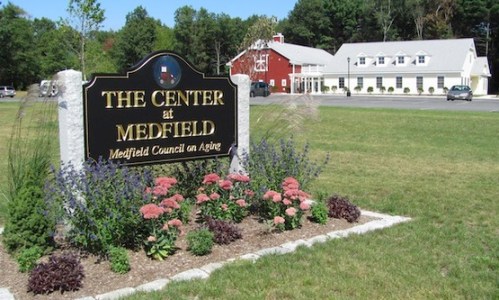
Center_and_sign

Selectman Office Hours Tomorrow

My regular monthly select board office hours are at The Center on the first Friday of every month from 9:00 to 10:00 AM (this Friday).

Residents are welcome to stop by to talk in person about any town matters. Residents can also have coffee and see the Council on Aging in action (a vibrant organization with lots going on).

I can be reached via my cell phone at 508-359-9190 or my blog about Medfield matters, where any schedule changes will be posted


MAPC seeks input on planning 1/30

MAPC

MAPC Invites Residents to Planning Meeting

Wednesday, January 30, 2019, from 3:00 PM to 8:00 PM, at Castle Island Brewing Co., 31 Astor Ave, Norwood, MA 02062.

Dear Mr. Peterson:

On behalf of MAPC, thank you for coming to the first TRIC/MetroCommon 2050 gathering on November 30th in Dedham.

During both the breakfast and lunch sessions, MAPC staff noted everyone’s comments and concerns, which are now being cataloged, categorized, and analyzed. This input, along with what we’re hearing from local officials and representatives from across the region, will be woven into the MetroCommon vision.

PLEASE SAVE THE DATE:  Briefly referenced at the gathering, the next event where your community’s voice can be heard is planned for Wednesday, January 30, 2019, from 3:00 PM to 8:00 PM, at Castle Island Brewing Co., 31 Astor Ave, Norwood, MA 02062.  The event will be an open-house-style listening session for everyone: residents, the business community, non-profit organizations, etc.  Please spread the word to your networks.

Additionally, as a local representative, please consider attending the first event in our MetroCommon Speaker Series: an invigorating lecture and discussion with the nationally-renowned Richard Rothstein, author of The Color of Law, on Thursday, January 24, 2019, from 7:00 PM to 9:00 PM This should be of particular interest to local officials, as this topic is how government-imposed segregation laid the groundwork for today’s racial divisions in cities and suburbs, alike. Register here.

My best regards, and wishing you a Happy New Year,

Laurie

mapc email signature for laurie zivkovich

MFD gets S.A.F.E. grant

MFD

Email today from Chief Carrico (via Kristine Trierweiler) –

=============================================================

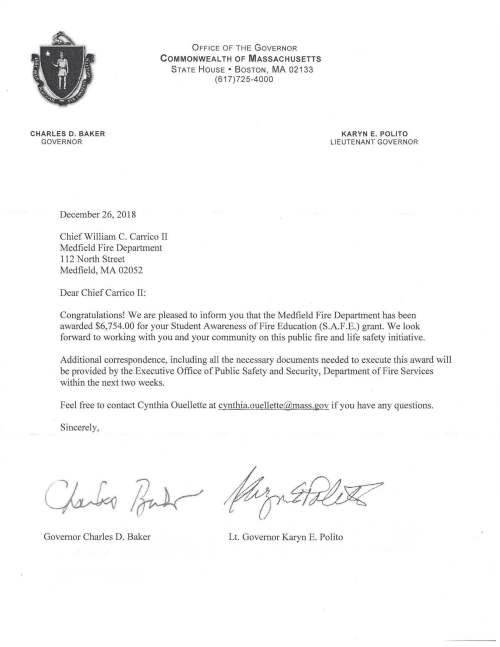
I was just notified that Medfield Fire has received the Student Awareness of Fire Education (SAFE) grant in the amount of $6,754.  This is the first time in several years that the department has taken advantage of this award program.  Fire Prevention Officer Lt. Mike Harman was instrumental in putting the grant application together, making sure it was sent out on time, and included key public fire and life safety initiatives planned for Medfield

William C. Carrico II, Fire Chief

Medfield Fire

112 North Street

Medfield, MA 02052

(O) 508-359-2323 Ext 3186


CHARLES D. BAKER GOVERNOR December 26, 2018 OFFICE OF THE GOVERNOR COMMONWEAL TH OF MASSACHUSETTS STATE HOUSE • BOSTON, MA 02133 (617) 725-4000 Chief William C. Carrico II Medfield Fire Department 112 North Street Medfield, MA 02052 Dear Chief Carrico II: KARYN E. POLITO LIEUTENANT GOVERNOR Congratulations! We are pleased to inform you that the Medfield Fire Department has been awarded $6,754.00 for your Student Awareness of Fire Education (S.A.F.E.) grant. We look forward to working with you and your community on this public fire and life safety initiative. Additional correspondence, including all the necessary documents needed to execute this award will be provided by the Executive Office of Public Safety and Security, Department of Fire Services within the next two weeks. Feel free to contact Cynthia Ouellette at cynthia.ouellette@mass.gov if you have any questions. Sincerely, Governor Charles D. Baker Lt. Governor Karyn E. Polito

MFi’s Volunteer Awards open

voty-2018

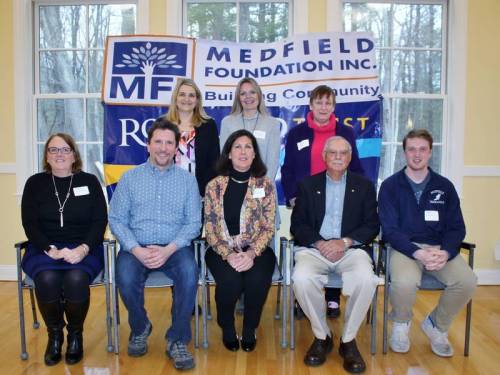
Rear: Liz Sandeman, Janie Boylan, Nancy Irwin
Front: Susan Holbrook, Chris Allan, Kim Agricola, Anthony Centore, Jack Morrill
Not pictured: Tracey Rogers and Renee Romanowski
Photo by Colleen Sullivan


The Medfield Foundation Opens Nominations for 2019 Volunteer Awards

MEDFIELD, MA, January 3, 2018 – The Medfield Foundation (MFi) is pleased to announce the opening of nominations for its twelfth annual Volunteer Awards. The Volunteer Awards, a Medfield Foundation initiative, celebrates the extraordinary efforts of passionate citizens whose works have made a marked difference in Medfield residents’ quality of life.

The Volunteer Awards are based exclusively on citizen nominations. Since 2008, more than 100 residents have been nominated for recognition. The Medfield Foundation asks Medfield citizens to nominate an exemplary volunteer for consideration in the 2019 Volunteer Awards.

To submit a nomination, please visit: http://bit.ly/MFiVol. All submissions must be submitted  by January 31, 2019.

“We are thrilled to celebrate over a decade of recognizing Medfield’s most giving citizens,” says Osler (Pete) Peterson, Medfield Town Selectman and MFi Board Member.

With Peterson, Volunteer Awards co-chairs, John Byrne of Juniper Lane and Linda D’Amore of Indian Hill Road, anxiously await citizen nominations and look forward to celebrating at the Volunteer Awards reception.

The 2019 Volunteer Awards reception will be held on Sunday, March 31, 2019, from 3:00 to 5:00 in the afternoon, at The Center at Medfield, One Ice House Road, Medfield. The Medfield Foundation Board Members welcome attendance by all townspeople and guarantee attendees will be moved and inspired.

Applaud commitment to community. Recognize those who give where they live. Nominate your neighbor today!

Brothers Marketplace and Roche Bros. have generously sponsored the Volunteer Awards this year.

brothers-marketplace-jgp

About The Medfield Foundation (MFi)
The Medfield Foundation (MFi) is a volunteer-run, 501(c)(3) non-profit charitable corporation. The Foundation facilitates the raising and allocation of private funds for public needs in the town of Medfield, with a mission to enrich the lives of residents and build a stronger community. Since 2001, the Foundation has raised over $2 m. to benefit the Town of Medfield. To learn more about the Foundation and its initiatives, or how to volunteer or contribute, please visit

Water use by state

domestic_water_use_per_capita_by_state_2005_1042_656_80


The Massachusetts DEP historically wanted us to use 60 gallons per person per day or less, and we are above that when we water grass in the summer.

It is instructive to see how water usage varies by states, with California and Texas being really high.  If it was just irrigation in hot climates, I would have expected Florida to be equally as high, but it is not.  Perhaps it is related to agricultural uses.

SHAW’S SHOPPING PLAZA SOLD

SHAW’S SHOPPING PLAZA SOLD

https://nerej.com/rk-centers-acquires-two-retail-properties-totaling-41-6-million


RK Centers acquires two retail properties totaling $41.6 million – including 114,244 s/f Walmart Supercenter at 770 Broadway, Saugus, MA

December 21, 2018 – Retail
Walmart Supercenter at 770 Broadway – Saugus, MA

Medfield, MA The steady growth of RK Centers of Needham, Mass.continues with the company’s December acquisitions of two landmark retail centers: the 87,614 s/f plaza formerly known as The Medfield Shops – rebranded as RK Medfield Shops –  on Rte. 109 (230 Main St.) in Medfield, and the 114,244 s/f Walmart Supercenter at 770 Broadway (Rte. 1) in Saugus.

RK Centers paid $17.5 million for RK Medfield Shops, and $24.1 million for the Walmart Supercenter, according to Ken Fries, director of acquisitions for RK Centers. In the last three years, RK Centers has acquired a total of 2.15 million s/f.

The seller of the Medfield property was OCW Retail Medfield, LLC (O’Connor Group). Brokers in the transaction were Geoffrey Millerd, Justin Smith, and Christian Brannelly of Newmark Grubb Knight Frank’s NGKF Capital Markets of Boston. The seller of the Walmart Supercenter was WS Saugus Properties LLC.  The brokers  for the transaction were Nat Heald, executive VP, and Chris Angelone, managing director of Jones Lang LaSalle / N. E. Capital Markets.

With the exception of an inline ATM, RK Medfield Shops is 100% leased. The center is anchored by Shaw’s Supermarket and Marshalls and features the Blue Moon Bagel Café, Jaie 3 Salon & Spa, and Fitness Together.

The Walmart Supercenter property, built in 2014, is entirely occupied by Walmart and serves over 400,000 residents within a five-mile radius.

Fries said, “These acquisitions nicely fit our portfolio profile: Open-air, well-situated, heavy traffic locations with good demographics – and well-known tenants.”

Teen vaping use spikes

From my Route Fifty newsletter – click here to view online.  I recently also heard that there is now monitors that can be installed that sense when vaping is occurring. Vaping can also be used to smoke marijuana. –


New Survey Finds Big Increase in U.S. Teen Vaping

 A hand holding an e-cigarette that was found at a 2018 high school graduation ceremony in California.

A hand holding an e-cigarette that was found at a 2018 high school graduation ceremony in California. SHUTTERSTOCK

One in five high school seniors vaped in 2018.

The U.S. Food and Drug Administration is taking action against e-cigarette companies out of fear that vaping by teens is skyrocketing. New data from this year’s Monitoring the Future survey suggests it’s true.

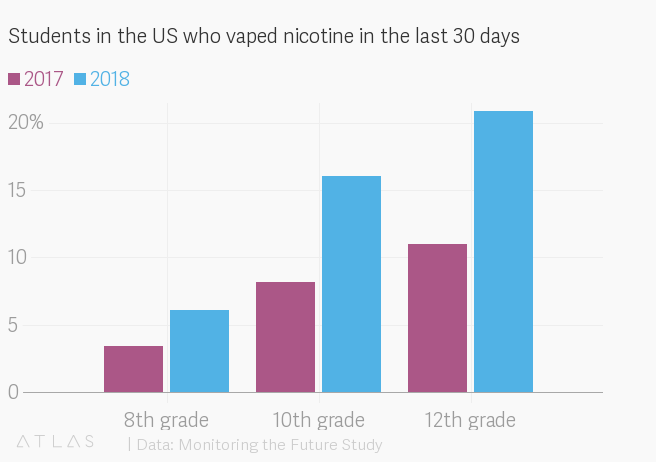
Between 2017 and 2018, the nationally representative survey of 13,850 teenagers found that the number of 12th graders who had vaped nicotine in the past 30 days grew by nearly 50%. In 2017, roughly one in 10 seniors had vaped, and in 2018, that number was roughly one in five. The jump from 11% to 21% is the largest increase among 12th graders using any substance in the survey’s 44 years.

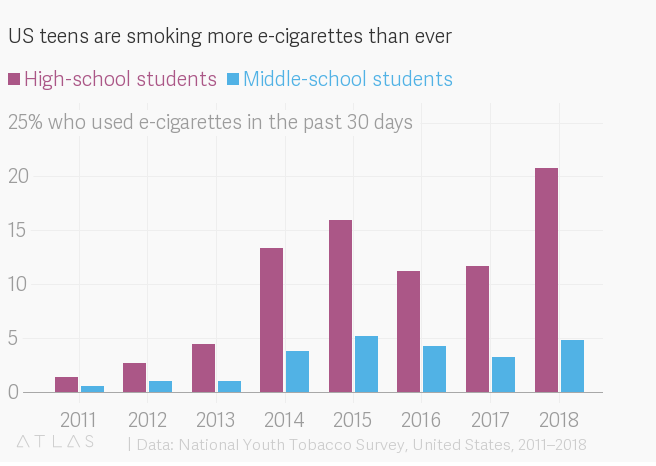
The survey, funded by the National Institute on Drug Abuse, has been conducted annually since 1975 by researchers at the University of Michigan (surveys on 8th and 10th grades only began in 1991). This year’s results reflect a trend the National Youth Tobacco Survey highlighted earlier this year, which found that the total number of high-school students who reported vaping in the past 30 days more than doubled.

“The policies in place as of the 2017 [to] 2018 school year were not sufficient to stop the spread of nicotine vaping among adolescents,” the authors of the Monitoring the Future survey wrote in an accompanying commentary published in the New England Journal of Medicine.

There are two two main health concerns with adolescent vaping. First, there’s limited evidence that the chemicals in vape cartridges—particularly the sweetly flavored cartridges—are completely safe. As Quartz previously reported, researchers have found entirely new compounds created when the chemicals in cartridges are vaporize and preliminary work has shown that some of the known compounds found in vapes can irritate immune cells within the lungs. Second, authorities are worried that vaping nicotine could lead to smoking tobacco cigarettes later on. However, it’s not yet clear that this claim is valid—a review published earlier this year suggested that e-cigarettes could actually be helping cigarette use fall among teens.

Nevertheless, these concerns led the FDA to take some action regulatory action against e-cigarettes and other tobacco products earlier this fall. In November, the regulatory agency announced that e-cigarettes could only be sold in stores in areas closed off to minors, although it’s already illegal to sell to people under the age of 18. Additionally, it’s now focusing on banning menthol cigarettes and flavored cigars.

Nomination papers available from Town Clerk

The first step in seeking an elected municipal position is gathering the signatures of fifty registered voters on nomination papers that one gets from the Town Clerk.  Those nomination papers then need to be returned to the Town Clerk in a couple of months, so the signatures can be certified.

Election banner

This notice today from the Town Clerk –

Nomination Papers – Town Election 3/25/2019

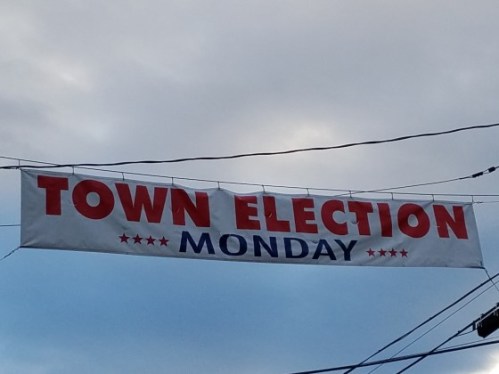
Nomination papers are available for the Town Election on 3/25/19 for the following positions: Moderator, Selectmen, Assessors, School Committee, Library Trustee, Planning Board, Park Commissioner and Trust Fund Commissioner.

Renewables now cheaper that coal generation

From the Router 50 newsletter today –

======================================================

Two Electric Utilities Have Promised to Go 100% Carbon-Free

SHUTTERSTOCK

The shift is in part driven by cities’ policies.

Two U.S. electric utilities recently declared something remarkable: It’s cheaper to tear down their coal plants and build renewable-energy plants than to keep the old boilers running. For the utilities, the goal is now to retire their coal plants and exceed the economy-wide climate targets set in the Paris Agreement: an 80% reduction of carbon emissions from 2005 levels by 2050.

It’s a surprising move by two (primarily) coal-powered utilities in the American West, but get ready for more. Economics, and politics, are fast converging on a consensus. Committing to a 100% carbon-free goal, even before we quite know how to reach it, is good for business.

The first to make the announcement was Xcel Energy, a utility serving 3.6 million people in eight states from Minnesota to New Mexico. On Dec. 4, the company said it would hit an 80% reduction target by 2030, and eliminate all carbon emissions from its power plants by 2050. Two days later, Colorado’s Platte River Power Authority (an Xcel competitor) approved its own goal of 100% carbon-free energy by 2030.

Jason Frisbie, general manager of Platte River Power Authority, said it was just an admission of economic realities, not a political statement. “This whole thing started because the board wanted to recognize the shift that has already been taking place in the business for several years,” he told a local newspaper. Cities buying its electricity were demanding clean energy, and the price of renewables had tumbled below even the cheapest fossil fuels.

Costly coal

Although the announcements came in quick succession, they’ve been a long time coming, says Mark Dyson of the energy nonprofit Rocky Mountain Institute. At least 90 cities have declared their intention to adopt 100% renewable energy goals. Utilities can accept this, or risk losing their biggest customers.

Two major defections recently drove home the point. In Boulder, Colorado, the city council voted on Dec. 4 (the same day Xcel made its announcement) to leave the utility to pursue its own 100% renewable electricity generation two decades earlier than Xcel. In Silicon Valley, San Jose left the utility PG&E this year to offer a 100% renewable option from San Jose Clean Energy. (PG&E is only delivering 80%.)

After years of hedging their bets, utilities can’t ignore the numbers anymore. PacifiCorp, which relies on coal for 59% of its fuel, recently said it’s more expensive to run 13 of its 22 coal units than to retire them and switch to renewables. The company estimated it could save money by shutting down 60% of its units by 2022, an assessment largely in line with the Sierra Club’s calculations. Globally, at least 42% of the world’s coal power stations are operating at a loss, estimates the research nonprofit Carbon Tracker.

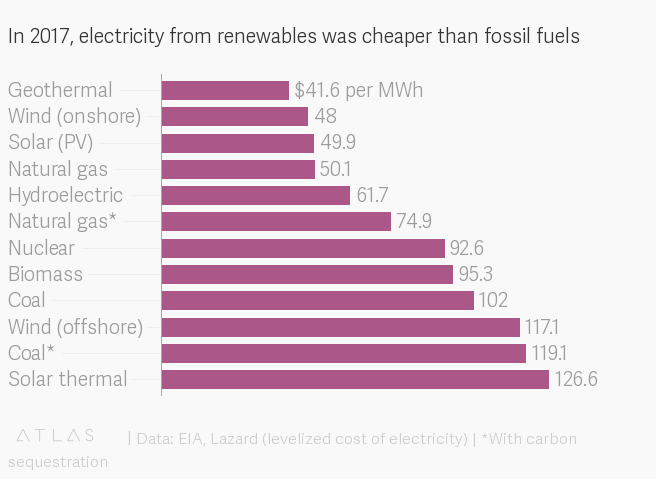
Dyson says it’s just a matter of time before more utilities across the US reach the same decision to replace old coal with “crazy cheap” new renewables. In Colorado, bidders are selling wind for as little as $12 per megawatt hour (MWh) and solar for $23 per MWh. Even after adding batteries to solar farms to keep supplying power into the evening, the cost rises to just $30 per MWh. That’s before income tax credits of 30%  for new renewables built by 2023. Those prices are well below the average US price of nuclear ($105/MWh), coal ($67/MWh), and even low-cost natural gas ($39/MWh), according to Ravi Manghani of energy research firm Wood Mackenzie.

Steel for fuel

With prices so low, investing in new renewable-energy infrastructure instead of fuel is a no-brainer. In fact, that’s the basis of Xcel’s new business model: “steel for fuel,” with steel meaning new wind turbines and solar arrays. Xcel, like most vertically integrated utilities, is a regulated monopoly. A state commission sets customers’ prices so the utility can earn a reasonable rate of return on what it builds without overcharging. More stuff on the ground equals more money. In the case of renewables, argues Xcel CEO Ben Fowke, “everybody benefits.” Xcel earns money on the new “steel” and customers get lower prices far into the future.

More utilities are following its lead. The Southern Company’s CEO said in April that the utility will be “low to no carbon” by 2050. Earlier this year, New Mexico utility PNM said (with no publicity) it will exit all coal generation by 2031. In October, northern Indiana’s Public Service Company said it will save $4 billion by replacing all coal generation with renewables by 2028.

Yet some are still fighting to make coal great again. In the same week of Xcel’s announcement, Wyoming’s Black Hills utility proposed buying an existing coal power plant as the cheapest option with “long-term price-stability,” a characterization that left some analysts scratching their heads (jobs may have something to do with it). Meanwhile the Trump administration is rolling back environmental rules such as the Clean Power Plan and promoting a Coal FIRST initiative to keep coal plants open. But Moody’s Analytics, a financial analysis firm, said these actions “will not materially derail decarbonization trends.”

Built-in climate catastrophe

Accelerating those trends is critical to avert catastrophic climate change. Greenhouse gas emissions have already baked at least 2°F into the climate, and just 15 years remain to avoid another one-degree rise. Stopping the construction of new, long-lived power plants that emit carbon for decades is the only way to avoid this. ”Most warming anticipated this century is from infrastructure yet to be constructed,” writes Ken Caldeira, a climate scientist at Stanford University.

For now, the grid is not quite ready for 100% renewables. Far more storage will need to come online. High-voltage transmission lines must ferry energy from (often remote) wind and solar arrays to their final, urban destinations. With utilities set to approach 80% renewables in the next decade, the last 20% of carbon-free electricity will be the hardest to achieve.

“Technical options exist but it does get costly,” says Tom Wilson, a renewable-energy expert at the Electric Power Research Institute. Right now, the only cost-effective commercial options running at scale are nuclear reactors (very pricey) and large hydroelectric facilities (hard to site new ones). While geothermal, carbon sequestration, revolutionary batteries, and experimental small reactors are among future cost-effective possibilities, utilities are betting the right solutions will come on time. “If you have the vision, and the need to get there, sometimes the technology shows up,” says Wilson.

Michael J. Coren is a reporter at Quartz, which originally published this article.