Category Archives: Uncategorized

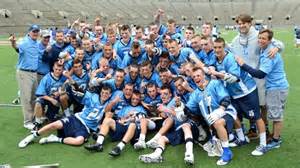
Globe on boys lacrosse

lacrosse

Boston Globe article on MHS boys lacrosse – click here to see

My April lawyer newsletter

Having trouble viewing this email? Click here to view newsletter online +SUBSCRIBE
April 2016
Photo
Osler “Pete” Peterson
617-969-1500 – Newton
508-359-9190 – Medfield
Dear Pete,Federal officials recently reported a steep increase in roadway deaths throughout the nation in 2015. We suspect that distracted driving is one factor in this increase. This month we urge all our friends and family to help end distracted driving.

Information that makes us safer
These newsletters are based on a simple idea – the more each one of us knows, the better off each us will be. Each newsletter focuses on a topic that relates to the health, wellness, and safety of each of us, our families, and our friends. I hope that you will find the information both interesting and informative, and that each month you can take away at least some nugget, that can make you or your family more secure.

Remember, the safer you remain, the less likely is that you will need the courts, as legal claims are generally only needed when proper safety measures were missing.

Pete

April Is Distracted Driving Awareness Month

Distracted Driving Still on the Rise, Especially Among Teens

According to AAA, Americans drive the fewest miles during the winter months. Once April rolls around and the sun shines a bit brighter, the mileage goes up as we shake off the winter doldrums. More miles behind the wheel also means there are more chances to become distracted. And unfortunately, those distractions – like texting, talking, eating, adjusting a radio, checking a map, applying makeup and many more – can have deadly consequences.

As we enter April and Distracted Driving Awareness Month 2016, we note sadly that the number of injuries and deaths from driving distracted continues to rise, especially among teenagers. Maybe the increase is due to our obsession with mobile technology or our love affair with the car or just the increasingly frantic pace of our lives (no one is quite sure). But we do know this: Distracted driving is a problem that is 100 percent preventable. Before you send that next text message or order that double cheeseburger to go, you should know the dangers of distracted driving and what you can do to prevent tragedy from striking in your life!

Start driving more safely here.

BY THE NUMBERS /
3,179
Killed

In 2014, 3,179 people were killed and 431,000 people injured in motor vehicle crashes involving distracted drivers.

660,000
Vehicles

At any given time on U.S. roads, there are 660,000 vehicles being driven by someone using a hand-held phone.

10%
Fatalities

In 2013, 10 percent of all drivers aged 15 to 19 involved in fatal crashes were reported as distracted at the time of the crash.

BOOKMARK FAVORITES /

Little Distractions Add Up to Big Trouble Behind the Wheel

An estimated nine people die and more than 1,000 are injured every day in crashes that involve distracted driving, according to the National Safety Council. View video.

New Hands-Free Systems Still Not Risk-Free

A recent AAA study showed that drivers are still distracted while using the new hands-free systems found in many new vehicles. View video.

“Moment of Silence” Campaign Fights Distracted Walking

SafeKids.org has partnered with FedEx in this public service campaign highlighting the dangers of distracted walking, especially among young people. View video.

Up Next Month: Forced Injustice

Next month we will feature an update on the widespread use of forced arbitration by many businesses to deny Americans their right to a day in court. We call it “forced injustice.”

Start here

EndDD Enlists Teens to Help Stop Distracted Driving

Joel Feldman, a lawyer and the father of a young woman killed by a distracted driver, leads a ground-breaking national campaign to stop distracted driving.

Listen now

You Should Know is a copyrighted publication of Voice2News, LLC, and is made possible by the attorney shown above. This newsletter is intended for the interest of past and present clients and other friends of this lawyer. It is not intended as a substitute for specific legal advice. If you no longer wish to receive these emails, click here to unsubscribe from this newsletter, and your request will be honored immediately. You may also submit your request in writing to: Steven L. Miller, Editor, 4907 Woodland Ave., Des Moines, IA 50312. Be sure to include your email address.
Click here to unsubscribe from this newsletter.

On being a selectman

BoS

Tired this afternoon – home for dinner at 10PM last night, 9:30 PM the night before, and 9:00PM tonight, for meetings respectively of the –

  •  Board of Selectmen
    • Schools seeking approval of application to the Massachusetts School Building Authority to start the process to replace Dale Street School, perhaps with an addition onto the Wheelock School, making Wheelock a grades 2 – 5 school.
    • Met with Liz Sandeman to receive a her donation of a flag and for recognition of Donate Life Month – organ donation promotion.
    • declared a snow emergency.
    • reviewed the warrant articles for the town meeting to assign speakers.
  • Medfield State Hospital Master Planning Committee
    • planning for its 4/11/16 public forum at the MHS auditorium.
  • Medfield Energy Committee
    • update of stretch code article for the town meeting
    • update on the solar installation at the WWTP
    • update of solar at the Public Safety Building and the DPW Garage
  • Met Tuesday morning with the Larkin Brothers about their Hospital Road 40B.
    • Their plans now down to 48-52 units,
    • 75% with first floor master suites,
    • they are continuing to plan to target the empty nesters market (no shared playground for kids).
    • Meeting again in two weeks with them and their architect.
    • Sunday I saw the open house sign out at their North Street, Grove Place development, Michael Larkin toured me through a three bedroom unit there with a first floor master suite.  It had nice details, with both angled and right angle bays, windows of different sizes, and good looking quality in the kitchen and baths.
  • Met this morning with the Medfield Cares About Prevention (MCAP) (www.MedfieldCares.org) leadership team.  Report on the recent member survey, and upcoming Hidden in Plain Sight event to take place at the Natick Mall from 10-2 on May 19 and 5-9 on May 20.  Invited three millennials to join the group.

Dog rules on town property???

TTOR  dog-cold-weather-med

At the Board of Selectmen meeting last night I brought up that I had received complaints from a resident who had been subjected to rude and offensive behavior by a professional dog walker while the resident was walking his dog at the Medfield State Hospital property.  So I was suggesting that the town might want to look at instituting some controls, to deal with the professional dog walkers, and the inconsiderate dog owners who do not pick up after their own dogs.

Diane Borrelli was kind enough to email me the links to the The Trustees of the Reservation materials on their Green Dog Program.  The great news is that the The Trustees of the Reservation have already figured out how to handle dog walking.  Their system looks simple – get a trustees membership, each person can have up to 2 dogs if they have 2 leashes, keep the dogs under control, and you pick up after your dog.

Trustees Green Dogs Program

I will suggest that the Medfield State Hospital Building and Grounds Committee and the Medfield Police Chief come up with a workable system for dogs at the Medfield State Hospital, Wheelock, and in the rest of the town, so that the inconsiderate few do not spoil things for others. The Chief tells the selectmen that he does not have a pooper scooper law that he can enforce.


Stretch Code forum 4/12

MEC

Public Forum :

Green Communities / Stretch Energy Code


The Medfield Energy Committee invites you to attend a forum to present and discuss the plan to qualify Medfield as a Green Community.  Representatives from the Department of Energy Resources will be on hand to address any questions or concerns regarding the Stretch Energy Code.  Adoption of the Stretch Energy Code will be voted on at Town Meeting April 25.  If you are a builder, developer or realtor please plan on attending this forum.


When:        April 12 at 4 PM

Where:       Town Hall Chenery Meeting room  –  2nd floor

Dale Street School

Dale Street School

From the Superintendent today, to the Selectmen, to start the replacement process for the Dale Street School.
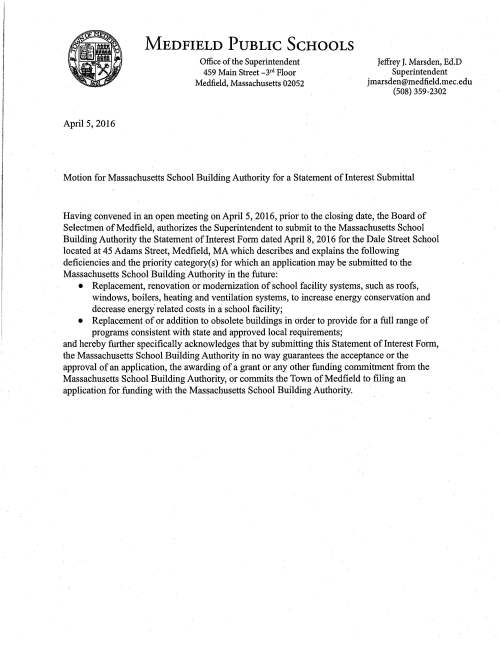


April 5, 2016 MEDFIELD PUBLIC SCHOOLS Office of the Superintendent 459 Main Street _3rd Floor Medfield, Massachusetts 02052 Jeffrey J. Marsden, Ed.D Superintendent jmarsden@medfield.mec.edu (508) 359-2302 Motion for Massachusetts School Building Authority for a Statement of Interest Submittal Having convened in an open meeting on April 5, 2016, prior to the closing date, the Board of Selectmen of Medfield, authorizes the Superintendent to submit to the Massachusetts School Building Authority the Statement of Interest Form dated April 8, 2016 for the Dale Street School located at 45 Adams Street, Medfield, MA which describes and explains the following deficiencies and the priority category(s) for which an application may be submitted to the Massachusetts School Building Authority in the future: • Replacement, renovation or modernization of school facility systems, such as roofs, windows, boilers, heating and ventilation systems, to increase energy conservation and decrease energy" related costs in a school facility; • Replacement of or addition to obsolete buildings in order to provide for a full range of programs consistent with state and approved local requirements; and hereby further specifically acknowledges that by submitting this Statement of Interest Form, the Massachusetts School Building Authority in no way guarantees the acceptance or the approval of an application, the awarding of a grant or any other funding commitment from the Massachusetts School Building Authority, or commits the Town of Medfield to filing an application for funding with the Massachusetts School Building Authority.


Tonight’s BoS agenda

cropped-medfield-town-house1.jpg

The agenda for tonight has grown substantially since Friday –
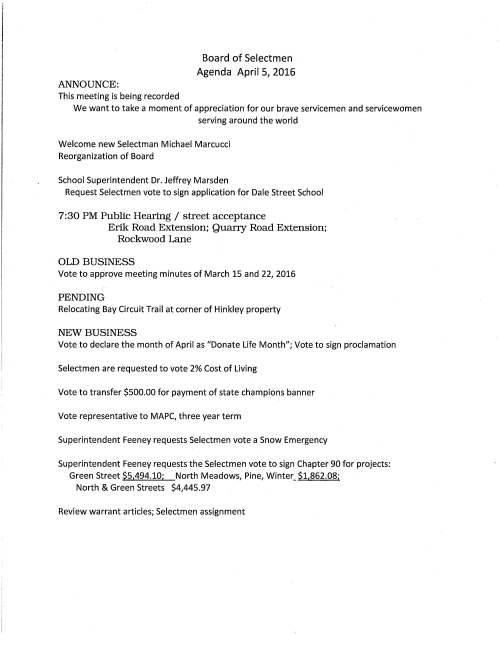

20160405-agenda_Page_1ANNOUNCE: This meeting is being recorded Board of Selectmen Agenda April 5, 2016 We want to take a moment of appreciation for our brave servicemen and servicewomen serving around the world Welcome new Selectman Michael Marcucci Reorganization of Board School Superintendent Dr. Jeffrey Marsden Request Selectmen vote to sign application for Dale Street School 7:30 PM Public Hearing/ street acceptance Erik Road Extension; Quarry Road Extension; Rockwood Lane OLD BUSINESS Vote to approve meeting minutes of March 15 and 22, 2016 PENDING Relocating Bay Circuit Trail at corner of Hinkley property NEW BUSINESS Vote to declare the month of April as "Donate Life Month"; Vote to sign proclamation Selectmen are requested to vote 2% Cost of Living Vote to transfer $500.00 for payment of state champions banner Vote representative to MAPC, three year term Superintendent Feeney requests Selectmen vote a Snow Emergency Superintendent Feeney requests the Selectmen vote to sign Chapter 90 for projects: Green Street $5,494.10; North Meadows, Pine, Winter_ $1,862.08; North & Green Streets $4,445.97 Review warrant articles; Selectmen assignment LICENSES & PERMITS Medfield Lions Club requests permission to hold a car wash with the High School Community Teens Organization on Saturday May 7 from 9AM-2PM, back of Town Hall Natick Rotary Club requests permission to bike ride through a part of Medfield on Sunday June 19, 2016. Chief Meaney reviewed and approves Montrose School requests permission to post signs at Selectmen's designated locations to advertise their Summer Program Medfield Garden Club requests permission to post signs May 8 to May 14 to promote their Spring Plant Sale to be held on Saturday May 14, 2016 The Gazebo Players of Medfield request permission to perform their 15th annual Shakespeare in the Park production of Hamlet at their new location "the lawn area behind First Parish U.U. Church of Medfield" (permission granted from the church); performances on Saturday July 23 and Sunday July 24 at 5:00 PM. In addition request permission to post signs July 11 to July 24 to promote event Medfield Lions Club request permission to post signs promoting their Spring Gala event to take place Saturday May 14, 2016 SELECTMEN REPORf INFORMATIONAL Norfolk County Mosquito Control will be conducting helicopter applications to control mosquitos between April 11 and April 29, 2016 massDOT notice-- FY17 Chapter 90 apportionment for Medfield is $394,992.00 Copy of invoices from Barry Mandell pertaining to beaver control Medfield's assessment to Tri-County School District for fy17 I $131,431 Medfield on the Charles Auto Show to take place June 26 9-4 at the hospital site Notice to demolish buildings at 21 Hospital Road from Country Estates of Medfield, LLC Copy of ZBA hearing notices Packet of information from Medfield Conservation Commission

Declaration of Snow Emergency

DPW sign

Email this afternoon from Mike.  We seem to go over the snow budget every year, i think because we just budget low for snow removal. –


We will need a declaration of snow emergency voted tomorrow night by the Selectmen and the Warrant Committee. We got through the last storm, but this one-two punch is putting us over the top. I spoke to Ken about getting a total figure, but, since the snow is now projected to continue until 7:00 p.m. tonight and it’s getting icy on the roads, we won’t have a total until tomorrow and even then it may still be an estimate. Mike

Image

MCPE’s LCR on 4/29

MCPE-LCR Tournament Flyer

My Dad

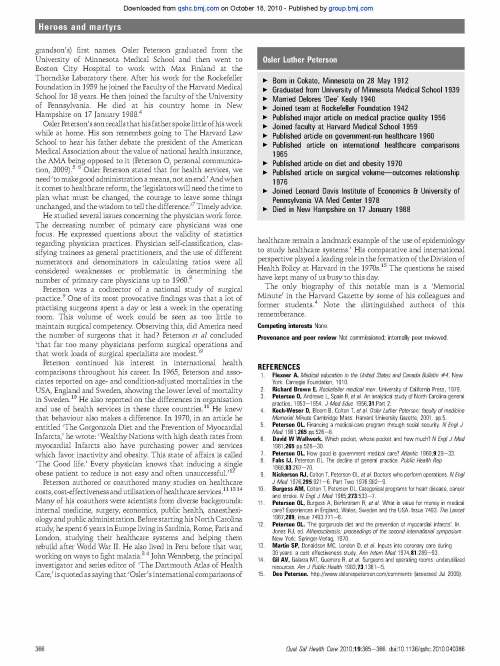
Below is a really nice article about my father that I came across today, which was written more than twenty years after his death by a couple of his colleagues (students I think).  I especially like that it appeared in a section called “Heroes and martyrs,” as he is a hero to me too.
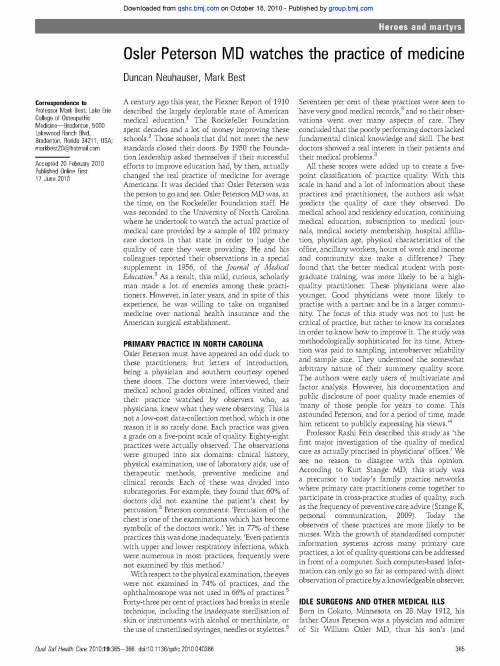
Osler Peterson MD watches the practice of medicine 20100617_Page_1Osler Peterson MD watches the practice of medicine 20100617_Page_2doi: 10.1136/qshc.2010.040386 2010 Qual Saf Health Care 2010 19: 365-366 originally published online June 17, Duncan Neuhauser and Mark Best medicine Osler Peterson MD watches the practice of http://qshc.bmj.com/content/19/4/365.full.html Updated information and services can be found at: These include: References http://qshc.bmj.com/content/19/4/365.full.html#ref-list-1 This article cites 9 articles, 2 of which can be accessed free at: service Email alerting box at the top right corner of the online article. Receive free email alerts when new articles cite this article. Sign up in the Notes http://group.bmj.com/group/rights-licensing/permissions To request permissions go to: http://journals.bmj.com/cgi/reprintform To order reprints go to: http://journals.bmj.com/cgi/ep To subscribe to BMJ go to: Downloaded from qshc.bmj.com on October 18, 2010 - Published by group.bmj.com Osler Peterson MD watches the practice of medicine Duncan Neuhauser, Mark Best A century ago this year, the Flexner Report of 1910 described the largely deplorable state of American medical education.1 The Rockefeller Foundation spent decades and a lot of money improving these schools.2 Those schools that did not meet the new standards closed their doors. By 1950 the Foundation leadership asked themselves if their successful efforts to improve education had, by then, actually changed the real practice of medicine for average Americans. It was decided that Osler Peterson was the person to go and see. Osler Peterson MD was, at the time, on the Rockefeller Foundation staff. He was seconded to the University of North Carolina where he undertook to watch the actual practice of medical care provided by a sample of 102 primary care doctors in that state in order to judge the quality of care they were providing. He and his colleagues reported their observations in a special supplement in 1956, of the Journal of Medical Education.3 As a result, this mild, curious, scholarly man made a lot of enemies among these practitioners. However, in later years, and in spite of this experience, he was willing to take on organised medicine over national health insurance and the American surgical establishment. PRIMARY PRACTICE IN NORTH CAROLINA Osler Peterson must have appeared an odd duck to these practitioners, but letters of introduction, being a physician and southern courtesy opened these doors. The doctors were interviewed, their medical school grades obtained, offices visited and their practice watched by observers who, as physicians, knew what they were observing. This is not a low-cost data-collection method, which is one reason it is so rarely done. Each practice was given a grade on a five-point scale of quality. Eighty-eight practices were actually observed. The observations were grouped into six domains: clinical history, physical examination, use of laboratory aids, use of therapeutic methods, preventive medicine and clinical records. Each of these was divided into subcategories. For example, they found that 60% of doctors did not examine the patient’s chest by percussion.3 Peterson comments: ‘Percussion of the chest is one of the examinations which has become symbolic of the doctors work.’ Yet in 77% of these practices this was done inadequately. ‘Even patients with upper and lower respiratory infections, which were numerous in most practices, frequently were not examined by this method.’ With respect to the physical examination, the eyes were not examined in 74% of practices, and the ophthalmoscope was not used in 66% of practices.3 Forty-three per cent of practices had breaks in sterile technique, including the inadequate sterilisation of skin or instruments with alcohol or merthiolate, or the use of unsterilised syringes, needles or stylettes.3 Seventeen per cent of these practices were seen to have very good medical records,3 and so their observations went over many aspects of care. They concluded that the poorly performing doctors lacked fundamental clinical knowledge and skill. The best doctors showed a real interest in their patients and their medical problems.3 All these scores were added up to create a fivepoint classification of practice quality. With this scale in hand and a lot of information about these practices and practitioners, the authors ask what predicts the quality of care they observed. Do medical school and residency education, continuing medical education, subscription to medical journals, medical society membership, hospital affiliation, physician age, physical characteristics of the office, ancillary workers, hours of work and income and community size make a difference? They found that the better medical student with postgraduate training, was more likely to be a highquality practitioner. These physicians were also younger. Good physicians were more likely to practise with a partner and be in a larger community. The focus of this study was not to just be critical of practice, but rather to know its correlates in order to know how to improve it. The study was methodologically sophisticated for its time. Attention was paid to sampling, interobserver reliability and sample size. They understood the somewhat arbitrary nature of their summery quality score. The authors were early users of multivariate and factor analysis. However, his documentation and public disclosure of poor quality made enemies of ‘many of those people for years to come. This astounded Peterson, and for a period of time, made him reticent to publicly expressing his views.’4 Professor Rashi Fein described this study as ‘the first major investigation of the quality of medical care as actually practised in physicians’ offices.’ We see no reason to disagree with this opinion. According to Kurt Stange MD, this study was a precursor to today’s family practice networks where primary care practitioners come together to participate in cross-practice studies of quality, such as the frequency of preventive care advice (Stange K, personal communication, 2009). Today the observers of these practices are more likely to be nurses. With the growth of standardised computer information systems across many primary care practices, a lot of quality questions can be addressed in front of a computer. Such computer-based information can only go so far as compared with direct observation of practice by a knowledgeable observer. IDLE SURGEONS AND OTHER MEDICAL ILLS Born in Cokato, Minnesota on 28 May 1912, his father Olaus Peterson was a physician and admirer of Sir William Osler MD, thus his son’s (and Correspondence to Professor Mark Best, Lake Erie College of Osteopathic MedicinedBradenton, 5000 Lakewood Ranch Blvd, Bradenton, Florida 34211, USA; markbest20@hotmail.com Accepted 20 February 2010 Published Online First 17 June 2010 Qual Saf Health Care 2010;19:365e366. doi:10.1136/qshc.2010.040386 365 Heroes and martyrs Downloaded from qshc.bmj.com on October 18, 2010 - Published by group.bmj.com grandson’s) first names. Osler Peterson graduated from the University of Minnesota Medical School and then went to Boston City Hospital to work with Max Finland at the Thorndike Laboratory there. After his work for the Rockefeller Foundation in 1959 he joined the Faculty of the Harvard Medical School for 18 years. He then joined the faculty of the University of Pennsylvania. He died at his country home in New Hampshire on 17 January 1988.4 Osler Peterson’s son recalls that his father spoke little of hiswork while at home. His son remembers going to The Harvard Law School to hear his father debate the president of the American Medical Association about the value of national health insurance, the AMA being opposed to it (Peterson O, personal communication, 2009).5 6 Osler Peterson stated that for health services, we need ‘tomake goodadministration ameans, not an end.’Andwhen it comes to healthcare reform, the ‘legislators will need the time to plan what must be changed, the courage to leave some things unchanged, and the wisdom to tell the difference.’7 Timely advice. He studied several issues concerning the physician work force. The decreasing number of primary care physicians was one focus. He expressed questions about the validity of statistics regarding physician practices. Physician self-classification, classifying trainees as general practitioners, and the use of different numerators and denominators in calculating ratios were all considered weaknesses or problematic in determining the number of primary care physicians up to 1960.8 Peterson was a codirector of a national study of surgical practice.9 One of its most provocative findings was that a lot of practising surgeons spent a day or less a week in the operating room. This volume of work could be seen as too little to maintain surgical competency. Observing this, did America need the number of surgeons that it had? Peterson et al concluded ‘that far too many physicians perform surgical operations and that work loads of surgical specialists are modest.’9 Peterson continued his interest in international health comparisons throughout his career. In 1965, Peterson and associates reported on age- and condition-adjusted mortalities in the USA, England and Sweden, showing the lower level of mortality in Sweden.10 He also reported on the differences in organisation and use of health services in these three countries.11 He knew that behaviour also makes a difference. In 1970, in an article he entitled ‘The Gorgonzola Diet and the Prevention of Myocardial Infarcts,’ he wrote: ‘Wealthy Nations with high death rates from myocardial Infarcts also have purchasing power and services which favor inactivity and obesity. This state of affairs is called ‘The Good life.’ Every physician knows that inducing a single obese patient to reduce is not easy and often unsuccessful.’12 Peterson authored or coauthored many studies on healthcare costs, cost-effectiveness and utilisation of healthcare services.11 13 14 Many of his coauthors were scientists from diverse backgrounds: internal medicine, surgery, economics, public health, anaesthesiology and public administration. Before starting his North Carolina study, he spent 6 years in Europe living in Sardinia, Rome, Paris and London, studying their healthcare systems and helping them rebuild after World War II. He also lived in Peru before that war, working on ways to fight malaria.3 4 JohnWennberg, the principal investigator and series editor of ‘The Dartmouth Atlas of Health Care,’ is quoted as saying that ‘Osler’s international comparisons of healthcare remain a landmark example of the use of epidemiology to study healthcare systems.’ His comparative and international perspective played a leading role in the formation of the Division of Health Policy at Harvard in the 1970s.15 The questions he raised have kept many of us busy to this day. The only biography of this notable man is a ‘Memorial Minute’ in the Harvard Gazette by some of his colleagues and former students.4 Note the distinguished authors of this rememberance. Competing interests None. Provenance and peer review Not commissioned; internally peer reviewed. REFERENCES 1. Flexner A. Medical education in the United States and Canada Bulletin #4. New York: Carnegie Foundation, 1910. 2. Richard Brown E. Rockefeller medical men. University of California Press, 1979. 3. Peterson O, Andrews L, Spain R, et al. An analytical study of North Carolina general practice, 1953e1954. J Med Educ 1956;31:Part 2. 4. Koch-Weser D, Bloom B, Colton T, et al. Osler Luther Peterson: faculty of medicine Memorial Minute Cambridge Mass: Harvard University Gazette, 2001. pp.5. 5. Peterson OL. Financing a medical-care program through social security. N Engl J Med 1961;265:pp.526e8. 6. David W Wallwork. Which pocket, whose pocket and how much? N Engl J Med 1961;265 pp.528e30. 7. Peterson OL. How good is government medical care? Atlantic 1960;9:29e33. 8. Fahs IJ, Peterson OL. The decline of general practice. Public Health Rep 1968;83:267e70. 9. Nickerson RJ, Colton T, Peterson OL, et al. Doctors who perform operations. N Engl J Med 1976;295:921e6. Part Two 1976:982e9. 10. Burgess AM, Colton T, Peterson OL. Categorical programs for heart disease, cancer and stroke. N Engl J Med 1965;273:533e7. 11. Peterson OL, Burgess A, Berfenstam R, et al. What is value for money in medical care? Experiences in England, Wales, Sweden and the USA. Issue 7493. The Lancet 1967;289, issue 7493:771e6. 12. Peterson OL. ‘The gorgonzola diet and the prevention of myocardial infarcts’. In: Jones RJ, ed. Atherosclerosis: proceedings of the second international symposium. New York: Springer-Verlag, 1970. 13. Martin SP, Donaldson MC, London D, et al. Inputs into coronary care during 30 years: a cost effectiveness study. Ann Intern Med 1974;81:289e93. 14. Gil AV, Galarza MT, Guerrero R, et al. Surgeons and operating rooms: underutilized resources. Am J Public Health 1983;73:1361e5. 15. Dee Peterson. http://www.delorespeterson.com/comments (assessed Jul 2009). Osler Luther Peterson < Born in Cokato, Minnesota on 28 May 1912 < Graduated from University of Minnesota Medical School 1939 < Married Delores ‘Dee’ Kealy 1940 < Joined team at Rockefeller Foundation 1942 < Published major article on medical practice quality 1956 < Joined faculty at Harvard Medical School 1959 < Published article on government-run healthcare 1960 < Published article on international healthcare comparisons 1965 < Published article on diet and obesity 1970 < Published article on surgical volumedoutcomes relationship 1976 < Joined Leonard Davis Institute of Economics & University of Pennsylvania VA Med Center 1978 < Died in New Hampshire on 17 January 1988 366 Qual Saf Health Care 2010;19:365e366. doi:10.1136/qshc.2010.040386 Heroes and martyrs Downloaded from qshc.bmj.com on October 18, 2010 - Published by group.bmj.com