Category Archives: State

MHS graduation guidelines

From the emailed newsletter this afternoon from Division of Local Services (DLS) –

DLS

DESE Provides Guidance Related to High School Graduations
Department of Elementary and Secondary Education

Earlier today, the Department of Elementary and Secondary Education (DESE) released guidance concerning high school graduations. Please see below.

Graduation guidelines:

Between now and July 18, graduation should be held virtually or in limited circumstances following safety protocols, such as car parades.

Beginning July 19, graduation ceremonies can take place OUTSIDE under certain conditions, assuming the public health data supports continued opening of our state, at that time.

  • Any graduation ceremony must be held outside only in a large venue to accommodate social distancing of at least six feet if attendees are not from the same immediate household. Tents or other enclosures are not permitted.
  • Only immediate family of graduates can attend. Families must sign up in advance, and only those who have pre-registered may attend.
  • All attendees must wear face masks in accordance with the Governor’s COVID-19 Executive Order No. 31 and the Massachusetts Department of Public Health’s guidance. Speakers may remove masks during their remarks.
  • Graduates should individually be invited to walk across the stage and turn their tassel in lieu of receiving a diploma by hand. No handshakes or hugs.

Social distancing guidelines

  • Guests who are not part of the same immediate household must be seated at least 6 feet apart. Members of the same household are permitted to sit together less than 6 feet apart.
  • If there is fixed seating, rows should be blocked off and kept empty to allow for sufficient distancing between rows.
  • Children under 5-years-old and older adults, or those with vulnerable health conditions, should be discouraged from attending.
  • School staff must monitor the number of attendees entering and confirm they have pre-registered.
  • No receptions are permitted before or after the graduation.

Venues must have sufficient access to hand-washing facilities, including soap and running water, as well as alcohol-based hand sanitizers available at all entrances and exits.

Mass fiscal situation

Senate Ways and Means Committee’s sobering data on our financial future (shared by Carol Read) –

05-05 Massachusetts Economic and Fiscal Outlook Caucus Presentation_Chairman Michael Rodrigues

05-05 Massachusetts Economic and Fiscal Outlook Caucus Presentation_Chairman Michael Rodrigues

Gov. Baker’s reopening plan

The Massachusetts Municipal Association explained the reopening as follows –

MMA-2

Baker-Polito Administration Releases State Reopening Plan

The Baker-Polito Administration today released the Reopening Advisory Board’s report, Reopening Massachusetts, which details a four-phased strategy to reopen businesses and activities while continuing to fight COVID-19. The state has launched a comprehensive website with detailed reopening information at www.mass.gov/reopening.


The Administration also released a new “Safer at Home” Advisory, which instructs residents to stay at home unless engaging with newly opened activities, as a way to continue limiting the spread of COVID-19.


All businesses and expanded activities, including governmental services, will need to comply with mandatory safety standards for workplaces that were announced last week, including social distancing, hygiene protocols, staffing and operations, and cleaning and disinfecting. In addition, the state will be setting industry-specific safety requirements and guidance, if clearer or more stringent steps are necessary, as determined by public health officials.


The Administration’s COVID-19 Reopening Advisory Board finalized the specifics of the plan over the weekend. Today’s announcement was accompanied by an official report, specific industry guidance for those businesses/activities that will be permitted in Phase 1, materials for businesses to use for preparation and self-certification of their compliance with state-set health and safety requirements, and updated Executive Orders to implement the new phase.


Phase 1 of the Reopening (“Start”) Begins Today, May 18


Allowed Activity During Phase One

  • Gatherings will continue to be limited to a maximum of 10 people, unless otherwise provided in other orders and guidelines.
  • The state is eliminating the “Essential” and “Non-Essential” distinctions, and will authorize categories of businesses or industry segments to reopen following specific guidance and conditions that will be provided in advance of each phase.
  • For the Start phase, the state is allowing the following business activity as of May 18:
    • Essential Businesses that are operating now will remain open, and have until May 25 to implement the new mandatory workplace safety standards and other Phase 1 requirements for their industry sector.
    • Manufacturing and Construction, following specific industry workplace guidelines & standards (links to these requirements can be found below).
    • Houses of Worship, with only 40% of maximum capacity allowed and other safety requirements (a link to the requirements can be found below).
    • Gun Stores are open due to a federal court ruling.
    • Outdoor Recreation activities, including Beaches, Parks, Fishing, Hunting, and other activities, following guidelines published today by the Executive Office of Energy & Environmental Affairs (a link to these can be found below).
  • For the Start phase, the state is allowing the following business activity as of May 25:
    • Offices and Laboratories (June 1 for Boston), with a cap on occupancy at 25% and other requirements, and a very strong “Work From Home” advisory for all those who can operate remotely (links to the requirements can be found below).
    • Retail Establishments – Fulfillment and Curbside Only, with no indoor customer access during Phase One.
    • Hair Salons, Car Washes and Pet Grooming, following conditions and requirements established by the state (links to these can be found below).
    • Expanded Elective Medical Procedures could proceed, following state guidelines.
  • For Phase 2, the reopening plan expects to include the following: In-store retail, restaurants and lodging (the limitations are under review), additional personal services (nail salons or day spas, e.g.), campgrounds, playgrounds, public and community pools, athletic fields, limited youth sports (no games).
  • For Phase 3, the reopening plan expects to include the following: bars, gyms, museums, other arts & entertainment (other than nightclubs and large venues), youth sports with games and tournaments (with limited crowd sizes).


Enforcement Will be a Combination of Self-Certification and On-Site Inspections


In order to reopen, businesses must develop a written COVID-19 Control Plan outlining how its workplace will prevent the spread of COVID-19. Required materials are located on mass.gov/reopening, and include detailed sector-specific circulars and checklists to facilitate compliance. Many of these links are listed below.

  • Rule-Making and Enforcement Roles – The Department of Public Health and the Department of Labor Standards is responsible for developing the health and safety standards for each industry sector, and enforcement will primarily occur through local Boards of Health.
  • Administration provides guidance document on municipal enforcement – the Baker-Polito Administration has provided a document outlining their guidance on municipal enforcement protocols and procedures as businesses begin to reopen. MMA is providing a link to the state’s guidance document here and below, and is reviewing the guidance with municipal officials.
  • Self-Attestation – All allowed businesses and activities would be required to download and sign an “Attestation Poster” from the state website to attest that they are in compliance with the mandatory safety standards announced last week and the supplemental industry-specific requirements published by the state.
  • Plans – All allowed businesses and activities would be required to develop their own plans on how to comply with the mandatory safety standards, with a sample template provided on the state website.
  • Posting – The attestations must be posted on site for employees and customers to see.

On-Site Records – The attestations and plans would be kept on site, and would not be filed with the Commonwealth or local government.


Access and Inspections – State and local enforcement agencies would have the authority to review the attestations and plans upon request and inspect to ensure compliance.


Additional Elements

  • The state is developing a series of guidelines and procedures for the Commonwealth’s own operations, and will be sharing those with municipalities, including human resources policies for state employees, the use and operation of public buildings (being developed by the Division of Capital Asset Management and Maintenance), and the delivery of public-facing services (being developed by the Registry of Motor Vehicles);
  • Future phases will progressively include additional activities and business operations (in-store retail operations, personal services, restaurants, bars, lodging, team sporting activities, large sporting and entertainment events, e.g.);
  • State officials will closely monitor key COVID-19 health metrics, and determine when it is safe to proceed to the next reopening phase, with at least three weeks needed in each stage before adequate information is available to assess public health outcomes and decide the timing of moving from Start to Cautious, and then to Vigilant and New Normal;
  • The state will continue to expand its testing and contact tracing capacity, with the intention of placing priority on high-density areas and hot spots;
  • The Administration projects that the childcare/daycare operations that are running now for emergency and healthcare workers have the capacity to serve families that need these services during Phase One; and
  • In the coming weeks, childcare/daycare and transportation, key enablers for reopening the economy will continue to be explored and expanded as possible within the realities of COVID-19, following strict health protocols to ensure public health and safety.
  • The Administration also reported that public health officials are currently drafting specific guidance on summer camps, and those recommendations will be forthcoming within the next couple of weeks – summer camps are not expected to begin until Phase 2 at the earliest.


Helpful Links to Reopening Documents and Materials


Link to the Reopening Massachusetts website:

https://www.mass.gov/info-details/reopening-massachusetts


Link to the Reopening Massachusetts Plan:

https://www.mass.gov/doc/reopening-massachusetts-may-18-2020/download


Link to the Mandatory Safety Standards for all workplaces:

https://www.mass.gov/info-details/reopening-mandatory-safety-standards-for-workplaces


Links to the sector specific requirements for what’s allowed to reopen on May 18:

Construction

https://www.mass.gov/lists/safety-standards-for-construction

Manufacturing

https://www.mass.gov/lists/safety-standards-for-manufacturing

Places of Worship

https://www.mass.gov/lists/safety-standards-for-places-of-worship


Links to the sector specific requirements for what is reopening on May 25:

Offices

https://www.mass.gov/lists/safety-standards-for-office-spaces

Labs

https://www.mass.gov/lists/safety-standards-for-laboratories

Hair Salons & Barbershops

https://www.mass.gov/lists/safety-standards-for-hair-salons-and-barbershops

Car Washes

https://www.mass.gov/lists/safety-standards-for-car-washes

Pet Grooming

https://www.mass.gov/lists/safety-standards-for-pet-grooming-services


Links to the business compliance documents:

State guidance on municipal enforcement of COVID-19 orders

https://www.mma.org/wp-content/uploads/2020/05/State-Guidance-to-Municipalities-on-COVID-19-Order-Enforcement-Final.pdf

Compliance attestation poster

https://www.mass.gov/doc/compliance-attestation/download

COVID-19 control plan template

https://www.mass.gov/doc/covid-19-reopening-control-plan-template/download

Employer poster

https://www.mass.gov/doc/employer-reopening-poster/download

Employee poster

https://www.mass.gov/doc/employee-reopening-poster/download


Links to updated (May 18) state guidance on outdoor recreation, beaches, campgrounds, boating, hunting, fishing, campgrounds, facility restrooms and more:

https://www.mass.gov/info-details/executive-office-of-energy-and-environmental-affairs-eea-covid-19-guidance-documents#parks,-open-space,-and-outdoor-education-programs-


MMA Issues Key Recommendations to Support Municipalities During the Reopening Process


The MMA has developed a series of strong recommendations to address the needs of cities and towns during the reopening process, and presented those key priorities to the Reopening Advisory Board on May 13, urging their adoption in the Reopening Plan. Please Click this Link to Read the MMA’s 22-Page Reopening Presentation to the Administration.


The MMA is emphasizing four main action areas:

  1. Providing timely notice, guidance and information to municipalities in advance of each phase;
  2. Issuing strong and clear directives and standards in each phase, including specific guidance for delivering public-facing programs and services;
  3. Ensuring universal access to resources for all municipalities, including PPE, equipment, cleaning supplies, testing for municipal employees and the public, technical assistance and funding; and
  4. Affirming clear local enforcement authority.

MMA leaders are continuing to hold detailed and productive discussions on these priorities at the highest levels of the Administration, and we appreciate that this collaborative and open discussion will be ongoing throughout the entire reopening process, particularly on those items that were not fully reflected in the state’s reopening plan as announced on May 18. Many details and questions will emerge in the coming days and weeks, and MMA will continue to work on all of these issues.


The MMA will provide further updates and information on the state’s reopening process as details become available


Thank you!

Medfield gets $1,137,716 from Cares Act

cares act


Town Administrator, Kristine Trierweiler, was notified by Michael J. Heffernan, Secretary of Administration and Finance, of the Commonwealth of Massachusetts this week that Medfield is slated to get $1,137,716 as its share of the $2.7 billion the Federal government is paying to Massachusetts under the Care Act.  Below are that letter and memorandum.

LetterSecHeffernantoMunicipalChiefExecutives

ANFGuidancetoMunicipalitiesonFederalCoronavirusReliefFund


MMA Zoom meeting

MMA

I attended at noon today a meeting of the Massachusetts Municipal Association’s Massachusetts Select Board Association (NB – MSA changed its name this year from “Selectmen”).  Bleak news about the state budget and the financial aid we will get from the state next fiscal year starting July 1 – may be down 20% this coming year.  The legislative delegation is coming to the Select Board meeting next Tuesday to personally share the bad news.

The only good news was at the end of this slide –

State Revenue and Budget Outlook
• Legislature has Announced that the Fiscal 2021 Budget Process is Delayed
• Administration & Legislative Budget Writers Held New Revenue
Hearing to Revisit Revenue Forecast, with $4B to $6B Shortfall Estimated
• State Budget Process Unclear (Joint Budget? Temporary Budgets?)
• GOOD NEWS … $3.5 Billion in the State Rainy Day Fund should Help to
Mitigate Fiscal 2020 Revenue Shortfalls (and Increased Expenditures)
• GOOD NEWS … Massachusetts Received $2.67 Billion from the Federal
CARES Act to Pay for Unexpected/Unbudgeted COVID-19 Expenses

SJC orders relief for 9/1 state primary participants

SJC

This afternoon the Supreme Judicial Court issued a decision giving relief to those seeking to qualify for the September 1 primary election:

=================================================

SJC-12931
ROBERT GOLDSTEIN & others vs. SECRETARY OF THE COMMONWEALTH.
Suffolk. April 16, 2020. – April 17, 2020.

. . .

In short, for all candidates seeking to appear on the State
primary ballot on September 1, we order three forms of relief.
First, we order that the number of required signatures be
reduced by fifty percent (50%). Second, we extend the deadlines
for candidates running for State district and county offices to
submit their nomination papers to local election officials for
certification and for the filing of certified nomination papers
with the Secretary to May 5, 2020, and June 2, 2020,
respectively, which are the current due dates for party
candidates running for Federal and Statewide offices. Third,
subject to the restrictions outlined later in this opinion, we order the Secretary to allow the submission and filing of
nomination papers with electronic rather than wet-ink original
signatures (“wet” signatures). We emphasize that the
declaration we make and the equitable relief we provide is
limited to the primary election in these extraordinary
circumstances, which is the sole subject of the case before us,
and does not affect the minimum signature requirements for the
general election this year or for the primary elections in any
other year.


MMA on our status

Good data in the slides –

MMA-3

Thank you for registering for the COVID 19 Update for city and town councillors and select board members and selectmen.  I’ve attached the Powerpoint presentation.

MMA Update for MSA MMCA Geoff Slides April 10

We will be posting the video link of the webinar to the MMA website.  That will be available Monday in the COVID 19 resource area.  Be sure to check this area often for updates.


Please be in touch if you have any questions.


Best,

Denise Baker

Senior Member Services Coordinator

MMA on virus legislation

MMA-3

Legislature Enacts Bill to Facilitate Municipal Governance and Budgeting During COVID-19 Emergency

Governor to Sign the Bill Today


April 3, 2020


Last night, the House and Senate enacted a key bill to assist cities and towns with a broad range of governance and budgeting issues during the COVID-19 emergency. This act has an emergency preamble, and will take effect immediately when signed by the Governor, which is expected today. The MMA worked closely with lawmakers and the Baker-Polito Administration on these measures, and deeply appreciates the passage of these important provisions.


The Division of Local Services will have a major role in implementing the finance provisions in the bill, and will be issuing a Bulletin to cities and towns with further details within the coming days. DLS has been a key source of information and guidance during the emergency, and MMA appreciates all of their efforts.


Please click here to download the text of the bill:

https://www.mma.org/wp-content/uploads/2020/04/H4617.pdf


The following is MMA’s summary of the key sections of An Act to Address Challenges Faced by Municipalities and State Authorities Resulting from COVID-19:

  • Town Meeting Delay Beyond June 30. Allows Town Meetings to be delayed beyond June 30 if Governor has declared a state of emergency related to public health or safety. (Section 1).
  • Recess and Continuance of Town Meeting. Allows the Moderator to recess and continue an already-called Town Meeting during (and until 5 days after) a public health, safety or weather emergency for up to 30 days, renewable for up to 30 days at time during the emergency, but not to a date more than 30 days following the rescission of the state of emergency. If a town does not have a moderator, the Select Board may recess and continue Town Meeting accordingly. A public safety or public health official designated by the Select Board shall submit a report to the Attorney General providing justification for the recess and continuance. These changes are effective as of March 10, 2020. (Sections 2, 3 and 4).
  • Adoption of Temporary Fiscal 2021 Budgets. If Town Meeting is unable to adopt an annual budget by June 30 due to a declared emergency, the Select Board shall notify the Director of Accounts at DLS, and the Director may approve expenditures from any appropriate fund or account of an amount sufficient for the operations of the Town during the month of July of not less than 1/12 of the total budget approved in the most recent fiscal year, pursuant to a plan approved by the Select Board, with such authority continuing for each successive month that the emergency prevents the adoption of a budget by Town Meeting. (Section 5).
  • Use of Free Cash and Undesignated Fund Balances. If a Town is delayed from adopting an annual budget due to the COVID-19 emergency, the Director of Accounts may authorize the Town to appropriate (for use in fiscal 2021) from the available undesignated fund balance or free cash certified by DLS as of July 1, 2019, including undesignated fund balances in enterprise funds or special revenue accounts. (Section 6).
  • Amortization of Fiscal 2020 Deficits. Allows cities and towns to amortize its fiscal 2020 deficit resulting from the COVID-19 emergency over fiscal years 2021 to 2023, to be funded in equal or more rapid installments, such amortization to be adopted prior to setting the fiscal 2021 tax rate. (Section 7).
  • Use of Revolving Funds. Allows cities and towns that are unable to adopt their fiscal 2021 annual budget due to the COVID-19 emergency to expend amounts from revolving funds not to exceed the authorized expenditure in fiscal 2020. The legislative body shall vote on the total amount to be expended from each revolving fund when the annual budget is adopted. (Section 8).
  • Tolling Required Action on “Chapter” Lands. Suspends the time period that municipalities are required to act, respond, effectuate or exercise an option to purchase Chapter 61 forest land, Chapter 61A agricultural land, or Chapter 61B recreational land until 90 days after the governor’s March 10, 2020 emergency declaration is terminated. (Section 9).
  • Option to Delay Property Tax Due Date to June 1. Allows the municipal chief executive to delay the due date for municipal property tax bills to June 1. (Section 10).
  • Option to Waive Interest and Penalties for Late Payments. Allows the municipal chief executive to waive the payment of interest and other penalties on late payments that were due after March 10, 2020 and paid before June 30, 2020, for any excise, tax, betterment assessment, water or sewer bill, or other charge added to a tax. (Section 11).
  • Non-Termination of Services to Residents Due to Late Payment. Cities and towns shall not terminate an essential service of a resident, including water, trash collection or electricity, for nonpayment of taxes or fees due on or after March 10, 2020 and paid after the due date but before June 30, 2020, if the nonpayment resulted from a demonstrated inability to pay due to the COVID-19 outbreak or the March 10, 2020 emergency declaration by the governor, provided that the inability to pay shall include a demonstrated financial hardship of a resident, including but not limited to loss of employment, serious illness or death of someone within the home. (Section 11).
  • State Income Tax Deadline Delayed. Postpones the deadline for filing Massachusetts state income tax returns and payments from April 15, 2020 to July 15, 2020. (Section 12).
  • Sale of Alcohol by Take-Out Restaurants. Allows restaurants licensed to sell alcoholic beverages on-premises may sell sealed containers of alcoholic beverages for off-premises consumption as part of take-out food transactions. (Section 13).
  • Facilitating Return to Service by Retirees. Allows state and municipal employees to return to work for the state or a municipality regardless of mandatory retirement ages or a statutory limit on hours worked and earnings received, to help with workforce needs. Those on disability retirement are not eligible. (Section 14).
  • Remote Meetings for Shareholder Corporations. Allows public corporations (private shareholder entities) to hold annual or special meetings of shareholders remotely for up to 60 days after the termination of the March 10, 2020 state of emergency. (Section 15).
  • Provisions for Nonprofit Corporations. Allows nonprofit entities (incorporated under Chapter 180) to conduct or postpone necessary business and meet remotely for up to 60 days after the termination of the March 10, 2020 state of emergency. (Section 16).
  • Tolling Municipal Requirements on Permits and Quasi-Judicial Public Meetings and Hearings (the “constructive approval” issue). Tolls required municipal actions on permits until 45 days after the termination of the COVID-19 emergency, and no permit shall be considered granted, approved or denied, constructively or otherwise due to the failure of a permit granting authority to act within timelines that would otherwise be in effect. This section also clarifies that permit granting authorities may conduct meetings and public hearings remotely during the COVID-19 emergency, consistent with the Governor’s March 12 Executive Order regarding the Open Meeting Law. This section also applies to the conduct of public meetings, public hearings or other actions taken in a quasi-judicial capacity by all local boards and commissions during the emergency declaration by the governor. (Section 17).

Virus legislation – re ATM & budget issues

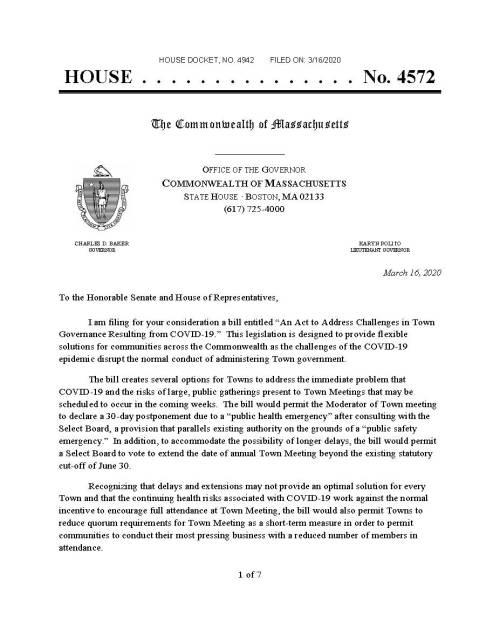
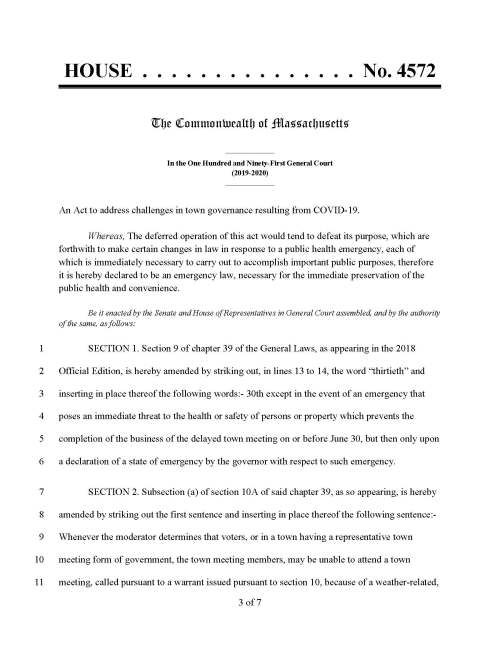
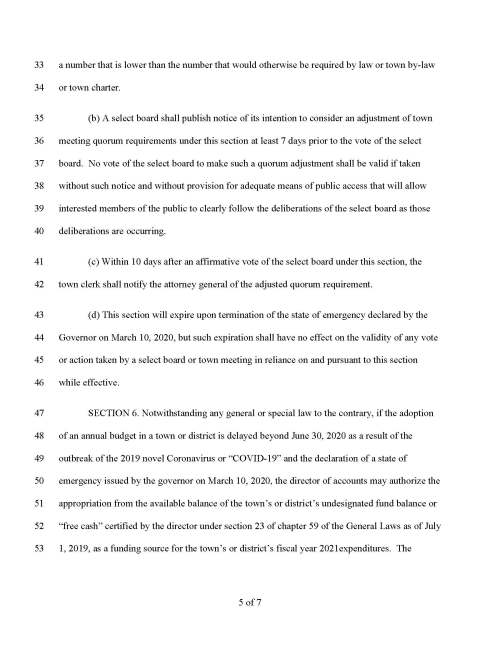
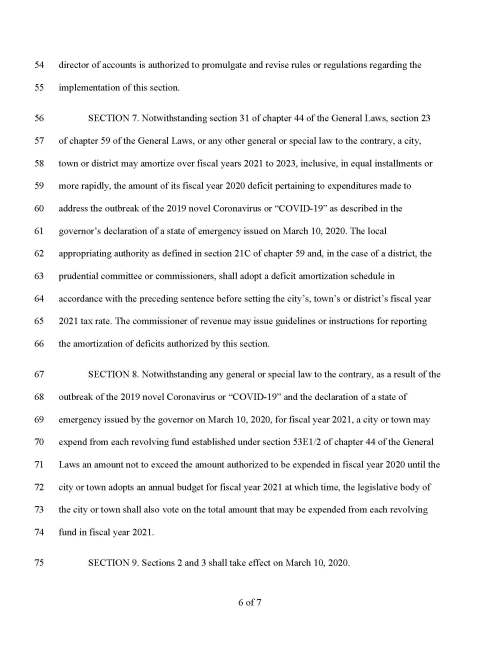
Legislation the Gov. filed this AM, that Assistant Town Admiistrator Nick Milano says is expected to be passed by the House today, allowing for postponement of our annual town meeting and municipal relief with respect to our impending budget issues –

H4572_Page_1H4572_Page_2H4572_Page_3H4572_Page_4H4572_Page_5H4572_Page_6H4572_Page_7

Courts closed next two days

Email alert from the Trial Court –
==============================================
Trial Court Listserv Recipients:


In light of the Governor’s Declaration, Court leaders have closed the Trial Courts to the public for Monday and Tuesday, March 16 & 17.  

Department heads will contact court personnel to arrange emergency staffing coverage.  Employees should check mass.gov/courts for details within the hour.
Courts will contact members of juries now hearing cases.  Anyone with pending matters should contact the Clerks Office when it opens on Wednesday.
We urge all court users and court staff to be vigilant in applying social distancing and hygiene precautions to mitigate spread of the coronavirus.
 
Executive Office of the Trial Court