HOUSE W&M COMMITTEE OFFERS $42.7B FY 2020 BUDGET WITH KEY INVESTMENTS IN MUNICIPAL & SCHOOL AID
• INCLUDES THE FULL $29.7M INCREASE IN UNRESTRICTED MUNICIPAL AID (UGGA)
• INCREASES CHAPTER 70 BY $218M TO FUND MINIMUM AID AT $30 PER STUDENT
• INCREASES CHARTER SCHOOL REIMBURSEMENTS BY $23M
• ADDS $16.5M RESERVE FOR LOW-INCOME STUDENTS
• ADDS $5M TO THE SPECIAL EDUCATION CIRCUIT BREAKER
• ADDS $5M MORE FOR REGIONAL SCHOOL TRANSPORTATION
• ADDS $1M TO McKINNEY-VENTO REIMBURSEMENTS
• LEVEL-FUNDS MOST OTHER MUNICIPAL AND SCHOOL ACCOUNTS
April 10, 2019
Dear Osler Peterson,
Earlier today, the House Ways & Means Committee reported out a $42.7 billion fiscal 2020 state budget plan to increase overall state expenditures by 3 percent. The House Ways & Means budget’s bottom line closely matches the budget filed by the Governor in January, yet allocates significantly more for school aid programs. The Chapter 70 aid increase is $17.7 million higher than the amount recommended by the Governor, by increasing minimum aid from $20 per student to $30 per student, and adopting a slightly different method of implementing the recommendations of the Foundation Budget Review Commission. The full House will debate the fiscal 2020 state budget during the week of April 22. House members must file all budget amendments by 5:00 p.m. on Friday, April 12. (Usually, the House considers over 1000 amendments during budget debate week.)
H. 3800, the House Ways & Means budget, provides progress on many important local aid priorities, including the full $29.7 million increase in Unrestricted General Government Aid that the Governor proposed and communities are counting on. The House W&M Committee would increase funding for other major aid programs, by adding $5 million to the Special Education Circuit Breaker, adding $5 million to Regional School Transportation, $1 million to McKinney-Vento reimbursements, and increasing Chapter 70 aid by $218 million more than fiscal 2019 levels.
Please Click this Link Now to See the HW&M Chapter 70 and Unrestricted Municipal Aid Numbers for Your Community
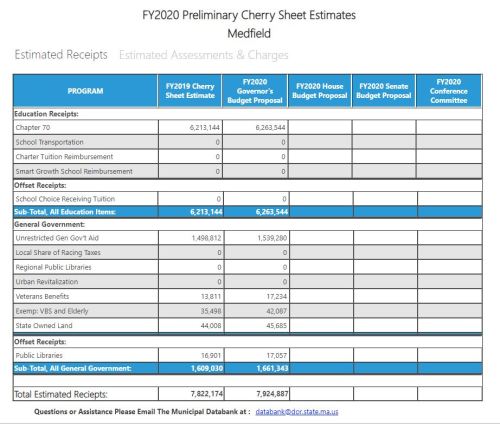
By Friday or Early Next Week – Click on this Link to See Your Community’s Local Aid and Preliminary Cherry Sheet Numbers in the House Ways & Means Budget, as Posted by the Division of Local Services:
https://www.mass.gov/lists/cherry-sheet-estimates
$29.7 MILLION INCREASE IN UNRESTRICTED MUNICIPAL AID
In a major victory for cities and towns, the HW&M fiscal 2020 budget plan would provide $1.128 billion for UGGA, a $29.7 million increase over current funding – the same increase proposed by Governor Baker. The $29.7 million would increase UGGA funding by 2.7 percent, which matches the projected growth in state tax collections next year. Every city and town would see their UGGA funding increase by 2.7 percent.
CHAPTER 70 MINIMUM AID WOULD INCREASE TO $30 PER STUDENT
The House budget committee is proposing a $218 million increase in Chapter 70 education aid (this is $17.7 million higher than the $200.3 million increase in House One), with a provision that every city, town and school district receive an increase of at least $30 per student (compared to the $20-per-student amount in the Governor’s budget). This represents meaningful progress, yet most communities would only receive minimum aid, which is why MMA members adopted a resolution in January calling for $100 in per-student aid as a minimum increase.
HW&M IS PROPOSING HIGHER CH. 70 SPENDING IN FISCAL 2020, YET MAJOR SCHOOL FINANCE LEGISLATION WILL BE CONSIDERED LATER THIS YEAR, NOT AS PART OF THE BUDGET DEBATE
House leaders are committed to action on major permanent updates to the Chapter 70 school finance formula this year. However, that legislation is still before the Joint Committee on Education, and will not be ready for deliberation and debate until after the House budget moves forward. Because of this, the House Ways & Means budget is taking a one-year approach to more aggressively implement many of the recommendations of the Foundation Budget Review Commission, but is not advancing permanent law changes, which will come as part of the school finance bill. The budget committee’s proposal builds on the Governor’s fiscal 2020 submission, increasing the state’s factors for health insurance, special education, English Language Learners, and low-income students. Because the House has a slightly different methodology than the Governor, Chapter 70 calculations may be slightly different for some communities and districts (not the minimum-aid communities). Combined with higher minimum aid, these foundation calculations are the reason why the HW&M budget would provide $17.7 million more Chapter 70 aid than the Governor.
In addition, the House budget committee is proposing a $16.5 million reserve fund for low-income student adjustments to ensure accurate counting of low-income students and ensure that additional funds are available to fund low-income student formula changes that may come later.
CHARTER SCHOOL REIMBURSEMENTS WOULD INCREASE BY $23M, UP TO A NEW HIGH OF $113M
HW&M is proposing a $23 million increase in Charter School Reimbursements, bringing the program up to $113 million from the current $90 million level. This is $7 million more than the Governor’s budget, and is very much appreciated. The total is still far below full funding of the statutory formula. The budget committee is also adopting the Governor’s recommendation to change the 6-year funding schedule of 100-25-25-25-25-25 to a new 3-year 100-60-40 schedule, and make other adjustments in the program. Because there are so many factors in play, municipal leaders will need to analyze their own specific charter school tuition assessments and reimbursement amounts to see if this provides relief.
The MMA continues to believe that the charter school finance system is deeply flawed, and a permanent fix should include a cap on Chapter 70 diversions to charter schools. No matter what changes are made to the Chapter 70 formula, problems will continue unless a true resolution of the charter school funding problem is integrated into any reform or update of the school finance system.
HW&M PROVIDES $5 MILLION MORE TO SPECIAL EDUCATION CIRCUIT BREAKER, GETTING CLOSER TO FULL FUNDING
The House budget would add $5 million more than the Governor, to fund the Special Education Circuit Breaker program at $328.9 million. This is progress in the right direction, because the Governor’s budget underfunded SPED reimbursements by $20 million, which means the account is still $15 million below full funding. The MMA will again be asking lawmakers to ensure full funding in fiscal 2020.
HW&M PROVIDES $5 MILLION MORE FOR REGIONAL SCHOOL TRANSPORTATION REIMBURSEMENTS
Gov. Baker’s budget submission would level-funded regional transportation reimbursements at $68.9 million, and the HW&M budget would provide a much-needed $5 million increase. Reimbursements for transportation of out-of-district vocational students remains significantly underfunded at $250K. Increasing these accounts is a priority for cities and towns.
HW&M PROVIDES $1 MILLION MORE FOR McKINNEY-VENTO REIMBURSEMENTS
The Governor’s budget would level-fund reimbursements for the transportation of homeless students at $9.1 million, and the House budget committee would raise this to $10.1 million. The impact of this funding level will vary from community-to-community depending on the number of homeless families that remain sheltered in local hotels and motels. The state has been successful in reducing the number of homeless students who are dislocated from their original district, but those communities that continue to provide transportation to many students may continue to see shortfalls.
PAYMENTS-IN-LIEU-OF-TAXES (PILOT), LIBRARY AID, and SHANNON GRANTS
The Governor’s and HW&M budgets would level fund PILOT payments at $28.48 million, which would create a hardship for smaller communities with large amounts of state-owned property, and library grant programs would stay flat at $19.8 million; and Shannon anti-gang grants would increase by $1 million up to $9 million.
SUMMARY
In the context of a tight budget year, with revenue growth of only 2.7%, it is clear that House leaders are prioritizing K-12 education funding and other increases for cities and towns, and this is deeply appreciated.
During the budget debate and legislative session, the MMA will work to build on this progress, and will continue to prioritize full funding for the Foundation Budget Review Commission’s recommendations and permanent improvements to Chapter 70, fixing the serious problems caused by the current charter school funding system, securing higher minimum aid increases, achieving full funding for all state municipal and school reimbursement programs, and providing higher PILOT funding and aid for rural regional school districts.
Please Call Your Representatives Today to Thank Them for the Local Aid Investments in the House Ways and Means Committee Budget – Which Increases Key Municipal and School Aid Accounts by $298.2 Million Above Fiscal 2019, and $45.2 Million More than the Governor’s Budget
Please Explain How the House Ways and Means Budget Impacts Your Community, and Ask Your Representatives to Build on this Progress During Budget Debate in the House
Thank You! |