Category Archives: State

Community Preservation Act primer

This comes from the newsletter that I get from the Division of Local Services (DLS) at the DOR –
DLS

Discussing Community Preservation
Jared Curtis – Bureau of Accounts Field Representative
Tony Rassias – Bureau of Accounts Deputy Director

Each year, the Bureau of Accounts distributes a Budget Bulletin in the spring addressing issues that cities, towns, regional school and other districts should consider for the upcoming fiscal year’s revenue and expenditure budgeting and other related matters.

One particular topic that appears annually in the Bulletin and always generates inquiries is the Community Preservation Act (CPA) as it relates to state matching funds estimate for cities and towns. The following represents a discussion between Tony Rassias, Deputy Director of the Bureau of Accounts, and Jared Curtis, the Bureau’s subject matter expert, covers a variety of topics related to the CPA. We hope you find it helpful.

Tony Rassias: Jared, for cities and towns that haven’t accepted the CPA, could you first explain what the Act is all about?

Jared Curtis: Sure. Cities and towns that accept the CPA impose a surcharge on each parcel of taxable real estate up to an additional 3% of the bill, less any exemption to the surcharge adopted by the city or town as allowed by the CPA law. Total surcharges received are then reserved into a local CPA fund for community preservation purposes to preserve open space and historic resources, create affordable housing and develop outdoor recreational facilities. A state trust fund, created from recording fees at the Registry of Deeds and Land Court, provides an additional source of revenue to the local CPA fund through state matching funds.

TR: How do cities and towns accept the Act?

JC: Cities and towns have two acceptance options. Under the first option, the CPA is accepted under M.G.L. c. 44B, §3(b) and a surcharge up to 3% of the tax assessed on each parcel of taxable real estate is approved. This is called the “traditional” CPA. Under the second option, the CPA is accepted under G.L. c. 44B, § 3(b1/2) and (1) a surcharge of at least 1% is approved and (2) an appropriation of other municipal revenue is made into the Community Preservation Fund (CPF) which when added together with the surcharge will not exceed 3% of the taxes assessed on real property. This is called the “blended” CPA.

If a city or town has adopted a “traditional” CPA, it must follow the amendment procedure under M.G.L. c. 44B, § 16(a) to adopt the “blended” CPA. Adoption of the CPA under both options requires either (1) legislative body approval and voter approval of a ballot question or (2) a petition process and voter approval of a ballot question.

TR: What happens to the CPA surcharge receipts?

JC: Surcharges, and the other revenue appropriated to the Community Preservation Fund by a “blended” CPA community, are credited to the local CPF and may be appropriated on the recommendation of the Community Preservation Committee for community preservation purposes under the CPA law.

TR: What are state matching funds?

JC:  A Community Preservation Trust Fund is established at the state level which is funded by surcharges on recording fees at the Registry of Deeds and Land Court. All municipalities imposing a surcharge the previous year receive a first round state match.

TR: Our Budget Bulletin begins with a total number of cities and towns that have accepted the CPA that are eligible for state matching funds in the upcoming fiscal year.  How does BOA know the correct number of acceptances and are they all eligible for state matching funds?

JC: Once the CPA has been accepted by either (1) a majority vote of the municipal legislative body followed by a majority vote of the electorate or by (2) a majority vote of the electorate after filing a local ballot question petition signed by at least 5% of the municipality’s registered voters, municipal clerks are required to submit a CPA Notification of Acceptance form to the Municipal Databank in the Division of Local Services (DLS). This notification is important, not only for tracking acceptances, but for distributing the state matching funds because the Municipal Databank is responsible for the distribution.

Because a municipality must commit one fiscal year of surcharges prior to receiving a state match, cities and towns where the CPA takes effect on July 1, 2018 will receive their first state match distribution in November of 2019, in FY2020. In FY2018, 172 municipalities committed the CPA local surcharge and will be eligible for the State match in FY2019. In FY2018, 162 cities and towns received just over $24 million for the FY2018 state match.

TR: The Bulletin then indicates a percentage first round state match as determined by the Municipal Databank. Why is this estimate so important?

JC: The CPA calls for up to three distribution rounds. All cities and towns that imposed a surcharge the previous fiscal year will receive first round match distributions. The estimate is important for local Community Preservation Committees to properly budget revenue to be received from the State’s Trust Fund in the upcoming fiscal year. For FY2019, the Databank has estimated a first round match of 11.5% of the municipality’s surcharge imposed in FY2018.

TR: How is the first round match estimate determined?

JC: The process of estimating the first round match is a bit complicated, but here is a very basic overview. The Databank estimates the match by:

  • reviewing the balance in the state trust fund as of March 15th
  • estimating deposits into the fund through October of the next fiscal year
  • splitting 80% of the projected fund balance, after administrative expenses, among the eligible cities and towns
  • estimating growth in the local surcharge commitments

TR: Why did our first round percentage estimate drop from FY2018 to FY2019?

JC: The FY2018 first round estimate was 15%, but the actual match was 17.2%. The actual percentage exceeded our estimate. But for FY2019, the estimate is 11.5%. I see two reasons for the estimate’s decline. The first and main reason is that recent legislative changes to the CPA have attracted 10 additional cities and towns, including several larger cities, to accept the law and these entities are now eligible to receive a state match in FY2019. The second reason is that fees taken in by the Registry of Deeds and Land Court that provide revenue for the match have remained stable. As a result, the percentage of the state match has decreased.

TR: As for the other distribution rounds, which cities and towns are eligible?

JC: We already know that municipalities that imposed a surcharge in the prior fiscal year are eligible for the first round distribution. If monies remain, there is a second or equity round and a third or surplus round distribution to cities and towns that have adopted the maximum 3% surcharge. The most a city or town may receive in state matching funds in any year is 100% of the total surcharge it assessed in the previous fiscal year.

TR: How is the state match determined for a “blended” CPA municipality?

JC: For these cities and towns, the state match is based on surcharge collections in the previous fiscal year plus the amount of the additional revenue appropriated by the municipality to the CPF by June 30 of that fiscal year. To be eligible for additional rounds of state matching funds, the “blended” CPA municipality must have appropriated additional municipal revenue to the CPF so that the total funds, additional appropriated municipal revenues plus surcharge, equal 3% of the real estate tax levy. The most a “blended” CPA city or town may receive in state matching funds in any year is 100% of the total surcharge assessed in the previous fiscal year plus additional funds appropriated in that fiscal year to the CPF.

TR: How many cities and towns have accepted the 3% maximum surcharge?

JC: Currently, for the 172 municipalities that have accepted the CPA, the breakdown of percentages accepted is:

  • 75 at 3%
  • 15 at 2%
  • 39 at 1.5%
  • 1 at 1.25%
  • 1 at 1.10%
  • 40 at 1%
  • 1 at .5%

Included within the 1% and 1.5% categories are five municipalities that have adopted or amended their CPA adoption to a “blended” CPA.

TR: The Bulletin says that the equity and surplus distributions will increase a city or town’s reimbursement depending upon their decile and total surcharge amount. What is a decile, and why will reimbursements increase because of it?

JC: It would probably help if I explain how the second and third rounds work. The 20% reserved in the state trust fund before the first round is calculated is used to determine the second or equity distribution round by dividing the remaining fund balance by the number of cities and towns receiving distributions. This result is called the “base.”

Every municipality’s equalized valuation or EQV per capita and population is then ranked from highest to lowest and the ranks are averaged to get a “raw score.” The “raw scores” are then ranked from lowest to highest and the cities and towns are placed into what are called deciles. Each decile has 35 municipalities, except decile 1 has 36. Each one of the 10 deciles has a percentage of the base assigned to it in descending order from 140% to 50%. Decile #1 is assigned 140%, decile 2, 130% and so on.

By formula, municipalities in the lower deciles (for example 1, 2, or 3) are determined to be those most in need and will receive a greater percentage share of the “base.”

If money is still available in the state trust fund after the second round, there is a third or surplus round. A new “base” is determined just as in the second round that is then multiplied by the same decile percentage used in the second round.

TR: How about a quick example?

JC: Let’s say that Community A accepted a surcharge percentage of 3% and is therefore eligible for three rounds of distribution and let’s say that money will be available in the fund after rounds one and two.

Now, let’s say that Community A collected a previous fiscal year surcharge of $1 million and the next fiscal year’s actual first round match is 17.2%. In the next fiscal year, Community A will receive a match of at least $172,000.

In the second round, Community A’s EQV and population was averaged to give it a raw score which was then ranked against all cities and towns. A base was calculated at $45,000. Community A’s ranking placed it into the fourth decile which allows an equity distribution of 110% of the base, another $49,500 or $45,000 times 110%. In the third round, after a new base of $25,000 is determined, Community A’s 110% decile percentage from the second round allows a surplus distribution of $27,500, or $25,000 times 110%. In total for the three rounds, Community A will receive a distribution of $249,000 from the state trust fund.

TR: Finally, the Budget Bulletin indicates that the estimates are subject to change depending upon Registry of Deeds collections between the time of the Bulletin and October of that year. Why does that time frame make a difference?

JC: The time frame when we issue our Budget Bulletin through October is important because actual Registry of Deeds and Land Court fees will be deposited into the State Trust Fund. The Databank does a great job estimating the amounts that will be collected, however; the actual receipts are what the final distribution in November is based on.

TR: Is there more than one distribution in a fiscal year?

JC: The only distribution for the fiscal year is in November provided the city or town submits to the Databank forms CP-1 and CP-3. Form CP-1 is available in Gateway and form CP-3 is available from Mass GIS after entering your community’s password issued by the DLS Databank. Contact the Databank to obtain a password. Any questions concerning the completion of the CP-3 should be directed to the Community Preservation Coalition at (617) 367-8998.

TR: Thank you for your explanations, Jared. I’m sure our readers will now more fully understand the Bureau’s guidance.

JC: Thanks, Tony!

The authors would like to thank Lisa Krzywicki, Director Municipal Databank/Local Aid Unit, and Patricia Hunt of the Bureau of Municipal Finance Law for their help in reviewing this article. 

DHCD OK’s finances of 67 North Street

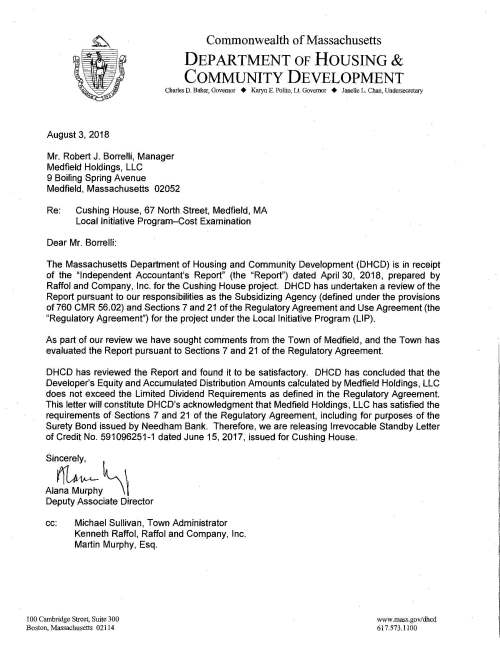
The Department of Housing and Community Development administers 40B and part of its task is to verify the limit on the profits that developers are allowed to make for any 40B project.  This letter acknowledges that Bob Borrelli has complied as to the eight unit Cushing House rental project he did at 67 North Street.

~ ·. 1·. ~ , I ~; . . Commonwealth of Massachusetts DEPARTMENT OF HOUSING & COMMUNITY DEVELOPMENT Charles D. Baker, Governor + Karyn E. Polito, Lt. Governor + Janelle L. Chan, Undersecretary s~" August 3, 2018 Mr. Robert J. Borrelli, Manager Medfield Holdings, LLC 9 Boiling Spring Avenue Medfield, Massachusetts 02052 Re: Cushing House, 67 North Street, Medfield, MA Local Initiative Program-Cost Examination Dear Mr. Borrelli: The Massachusetts Department of Housing and Community Development (DHCD) is in receipt of the "Independent Accountant's Report" (the "Report") dated April 30, 2018, prepared by Raffol and Company, Inc. for the Cushing House project. DHCD has undertaken a review of the Report pursuant to our responsibilities as the Subsidizing Agency (defined under the provisions of760 CMR 56.02) and Sections 7 and 21 of the Regulatory Agreement and Use Agreement (the "Regulatory Agreement") for the project under the Local Initiative Program (LIP). As part of our review we have sought comments from the Town of Medfield, and the Town has evaluated the Report pursuant to Sections 7 and 21 of the Regulatory Agreement. DHCD has reviewed the Report and found it to be satisfactory. DHCD has concluded that the Developer's Equity and Accumulated Distribution Amounts calculated by Medfield Holdings, LLC does not exceed the Limited Dividend Requirements as defined in the Regulatory Agreement. This letter will constitute DHCD's acknowledgment that Medfield Holdings, LLC has satisfied the requirements of Sections 7 and 21 of the Regulatory Agreement, including for purposes of the Surety Bond issued by Needham Bank. Therefore, we are releasing Irrevocable Standby Letter of Credit No. 591096251-1 dated June 15, 2017, issued for Cushing House. Sincerely, Ala~~y~ Deputy Associate Director cc: Michael Sullivan, Town Administrator Kenneth Raffol, Raffol and Company, Inc. Martin Murphy, Esq. 100 Cambridge Street, Suite 300 Boston, Massachusetts 02114 www.mass.gov/dhcd 617.573.1100

AG approved ATM bylaw changes today

The following is from Carol Mayer, Town Clerk –

 town seal

           TOWN OF MEDFIELD

                                                    Office of

                                        TOWN CLERK

                                 Carol A. Mayer, CMMC

                                                    459 Main St

                                       Medfield, Massachusetts 02052

 (508)-906-3024

Fax: (508) 359-6182

Email: cmayer@medfield.net


LEGAL NOTICE


In accordance with Massachusetts General Law Chapter 40 Section 32,   Notice is hereby given that Articles 28, 37, 38, 39, 40 and 41 voted at the Annual Town Meeting held April 30, 2018 have been approved by the Attorney General on July 6, 2018 and are available for public inspection in the Office of the Town Clerk. 


Article 28:  Amend Bylaws Ch. 170 Licenses and Permits, Section 170-1


Article 37:  Amend Bylaws to establish formally and to define the composition and duties of the Permanent Planing and Building Committee


Article 38:  Amend Bylaws, chapter 100 Animals, Article II Dog Control


Article 39:  Amend Town Bylaws to authorize Water & Sewerage Board to adopt regulations and enforcement procedures


Article 40:  Amend zoning Bylaws to allow granting of waivers for landscaping requirements in certain zoning district


Article 41:  Amend Zoning Bylaws to create new special permit criteria for multi-family dwelling developments


Copies of the above amendments may be examined and obtained at the Office of the Town Clerk.


Carol Mayer

Medfield Town Clerk

More safe harbor

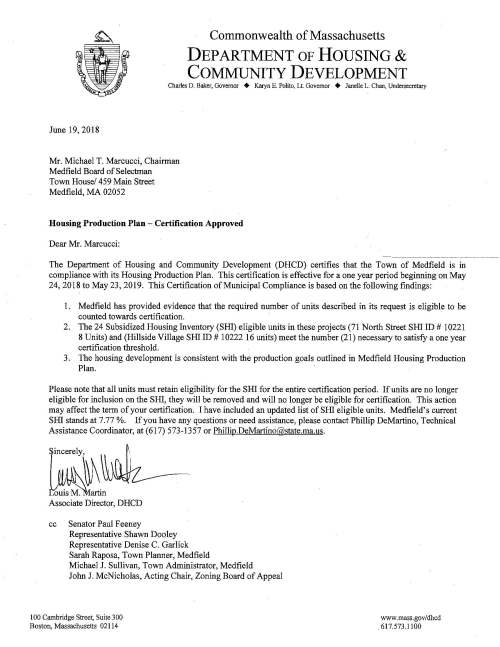
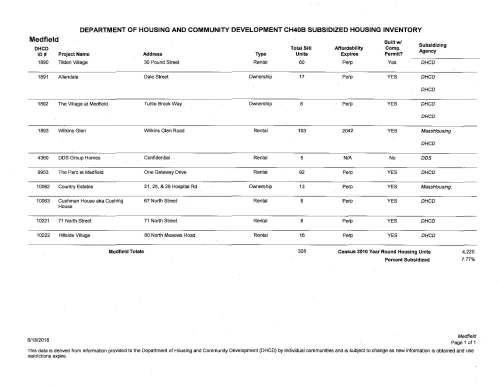
The town received notice form Department of Housing and Community Development that DHCD acknowledges that the Town of Medfield is in a safe harbor with respect to G. L. c. 40B for the next year.  That mailing appears below.  20180618-DHCD-ltr from-HPP Cert Medfield 2018

Commonwealth of Massachusetts DEPARTMENT OF HOUSING & COMMUNITY DEVELOPMENT Charles D. Baker, Governor + Karyn E. Polito, Lt. Governor + Janelle L. Chan, Undersecretary June 19, 2018 Mr. Michael T. Marcucci, Chairman Medfield Board of Selectman Town House/ 459 Main Street Medfield, MA 02052 Housing Production Plan - Certification Approved Dear Mr. Marcucci: The Department of Housing and Community Development (DHCD) certifies that the Town of Medfield is in compliance with its Housing Production Plan. This certification is effective for a one year period beginning on May 24, 2018 to May 23, 2019. This Certification of Municipal Compliance is based on the following findings: 1. Medfield has provided evidence that the required number of units described in its request is eligible to be counted towards certification. 2. The 24 Subsidized Housing Inventory (SHI) eligible units in these projects (71 North Street SHI ID# 10221 8 Units) and (Hillside Village SHI ID # 10222 16 units) meet the number (21) necessary to satisfy a one year certification threshold. 3. The housing development is consistent with the production goals outlined in Medfield Housing Production Plan. Please note that all units must retain eligibility for the SHI for the entire certification period. If units are no longer eligible for inclusion on the SHI, they will be removed and will no longer be eligible for certification. This action may affect the term of your certification. I have included an updated list of SHI eligible units. Medfield's current SHI stands at 7.77 %. If you have any questions or need assistance, please contact Phillip DeMartino, Technical Assistance Coordinator, at ( 617) 573-13 57 or Phillip.DeMartino@state.ma.us. Associate Director, DHCD cc Senator Paul Feeney Representative Shawn Dooley Representative Denise C. Garlick Sarah Raposa, Town Planner, Medfield Michael J. Sullivan, Town Administrator, Medfield John J. McNicholas, Acting Chair, Zoning Board of Appeal 100 Cambridge Street, Suite 300 Boston, Massachusetts 02114 www.mass.gov/dhcd 617.573.1100 DEPARTMENT OF HOUSING AND COMMUNITY DEVELOPMENT CH408 SUBSIDIZED HOUSING INVENTORY Medfield Built w/ DHCD Total SHI Affordability Comp. Subsidizing ID# Project Name Address Type Units Expires Permit? Agency 1890 Tilden Village 30 Pound Street Rental 60 Perp Yes DHCD 1891 Allendale Dale Street Ownership 17 Perp YES DHCD DHCD 1892 The Village at Medfield Turtle Brook Way Ownership 6 Perp YES DHCD DHCD 1893 Wilkins Glen Wilkins Glen Road Rental 103 2042 YES MassHousing DHCD 4360 DDS Group Homes Confidential Rental 5 N/A No DDS 9953 The Pare at Medfield One Gateway Drive Rental 92 Perp YES DHCD 10062 Country Estates 21, 25, & 29 Hospital Rd Ownership 13 Perp YES MassHousing 10063 Cushman House aka Cushing 67 North Street ·Rental 8 Perp YES DHCD House 10221 71 North Street 71 North Street Rental 8 Perp YES DHCD 10222 Hillside Village 80 North Meaows Road Rental 16 Perp YES DHCD Medfield Totals 328 Census 2010 Year Round Housing Units Percent Subsidized 6/18/2018 4,220 7.77°/o Medfield Page 1 of 1 This data is derived from information provided to the Department of Housing and Community Development (DHCD) by individual communities and is subject to change as new information is obtained and use restrictions expire.20180618-DHCD-ltr from-HPP Cert Medfield 2018_Page_2

MMA on state budget

This today from the Massachusetts Municipal Association, with a good summary of the state budget issues –

MMA-2

LEGISLATIVE CONFERENCE COMMITTEE FINALIZING FISCAL 2019 STATE BUDGET – MILLIONS IN MUNICIPAL AND SCHOOL FUNDING AT STAKE


PLEASE CALL YOUR LEGISLATORS TODAY TO SUPPORT LOCAL AID FUNDING AND KEY MUNICIPAL ISSUES

June 7, 2018


Dear Osler Peterson,


Now that the House and Senate have each passed their own versions of next year’s fiscal 2019 state budget, the next step is for a conference committee to iron out the differences and present a balanced budget for adoption by July 1.


While both budgets would increase municipal and school aid, there are significant differences between the branches, especially in funding for essential K-12 education accounts. It is imperative that you contact your legislators today and ask them to support the full appropriations, and make municipal and education aid a top priority.


Earlier this morning, the MMA delivered a detailed letter to the conference committee emphasizing the key local aid accounts that need to be funded at the highest possible level. Please call your legislators today and ask them to support the highest possible funding amounts for these municipal and school aid programs.


Please click here to download a copy of the MMA’s letter, so you can read and reference it when you speak with your legislators


The House and Senate budgets would both add to the municipal and school aid recommendations made by the governor in January, which is good news. When you talk with your local legislators, please thank them for making local aid a priority during the budget process this year, and ask that they contact conference committee members in support of the highest possible funding for municipal and school aid.


Millions of dollars are at stake: if the conference committee agrees on full funding by adopting the higher number for municipal and school aid accounts, this would return over $75 million more to cities and towns, compared to the funding that would result from adopting the lower number.


Here is a summary of the key priorities for cities and towns:


Unrestricted General Government Aid (UGGA)

The House and Senate both appropriated $1.099 billion for the Unrestricted General Government Aid (UGGA) account, an increase of $37.2 million over the fiscal 2018 level of funding. The 3.5 percent increase reflects the policy of increasing general municipal aid at the rate of growth in state tax collections reflected in the consensus tax forecast. This policy has been adopted by the Governor and the House and Senate since fiscal 2016, and is supported by the MMA. The good news is that the $37.2 million UGGA increase has already been agreed to by the House and Senate!


Chapter 70 School Aid and Local Contributions

The House funds the basic requirements of Chapter 70 education aid (7061-0008 and section 3), adopts provisions to continue to implement the recommendations of the Foundation Budget Review Commission, phases in target share funding for those communities where the local contribution exceeds the target share amount, and funds minimum aid at $30 per student. This would provide a Chapter 70 increase of $124.6M – which is significantly higher than the $103.6M increase in the governor’s budget proposal.


The Senate budget builds on the House approach by closing 100% of the target share gap and establishing an enhanced English language learner (ELL) foundation budget factor. These two changes would provide a Chapter 70 increase of $160.6M, or $36M more than the House. The MMA is supporting the Senate funding level.


Both the House and Senate would supplement Chapter 70 by providing $12.5 million to provide assistance to communities impacted by changes in how low-income students are counted. They do this in different accounts. What matters is that the final budget maintain the $12.5 million.


Special Education Circuit Breaker

Please ask your legislators to support the Senate’s full funding of the Special Education Circuit Breaker Program at $319.3 million, through which the state provides a measure of support for services provided to high-cost special education students. This is critically important.


Charter School Impact Mitigation Payments

Please ask your legislators to support the Senate appropriation of $100 million for Charter School Impact Mitigation Payments (7061-9010). This reflects an increase of $19.5 million above the current fiscal 2018 level of funding. This is a vital account for those communities impacted by charter schools.


Charter School Impact Analysis and Accountability

Please ask your legislators to support sections 61 and 62 in the Senate bill, which would bring a much-needed level of accountability related to state decisions to approve new and expanded charter schools that would include an assessment of the impact on local public schools.


Regional School District Student Transportation

Please ask your legislators to support the Senate appropriation of $68.9 million to reimburse regional school districts for a portion of the cost of transporting students.


McKinney-Vento Homeless Student Transportation

Please ask your legislators to support the House appropriation of $9.1 million for this account to reimburse municipalities and school districts for a portion of the cost of transporting homeless students as required under state and federal rules.


Payment in Lieu of Taxes on State-owned Land

Please support the Senate appropriation of $28.5 million to pay a portion of the payment-in-lieu-of taxes amount due to cities and towns to offset the property tax exemption for state-owned land. We support the additional $1.7 million set aside in the Senate appropriation language to ensure that Cherry Sheet PILOT payments next year are not reduced below the fiscal 2018 level due to the revaluation of state-owned land that takes effect next year.


Shannon Anti-Gang Grant Program

Please support the Senate level of funding of $8 million for the highly effective and valuable Shannon Anti-Gang Grant Program that has helped cities and towns respond to and suppress gang-related activities.


Reserve Fund for Municipal Improvements

Please support the House appropriation that would provide $2.8 million for the District Local Technical Assistance Fund (DLTA) that helps support local efforts to regionalize local government services. Please support the Senate appropriation that includes $2 million to support the Community Compact Cabinet program to facilitate the adoption of municipal best practices in cities and towns.


Community Preservation Act

Please support sections 45, 46, 47, 142, 143 and 196 of the Senate bill which would strengthen the Community Preservation Act (CPA) by updating the Registry of Deeds fee schedule to provide adequate revenue to restore the state match to an estimated 30 percent.


Municipal Police Training Fund

Please support sections 13, 14, and 70 in the Senate bill that would create a $2 surcharge on each rental car transaction in the Commonwealth to help fund an expanded police training program.


If you have any questions or need additional information, please contact MMA Legislative Director John Robertson at 617-426-7272 ext. 122 or jrobertson@mma.org.


Thank you very much!

EQV set for state $

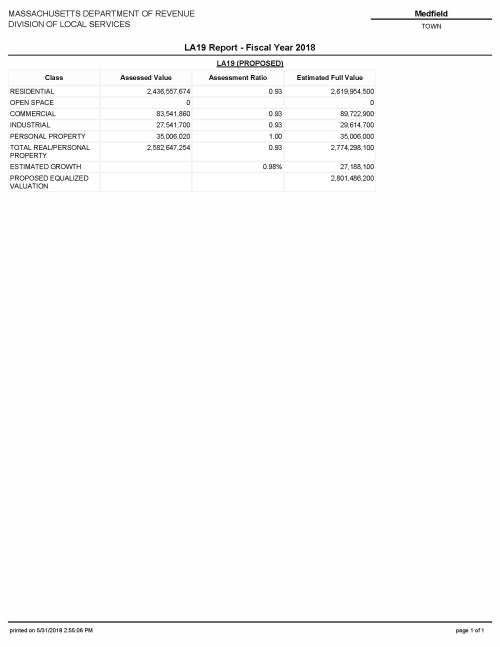
The state’s Division of Local Services (DLS) in the DOR emailed today about their having set the Estimated Full Value for the Equalized Valuations (EQVs) for all 351 cities and town.  Medfield is worth $2.8b.  That amount is used to say how much state money we get (a copy of the DLS email appears below).

LA19_Report

Proposed 2018 Equalized Valuations

Today, the Bureau of Local Assessment (BLA) posted the 2018 Equalized Valuations (EQVs) representing the full and fair cash value of all taxable property for each municipality as of January 1, 2018 to the Division of Local Services Gateway website at https://dlsgateway.dor.state.ma.us/gateway/Login. Access can be made directly from the landing page by clicking on the LA19 Equalized Valuation Report.

These EQVs will be used as a basis of comparison among the 351 municipalities within the Commonwealth for certain state and local purposes. Specifically, EQV is used in the allocation of aid to public libraries, in the calculation of Chapter 70 funding, and in the reimbursement rate of school construction projects. Certain Cherry Sheet charges also use EQV: County Tax, Boston Metropolitan Transit District, Mosquito Control Projects and Air Pollution Control Districts. In addition, EQV is used in calculating a community’s debt limit (M.G.L. c.44, § 10).

Informal hearings will be conducted for the convenience of communities who wish to question their proposed EQV. These hearings will be held from June 4th through June 8th. BLA representatives will meet personally with boards of assessors in Boston or conduct telephone conference calls to address concerns and discuss documentation submitted by assessors that support different values.

In addition, a Formal Public Hearing on the proposed 2018 Equalized Valuations will be held in Boston, Massachusetts at the Saltonstall Building, 100 Cambridge Street, 6th floor conference room on Wednesday, June 6, 2018 at 10:00 a.m.

Anomalous state programs – entry #1

State-House-smaller_1 (1)


This is the first time that I have heard of this particular state revenue sharing.  The state is sending the Town of Medfield our $0.20 per rides with Transportation Network Companies that originated in town.  Below is an email from Mike Sullivan and the forwarded email from the state DPU.  I see that Boston is getting about $3.5m.

=========================================================

Just received this. Medfield’s distribution amount is $734.70. this might just cover the overhead administrative costs to comply with the reporting requirements. If any left over, maybe we can use it to put 109 underground through the center. Mike


———- Forwarded message ———-
From: O’Connor, Angie (DPU) <Angie.Oconnor@massmail.state.ma.us>
Date: Fri, May 25, 2018 at 10:56 AM
Subject: Municipal Disbursement
To: “O’Connor, Angie (DPU)” <angie.oconnor@state.ma.us>
Cc: “Lubitz, Katherine (DPU)” <katherine.lubitz@state.ma.us>, “Hawkins, Ryan M (DPU)” <ryan.m.hawkins@state.ma.us>

Dear Municipal Official:

I write in regards to trips conducted by Transportation Network Companies (“TNCs”) in Massachusetts for the 2017 calendar year and the requirement of a $0.20 per‑ride assessment.  St. 2016, c. 187, § 8.  The Transportation Network Company Division (“Division”) of the Department of Public Utilities (“Department”), as the oversight authority for TNCs, has recently collected assessments from all TNCs and will be proportionately distributing the funds to municipalities.  A spreadsheet of municipal disbursements is attached to this email.  In addition, the Division has recently collected and analyzed TNC trip data across Massachusetts, and has made this information publically available.  The purpose of my writing to you is to provide information regarding municipal use of funds received from the assessment, as well as the published information on TNC trip data.

Chapter 187 of the Acts of 2016 established a Commonwealth Transportation Infrastructure Fund (“Fund”).  St. 2016, c. 187, § 8(a).  As required, each TNC has submitted to the Division the number of rides from the previous calendar year that originated within each city or town and a per‑ride assessment of $0.20, which has been credited to the Fund.  St. 2016, c. 187, § 8(a).  One‑half (½) of the amount received from the Fund will be distributed proportionately to each city and town based on the number of rides that originated in that city or town.  St. 2016, c. 187, § 8(c)(i).  In addition, one fourth (¼) will be distributed to the Massachusetts Development Finance Agency, established in G.L. c. 23G, § 2, in order to provide financial assistance to small businesses operating in the taxicab, livery, or hackney industries and to encourage the adoption of new technologies and advanced service, safety, and operational capabilities and to support workforce development; and one fourth (¼) to the Commonwealth Transportation Fund, established in G.L. c. 29, § 2ZZZ.  St. 2016, c. 187, §§ 8(c)(ii) and (iii).

We expect to disburse these funds within the coming weeks.

The distributed funds are special revenue without further appropriation.  The funds must be used “to address the impact of transportation network services on municipal roads, bridges and other transportation infrastructure or any other public purpose substantially related to the operation of transportation network services in the city or town including, but not limited to, the complete streets program established in [G.L. c. 90I, § 1] and other programs that support alternative modes of transportation.”  St. 2016, c. 187, § 8(c)(i).  Each city or town receiving distribution from the Fund must submit a report to the Division not later than December 31, 2018, detailing the projects and the amount used or planned to be used for transportation-related projects, as described above.  St. 2016, c. 187, § 8(d).  The Division is required to compile the reports and post the projects and amounts of money used on its website, located at https://www.mass.gov/orgs/department-of-public-utilities-transportation-network-company-division.  St. 2016, c. 187, § 8(d).

In addition, as required by regulation, the Division has recently collected data regarding TNC trips throughout Massachusetts, such as data on ride origination and destination, and average time and distance of trips.  220 CMR 274.12(2)(a).  The Division has published this information, along with preliminary analyses, which can be located at https://tnc.sites.digital.mass.gov/.  Lastly, the Department intends to continue working with TNCs to obtain and publish further information regarding their contribution to the Commonwealth’s transportation landscape.

I hope that you find this information beneficial.


Sincerely,

Angela M. O’Connor

Chairman

Massachusetts Department of Public Utilities

One South Station

Boston, Massachusetts 02110


Cherry Sheet for FY19

Historically, for the 18 years that I have been a selectman and therefore watching with interest the state budgets unfold, so I can learn what Medfield will get in state aide, I have noticed that we have always received more monies from the state Senate than in either proposals from the Governor or the House, but not this year.

It looks like our increase in state aide over last year will be about $62K.  Hardly enough to help with all our cost increases – the state continues to transfer to our property taxes the cost of running our town, by virtue of the state’s declining financial support of towns over time.

Below is the Cherry Sheet projection of where we will end up on state aid for the next fiscal year.

fy19-senate-20180511

Medfield awarded state cultural planning grant

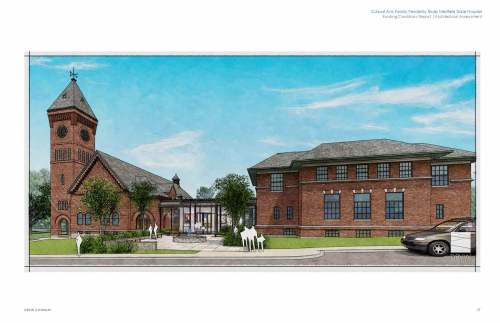
The town received a notice this week that it had been awarded a state planning grant for developing a cultural arts facility at the former Medfield State Hospital site. A rendering of one possibility is shown below.

This from Jean Mineo –

DBVW Architrects-cultural arts center

Medfield has been awarded a $30,000 planning grant from the Massachusetts Cultural Facilities Fund, a state program that fosters the growth of the creative economy by supporting building projects in the nonprofit arts, humanities and sciences. Medfield received one of 35 planning grants across the state. The grants require a 1:1 match. There were also 63 capital grants for a total of $9.3 million in awards that will generate at least another $9.3 million in private investment in cultural facilities.

The Town approved $25,000 toward the required grant match at the Annual Town Meeting last week. The Cultural Alliance of Medfield has committed to raising the balance for the $115,000 project to complete schematics and apply for historic tax credits. If you’d like to help, you can make a donation at their website www.MedfieldCulture.org or read more about their exciting plans on their link to the Medfield State Hospital. Contact Jean Mineo at 617-877-5158 or JeanMineo@aol.com with any questions.

To see the grants:
http://www.massculturalcouncil.org/facilities/facilities_fundinglist.htm#Boston


Senate budget recommendations out

The Massachusetts Senate has issued its budget recommendations, which this year are lower that the House numbers (usually they are higher from my memory).  Unfortunately for Medfield, state revenue sharing with cities and towns continues on a downward trajectory, so that more of municipal costs msut be paid for off our property taxes.  This alert this afternoon from the Massachusetts Municipal Association with its summary –

MMA-2

SENATE BUDGET COMMITTEE FILES $41.4 B FY19 STATE BUDGET THAT ADDS MUNICIPAL AND SCHOOL AID

• INCLUDES THE FULL $37M INCREASE IN UNRESTRICTED MUNICIPAL AID (UGGA)

• INCREASES CHAPTER 70 BY $148M TO FUND MINIMUM AID AT $30 PER STUDENT

• ADDS $38M FOR SPECIAL EDUCATION CIRCUIT BREAKER

• ADDS $20M FOR CHARTER SCHOOL IMPACT PAYMENTS

• ADDS $1.7 MILLION FOR PILOT PAYMENTS TO ENSURE NO FY19 AID LOSS

May 10, 2018

Dear Osler Peterson,

Earlier today, the Senate Ways & Means Committee reported out a $41.4 billion FY19 state budget plan to increase overall state expenditures by 3 percent. The SW&M plan is $61 million more than the budget filed by the Governor in January and $97 million less than the budget voted by the House last month. The full Senate will debate the FY19 spending plan starting May 22.

S. 4, the S W&M budget bill, provides significant progress on many important local priorities, including the full $37 million increase in Unrestricted General Government Aid that the Governor proposed and cities and towns are counting on. The SW&M budget would increase funding for other major aid programs by adding $38 million for the Special Education Circuit Breaker, adding $20 million for charter school impact mitigation payments, adding $1 million to Regional School Transportation, and increasing Chapter 70 aid by $148 million more than the FY18 level.

Please Click this Link Now to See the Chapter 70 and Unrestricted Municipal Aid Numbers for Your Community

Later Today or Early Tomorrow – Click on this Link to See Your Community’s Local Aid and Preliminary Cherry Sheet Numbers in the House Ways & Means Budget, as Posted by the Division of Local Services

$37.2 MILLION INCREASE IN UNRESTRICTED MUNICIPAL AID

In a continuing good news story for cities and towns, the SW&M budget plan would provide $1.1 billion for UGGA, a $37.2 million increase over current funding – the same increase proposed by Governor Baker and voted by the House. The $37.2 million would increase UGGA funding by 3.5 percent, which matches the projected growth in state tax collections next year. Every city and town would see their UGGA funding increase by 3.5 percent.

SW&M BUDGET BUILDS ON PROGRESS IN HOUSE BUDGET, WITH $23.5M MORE FOR CHAPTER 70 ($44.1M MORE THAN GOV’S BUDGET), MINIMUM AID WOULD MATCH HOUSE’S $30 PER STUDENT

The Senate budget committee is proposing to increase Chapter 70 education aid by $147.7 million above current fiscal 2018 levels. This is $44.1 million higher than the increase in the Governor’s recommendation, and $23.5 million more than the budget passed by the House in April), with a provision that every city, town and school district receive an increase of at least $30 per student (compared to the $20-per-student amount in the Governor’s budget). The SW&M budget would continue to implement the target share provisions enacted in 2006 and would do so on a more accelerated schedule than proposed by the Governor and voted by the House. Further, the SW&M proposal would build on formula changes proposed by Governor and voted by the House to start addressing shortfalls in the foundation budget framework, by increasing the cost factors for school employee health benefits and for English Language Learners (ELL).

Please ask your Legislators to support a funding increase for Chapter 70 school aid that ensures that all schools receive a suitable and appropriate increase in fiscal 2019, which the MMA targets at $100 per student. The MMA also strongly supports implementation of all of the recommendations of the Foundation Budget Review Commission to update the Chapter 70 “foundation budget” minimum spending standards for special education and employee health insurance, and to add to the spending standard a measure of recognition for the cost of services for low-income, English Language Learner (ELL) and other students who would benefit from more intensive services. The Commission recommended phasing in the changes over a four-year period, a position the MMA supports as well. Increasing minimum aid and fixing the inadequacies in the foundation formula are essential.

$37.7 MILLION INCREASE FOR SPECIAL EDUCATION CIRCUIT BREAKER

In S. 4, Senate leaders have made clear that they support increased funding for the Special Education Circuit Breaker program with the intent to reach full funding next year. The SW&M plan would provide $318.9 million, a $27.7 million increase above the Governor’s proposed FY19 level of $291.1 million, and $37.7 million more than the $281.2 million FY18 level. This is a vital program that every city, town and school district relies on to fund state-mandated services.

ADDS $1 MILLION TO REGIONAL SCHOOL TRANSPORTATION

The Senate Ways and Means Committee budget would add $1 million to bring regional transportation reimbursements up to $62.5 million. The MMA will work to continue building on this increase to get to full funding.

CHARTER SCHOOL REIMBURSEMENTS WOULD BE FUNDED AT $100 MILLION

The SW&M budget would provide $100 million to cover charter school impact mitigation payments, compared to the Governor’s recommendation to level fund the program at $80.5 million and the House plan to increase funding to $90 million. While the SW&M increase is certainly welcome and appreciated, both legislative proposals remain below the amount necessary to fully fund the statutory formula that was originally established to offset a portion of the funding that communities are required to transfer to charter schools. The FY18 funding level is currently $73.4 million below what is necessary to fund the reimbursement formula that is written into state law. An expanding shortfall would lead to the continued and growing diversion of Chapter 70 funds away from municipally operated school districts, and place greater strain on the districts that serve 96 percent of public school children. Solving the charter school funding problem must be a major priority during the budget debate.

PAYMENTS-IN-LIEU-OF-TAXES (PILOT), LIBRARY AID ACCOUNTS, METCO, AND SHANNON ANTI-GANG GRANTS

The Senate budget committee’s proposal would increase PILOT payments by $1.7 million to ensure that no city or town loses PILOT aid next year, add $540,000 to library grant programs, add $500,000 to METCO, and level fund McKinney-Vento reimbursements at $8.1 million.The SW&M budget would level fund Shannon Anti-Gang Grants at $6 million.

Please Call Your Senator Today to Thank Them for the Local Aid Investments in the Senate Ways and Means Committee Budget – Which Increases Direct Municipal and School Aid Accounts by More Than the Governor’s Budget

Please Explain How the Senate Ways and Means Budget Impacts Your Community, and Ask Your Senators to Build on this Progress During Budget Debate in the Senate

Thank You!