Category Archives: Budgets

Tri-County $ next year

Town’s contribution to Tri-County Regional Vocational Technical School District is based on the number of our students.  Yesterday Mike circulated the list below:

fy18-tri-county

First state local aid

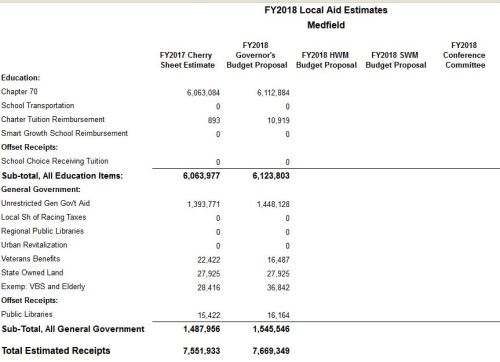
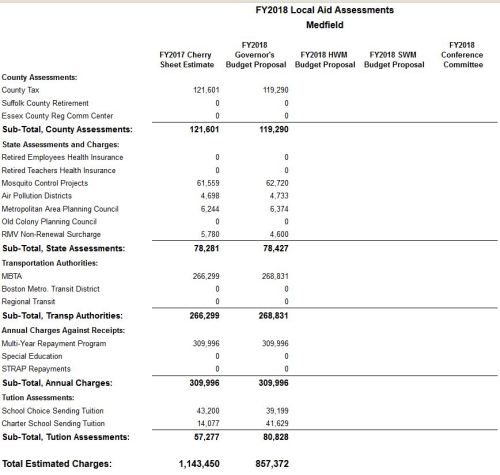
DOR is providing us these local aid figures for Medfield based on the Governor’s budget proposal (NB, the sum appears to be incorrect on the assessments):

fy18-local-aid-medfield


fy18-local-aid-assessments-medfield

State budget

The state budget starts with the Governor’s proposal, moves on to the House’s proposal, to the Senate’s proposal, and then finally a House-Senate reconciliation committee to iron out the differences.  The Governor has just filed his proposed budget, and he is keeping to his plan to have municipal aid track the percentage revenue increases.  The analysis of the Governor’s proposed budget that follows was provided to me by the Massachusetts Municipal Association.

MMA-2


January 25, 2017
GOV. BAKER FILES $40.5 BILLION FY 2018 BUDGET PROPOSAL

• UNRESTRICTED MUNICIPAL AID WOULD INCREASE BY $39.9 MILLION (3.9%)

• CHAPTER 70 AID WOULD INCREASE BY ONLY $91.4 MILLION (2%)

• MOST OTHER MUNICIPAL AND SCHOOL ACCOUNTS LEVEL-FUNDED


Earlier this afternoon, Gov. Charlie Baker submitted a $40.5 billion fiscal 2018 state budget plan with the Legislature, proposing a spending blueprint that would increase overall state expenditures by 4.3 percent, as the new Administration seeks to close an ongoing structural budget deficit by restraining spending across the board and placing an estimated $98 million into the state’s rainy day fund. The budget relies on $95 million in one-time revenues.

As Gov. Baker pledged to local officials on Jan. 21 at the MMA’s Annual Meeting, his budget includes a $39.9 million increase in Unrestricted General Government Aid, and $91.4 million more for Chapter 70 school aid. The Gov.’s proposal for Chapter 70 aid includes a minimum aid increase of $20-per- student, full funding of the foundation budget requirements, and continued implementation of the “target share” equity provisions. The foundation budget calculation would partially implement the Foundation Budget Review Commission’s recommendation to use a more realistic factor for the cost of employee health insurance in school systems.

Most other municipal and education aid accounts in the Governor’s budget proposal would remain at fiscal 2017 levels. This includes the special education circuit breaker, payments-in- lieu of taxes, regional school transportation, Shannon anti-gang grants, McKinney-Vento reimbursements and METCO funding.

The Governor would level-fund charter school reimbursements at $80.5 million, far below the amount necessary to fully fund the statutory formula that is designed to offset a portion of the amount that communities are required to transfer to charter schools. Level-funding this account would lead to the continued and growing diversion of Chapter 70 funds away from municipally operated school districts, and place greater strain on the districts that serve 96% of public school children.


Click here to see the UGGA and Chapter 70 Aid amounts listed by community in the

Governor’s budget


• Click below to see the Division of Local Services preliminary fiscal 2018 Cherry Sheet

aid amounts for your community, based on the Governor’s proposed budget (you will

need to insert the name of your community in the field):

Municipal Aid

Regional School District Aid


Click here to see DESE’s calculation of fiscal 2018 Chapter 70 aid and Net School

Spending requirements for your city, town, or regional school district, based on the

Governor’s proposed budget


UNRESTRICTED MUNICIPAL AID INCREASED BY $39.9 MILLION

In a major victory for cities and towns, House One (the Governor’s fiscal 2018 budget submission) would provide $1.062 billion for UGGA, a $39.9 million increase over current funding. This fulfills one of Gov. Baker’s major campaign promises to increase direct municipal aid by the same rate of growth as state tax revenues.

The $39.9 million would increase UGGA funding by 3.9 percent, the same rate of growth projected for state tax revenues. Every city and town would see their UGGA funding increase by this 3.9 percent growth rate.

CHAPTER 70 SCHOOL AID WOULD GO UP JUST 2 PERCENT

The Governor’s budget submission proposes a small 2 percent increase in Chapter 70 education aid of $91.4 million, providing every city, town and school district with a minimum increase of $20 per student. The Governor’s budget would continue to implement the target share provisions enacted in 2007. The overall Chapter 70 increase would be significantly smaller than in recent years. The Governor’s budget includes a partial reflection of one of the Foundation Budget Review Commission’s key recommendations, which is updating the foundation budget to reflect the cost of employee health insurance. But this adjustment in the foundation budget is not enough to increase aid to many districts. 237 cities and towns (74% of all operating districts) would only receive an increase of $20 per student under the Governor’s budget. This below-inflation increase is too low, and would force communities to reduce school programs or further shift funds from the municipal side of the budget.

Please ask your Legislators to support a funding increase for Chapter 70 school aid that ensures that all schools receive a suitable and appropriate increase in fiscal 2018, which the MMA believes should be at least $100 per student. The MMA also strongly supports implementation of all of the recommendations of the Foundation Budget Review Commission to update the Chapter 70 “foundation budget” minimum spending standards for special education and employee health insurance, and to add to the spending standard a measure of recognition for the cost of services for low-income, English Language Learner (ELL) and other students who would benefit from more intensive services. The Commission recommended phasing in the changes over a four-year period, a position the MMA supports as well. Increasing minimum aid and fixing the inadequacies in the foundation formula are essential.

It should also be noted that House One contains language that would continue to allow communities to count retiree health insurance toward their net school spending, but only if they have done so beginning when the school finance law first went into effect in 1994, or if they have previously voted to adopt the local-option provision in section 260 of the fiscal year 2015 general appropriations act to allow a phase-in of retiree health insurance costs in their net school spending calculation.

Further, House One would use the same methodology that was used in this year’s fiscal 2017 budget to estimate the number of low-income students used in the foundation budget calculation.

SPECIAL EDUCATION CIRCUIT BREAKER UNDERFUNDED

The Governor’s budget would level-fund the Special Education Circuit Breaker program at $277 million. Because special education costs are expected to rise in fiscal 2018, this means that the Governor’s budget likely underfunds reimbursements by as much as $10 million. This is a vital account that every city, town and school district relies on to fund state-mandated services. The Legislature has intended to fully fund the program for the past five years, and the MMA will again be asking lawmakers to ensure full funding in fiscal 2018.

CHARTER SCHOOL REIMBURSEMENTS LEVEL FUNDED AT $80.5 MILLION

As noted above, the Governor would level-fund charter school reimbursements at $80.5 million, far below the amount necessary to fully fund the statutory formula that was originally established to offset a portion of the funding that communities are required to transfer to charter schools. The fiscal 2017 funding level is $54 million BELOW what is necessary to fund the reimbursement formula that is written into state law, so it is clear that the shortfall will grow significantly in fiscal 2018. Even though the reimbursement formula is level-funded at $80.5 million, the Governor’s fiscal 2018 budget would INCREASE charter school assessments by $60 million. This would lead to the continued and growing diversion of Chapter 70 funds away from municipally operated school districts, and place greater strain on the districts that serve 96% of public school children. Solving the charter school funding problem must be a major priority during the budget debate.

REGIONAL SCHOOL TRANSPORTATION REIMBURSEMENTS LEVEL FUNDED

Gov. Baker’s budget submission would level-fund regional transportation reimbursements at the $61 million amount. This will be a hardship for virtually all communities in regional districts. Reimbursements for transportation of out-of- district vocational students remains significantly underfunded at $250K. Increasing these accounts is a priority for cities and towns.

McKINNEY-VENTO REIMBURSEMENTS LEVEL FUNDED

The Governor’s budget would level-fund reimbursements for the transportation of homeless students at $8.35 million. The impact of this funding level will vary from community-to- community depending on the number of homeless families that remain sheltered in local hotels and motels. The Administration has been successful in reducing the number of homeless students who are dislocated from their original district, but those communities that continue to provide transportation to many students may continue to see shortfalls.

PAYMENTS-IN- LIEU-OF- TAXES (PILOT) AND SHANNON GRANTS LEVEL FUNDED, AND LIBRARY AID UP $189K

The Governor’s budget would level fund PILOT payments at $26.77 million, Shannon anti-gang grants at $6 million, and fund library grant programs at $19.07 million (up $189K).

GOV. PROPOSES APPLYING HOTEL-MOTEL TAX TO AIRBNB AND OTHER SHORT-TERM RENTALS, BUT ONLY IF RENTED FOR 150 DAYS

House One includes an outside section that would subject Airbnb and other short-term rentals to the local room occupancy excise tax. However, this would only apply in cases where the property is rented for 150 days or more. The MMA strongly supports extending the room occupancy excise to ALL short-term rentals. The 150-day threshold would continue to shield almost all seasonal and short-term rentals from taxation, and would not close the loophole that exists now.

GOV. PROPOSES FUNDS TO BEGIN PROCESS OF HAVING DEP TAKE THE LEAD IN OVERSEEING FEDERAL STORMWATER PERMITS

The Governor’s budget proposes $1.4 million to begin the process of having the Department of Environmental Protection assume “delegated authority” from the U.S. EPA to oversee the NPDES Stormwater Permit process (also referred to as MS4 permits). The MMA supports having DEP as the lead agency for stormwater permits. The $1.4 million would fund 12 DEP staff positions to begin the transition to becoming the lead agency. Full funding would take approximately $4.7 million. The Governor will be filing separate legislation to allow DEP to petition the EPA for this authority.


PLEASE CONTACT YOUR LEGISLATORS TODAY AND CALL ON THEM TO PUBLICLY SUPPORT THE GOVERNOR’S PROPOSAL TO INCREASE UNRESTRICTED MUNICIPAL AID BY $39.9 MILLION – THIS  INCREASE IS VITAL TO LOCAL BUDGETS IN EVERY CORNER OF MASSACHUSETTS


AND PLEASE ASK YOUR LEGISLATORS TO COMMIT TO INCREASING CHAPTER 70 EDUCATION AID, FIXING THE FLAWS IN CHARTER SCHOOL FUNDING, AND FULLY FUNDING KEY MUNICIPAL AND SCHOOL PROGRAMS

 
Massachusetts Municipal Association
One Winthrop Square, Boston, MA 02110
(617) 426-7272
All contents copyright 2015, Massachusetts Municipal Association

Unsubscribe from MMA Legislative Alerts.


ALS

ambulance

Yesterday afternoon from 6-7 PM before the regular meeting of the Board of Selectmen there was a well attended session that was billed as a working meeting of the Board of Selectmen with Chief Kingsbury and Lieutenant Bennotti of the Medfield Fire Department to discuss the possible solutions for the town to the provision of Advanced Life Support (ALS) services to town residents. The MFD currently only provides intermediate basic life support (EMT) ambulance services to residents, and only one of the current seven full time firefighters is a paramedic.

One firefighter recently resigned, and will be replaced with a paramedic, however, until the whole service is staffed with paramedics, the two paramedics will not be able to provide paramedic services.

The ALS session was not covered by Medfield.TV – I do not know why not, as I was not involved in making that decision.  Personally, I would have put it on TV.

Basically the Chief and the Lieutenant

  • expect that the MFD will have increasing problems in the future staffing a call department,
  • expect the current towns providing the ALS intercept services (Westwood, Walpole, and Norfolk) as tiring of doing so if we are not making efforts to solve our situation,
  • see no likely chance of doing a regional ALS with other towns (Dover and Sherborn are the logical ones),
  • generally see no interest in current EMT’s becoming paramedics,
  • see the cost of using a private ALS provider as similar to the cost to expand the MFD (they have been quoted $600,000 per year, plus $250 per run by private providers), and
  • therefore that the best solution is for the town to hire eight new full time firefighter/paramedics at a cost of about $650,000 per year, plus start up costs.

Whether to hire the paramedics will be a decision for residents to make at at the annual town meeting (ATM).

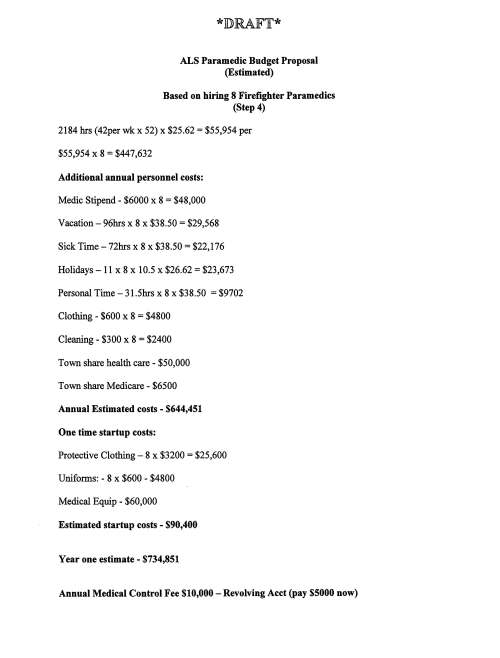
Below are the Chief’s cost projections:

* lIJ) RAIF'f * ALS Paramedic Budget Proposal (Estimated) Based on hiring 8 Firefighter Paramedics (Step 4) 2184 hrs (42per wk x 52) x $25.62 = $55,954 per $55,954 x 8 = $447,632 Additional annual personnel costs: Medic Stipend - $6000 x 8 = $48,000 Vacation - 96hrs x 8 x $38.50 = $29,568 Sick Time- 72hrs x 8 x $38.50 = $22,176 Holidays -11x8 x 10.5 x $26.62 = $23,673 Personal Time-31.5hrs x 8 x $38.50 = $9702 Clothing - $600 x 8 = $4800 Cleaning - $3 00 x 8 = $2400 Town share health care - $50,000 Town share Medicare - $6500 Annual Estimated costs - $644,451 One time startup costs: Protective Clothing- 8 x $3200 = $25,600 Uniforms: - 8 x $600 - $4800 Medical Equip - $60,000 Estimated startup costs - $90,400 Year one estimate - $734,851 Annual Medical Control Fee $10,000 - Revolving Acct (pay $5000 now)

I suggest that these figures do not reflect the true cost to the town of the additional employees, as these estimates do not include the present value of the future retirement benefits the town will ultimately have to pay.  Those retirement benefits (i.e. pension and health care) are called Other Post Employment Benefits (OPEB).  To truly tell us the cost, the estimates should include the present value of the actuarial costs we incur each year to pay future retirement benefits to such employees.

The town was only recently required to figure out the value of its OPEB liability. Currently the unfunded actuarial cost for the town’s OPEB is over $40m. OPEB costs currently cost the town about $1.5m. per year, and the town only just recently (a couple of years ago) started to budget $400,000 a year to pay into a trust fund to partially cover the future OPEB as they come due.  Therefore the town is still adding over $1m. a year to its OPEB liability, which is basically pushing off current town costs to be paid by future residents.

OPEB benefits to retired former town employees were until relatively recently not funded at all while those retirees were working, and even now the town is not fully funding its future OPEB liability.  As we add new town employees, we may want to include the OPEB liabilities in our cost estimates.

ALS cost estimate

mfd

At the Board of Selectmen last night Chef Kingsbury handed out the attached estimate of what it would cost the town to hire eight new paramedics, such that the Medfield Fire Department would be staffed by four full time firefighters on duty, 24/7.  Under this scenario, the Medfield Fire Department staffing would double from eight full time firefighters to sixteen firefighters, with half of the employees being paramedics, and half EMT’s.

Since 2000 we have provided EMT intermediate ambulance services, and we employ eight full time EMT’s to do so.  We are staffed by two EMT’s per shift, 24/7.

I believe that the major treatment difference between EMT and paramedic services is the ability of the latter to administer medication and insert IV’s.  I also understand that paramedics have about 1,640 hours of training beyond EMT’s.

At the meeting, ALS services were estimated to be used on 80% of the current runs, needed on maybe 60%, and currently ALS services are provided by ALS intercepts, if available, as the result of a ten year old agreement with the towns of Westwood, Walpole, and Norfolk.  We split any fees received for runs with ALS intercepts with the other towns on a 50/50 basis.

The data that especially interested me was that the Medfield Fire Department does about 650 ambulance runs per year, or about two per day on average, and that each run takes up to an hour and a half.  That would appear to mean that there is a lot of capacity for which we are staffed, to do more runs.  When figured on a yearly average, if the two runs take about three hours, there is about twenty hours per day of non-run time.  If all the departments in surrounding towns have the same issue, it seems that it cries out for a regional solution by which all departments are using more of that currently underutilized capacity.

There were several comments made about the safety issues of being properly staffed with employees who have the proper training, both for the safety of the firefighters themselves and for the safety of the public.  One call firefighter assured that no apparatus ever leaves the station without being fully and properly staffed.

Alternatives that were also mentioned included:


  • converting to a paramedic service slowly over time by requiring any new hire to be a paramedic
  • hiring a company to provide the ALS service on an intercept basis, which was estimated to cost $600,000/year,plus a charge per run, for three towns;
  • starting a regional ALS service shared with other towns that do not currently have ALS (i.e. Millis, Dover, Sherborn, and one other, Holliston maybe), but it was reported that there appears to be no interest in those other towns per the Chief in doing a regional service; and
  • NB, it was stated that there was felt to be little interest among our current EMT’s in their becoming paramedics.


Another alternative, that was not discussed, is whether the Medfield Fire Department could just be converted to an all paramedic service by requiring current employees to become paramedics within a set amount of time, say within the next three years.  In the past the Chief has opined that was not possible.

The more I learn about ALS services, the more uncertain of the right solution I become.  What is the proper balance between services and costs?  I still need a lot of education, so I hope the selectmen get a lot more input.  Today in follow up discussions with one of the meeting participants I was provided the Massachusetts EMERGENCY MEDICAL SERVICES PRE-HOSPITAL STATEWIDE TREATMENT PROTOCOLS, all 176 pages of it – so I have some homework to get me started.

*]])RAJF'Ir* ALS Paramedic Budget Proposal (Estimated) Based on hiring 8 Firefighter Paramedics (Step 4) 2184 hrs (42per wk x 52) x $25.62 = $55,954 per $55,954 x 8 = $44 7 ,632 Additional annual personnel costs: Medic Stipend - $6000 x 8 = $48,000 Vacation-96hrs x 8 x $38.50 = $29,568 Sick Time-72hrs x 8 x $38.50 = $22,176 Holidays-11x8 x 10.5 x $26.62 = $23,673 Personal Time - 31.5hrs x 8 x $38.50 = $9702 Clothing - $600 x 8 = $4800 Cleaning - $300 x 8 = $2400 Town share health care - $50,000 Town share Medicare - $6500 Annual Estimated costs - $644,451 One time startup costs: Protective Clothing- 8 x $3200 = $25,600 Uniforms: - 8 x $600 - $4800 Medical Equip - $60,000 Estimated startup costs - $90,400 Year one estimate - $734,851 Annual Medical Control Fee $10,000 - Revolving Acct (pay $5000 now)

Mass vs. US on property taxes

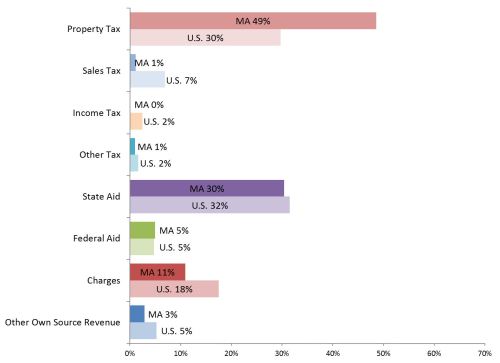
I was just reading the Lincoln Institute’s piece on how property taxes in Massachusetts shape up compared to the rest of how the states in the United States do things.  In general, Massachusetts cities and towns rely more on our property taxes, and less on sales taxes or fees to run our cities and towns than the rest of the states.  Massachusetts towns get just below the average state monies contributed to them.

ma_final_nov_7_2016_upload

Financial data online

budget-3

ClearGov put our general financial data from the Massachusetts Department of Revenue on-line for us as a promotion, seeking to sell us more services.

http://www.cleargov.com/massachusetts/norfolk/town/medfield/2014

If  residents want access to the details of the town’s finances, it too can be put on-line for them.  The state and the City of Boston have both put their checkbooks online.

Medfield’s one earmark vetoed by Governor

State-House-smaller_1 (1)

Medfield was scheduled to get only one earmark in the FY17 state budget, $150,000 for the state to build a new road to the Charles River Overlook on state land, so that the easement over the town’s former MSH property could be eliminated.  Per John Nunnari’s email this morning, Governor Baker vetoed that money.  Many such vetoes are overridden by the legislature.

John closely follows the legislature for the architects, and always knows what is happening.


All,

Just fyi, but as part of the Governor’s veto message, the following has been eliminated:

 2810-0100 For the operation of the division of state parks and recreation;…. provided further, that not less than $150,000 shall be expended for the creation of a roadway at the former Medfield State Hospital property in the town of Medfield

 I’m hearing that the House/Senate intend to take up the Governors vetoes during Formal Sessions on Thursday  – with the potential for it to extend into a rare Friday Formal Session.

House and Senate leadership are upset with the Gov’s $256M in reductions over 303 line items (which included approx.. $60M in earmarks – which the Medfield State Hospital roadway project would be considered).

More to come.

john

Medfield $ in state budget

budget-2

John Nunnari provided the final Medfield money in the state budget, which includes money for the state to build its own road to the Charles River Overlook, so Medfield does not have to encumber our MSH land with that access, if we decide it is not in our best interest.


Municipality/Regional District 7061-0008 Chapter 70 Unrestricted General Government Aid Annual Formula Local Aide
FY ’15 Actual Appropriation $5,862,409.00 $1,289,875.00 $0.00
FY ’16 Actual Appropriation $5,925,859.00 $1,336,310.00
Governors FY ’17 Proposal $5,975,759.00 $1,393,771.00 $0.00
Medfield (House FY ’17 Proposed Numbers) $6,063,084.00 $1,393,771.00 $0.00
Medfield (Senate FY 17 Proposed Numbers) $6,063,084.00 $1,393,771.00 $0.00
FY ’17 Conference Committee Report           July +/- $6,063,084.00 $1,393,771.00 $0.00


2810-0100 For the operation of the division of state parks and recreation;…. provided further, that not less than $150,000 shall be expended for the creation of a roadway at the former Medfield State Hospital property in the town of Medfield


John Nunnari, Assoc AIA
Executive Director, AIA MA

State budget protects Medfield

State-House-smaller_1 (1)

The state economic downturn will effect our state services, but not the state aid to education or local state aid for Medfield (see text I put in red below), as the state cuts monies for programs and cancels an income tax cut in order to balance its FY17 budget.

This Statehouse News Service article was shared by John Nunnari.


BUDGET CONFEREES CHOP $413 MIL, COUNT ON INCOME TAX CUT CANCELLATION

By Matt Murphy
STATE HOUSE NEWS SERVICE

STATE HOUSE, BOSTON, JUNE 29, 2016…..House and Senate leaders on Thursday will seek passage of a $39.15 billion budget accord for the fiscal year that begins on Friday, crafting a compromise in the face of unstable economic conditions that cuts $750 million in projected revenue and $413 million in proposed spending from previous plans.

The deal, reached on Wednesday by six negotiators from both branches, preserves increases to local aid and school funding for cities and towns, as well as substance abuse programs, but made tradeoffs that will result in many agencies and programs receiving level funding as the page turns Thursday night from fiscal 2016 to fiscal 2017.

The compromise plan would increase Chapter 70 school aid by $116 million and unrestricted local aid by $42 million, Dempsey told reporters.

House Ways and Means Chairman Brian Dempsey said the compromise cuts $260 million from the roughly $39.5 billion spending plans approved by the House and Senate in April and May, including $142 million from Medicaid by deferring some payments until fiscal 2018 and reducing caseload estimates in public assistance and health insurance programs.

The budget bill, which will be put before House and Senate lawmakers Thursday for passage, also cancels a proposed $200 million deposit in the state’s reserves due to lower than anticipated capital gains taxes, which have taken a hit from the volatility in the stock market.

Dempsey said the budget conferees, with the help of the Baker administration, identified $100 million in savings through “procurement efficiencies,” and are no longer assuming a reduction in the income tax rate from 5.1 percent to 5.05 percent in January, freeing up $80 million in taxes for spending.

“I think that this action on the part of the House and Senate, the conferees that have worked very, very hard over the last several weeks, shows that we are taking strong action that will certainly deal with the challenges and adjustments that we see with respect to revenue,” Dempsey said.

As a result of the lower anticipated revenues in fiscal 2017, automatic transfers to the School Building Authority and the MBTA from sales taxes will occur at lower levels, reducing the amount delivered to each entity by about $30 million, Dempsey said.

Senate budget chief Karen Spilka plans a 5 p.m. budget briefing.

[The News Service will have further budget coverage as more details become available]

END
06/29/2016

Serving the working press since 1910
http://www.statehousenews.com