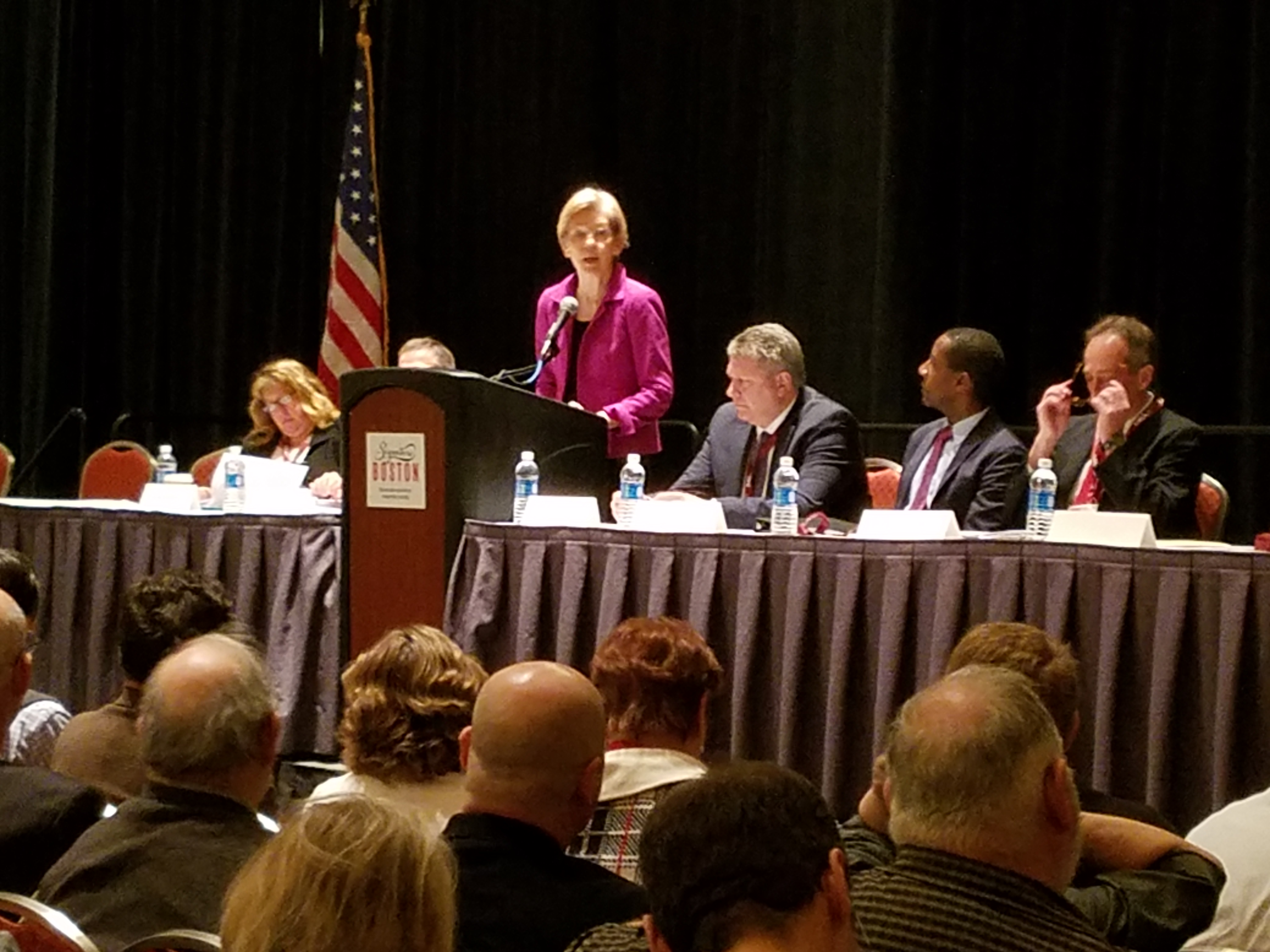
Hearing this morning from Senators Warren and Markey, and Governor Baker.
Warren says report on federal level is that many in state will lose health care, Sec. Of education does not believe in public education, and that she is speaking first so she can go to march.
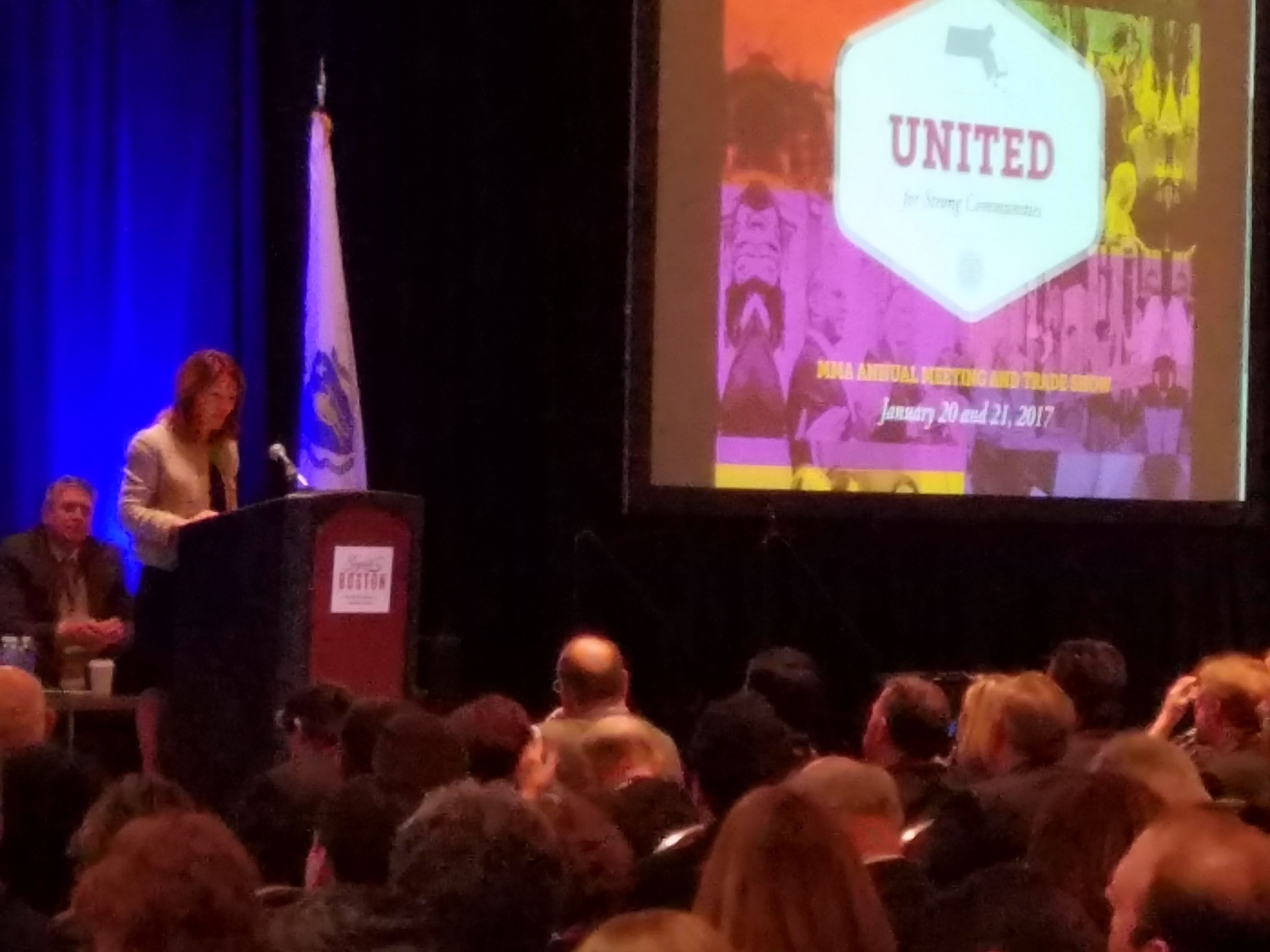
More ideas already for Medfield today from annual meeting of the Massachusetts Selectmen Association.
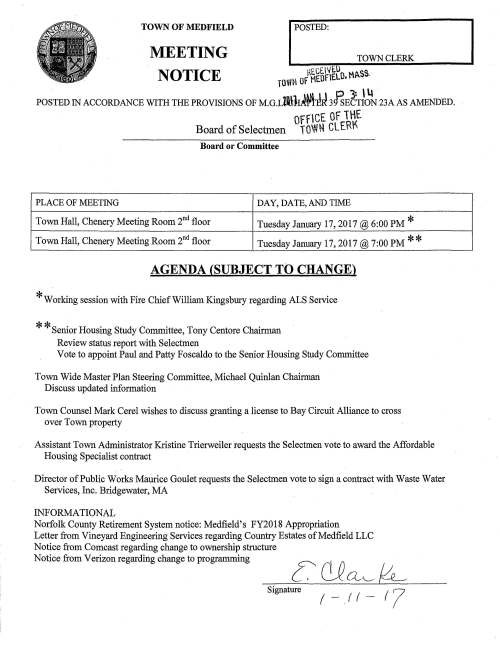
The Board of Selectmen did two things last night related to affordable housing.
First the selectmen heard a report from the Senior Housing Study Committee about its seeking to have the town donate the nine acre Hinkley land next to The Center for the purpose of building 5-6 moderately priced ranch houses per acre there. About half of the Hinkley land is wetlands, so that could amount to about 25 homes. The committee said it would put its slides online.
Second, the selectmen hired the Community Opportunities Group as our consultant to assist the town with planning and executing the town’s affordable housing strategy. We hired the Community Opportunities Group for its $38,000 bid amount. Community Opportunities Group submitted the only response to the town’s RFP, with a not to exceed $40,000 limit. Community Opportunities Group assisted the town in preparation of the Housing Production Plan that we approved last fall, and Assistant Town Administrator, Kristine Trierweiler, stated that she was more than satisfied with its past work for the town. Click this link to see its proposal – 20170117-community-opportunities-group-inc-proposal
Yesterday afternoon from 6-7 PM before the regular meeting of the Board of Selectmen there was a well attended session that was billed as a working meeting of the Board of Selectmen with Chief Kingsbury and Lieutenant Bennotti of the Medfield Fire Department to discuss the possible solutions for the town to the provision of Advanced Life Support (ALS) services to town residents. The MFD currently only provides intermediate basic life support (EMT) ambulance services to residents, and only one of the current seven full time firefighters is a paramedic.
One firefighter recently resigned, and will be replaced with a paramedic, however, until the whole service is staffed with paramedics, the two paramedics will not be able to provide paramedic services.
The ALS session was not covered by Medfield.TV – I do not know why not, as I was not involved in making that decision. Personally, I would have put it on TV.
Basically the Chief and the Lieutenant
expect that the MFD will have increasing problems in the future staffing a call department,
expect the current towns providing the ALS intercept services (Westwood, Walpole, and Norfolk) as tiring of doing so if we are not making efforts to solve our situation,
see no likely chance of doing a regional ALS with other towns (Dover and Sherborn are the logical ones),
generally see no interest in current EMT’s becoming paramedics,
see the cost of using a private ALS provider as similar to the cost to expand the MFD (they have been quoted $600,000 per year, plus $250 per run by private providers), and
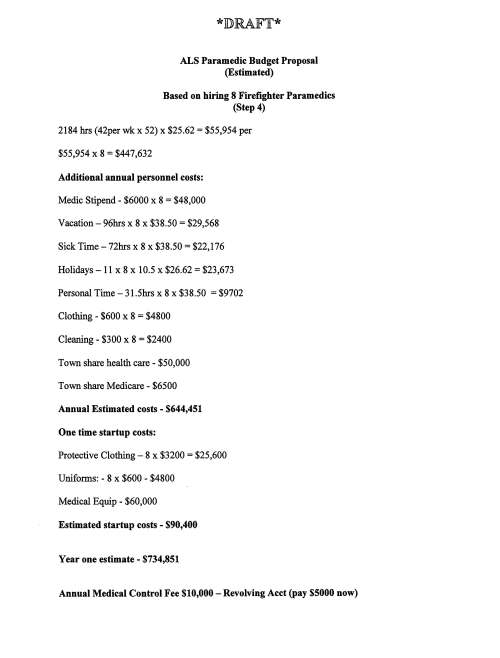
therefore that the best solution is for the town to hire eight new full time firefighter/paramedics at a cost of about $650,000 per year, plus start up costs.
Whether to hire the paramedics will be a decision for residents to make at at the annual town meeting (ATM).
Below are the Chief’s cost projections:
I suggest that these figures do not reflect the true cost to the town of the additional employees, as these estimates do not include the present value of the future retirement benefits the town will ultimately have to pay. Those retirement benefits (i.e. pension and health care) are called Other Post Employment Benefits (OPEB). To truly tell us the cost, the estimates should include the present value of the actuarial costs we incur each year to pay future retirement benefits to such employees.
The town was only recently required to figure out the value of its OPEB liability. Currently the unfunded actuarial cost for the town’s OPEB is over $40m. OPEB costs currently cost the town about $1.5m. per year, and the town only just recently (a couple of years ago) started to budget $400,000 a year to pay into a trust fund to partially cover the future OPEB as they come due. Therefore the town is still adding over $1m. a year to its OPEB liability, which is basically pushing off current town costs to be paid by future residents.
OPEB benefits to retired former town employees were until relatively recently not funded at all while those retirees were working, and even now the town is not fully funding its future OPEB liability. As we add new town employees, we may want to include the OPEB liabilities in our cost estimates.
Posted onJanuary 17, 2017|Comments Off on No town administrator evaluation tonight
Kristine Trierweiler just emailed that the Selectmen are doing the evaluation of the town administrator at our next meeting, February 7, not this evening. Sorry – my mistake.
Comments Off on No town administrator evaluation tonight
Posted onJanuary 17, 2017|Comments Off on Town administrator evaluation
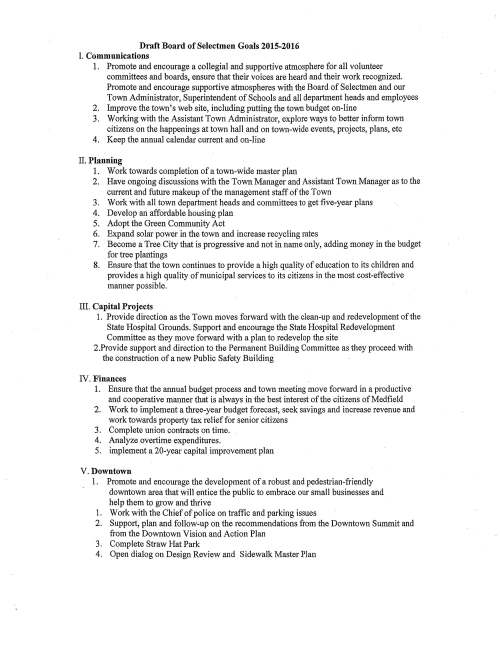
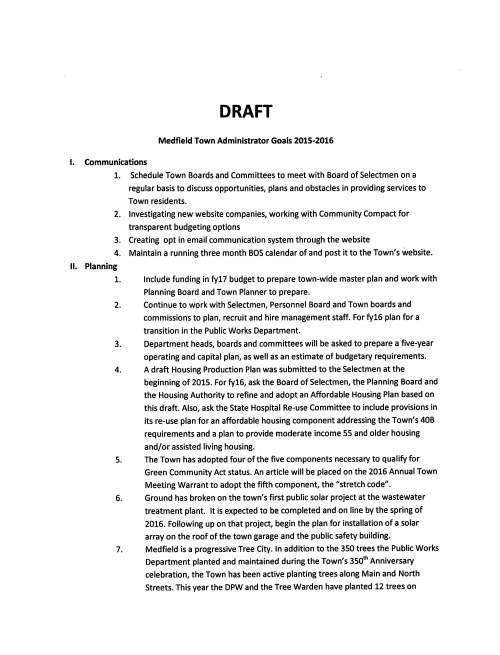
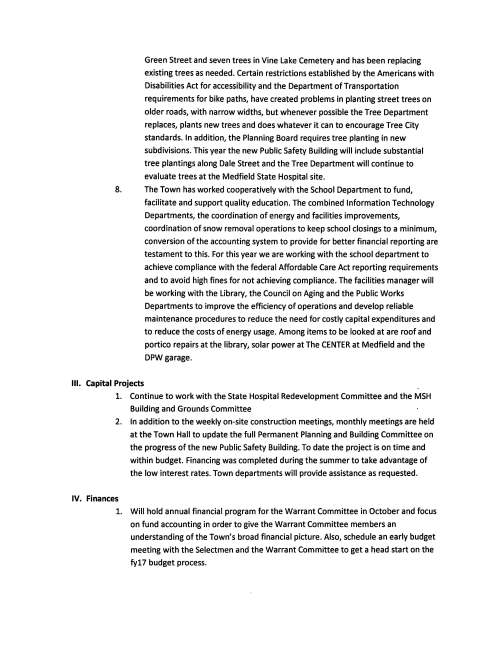
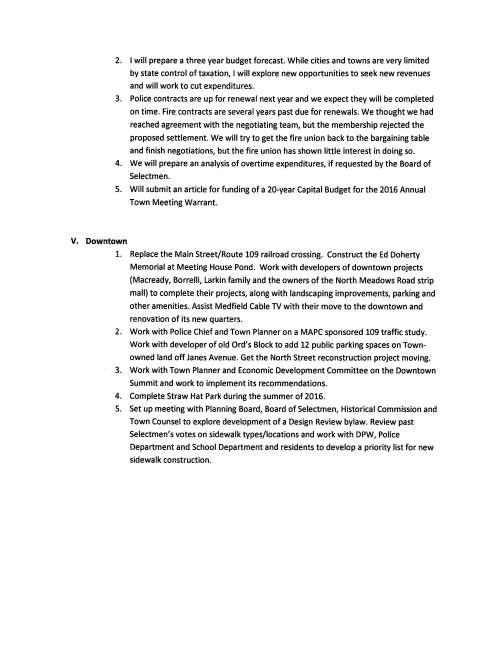
The Board of Selectmen are being asked to evaluate the town administrator tonight based on his goals and the goals of the selectmen from 2015, so I thought it might be useful for people to see what those goals were stated to be.
The selectmen prepared its goals first in October 2015, with selectman DeSorgher crafting the final combination for each of our separate inputs into the consensus document below. Then Mike drafted his goals in November 2015, which essentially track the selectmen goals.
Medfield has a few intersections that could perhaps benefit from roundabouts, and I am especially thinking of ones along Rte. 27. Click the title to see the article online.
Why is Carmel, Indiana, planning to build as many as 40 more roundabouts on top of its existing 102?
Carmel’s 100th roundabout, opened this year. (City of Carmel)
In Carmel, driving around in circles isn’t a symptom of being lost; it’s a way of life. Despite its small size, the Indiana city has more roundabouts than any other burg in the U.S. Much of that has to do with its Republican mayor, Jim Brainard, who has seemingly waged a campaign to pave all of Carmel with these traffic-calming, accident-reducing rings.
Given that Carmel installed its hundredth roundabout this November—and has since debuted two more—CityLab thought it’d be good to query Brainard about his roundabout obsession. Here’s the (slightly condensed) interview:
What initially got you interested in roundabouts?
I first encountered roundabouts during a graduate-school trip to England. I watched how efficiently traffic flowed through the intersections. Drivers were yielding to traffic and to bikes and pedestrians. No unsightly traffic signals and no long lines or congestion. It made me wonder why the U.S. had not built more roundabouts.
Will Carmel ever have enough roundabouts?
We plan to add 28 more in 2017 and 2018 and then our long-range plans also have several more. All told, we probably have another 35 to 40 roundabouts to build before we finally are finished.
What do you think is a common misconception about roundabouts?
The most common misconception is that motorists will be so confused by the rules of roundabouts that they will make mistakes and the roundabouts will become unsafe. But the facts prove otherwise. At most all times of the day, motorists simply slow down as they approach a roundabout. They look to the left, and they yield to traffic that is already in the roundabout. It is that simple.
Studies show a 90 percent reduction in fatal accidents, 80 percent reduction in accidents with serious injury, and 40 percent reduction in all accidents at these intersections when a roundabout replaces a traffic signal. When there are accidents, they are typically low impact, at an angle (rather than a deadly T-bone crash), and result in mostly minor damage.
City of Carmel
What do you think is their most unheralded benefit?
The thing most people don’t know is how much money is saved by converting traffic signals into roundabouts. Our city engineer’s office has found that on average, roundabouts in Carmel have cost $250,000 less to build than signalized intersections and they are much less expensive to maintain than signalized intersections, saving our taxpayers $5,000 per intersection per year in electricity costs.
And because we have eliminated most all of our traffic jams, we spend much less time sitting in traffic and idling our engines, which is saving about 24,000 gallons of gas per year per roundabout, based on federal highway studies, which also leads to reduced vehicular emissions and improved air quality. With 102 roundabouts and the cost of gasoline at $2 a gallon, the public is saving about $4.9 million per year.
Do you expect the Trump administration to have an impact on Carmel in terms of infrastructure, climate change, or any other issues you’ve been passionate about?
I have heard that our president-elect is planning to boost spending in infrastructure, and that is a good thing for cities across the nation. It is important that local and state governments spend their money wisely by not building sprawl that is environmentally or financially unsustainable. The funds should be spent on repairs, safety improvements, public transit, and completing existing highway grids. Many of our roundabout projects—and other projects—have benefited from federal support over the years. We have a number of projects on our long-term plans that would be excellent candidates for that.
On climate change, I am hopeful that we continue to improve our drinking water, air quality, and work toward energy independence thereby avoiding costly involvement in maintaining the Middle East oil supply. There are multiple reasons to support the reduction of fossil fuel usage that will improve our quality of life and make our country more resilient and safer.
The Medfield Energy Committee has been investigating the benefits of converting the Town’s 347 streetlights to LED technology for the past few years.
The economics are compelling. Currently, the Town pays Eversource $41,000/year for the operation and maintenance of the lights. A conversion to LED would reduce the cost of operation and maintenance to $8,300/year.
A newly announced program from the Massachusetts Department of Energy Resources (DOER) would provides a grant to take 30% off installation costs. The $105,000 total cost of installation would fall to $68,000 after factoring in utility incentives and the 30% DOER grant. The return on the investment would be 48%, a 2.1 year simple payback.
The Medfield Energy Committee supports the conversion and urges the Select Board and Town Administrator to take the steps necessary to allocate the funds to accomplish the project as soon as possible. Jerry McCarty, Director of Facilities and Maurice Goulet Director of the Department of Public Works are both in support of the project.
We recognize there is a concern about maintenance. Contacts with suppliers and municipalities are in progress to address these concerns. Also the visual impact of the change to LED may be a concern. The Town of Westwood has converted to LED so a drive east on Route 109 might answer questions about the visual impact.
There is urgency to this request as the DOER grant program was just announced and the funds may be limited. There are many interested towns, so the Energy Committee would like to see Medfield apply as early as possible.
A financial analysis of the conversion is attached.
The Medfield Energy Committee is ready to meet with the Select Board at the earliest convenient time.
To the Honorable Selectmen and residents of Medfield
The Energy Committee was chartered by the Select Board in 2008 to help the Town reduce energy consumption and reduce operating costs. We have been making steady progress on reducing energy use and supporting generation of renewable energy.
The Town of Medfield used 48,966 MM BTU of energy costing $762,000 in calendar year 2016. Partially due to a milder winter, energy usage was 24% lower and costs were 23% below 2015.
In April 2016, the Solar Array at the Medfield Waste Water Treatment Plant was completed and put on-line. Since June, the panels have generated 181,000 kilowatt-hours of electricity, saving the Town $19,000. The panels have provided about 58% of the WWTP electricity. The Solar project, approved at 2015 Town Meeting, was budgeted at $700,000, but with the continuing fall in the price of solar panels, was completed $240,000 under budget. The surplus was set aside and included in funding of $390,000 for a 155 KW solar panel installation on the Town Garage. The project, planned for 2017, was approved at the 2016 Town Meeting.
A 60KW solar panel installation on the new Public Safety Building was completed in December as a change order on the project, which is under budget. These panels are expected to generate 20% of the building electricity.
The Energy Committee has been working to qualify Medfield as a Green Community since 2011. In 2014 the adoption of the Solar By-Law accomplished the first two of the 5 elements necessary to qualify as a Green Community. In 2015, the Energy Efficient Vehicle policy was adopted. The final two elements were achieved in 2016:
The Stretch Energy Code was adopted at the April 25, 2016 Town Meeting
A plan for 20% reduction in Town energy use from a 2015 baseline was developed by the Energy Manager and the Energy Committee and was adopted by both the School Committee and the Select Board in November.
The Energy Committee completed the Green Communities application and submitted it to the Massachusetts Department of Energy Resources November 21st. The review of the application went well, and the Town is expecting to be notified of acceptance in January. At that time, the Town will receive a grant of $148,000 for energy improvement projects.
The Energy Committee said goodbye to Andrew Seaman who served as Energy Manager since 2014. Andrew saved the Town many thousands of dollars by renegotiating power contracts, completing energy improvement projects and pushing through the installation of solar panels. Jerry McCarty, the Town Facilities Director has taken on the role of Energy Manager in addition to his other duties.
Medfield was accepted into the Solarize Massachusetts Solar Challenge program in May. Solarize Medfield encouraged homeowners to install solar panels by offering lower installation costs as more installations were signed-up. New England Clean Energy was the selected vendor. At the completion of the program at the end of November, 91 homes were assessed for solar panels and 89 were considered feasible. 16 homes totaling 155.86 KW of generating capacity signed contracts for installation of solar panels. The program achieved tier 4 of 5, which provided an estimated savings of $900 per installation. The Energy Committee continues to encourage homeowners and businesses to consider installing solar panels. Return on investment for home solar generation exceeds 10%.
In 2017, the Energy Committee will be working on energy improvement projects as outlined in the Green Communities 5 year plan. Projects for 2017 will be identified to that make the most effective use of the $148,000 initial grant.
Conversion of the 347 streetlights in the Town to LEDs is under consideration. The lights are currently owned by Eversource, but they have agreed to transfer the lights to the Town for $1. With a potential DOER grant & Eversource incentives, the net installation cost of $68,000 would be paid off in 2.1 years by the $32,600 annual energy savings. A maintenance contract acceptable to the Town is currently being sought.
The Medfield Energy Committee usually meets on the second Thursday evening of the month in the Town Garage. The public is invited to attend the meetings, participate in the discussion and offer help in reducing energy consumption in the Town. Residents interested in becoming a member of the Energy Committee are encouraged to contact the Town Administrator for consideration.
I started this blog to share the interesting and useful information that I saw while doing my job as a Medfield select board member. I thought that my fellow Medfield residents would also find that information interesting and useful as well. This blog is my effort to assist in creating a system to push the information out from the Town House to residents. Let me know if you have any thoughts on how it can be done better.
For information on my other job as an attorney (personal injury, civil litigation, estate planning and administration, and real estate), please feel free to contact me at 617-969-1500 or Osler.Peterson@OslerPeterson.com.





 Medfield02052's Blog