Reposted to correct my error yesterday on the date in the headline – 10/22/25 –

Reposted to correct my error yesterday on the date in the headline – 10/22/25 –
Comments Off on Energy Com. Info Sessions on Coming Specialized Energy Code – 10/22
Posted in Uncategorized
From the Medfield Energy Committee –
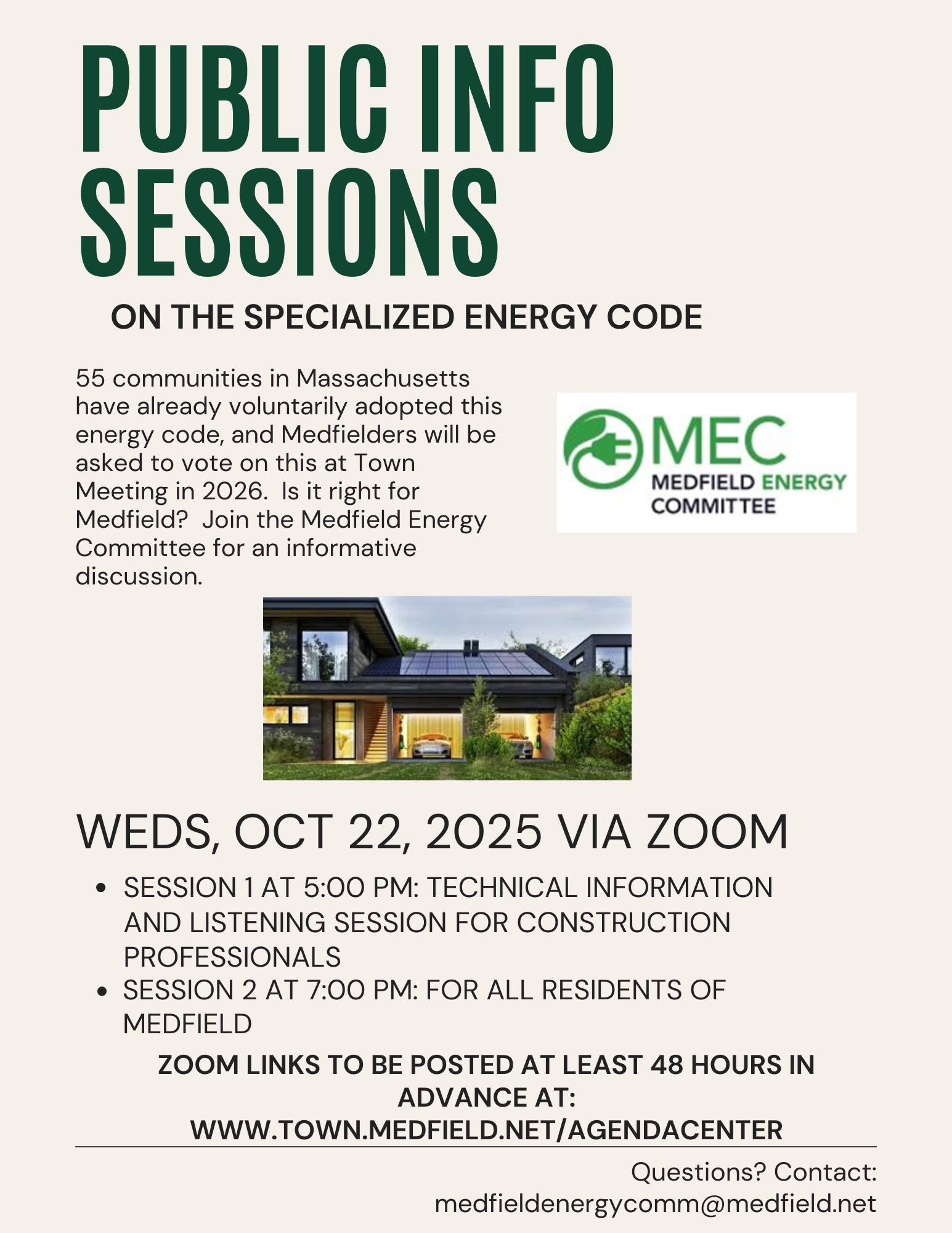
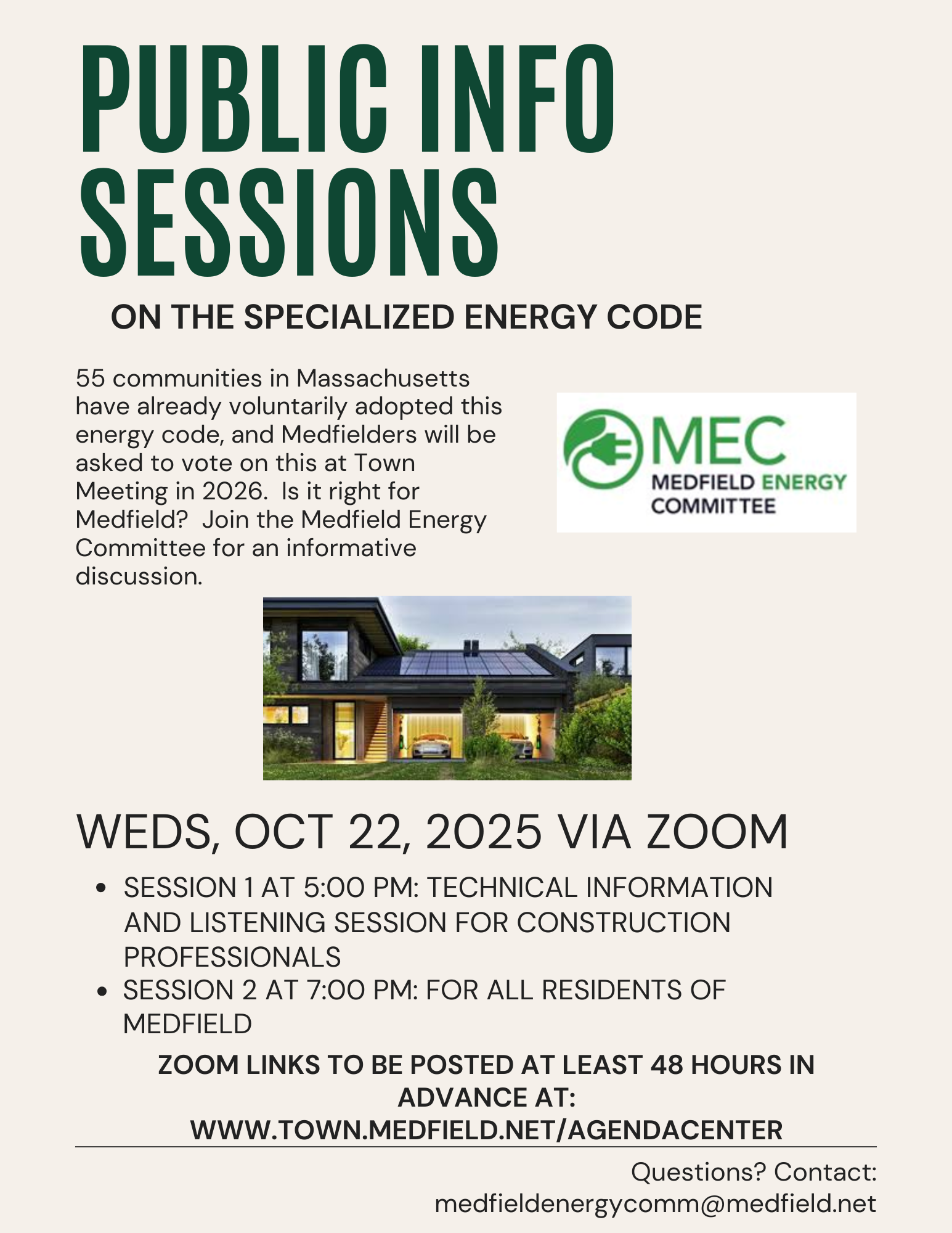
The Medfield Energy Committee will hold two public forums on Wednesday, October 22nd to discuss a new building energy code known as the Specialized Code. Medfield residents will likely be asked to vote on adoption of the Specialized Code at Town Meeting in 2026, and MEC is continuing to educate the public on this topic. Fifty-five other towns in Massachusetts have already chosen to adopt this code.
The Specialized Code requires new construction, only, to be built to increased energy efficiency standards. It is very important to note that the Specialized Code DOES NOT affect any existing homes, renovations/additions to homes, or historic homes. Under the Specialized Code, new buildings can comply by being built all-electric (meaning no oil, gas, or propane fuel is used anywhere in the home). If a new building’s design includes the use of some fossil fuels for heating, cooking, etc., this is still allowable under the Specialized Code, but the code requires that such buildings be pre-wired for future electrification, and to have on-site solar generation.
The Medfield Energy Committee supports adoption of the Specialized Code, given that it is an opportunity to ensure that new buildings in town are built to the best available energy efficiency standards. Additionally, enhanced state funding is available to towns that have adopted the Specialized Code and fulfilled other requirements, as part of the Climate Leaders Program, the next tier of the Green Communities program. Medfield has already received $666,000 in funding under the state’s Green Communities program, and would be eligible for continued and enhanced funding opportunities as a Climate Leaders community. These grants have allowed Medfield to install energy efficient upgrades in municipal buildings and schools when equipment needed replacing, leading to energy savings and reduced carbon emissions.
The forums on October 22nd will be held via Zoom, and will offer two separate sessions. Session 1, beginning at 5:00 p.m., will be geared towards construction professionals, and will include technical information and time for feedback. Session 2 will begin at 7:00 p.m. and is intended for the general public. The Zoom links for these sessions can be found at the MEC website: https://www.town.medfield.net/2308/Specialized-Code
Comments Off on Energy Com. Info Sessions on Coming Specialized Energy Code – 10/22
Posted in Buildings, Climate, Energy Committee, Environmental, Green
Tagged climate-change, environment, news, sustainability, Technology
Recently authored by Medfield Community Electricity
MCE is Medfield’s electricity supply program designed to provide Town residents and businesses with regulated (DPU and Town oversight) alternatives to Eversource’s Basic Service supply offering and offerings from third party suppliers by leveraging the town’s collective buying power. This program was approved by the Medfield Town Meeting in 2021, approved by the Department of Public Utilities in January 2024 and implemented month end in June 2024. Nearly 170 other cities and towns in Massachusetts, including Millis, Walpole and Westwood have similar programs.
Eversource renews its Basic Service contract every 6 months with probable rate change at each renewal.
3 program options: Medfield Basic, Medfield Standard, Medfield 100
| Medfield Community Electricity Program Options | ||||
| Medfield Basic (Equivalent to Eversource Basic Service) | Medfield Standard (default registration) | Medfield 100 | Eversource Basic Service- Residential | |
| Price | $0.1265/kWh | $0.13063/kWh | $0.14108/kWh | $0.14884/kWh |
| Additional Renewable Energy Content | No additional renewable energy content beyond State requirement | Adds 10% renewable energy (MA Class I RECs) beyond State requirement | Provides 100% renewable energy by adding 37% more renewable energy (MA Class I Recs) beyond what the state requires | No additional renewable energy content beyond State requirement |
| Program Duration | 30 months: June 2024 meter reads until December 2026 meter reads | 30 months: June 2024 meter reads until December 2026 meter reads | 30 months: June 2024 meter reads until December 2026 meter reads | 6 Months: August 1, 2025 – January 31, 2026 |
| Enrollment (July 2025) | 288 | 3396 | 72 | 615 |
| MCE cannot guarantee savings beyond the current (August 1, 2025 – January 31, 2026) Eversource Basic Service 6 month term rate of 14.885 cents/kWh since future 6 month term rates are unknown. 2025 State minimum renewable energy content required of electricity suppliers – 63% | ||||
The Eversource Basic Service Rate for August 1, 2025 – January 31, 2026 is included in the chart above for comparison with the MCE offerings. All MCE options will recognize more savings in the forthcoming 6 month Eversource contract period (August 1, 2025 – January 31, 2026). Eversource rates in effect during the MCE program’s first year are as follows (Note: Eversource Small Business Rates have varied slightly from the Residential Rates shown here):
| Eversource Basic Service Rates | ||||
| Term Period | June 1, 2024 – July 31, 2025 | Aug. 1, 2024 -Jan. 31, 2025 | Feb. 1, 2025 – July 31, 2025 | Aug. 1, 2025 -Jan. 31, 2026 |
| Rate ($/kWh) | 0.17216 | 0.15772 | 0.13241 | 0.14884 |
| Average Residential MCE Subscriber Savings vs Eversource Basic Service June 2024 – June 2025 meter reads* | ||
| Medfield Basic | Medfield Standard | Medfield 100 |
| $206 | $167 | $68 |
| *Most Medfield residents and businesses have a meter read on or around the 23rd of the month. Exact dates are in your Eversource bill. | ||
Small business savings over this period approximate those of residential subscribers.
To join an MCE program of choice, use the form at electricity.medfield.net or call the supplier, Direct Energy, at (866) 968-8065.
To opt-in or out or to switch plans, use the form at electricity.medfield.net or call the supplier, Direct Energy, at (866) 968-8065.
For more information about the Medfield Community Electricity program, go to electricity.medfield.net
Comments Off on Medfield Community Electricity (“MCE”) 1st Year, Midterm Report
Posted in Climate, Environmental, Town Services, Utilities
From the Globe –
By Ross CristantielloOctober 7, 2025 | 11:24 AM
Massachusetts officials launched a new online dashboard this week designed to clearly show how federal funding cuts are negatively impacting Massachusetts under the Trump administration. All told, the state has lost about $3.7 billion due to President Trump and a Congress beholden to him, according to the dashboard.
From Massachusetts state website –

Comments Off on Massachusetts losing $3.7 billion to Trump policies, per state dashboard
Posted in Budgets, Federal Government, Financial, State
Read Online  New tax provisions brings a $650M state budget hit with the shutdown adding to the woes  Sam Drysdale Sam Drysdale     |
Just three months into the new fiscal year, lawmakers learned about a new wrinkle caused by the One Big Beautiful Bill: federal tax law changes within the new law that could remove $650 million in state tax revenue supports that are holding up the $61 billion annual budget. The sweeping federal legislation, signed the same day as the state budget, could siphon hundreds of millions from Beacon Hill’s coffers, a development disclosed at an economic roundtable. The news is forcing lawmakers to rethink core assumptions and scramble for possible fiscal workarounds. Add a full-blown federal government shutdown to the mix, and the state’s economic footing looks shakier by the day. The shutdown became official on Wednesday. Federal offices closed. Economic data streams went dark. Gov. Maura Healey didn’t mince words: “It’s terrible for our country.” She blasted Congressional Republicans for “driving us over a cliff.” Roughly 45,000 federal workers who live in Massachusetts could be facing furloughs, and state officials began preliminary planning last week to keep key programs afloat while federal dollars are paused. The U.S. Department of Labor also confirmed that Friday’s national jobs report would be shelved, sidelining data that influences economic, government and business decisions. On Tuesday, Revenue Commissioner Geoffrey Snyder dropped the news about the $650 million exposure that occurs because the state is “coupled” with many federal tax provisions, creating ripple effects. “This is one of the more challenging times that we’ve faced from a fiscal perspective,” said House Ways and Means Chair Aaron Michlewitz, noting that while several options are on the table, few are ideal. Budget leaders are now weighing, at a minimum, whether to dip into reserves, revise revenue forecasts mid-year (a decision due by Oct. 15), or decouple state tax law from specific parts of the federal code. Administration and Finance Secretary Matt Gorzkowicz was blunt: “There’s a lot of uncertainty, and there’s a lot of things we have to consider in managing that.” Pressed on whether midyear budget cuts might be necessary, Gorzkowicz said simply: “I don’t know.” The state does $860 million in unallocated funds built into the budget, perhaps with some foresight of what was coming but possibly also due to the common legislative tendency to pass supplemental budgets. Sen. Michael Rodrigues, however, signaled restraint around the state’s over-$8 billion reserve fund: “We have other tools available. I’d be hard-pressed to suggest dipping into the Stabilization Fund right now.” |
Posted in Budgets, Federal Government, Financial, Legislature, State
Medfield Select Board member
I started this blog to share the interesting and useful information that I saw while doing my job as a Medfield select board member. I thought that my fellow Medfield residents would also find that information interesting and useful as well. This blog is my effort to assist in creating a system to push the information out from the Town House to residents. Let me know if you have any thoughts on how it can be done better.
For information on my other job as an attorney (personal injury, civil litigation, estate planning and administration, and real estate), please feel free to contact me at 617-969-1500 or Osler.Peterson@OslerPeterson.com.
 | Zach on Warrant Committee’s slid… |
 | Donna Knott on Reading for “Read Across… |
 | Lester Cohen on Town’s Buildings Require… |
 | Select Board member… on Black Out at Budget Works… |
| Lester Cohen on Black Out at Budget Works… |

 Medfield02052's Blog