Received today from Division of Local Services (DLS) at Massachusetts Department of Revenue. The Senate Ways and Means Committee added about $20K to the Governor and House budget version for Medfield (copy attached below) –


Received today from Division of Local Services (DLS) at Massachusetts Department of Revenue. The Senate Ways and Means Committee added about $20K to the Governor and House budget version for Medfield (copy attached below) –
Comments Off on Senate adds about $20K to Medfield’s state budget $
Posted in Budgets, Legislature, State
From Division of Local Services (DLS) –
 |
| FY2024 Preliminary Cherry Sheet Estimates On Wednesday April 12th the House Ways & Means Committee (HWM) released their version of the FY2024 budget proposal. The Division has posted updated preliminary cherry sheets on the DLS website. Click here for Preliminary Municipal Cherry Sheet Estimates or here for Preliminary Regional Cherry Sheet Estimates. Cherry sheet estimates for charter school tuition and reimbursements are based on estimated tuition rates and projected enrollments under charters previously issued by the Board of Elementary and Secondary Education. Please be advised that charter school assessments and reimbursements will change as updated tuition rates and enrollments become available. Estimates for the school choice assessments may also change significantly when updated to reflect final tuition rates and enrollments. It is important for local officials to remember that these estimates are preliminary and are subject to change as the legislative process unfolds. If you have any questions about the preliminary estimates, please contact the Data Analytics and Resources Bureau at databank@dor.state.ma.us. |
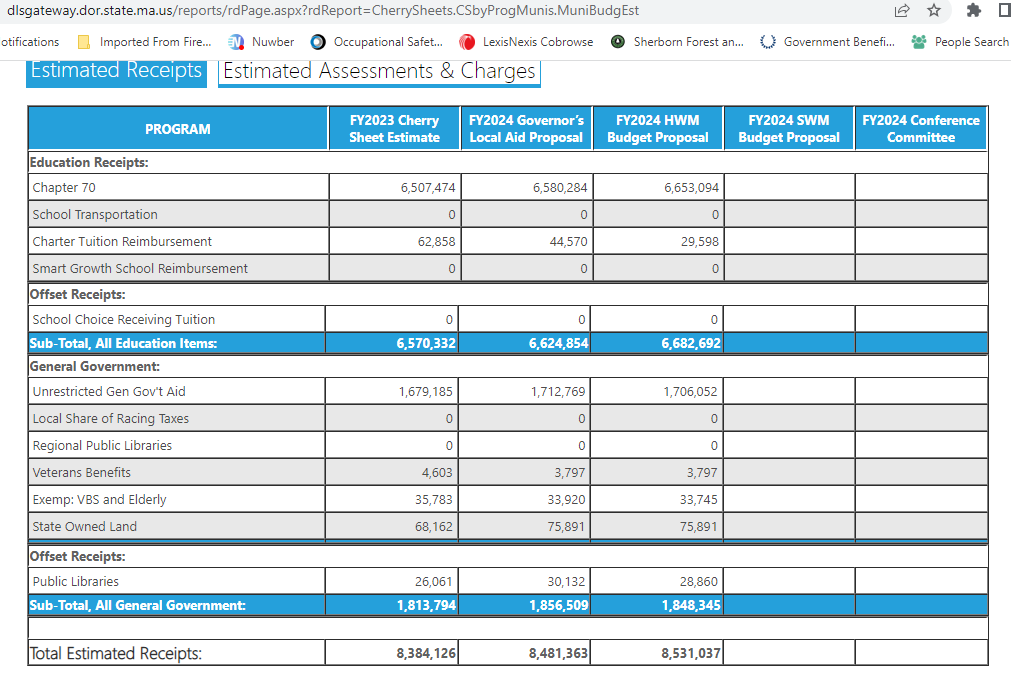
Comments Off on Initial Cherry Sheet estimates have our state $ up about $147K
Posted in Budgets, Legislature, State
From the Massachusetts Municipal Association –
View this email in your browser  Breaking News from the MMA  Gov. signs supplemental budget with pandemic-era extensions, key investments Gov. Maura Healey this afternoon signed a supplemental 2023 budget bill that includes a majority of her proposed “immediate needs” bond bill as well as extensions of pandemic-related authorizations related to public meetings and outdoor dining. The final compromise bill was enacted by the House and Senate on March 23. The new law extends to pandemic-related authorizations that were set to expire on March 31 and April 1, thereby: • Allowing remote and hybrid meeting options for public bodies through March 31, 2025 • Allowing remote and hybrid participation options for representative town meetings through March 31, 2025 • Permitting reduced quorums for open town meetings through March 31, 2025 • Extending the expedited outdoor dining permit process and allowing restaurants to offer to-go cocktails through April 1, 2024    Copyright © 2023 Massachusetts Municipal Association, All rights reserved. You are receiving this email because you opted in via our website. Our mailing address is: Massachusetts Municipal Association 3 Center Plaza Suite 610 Boston, MA 02108 Add us to your address book Want to change how you receive these emails? You can update your preferences or unsubscribe from this list. |
Comments Off on State again extends, instead of enacting, remote and hybrid meeting
Posted in Legislature, Massachusetts Municipal Association, State
From the Massachusetts Municipal Association. NB, the state budget process will likely be slower to unfold this year due to the gubernatorial change –
| View this email in your browser Breaking News from the MMA  State budget writers announce consensus revenue growth forecast of 1.6% for FY24 The state’s budget writers announced yesterday that state tax collections are expected to grow by 1.6% in fiscal 2024 over a recently adjusted projection for fiscal 2023 revenue. Administration and Finance Secretary Matthew Gorzkowicz, Senate Ways and Means Chair Michael Rodrigues and House Ways and Means Chair Aaron Michlewitz announced a consensus state tax revenue forecast of $40.41 billion for the fiscal year that will begin on July 1. The increase does not include an additional $1 billion in projected revenue from the state’s new surtax on annual incomes over $1 million, which was adopted by voters in November. Dispensing funds generated from the surtax will be subject to appropriation, but the ballot measure stipulated that funds must be spent only in areas of transportation and education. Including the surtax, estimated revenue would increase the total budget projection for fiscal 2024 by 4.1% over the adjusted fiscal 2023 revenue estimate. Copyright © 2023 Massachusetts Municipal Association, All rights reserved. You are receiving this email because you opted in via our website. Our mailing address is: Massachusetts Municipal Association 3 Center Plaza Suite 610 Boston, MA 02108 Add us to your address book Want to change how you receive these emails? You can update your preferences or unsubscribe from this list. |
Email from the Town Administrator, Kristine Trierweiler this afternoon –
Atty Gen Approved the SBC Bylaw –
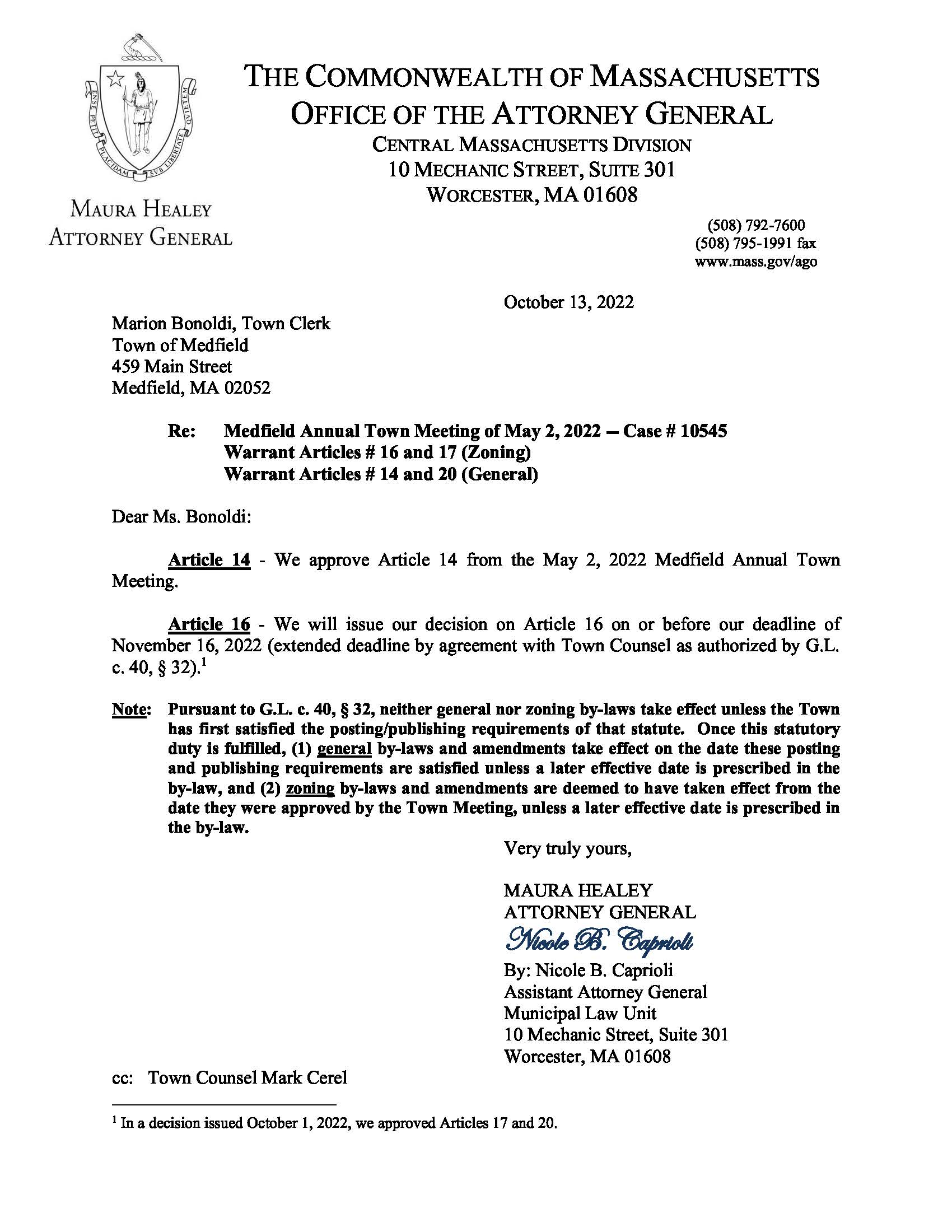
From the State House News Service today –

Comments Off on State 62F tax refunds likely to be proportional to what you paid in
Posted in State

From: Burney, Danielle (EEA)
Sent: Tuesday, August 9, 2022 3:03 PM
Subject: FOR IMMEDIATE RELEASE: Drought Conditions Worsen in CT River Valley, Southeast, and Cape Cod Regions

Drought Conditions Worsen in CT River Valley, Southeast, and Cape Cod Regions
Public is Asked to Continue to Practice Water Conservation Methods
BOSTON — Energy and Environmental Affairs (EEA) Secretary Beth Card today declared the Connecticut River Valley and Southeast Regions will join the Northeast and Central Regions as a Level 3-Critical Drought. The Cape Cod Region will elevate to a Level 2-Significant Drought, and the Islands and Western Regions will remain at a Level 1-Mild Drought. As outlined in the Massachusetts Drought Management Plan, a Level-3 Critical Drought and a Level 2-Significant Drought calls for the convening of an inter-agency Mission Group, which has already began to meet, to more closely coordinate on drought assessments, impacts, and response within the government. Additionally, a Level 1-Mild Drought recommends detailed monitoring of drought conditions, close coordination among state and federal agencies, and technical outreach and assistance to the affected municipalities.
“With the majority of the state now experiencing a Level-3-Critical Drought, it is incredibly important that we all practice water conservation and adhere to local requirements and recommendations in order avoid over stressing our water resources,” said Energy and Environmental Affairs Secretary Beth Card. “Efforts to minimize water usage now will help our water systems to rebound more quickly, and ensure that essential public health, safety and environmental needs continue to be met.”
“The continued dry, hot weather has increased drought-related hazards for much of Massachusetts including the risk for fires,” said Massachusetts Emergency Management Agency (MEMA) Acting Director Dawn Brantley. “We need the public to be especially careful during this time by adhering to local water use restrictions, and exercising caution around any outdoor activities that increase the risk of brush and forest fires such as barbecues, campfires, and safe disposal of smoking materials.”
The month of July 2022 experienced minimal precipitation and high temperatures throughout the state. Rainfall was the lowest across eastern Massachusetts, particularly within Cape Cod and Martha’s Vineyard reporting less than an inch of rain, less than 50% of normal precipitation. Within eastern Massachusetts, rainfall totals ranked within the top 15 driest Julys on record with Boston and the Blue Hills experiencing the 4th driest. However, slightly higher rainfall totals occurred across much of central and western Massachusetts, ranging from 50 to 100 percent of normal, as well as on Nantucket. Totals ranged mostly between two and four inches, while some locations in the Springfield area and southern Berkshire County experienced higher totals of four to five inches.
Additionally, the Commonwealth is also experiencing decreasing levels in some reservoirs, dry streambeds, ponding, and diminished extent of streams in many watersheds leading to lack of flow, increased turbidity, higher water temperature, and increase in growth of plants and algae in the water. Groundwater, which is a slow reacting index, is starting to be impacted in many regions. Caution is also advised as fire activity has increased across the state as drought conditions have set in, and wildfires in remote areas with delayed response are now burning deep into the organic soil layers. Drought induced fire behavior can result in suppression challenges for fire resources and result in extended incidents so residents are asked to exercise caution while working with open flames, and to completely drown all campfires out cold.
The agricultural sector continues to also experience drought impacts, such as some depletion of water sources, and production acreage and are irrigating crops on a more consistent basis due to current precipitation deficits, high temperatures, and low soil moisture. Consumers are encouraged to purchase fresh fruits, vegetables, and other products at local farm stands and retail stores throughout the Commonwealth.
The Massachusetts Water Resources Authority (MWRA) water supply system is not experiencing drought conditions, as defined within its individual plan. Private wells, local streams, wetlands, vernal pools, and other water-dependent habitats located within MWRA-serviced areas are being impacted by drought conditions while water quality in ponds can deteriorate due to lowering of levels and stagnation.
Below are recommendations for communities and individuals living and working within a Level 3 – Critical Drought, Level 2 – Significant Drought and Level 1 – Mild Drought region, including those utilizing a private well. Residents and businesses are also asked to check with their local water system in case more stringent watering restrictions are in place.
For Regions in Level 3 – Critical Drought
Residents and Businesses:
Immediate Steps for Communities:
Short- and Medium-Term Steps for Communities:
For Regions in Level 2 – Significant Drought
Residents and Businesses:
Immediate Steps for Communities:
Short- and Medium-Term Steps for Communities:
For Regions in Level 1 – Mild Drought
Residents and Businesses:
Immediate Steps for Communities:
Short- and Medium-Term Steps for Communities:
Practicing water conservation now will greatly help reduce water use to ensure essential needs, such as drinking water and fire protection, are being met, habitats have enough water to support their natural functions, and to sustain the Commonwealth’s water supplies in the long-term. State agencies will continue to monitor and assess current conditions and any associated environmental and agricultural impacts, coordinate any needed dissemination of information to the public, and help state, federal and local agencies prepare additional responses that may be needed in the future. Furthermore, the Massachusetts Department of Environmental Protection (MassDEP) will continue to provide technical assistance to communities on managing systems, including emergency connections and water supplies assistance.
“Under current drought conditions, it is critically important that all residents heed their water suppliers’ requests to cut back on nonessential water use,” said MassDEP Commissioner Martin Suuberg. “Cutting back on outdoor water use and following local conservation requirements will help sustain our water sources until precipitation rates can rebound.”
The Drought Management Task Force will meet again on Tuesday, August 23, 2022, at 10:00AM. For further information on water conservation and what residents can do, please visit EEA’s drought page and water conservation page. To get the most up-to-date information on the drought indices, go to the state’s drought dashboard page.
See the town Cherry Sheet for FY2023 here – https://dlsgateway.dor.state.ma.us/reports/rdPage.aspx?rdReport=CherrySheets.CSbyProgMunis.MuniBudgFinal
FY2022 we got $8,116,943 from the state
FY2023 we will get $8,384,126, or $267,183 more (a 3.2% increase).
This alert below came this afternoon from the Massachusetts Municipal Association –
 |
| Governor Signs FY23 Budget Supports Key Municipal Aid and School Funding And Offers Amendment to Important Retiree COLA Language Please Thank Your Legislators and Ask Them to Accept the Governor’s Amended COLA Language July 28, 2022 Dear Osler L. Peterson, This morning, Governor Baker signed a $52.7 billion budget, including each of the increases in municipal and school aid accounts for which the MMA has prioritized throughout the process. The Governor also signed 153 of 194 of the outside sections of the budget and has returned a key section with an amendment for the Legislature’s consideration. As enacted by the Legislature, Outside Section 134 would allow retirement boards that have accepted Section 103 of Chapter 32 to award a cost-of-living-adjustment of up to 5% to retirees, rather than the current limit of up to 3%. In response to concerns voiced by the MMA, specifically related to the lack of decision-making authority on a potentially large expense for municipal budgets, the Governor returned this section with amended language (for the full language, see Attachment S, Returned with Amendments, Section 134). The amended language provides that if a local or regional retirement board chooses to adopt this provision, municipalities would have the authority to accept or reject its decision. There is further clarifying language regarding situations that involve a county retirement board with more than one participating municipality. For those regional systems, 2/3rds of the participating municipalities would need to approve the higher COLA. In addition, the Governor’s amended language would provide important clarification that the potential 3-5% increase would apply only on the approved base, not the entire pension. This would eliminate some lack of clarity in the current language. The Governor’s amendments would provide critical municipal oversight for this costly provision. The provision now returns to the Legislature, which can accept the Governor’s proposed amendment, insist on its original language, or propose different language. If the Legislature insists on its own language, or proposes different language, the provision would return to the Governor, who would have 10 days to sign or veto the provision. With formal legislative sessions ending on July 31, a veto after that date would kill the provision, an outcome that is unlikely, since the Governor is likely to support a 5% COLA for state retirees. Please contact your legislators and ask them to accept the Governor’s amendments to Section 134 (via Attachment S). Please also be sure to thank your legislators again for the important and significant increases in key accounts for municipal and school funding, all of which were included in the budget signed by the Governor: $63 million (5.4%) increase in Unrestricted General Government Aid, for a total of $1.23B, which is $31.5 million more than originally proposed Nearly $6B for Chapter 70 School Aid, Including doubling the increase for minimum aid districts from $30 per pupil to $60 per pupil $440M for Special Education Circuit Breaker, an increase of $67M from FY22 $5.5M for Rural School Aid $45M for PILOT for state-owned land, a 29% increase from FY22 $20M transfer from FY22 surplus for the Community Preservation Trust Fund If you have any questions, please contact MMA Legislative Director Dave Koffman at dkoffman@mma.org or MMA Senior Legislative Analyst Jackie Lavender Bird at jlavenderbird@mma.org. Please Call Your Legislators Today to Thank Them for their Support of Key Local Accounts and Ask Them to Accept the Governor’s Proposed Language Regarding the Retiree COLA Provision Thank You!! |
    Massachusetts Municipal Association 3 Center Plaza Suite 610 Boston, MA 02108 (617) 426-7272 | Email Us | View our website Unsubscribe from MMA Legislative Alert Emails Massachusetts Municipal Association 3 Center Plaza Suite 610 Boston, MA 02108 (617) 426-7272 | Email Us | View our website Unsubscribe from MMA Legislative Alert Emails |
Email today from the Massachusetts Municipal Association –

• LEGISLATURE’S BUDGET INCREASES UNRESTRICTED GENERAL GOVERNMENT AID BY $63M (5.4%) – A WIN FOR CITIES AND TOWNS!
• INCREASES CHAPTER 70 BY $485.2M ABOVE FY22, FUNDING THE STUDENT OPPORTUNITY ACT ON ITS ORIGINAL (PRE-COVID) SCHEDULE
• DOUBLES NEW FUNDING TO MINIMUM AID DISTRICTS TO $60 PER STUDENT
• INCREASES CHARTER SCHOOL REIMBURSEMENTS BY $89.2M
• INCLUDES $441M TO FUND THE SPECIAL EDUCATION CIRCUIT BREAKER
• ADDS $10M TO PILOT, BRINGING THE PROGRAM TO $45M
• INCLUDES $5.5M FOR RURAL SCHOOL AID
• INCLUDES $82.1M FOR REGIONAL SCHOOL TRANSPORTATION
• ADDS $20M TO STATE’S COMMUNITY PRESERVATION ACT MATCH
OTHER BREAKING NEWS: REMOTE MEETING EXTENSION BILL SIGNED INTO LAW BY LT. GOV. POLITO ON SATURDAY – Cities and towns now retain the option to hold public meetings remotely through March 31, 2023, following the same guidelines that have been in place since the COVID public health emergency was first declared. With Gov. Baker out of state over the weekend, Lt. Gov. Polito (as Acting Governor) signed the bill, which took effect immediately. MMA pushed hard for this extension, and successfully advocated against attempted amendments that would have burdened communities with unfunded mandates.
July 18, 2022
Dear Osler L. Peterson,
Last night, Sunday, July 17, the fiscal 2023 state budget conference committee released H. 5050, the House-Senate compromise budget bill. The House and Senate have scheduled formal sessions for Monday, July 18, and both chambers are expected to pass the measure at that time. The Governor will then have 10 days to approve the spending appropriations and proposed law changes, veto, or return any items with amendments. That will give lawmakers several days to consider overriding any vetoes before formal sessions end on July 31.
Following months of state tax collections exceeding expectations, the $52.7 billion fiscal year 2023 state budget plan reflects an agreement between Senate and House leaders to increase tax collection estimates for fiscal year 2023 by $2.66 billion, with $1.9 billion available for the general budget after statutorily required transfers. As a result, all key local aid accounts received the higher funding levels in areas where the Senate and House needed to resolve differences.
In a major win for cities and towns, the Legislature’s budget bill increases Unrestricted General Government Aid (UGGA) by $63 million (5.4%), a major priority pushed by MMA throughout the budget deliberations. This will double the municipal aid increase originally proposed by the Governor in January. In addition, the budget would also significantly increase Chapter 70 school aid over fiscal year 2022, bringing the total to nearly $6 billion. The budget includes a $67 million increase for Special Education Circuit Breaker, an additional $89 million for Charter School Mitigation payments, and an increase of $10 million for Payments-in-Lieu-of-Taxes for state-owned land (PILOT).
You can find the Chapter 70 and UGGA amounts for your community in Section 3 of H. 5050, beginning on page 302 of the downloadable PDF (see the link below this line).
Click Here for a Link to the Legislature’s Budget
Unrestricted General Government Aid (UGGA)
In a major win for local government, the conference committee report includes $1.23 billion for Unrestricted General Government Aid (line item 1233-2350 and section 3), an increase of $63 million, or 5.4%, over the fiscal 2022 level of funding, which is double the $31.5 million increase originally proposed by the Governor in January. Increasing UGGA has been a key MMA priority throughout the process. With property taxes tightly capped by Proposition 2½, cities and towns rely on state revenue sharing to provide municipal and school services, ensure safe streets and neighborhoods, and maintain vital infrastructure. These services are fundamental to our state’s economic recovery, success and competitiveness. Unrestricted General Government Aid is the revenue sharing program that cities and towns receive to fund essential municipal services.
Chapter 70
The Legislature’s budget would fund Chapter 70 aid at nearly $6 billion, representing a commitment to fund the Student Opportunity Act (SOA) according to the original intended schedule, a solid achievement given the initial disruption caused by COVID’s economic disruption. In addition to keeping the commitment to fund the SOA, the Legislature recognized the challenges facing 135 “minimum aid” districts that would have received only a $30 per student increase over the previous year under the budget filed by the Governor in January. MMA applauds the Legislature for doubling the minimum aid increase to $60 per student.
Special Education Circuit Breaker
H. 5050 provides $441 million for Special Education Circuit Breaker (7061-0012), which reimburses school districts for the high cost of educating students with disabilities. This amount reflects an increase of $67 million over the current fiscal year. The Student Opportunity Act expanded the circuit breaker by including out-of-district transportation, to be phased in over three years. The fiscal 2023 budget reflects years two and three of the schedule in the Student Opportunity Act, achieving full funding one year ahead of schedule.
Charter School Mitigation Payments
To address charter school mitigation payments, H. 5050 includes $243 million for charter school mitigation payments (7061-9010), which represents an increase of $89.2 million over the current fiscal year. This funds the state’s statutory obligation for charter school mitigation payments as outlined in the Student Opportunity Act, pushing the state to phase in the plan by fiscal 2023, a full year ahead of schedule.
School Transportation
The Legislature’s budget level funds regional school transportation at $82.1 million, representing a reimbursement rate of 85% of DESE’s estimated costs for FY23. H. 5050 fully funds the McKinney-Vento account for transportation of homeless students at $22.9 million, and level funds out-of-district vocational transportation at $250,000.
PILOT Funding
Recognizing the importance of Payments-in-Lieu-of-Taxes (PILOT) for state-owned land, H. 5050 increases the line item to $45 million (a $10 million increase over fiscal year 2022). This has been a key priority for many years. Low PILOT funding has created a significant hardship for smaller communities with large amounts of state-owned property, and this 29% increase is very welcome news, and will provide an important boost.
Rural School Aid
Rural School Aid (7061-9813) is funded at $5.5 million in H. 5050, providing rural school assistance to eligible towns and regional school districts. These grants will help schools facing the challenge of declining enrollment to identify ways to form regional school districts or regionalize certain school services to create efficiencies.
Outside Section – Retiree COLA Provision
Section 134 of the budget would allow retirement boards that have accepted Section 103 of Chapter 32 to award a cost-of-living-adjustment of up to 5% to retirees, rather than the current limit of up to 3%. While MMA appreciates the concern driving this provision, we opposed this section due to the potential negative impact on unfunded pension liabilities. Most communities in the state participate in regional pension systems, and do not have direct decision-making authority regarding adoption of a higher COLA. Adoption of a higher COLA, even if limited to one year, would permanently increase the pension obligations for all participating communities, requiring increased annual appropriations to fund the cost. We encourage local officials to contact their retirement boards to discuss the financial implications of adopting a higher COLA for fiscal 2023.
Outside Section – Community Preservation Act
Section 174 of H. 5050 directs the comptroller to transfer $20 million of the fiscal year 2022 budget surplus to the Massachusetts Community Preservation Trust Fund. This provision would increase the state’s match from an estimated 35% to 43%, approximately the same state match percentage as fiscal year 2022. The number of CPA communities has reached 187, and this budget item will benefit cities and towns that have adopted higher local property taxes to address environmental and housing challenges.
THE LEGISLATURE’S BUDGET IS GOOD NEWS FOR CITIES AND TOWNS
Please call your Representatives and Senators and thank them for the important and much-appreciated municipal and school investments that are included in the Legislature’s budget bill. This has been a tumultuous time for state and municipal finances, and the Legislature is advancing a spending plan that invests in communities, which is much appreciated.
If you have any questions or need additional information on any municipal aid priority, please contact MMA Senior Legislative Analyst Jackie Lavender Bird at 617-426-7272 ext. 123 or jlavenderbird@mma.org.
Massachusetts Municipal Association
3 Center Plaza
Suite 610
Boston, MA 02108
(617) 426-7272 | Email Us | View our website
Unsubscribe from MMA Legislative Alert Emails
Comments Off on MMA on state budget – more for Medfield
Posted in Budgets, Financial, Legislature, State
From the Massachusetts Municipal Association today –
|
| Legislature Passes Remote Meeting Extension Through March 31, 2023 On Thursday afternoon, the House and Senate passed legislation (S. 3007) extending key pandemic-era accommodations, including remote meeting authorizations, to March 31, 2023. Once the Governor signs the bill, cities and towns will retain the option to hold public meetings remotely, following the same guidelines that have been in place since the COVID public health emergency was first declared in March of 2020. Back in May, a remote meeting extension was included in the final FY23 Senate Budget as an outside section, but this language was advanced by the Senate as a standalone bill last week with the July 15th expiration approaching and the final budget still tied up in negotiations. The House later passed its own version of the bill, including language that would have created a permanent mandate for remote access to all public meetings aside from those in executive session, with a provision requiring remote participation by the public if public participation is allowed or required at the meeting. This would have gone into effect on April 1, 2023. The MMA worked with our members and stakeholders across the Commonwealth to make it clear to the Legislature that despite the good intentions behind H. 4991, such an unfunded mandate would have presented unworkable financial, technological, logistical, and practical challenges for cities and towns. The MMA is pleased the Legislature took these concerns very seriously and removed this unfunded mandate from the bill, extending current remote meeting options through March 31st of next year. The MMA will continue to push for a permanent solution that gives municipalities the necessary flexibility and funding they will need to expand participation and engagement through remote and hybrid meetings. The bill is now on the Governor’s desk awaiting action, and will go into effect immediately once signed. Communities with public meetings scheduled today or early next week are encouraged to consult with their municipal legal counsel on the best course of action. Please thank your Representatives and Senators for extending the remote meeting options, and for recognizing the challenges that would have been created with an unworkable mandate. |
| Massachusetts Municipal Association 3 Center Plaza Suite 610 Boston, MA 02108 (617) 426-7272 | Email Us | View our website Unsubscribe from MMA Legislative Alert Emails |
Comments Off on Zoom municipal meeting to continue
Posted in Legislature, Massachusetts Municipal Association, State
Medfield Select Board member
I started this blog to share the interesting and useful information that I saw while doing my job as a Medfield select board member. I thought that my fellow Medfield residents would also find that information interesting and useful as well. This blog is my effort to assist in creating a system to push the information out from the Town House to residents. Let me know if you have any thoughts on how it can be done better.
For information on my other job as an attorney (personal injury, civil litigation, estate planning and administration, and real estate), please feel free to contact me at 617-969-1500 or Osler.Peterson@OslerPeterson.com.
 | Zach on Warrant Committee’s slid… |
 | Donna Knott on Reading for “Read Across… |
 | Lester Cohen on Town’s Buildings Require… |
 | Select Board member… on Black Out at Budget Works… |
| Lester Cohen on Black Out at Budget Works… |


 Medfield02052's Blog