Category Archives: State

MMA to Senate on budget

MMA

This was my email this afternoon to Senator Timilty to support the MMA’s analysis of where the state budget discussions that are happening this week in the State Senate should lead:


Jim,

As a Town of Medfield selectman, I ask that you support the Massachusetts Municipal Association’s stated interests in the budget discussions.  Thanks in advance.  I have copied in below the MMA’s stated interests:


Monday May 23, 2016

SENATORS SET TO DEBATE FISCAL 2017 BUDGET

DEBATE WILL BEGIN ON TUESDAY, MAY 24

1,167 AMENDMENTS FILED

PLEASE CALL YOUR SENATORS TODAY TO SUPPORT KEY FUNDING

ASK YOUR SENATORS TO OPPOSE AMENDMENT 91, WHICH WOULD TO LIMIT MUNICIPAL AUTHORITY ON RETIREE HEALTH INSURANCE

Beginning on Tuesday, May 24, the Senate will debate the Senate Ways & Means Committee’s proposed fiscal 2017 state budget plan. With 1,167 amendments filed, it is critically important for you to call your Senators now to discuss key budget and funding issues that will impact your community.

S. 4, the Senate Ways & Means budget, provides progress on many important local aid priorities, including the full $42 million increase in Unrestricted General Government Aid that the Governor and House have agreed on. The SW&M Committee would increase funding for several major aid programs, by adding $9.3 million to the Special Education Circuit Breaker, increasing Chapter 70 minimum aid to $55 per student, and by adding funds in the Chapter 70 distribution to help address the low-income student calculation and to accelerate implementation of the so-called target share provisions in Chapter 70.

However, the proposed Senate budget would also cut nearly 90% from kindergarten development grants, cutting $16.6 million from key kindergarten grant assistance that goes to 164 cities, towns and school districts. There are several amendments to restore these funds.

Another issue is the need to defeat a harmful amendment (Amendment #91), which would interfere with local officials’ decision-making authority to act on behalf of taxpayers on the basic issue of contribution levels for retiree health insurance. Amendment 91 would extend a state-mandated freeze on adjusting retiree health contributions in any community that has used the municipal health insurance reform law to implement health insurance savings measures. Details on this issue are available in the MMA’s budget letter to Senators – just click on the link below.


PLEASE CLICK HERE TO SEE THE MMA’S DETAILED LETTER TO SENATORS ON ALL OF THE KEY BUDGET AMENDMENTS, AND PLEASE CALL YOUR SENATORS TODAY TO DISCUSS THE ISSUES THAT IMPACT YOUR COMMUNITY


There are many budget amendments to discuss with your Senators, including:

• Increasing Chapter 70 minimum aid up to $100 per student;

• Restoring $16.6 million to Kindergarten Development Grants;

• Increasing funding for Charter School Reimbursements;

• Creating a reserve account to help with extraordinary Special Education Costs;

• Increasing reimbursements for the McKinney-Vento unfunded mandate;

• Increasing reimbursements for Regional School Transportation and Out-of-District Vocational School Transportation;

• Opposing Amendment 91, which would interfere with local decisions on retiree health insurance;

• Adding a municipal seat on the State Retiree Benefits Trust Fund;

• Increasing funding for the Shannon Anti-Gang grant program;

• Increasing funding for the Safe and Successful Youth Initiative;

• Increasing funding for Summer Jobs for At-Risk Youth;

• Banning “Pay the Patient” in ambulance insurance payments;

• Supporting Chapter 40S payments for communities with Smart Growth Districts;

• Adding funds for Brownfield redevelopments;

• Allowing communities to levy fines for delays in removing double poles; and

• Increasing the state match for the CPA program.


Please Call Your Senators Today Discuss the Key Budget Issues that Impact Your Community

Click the Link Above to Read the MMA’s Detailed Letter to Senators

THANK YOU

Senate’s Medfield amendments in budget

State-House-smaller_1 (1)

John Nunnari follows the legislature closely for the architects, and kindly also keeps the town administration informed about happenings that affect Medfield.  This from John this morning about:

  • funding to repair the West Street bridge
  • funding a road to the Charles River overlook on the state land next to the former MSH site
  • north south railroad line in town

See below for all amendments filed to the Senate budget dealing directly with Medfield.


Debate begins tomorrow.


John


Amendment #116

West Street Bridge in Medfield and Millis

Mr. Ross moved that the proposed new text be amended, in Section 2, in item 1599-0026, by adding at the end thereof the following:- “provided that not less than $1,000,000 shall be expended for the maintenance of the West Street Bridge in the towns of Medfield and Millis”; and in said item, by striking out the figures “$5,000,000” and inserting in place thereof the figures “$6,000,000”


Amendment #883

Accessibility to Open Space

Mr. Timilty moved that the proposed new text be amended, in Section 2, in item 2810-0100, by inserting the following:- “provided further, that not less than $200,000 shall be expended for the creation of a roadway at the property formally known as the Medfield State Hospital in the town of Medfield.”


Amendment #1154

Framingham Secondary Line

Mr. Timilty moved that the proposed new text be amended by adding at the end thereof the following new section:-

SECTION X. No funds shall be disbursed to the Massachusetts Bay Transportation Authority under section 35T of chapter 10 of the General Laws for the extension of services on the Framingham Secondary line in the towns of Framingham, Sherborn, Medfield, Walpole, Foxborough, and Mansfield including, but not limited to, for the addition of new line service through the creation of a new line, extension of a current line or increasing the service area of a current line until the authority receives legislative approval for a plan, specifically detailing:

(i) how the authority will pay for the proposed expansion

(ii) certification that such expansion and diversion of funding will not adversely affect existing services already offered by the authority and

(iii) certification that the state of the Framingham Secondary line’s real property, including but not limited to the physical track, at-grade crossings, and safety features to protect abutters, have been upgraded, repaired, or replaced to meet any increase in service

The plan shall be submitted to the clerks of the senate and house of representatives, the joint committee on transportation and the chairs of the senate and house committees on ways and means


John Nunnari, Assoc AIA
Executive Director, AIA MA

MMA on Senate budget

MMA

Tuesday, May 17, 2016

SENATE BUDGET COMMITTEE OFFERS $39.5B FY 2017 STATE BUDGET THAT MAKES KEY INVESTMENTS IN MUNICIPAL AND SCHOOL AID

• INCLUDES THE FULL $42M INCREASE IN UNRESTRICTED MUNICIPAL AID (UGGA)

• INCREASES CHAPTER 70 BY $44M ABOVE THE GOVERNOR’S BUDGET TO PROVIDE MINIMUM AID OF $55 PER STUDENT, INCREASE TARGET SHARE FUNDING, AND HELP ADDRESS THE LOW-INCOME STUDENT FACTOR

• ADDS $9.3M TO FULLY FUND THE SPECIAL EDUCATION CIRCUIT BREAKER

• LEVEL-FUNDS MOST OTHER MUNICIPAL AND SCHOOL ACCOUNTS

• BUT THE SW&M BUDGET CUTS $16.6M FROM KINDERGARTEN DEVELOPMENT GRANTS, WHICH WOULD CREATE SHORTFALLS IN 164 SCHOOL DISTRICTS

Earlier today, the Senate Ways and Means Committee reported out a tight $39.5 billion fiscal 2017 state budget plan to increase overall state expenditures by approximately 3.5 percent. The Senate Ways and Means budget is slightly smaller than the budget passed by the House in April and the version filed by the Governor in March, yet it would offer the largest increase in Chapter 70 aid. The full Senate will debate the fiscal 2017 state budget beginning on Tuesday, May 24.

S. 4, the Senate Ways & Means budget, provides strong progress on many important local aid priorities, including the full $42 million increase in Unrestricted General Government Aid that the Governor and House have agreed on. The SW&M Committee would increase funding for several major aid programs, by adding $9.3 million to the Special Education Circuit Breaker, increasing Chapter 70 minimum aid to $55 per student, and by adding funds in the Chapter 70 distribution to help address the low-income student calculation (the House budget has a separate $10 million reserve account for this issue), and to accelerate implementation of the so-called target share provisions in Chapter 70.

PLEASE CLICK HERE TO SEE YOUR COMMUNITY’S LOCAL AID AND PRELIMINARY CHERRY SHEET NUMBERS IN THE SENATE WAYS & MEANS BUDGET, AS ESTIMATED BY THE DIVISION OF LOCAL SERVICES

$42 MILLION INCREASE IN UNRESTRICTED MUNICIPAL AID

In a major victory for cities and towns, S. 4 (the SW&M fiscal 2017 budget plan) would provide $1.021 billion for UGGA, a $42 million increase over current funding – the same increase proposed by Governor Baker and the House of Representatives. The $42 million would increase UGGA funding by 4.3 percent, which matches the growth in state tax collections next year. This would be the largest increase in discretionary municipal aid in nearly a decade. Every city and town would see their UGGA funding increase by 4.3 percent.

CHAPTER 70 MINIMUM AID WOULD INCREASE TO $55 PER STUDENT

The Senate budget committee is proposing a $116 million increase in Chapter 70 education aid above fiscal 2016 levels, providing every city, town and school district with an increase of at least $55 per student. In addition to the minimum aid increase, which matches the House-passed level, the SW&M Committee would add additional funds to aid communities impacted by changes in the calculations used to account for low-income students. (The House included a $10 million reserve account for this issue instead of incorporating the funds into the Chapter 70 distribution). Further, the SW&M budget would accelerate the implementation of the 2007 target share provisions (the Senate proposal is to fund 85% of the target share goal, compared to the House’s 70% funding level). Overall, the SW&M budget would provide $44 million more in direct Chapter 70 distributions than the Governor’s budget, and $20 million more than the House (or $10 million more after recognizing the House’s $10 million reserve for low-income students).

$9.3 MILLION INCREASE INTENDED TO FULLY FUND SPECIAL EDUCATION CIRCUIT BREAKER

In another victory for cities and towns, Senate leaders have announced that they support full funding for the Special Education Circuit Breaker program. Their budget plan would provide $281.1 million, a $9.3 million increase above fiscal 2016, with the intention of fully funding the account. The Governor level funded the circuit-breaker program, and the House provided a $5 million increase. This is a vital program that every city, town and school district relies on to fund state-mandated services.

BUT THE SW&M BUDGET WOULD CUT $16.6 MILLION FROM KINDERGARTEN DEVELOPMENT GRANTS, AN 89% REDUCTION THAT WOULD HIT 164 DISTRICTS

In a troubling development, S. 4 would cut $16.6 million from Kindergarten Development Grants, leaving only $2 million in this program that funds Kindergarten programs in 164 school districts. The Governor and House level-funded the program at $18.6 million. Restoring these funds will be a major priority during the budget debate, and local officials will want to talk with their Senators about this program right away. Please click here to see if your community is receiving these grants in fiscal 2016. These funds are in jeopardy if the S. 4 appropriation remains in place.

FUNDING FOR CHARTER SCHOOL REIMBURSEMENTS INCREASED BY $7 MILLION, BUT STILL UNDERFUNDED

Under state law, cities and towns that host or send students to charter schools are entitled to be reimbursed for a portion of their lost Chapter 70 aid. The state fully funded the reimbursement program in fiscal years 2013 and 2014, but is underfunding reimbursements by approximately $46.5 million this year. The Senate Ways and Means budget would increase funding for charter school reimbursements to $87.5 million, a $7 million boost. This is $2 million more than the House proposed and $15 million less than the amount recommended by Gov. Baker. The program is underfunded in all three budget proposals, and increasing this account will be a top priority during the Senate budget debate.

REGIONAL SCHOOL TRANSPORTATION, PAYMENTS-IN-LIEU-OF-TAXES (PILOT), LIBRARY AID ACCOUNTS, METCO, McKINNEY-VENTO, AND SHANNON ANTI-GANG GRANTS

The Senate budget committee’s proposal would level-fund Regional School Transportation Reimbursements at $59 million ($1 million less than the House budget), level fund PILOT payments at $26.77 million (the same as the House and Governor), level-fund METCO at $20.1 million, and level-fund McKinney-Vento reimbursements at $8.35 million. S. 4 would fund library grant programs at $18.9 million ($70K less than fiscal 2016 and $750K less than the House). The SW&M budget would reduce Shannon Anti-Gang Grants to $5 million (a $2 million reduction below fiscal 2016, and $1 million below the House).

Please Call Your Senators Today to Thank Them for the Strong Municipal Aid and Chapter 70 Investments in the Senate Ways and Means Committee Budget, Including the $42 Million Increase in Unrestricted Local Aid, Providing Chapter 70 Minimum Aid at $55 Per Student, and Full Funding for the Special Education Circuit Breaker

Please Let Your Senators Know if You Are Affected by Underfunding in Charter School Reimbursements and Kindergarten Development Grants

Please Explain How the Senate Ways and Means Budget Impacts Your Community, and Ask Your Senators to Build on this Progress During Budget Debate in the Senate

$200K more in FY17 state aide proposed

State-House-smaller_1 (1)

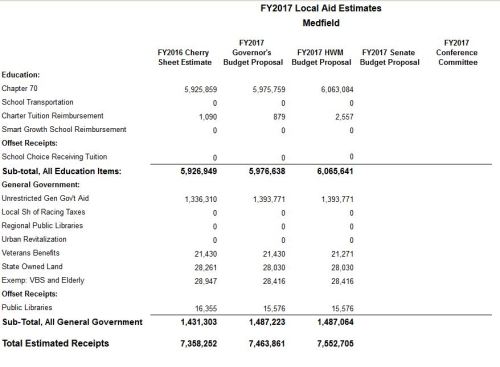
The Senate budget numbers for FY17 are now out, and they are the same as the House numbers.  We are looking at about a $200K increase over last year.  John Nunnari provided the following proposed state funding for Medfield numbers.


Just in case you hadn’t seen it, the Senate budget came out today.

Here is where Medfield stands in terms of Chapter 70 allocations.

john


Municipality/Regional District 7061-0008 Chapter 70 Unrestricted General Government Aid Annual Formula Local Aide
FY ’15 Actual Appropriation $5,862,409.00 $1,289,875.00 $0.00
FY ’16 Actual Appropriation $5,925,859.00 $1,336,310.00
Governors FY ’17 Proposal $5,975,759.00 $1,393,771.00 $0.00
Medfield (House FY ’17 Proposed Numbers) $6,063,084.00 $1,393,771.00 $0.00
Medfield (Senate FY 17 Proposed Numbers) $6,063,084.00 $1,393,771.00 $0.00
FY ’17 Conference Committee Report           July +/- $0.00 $0.00 $0.00


John Nunnari, Assoc AIA
Executive Director, AIA MA

Medfield state budget earmarks out

State-House-smaller_1 (1)

I spoke with Representative Shawn Dooley at the ribbon cutting this morning for the Waste Water Treatment Plant’s solar PV installation, about the two earmarks he included in the House version of the state budget for Medfield

  • $15,000 to the Medfield Fire Department for the purchase of an automatic chest compression device,and
  • $1m. towards repair of West Street bridge over the Charles River

and learned that both had effectively been defeated.  They are still there, just without any money assigned to them.  It is possible the Senate could fund them, but not likely.

This email today from Medfield’s man at the legislature, John Nunnari, with the excruciating details about how the legislature does things –


An update on the proposed amendments noted below.


For consideration, the amendments were respectively wrapped into Consolidated Amendments “H” and “I”.


In order to speed up the process of considering amendments, leadership bundled most of the 1307 amendments into nine categories; Education and Local Aid; Constitutional Officers, State Administration, and Transportation; Energy and Environmental Affairs; Social Services and Veterans; Housing, Mental Health and Disability Services; Public Health; Health and Human Services and Elder Affairs; Public Safety and Judiciary; Labor and Economic Development


Amendment 306 was bundled into Consolidated Amendments “H” – Public Safety and Judiciary and Amendment 310 was bundled into Consolidated Amendments “I” – Labor and Economic Development.


While both consolidated amendments did pass today, through a parliamentary procedure designed to shield members votes, Amendments 306 (and 166 other amendments included in “H”) and 310 (and 178 other amendment included in “I”) did not pass.


I’m sorry to say that the money proposed via these amendment will not be forthcoming.


John


From: John Nunnari
Sent: Tuesday, April 19, 2016 4:46 PM
Subject: State Budget – Medfield Amendments


Two amendments filed to the House budget and up for consideration during next weeks debate.

john


AmdID Amd# Sponsor Sponsor Title Amending DEP Description InstaTrac Summary Amount Requested Increase Earmark HFY16 Comment
2017H0306 306 Shawn Dooley Medfield Fire Department Purchase 8324-0000 DFS Department of Fire Services Administration Earmarks $15,000 to the Medfield Fire Department for the purchase of an automatic chest compression device and/or associated materials, and increases the item by the same amount. $20,799,781 $20,814,781 $15,000 $15,000 2016H0486 Amendment #486 in FY16, this item was excluded from a bundle in last year’s budget.
2017H0310 310 Shawn Dooley Maintenance of the West Street Bridge in the towns of Medfield and Millis 1599-0026 ANF Municipal Regionalization and Efficiencies Incentive Reserve Earmarks $1,000,000 for the maintenance of the West Street Bridge in the towns of Medfield and Millis, and increases the item by the same amount. $5,240,000 $6,240,000 $1,000,000 $1,000,000


Medfield earmarks proposed

State-House-smaller_1 (1)

Per an email from John Nunnari, Representative Shawn Dooley is asking for monies for Medfield in the state budget

  • to repair the West Street bridge to Millis, and
  • for a chest compressor for the MFD

Two amendments filed to the House budget and up for consideration during next weeks debate.

john


AmdID Amd# Sponsor Sponsor Title Amending DEP Description InstaTrac Summary Amount Requested Increase Earmark HFY16 Comment
2017H0306 306 Shawn Dooley Medfield Fire Department Purchase 8324-0000 DFS Department of Fire Services Administration Earmarks $15,000 to the Medfield Fire Department for the purchase of an automatic chest compression device and/or associated materials, and increases the item by the same amount. $20,799,781 $20,814,781 $15,000 $15,000 2016H0486 Amendment #486 in FY16, this item was excluded from a bundle in last year’s budget.
2017H0310 310 Shawn Dooley Maintenance of the West Street Bridge in the towns of Medfield and Millis 1599-0026 ANF Municipal Regionalization and Efficiencies Incentive Reserve Earmarks $1,000,000 for the maintenance of the West Street Bridge in the towns of Medfield and Millis, and increases the item by the same amount. $5,240,000 $6,240,000 $1,000,000 $1,000,000


John Nunnari, Assoc AIA
Executive Director, AIA MA

House budget #s

The House released its proposed budget numbers, and we do about $200,000 better than last year with their proposal.  The Governor gave us about $100,000 more than last year.  Usually our numbers do not go down, and the Senate which weighs in last often increases our total state aid.   The Governor did revenue sharing by increasing part of our state aid by the same 4.3% that the state’s revenues increased, and the House extends that 4.3% increase to more state aid items. I am not sure why our Charter Tuition Reimbursement has gone up so much on a percentage basis.

20160414-house budget

Below is the report and instant analysis from the MMA yesterday afternoon on the state budget as it affects municipalities.


Wednesday, April 13, 2016

HOUSE BUDGET COMMITTEE OFFERS $39.5B FY 2017 STATE BUDGET THAT MAKES KEY INVESTMENTS IN MUNICIPAL AND SCHOOL AID
• INCLUDES THE FULL $42M INCREASE IN UNRESTRICTED MUNICIPAL AID (UGGA)
• INCREASES CHAPTER 70 BY $24M TO FUND MINIMUM AID AT $55 PER STUDENT
•ADDS A $10M RESERVE TO AID COMMUNITIES WITH LOW-INCOME STUDENTS
• ADDS $5M TO FUND THE SPECIAL EDUCATION CIRCUIT BREAKER
• ADDS $1M MORE FOR REGIONAL SCHOOL TRANSPORTATION
• LEVEL-FUNDS MOST OTHER MUNICIPAL AND SCHOOL ACCOUNTS

Earlier this afternoon, the House Ways and Means Committee reported out a lean $39.5 billion fiscal 2017 state budget plan to increase overall state expenditures by 3.3 percent. The House Ways and Means budget is $76 million smaller than the budget filed by the Governor in March, yet it also increases Chapter 70 aid by $24 million above the Governor’s recommendation by increasing minimum aid from $20 per student to $55 per student, and also includes a new $10 million reserve to aid communities impacted by changes in the calculations used to account for low-income students. The full House will debate the fiscal 2017 state budget during the week of April 25.

H. 4200, the House Ways and Means budget, provides strong progress on many important local aid priorities, including the full $42 million increase in Unrestricted General Government Aid that the Governor proposed and communities are counting on. The House W&M Committee would increase funding for several major aid programs, by adding $5 million to the Special Education Circuit Breaker, adding $1 million to Regional School Transportation, and increasing Chapter 70 minimum aid to $55 per student.

PLEASE CLICK HERE TO SEE YOUR COMMUNITY’S LOCAL AID AND PRELIMINARY CHERRY SHEET NUMBERS IN THE HOUSE WAYS & MEANS BUDGET, AS ESTIMATED BY THE DIVISION OF LOCAL SERVICES

$42 MILLION INCREASE IN UNRESTRICTED MUNICIPAL AID
In a major victory for cities and towns, H. 4200 (the HW&M fiscal 2017 budget plan) would provide $1.021 billion for UGGA, a $42 million increase over current funding – the same increase proposed by Governor Baker. The $42 million would increase UGGA funding by 4.3 percent, which matches the growth in state tax collections next year. This would be the largest increase in discretionary municipal aid in nearly a decade. Every city and town would see their UGGA funding increase by 4.3 percent.

CHAPTER 70 MINIMUM AID WOULD INCREASE TO $55 PER STUDENT
The House budget committee is proposing a $95.8 million increase in Chapter 70 education aid, with a provision providing every city, town and school district an increase of at least $55 per student. This is $24 million more than the recommendation in the Governor’s budget submission. The budget would continue to implement the target share provisions enacted in 2007. Because most cities and towns only receive minimum aid, this increase would benefit the vast majority of communities.

FUNDS A $10M RESERVE TO AID COMMUNITIES WITH LOW-INCOME STUDENTS
The House Ways & Means budget also includes a new $10 million reserve to aid communities impacted by changes in the calculations used to account for low-income students. This would supplement Chapter 70 distributions to address shortfalls in aid levels due to the new methodology used to count low-income students. DESE would administer this program, and make funding decisions by October 2016.

$5 MILLION INCREASE INTENDED TO FULLY FUND SPECIAL EDUCATION CIRCUIT BREAKER
In another victory for cities and towns, House leaders have announced that they support full funding for the Special Education Circuit Breaker program. Their budget plan would provide $276.7 million, a $5 million increase above fiscal 2016, with the intention of fully funding the account. This is a vital program that every city, town and school district relies on to fund state-mandated services.

ADDS $1 MILLION TO REGIONAL SCHOOL TRANSPORTATION
House Ways and Means Committee budget would add $1 million to bring regional transportation reimbursements up to $60 million. The MMA will work to continue building on this welcome increase.

FUNDING FOR CHARTER SCHOOL REIMBURSEMENTS INCREASED BY $5 MILLION, BUT STILL UNDERFUNDED
Under state law, cities and towns that host or send students to charter schools are entitled to be reimbursed for a portion of their lost Chapter 70 aid. The state fully funded the reimbursement program in fiscal years 2013 and 2014, but is underfunding reimbursements by approximately $46.5 million this year. The House Ways and Means budget would increase funding for charter school reimbursements to $85.5 million, a $5 million boost, although this is $15 million less than the amount recommended by Gov. Baker. The program is underfunded in both budget proposals, and increasing this account will be a top priority during the budget debate.

PAYMENTS-IN-LIEU-OF-TAXES (PILOT), LIBRARY AID ACCOUNTS, METCO, McKINNEY-VENTO, AND SHANNON ANTI-GANG GRANTS
The House budget committee’s proposal would level-fund PILOT payments at $26.77 million, continue to fund library grant programs at $18.83 million, level-fund METCO $20.1 million, and level-fund McKinney-Vento reimbursements at $8.35 million. All four of these accounts are funded the same in both the Governor’s and House Ways and Means Committee’s budgets. However, the HW&M budget would reduce Shannon Anti-Gang Grants to $5 million, a $2 million reduction.

Please Call Your Representatives Today to Thank Them for the Strong Local Aid Investments in the House Ways and Means Committee Budget – Including the $42 Million Increase in Unrestricted Local Aid, Providing Chapter 70 Minimum Aid at $55 Per Student, Funding the Special Education Circuit Breaker, and Adding Funds to Regional School Transportation

Please Explain How the House Ways and Means Budget Impacts Your Community, and Ask Your Representatives to Build on this Progress During Budget Debate in the House

Thank You!

Solarize Medfield! – town chosen

Marie Zack Nolan lead the Medfield Energy Committee effort for Medfield to be named to the one of the few Solarize Mass slots.

doer

State Energy Officials Announce New Communities to Join Solar Program

Media Inquiries

Katie Gronendyke (DOER) (617) 626-1129  katie.gronendyke@state.ma.us
Matt Kakley (MassCEC) (617) 315-9339 mkakley@masscec.com

Program Will Lower Costs of Installing Solar Electric Systems for Bolton and Medfield
Mar 17, 2016 –
Boston

State energy officials today announced the selection of two additional communities, Bolton and Medfield, to participate in Solarize Mass for 2016.  The community-based solar energy group-buying program is currently underway in Somerville, Natick and Shelburne, Colrain and Conway, with the latter three communities participating as a group.

“As Massachusetts looks to diversify its energy mix, partnering with local communities on programs like Solarize Mass drives down costs while reducing our carbon footprint and helping reach our goal of 1,600 megawatts of solar by 2020,” said Energy and Environmental Affairs Secretary Matthew Beaton.

A partnership between the Massachusetts Clean Energy Center (MassCEC), the Department of Energy Resources (DOER) and local communities, Solarize Mass reduces the overall cost of solar in communities across the state, helping residents save as much as 20 percent on solar pricing (compared to the statewide average).  Through a competitive bidding process, communities select designated Solarize Mass installers that feature the most attractive pricing, outreach and community education packages.

“Reducing the cost of solar makes the technology more affordable for homeowners across the state and DOER is proud to partner with these communities on this initiative,” said DOER Commissioner Judith Judson.

“Solar electricity provides environmental and economic benefits for homeowners and our communities,” said MassCEC Interim CEO Stephen Pike. “Solarize Mass makes solar electricity even more affordable and accessible for residents in cities and towns across the Commonwealth.”

Since its launch in 2011, 51 cities and towns have participated in Solarize Mass, which has led to the contracting of more than 2,600 new small-scale installations at homes and businesses resulting in 18 megawatts of contracted solar capacity. To date, systems installed under Solarize Mass have reduced greenhouse gas emissions equivalent to removing 1,500 cars off the road annually.

Massachusetts currently has 1,058 megawatts of solar capacity installed statewide, more than halfway to the Commonwealth’s goal of 1,600 megawatts installed by 2020 and enough to power more than 161,000 homes. MassCEC and DOER are currently accepting applications from communities interested in participating in the 2016 round of the Solarize Mass program. More information on the application process can be found here.

“I want to congratulate the town of Bolton on their participation with Solarize Mass,” said State Senator Jennifer Flanagan (D-Leominster). “Clean energy solutions are certainly starting to lead the way, and programs such as Solarize Mass are the perfect opportunity for communities to not only benefit from the cost effectiveness of solar, but to also get excited about clean energy in general.”

“The Town of Medfield has once again shown their commitment to forward-thinking cost-saving efforts for their citizens,” said State Senator Jim Timilty (D-Walpole). “There were many proposals for the Solarize Mass project submitted and I am thrilled that MassCEC and DOER saw fit to bring this important state program to my district.”

“I am proud to see that the Town of Bolton will be participating in the next round of Solarize Mass,” said State Representative Kate Hogan (D-Stow). “Our region has long been committed to clean energy solutions and Bolton’s participation in this program will further increase local solar power opportunities. Thank you to all of the stakeholders, volunteers, and committed citizens who worked together to achieve this goal.”

“The Town of Medfield is a leader in its commitment to provide choice and opportunity to residents seeking a variety of energy sources,” said State Representative Denise Garlick (D-Needham). “This initiative aids the homeowner and also strengthens the Commonwealth’s environment and economic development through employment opportunities.”

“Medfield is excited to be selected for the next Solarize Mass program,” said Andrew Seaman, Energy and Facilities Manager for the Town of Medfield. “The Town has made great strides towards diversifying their electric supply by developing solar on Town land, and we are happy to have a similar initiative in place for residents to add solar to their property.”

“Bolton is delighted to be recognized as a Solarize Massachusetts community by MassCEC and DOER,” said Tony Jagodnik, Bolton’s volunteer solar coach. “We look forward to increasing education, awareness, conservation, and local adoption of solar via a best-quality and value group purchase for our homes and businesses, while reducing greenhouse gas emissions and making the grid more-robust for everyone.”

– See more at: http://www.masscec.com/about-masscec/news/state-energy-officials-announce-new-communities-join-solar-program#sthash.Q1dxGSjV.dpuf

http://www.masscec.com/about-masscec/news/state-energy-officials-announce-new-communities-join-solar-program doerdoer

House budget

This analysis from the Mass. Municipal Assoc. this afternoon of the budget we can expect soon out of the House, and what we should want it to contain.  The $100/children education funding versus the $20/student the Governor proposes is the biggest one for me.

MMA-2

 
Wednesday, March 16, 2016

HOUSE BUDGET COMMITTEE PREPARING FISCAL 2017 STATE BUDGET

UGGA, CHAPTER 70, AND KEY MUNI & ED ACCOUNTS AT STAKE

PLEASE CALL YOUR REPRESENTATIVES TODAY AND SECURE THEIR PLEDGE TO SUPPORT THE $42 MILLION INCREASE IN UNRESTRICTED MUNICIPAL AID, HIGHER CH. 70 MINIMUM AID, AND FULL FUNDING FOR KEY EDUCATION AND MUNICIPAL REIMBURSEMENTS AND GRANTS

The House and Senate budget committees have wrapped up public hearings on the fiscal 2017 state budget and are now drafting detailed spending plans that reflect the priorities of each branch. We know from our meetings with legislators that many of you have met with your legislators on local priorities for the many municipal and school aid accounts in the state budget.

With the House Ways & Means Committee’s version of the budget scheduled for release on April 13, it is imperative that you call your legislative delegation to highlight the importance of key local aid accounts before final decisions are made.

On February 29, MMA officers and other local officials testified on the many municipal and school aid accounts that the MMA tracks and supports. Please click here to see MMA’s detailed testimony. Please ask your Representatives to talk to the House Ways & Means Committee and ask that they support the main statewide priority accounts and your own local priorities.

UNRESTRICTED GENERAL GOVERNMENT AID (UGGA)
This is a top priority. Ask your legislators to support the $42 million increase in the Unrestricted General Government Aid (UGGA) account included in H. 2, the fiscal budget recommendation submitted by the Governor in January. The UGGA account is currently funded at $979.8 million, and the 4.3 percent increase in H. 2 would simply track the growth in state tax revenues forecast for next year.

CHAPTER 70 SCHOOL AID
The Governor’s budget recommendation provides a far-too-small 1.6% increase in Chapter 70 school aid, which is much to low. Please ask your legislators to support funding increases for two key aspects of the Chapter 70 calculation for fiscal 2017. The first increase is to ensure adequate funding for the current basic school aid framework. The second is to begin implementation of the Foundation Budget Review Commission’s recommendations to correct outdated and obsolete aspects of the foundation budget framework.

MINIMUM AID SHOULD BE $100 PER STUDENT. Please support an increase in the “minimum aid” amount to $100 per student, instead of the $20-per-student amount in the Governor’s budget. This is an important way to offset the low inflation factor used to adjust foundation budget components for fiscal 2017 and to help correct the impact of the change in how low-income students are counted. We are also asking legislators to review how low-income students should be counted and added into the formula.

FLAWS IN THE CHAPTER 70 FORMULA SHOULD BE FIXED. Second, please ask your legislators to support the implementation of the Foundation Budget Review Commission’s recommendations to update the Chapter 70 “foundation budget” minimum spending standards for special education and health insurance costs for school employees, and to add to the spending standard a measure of recognition for the cost of services for low-income, English Language Learner (ELL) and other students who would benefit from more intensive services. The Chapter 70 framework is clearly outdated and inadequate, and the Commission’s recommendations would address the major shortcomings in the formula.

REIMBURSEMENTS FOR SCHOOL AID LOSSES RELATED TO CHARTER SCHOOLS
Please ask your Representatives to support full funding of the state’s legal commitment to reimburse school districts for the loss of a portion of their Chapter 70 aid that is redirected to fund charter schools. This is a growing financial burden on cities and towns that is becoming more acute as the state grants more charters and existing charter schools expand. The shortfall in charter school reimbursements is crippling funding for schools in scores of cities, towns and school districts.

SPECIAL EDUCATION “CIRCUIT BREAKER”
Please ask your Representatives to support full funding of the Special Education “Circuit Breaker” Program, through which the state provides a measure of support for services provided to high-cost special education students. H. 2 would level-fund the Special Education Circuit Breaker program at $272 million. This means that the Governor’s budget likely underfunds reimbursements by approximately $10 million.
PLEASE CALL YOUR REPRESENTATIVES TODAY TO SUPPORT THESE FOUR MAJOR MUNICIPAL AND SCHOOL AID ACCOUNTS, AND DISCUSS OTHER LOCAL PRIORITIES

THANK YOU!


Massachusetts Municipal Association
One Winthrop Square, Boston, MA 02110
(617) 426-7272
All contents copyright 2015, Massachusetts Municipal Association

Unsubscribe from MMA Legislative Alerts.

Community Compact

Below are two communications from the state about our new community compact with them.  The state did budget some monies to go along with this effort of theirs, so we are getting a $30,000 grant towards the $80,000 cost to create a 20 year capital improvement plan, with the remainder coming from a town meeting budget item.

community compart-2

March 4, 2016


Richard DeSorgher

Chair, Board of Selectmen

Town of Medfield


Dear Mr. DeSorgher:


Congratulations on entering into a Community Compact with the Baker-Polito Administration. Community Compacts create clear mutual standards, expectations, and accountability for both the state and municipalities as together we seek to create better government for our citizens.


We are excited to partner with Medfield as you implement your chosen best practices:


Financial Management/Capital Improvement Plan: The community develops and documents a multi-year capital plan that reflects a community’s needs, is reviewed annually and fits within a financing plan that reflects the community’s ability to pay.


  • Next Steps: The Commonwealth will provide Medfield with a Community Compact grant to hire a consultant to help with the development of a long-range comprehensive capital improvement plan. Pam Kocher from my office will be in touch regarding the grant process.


Technology – Transparency: There is a documented open data strategy including timelines for making municipal spending and budget information accessible from the city or town website in a machine readable and graphical format.


  • Next Steps: MassIT’s Office of Municipal and School Technology will provide technical assistance to support the Town’s initiative to increase transparency by presenting financial data on the Town’s website. Your contact is Michael Hamel (hamel@mass.gov), Director of the Office of Municipal and School Technology.


Technology – Citizen Engagement: There is a documented citizen engagement strategy for deployment of technology solutions, including a public communication strategy and a professional development strategy to ensure that internal resources can effectively engage with users via technology.


  • Next Steps: The Commonwealth’s MassIT Office of Municipal and School Technology will work with Medfield to develop policies and procedures that will allow the Town to effectively communicate out to the public, and a strategy to make public input a part of town culture. Michael Hamel is the contact for this best practice, too.


Sincerely,

Sean Cronin

Senior Deputy Commissioner of Local Services


cc: Pam Kocher, Director of Special Initiatives, Division of Local Services

Michael Hamel, Director of the Office of Municipal and School Technology


Dear Mr. DeSorgher:


Congratulations on entering into a Community Compact with the Baker-Polito Administration. Community Compacts create clear mutual standards, expectations and accountability for both the state and municipalities as together we seek to create better government for our citizens.


We are excited to partner with Medfield as you implement your chosen best practices. Please see the attached letter from Sean Cronin.


Our commitments include a Community Compact grant to hire a consultant to help with the development of a long-range comprehensive capital improvement plan.  We have budgeted up to $30,000 for this grant.  Please gather some cost information to help us determine the final grant amount and email it to me.


Here’s more detail about the grant process:


You will have until June 30, 2017 to complete the project.

The grant funds will be paid to the community in two installments:

75% of the total upon execution of the state grant contract;

25% of the total upon completion of the project and upon submission to the Division of Local  Services of a report certifying completion of the project and identifying how the results are being used (as opposed to just sitting on a shelf somewhere).

We can get the grant contract process started as soon as you provide some key information:

After we confirm the grant amount, you will be asked to provide a scope of work, a budget and a project timeline for this project.  (It’s fine if this is a couple paragraphs and not the multi-page detailed document a consultant might prepare as scope of work and agreement with them.) Please email this information to me.

Once I receive this information, I will prepare a state contract and grant agreement package for you to sign and return to me.  The contract will then be signed by the state and a payment of 75% of the grant amount will be made to your account.

Let me know if you have any questions about the grant process.


Regards,


Pam


Pam Kocher

Director of Special Initiatives

Division of Local Services

Commonwealth of Massachusetts

PO Box 9569

Boston, MA 02114