DOR is providing us these local aid figures for Medfield based on the Governor’s budget proposal (NB, the sum appears to be incorrect on the assessments):
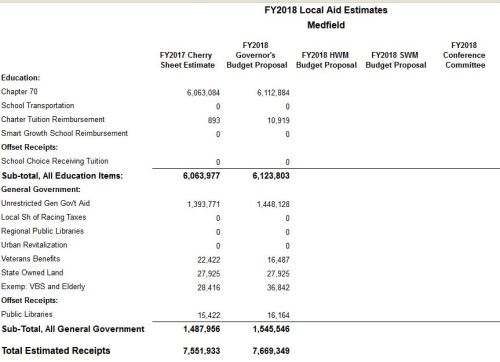
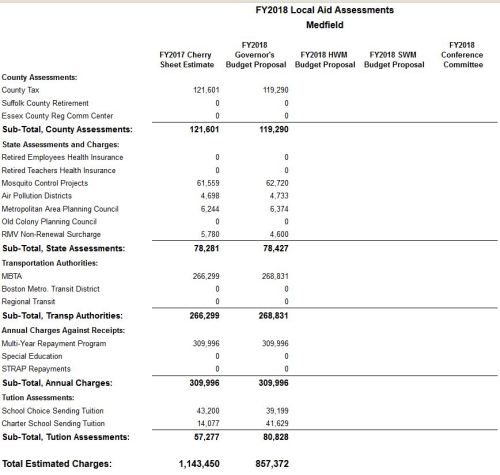

DOR is providing us these local aid figures for Medfield based on the Governor’s budget proposal (NB, the sum appears to be incorrect on the assessments):
Comments Off on First state local aid
Posted in Budgets, Financial, State, Uncategorized
The state budget starts with the Governor’s proposal, moves on to the House’s proposal, to the Senate’s proposal, and then finally a House-Senate reconciliation committee to iron out the differences. The Governor has just filed his proposed budget, and he is keeping to his plan to have municipal aid track the percentage revenue increases. The analysis of the Governor’s proposed budget that follows was provided to me by the Massachusetts Municipal Association.

|
Comments Off on State budget
Posted in Budgets, Financial, State, Uncategorized
November 30, 2016


His Excellency Charles D. Baker
Governor of the Commonwealth
State House, Boston
The Hon. Robert A. DeLeo
Speaker of the House
State House, Boston
The Hon. Stanley C. Rosenberg
Senate President
State House, Boston
Dear Governor Baker, Speaker DeLeo, and President Rosenberg,
With the passage of Question 4, Massachusetts became one of just eight states that have legalized the recreational use of marijuana. Because of our population and our prime location in the center of a compact geographic region, our state will soon become the commercial marijuana industry’s East Coast base. The growing industry will certainly use Massachusetts as the retail platform for Rhode Island, Connecticut, New York, Vermont and New Hampshire.
Cities and towns have a responsibility to ensure that the new law is implemented locally in a manner that protects the public interest, including addressing public health and public safety concerns, and ensuring that the roll-out does not negatively impact residents, other businesses, neighborhoods, economic development plans, or other important considerations. As such, municipal officials are scrambling to get information and plan their own policy responses. This will be very difficult in the short term, as there are many unanswered questions and many significant flaws in the new law.
It is important to recognize that Question 4 prevailed and the issue of whether to legalize the recreational use of marijuana has been settled. Yet it is also clear that the new law has several significant drafting flaws that require fixing in order to prevent negative outcomes. Just as the Legislature and governor acted in 1981 to amend Proposition 2½ to make it workable, we believe it is both appropriate and necessary for state lawmakers to take action to address the shortcomings in Question 4. Doing so would benefit the public interest and every community.
While there are many smaller details that warrant attention, the major problems that must be fixed are: 1) deadlines that are too short to give state and local officials enough time to prepare for and administer the law; 2) the preemption and loss of local control; 3) the unregulated “home grow” provisions that could foster a new black market for marijuana sales; and 4) the inadequate tax revenues written into the statute.
An Unrealistic Timeline
Question 4 sets an unrealistic deadline, instructing the state to construct the entire regulatory framework for the commercial marijuana industry by January 1, 2018. That is too little time to recruit and appoint a first-ever, three-person Cannabis Control Commission (CCC) and give the rookie commissioners the time to build a brand-new state agency, recruit and hire agency staff, draft initial versions of all regulations, solicit input from all stakeholders, promulgate final regulations, and provide enough lead-time for a rational roll-out that protects the public interest. If the state fails to meet the January 1 deadline, the industry has written Question 4 in such a way that the commercial industry would arise in a mostly unregulated environment, because medical marijuana operators would automatically be licensed as commercial agents for recreational marijuana, giving them a near-monopoly in the marketplace.
We respectfully ask you to act swiftly to extend these deadlines and give the state and municipalities more time to get the regulatory framework in place and adopt reasonable rules to govern this new commercial industry.
In the meantime, we request passage of statutory authority to allow cities and towns to enact a moratorium on new commercial marijuana facilities until the Cannabis Control Commission has promulgated regulations governing the industry. Because the deadline for regulations comes after the CCC is instructed to begin processing applications and licenses for commercial facilities, local governments will begin to see applications for commercial facilities before they know the full extent of the regulations under which those facilities will be operating.
Unwise Preemption of Local Control
A second major concern is the preemption of local control. The new law prevents cities and towns from making local decisions on whether to allow commercial retail sales in their municipalities. Here it is clear that the marijuana industry lobbyists learned a lesson from Colorado, the first state to legalize recreational use. The Colorado law allows local governing bodies to ban retail sales in their communities – and 70 percent of their cities and towns have enacted such a ban. Question 4 makes it impossible for selectmen, mayors, councils or town meetings to make this decision. Instead, communities are only allowed to enact a ban if 10 percent of local residents who voted in the last state election sign a petition to place a question on the ballot, and voters approve the question at a state general election in 2018 or later. This means the earliest that communities can even consider a ban will be nearly a year after commercial sales become legal – it is hard to imagine that this industry-friendly loophole was unintentional.
Further, Question 4 includes language that would allow the CCC to preempt or disallow any local zoning rule, ordinance or regulation that is inconsistent with their wishes – a concern made even more serious because the “advisory board” in the law is actually a pro-industry panel dominated by commercial marijuana interests.
We respectfully ask you to act swiftly to restore decision-making authority to municipal governing bodies on the question of commercial bans, and clarify that the CCC cannot override local zoning decisions and ordinances on the location and operation of locally permitted commercial facilities, including recreational marijuana. The broad preemption language must be eliminated.
An Unregulated Non-Commercial Market
Starting on December 15, the home cultivation of marijuana will be allowed through a totally unregulated “home grow” provision, which will allow individuals to cultivate up to 12 plants at any one time. Calculating the street value, that’s $60,000 worth of marijuana, and based on reasonable processing estimates, the 12 plants could yield approximately 12,000 joints, or thousands of “servings” of marijuana-infused edibles.
Local and state law enforcement officials are gravely concerned about the home grow language in the new law. The sheer volume of home grown marijuana will certainly incentivize a burgeoning black market that will hit the street at least a year before official, regulated commercial sales become lawful, creating a source of sales that could easily reach school-aged children and teenagers.
We respectfully ask you to delay the home grow provisions, and develop a structure to appropriately regulate and monitor this activity to safeguard public safety and health, and protect neighborhoods, residents and youth.
Inadequate Revenues
Another major concern is the rock-bottom excise revenue that would be generated by Question 4, where it is again clear that the marijuana industry learned a lesson from earlier experiences in Colorado and Washington state. In addition to state sales taxes, the Colorado law imposes a 25 percent tax on marijuana, and cities and towns can enact their own local sales taxes of up to 8 percent. The state of Washington imposes a 37 percent excise tax, and cities and towns can collect their own local sales tax of up to 3.4 percent.
Here in Massachusetts, the commercial interests behind Question 4 set the state marijuana excise tax at just 3.75 percent, and capped the local-option marijuana excise tax at only 2 percent. These would be the lowest rates in the nation.
Given the significant new burden of regulating and monitoring a new commercial industry (which will deal in a controlled substance that is still illegal under federal law), the state and local revenue rates are unreasonably low and damaging to public budgets. The state excise will clearly fall short, and we urge you to increase the state tax so that, at a minimum, resources will be available to provide statewide training of police officers and fund the CCC and other state agency needs. Further, cities and towns will have new responsibilities in areas of public safety, public health, zoning, permitting and licensing. At 2 percent, the local revenue in Question 4 will fall far short of local needs.
We respectfully ask you to increase the allowable state and local tax rates to bring them in line with Colorado and Washington and other “first-wave” legalization states. We recommend that cities and towns be authorized to implement, on a local-option basis, an excise of between 2 to 6 percent, to be determined by vote of the local governing body.
An Independent Advisory Board is Necessary
We urge you to improve the makeup of the Cannabis Advisory Board to make it a truly independent entity, instead of the industry-dominated panel that it is under Question 4. It is striking that the ballot question was written to give commercial marijuana interests control of a board that will be so heavily involved in regulating the industry. We respectfully ask that a municipal representative be added to the board, as well as a representative from municipal police chiefs and a seat representing local boards of health. We believe the addition of these perspectives is vital to ensure that local public safety and health concerns are considered when crafting the regulations.
Summary
Cities and towns have a responsibility to implement the new law in a manner that protects the public interest, yet communities will not be able to fulfill this responsibility unless the significant flaws detailed in this letter are addressed. Just as the Legislature and governor acted in 1981 to amend Proposition 2½ to make it workable, we respectfully ask the Commonwealth to take action to address the shortcomings in Question 4. Doing so would benefit the public interest and every community.
Thank you very much for your consideration. If you have any questions or wish to receive additional information, please do not hesitate to have your offices contact me or MMA Legislative Director John Robertson at (617) 426-7272 at any time.
Sincerely,
Geoffrey C. Beckwith
MMA Executive Director & CEO
Comments Off on MMA on marijuana law problems
Posted in Legal, Marijuana, State, Uncategorized
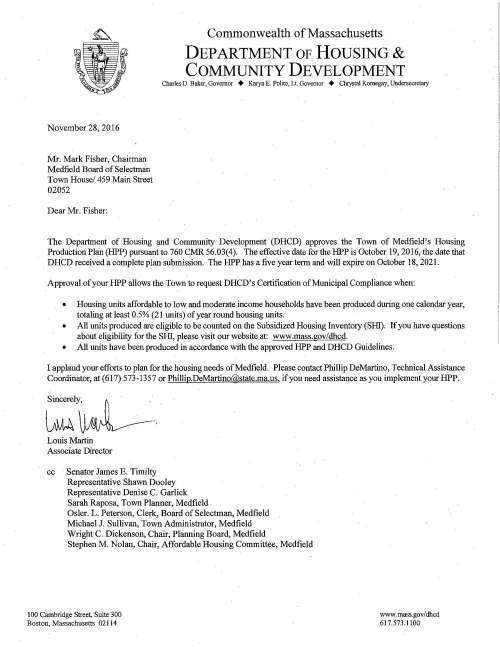
When the Department of Housing and Community Development(DHCD) approved the Town’s Housing Production Plan this past month, it incorrectly stated the effective date in it approval. Today the DHCD corrected that error with a new letter (copy attached below) noting the correct date.
Comments Off on DHCD corrects HPP date
Posted in Affordable housing / 40B, State

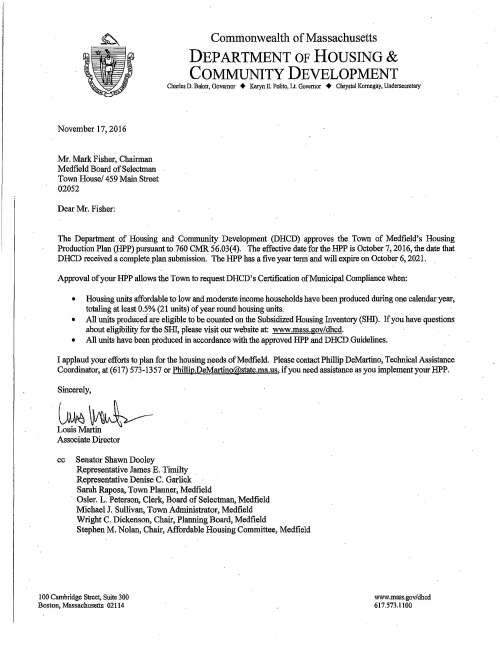
Step #1 completed: The Town of Medfield today received the letter below from the Department of Housing and Community Development (DHCD) announcing that our Housing Production Plan had been approved.
Also attached are the two letters from our Representatives, Denise Garlick and Shawn Dooley to DHCD and MassHousing citing issues with respect to the Dale Street 40B proposal.
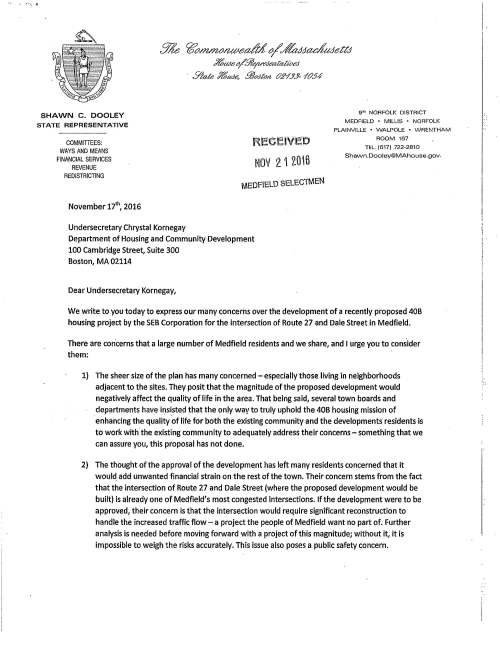
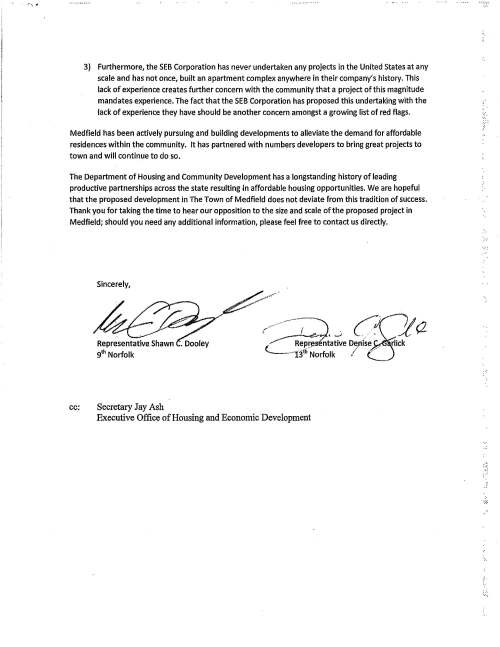
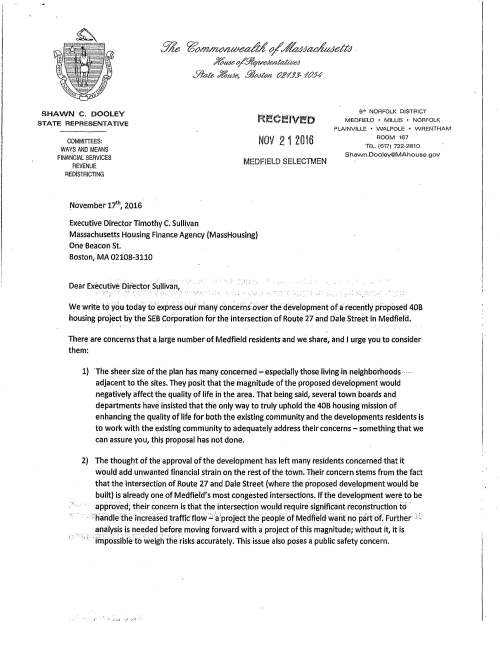
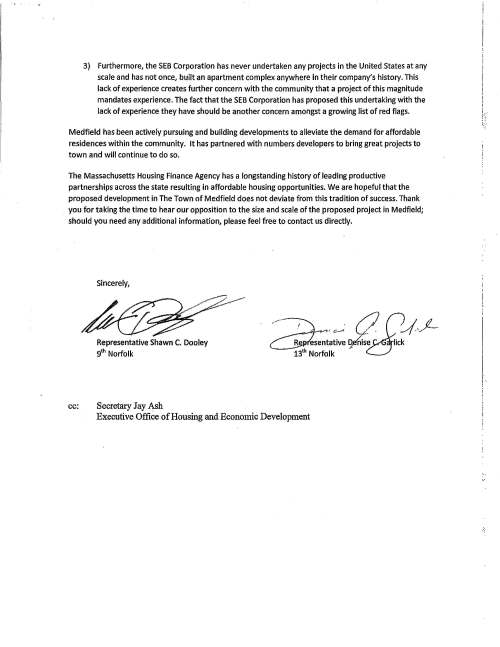
Comments Off on HHP approved by DHCD
Posted in Affordable housing / 40B, State

Today the Town of Medfield completed its submissions to DOER to qualify as a green community under the state’s Green Communities Act, as per the attached email from the town’s consultant at the Metropolitan Area Planning Council (MAPC) – interestingly, our main MAPC consultant is in Morocco this moment at a conference. There was a last minute flurry of activity to locate all the required town actions.
11/21/2016 3:34PM
Green Communities Application Complete and Submitted: Medfield
MEC
akrishnan@mapc.org
fbunger@verizon.net; aseaman@medfield.net; msullivan@medfield.net; ktrierweiler@medfield.net; eclarke@medfield.net; mlafrancesca@email.medfield.net; osler.peterson@verizon.net, ATeferra@mapc.org,
===========================================================
All of the required documents for Medfield’s Green Communities application have
been submitted through DOER’s online portal. We have received confirmation from
DOER that they have marked Medfield’s application ‘Complete’. Congratulations to
everyone involved!
DOER will follow up with MAPC directly during the review process if there are
items that require further clarification. Axum is back in the office tomorrow
(11/22). Please do not hesitate to follow up with either of us if you have any
questions regarding the process moving forward.
Regards,
Ani
Ani Krishnan
Interim Manager of Clean Energy
Metropolitan Area Planning Council
60 Temple Place, Boston, MA 02111
617-933-0715 | akrishnan@mapc.org
Please be advised that the Massachusetts Secretary of State considers e-mail
to be a public record, and therefore subject to the Massachusetts Public Records
Law, M.G.L. c. 66 § 10.
Posted in Energy Committee, State, Uncategorized

This from Mike Sullivan this afternoon –
Date: Thu, Nov 10, 2016 at 3:50 PM
Subject: FOR IMMEDIATE RELEASE: Historic Drought Conditions Continue for Commonwealth, Cape and Islands Downgraded to Drought Advisory
To: Michael Sullivan <msullivan@medfield.net>
For your situational awareness, the Massachusetts Emergency Management Agency is sharing this press release from the Executive Office of Environmental Affairs about the continuing drought in the Commonwealth and the updated Drought Warnings and Advisory that have been issued for regions of the state. Despite the above-average precipitation in October for four of the state’s six regions, the drought conditions are not easing.
Sincerely,
Kurt Schwartz
Director
Massachusetts Emergency Management Agency
400 Worcester Road
Framingham, MA 01702
508-820-2010 (Office)
508-820-2000 (24/7 Communications Center)
617-590-3360 (Cell)
[cid:image001.jpg@01D23A93.07A78BB0]
Commonwealth of Massachusetts
Executive Office of Energy and Environmental Affairs
Governor Charles D. Baker
Lt. Governor Karyn E. Polito
Secretary Matthew A. Beaton
Press Release Contact: Katie Gronendyke – 617-626-1129 or katie.gronendyke@state.ma.us<mailto:katie.gronendyke@state.ma.us>
Historic Drought Conditions Continue for Commonwealth, Cape and Islands Downgraded to Drought Advisory
Monitoring of Water Resources to Continue, Water Conservation by Public Necessary
BOSTON – November 9, 2016 – While portions of Massachusetts have experienced measurable amounts of rainfall in the past month, large portions of the state continue to experience rainfall amounts remaining below average. As a result, Energy and Environmental Affairs (EEA) Secretary Matthew Beaton today declared the following drought levels throughout the Commonwealth: a Drought Warning for the Connecticut River Valley, Western, Central, Northeast, and Southeast Massachusetts, unchanged for the Connecticut River Valley, Central, Northeast and Southeast Regions, and up from a Drought Watch for the Western Region in October; and a Drought Advisory for the Cape and Islands, down from a Drought Watch in October. The declaration was the result of a recommendation issued from a recent meeting of the Drought Management Task Force<http://www.mass.gov/eea/waste-mgnt-recycling/water-resources/preserving-water-resources/partners-and-agencies/water-resources-commission/drought-management-task-force.html>, comprised of state, federal and local officials, and will remain in effect until water levels return to normal in the affected regions.
“While many communities throughout the Commonwealth have received rain during the month of October, it is important to remember that over 80% of the state continues to experience historic drought conditions, and several months of significant precipitation are needed for water sources to truly rebound,” said Energy and Environmental Affairs Secretary Matthew Beaton. “The Baker-Polito Administration asks that residents and communities continue to remain diligent in their efforts to conserve water in order to ensure our reservoirs, groundwater, and stream flow systems return to a more sustainable water level.”
“While we are grateful that four of the state’s six regions received above-average precipitation in October, and that the public has taken conservation requests and restrictions seriously and has significantly reduced water consumption, drought conditions continue throughout the state and the need to conserve water remains a priority,” said Massachusetts Emergency Management Agency (MEMA) Director Kurt Schwartz.
A Drought Warning, as outlined in the Massachusetts Drought Management Plan<http://www.mass.gov/eea/docs/eea/wrc/droughtplan.pdf>, indicates consecutive months of groundwater, stream flow, and reservoir levels being below normal, and initiates a much more concerted set of government responses including instating water restrictions, and more intensified monitoring and coordination between the agencies. Areas within the Drought Warning are currently experiencing precipitation levels below normal for six out of seven consecutive months. The declaration of a Drought Advisory indicates a level of dry conditions that warrants closer tracking by government agencies.
[drought_status_map2016-October conditions]
While certain sub-regions within Central Massachusetts are experiencing much more severe impacts, and areas within the Cape and Islands region are experiencing almost normal conditions, the state continues to intensely monitor and assess the drought situation, and any associated environmental and agricultural impacts. Furthermore, the state asks the public to be mindful of the amount of water they are using, and to eliminate or greatly reduce outdoor water use to ensure essential needs such as drinking water, fire protection, and crop hydration are being met.
For Regions in Drought Warning:
* Outdoor water use should be eliminated.
For Regions in Drought Advisory:
* Outdoor watering with irrigation systems and sprinklers should be limited to no more than one day per week; and
* Watering with a handheld hose should be limited to after 5pm or before 9am (to avoid evaporative losses).
The Massachusetts Department of Environmental Protection’s (MassDEP) permits exempt certain water uses from mandatory restrictions, including: for health or safety reasons; the production of food and fiber; the maintenance of livestock; and to meet the core functions of a business. MassDEP continues to provide technical assistance to communities on managing systems, including assistance on use of emergency connections and water supplies, as well as assisting towns on how to request a declaration of drought emergency.
“The month of October has experienced generally good rainfall amounts, but we are still in a significant drought that will take time to get back to normal,” said Massachusetts Department of Environmental Protection Commissioner Martin Suuberg. “People should continue to use water wisely, and in particular, as the outdoor water-use season ends, people should look to efforts within the home to conserve water. Fixing leaky faucets, toilets and showerheads is a great way to conserve water and save money.”
To aid farmers and other small businesses, the Baker-Polito Administration launched the Massachusetts Drought Emergency Loan Fund<http://www.mass.gov/governor/press-office/press-releases/fy2017/administration-launches-drought-emergency-loan-fund.html>, and continues to work closely with the United States Department of Agriculture (USDA), Farm Service Agency. As a result of USDA primary agricultural disaster designations<http://www.fsa.usda.gov/news-room/emergency-designations/2016/ed_2016_0922_rel_0120> due to losses caused by drought, all Massachusetts counties are now eligible for federal emergency loans through the Farm Service Agency to help recover from crop losses. Additionally, all Massachusetts counties are eligible for federal emergency loans as a result of a USDA primary agricultural disaster designation<http://www.mass.gov/eea/pr-2016/usda-designates-primary-natural-disaster-areas.html> due to crop losses of tree fruits like peaches that were caused by frost and freeze occurring between February and May.
“Despite having received some much needed rainfall and the fall harvest winding down, the ongoing drought conditions continue to adversely affect farmers across Massachusetts,” said Department of Agricultural Resources Commissioner John Lebeaux. “We are committed to working with farmers not only through this difficult time, but also to helping farmers adapt their operations in anticipation of future droughts and environmental challenges. We encourage residents to buy local and continue to support our hard-working farmers.”
Task Force officials noted that while reservoir levels, especially smaller systems, are low for this time of year, the Massachusetts Water Resources Authority (MWRA) water supply system is not currently experiencing drought conditions, as defined within its individual plan.
“The Quabbin Reservoir is still within normal levels,” said MWRA Executive Director Fred Laskey. “Although we still have a long way to go before we get to a drought stage, we continue to encourage residents and businesses within our service area to conserve water in their daily routines.”
The declaration of a Drought Warning and Drought Advisory requires the Drought Management Task Force to meet on a regular basis to more closely assess conditions across the state, coordinate dissemination of information to the public, and help state, federal and local agencies prepare any responses that may be needed in the future. The Task Force will next meet in December. For further information on water conservation and what you can do, visit the Executive Office of Energy and Environmental Affairs’ drought page<http://www.mass.gov/eea/drought/>, the Department of Conservation and Recreation’s drought management page<http://www.mass.gov/eea/agencies/dcr/water-res-protection/water-data-tracking/drought-status.html>, and the MassDEP Water Conservation page<http://www.mass.gov/eea/agencies/massdep/water/watersheds/water-conservation.html>.
Comments Off on Downgrade to drought advisory
Posted in State, Water & Sewer
This article is from my EfficientGov.com newsletter – see it on-line here
The Massachusetts Community Preservation Act (CPA) in my analysis is all about the town being smart enough to pick up the matching state monies, because we know that in the future we will be spending on the three CPA categories: affordable housing, historic preservation, and open spaces/recreation.
Medfield is currently getting a double whammy, because (1) our residents are paying in to the state the funds that are distributed to other towns, but (2) we just are not sharing any of the state CPA matching monies that others are getting. Medway gets about a 40% state match.

See how some Massachusetts’ towns are managing community preservation funds for affordable housing projects and requests.
In Massachusetts towns that have adopted the state’s Community Preservation Act, appointed committees make recommendations to town councils on how to spend the money. The community preservation funds are often used for open space, historic preservation or recreation projects, but they can also be applied to community housing projects.
Community housing is defined in the law as “low and moderate income housing for individuals and families, including low or moderate income senior housing.”
Gatehouse Media reporters took a close look at how several Massachusetts towns are handling their community preservation spending. While a lot of the money is dedicated to open spaces and historic preservation of town properties, some affordable housing projects are funded. For example, the town of Chelmsford has spent $2.1 million in community preservation funds on the 116-unit Chelmsford Woods complex, a property of the Chelmsford Housing Authority.
The town of Belmont, west of Boston, and two current affordable housing projects offer a dichotomy in how effective community preservation funds are for improving or increasing affordable housing.
In the first case, Belmont Village, 25 four-family buildings with 100 total units, had outdated electrical wiring with only one outlet per room. Most people were using extension cords, according to Margaret Velie, chairwoman of the Belmont Community Preservation Committee.
Belmont Village, originally built in 1950, is a state-aided housing project of the Belmont Housing Authority that is home to families and veterans. There are 50 two-bedroom and 50 three-bedroom apartments. Belmont earmarked more than $522,000 in its community preservation funding in 2015. Interior wiring upgrades, and additional electrical outlets, are being completed this summer.
According to Gatehouse Media, the town also previously set aside $375,000 of community preservation funds for a first-time homeowners assistance program to procure three more affordable housing units. But the program has not been very effective. A lottery gave three residents earning below 80 percent of median average income a chance to use a portion of the earmark to help them purchase condominiums, in exchange for the three properties becoming part of the housing authority’s affordable housing portfolio.
According to Velie, all three residents have not been able to find affordable condos in the Belmont housing market.
How are Community Preservation Funding Requests Made?
Local groups and town agencies are typically allowed to seek community preservation funds. But it’s usually a town committee or official working with a community organization making the request, Evan Belansky, director of community development in Chelmsford, told Gatehouse Media.
Chelmsford Housing Authority requests come through the authority’s executive director, for example. Small projects may also receive community preservation funding through capital improvements cycles.
But there are also ways to get approved without having to make a request through the community preservation committee and then have it recommended and approved at a town meeting.
“What we do in Chelmsford over the years, is we have learned some lessons on how to expedite the process,” Belansky said. “For example, we have an open space and recreation account, whereby the community preservation committee can approve smaller-dollar figure projects, so it is direct, without town meeting approval.”
Read the original story on the Arlington Advocate website.
Note in other states, there is similar funding for historic preservation designations. But, the historic preservation designation can play the double agent in local affordable housing battles, as EfficientGov has reported on previously.
Comments Off on CPA for affordable housing
Posted in Affordable housing / 40B, State, Uncategorized
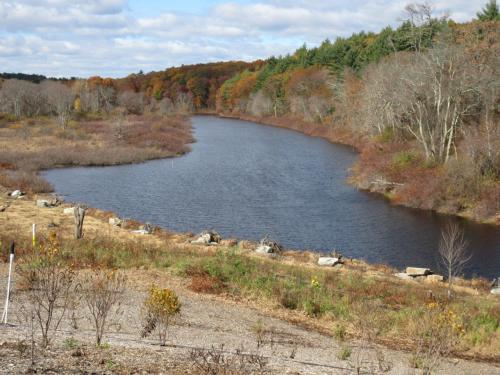
Bill Massaro post #2 of the day – this email below from Bill just now – Bill was one of the individuals who requested that the $150,000 earmark be inserted into the state budget to fund the work on the new state road to the Charles River Gateway overlook. Once the Town of Medfield gives the state the required notice under the Land Disposition Agreement for the former Medfield State Hospital site, the state will then be required to construct a new access road to its Charles River Gateway overlook park on its own state land, so that the town land will no longer be required to provide that access to the public. Although the town may ultimately want to provide some such access, we will not be required to do so. We negotiated that term to require the new road to add more value to the town land.
BTW, Representative Dooley can be seen in one of my photos yesterday from the Ken and Bob retirement party, traveling incognito in shorts, a tee shirt, and a beard.
BTW #2, today is Ken Feeney Day in Medfield!
FYI-
Thanks to Sen. Timilty and Rep. Dooley, to paraphrase Mark Twain I am happy to say:
“The reports of our earmark’s death have been greatly exaggerated!”
In conversation with Shawn Dooley yesterday, I asked if the House had also failed to get the Access earmark into the override budget. He seemed surprised and said that it was definitely in the House bundle; and unless something happened in the Senate at the last minute, it should have been included in the combined package sent back to the Governor. He did say it was a single item in the middle of a large bundle…. He promised to check it out and let me know what happened…
I got an e-mail from Rep. Dooley and an apologetic call from Molly in Sen. Timilty’s office this a.m. confirming that the combined budget with the Access earmark for $150K sponsored by Sen. Timilty did go back to the Governor. (She did caution that there is always the potential of subsequent budget cuts by the Governor in the fall and spring, but for now it’s in!)
As I had stated when we thought the override had failed, Town and DCAMM obligations under the LDA do not change… Having the earmark, however, should help at least to expedite completion of a favorable engineering design …
Getting the Town’s “build it on State land” letter out sooner, rather than waiting for the LDA’s Dec 1 deadline and risking new budget cuts, would seem to be the prudent next step. This would also give us the opportunity to work with current DCAMM engineering who are familiar with the Mediated cleanup/restoration and the unique features of the property.
Bill
Comments Off on MSH road $ veto was overridden, after all
Posted in Legislature, Medfield State Hospital, State, Uncategorized

Current access to the Charles River Overlook is via the Town of Medfield land, but the Land Disposition Agreement that the town negotiated with the state gives the town the option to require the state to build a new access road to the park area across the land the state kept to the west of the Medfield State Hospital site, if the town feels continuing the easement would depress the value of the town land, and so notifies the state.
Some worked to have Senator Timilty add $150,000 to the budget this year to go towards that new road, but the Governor vetoed that earmark and it was not one that was overridden. Below is an explanation in an email exchange by Bill Massaro and Senator Timilty’s staff person.
The Governor’s veto of the $150K earmark intended for DCAMM design/construction of the Overlook Parking Lot access was not overridden.
As I had stated in my previous background info e-mail on the Governor’s veto, loss of the earmark does not change DCAMM’s obligations under the LDA, and does not affect the Town’s deadline to notify DCAMM by 1 Dec 2016 if the town wants the permanent general public access to the State-owned Overlook on State-owned land and not on Town-owned MSH land.
Given the loss of the earmark and given their 3 year (by 1 Dec 2019) construction window under the LDA , there is no immediate incentive for DCAMM to begin design/engineering and construction in FY 2017… but likely pushing it out closer to the end of into the 3-year window and uncertainties of 2019’s budget
Accordingly, I have asked that the Senator’s office consider trying again when the FY 2018 budget process starts..
Bill
———————————————————————————————————————————————————————————————————-
From: “Molly Sullivan (SEN)” <Molly.Sullivan@masenate.gov>
Sent: Monday, August 1, 2016 4:59:21 PM
Subject: RE: Override Status– Medfield Access Earmark
Hi Bill,
Sorry it took me a bit to get back to you. The Senate was in very late last night, as you saw in the Globe, so I took today off, but I wanted to get you an answer!
Unfortunately, the veto by the Governor was not overridden. Senator Timilty did file a similar amendment in for the roadway in the Senate’s Economic Development bill as well. We got it in the Senate bill but it looks like it did not survive the conference committee.
Senator Timilty and I know how important this is, and we will keep trying to get some funding anyway we can! But of course we can keep it on the radar for FY18 as well. Even though we didn’t get the funding this year, its great for it to be on the legislature’s radar.
Let me know if I can do anything else for you all! Hope you are all having a great summer!!
Best,
Molly
From: wmassaro@comcast.net [wmassaro@comcast.net]
Sent: Monday, August 01, 2016 12:35 PM
To: Sullivan, Molly (SEN)
Cc: Harney, John; Thompson, John
Subject: Re: Override Status– Medfield Access Earmark
Hi Molly,
Saw in the Globe that the FY 17 budget veto override efforts completed late last night and that several earmarks had been re-instated. I would like to be able to tell the Medfield Selectmen and the Hospital Reuse Committee what happened to Medfield’s $150K for the Overlook Access road.
With or without the earmark the Town ‘s & DCAMM’s responsibilities under the December 2, 2014 Land Disposition Agreement are unchanged:
– The Town must notify DCAMM by 1 December 2016 if it wants the permanent access road built on State Land
– If notified DCAMM must construct the road by 1 December 2019
If the override has failed for FY 2017, I suspect that when the Town makes the Dec 2016 “relocate the road” notification DCAMM will likely delay design/construction as far into 2019 as they can. Keeping an FY 2018 earmark on the radar would still be beneficial
Thanks,
Bill
Comments Off on Vetoed MSH road money
Posted in Medfield State Hospital, State, Uncategorized
Medfield Select Board member
I started this blog to share the interesting and useful information that I saw while doing my job as a Medfield select board member. I thought that my fellow Medfield residents would also find that information interesting and useful as well. This blog is my effort to assist in creating a system to push the information out from the Town House to residents. Let me know if you have any thoughts on how it can be done better.
For information on my other job as an attorney (personal injury, civil litigation, estate planning and administration, and real estate), please feel free to contact me at 617-969-1500 or Osler.Peterson@OslerPeterson.com.
 | pmdunner on Crosswalks & Sidewalks at… |
 | EILEEN DESORGHER on Vote Djuna Perkins for DA |
 | Amy Cohen on Delineator Flexposts – t… |
 | Zach on Warrant Committee’s slid… |
 | Donna Knott on Reading for “Read Across… |

 Medfield02052's Blog
