Category Archives: Medfield State Hospital

MSH STM 1/8/18

MSH-night-1

Photo by Victor Cevoli

Special Town Meeting for Medfield State Hospital Planned for 1/8/2018

The Medfield State Hospital Master Planning Committee’s current best estimate continues to be that the special town meeting (STM) at which residents will be asked to decide on the Medfield State Hospital use and zoning issues will be held on January 8, 2018.

The annual calendar for the Board of Selectmen that I posted yesterday contained a Feburary 2018 place holder date for that STM, which was a misstatement.  Adjust your ski plans accordingly.

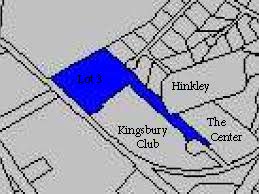
Lot 3 & Hinkley

LOT 3

Lot 3 & Hinkley Property

The Board of Selectmen received the following memo from the Medfield State Hospital Master Planning Committee at last night’s (really long – 4+ hours) meeting.  I am an abutter to an abutter of both Hinkley and Lot 3 (in blue above), so I recuse myself from any discussions about either.

After hearing from Chair Nolan and his fellow committee members, the Selectmen agreed last night to allow the Medfield State Hospital Master Planning Committee process, as planned, to proceed to its expected January special town meeting (STM) to consider the rezoning and disposition of the Medfield State Hospital land, instead of doing either an immediate disposition and/or a commercial use disposition.

========================================================

MEMORANDUM


TO:                 Medfield Board of Selectmen                      

FROM:           Stephen M. Nolan, Chair

Medfield State Hospital Master Planning Committee


RE:                 Hinkley Property and Lot 3, Ice House Road       

DATE:           July 6, 2017   


At your meeting on June 20, 2017, Mike Marcucci raised the possibility that Lot 3 on Ice House Road (“Lot 3”) and the adjacent Hinkley property (the “Hinkley Property”) be removed from the purview of the Medfield State Hospital Master Planning Committee (the “Committee”) and instead assigned to the newly-created Affordable Housing Trust (the “Trust”).  I raised this subject for discussion at our Committee meeting the following evening.  After further discussion at our meeting on July 5, the Committee voted unanimously to recommend to Board of Selectmen that Lot 3 and the Hinkley Property remain as part of our charge, with the understanding that two members of our Committee would be designated to work with one or more members of the Trust and/or the Affordable Housing Committee on an RFP for disposition of Lot 3 and the Hinkley Property to one or more developers for the following uses: 42 units of senior affordable rental housing (40B compliant) on Lot 3 and approximately 15 small single-family units on the Hinkley Property.  Our thought process is set forth in more detail below.


  1. Intended Use of Lot 3 and the Hinkley Property.

The consensus that has emerged from our public sessions, our meetings with the Council on Aging and the Senior Housing Study Committee and Committee deliberations is that the most desirable use for Lot 3 and the Hinkley Property is senior housing.  The principal reasons for this are twofold: access to The Center and the possibility that a senior housing development could happen on a more expedited basis than the re-development of the MSH core campus because infrastructure is more readily available and the properties are distinct enough from the core campus to be susceptible of proceeding on an independent track without pre-determining other uses at the core campus that are still under discussion.  The Council on Aging has expressed potential willingness to cede a small portion  of the land at the corner of The Center adjacent to Hinkley for purposes of enhancing the development potential of the Hinkley Property.  In addition, our consultant has advised that more intense commercial uses at Lot 3 and the Hinkley Property are likely to negatively impact The Center and overload Ice House Road.

Concern has been expressed by some, including Mike Sullivan and Gus Murby, about using a commercially zoned property for residential purposes, but the overall MSH master plan is likely to include not only a site on the MSH property for a recreational facility (whether Town-owned, private or public-private-partnership is a subject to be addressed by the Town) but also other commercially-designated parcels at the core campus that are more likely to draw interest from commercial users due to their favorable location in midst of a vital redevelopment project.  Given the proximity of the MSH property to McCarthy Park and the fact that there are no restrictive covenants applicable to that land (unlike the covenants that the Town is subject to under the Kingsbury Club lease), the MSH property is a more favorable site for a recreational facility.  And we have heard from the Economic Development Committee that the only serious proposal for a commercial use at Lot 3 that came out of their request for expressions of interest was a recreational facility, the other potential use being senior housing.  If other land at the MSH property is being proposed for such a use as well as other commercial uses, the Committee does not see any disadvantage to changing the zoning of Lot 3 to residential, effectively swapping this commercial land for other more-suitable commercial land at the MSH property.

  1. Advantages to Keeping Properties within MSH Master Plan.

The biggest reason for keeping Lot 3 and the Hinkley Property as part of the charge of the Committee is that by doing so they can be rezoned as part of the overall re-zoning of the MSH property.  Such re-zoning will significantly enhance the value of the properties because a developer will not be required to obtain a Chapter 40B comprehensive permit, which is both time-consuming and expensive, even if it is a “friendly 40B”.  In addition, the Committee believes that moderately-priced single-family homes are in demand by Medfield seniors and such units would not qualify for a comprehensive permit.  So without including the Hinkley Property under the MSH re-zoning, those units would not be feasible at the Hinkley Property.  The Committee is also looking at possible creation of a Chapter 40R district that would encompass Lot 3 and the Hinkley Property, possibly resulting in financial incentive payments to the Town.

An additional consideration is that the MSH master plan is more likely to succeed at Town Meeting if it draws upon the broadest coalition of supporters, including seniors and advocates for maintaining safe harbor status under Chapter 40B.  The Committee believes that if key parts of the redevelopment plan are removed from our scope and made stand-alone proposals, the MSH master plan is less likely to pass due to the loss of constituencies who might otherwise be expected to vigorously support the master plan.  This dissipation of support through segmentation of the plan poses a real risk to our ability to muster two-thirds support at Town Meeting.

Finally, in examining the financial impact of the MSH redevelopment, the location of senior housing at Lot 3 and the Hinkley Property, rather than at the core campus, will produce a net shift of positive economic benefits from the core campus to Lot 3 and the Hinkley Property due to (i) senior housing being a net revenue generator because of the lack of school children and (ii) a relatively higher purchase price for those properties because of lower infrastructure costs.  On the other hand, the possibility of family housing around the core campus and the higher infrastructure costs are likely to make the financials at the core campus more challenging.  For these reasons we prefer to keep Lot 3 and the Hinkley Property within our scope.

  1. Potential Disposition Process and Timing.

Finally, the issue of speed needs to be examined in light of other affordable housing efforts in Town.  We look to the Selectmen, the Affordable Housing Committee and the Affordable Housing Trust for guidance in this area.  We are aware of multiple efforts on the affordable housing front, including Tilden Village (42+ units), the American Legion property (42+ units), Lot 3 (42 units) and the core campus (undetermined number of units, but likely at least 50 units).  The combination of these units would bring the Town over the 10% mark.  Managing the delivery of these units so as to keep within safe harbor will be a complicated task, but given the difficulty of getting projects permitted and funded, it seems to us better to be pro-active and have multiple irons in the fire rather than trying to stretch out efforts in order to avoid overlap.  If one of the proposed projects were to slip for unanticipated reasons and another wasn’t well along in the process, the Town could fall out of safe harbor, and be vulnerable to unfriendly 40Bs.  In addition, the seniors in Town are impatient for progress on the goal of providing alternative housing options in order to avoid losing more of their number to out-of-town options.

Because Lot 3 and the Hinkley Property are Town-owned properties, they require a public disposition process in addition to re-zoning.  We would propose that the Town proceed on a parallel track to prepare a disposition RFP that would allow for selection of a preferred developer/purchaser, subject to re-zoning and Town Meeting approval.  This would allow for a potential disposition shortly after Town Meeting in January.  We have already done significant planning work with respect to Lot 3 and the Hinkley Property, including wetlands mapping and infrastructure analysis, and as a result our Committee is familiar with the constraints and development potential of the two sites.  Because our planning consultant is working with us on possible lay-outs of Lot 3 and the Hinkley Property and because, as stated above, we believe it makes sense to keep the properties under the MSH master plan, we suggest our Committee proceed to work on an RFP for the disposition, either as a single project comprising both the affordable senior rentals (40B) and the moderately-priced single family units or as two separate projects. We would consult with the Affordable Housing Trust and Affordable Housing Committee as we draft the RFP and we would welcome their input.  A recommendation on disposition as one single or two separate projects would be made by the Committee, once it digs into the substance more thoroughly and examines the merits of both approaches.


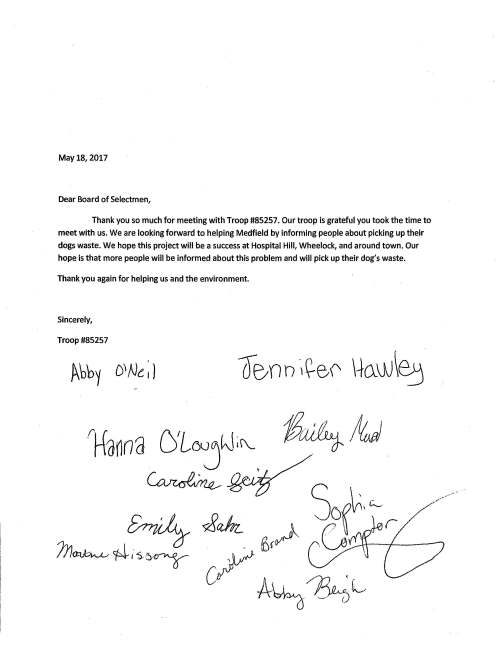
Girl Scouts take on dog waste

Keep Medfield Free 01 Dog waste By Girl Scout Troop 85257 HI we are Troop 85257 we are working on a proiect to complete our Bronze Award. A Bronze Award is the third highest award a girl scout can earn latter silver and gold). For our proiect we are informing people about the imponance 01 picking up their dog's waste to help inlorm we are doing booth's at Wheelock and Hospital Hill we will have a game and better inform people about the the problem's dog waste can cause ii not picked up. we hope you can come and support us and dates are listed below. PLEA'S£ VISlT 6V.t Btl()nl t:JIJ 3lJNE Stl> - rAM Td llAM AT U6SPITAL. UIL.L. 3lJNE 'l'TU - rAM T6 llAM AT WUEEL.6t:.IC FIEL.l>S If this dog can do it so can you. May 18, 2017 Dear Board of Selectmen, Thank you so much for meeting with Troop #85257. Our troop is grateful you took the time to meet with us. We are looking forward to helping Medfield by informing people about picking up their dogs waste. We hope this project will be a success at Hospital Hill, Wheelock, and around town. Our hope is that more people will be informed about this problem and will pick up their dog's waste. Thank you again for helping us and the environment. Sincerely, Troop #85257 rKanna 0'LCA.Jjw;~. ~201705170GS-ltr from_Page_2

MSH public input tonight

The Medfield State Hospital Master Planning Committee is seeking public input this evening at 7PM at the Blake Middle School cafeteria.

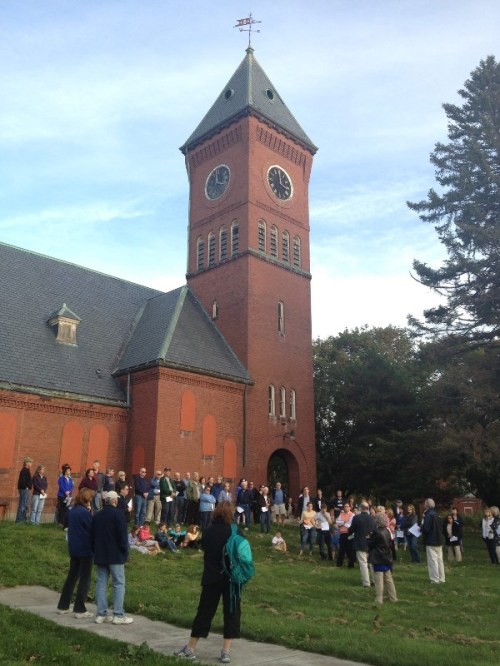
This was the crowd at the tour John Thompson lead last Sunday –

20170521-MSH Tour3 SC 052117_B6A6487

MSH workshop 5/24 at 7PM

From Gil Rodgers of the Medfield State Hospital Master Planning Committee –

Lee Chapel at msh

Master Planning Committee Holding Workshop on Hospital Reuse Alternatives


The Medfield State Hospital Master Planning Committee (MSHMPC) is pleased to announce a Public Meeting and Workshop at the Blake Middle School Gymnasium on Wednesday, May 24, 2017 from 7pm to 9:30pm. 


As part on the ongoing master planning process the MSHMP Committee has narrowed down the alternative scenarios and seeks public feedback at this critical juncture. Kathy McCabe and her team from McCabe Enterprises Consultants will present two scenarios that are the result of a collaborative process that includes input from three key sources:  (1) MSHMPC, (2) public input through meetings and surveys, and (3) the expertise of McCabe Enterprises.  The presentation will also incorporate analyses of external market forces that impact the property such as historic tax credits, regional housing needs, and business opportunities.

The focus will be on:

  • potential uses of the properties,
  • market priorities,
  • building and land assessments,
  • infrastructure considerations, and
  • financial analyses.


Feedback from the public is sought to help develop a preferred development scenario — which may be a combination or modification of the two alternatives presented — and also be used to identify priority features and elements for inclusion in the final development and implementation plans.

The format will be somewhat different than the February workshop held in the Medfield High School Cafeteria.  The agenda will begin with short presentations being made by MSHMPC and McCabe Enterprise consultants presenting overview and summary of the two scenarios and analyses of their impacts and implications.    Attendees will break into small “round-table” discussion groups facilitated by MSHMPC members.  As a new technique for gathering feedback, hand-held, electronic polling devices will be employed to obtain individual responses to a few key questions allowing for instant tabulation of responses.  Finally, using all of these steps and information a closing  presentation will summarize the conclusions.

MSHMPC encourages participation in this meeting and workshop as one of the most important decisions ever faced by Medfield that will have enduring implications for this community and neighboring communities.

MSHMPC Communications Subcommittee

Vote daily to 5/12

vote.2msh-lee-chapel-by-jt

VOTE DAILY ONLINE FOR CULTURAL ALLIANCE GRANT

The Cultural Alliance has submitted a video grant application. If the video gets enough votes (i.e. lands in the top 10 of the category “arts and culture”), it advances to the next round of evaluation which will award one application in each category $100k and two applications $50k each. A lot of money!
PLEASE VOTE FOR OUR VIDEO GRANT today and everyday thru May 12
http://act.usatoday.com/submit-an-idea/#/gallery/60445715

Leave a browser tab open, refresh the page each day, and click “VOTE.”

Votes needed for MSH

From Jean Mineo – her latest thing that helps us all.

vote.2

Hello Medfield Friends,
The Cultural Alliance has submitted a video grant application and we need your vote.

If the video gets enough votes (i.e. lands in the top 10 of the category “arts and culture”), it advances to the next round of evaluation which will award one application in each category $100k and two applications $50k each. A lot of money!

The link to the 2:45 minute video is here:

http://act.usatoday.com/submit-an-idea/#/gallery/60445715

Click on the green vote button next to the video to cast your vote! You may vote once a day, every day through May 12. There are no forms to fill out. Then please share on Facebook or Twitter using the buttons under the video and help spread the word.

The grant addresses the renovation of key historic buildings at the former Medfield State Hospital into an arts and cultural center. The money would go toward hiring an expert to secure historic tax credits worth about $2 million – applicable to any project renovating the Chapel within historic guidelines, even if it doesn’t become a cultural center. This is a valuable asset to our town that does not commit us to a specific use!

Thanks for your help! Like us on Facebook for progress reports:
https://www.facebook.com/CulturalAllianceofMedfield/

Jean


C 617-877-5158

JeanMineo@aol.com

@JeanRMineo

www.LinkedIn.com/in/JeanMineo

More on DIF & TIF

DIF houses-bus

http://www.mass.gov/envir/smart_growth_toolkit/pages/mod-diftif.htmlhttp://www.mass.gov/envir/smart_growth_toolkit/pages/mod-diftif.html

Both DIF and TIF provide municipalities with innovative tools to target districts or specific projects for redevelopment. The use of tax increments is the centerpiece of both tools. A tax increment is the difference between the beginning assessed value of the targeted property in its dilapidated state and the assessed value going forward in time, as the planned improvements take shape. The tax increment, calculated by the local Assessor, is the tax on the added value of new construction, rehabilitation or new equipment or machinery. Determining the value of the tax increment is essentially the same for both DIF and TIF. How the tax increment is used as an incentive, however, is very different. Using DIF, municipalities can pledge all or a portion of tax increments to fund district improvements over time. With TIF, municipalities may grant property tax exemptions to landowners of up to 100% of the tax increment for a fixed period.

District Improvement Financing (DIF)/
Tax Increment Financing (TIF)

In Brief: District Improvement Financing (DIF) and Tax Increment Financing (TIF) are economic tools that promote redevelopment by use of public/private partnerships. TIF offers tax breaks to developers, while DIF channels tax dollars into targeted redevelopment districts.

DIF & TIF for MSH

The cultural arts center analysis recommends the use of district improvement financing (DIF) and tax increment financing (TIF) as mechanisms for financing the cultural arts center and the needed infrastructure.  A DIF allows one to raise monies by issuing bonds that are paid back only out of property tax monies derived from the lands within the DIF boundaries, so the DIF could be the former Medfield State Hospital campus, and the rest of the town would not have to pay in. A TIF sounds like a straight tax break given to stimulate a particular result.

Interestingly, the DLS newsletter this month had the following article on those –

DLS

Ask DLS: Property Tax Incentive and Financing Program Changes

This month’s Ask DLS features questions relating to changes in economic and housing development property tax incentives and financing programs under the Job Creation and Workforce Development Act, Chapter 219 of the Acts of 2016, and the Municipal Modernization Act, Chapter 218 of the Acts of 2016. A summary of the changes made by the Municipal Modernization Act can be found in the August 18, 2016 issue of City & Town. We have also compiled the questions answered in the Municipal Modernization Act series of Ask DLS for your convenience. Please let us know if you have other areas of interest or send a question to cityandtown@dor.state.ma.us. We would like to hear from you.

What is the District Improvement Financing Program?

Under MGL c. 40Q, cities and towns may create one or more improvement districts within their boundaries to promote increased residential, industrial, and commercial activity. Development districts are created by action of the mayor and council in cities, and town meeting in towns.

The centerpiece of the district improvement financing (DIF) program is the “District Development Program,” which is a statement of means and objectives designed to improve the quality of life, the physical facilities and structures and the quality of pedestrian and vehicular traffic control and transportation within a development district. Development programs may also include means and objectives to increase residential housing, both market rate and affordable. Every development program must include a financial plan, which is a statement of the costs and revenue sources needed to carry out development programs, to include (1) cost estimates for the development program; (2) the amount of indebtedness to be incurred; and (3) sources of anticipated capital. MGL c. 40Q, sec. 2.

How is municipal financing of improvements under the DIF program different than financing of other improvements?

A unique financing option involves setting aside all or a portion of the additional taxes, generated by the public improvements entailed in the development program. Districts that set aside a portion of the rise in property tax revenues (the “increment”) to finance the development program are referred to as “invested revenue districts.” General obligation or revenue bonds can be issued in anticipation of higher property tax revenues spurred by the development program in the district.

The revenue from the retained tax increment is reserved and credited to two accounts. MGL c. 40Q, sec. 3. First in priority is the “development sinking fund account” that is used to cover payment of interest and principal on debt taken out to fund the program. Second priority goes to a “project cost account” to cover separate project costs as outlined in the financial plan for the program. An amendment made by the Municipal Modernization Act provides that the requirement to reserve the increment ends when sufficient monies have been reserved to cover the full, anticipated liabilities of both these accounts. MGL c. 40Q, sec. 3(d).

How is the District Improvement Financing tax increment calculated?

The Municipal Modernization Act amended the calculation of the tax increment reserved for debt service and project costs in cities and towns with invested revenue districts under MGL c. 40Q. It will now equal the actual new growth increase added to the municipality’s levy limit under Proposition 2½ for the development activity and expanded tax base within the district. MGL c. 40Q, sec. 1. The previous formula was based on certain adjusted valuation increases that were difficult to calculate, did not correspond to the new property tax revenue generated by the program and were not fixed until the tax rate for the year was set. The amount will now be known before the rate is set since it is based on Proposition 2½ new growth. Moreover, the assessors can provide a realistic estimate of the increment for budgeting purposes. This will ensure that the revenues generated by the increment are not used to support the budget generally.

The annual increment is based on the increase in the community’s levy limit (“new growth”) attributable to real estate parcels within the district for that year, including the portion attributable to prior years with an assessment date after the base date of the program. The percentage of the increment being reserved for financing the project must be specified as part of the district financing plan.

Example
District is created April 1, 2017
Base date is January 1, 2017 (FY18)
FY19 with January 1, 2018 assessment date is first year for tax increment

$100,000 of FY19 tax base growth is attributable to parcels in district
FY19 increment = $100,000.

$150,000 of FY20 tax base growth is attributable to parcels in district
FY20 increment = $252,500 [$102,500 ($100,000 FY19 increment increased by 2.5%) PLUS $150,000 additional increment]

$100,000 of FY21 tax base growth is attributable to parcels in district
FY21 increment = [$358,813 [$258,813 ($252,500 FY20 increment increased by 2.5%) PLUS $100,000 additional increment]

Where can municipalities enter into TIF Agreements?

The Job Creation and Workforce Development Act, Chapter 219 of the Acts of 2016, made a number of changes in the economic development incentive program (EDIP), which makes state tax credits and local property tax exemptions available for certain economic development projects. MGL c. 23A, secs. 3A3G. The EDIP program is administered by the state Economic Affairs Coordinating Council (EACC), which approves the tax incentives. The Act streamlined the requirements and procedures for the two local property tax exemptions under the program, which are the tax increment financing (TIF) exemption and the special tax assessment (STA).

Municipalities may now apply to the EACC to declare an area in their city or town, or contiguous areas in neighboring cities or towns, as eligible for TIF agreements. An area can be designated as TIF-eligible if the EACC finds that there is a strong likelihood that any of the following will occur within a specific and proximate period of time: (1) a significant influx or growth in business activity; (2) creation of a significant number of new jobs—not merely replacement or relocation of current jobs within the state; or (3) a private project or investment will contribute significantly to the resiliency of the local economy. It is no longer necessary that a TIF-eligible area be within an Economic Target Area (“ETA”).

Cities and towns can enter into TIF agreements with persons or entities undertaking either (1) certified projects, or (2) real estate or facility expansion projects in a TIF-eligible area. Any project must be consistent with the municipality’s economic development objectives and likely to increase or retain employment opportunities for residents of the municipality. MGL c. 23A, sec. 3E. A certified project is a project run by a business for which the EACC has approved state tax incentives. An eligible real estate project must be construction, rehabilitation or improvement of any building or other structure on a parcel of real property which, when completed, will result in at least a 100% increase in the assessed value of the real property over the assessed value of the real property prior to the project. A facility expansion project requires relocation from one location to another in the state or expansion of an existing facility that results in a net increase in the number of full-time jobs at the relocated or expanded facility. See definitions in MGL c. 23A, sec. 3A.

What happens to a local tax incentive for a certified project when the certification is revoked?

The 2016 Act clarified the impact of an EACC revocation of a certified project for a business that is also receiving a local tax incentive. MGL c. 23A, sec. 3F. The EACC can revoke state tax credits for certified projects that are in material non-compliance with the job creation or other requirements agreed to as a condition of the credits. The local tax incentive will now terminate at the beginning of the tax year in which the material non-compliance occurred, unless the agreement between the municipality and business expressly provides otherwise. If a local tax incentive is terminated, the municipality may amend the agreement to continue it. The amended agreement must be approved by the legislative body and EACC. In addition, the municipality may recapture the previously foregone taxes by making a “special assessment” on the taxpayer in the year after the year of the EACC’s decision to revoke project certification. The recapture could go as far back as the finding of material non-compliance. The procedure for municipalities to assess and collect the recaptured amount as a property tax is also spelled out.

What is the new local option to promote creation of middle income housing? (Republished from March 2, 2017 City & Town)

Under G.L. c. 40, sec. 60B, cities and towns may, through their respective legislative bodies, provide for Workforce Housing Special Tax Assessments (WH-STA’s) as incentive to create middle-income housing. Municipal Modernization Act, Chapter 218, sec. 39 of the Acts of 2016. Unlike other property tax incentives, such as economic development tax increment finance (TIFs) agreements, no state-level approval is required. Local WH-STA plans may allow for exemptions as great as 100% of the fair cash value of the property during the first two years of construction. Over a three-year stabilization phase following construction, the exemptions are available in declining maximum percentages of the fair cash value.

To use this incentive, a city or town must designate one or more areas that present exceptional opportunities for increased development of middle income housing as WH-STA zones. The plan must describe in detail all construction activities and types of residential developments intended for the WH-STA zone. The city or town must also promulgate regulations establishing eligibility requirements for developers to enter into WH-STA agreements. The regulations must address procedures for developers to apply for a WH-STA; the minimum number of new residential units to be constructed to qualify for WH-STA tax incentives; maximum rental prices and other eligibility criteria to facilitate and encourage construction of workforce housing.

The city or town may then enter into tax agreements with property owners in WH-STA zones that will set maximum rental prices that may be charged by the owner to create middle income workforce housing.

The revised Cultural Arts Facility Feasibility Study

DBVW Architrects-cultural arts center

I had not realized that Louise Stevens had done an updated revision to her financial analysis of a cultural arts center at the former Medfield State Hospital site, so I am posting a link to that updated report here –

20170406-ArtsMarket-Medfield Feasibility Report April REV

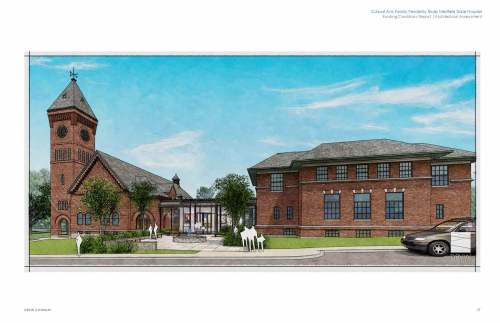
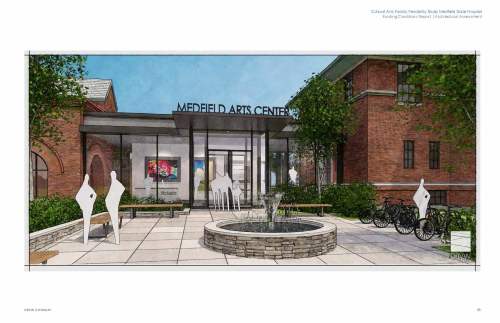
DBVW Architrects-cultural arts center-glass connector

These renderings are from the DBVW Architects report –

20170406-DBVW Architrects-1624_Existing-Conditions-Report_17-0403-Email(1)