Category Archives: Fire Department

ALS status

ambulance

The Warrant Committee and the Board of Selectmen held a joint 2.5 hour meeting last night with about 25-30 residents to discuss how to best proceed with the advanced life support (ALS) issue at the annual town meeting (ATM).  The collective wisdom of the all town officials (all the Warrant Committee and selectmen) was to create an ALS Study Committee to gather all the data, to figure out the best solution, and to report back on how the town should best provide ALS services.

Currently, since the private providers ceased providing our ALS intercept services several months ago on short notice, the town provides paramedic service by means of ALS intercepts with ambulances staffed by paramedics from Westwood, Walpole, and Norfolk via the mutual aid that fire departments render to one another.  ALS intercept services are the ALS ambulance from one of the other towns meeting the Medfield ambulance en route and transferring the patient to the ALS ambulance to complete the transfer to the hospital.  Medfield then splits the monies from those ALS intercept calls with the other towns.  It is expected that mutual aid will continue until the Town of Medfield solves how it will provide ALS on its own.

The Warrant Committee presented the issues as it has determined them, and unanimously recommended the creation of an ALS Study Committee to better define the best solution.  The following was the Warrant Committee’s written report:


ALS Options Overview

BoS/WC Joint Working Session, April 10th, 2017


As Is For A Very Limited Period – ATM, 2018  

Rely on mutual aid to provide ALS intercept
(while evaluating an optimal long term solution)


Financial:        Potential $25K to study committee

Service:           Same as we have been receiving for several months

Uncertainty:   Not a long term solution


Contract ALS

Hire a service to dedicate ambulance and medics to Medfield


Financial:        $600K budget

Service:           Equivalent to hiring medics

Uncertainty:   Control of resources, Potential sharing of costs & services


Hire ALS

Hire medics and equip current ambulance to accommodate ALS service


Financial:        $750K budget (Cost of hiring plus $90K to equip ambulance)

Service:           Response time fast (assuming no concurrent calls), utilization low

Uncertainty:   # of hires/level of coverage, who hires/trains,

cost may be higher due to estimates for benefits/OPEB


Regionalize ALS

Share resources (either hired or contracted ALS) with other towns locally


Financial:        Unknown – but lower than other long term options.

Potentially 1/3  to ½ of cost of other solutions – or profit center)

Service:           Response time fast (assuming no concurrent calls), utilization higher

Uncertainty:   Partners, cost sharing, location of ambulance


Selectmen Marcucci proposed asking the annual town meeting (ATM) to vote to approve about $650,000 of monies to implement the ALS services, and to just leave the form of the ALS services to be implemented in the discretion of the Board of Selectmen.   In that scenario, the Board of Selectmen would first get the ALS study results, and then implement on what is proposed.  Selectman Murby seemed to agree with that proposal.  I prefer to give the town residents the right and opportunity to vote the ALS monies once the Board of Selectmen determines and presents to the residents what the Board of Selectmen thinks is the best ALS solution.  However, if the residents opt to trust the selectmen with the monies now to make the best ALS decision later, I am happy to execute on that trust.


ALS discussion 4/10

ambulance

The Warrant Committee and the Board of Selectmen just confirmed arrangements for a joint meeting at 7:30 PM on Monday April 10 to discuss the pending Advance Life Support (ALS) town meeting warrant article and the town’s ALS situation and its solution.

The town’s private ALS service providers ceased supplying ALS services on short notice to the town last year, and the town now relies on mutual aid from Westwood, Walpole, and Norfolk to supply ALS intercept services as needed.

On average, the Medfield Fire Department has two ambulance runs per day and where about 25% of the runs require ALS services, therefore the town averages one ALS run every other day.

Before announcing his retirement, Chief Kingsbury had recommended the hiring of six full time firefighter-paramedics to provide the ALS service, at a present cost of close to $500,000 a year, which was exclusive of the retirement pension and retiree health care costs the town would eventually pay later.

Other possible alternatives include:

  • hiring a private service to provide the needed ALS service (estimated at $600,000/year); and
  • seeking a regional solution with the surrounding towns that also do not now provide ALS services – Dover, Sherborn, Millis, and Medway.

It really comes down to a policy decision of both how much the town is willing to pay to have the paramedic answer the calls when the ALS services are needed, and how best to have the paramedic there when needed from among the various options that are available.

ALS costs

Chief Kingsbury provided new figures for various permutations (use the link to get a copy with correct formatting):

ambulance

20170131-wk-advanced-life-support-for-the-town-of-medfield


Advanced Life Support for the Town Of Medfield


Total calls for service by the Medfield Fire Dept. was 1274 for 2016 of that 517 were for Emergency Medical Services.


Emergency Medical Services


517 Requests               257 BLS Transports                189 ALS Transports               71 Refusals


The 189 transports were accompanied by paramedics from Events EMS, Westwood FD, Walpole FD, Norfolk FD and Brewster EMS.


Events EMS ceased operations and Brewster as of now is not available.


The Problem? Who is going to provide Advanced Life Support (ALS) for the almost 200 calls requiring Paramedic (Medic) intervention? What are our options?


  • If we do nothing.


We might be able to get away with it. It delays providing in-house ALS for a year if not more. It takes advantage of other communities ALS at their expense. We risk being shut off from their services as it is not mutual aid. A fellow chief who is struggling to staff his volunteer Fire Dept. and is using mutual aid excessively said it best,


“Mutual Aid is a network of sharing, with resources flowing back and forth across jurisdictional borders, and should not routinely benefit one partner in the form of subsidized services by the taxpayers of another community.”


  • Hire a Private Provider


Initial conversations with Millis & Medway resulted in a proposal from a private company for a dedicated ALS response truck to service the three communities it would be @ $600,000 per year and another $225.00 per intercept. Millis & Medway were not interested in pursuing further. On 01/19/17 as requested, I met with Chris DiBona of Brewster Ambulance to see if there was anything his company could do with either the three towns of Medfield, Dover and Sherborn or from their base in Norwood. Chris got back to me on 01/25/17 and said they were still working on it. I reached out to the Fire Chiefs in Sherborn and Dover, Sherborn expressed a little interest as they are struggling too and Dover does not appear to be interested.  I have not heard anymore as of yet. I will provide any info as soon as it’s available.


  • Add Staffing (options)


  1. I met with the Fire Chiefs from Millis and Medway on 01/23/17 to further discuss what options we might have. Both of those towns are pursuing advancing to the ALS level through hiring and training, more so hiring. As a result of these discussions if we were to get to the level of at least four (4) Medics each we could seek permission from our Medical Directors to run at a Paramedic/Basic (P/B) level and when needed we would pull a second medic from a neighboring town to facilitate a two medic event.


Pro’s: It’s a start                                                       Con’s: 2nd Medic availability =

We would have 2 Medics 50% of the time     delayed response

Increased Revenue                                           Expense


Cost Estimate:  4 Staff @ $80,556 = $322,224

Startup                       $90,400

Est. Total                                           $412,224         


 B)If we were to hire six (6) additional Medics we would have adequate resources to staff the Ambulance at the ALS level 24/7/365. The additional staff would have two shifts with four (4) personnel and two shifts with three (3) personnel.


Pro’s: 24/7 coverage at the ALS level                  Con’s: Expense

Increased Revenue

Staffing to aid in medical calls

Staffing to respond to fire calls


Cost Estimate:  6 Staff @ $80,556 = $483,336

Startup                        $90,400

Est. Total                                            $573,336


  1. If we were to hire eight (8) additional Medics we would have adequate resources to staff the Ambulance at the ALS level 24/7/365. The additional staff would have all shifts with four (4) personnel. With the additional staff and by having a second ambulance, in the event of back to back medicals, we could staff it to respond at the Basic Life Support (BLS) level. Added Medic staff would be able to cover open shifts to maintain ALS staffing.


Pro’s: 24/7 coverage at the ALS level                  Con’s: Expense

Increased Revenue

Run a 2nd BLS ambulance

Staffing to aid in medical calls

Staffing to respond to fire calls


Cost Estimate:  8 Staff @ $80,556 = $644,451

Startup                        $90,400

Est. Total                                            $734,851


According to Joy Ricciuto our Town Accountant, the Ambulance service generated $439,644 for FY16. Although I do not want to predict how much in this volatile time in Healthcare, it is safe to say there will be an increase to our revenue stream by advancing to the ALS level of service. By keeping it in-house we will keep the $62,000 we paid for outside services. The likelihood of increased revenue by way of increased demand for ALS calls and being able to reciprocate with mutual aid does exist.


Hiring additional Staff to provide ALS


Pro’s:


By providing in-house ALS you get the needed resources to the patients side the fastest possible way. No delay with patient care by waiting for a regional or alternative ALS intercept service.

Patients deteriorate every minute you wait for intervention.


You have more control on direct patient care by managing ourselves. We can choose the equipment to use to provide services. You have the ability to participate with any project waivers when they are available.


We can control the training of in-house medics. Training is key to this type of operation.


We have the ability to schedule medics in teams to capitalize on their experiences and skill level to provide the best service for the town.


We will maintain our own local medical control MD that is knowledgeable of the region and will oversee our entire service.


Increased billing for services rendered at the ALS level will result in increased revenue.


Increased staffing could result in running a 2nd ambulance resulting in increased revenue.


Increased staffing will aid in responding to Fire related calls for service as well as the day to day operational activities that are done.


Con’s:


Delay in providing ALS intervention to patients in need. Our avg. response time is under five minutes; it is a fifteen minute response from Norwood if we were to use Brewster as an intercept.


The startup expense is a downside but will be offset by increased revenues that will be better determined after it is up and running.


Conclusion:


This is an issue that will not be going away. We as a community need to address it so that all our residents have the best medical resources available to them in their time of need. I believe this decision as to what level of care is acceptable to our taxpayers should be left up to them. I would recommend the hiring of six (6) Medics to properly cover at the ALS level 24/7/365.

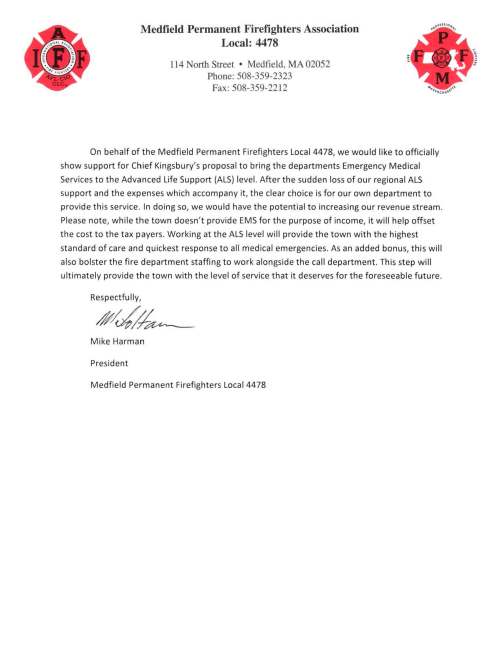
Union support for Chief

The following letter was received today –

Medfield Permanent Firefighters Association Local: 4478 114 North Street • Medfield, MA 02052 Phone: 508-359-2323 Fax: 508-359-2212 On behalf of the Medfield Permanent Firefighters Local 4478, we would like to officially show support for Chief Kingsbury's proposal to bring the departments Emergency Medical Services to the Advanced Life Support (ALS) level. After the sudden loss of our regional ALS support and the expenses which accompany it, the clear choice is for our own department to provide this service. In doing so, we would have the potential to increasing our revenue stream. Plea se note, while the town doesn't provide EMS for the purpose of income, it will help offset the cost to the tax payers. Working at the ALS level will provide the town with the highest standard of care and quickest response to all medica l emergencies. As an added bonus, this will also bolster the fire department staffing to work alongside the call department. This step will ultimately provide the town with the level of service that it deserves for the foreseeable future. Respectfully, #/0/#~ Mike Harman President Medfield Permanent Firefighters Local 4478

ALS

ambulance

Yesterday afternoon from 6-7 PM before the regular meeting of the Board of Selectmen there was a well attended session that was billed as a working meeting of the Board of Selectmen with Chief Kingsbury and Lieutenant Bennotti of the Medfield Fire Department to discuss the possible solutions for the town to the provision of Advanced Life Support (ALS) services to town residents. The MFD currently only provides intermediate basic life support (EMT) ambulance services to residents, and only one of the current seven full time firefighters is a paramedic.

One firefighter recently resigned, and will be replaced with a paramedic, however, until the whole service is staffed with paramedics, the two paramedics will not be able to provide paramedic services.

The ALS session was not covered by Medfield.TV – I do not know why not, as I was not involved in making that decision.  Personally, I would have put it on TV.

Basically the Chief and the Lieutenant

  • expect that the MFD will have increasing problems in the future staffing a call department,
  • expect the current towns providing the ALS intercept services (Westwood, Walpole, and Norfolk) as tiring of doing so if we are not making efforts to solve our situation,
  • see no likely chance of doing a regional ALS with other towns (Dover and Sherborn are the logical ones),
  • generally see no interest in current EMT’s becoming paramedics,
  • see the cost of using a private ALS provider as similar to the cost to expand the MFD (they have been quoted $600,000 per year, plus $250 per run by private providers), and
  • therefore that the best solution is for the town to hire eight new full time firefighter/paramedics at a cost of about $650,000 per year, plus start up costs.

Whether to hire the paramedics will be a decision for residents to make at at the annual town meeting (ATM).

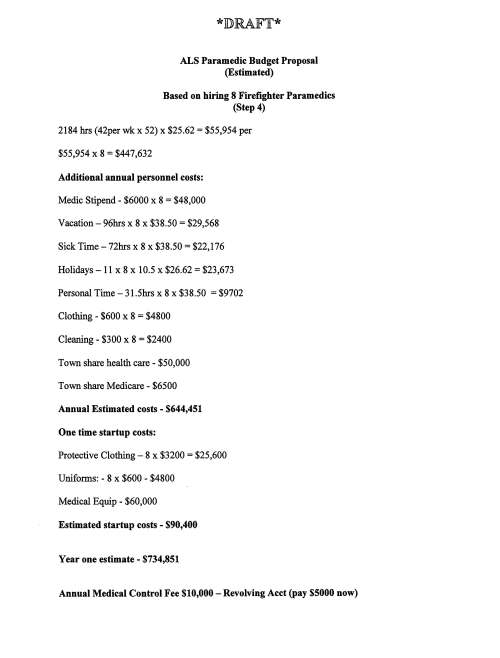
Below are the Chief’s cost projections:

* lIJ) RAIF'f * ALS Paramedic Budget Proposal (Estimated) Based on hiring 8 Firefighter Paramedics (Step 4) 2184 hrs (42per wk x 52) x $25.62 = $55,954 per $55,954 x 8 = $447,632 Additional annual personnel costs: Medic Stipend - $6000 x 8 = $48,000 Vacation - 96hrs x 8 x $38.50 = $29,568 Sick Time- 72hrs x 8 x $38.50 = $22,176 Holidays -11x8 x 10.5 x $26.62 = $23,673 Personal Time-31.5hrs x 8 x $38.50 = $9702 Clothing - $600 x 8 = $4800 Cleaning - $3 00 x 8 = $2400 Town share health care - $50,000 Town share Medicare - $6500 Annual Estimated costs - $644,451 One time startup costs: Protective Clothing- 8 x $3200 = $25,600 Uniforms: - 8 x $600 - $4800 Medical Equip - $60,000 Estimated startup costs - $90,400 Year one estimate - $734,851 Annual Medical Control Fee $10,000 - Revolving Acct (pay $5000 now)

I suggest that these figures do not reflect the true cost to the town of the additional employees, as these estimates do not include the present value of the future retirement benefits the town will ultimately have to pay.  Those retirement benefits (i.e. pension and health care) are called Other Post Employment Benefits (OPEB).  To truly tell us the cost, the estimates should include the present value of the actuarial costs we incur each year to pay future retirement benefits to such employees.

The town was only recently required to figure out the value of its OPEB liability. Currently the unfunded actuarial cost for the town’s OPEB is over $40m. OPEB costs currently cost the town about $1.5m. per year, and the town only just recently (a couple of years ago) started to budget $400,000 a year to pay into a trust fund to partially cover the future OPEB as they come due.  Therefore the town is still adding over $1m. a year to its OPEB liability, which is basically pushing off current town costs to be paid by future residents.

OPEB benefits to retired former town employees were until relatively recently not funded at all while those retirees were working, and even now the town is not fully funding its future OPEB liability.  As we add new town employees, we may want to include the OPEB liabilities in our cost estimates.

ALS cost estimate

mfd

At the Board of Selectmen last night Chef Kingsbury handed out the attached estimate of what it would cost the town to hire eight new paramedics, such that the Medfield Fire Department would be staffed by four full time firefighters on duty, 24/7.  Under this scenario, the Medfield Fire Department staffing would double from eight full time firefighters to sixteen firefighters, with half of the employees being paramedics, and half EMT’s.

Since 2000 we have provided EMT intermediate ambulance services, and we employ eight full time EMT’s to do so.  We are staffed by two EMT’s per shift, 24/7.

I believe that the major treatment difference between EMT and paramedic services is the ability of the latter to administer medication and insert IV’s.  I also understand that paramedics have about 1,640 hours of training beyond EMT’s.

At the meeting, ALS services were estimated to be used on 80% of the current runs, needed on maybe 60%, and currently ALS services are provided by ALS intercepts, if available, as the result of a ten year old agreement with the towns of Westwood, Walpole, and Norfolk.  We split any fees received for runs with ALS intercepts with the other towns on a 50/50 basis.

The data that especially interested me was that the Medfield Fire Department does about 650 ambulance runs per year, or about two per day on average, and that each run takes up to an hour and a half.  That would appear to mean that there is a lot of capacity for which we are staffed, to do more runs.  When figured on a yearly average, if the two runs take about three hours, there is about twenty hours per day of non-run time.  If all the departments in surrounding towns have the same issue, it seems that it cries out for a regional solution by which all departments are using more of that currently underutilized capacity.

There were several comments made about the safety issues of being properly staffed with employees who have the proper training, both for the safety of the firefighters themselves and for the safety of the public.  One call firefighter assured that no apparatus ever leaves the station without being fully and properly staffed.

Alternatives that were also mentioned included:


  • converting to a paramedic service slowly over time by requiring any new hire to be a paramedic
  • hiring a company to provide the ALS service on an intercept basis, which was estimated to cost $600,000/year,plus a charge per run, for three towns;
  • starting a regional ALS service shared with other towns that do not currently have ALS (i.e. Millis, Dover, Sherborn, and one other, Holliston maybe), but it was reported that there appears to be no interest in those other towns per the Chief in doing a regional service; and
  • NB, it was stated that there was felt to be little interest among our current EMT’s in their becoming paramedics.


Another alternative, that was not discussed, is whether the Medfield Fire Department could just be converted to an all paramedic service by requiring current employees to become paramedics within a set amount of time, say within the next three years.  In the past the Chief has opined that was not possible.

The more I learn about ALS services, the more uncertain of the right solution I become.  What is the proper balance between services and costs?  I still need a lot of education, so I hope the selectmen get a lot more input.  Today in follow up discussions with one of the meeting participants I was provided the Massachusetts EMERGENCY MEDICAL SERVICES PRE-HOSPITAL STATEWIDE TREATMENT PROTOCOLS, all 176 pages of it – so I have some homework to get me started.

*]])RAJF'Ir* ALS Paramedic Budget Proposal (Estimated) Based on hiring 8 Firefighter Paramedics (Step 4) 2184 hrs (42per wk x 52) x $25.62 = $55,954 per $55,954 x 8 = $44 7 ,632 Additional annual personnel costs: Medic Stipend - $6000 x 8 = $48,000 Vacation-96hrs x 8 x $38.50 = $29,568 Sick Time-72hrs x 8 x $38.50 = $22,176 Holidays-11x8 x 10.5 x $26.62 = $23,673 Personal Time - 31.5hrs x 8 x $38.50 = $9702 Clothing - $600 x 8 = $4800 Cleaning - $300 x 8 = $2400 Town share health care - $50,000 Town share Medicare - $6500 Annual Estimated costs - $644,451 One time startup costs: Protective Clothing- 8 x $3200 = $25,600 Uniforms: - 8 x $600 - $4800 Medical Equip - $60,000 Estimated startup costs - $90,400 Year one estimate - $734,851 Annual Medical Control Fee $10,000 - Revolving Acct (pay $5000 now)

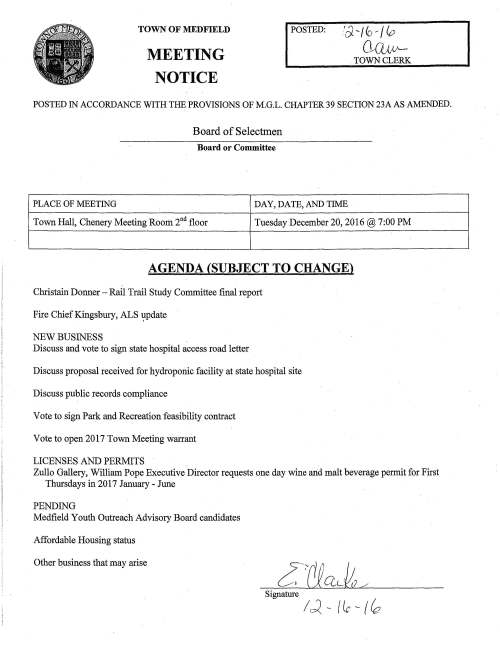
Selectmen 12/20

TOWN OF MEDFIELD MEETING NOTICE POSTED: 'd.-/fo--/0 0/Q,20161220-agenda_page_2

No ALS in town

ambulance

The Medfield Fire Department runs an Emergency Medical Service (EMS), staffed by EMT’s (Emergency Medical Technicians), who are also firefighters.  We have historically utilized Advanced Life Support (paramedic) intercepts  – i.e. the MFD EMT’s will begin the patient transport and transfer the patient to the ALS ambulance when the ALS ambulance intercepts the MFD ambulance on the way to the hospital.  However, within the past two months, two ALS services have cancelled their ALS intercept services with Medfield, because the intercepts were not making enough money, and as a result we currently have no ALS intercept service,.  And we are told,  with the economies making it unlikely that there will be any new ALS offers.

Our EMT’s now transport patients all the way to the hospital.  So what is the difference?  MFD ambulance EMT’s offer fewer services to someone than a paramedic could supply.  As I understand the differences, it is mainly in the ability of paramedics to administer medications, provide shots, and insert IV’s.

Like the author of the email below, I personally met a young Medfield man, at a BSA event, who I was told is alive today, after his heart stopped, only because he was revived by paramedics.

The town will need to make the decision whether it values having a paramedic service enough to pay for it, and if so, how it wants to achieve that change.  One resident who works in another town’s fire department suggested to me several years ago that the town could give its current EMT’s three years to become paramedics.  Becoming a paramedic requires a 1,400 hour training process:  600 hours of classroom work, 400 hours of clinical, and 400 hours of field work.  Such a work change would have to go through the collective bargaining process.  Alternately, the writer below suggest hiring eight new paramedics and having them run the town’s ambulance service, and having the current EMT’s remain as just firefighters.  The MFD would thereby double its size.


Paul Enos <paul.c.enos@gmail.com>
To: eclarke@medfield.net
Dear Medfield Selectmen,
Evelyn Clarke <eclarke@medfield.net>
Mon, Oct 31, 2016 at 12:52 PM
I am writing to formally request the hiring of 8 firefighter/paramedics and the implementation of an Advanced Life Support ambulance be implemented to the Medfield Fire Department services. Many residents I have spoken with would like this matter added to the November 1st Town Meeting Agenda. It is a dangerous gap in our towns services and absolutely must be rectified immediately.

I would like to provide you a personal example of how ALS can impact the survival of a 911 patient. Seven years ago my father and I were working to replace some windows of his Needham home. After about an hour of work in the sun, my father collapsed. He immediately woke and told me he felt dizzy. I called 911 and moved him into a shaded area where I took his blood pressure, which fell to 50/null. How helpless I felt in the moments leading to that point – being a paramedic myself and having no equipment or manpower to help me find out what had gone wrong with my father. Every second felt like eternity, as it does when you are in a crisis. My father soon again went unresponsive when Needham Fire Department Paramedics arrived and began treatment. Within two minutes of patient contact, my father was properly assessed, placed on ECG monitoring, had an IV line established, and fluids initiated to bring his pressure up. It was discovered that his body reacted poorly to being placed on HCTZ (a diuretic) and when coupled with a hot day in the sun, lead to dangerously low blood pressure due to dehydration. If Needham paramedics had not responded and treated my father on site, I believe he would have died that day as his pressure was so low he was subject to cardiac arrest. My father, again, just this past year, required the Needham ALS ambulance when he fell and broke his forearm in 2 places, dislocated his elbow, and fractured his spine. The paramedics could not have moved him without administering narcotics to manage the immense pain he was in that day. ***Every stated skill that was performed on my father in these two instances, are ALS skills, and would not have been provided in the town of Medfield.*** Knowing my family has required these services in the past, and likely will again in the future, I would never recommend my parents move to Medfield. Not until the town adds ALS service to its fire department.

Having the experience of having worked as a paramedic for and along side private services over the past 8 years has given me a definitive perspective that every municipality is better seNed having public sector EMS service. Pr ivate services, as this town has learned recently, has one true interest – Profit. We are without ALS coverage, once again, because these services find our towns service area not to be profitable. They will emphasize how important patient care is to them and tell you what you need to hear to get the contract, but if you get inside those walls and experience how these services operate on a day to day basis, you and much of the public would be horrified to find how these services jeopardize the health and well being of the communities they service in order to turn a profit.

One glaring example I can provide is an incident where I took a transfer patient with my partner to a hospital more than 30 miles outside of our service area. While a competing ambulance service had more localized operating ambulances in several neighboring communities to that service area, my partner and I were still dispatched to an ALS response back in the town as we finished our transfer. We stated back to dispatch our distance from address, but we were told  to continue in to the call. There were likely dozens of ambulances closer to that patient than we were, but they were not dispatched since they were working for a different company. This is how private ems functions. Services will not give up calls to competing ambulance services even if those units are significantly closer to the patient, as this forfeits the profits of that call to the competitor.

Additionally, Private EMS services are a continuous revolving door of personnel. In the world of private ems,  staff are constantly switching companies, service areas, and career fields, leaving little if any continuity over the years. This is for many reasons – poor work conditions, poor pay, lack of quality leadership, and lack of benefits. This leads to massive problems with familiarity with a community, which in truth is half the battle working in a 911 service. Knowing where you are going. Knowing your surroundings and structures. Knowing which hospitals have which capabilities, and which would be the best point of entry for which patients. These logistical skills take great time and effort to ascertain and maintain and go well beyond using a GPS system. Having the same personnel working within your community and system for the length of their career offers enormous benefits relating to response times, community outreach, and continuity of care to town residents who frequently require these services due to chronic health problems. And who are those folks with chronic health problems? Children with special health concerns such as diabetes, asthma, allergies, and other ongoing medical conditions. Residents with disabilities, history of heart disease, and stroke. People who have had to experience medical emergencies first hand are fully aware of this gap in our towns capabilities.

When hired via civil service, employees typically remain with their departments for 30+ years, servicing the same community, working the same streets, and staying current with the changes in the community. They stay committed to their craft as they are provided a stable paying job with strong town benefits, and are integrated into the strong leadership a para-military structure provides in the fire department. They form strong relationships with their community and add the strength of continuity those private sector services lack. Most importantly, their number one priority is the health and well being of their patients. Profit is no longer a factor in clinical and logistical decision making.

Some residents may wonder, “Don’t we already have an ambulance on our fire department?” We do, but we do not have paramedics. A paramedic is a 911 responder who has undergone extensive training on the application of emergency medicine. ALS stands for Advanced Life Support, which is what a paramedic provides to it’s patients. Paramedics carry life saving medications and medical interventions that dramatically impact the survival of the patients they respond to.  These services for Medfield have been covered via a regional contract provided by private ambulance services, which have now abandoned our town for the second time this year as we have been deemed by them to be a poor investment. This leaves us without coverage and relying on borrowing extended response times for ALS service from Walpole and Westwood.

Currently, Medfield has a BLS ambulance. BLS stands for Basic Life Support. It is operated by basic level Emergency Medical Technicians. While these staff members are also vital to a medical response, they do not carry the majority of the life saving medications and interventions that an ALS unit carries. The level of training for a BLS staff member is significantly less than is for ALS. BLS ambulances are essentially transport units that  provide minimal measures in medical intervention. I will outline a two examples of vital differences is how BLS staff treat common medical emergencies versus how ALS treats them.

WHAT IS THE DIFFERENCE IN TREATMENT OF A HEART ATTACK?
If your town offers BLS, the BLS ambulance can provide Aspirin and Oxygen. They will always then call for an ALS Unit and hope one is available to meet them.

If your town offers ALS, they would administer the Aspirin and Oxygen. ALS would them provide a 12-lead ECG. This assists with pinpointing where in the heart the damage is taking place. Based of where the problem is in the heart, Paramedics typically administer Nitroglycerine. This medication opens the coronary arteries to help circumvent blood flow around a blockage in the heart, protecting the heart from cell death and minimizing the damage from a heart attack. ALS also provides IV access to administer narcotics for pain relief as chest discomfort from a heart attack can be significant, and alleviates the anxiety that further progresses damage to the heart. They can also provide blood pressure support with fluids through the IV if needed. These interventions are all time sensitive as with each passing minute, the heart incurs more damage ultimately resulting in disability and death. The sooner ALS reaches you, the more effective these treatments are and the greater chance you have for long term survivability.

WHAT IS THE DIFFERENCE IN TREATMENT OF CARDIAC ARREST?
If your town offer BLS, the BLS ambulance can provide CPR and an Automated Defibrillator. They will always then call for an ALS Unit and hope one is available to meet them.
If your town offers ALS, they would administer CPR and connect to an ECG monitor. With an ECG monitor, a Paramedic is trained to read what arrhythmia has caused the cardiac arrest, and administer the appropriate charge of electricity to treat that arrhythmia. Paramedics will also administer an IV to administer life saving medications that assist in restarting the heart into a normal rhythm. If an IV can not be started, which is the case in many sick patients with poor IV access, paramedics can also drill into the patients bone to administer these medications into the bone marrow. Paramedics will also intubate these patients for a controlled airway and monitor blood gas levels to ensure respiration are being provided as the patient needs them.
These differences in level of care continue through out all medical and traumatic protocols, and I would be happy to outline the difference in care in any medical or traumatic emergency you would like information on. Here is a reference link if you would like to read more treatment differences yourself.

http: //www.mass.gov/eohhs/provider/guidelines/resources/clinical-treatment/public-health-oems-treatment-protocols.html

It is easy to dismiss these differences in care until it is you or a loved one who is in need of these services. A medical emergency comes immediately and without warning, and is not an event a family can appropriately plan for. This is why you hire skilled responders – it is their job to be as prepared as possible for these emergencies. Every second matters when it comes to vital structures of the body. Having a responding public sector ALS services within our community is critical to our towns safety and well being. In addition to providing advanced life support to our community, these first  responders would be cross trained as firefighters, as is typical of this addition, boosting our fire department to 4 members on shift instead of just 2.

Attempting to force our current firefighters to upgrade to ALS is unacceptable and not a viable option. Being a paramedic is a different job with different requirements. It is a decision that should be made by the individual. To be an effective paramedic, it is a training you must want fo obtain and maintain, and while our current fire department members are effective as Firefighter’s and EMT’s, being a paramedic does not translate for all in the field. Additionally, our two firefighters per shift are outnumbered in operating the three different typical responding apparatus – that is an engine company (which supplies water to a fire), a ladder company (which supplies an aerial ladder and ground ladders), and an EMS/Rescue unit. The NFPA (National Fire Protection Association) requires four personnel be staffed to each company for safe and effective operation. Therefore, our fire department should be advancing it’s staffing numbers, not bombarding it’s current members with more tasks when they are already undermanned. Hiring 8 Firefighter/Paramedics would bring our staffing per shift to 4 members, allowing them to at least safely operate any one responding company at one time. The distribution of that staffing and the logistics of how those apparatus respond is surely in great hands with our current fire department members under the leadership of Chief Kingsbury. Please see the NFPA staffing requirement outlined below:

“NFPA 1710 outlines the following minimum requirements for staffing fire suppression The activities involved in
controlling and extinguishing fires. services (based upon operations for a 2000 square-foot, two-story, single-family occupancy with no basement, exposures or unusual hazards):
“A minimum of four fire fighters per engine company. Fire companies whose primary functions are to pump and deliver water and perform basic fire fighting at fires, including search and rescue. or truck company. Fire companies whose primary functions are to perform the variety of services associated with truck work, such as forcible entry, ventilation, search and rescue, aerial operations for water delivery and rescue, utility control, illumination, overhaul, and salvage work. (§ 5.2.2.1.1).”

Though I have not conducted the research to confirm any financial figures, I read one statement by one selectman to be a $1.6 million startup cost. However the billing for the services of an ALS ambulance can help to offset some of the operation costs. Though those profits have proven not to be strong enough to hold a private service in place, the billing income would certainly be a strong contribution towards offsetting the expenses. We cannot go on having these gaps in service, and we cannot go on taking these services from our neighboring communities. I suggest to you that this is no longer a choice, but a necessity. Hiring another private service will only lead to another dropped contract, another gap in coverage, in addition to all the other stated problems that accompany a private service. It would continue leaving our valued fire department understaffed to perform their job. The citizens of Walpole and Westwood have been responsible enough to spend their tax dollars on an ALS ambulance, and every time we need them, we are robbing their community
of the services they pay to keep in place. We need to provide this service for ourselves, and to get our fire department to safe staffing levels. It is our responsibility to provide our emergency departments with the funding to operate their equipment at an emergency scene with safe levels of staffing. They are there to protect us, let’s do what we can to protect them.

It is time for us to act. The longer we wait, the more we invite a tragic outcome. It is time for us to upgrade our fire department and ems services to ALS by hiring 8 Full Time Firefighter/Paramedics to supplement the current hard working department.

Paul Enos
Firefighter/Paramedic
Cambridge Fire Department
Medfield Resident
paul. c. enos@gmail.com

Open house Saturday AM

Public Safety Building

Following is the schedule for the Public Safety Building Open House


Saturday October 29

9:00 AM to Noon

Ribbon cutting ceremony and speeches 9:30 AM

Paramedics gone Monday

ambulance

Email this week about the town’s ALS provider disappearing come Monday, and the town probably needing to have its own paramedics.  From memory, only one of our current firefighters is a paramedic and the rest are EMT’s.  Paramedics are allowed to do more treatment than EMT’s, such as IV’s and injections.


Mike, Kristine,


After approx.10 years of service to Medfield, I was informed late last night that Events EMS who have been providing our Advanced Life Support (Paramedic) services will cease operations as of 0700 hrs Monday morning. This notice came without warning. I will be talking with the Fire Chiefs’ from Millis & Medway who have also been affected by this recent turn of events. We will be looking to see if we can come up with another alternative for ALS services. I don’t believe there are many options. We will continue to use Westwood, Walpole and Norfolk in the interim to fill in until a remedy is found.


I know we have had discussions of going to the next level and have our own Paramedics on staff and I think we now have to have some frank discussions on how we can achieve it.We can’t expect other towns to be providing this service for the long haul.


If you could let the Selectmen know I’d appreciate it.


Chief


Chief William A. Kingsbury

Medfield Fire Department

114 North Street

Medfield, MA 02052

508-359-2323

508-359-2212 (Fax)