Category Archives: Budgets

Moody’s says we’re Aa1

New Issue: Moody’s assigns Aa1 to Medfield, MA’s $18.7M GO Bonds
Global Credit Research – 07 May 2015
Affirms Aa1, affecting $62.3M of parity debt, post-sale

MEDFIELD (TOWN OF) MA
Cities (including Towns, Villages and Townships) MA
Moody’s Rating
ISSUE                                                                  RATING
General Obligation Municipal Purpose Loan of 2015 Bonds  Aa1
Sale Amount                  $18,700,000
Expected Sale Date        05/12/15
Rating Description        General Obligation

Moody’s Outlook NOO
NEW YORK, May 07, 2015 –Moody’s Investors Service has assigned a Aa1 rating to the Town of
Medfield’s (MA)
$18.7 million General Obligation Municipal Purpose Loan of 2015 Bonds. Concurrently, Moody’s has
affirmed the Aa1 rating on the town’s outstanding GO debt. Post-sale, the town will have $62.3
million of GO debt.
SUMMARY RATING RATIONALE
The Aa1 rating reflects the town’s sound financial position, stable residential tax base with
strong wealth levels and a manageable debt and pension burden.
OUTLOOK
Outlooks are usually not assigned to local government credits with this amount of debt outstanding.
WHAT COULD MAKE THE RATING GO UP
-Increased budget capacity and flexibility
-Material increase in available fund balance
-Large increase in the tax base
WHAT COULD MAKE THE RATING GO DOWN
-Prolonged operating imbalance resulting in a decline in available reserves
-Material decline in tax base or demographic profile
-Significant increase in debt burden
STRENGTHS
-Sound financial position with healthy reserve levels
-Stable tax base with strong wealth levels
-History of voter approvals for overrides and exclusions of Proposition 2 ½

CHALLENGES
-Limited levy capacity and budget flexibility due to Proposition 2 ½
-Planned appropriation of reserves RECENT DEVELOPMENTS
The fiscal 2014 audited financials reflect continued stability in the town’s financial position.
The $1.2 million drawdown of General Fund balance in fiscal 2014 reflects the ongoing planned use
of a restricted debt service reserve. Net of this draw, the town ran a surplus of $709,000 with
little change to available fund balance. Please see the Detailed Ratings Rationale for further
details.
DETAILED RATING RATIONALE
ECONOMY AND TAX BASE: STABLE RESIDENTIAL TAX BASE WITH STRONG WEALTH LEVELS
Medfield is a primarily residential community (95% of the 2015 assessed valuation) with a
population of 12,024, located approximately 20 miles southwest of Boston (Aaa stable). The town’s
$2.4 billion tax base is expected to remain stable with limited growth, reflecting a turnaround in
the regional real estate market. Assessed value increased 4.5% in 2015, bringing the five-year
compound annual growth to 0.6%. The town’s equalized value per capita remains strong at $199,561,
reflecting the strength of the residential sector. In addition, the town has a number of
residential developments underway, including new construction of high-end homes and condos, and a
new apartment complex which will continue to provide annual new growth revenue. Wealth levels are
also substantially higher than state and national averages, with median family income well over two
times the national average. Also, the town’s unemployment rate of 3.7% (January 2015) continues to
fall below the state (5.6%) and US (6.1%).
FINANCIAL OPERATIONS AND RESERVES: SOUND OPERATIONS WITH PLANNED USE OF RESERVES; FUND BALANCE
REMAINS HEALTHY
Medfield will maintain a healthy financial position over the near term given conservative budget
practices and limited, planned draws on reserves. Since 2008, the town’s financial statements
reflect annual use of reserves due to the drawdown of a large grant of $18.1 million from the
Massachusetts School Building Authority (MSBA) to cover school-related debt service. The current
balance of the grant is $10.8 million and is classified as restricted fund balance. The annual
drawdown averages $1.2 to $1.3 million and will continue to be reflected in the town’s annual
operations through 2023, the anticipated final draw date.
The fiscal 2014 operating results when netting out the use of $1.3 million of debt service reserve
appropriations reflects an operating surplus of $708,000, attributable to positive variance in
revenues and expenditures. Available fund balance remained relatively unchanged from the prior year
at $7.3 million, or 13.4% of revenues.
The fiscal 2015 budget increased by 3.9%, or $2.2 million from the prior year, driven by education,
health insurance and employee benefits. The budget was balanced with a 1.4% increase to the tax
levy and free cash appropriations of $1.3 million and $1.2 million from the debt service reserve,
covering both operating and capital needs. As of March, revenues are ahead of budget projections
while expenditures are on budget.
The fiscal 2016 budget increased by 6% from 2015 due to the debt exclusion, education, and employee
benefits. The budget is balanced with a 7.9% tax levy increase, free cash appropriation of $898,000
and $1.2 million from the debt service reserve.
Medfield derives the majority of its revenues from property taxes (67% of 2014 revenues) and
continues to benefit from a strong collection rate of 99% within the fiscal year. Positively, the
town benefits from a history of voter- approved general overrides to the Proposition 2 ½ tax levy
limit. In each of 2008, 2009 and 2012, the town passed a override to aid in general operations of
the town and education expenses, providing some additional revenue flexibility. Our ongoing
assessment of the town’s credit quality will factor in management’s ability to continue to maintain
a nominally balanced budget with sound fund balance levels.
Liquidity
Medfield’s net cash position at the end of fiscal 2014 was $23.2 million, or a healthy 42.4% of
revenues. DEBT AND OTHER LIABILITIES

Medfield’s net direct debt burden of 2.3% of equalized value will remain above average, but
manageable, given average amortization of principal and voter support for debt exclusions. The town
currently has no authorized, but unissued debt, and future debt plans are limited to an elementary
school project with an estimated cost of $30 million and expected no sooner than 2020. Given its
history, approval of future projects will likely include debt exclusions from Proposition 2 ½.
Debt Structure
The town’s principal amortization is average with 78% retired in ten years. Fiscal 2014 annual debt
service represented 8.4% of expenditures and the entire debt portfolio consists of fixed rate debt.
Debt-Related Derivatives Medfield has no derivatives. Pensions and OPEB
The town participates in the Norfolk County Contributory Retirement System, a multi-employer,
defined benefit retirement plan. The town’s annual required contribution (ARC) for the plan was
$1.6 million in fiscal 2014, or 2.9% of General Fund expenditures. The town’s 2013 adjusted net
pension liability, under Moody’s methodology for adjusting reported pension data, is $44.7 million,
or a moderate 0.84 times General Fund revenues. Moody’s uses the adjusted net pension liability to
improve comparability of reported pension liabilities. The adjustments are not intended to replace
the town’s reported liability information, but to improve comparability with other rated entities.
Medfield also makes pay-as-you-go contributions to OPEB in the amount of $1.5 million in 2014,
representing 41% of the ARC. The UAAL is $43 million and the town has established an OPEB trust and
recently began making annual deposits of $400,000. The 2014 total fixed costs for pension, OPEB and
debt service represented $7.8 million or 14% of expenditures.
MANAGEMENT AND GOVERNANCE
Massachusetts cities have an institutional framework score of ‘Aa’ or strong. The primary revenue
source for Massachusetts municipalities is property taxes which are highly predictable and can be
increased annually as allowed under the Proposition 2 ½ levy limit. Expenditures are largely
predictable and cities have the ability to reduce expenditures.
The town’s management team has shown a long term trend of consistent and conservative fiscal
management with multi-year capital planning.
KEY STATISTICS
-2015 Equalized Valuation: $2.4 billion
-2015 Equalized Value Per Capita: $199,561
-Median Family Income as % of US Median: 208.69%
-Fiscal 2014 operating fund balance as a % of revenues: 13.46%
-5-Year Dollar Change in Fund Balance as % of Revenues (2010-2014): 4.58%
-Fiscal 2014 Cash Balance as % of Revenues: 42.56%
-5-Year Dollar Change in Cash Balance as % of Revenues (2010-2014): 0.55%
-Institutional Framework: “Aa”
-5-Year Average Operating Revenues / Operating Expenditures (2010-2014): 0.98x
-Net Direct Debt as % of Full Value: 2.29%
-Net Direct Debt / Operating Revenues: 1.0x
-3-Year Average of Moody’s ANPL as % of Full Value: 1.35%

-3-Year Average of Moody’s ANPL / Operating Revenues: 0.6x OBLIGOR PROFILE
Medfield is a primarily residential community with a population of 12,024, located approximately 20
miles southwest of Boston.
LEGAL SECURITY
Of the current issue, $18 million is secured by the town’s general obligation unlimited tax pledge
as debt service has been excluded from the levy limitations of Proposition 2 ½. The balance is
secured by the town’s general obligation limited tax pledge as debt service has not been excluded
from the levy limit.
Of the town’s $45 million of outstanding debt, $31.7 million is secured by the town’s general
obligation unlimited tax pledge as debt service has been excluded from the levy limitations of
Proposition 2 ½. The balance is secured by the town’s general obligation limited tax pledge as debt
service has not been excluded from the levy limit.
USE OF PROCEEDS
Bond proceeds will be used to finance a public safety building project and solar project. RATING
METHODOLOGY
The principal methodology used in this rating was US Local Government General Obligation Debt
published in January 2014. Please see the Credit Policy page on http://www.moodys.com for a copy of this
methodology.
REGULATORY DISCLOSURES
For ratings issued on a program, series or category/class of debt, this announcement provides
certain regulatory disclosures in relation to each rating of a subsequently issued bond or note of
the same series or category/class of debt or pursuant to a program for which the ratings are
derived exclusively from existing ratings in accordance with Moody’s rating practices. For ratings
issued on a support provider, this announcement provides certain
regulatory disclosures in relation to the rating action on the support provider and in relation to
each particular rating action for securities that derive their credit ratings from the support
provider’s credit rating. For provisional ratings, this announcement provides certain regulatory
disclosures in relation to the provisional rating assigned, and in relation to a definitive rating
that may be assigned subsequent to the final issuance of the debt, in each case where the
transaction structure and terms have not changed prior to the assignment of the definitive rating
in a manner that would have affected the rating. For further information please see the ratings tab
on the issuer/entity page for the respective issuer on http://www.moodys.com.
Regulatory disclosures contained in this press release apply to the credit rating and, if
applicable, the related rating outlook or rating review.
Please see http://www.moodys.com for any updates on changes to the lead rating analyst and to the Moody’s
legal entity that has issued the rating.
Please see the ratings tab on the issuer/entity page on http://www.moodys.com for additional regulatory
disclosures for each credit rating.
Analysts
Nicholas Lehman Lead Analyst
Public Finance Group Moody’s Investors Service
Thomas Compton Backup Analyst Public Finance Group
Moody’s Investors Service
Geordie Thompson Additional Contact Public Finance Group

Moody’s Investors Service
Contacts
Journalists: (212) 553-0376
Research Clients: (212) 553-1653

Moody’s Investors Service, Inc. 250 Greenwich Street
New
New
USA

House budget passed

The Mass. Municipal Association has analyzed and sent out an alert on the House budget, and its inadequacies.  The main MMA issues continue to be the lack of proper financial support by the state for the towns, and mainly education funding.  The Governor’s budget proposed a $20/child increase in education funding, the House proposes a $25/child increase, and the MMA says it really should be $100/child, but at the very least a $50/child increase.

This was the MMA alert yesterday analyzing the House budget –


Thursday, April 30, 2015

HOUSE PASSES $38.1B FY 2016 STATE BUDGET THAT INCLUDES FUNDING FOR KEY MUNICIPAL AND SCHOOL AID PROGRAMS

BUDGET AND LOCAL AID ACTION NOW GOES TO THE SENATE:
PLEASE CALL YOUR SENATORS TODAY AND URGE THEM TO INVEST IN CITIES AND TOWNS

Late yesterday afternoon, after 3 days of deliberation on 1096 amendments, the members of the House of Representatives unanimously adopted a trim $38.1 billion fiscal 2016 state budget plan that is nearly identical to the House Ways and Means draft (H. 3400) that was unveiled 2 weeks ago.

The House-passed budget would increase overall state expenditures by less than 3 percent, as the state seeks to close a projected $1.8 billion structural budget deficit by restraining spending and eliminating 4,500 state jobs through an early retirement program. The final House budget is several million dollars smaller than the budget filed by Governor Baker in March.

The action now turns to the state Senate. The Senate Ways & Means Committee is expected to release its proposed budget by mid-May, and the full Senate will pass its version before the end of the month.

The House budget provides strong progress on many important local aid priorities, while there are still a number of issues where further action or additional funding is needed.

Here is a summary and status of the key municipal and school funding issues in the fiscal 2016 state budget as adopted by House of Representatives on Wednesday:

$34 MILLION INCREASE IN UNRESTRICTED MUNICIPAL AID
In a major win for cities and towns, the House budget supports $979.8 million for UGGA, a $34 million increase over current funding – the same increase proposed by Governor Baker.  This would be the largest increase in discretionary municipal aid in nearly a decade.  Every city and town would see their UGGA funding increase by 3.6 percent.

$8.3 MILLION INCREASE INTENDED TO FULLY FUND SPECIAL EDUCATION CIRCUIT BREAKER
In another victory for cities and towns, House members supported full funding for the Special Education Circuit Breaker program.  Their budget plan would provide $261.7 million, an $8.3 million increase above fiscal 2015, with the intention of fully funding the account.  This is a vital program that every city, town and school district relies on to fund state-mandated services.

RESTORES $5 MILLION TO REGIONAL SCHOOL TRANSPORTATION
Last November, former Gov. Patrick used his 9C budget powers to eliminate the $18.7 million increase regional school transportation reimbursements that the Legislature originally enacted for fiscal 2015, reducing the final amount to $51.5 million.  The Governor proposed level funding at $51.5.  Recognizing the importance of this funding, the final House budget would restore $5 million to bring regional transportation reimbursements up to $56.5 million.  A proposed amendment to increase funding by another $4 million did not pass during the House budget debate.

RESTORES $18.6 MILLION TO KINDERGARTEN DEVELOPMENT GRANTS
The House budget would restore $18.6 million to the Kindergarten Development Grant program.  The Governor’s budget would have eliminated all funding, and House members want to level-fund the current appropriation, at least for the next year.  This is an important account, because eliminating the $18.6 million would have jeopardized expanded kindergarten programs all throughout the state.

CHAPTER 70 MINIMUM AID WOULD INCREASE TO $25 PER STUDENT
The House budget supports a $108.2 million increase in Chapter 70 education aid, with a provision providing every city, town and school district an increase of at least $25 per student.  This is $2.9 million more than the recommendation in the Governor’s budget submission, which included minimum aid of only $20 per student.  During the debate, the House did not adopt an amendment to raise minimum aid to $50 per student. Because most cities and towns only receive minimum aid, the MMA is calling for at least $50 per student minimum aid in the Legislature’s final budget.

McKINNEY-VENTO REIMBURSEMENTS WOULD INCREASE BY $1 MILLION
The final House budget would add $1 million to increase fiscal 2016 reimbursements for the transportation of homeless students to $8.4 million.  While the account remains below the full reimbursement called for under the state’s unfunded mandate law, it would be the first increase since fiscal 2013.  The House did not pass a proposed amendment to fully fund the account.

CHARTER SCHOOL REIMBURSEMENTS REMAIN SERIOUSLY UNDERFUNDED
Under state law, cities and towns that host or send students to charter schools are entitled to be reimbursed for a portion of their lost Chapter 70 aid.  The state fully funded the reimbursement program in fiscal 2013 and 2014, but is underfunding reimbursements by approximately $34 million this year.  Both the Governor and the House Ways and Means budgets would level-fund charter school reimbursements at $76.8 million, which would guarantee another major shortfall in fiscal 2016, and result in cutbacks for the majority of students who remain in the traditional school setting.  Increasing this account was a top priority for municipalities and school districts during the budget debate, but House members rejected an amendment that would have raised funding up to $130.5 million.  This will continue to be a major budget issue as debate turns to the Senate.

PAYMENTS-IN-LIEU-OF-TAXES (PILOT), LIBRARY AID ACCOUNTS, METCO, AND SHANNON ANTI-GANG GRANTS
The House budget would level fund PILOT payments at $26.77 million, continue to fund library grant programs at $18.5 million, and restore funding for METCO to $20.14 million. During debate, the House adopted an amendment to add $1 million to the Shannon anti-gang grant program, providing a final appropriation of $6 million, which is still $1 million below current fiscal 2015 (post-9C) funding.

PROTECTION OF MUNICIPAL EMERGENCY MEDICAL SERVICES
During the budget debate, Representatives approved an amendment adding an outside section that would prevent the practice of “pay the patient” by insurance companies, which undermines the ability of cities and towns to fund and operate effective and efficient ambulance services that are at the core of emergency medical response in Massachusetts. “Pay the patient” would force communities to pursue their own residents to recoup thousands of dollars in ambulance expenses, a system that is inefficient and subject to abuse.  The amendment would also clarify that municipalities are authorized to set a fair rate for ambulance services, preventing insurance companies from shifting costs to local property taxpayers through below-cost reimbursements.

COMMUNITY PRESERVATION ACT FUNDING COULD RECEIVE $10 MILLION
During fiscal 2015, 156 cities and towns collected the local Community Preservation Act (CPA) surcharge and are eligible for state matching grants in fiscal 2016.  The Division of Local Services (DLS) estimates that the balance in the state trust fund will be sufficient to provide a first round match of only 18 percent of the surcharge levied by each city and town.  This would be the lowest state match in the program’s history.  Knowing this, House members voted to dedicate up to $10 million of any fiscal 2015 year-end state budget surplus to supplement the fiscal 2016 state match.

Please Call Your Senators Today and Urge them to Support Essential Funding for Municipal and Education Aid – Including the $34 Million Increase in Unrestricted Local Aid, Full Funding for the Special Education Circuit Breaker, Restoring Kindergarten Grants, and Adding Funds to Regional School Transportation

Please Explain How the House Budget Impacts Your Community, and Ask Your Senators to Build on this Progress with Further Increases for Charter School Reimbursements, Chapter 70 Minimum Aid, Regional School Transportation and Other Key Accounts

Thank You!

ATM 2015

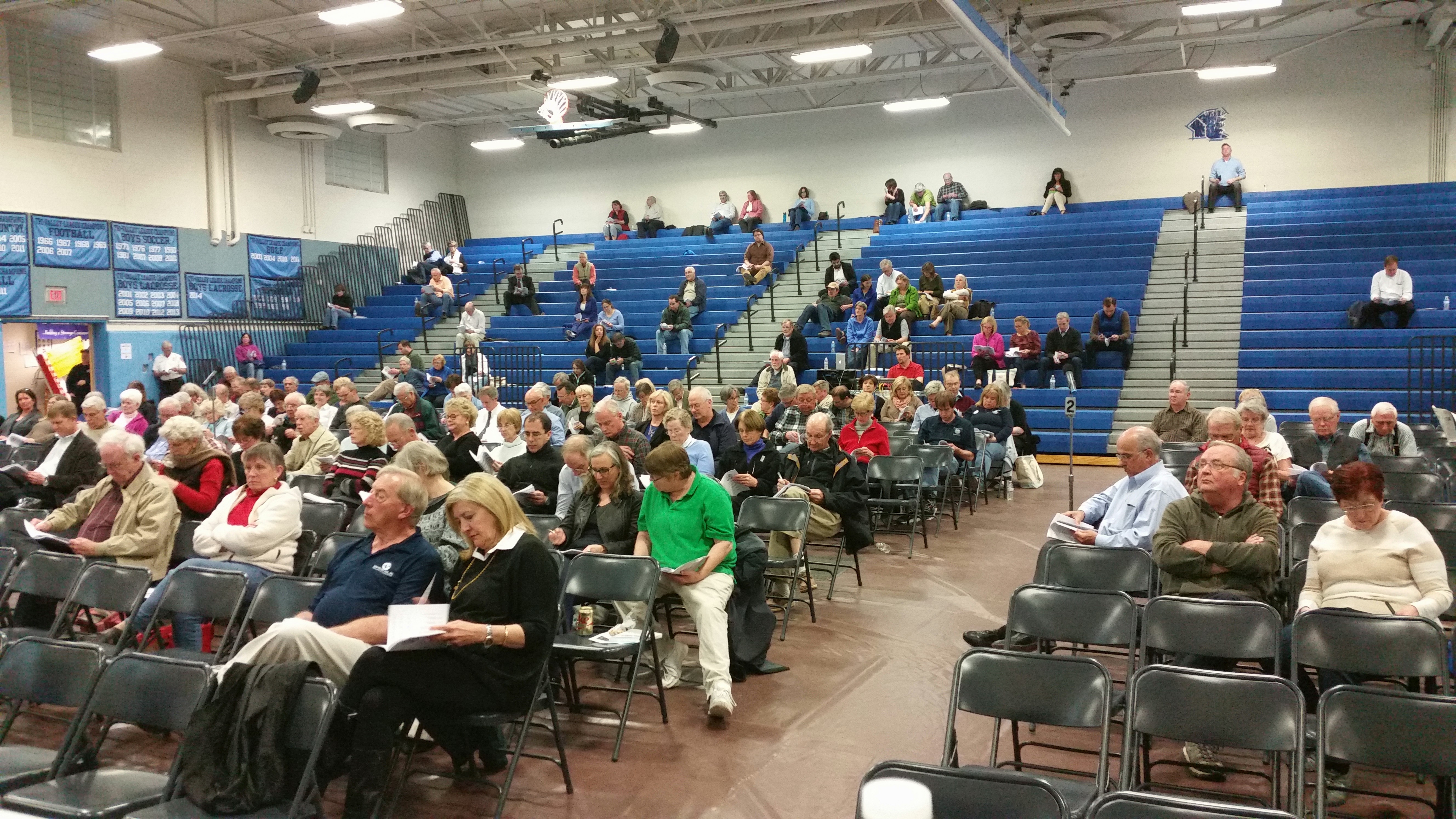
At last night’s annual town meeting it took about an extra ten minutes after the 7:30 PM scheduled start time for the 250th attendee to arrive and make the required quorum number.  This was the MHS gym at the outset.

2015-2

In what was mainly a routine ATM, the three most contentious issues turned out to be:

  1. a proposed zoning change that would have deleted a limit on  building heights to “2 1/2 stories,” to instead to rely upon the 35′ height limit.  There is no definition in our zoning of what constitutes a “1/2 story,” so that vagueness in that current zoning caused the Planning Board to seek greater certainty.  Zoning changes need a 2/3 vote to pass, and this article probably did not even get a simple majority, and thus was easily defeated.
  2. Straw Hat Park funding of $32,500, which is half of what is required to construct what will surely be the gem of the downtown, thus making the construction happen over two years instead of  one.  It passed by a vote of 143-96.  Lots of discussion for such a small part of the town’s $60m. annual budget.
  3. $150,000 to fund the consultants this next year for the master planning and continued clean up of the former Medfield State Hospital site, which controversy was caused by warnings from one resident that development at the MSH site had already been predetermined, and that the no build/open space option is not included, despite that the latter has always been stated as the first option that the master planning will consider.

This was the room at the 10:30 PM end of the ATM, when we had almost certainly dropped below the quorum level, but thankfully no one asked for a quorum call, so we successfully concluded the town’s business –

2015-1

MMA on state budget

This today from the Massachusetts Municipal Association on what is important to towns in the state budget.  Highlights are the $50/pupil minimum state funding for education (currently it is at $25/pupil) and $25m. for the CPA –


Thursday, April 23, 2015

HOUSE DEBATE ON FY 2016 STATE BUDGET BEGINS MONDAY – CALL YOUR REPS.

Lawmakers Will Decide the Fate of 1,096 Amendments

Please Call Your Representatives Today on the Budget Amendments that Impact Key Municipal and School Priorities

The House of Representatives will begin debating the $38 billion fiscal 2016 state budget on Monday, April 27. The deliberations are expected to take several days, as Representatives have filed 1,096 amendments to make changes to H. 3400, the House Ways & Means Committee’s budget recommendation that was released last week.

Many of these amendments would directly impact cities and towns, including a number of welcome amendments that would increase funding for municipal and school aid accounts, and an unwelcome amendment that would have a negative impact on municipalities. This Legislative Alert describes the most important amendments that will be debated.

Please Call Your Representatives Today

Please call your Representatives as soon as possible today to secure their support for those amendments that would help your community, and ask them to oppose those amendments that would be harmful.

Lawmakers must hear from you on these issues. Because of the great number of amendments, the summaries here are very brief. Please contact MMA Legislative Director John Robertson at jrobertson@mma.org or 617-426-7272 x122 at any time if you have questions or need more details.

When you call your Representatives, please make sure to thank them for the proposals in the House budget to increase Unrestricted General Government Aid by $34 million (matching the Governor’s recommendation), for the $8.3 million increase intended to fully fund the Special Education Circuit Breaker, and for restoring $18.6 million to Kindergarten Development Grants.

Please Click Here to Download a Copy of the MMA’s Budget Letter to the House

Please Click Here to Visit the House Budget Website to See the Amendments: The House budget committee recommendation (H. 3400) and all proposed amendments are posted on the Legislature’s website at: http://malegislature.gov/Budget/FY2016/House/ChamberActions

KEY BUDGET AMENDMENTS ON SCHOOL AND EDUCATION FUNDING
Adequate Chapter 70 Minimum Aid for Municipal and Regional Schools
The MMA is calling for a sufficient funding increase for Chapter 70 school aid to ensure that all municipal and regional school districts are able to reach the “foundation” level of spending, implement the equity provisions adopted in 2006, and provide an adequate amount of minimum aid that ensures that all schools receive an increase in fiscal 2016.

The Governor proposed a fiscal 2016 Chapter 70 increase of $105.3 million, which includes minimum aid of only $20 per student for 245 cities, towns and school districts, an insufficient amount to maintain current school staffing and services.  The HW&M recommendation would increase minimum aid to $25 per student, but in reality this still leaves too many schools unable to maintain quality school programs.  Recognizing that the Foundation Budget Review Commission will not file its report until mid-2015, far past the deadline for inclusion in the fiscal 2016 state budget, the MMA is urging the House to adopt a higher minimum aid amount to prevent further erosion in school financing at the local level.

• Please ask your Representatives to Support Amendment 663 filed by Rep. Cutler and others to increase the “minimum aid” amount to $50 per student.  This amendment would benefit 245 cities, towns and school districts, and give these communities a better chance of maintaining the quality of their existing education programming.

Reimbursements for Charter School Losses
The diversion of Chapter 70 school aid away from public schools to pay tuition to charter schools has imposed a major and growing financial burden on cities and towns, a problem made more acute as the state grants more charters and existing charter schools expand.  Local officials strongly support full funding of the Commonwealth’s commitment under section 89 of Chapter 71 of the General Laws to reimburse school districts for the loss of a portion of their Chapter 70 aid that is redirected to fund charter schools.

In fiscal 2015, it is expected that cities and towns will be forced to divert $444 million to fund charter schools, 10 percent of all Chapter 70 dollars.  This illustrates the importance of this issue to local governments, and why it is critical for the state to meet its commitment to this program.  The original $80 million appropriation in the fiscal 2015 general appropriations act was $30.5 million below the full funding amount required in the statutory formula, which was signed into law only a few years ago.  The problem has deepened with two rounds of 9C cuts to this account ($3.1 million), increasing the fiscal 2015 shortfall to at least $33.6 million.

The funding shortfall means that cities and towns are receiving only a fraction of the reimbursements due according to state law.  This is impacting a large number of communities, including some the state’s poorest and most financially distressed cities and towns.  Thus, the underfunding of the charter school reimbursement formula is harming the most vulnerable and challenged school districts and communities.

The Governor’s fiscal 2016 budget would level fund charter school reimbursements at $76.9 million, even though local payments to charter schools are expected to increase by $55 million.  Full funding of the statutory formula would require $130.5 million.  Without these funds, cities and towns will face another major shortfall next year, and result in cutbacks for the vast majority of students who remain in the traditional public school setting.  The HW&M budget includes the Governor’s recommendation for this account.

• Please ask your Representatives to Support Amendment 822 filed by Rep. Ultrino and others, and Amendment 795 filed by Rep. Malia and others.  These critical amendments would fully fund charter school reimbursements due to cities, towns and regional school districts by providing the full $130.5 million necessary to meet the state’s obligation.

McKinney-Vento Homeless Student Transportation Costs
In fiscal 2013, the state budget provided $11.3 million to fully fund the state-mandated costs that resulted from the Commonwealth’s adoption of the federal McKinney-Vento Act. The State Auditor ruled that the McKinney-Vento program was an unfunded mandate on cities and towns, and the Legislature provided full funding soon after that ruling.  Under the program, communities are providing very costly transportation services to bus homeless students to schools outside of the local school district.  However, the fiscal 2014 state budget reduced McKinney-Vento reimbursements to $7.4 million, underfunding this state mandate.  Full funding for this year is estimated at $19.8 million, but the Commonwealth level-funded the program at $7.35 million, creating a shortfall of $12.5 million in the current fiscal year.

The Governor proposed a $1 million increase for fiscal 2016 to bring funding for McKinney-Vento reimbursements up to $8.4 million, which is the amount provided in H. 3400.  Full funding for this state mandate would require $20.8 million, according to the most recent DESE projection.

• Please ask your Representatives to Support Amendment 620 filed by Rep. Heroux and others that would fully fund reimbursements due to municipalities and school districts for the cost of transporting homeless students from temporary shelters to school.

Regional School District Student Transportation Reimbursements
Funding for transportation reimbursements to regional school districts is vital to all regional districts and their member cities and towns, particularly in sparsely populated parts of the state.  The Legislature appropriated $70.3 million for fiscal 2015, but, unfortunately, Governor Patrick used his 9C powers to cut the amount in November by 27 percent, an unexpected $18.7 million loss, returning the program to fiscal 2014 levels just months after coming closer to full funding. Decades ago, the state promised 100 percent reimbursement as an incentive for towns and cities to regionalize, and the consistent underfunding of this account has presented serious budget challenges for these districts, taking valuable dollars from the classroom.  Governor Baker’s budget proposal would level-fund regional school transportation reimbursements at $51.5 million, dropping the reimbursement percentage down to 64 percent.  The House Ways and Means Committee would restore $5 million to this key program in fiscal 2016, and bring funding up to $56.5 million, a positive and helpful increase, yet still below the funding needed.

• Please ask your Representatives to Support Amendment 744 filed by Rep. Benson and others that would increase transportation reimbursements to regional school districts by an additional $4 million to bring fiscal 2016 funding to $60.5 million.

Out-of-District Vocational Education Student Transportation
The fiscal 2015 state budget included $2.25 million item to reimburse communities for a portion of the $3.8 million cost of transporting students to out-of-district placements in vocational schools, as mandated by state law.  This account recognizes the significant expense of providing transportation services for out-of-district placements, as these students must travel long distances to participate in vocational programs that are not offered locally. Governor Patrick slashed all funding with his November 9C cuts, a painful mid-year loss.  The Governor’s fiscal 2016 recommendation and the HW&M budget do not include any funding.

• Please ask your Representatives to Support Amendment 151 filed by Rep. Durant and others to fully fund the $3.9 million cost of transporting students to out-of-district placements in vocational schools.

Kindergarten Expansion Grants
Cities, towns and regional school districts across the Commonwealth use this important grant program to support full-day access to local kindergarten programs.  Funding for the program in the fiscal 2015 general appropriations act was $23.9 million before being reduced through two rounds of 9C cuts to $18.6 million.  The Governor’s budget recommendation would eliminate all funding in fiscal 2016, an extremely disruptive step that would force participating communities to immediately decide whether to end or scale back their current kindergarten programs or cut other school and classroom services.  The MMA applauds the recommendation in H. 3400 to restore funding for Kindergarten Development Grants to the fiscal 2015 post 9C level of $18.6 million, and is asking House members to restore the program to the original $23.9 million level.

• Please ask your Representatives to Support Amendment 502 filed by Rep. DiNatale and others to level fund this accounts at the original fiscal 2015 appropriation.

KEY BUDGET AMENDMENTS ON MUNICIPAL AID PROGRAMS AND
MUNICIPAL MANAGEMENT POLICY

Please ask your Representatives to Oppose Amendment 601, Which Would Circumvent and Weaken Municipal Personnel Law by Allowing Tobacco Users to Qualify for the Public Safety Heart-Lung and Cancer Presumptions

Because of special provisions in state law that established a work-related presumption for heart and lung disease for public safety personnel, state law mandates a no smoking rule for public safety employees.  Under Chapter 32 of the General Laws, any police officer or firefighter with heart disease and any firefighter with lung disease or lung cancer is automatically eligible for a disability pension, but the enactment of these presumptions included an absolute ban on the use of tobacco products because smoking and tobacco use is the primary and overwhelming cause of heart and lung disease and cancer. Under Section 101A of Chapter 41, employees who violate this strict prohibition are subject to dismissal.  This has been the law since 1988.

But Amendment 601 would reverse 27 years of standing law and personnel policy, and instead mandate that a smoking cessation program be offered to those who violate the policy while keeping the presumption in place for these employees, in spite of their use of tobacco products.  All public safety personnel are aware of the no smoking rule, and violations must be addressed fully because the special treatment and protections that are in place were granted only on the condition that these employees refrain from tobacco use.  Amendment 601 would remove a very important taxpayer protection, and should be rejected.

• Please ask your Representatives to Oppose Amendment 601, which would significantly weaken the smoking prohibition for public safety employees.

Payments-in-Lieu-of-Taxes (PILOT)
The Payment-in-Lieu-of-Taxes (PILOT) program is a particularly important program for the cities and towns that host and provide municipal services to state facilities that are exempt from the local property tax.  This account is underfunded at $26.77 million this year, and is still below fiscal 2008 funding.  Many of our state’s smallest communities rely heavily on PILOT payments, and shortfalls in this account have a significant impact on their ability to deliver basic municipal services.  House One and H. 3400 would level fund PILOT at $26.77 million.

• Please ask your Representatives to Support Amendment 961 filed by Rep. D’Emilia to add $3.5 million to increase PILOT payments to cities and towns, and bring the account up to $30.3 million.

Shannon Anti-Gang Grants
• The Shannon Grant program has been very effective in enabling cities and towns to respond to and suppress gang-related activities.  Please ask your Representatives to Support Amendment 945 filed by Rep. Brady and others to increase funding for the Shannon anti-gang grant program.  This amendment would add $3.25 million and bring total funding up to $8.25 million, which is the original fiscal 2015 appropriation.

Safe and Successful Youth Initiative
• Please ask your Representatives to Support Amendment 907, filed by Rep. Vega and others to increase funding of the Safe and Supportive Youth Initiative from $6 million to $9.5 million. The program seeks to reduce youth violence through wrap-around services for those most likely to be victims or perpetrators, and is vital to violence prevention efforts in dozens of communities.

Summer Jobs for At-Risk Youth
• Please ask your Representatives to Support Amendment 572 filed by Rep. Scibak and others to increase funding for youth summer jobs from $9 million to $12 million. This funding is critical to providing employment opportunities for at-risk teenagers in our cities and towns, especially with youth unemployment rates climbing.

Protection of Municipal Emergency Medical Services
• Please ask your Representatives to Support Amendment 1040 filed by Rep. Cantwell of Marshfield and others that would prevent the practice of “pay the patient,” by insurance companies, which undermines the ability of cities and towns to fund and operate responsive and efficient ambulance services that are at the core of emergency medical services in Massachusetts. “Pay the patient” would force communities to pursue their own residents to recoup thousands of dollars in ambulance expenses, a system that is inefficient and subject to abuse.  Amendment 1040 would also clarify that municipalities are authorized to set a fair rate for ambulance services. Cities and towns set fees and charges for a wide variety of municipal services very strictly limited by state law to the cost of providing the service. This is the same rule that would apply to rate setting for emergency ambulance services. It would ensure that rates are reasonable and prevent insurance companies from shifting costs to local property taxpayers through below-cost reimbursements.

KEY BUDGET AMENDMENTS ON CAPITAL SPENDING PRIORITIES

Brownfields Redevelopment Funds
• Please ask your Representatives to Support Amendment 753 filed by Rep. Walsh and others to increase available funding for brownfield redevelopment projects.  This funding is critical to the successful redevelopment of former industrial sites and will enhance local economic development efforts across the state, and improve the environment.  This amendment would appropriate $15 million to recapitalize the Brownfield Redevelopment Fund.

Community Preservation Act Funding
During fiscal 2015, 156 cities and towns collected the local Community Preservation Act (CPA) surcharge and are eligible for state matching grants in fiscal 2016.  The Division of Local Services (DLS) estimates that the balance in the state trust fund will be sufficient to provide a first round match of only 18 percent of the surcharge levied by each city and town.  This would be the lowest state match in the program’s history.

• Please ask your Representatives to Support Amendment 881 filed by Rep. Kocot and others that would dedicate a portion of any fiscal 2015 year-end state budget surplus, up to $25 million, to supplement the fiscal 2016 state match.  The fiscal 2014 state match was supplemented by $25 million from the fiscal 2013 year-end surplus, and $11.4 million was made available last year from the fiscal 2014 surplus.

Please Call Your Representatives Today on the Budget Amendments that Impact Your Community!

 Thank You!

MMA on House budget

The annual state budget process starts with the Governor’s proposed budget, followed next by the House version, then next by the Senate version, and the final result from the House/Senate committee set up to resolve the two versions.  This year we are now up to the House version, and below is the Massachusetts Municipal Association’s comments on that House version.

To put state aid to towns in its recent context, while the state revenues have now recovered to be above the levels existing before the Great Recession, the state’s revenue sharing aid to municipalities still lags far behind the pre-2007 levels.  The general result of that lower state aid is that the state has effectively transferred to cities and towns the cost of providing the required municipal services.  Towns must then either opt to provide less service, or tax our residents more via property taxes to get the same level of service as before the Great Recession.

If residents do not like their property taxes rising, they should have a discussion with their state legislators to ask for a return to pre-2007 state aid levels.


Wednesday, April 15, 2015

HOUSE BUDGET COMMITTEE OFFERS $38B FY 2016 STATE BUDGET THAT MAKES KEY INVESTMENTS IN MUNICIPAL AND SCHOOL AID
• INCLUDES THE FULL $34M INCREASE IN UNRESTRICTED MUNICIPAL AID (UGGA)
• ADDS $8.3M TO SPECIAL EDUCATION CIRCUIT BREAKER
• RESTORES $5M TO REGIONAL SCHOOL TRANSPORTATION
• RESTORES $18.6 MILLION TO KINDERGARTEN DEVELOPMENT GRANTS
• INCREASES CHAPTER 70 MINIMUM AID TO $25 PER STUDENT
• LEVEL-FUNDS MOST OTHER MUNICIPAL AND SCHOOL ACCOUNTS

Earlier this afternoon, the House Ways and Means Committee reported out a lean $38 billion fiscal 2016 state budget plan to increase overall state expenditures by 2.8 percent, as the state seeks to close a projected $1.8 billion structural budget deficit by restraining spending and eliminating 4,500 state jobs through an early retirement program. The House Ways and Means budget is $100 million smaller than the budget filed by Governor Baker in March.  The full House will debate the fiscal 2016 state budget during the week of April 27.

H. 3400, the House Ways and Means budget, provides strong progress on many important local aid priorities, including the full $34 million increase in Unrestricted General Government Aid that the Governor proposed and communities are counting on. The House W&M Committee would increase funding for several major aid programs, by adding $8.3 million to the Special Education Circuit Breaker, restoring $18.6 million to Kindergarten Development Grants, restoring $5 million to Regional School Transportation, and increasing Chapter 70 minimum aid from $20 to $25 per student.

PLEASE CLICK HERE TO SEE THE UNRESTRICTED GENERAL GOVERNMENT AID AND CHAPTER 70 AID AMOUNTS FOR YOUR COMMUNITY AS PROPOSED IN THE HOUSE WAYS AND MEANS COMMITTEE BUDGET

$34 MILLION INCREASE IN UNRESTRICTED MUNICIPAL AID
In a major victory for cities and towns, H. 3400 (the HW&M fiscal 2016 budget plan) would provide $979.8 million for UGGA, a $34 million increase over current funding – the same increase proposed by Governor Baker.  The $34 million would increase UGGA funding by 3.6 percent, which is 75 percent of the projected 4.8 percent increase in state tax collections next year.  This would be the largest increase in discretionary municipal aid in nearly a decade.  Every city and town would see their UGGA funding increase by 3.6 percent.

$8.3 MILLION INCREASE INTENDED TO FULLY FUND SPECIAL EDUCATION CIRCUIT BREAKER
In another victory for cities and towns, House leaders have announced that they support full funding for the Special Education Circuit Breaker program.  Their budget plan would provide $261.7 million, an $8.3 million increase above fiscal 2015, with the intention of fully funding the account.  This is a vital program that every city, town and school district relies on to fund state-mandated services.

RESTORES $5 MILLION TO REGIONAL SCHOOL TRANSPORTATION
Last November, former Gov. Patrick used his 9C budget powers to eliminate the $18.7 million increase regional school transportation reimbursements that the Legislature originally enacted for fiscal 2015, reducing the final amount to $51.5 million.  The Governor proposed level funding at $51.5 million.  Recognizing the importance of this funding, the House Ways and Means Committee budget would restore $5 million to bring regional transportation reimbursements up to $56.5 million.  The MMA will work to continue building on this welcome increase.

RESTORES $18.6 MILLION TO KINDERGARTEN DEVELOPMENT GRANTS
The House Ways & Means budget would restore $18.6 million to the Kindergarten Development Grant program.  The Governor’s budget would have eliminated all funding, and House leaders want to level fund the current appropriation, at least for the next year.  This is an important account, because eliminating the $18.6 million would have jeopardized expanded kindergarten programs all throughout the state.

CHAPTER 70 MINIMUM AID WOULD INCREASE TO $25 PER STUDENT
The House budget committee is proposing a $108.2 million increase in Chapter 70 education aid, with a provision providing every city, town and school district an increase of at least $25 per student.  This is $2.9 million more than the recommendation in the Governor’s budget submission.  The budget would continue to implement the target share provisions enacted in 2007.  Because most cities and towns only receive minimum aid (245 operating districts in cities, towns and regions would only receive minimum aid), the MMA will work to build on this progress and will continue to advocate for higher funding.

McKINNEY-VENTO REIMBURSEMENTS WOULD INCREASE BY $1 MILLION
The House Ways and Means Committee budget would add $1 million to increase reimbursements for the transportation of homeless students to $8.4 million, the same funding level proposed in the Governor’s budget.  While the account remains below the full reimbursement called for under the state’s unfunded mandate law, it would be the first increase since fiscal 2013.

CHARTER SCHOOL REIMBURSEMENTS UNDERFUNDED
Under state law, cities and towns that host or send students to charter schools are entitled to be reimbursed for a portion of their lost Chapter 70 aid.  The state fully funded the reimbursement program in fiscal 2013 and 2014, but is underfunding reimbursements by approximately $34 million this year.  Both the Governor and the House Ways and Means budgets would level-fund charter school reimbursements at $76.8 million, which would guarantee another major shortfall in fiscal 2016, and result in cutbacks for the majority of students who remain in the traditional school setting.  Increasing this account will be a top priority during the budget debate.

PAYMENTS-IN-LIEU-OF-TAXES (PILOT), LIBRARY AID ACCOUNTS, METCO, AND SHANNON ANTI-GANG GRANTS
The House budget committee’s proposal would level fund PILOT payments at $26.77 million, continue to fund library grant programs at $18.5 million, and restore funding for METCO to $19.1 million.  All three of these accounts are funded the same in both the Governor and House Ways and Means budgets.  However, the HW&M budget would reduce Shannon Anti-Gang Grants to $5 million, a $2 million reduction.

CPA – Lexington’s experience

Interesting insights below into the Community Preservation Act, by Lexington’s Capital Expenditure Committee, which in hindsight rued its opposition to the CPA, given how much state money they got.

The CPA is all about getting the state matching money – because that state money in turn lowers our property taxes (if we eventually spend for open space, historic preservation, and affordable housing).

Medfield has adoption of the CPA as a question at its annual town meeting on 4/27/15, at 7:30 PM in the gym at MHS.


LEXINGTON CAPITAL EXPENDITURES COMMITTEE
STATEMENT TO TOWN MEETING
April 6, 2011
(edited for length)
When Lexington’s Town Meeting considered adopting the Community
Preservation Act in 2005, the Capital Expenditures Committee unanimously
recommended its rejection, primarily citing concerns about “crowding” out
future Proposition 2½ override votes. With 20:20 hindsight, the present
committee, 4 of the 5 members still being the same as 6 years ago, will be the
first to admit that we were wrong. I will have more to say on that topic in a
minute.
State Match
Clearly, the most important aspect of the CPA is the State “match”. Since
ratification, Lexington has received $6.4M in matching funds and we expect
approximately $859,000 more in the upcoming fiscal year. That yields an
effective State-match rate of about 50% over those five years. While the trend
in matching percentage has been downward since the 100% match in our first
year of adoption, the most likely scenario is that the matching funds remain
strong enough to justify continued CPA project funding in Lexington. And
because we are at the maximum surcharge level Lexington receives a higher
matching percentage rate than towns with a lower surcharge level.
Proposition 2½ Debt Exclusions
Some of the CPA projects we have funded in Lexington over the past several
years would, by policy, have been performed using Proposition 2½ Debt
Exclusions if the CPA had not been adopted here. This is because not only is
it difficult to find that much money in the “regular” tax levy, but it also
implies widespread consensus by virtue of passing a voter referendum. So by
obviating the need for debt exclusions for eligible big-ticket items like land
purchases, the CPA has provided a more flexible funding environment.
This flexibility and streamlining can be considered a positive in that it has
created a debt exclusion-free environment for CPA-eligible projects.
Regarding Lexington’s recent CPA land purchases, it is arguable that the
CPA aspect of their funding has saved the taxpayers money. Clearly there is
the obvious state match to consider. But there is also the aggressive bonding
taken by the Town with the recommendation and approval of the finance
committees. Of the three major CPA land purchases, one was cash and two
were financed with 3 year front-loaded bonds. Had any of these been funded
using debt exclusions, the bonding would almost certainly have been for a
much longer term and therefore would have cost the taxpayers tens of
thousands of dollars more in debt service.
Project Diversity
The CPA has allowed Lexington to advance several projects which would not
normally be on the Town’s agenda. For example, the Lexington Historical
Society has received funds for restoring the Hancock-Clarke House and
Munroe Tavern. And funding has been approved for several affordable
housing projects which normally would have been difficult to fund with tax
levy monies. These projects count favorably against our Chapter 40(b)
threshold.
Impact of a Reduction
CPA-related projects in Lexington would look quite different should a
reduction of our 3% surcharge prevail. A cursory scan of the projects that
have been funded over the last five years indicates that most of those would
not have been funded if the only revenues available had been from a 1%-
surcharge. Moving forward with a reduced surcharge, it is clear that large
land and affordable housing purchases will be far less likely to occur, and if
they do, they will likely require the use of long-term bonding, a policy which
contradicts our past tendency to thoughtfully use short-term bonding for CPA
monies when debt funding has been necessary. Further, a reduced surcharge
will eliminate significant contributions towards Town projects creating the
possibility of deferred or eliminated projects, and/or future debt exclusions.
Crowding
As I mentioned before, prior to Lexington’s adoption of the CPA in 2006, this
Committee had been concerned that once the taxpayers had experienced the
additional demand of the CPA surcharge, it would “crowd out” their support
of Proposition 2½ operating overrides and debt exclusions. We were wrong in
this assumption. So far, that crowding effect has not materialized. In fact,
while there was split support for the four overrides in June 2006 before any
CPA surcharge appeared on tax bills, in Jun 2007, after the CPA surcharge
appeared on the bills, there was support for both a $4 million override for the
schools and a $27 million debt exclusion for the public works facility. The
current 3% rate creates a relatively minor impact on the average tax bill and
won’t present a crowding factor. Additionally on the topic of crowding, it can
be reasonably argued that the CPA funding at the current percentage has
actually reduced the number of overrides and debt exclusions, and will
continue to do so.
Project Costs and Matching Funds
Based on the most recent State-matching funds rate, the taxpayer presently
pays only 78 cents on the dollar of every CPA project. That number is 67
cents on the dollar if you take the overall matching rate over the past five
years. Undeniably, there are some projects that have been advanced by the
CPC over the past five years that were not unanimously supported by the
CPC and Town Meeting. That’s nothing new. Very rarely does Town
Meeting show unanimous support for any given year’s capital docket.
Nevertheless, the CPA has funded many beneficial and positive projects in
Lexington. If they weren’t positive, a majority of Town Meeting members
wouldn’t have approved them. And the fact stands that Lexington has already
received $6.4 million of CPA matching funds; make that $7.3 million with
this year’s match.
Capital Advocacy
It is this Committee’s job to advise Town Meeting on matters related to
capital spending in Lexington. The Capital Expenditures Committee believes
that the CPA at the current 3% surcharge level and State match have been
beneficial to Lexington’s capital agenda and we unanimously oppose
reduction of the percent 3% surcharge.

House adds to our budget #s

This from John Nunnari today – House added $12K to our #s from Governor’s initial budget –


House budget was released today.

House gave a slight boost in Chapter 70 funding over the governor ($12K).

john

John Nunnari, Assoc AIA
Executive Director, AIA MA

Road $ is done

This from John Nunnari –


ROAD REPAIR $$ SENT TO BAKER’S DESK

House and Senate lawmakers gave the final approval on Wednesday afternoon to legislation that will provide municipalities with $200 million for road and bridge repairs.

City and town officials, who press each year to see the so-called Chapter 90 money authorized by April 1, hoped again to get the money quickly this year to begin road repairs early after severe winter weather pummeled roadways. The bill (H 3187) required a two-thirds vote in both branches, and was enacted unanimously in the House and Senate. Both branches had previously passed the bill, but needed to take final votes to send the bill to the governor’s desk.

The $200 million in Chapter 90 funding will be added to the $100 million Gov. Charlie Baker authorized in borrowing after taking office in January, making a total of $300 million available to cities and towns for the spring and fall construction seasons. Baker separately created a $30 million fund to help repair potholes. – Colleen Quinn/SHNS

State road $

This alert this afternoon from the Massachusetts Municipal Association-


April 8, 2015

LEGISLATURE ENACTS $200M CH. 90 BOND BILL
GOVERNOR’S SIGNATURE EXPECTED ALMOST IMMEDIATELY
Cities and Towns Now Have a Total of $330M Available for 2015 Construction Season

This afternoon, the House and Senate both enacted a one-year, $200 million Chapter 90 bond bill, which gives cities and towns access to a total of $330 million to repair and maintain local roads during the 2015 spring-to-fall construction season.

The Chapter 90 bond bill for fiscal 2016 was filed by Gov. Charlie Baker on March 12 and was passed unanimously by the House and Senate on March 25 and April 1, respectively. The Massachusetts Constitution, however, requires a two-thirds vote of each branch to enact all bond bills, which necessitated the votes cast today.

The Governor is expected to sign the bill immediately.

The funding will be combined with $100 million in new Chapter 90 authorizations that the Governor released in January, as well as the $30 million fund announced last month to help cities and towns repair potholes and other winter damage. Municipalities look forward to putting the money to work to repair local roads that took a beating during an historic winter.

The MMA applauds the Baker Administration and all members of the Legislature for moving swiftly on this critical funding bill. This year more than ever, cities and towns need to be able to get to work early in the construction season.

The Chapter 90 local road and bridge program provides cities and towns with a source of funding to maintain, repair and rebuild 30,000 miles of local roads in every corner of the state. Adequate and timely funding for Chapter 90 is essential for public safety, economic growth, and quality of life in Massachusetts.

With the state working to erase a $1 billion mid-year budget deficit in fiscal 2015 and a $1.8 billion structural budget gap for fiscal 2016, the Baker-Polito Administration decided to file a one-year Chapter 90 bond bill. Now that it has been enacted, the MMA and local officials will work in partnership with the Governor and legislators to achieve long-range funding for Chapter 90 that is both adequate for cities and towns and sustainable for the Commonwealth.

Trees save towns $

This came in today on the benefits of trees to a town, some of which are economic in ways that had not occurred to me.  For instance, one benefit is extended roadway asphalt life due to the shading and temperature control.

Medfield needs better data on all our town trees by means of an inventory, and then a thoughtful plan on where and when to plant more trees.

Also, I noticed while jogging at the former MSH site this weekend that many of the sugar maples that line the main entrance driveway that crosses the front view scape are now looking like they are beyond saving, and since they are now the town’s responsibility, we should probably cut many down and trim the rest, to reduce the safety risk and prolong the life of those we can save.  In years past someone has taped the trees for their sap to make maple syrup, which is a great synergy, especially if the sugar shack could be located in town –  Weston has one attached to its middle school and the kids help out.

Finally, the DPW was at the former MSH site this weekend taking collapsed porches off some buildings.

Below is an excerpt from the tree article –


Everyone knows trees are good for the environment – they generate oxygen, filter air pollutants and absorb rainwater during storms. A growing volume of research indicates trees are also providing perks to local transit, quality of life and property values.

According to the Michigan Department of Natural Resources, for every single street planted – at a cost of around $300 – the city will enjoy more than $90,000 in direct benefits throughout the lifetime of the tree. The research suggests adding trees to urban landscapes can bring about a significant number of benefits to the local community including:

  • Increased motorized traffic and pedestrian safety through reduced speeds
  • Creating safer walking environments
  • Increased access to green space
  • Boosted security
  • Economic growth and sustainability
  • Less drainage infrastructure
  • Protection from rain, sun and heat
  • Reduced impact of tailpipe emissions
  • Gas transformation efficiency
  • Lower urban air temperatures
  • Reduced blood pressure, improved overall emotional and psychological health
  • Added value to adjacent homes, businesses and taxes