Category Archives: Budgets

DLS data

DLS

The state’s Division of Local Services sends me an interesting newsletter, which this time lead me to the data that they track on us at http://www.mass.gov/dor/local-officials/municipal-databank-and-local-aid-unit/databank-reports-new.html .


These are our FY15 receipts from the state:                                    ESTIMATED       ACTUAL

175 Medfield 2015 PAYMENTS IN LIEU OF TAXES 1,860 2,941
175 Medfield 2015 DEPARTMENTAL REVENUE – SCHOOLS 0 6,058
175 Medfield 2015 FINES AND FORFEITS 19,225 15,237
175 Medfield 2015 DEPARTMENTAL REVENUE – CEMETERIES 18,000 29,654
175 Medfield 2015 INVESTMENT INCOME 28,000 33,501
175 Medfield 2015 FEES 49,000 52,770
175 Medfield 2015 PENALTIES AND INTEREST ON TAXES AND EXCISES 82,000 85,473
175 Medfield 2015 a.Meals 53,000 98,793
175 Medfield 2015 RENTALS 275,532 281,180
175 Medfield 2015 SPECIAL ASSESSMENTS 366,958 496,741
175 Medfield 2015 OTHER DEPARTMENT REVENUE 448,994 585,766
175 Medfield 2015 LICENSES AND PERMITS 642,901 779,442
175 Medfield 2015 MOTOR VEHICLE EXCISE 1,969,000 2,050,159


These are their estimates for FY16 –

NB – some have some large changes downward from the “actual” #s from last year.

175 Medfield 2016 PAYMENTS IN LIEU OF TAXES 2,941
175 Medfield 2016 FINES AND FORFEITS 15,237
175 Medfield 2016 DEPARTMENTAL REVENUE – CEMETERIES 26,700
175 Medfield 2016 INVESTMENT INCOME 38,000
175 Medfield 2016 FEES 49,728
175 Medfield 2016 PENALTIES AND INTEREST ON TAXES AND EXCISES 83,000
175 Medfield 2016 a.Meals 120,000
175 Medfield 2016 RENTALS 281,180
175 Medfield 2016 SPECIAL ASSESSMENTS 333,128
175 Medfield 2016 MISCELLANEOUS NON-RECURRING (PLEASE SPECIFY) 445,905
175 Medfield 2016 OTHER DEPARTMENT REVENUE 514,284
175 Medfield 2016 LICENSES AND PERMITS 615,470
175 Medfield 2016 MOTOR VEHICLE EXCISE 2,050,000  


House budget

This analysis from the Mass. Municipal Assoc. this afternoon of the budget we can expect soon out of the House, and what we should want it to contain.  The $100/children education funding versus the $20/student the Governor proposes is the biggest one for me.

MMA-2

 
Wednesday, March 16, 2016

HOUSE BUDGET COMMITTEE PREPARING FISCAL 2017 STATE BUDGET

UGGA, CHAPTER 70, AND KEY MUNI & ED ACCOUNTS AT STAKE

PLEASE CALL YOUR REPRESENTATIVES TODAY AND SECURE THEIR PLEDGE TO SUPPORT THE $42 MILLION INCREASE IN UNRESTRICTED MUNICIPAL AID, HIGHER CH. 70 MINIMUM AID, AND FULL FUNDING FOR KEY EDUCATION AND MUNICIPAL REIMBURSEMENTS AND GRANTS

The House and Senate budget committees have wrapped up public hearings on the fiscal 2017 state budget and are now drafting detailed spending plans that reflect the priorities of each branch. We know from our meetings with legislators that many of you have met with your legislators on local priorities for the many municipal and school aid accounts in the state budget.

With the House Ways & Means Committee’s version of the budget scheduled for release on April 13, it is imperative that you call your legislative delegation to highlight the importance of key local aid accounts before final decisions are made.

On February 29, MMA officers and other local officials testified on the many municipal and school aid accounts that the MMA tracks and supports. Please click here to see MMA’s detailed testimony. Please ask your Representatives to talk to the House Ways & Means Committee and ask that they support the main statewide priority accounts and your own local priorities.

UNRESTRICTED GENERAL GOVERNMENT AID (UGGA)
This is a top priority. Ask your legislators to support the $42 million increase in the Unrestricted General Government Aid (UGGA) account included in H. 2, the fiscal budget recommendation submitted by the Governor in January. The UGGA account is currently funded at $979.8 million, and the 4.3 percent increase in H. 2 would simply track the growth in state tax revenues forecast for next year.

CHAPTER 70 SCHOOL AID
The Governor’s budget recommendation provides a far-too-small 1.6% increase in Chapter 70 school aid, which is much to low. Please ask your legislators to support funding increases for two key aspects of the Chapter 70 calculation for fiscal 2017. The first increase is to ensure adequate funding for the current basic school aid framework. The second is to begin implementation of the Foundation Budget Review Commission’s recommendations to correct outdated and obsolete aspects of the foundation budget framework.

MINIMUM AID SHOULD BE $100 PER STUDENT. Please support an increase in the “minimum aid” amount to $100 per student, instead of the $20-per-student amount in the Governor’s budget. This is an important way to offset the low inflation factor used to adjust foundation budget components for fiscal 2017 and to help correct the impact of the change in how low-income students are counted. We are also asking legislators to review how low-income students should be counted and added into the formula.

FLAWS IN THE CHAPTER 70 FORMULA SHOULD BE FIXED. Second, please ask your legislators to support the implementation of the Foundation Budget Review Commission’s recommendations to update the Chapter 70 “foundation budget” minimum spending standards for special education and health insurance costs for school employees, and to add to the spending standard a measure of recognition for the cost of services for low-income, English Language Learner (ELL) and other students who would benefit from more intensive services. The Chapter 70 framework is clearly outdated and inadequate, and the Commission’s recommendations would address the major shortcomings in the formula.

REIMBURSEMENTS FOR SCHOOL AID LOSSES RELATED TO CHARTER SCHOOLS
Please ask your Representatives to support full funding of the state’s legal commitment to reimburse school districts for the loss of a portion of their Chapter 70 aid that is redirected to fund charter schools. This is a growing financial burden on cities and towns that is becoming more acute as the state grants more charters and existing charter schools expand. The shortfall in charter school reimbursements is crippling funding for schools in scores of cities, towns and school districts.

SPECIAL EDUCATION “CIRCUIT BREAKER”
Please ask your Representatives to support full funding of the Special Education “Circuit Breaker” Program, through which the state provides a measure of support for services provided to high-cost special education students. H. 2 would level-fund the Special Education Circuit Breaker program at $272 million. This means that the Governor’s budget likely underfunds reimbursements by approximately $10 million.
PLEASE CALL YOUR REPRESENTATIVES TODAY TO SUPPORT THESE FOUR MAJOR MUNICIPAL AND SCHOOL AID ACCOUNTS, AND DISCUSS OTHER LOCAL PRIORITIES

THANK YOU!


Massachusetts Municipal Association
One Winthrop Square, Boston, MA 02110
(617) 426-7272
All contents copyright 2015, Massachusetts Municipal Association

Unsubscribe from MMA Legislative Alerts.

Energy Committee from 2/11

MEC

Town can save $34,740/year by buying our streetlights, and switching to LED streetlights.  The selectmen said we want the town meeting to make the decision, but let’s not wait a whole year and lose that much money in the interim.

We save money, we get better, safer lighting too – it’s a no-brainer.


MEC Meeting Minutes-February 11, 2016

Attendance: Andrew Seaman, Lee Alinsky, Cynthia Greene, Pete Peterson, Maciej Konieczny, Fred Davis, Marie Nolan

  1. January 13 meeting minutes accepted with additions.
  2. High School Students – not in attendance.
  3. Energy Manager’s Report
    1. WWTP Solar – Could start generating next week. PV system will be accepted by Town 3/1/16. On wait list for SRECs.
    2. 60 kW system is being considered for Public Safety Building. Roof weight and conduits sized for this system. Dore & Whittier drawing up plans. About a 7 to 9-year payback with SRECs. Options include having it done by GC or going out to bid later. Building construction estimated to be done October 7, 2016. Awaiting word on expansion of SREC program before moving forward with these plans.
    3. LED streetlights – Revised analysis provided by Fred D and Andrew S. Fixtures and installation costs $104,864 ($88,677 after incentives). Results in savings of $34,740/year including utility incentives and installation. Simple payback of 2.6 years to replace all 347 lamps with new LED fixtures after purchasing old HID fixtures for $1. Andrew confirmed $1 price from Eversource, offer good until April after Town Meeting. If Medfield did not purchase streetlights, likely replace with high sodium fixtures like existing on as need basis. Concluded best to replace all 347 streetlight all at once. Westwood used this approach with grant money from Green Communities. Andrew S. will investigate adding line item for streetlight purchase in this year’s capital budget or adding a warrant article. If wait one year, then forgo the $34,000 savings for one year. Streetlights are mounted on Verizon poles. Town owns arm and lamp itself. LED light warranty is 10 years. Money could be set-aside annually in reserve fund to pay for replacement in 15 years.
  4. Solarize Massachusetts’ status – Marie N. presented proposal at last week’s Selectmen’s meeting.   The program received endorsement by them and a letter of support was written. Andrew S. is to submit application with attachments to Mass CEC tomorrow. It could take 4-6 weeks to learn whether application is accepted.
  5. Community Shared Solar – similar to virtual net metering. Lee A. described the renewable Mass based program and will present possible projects for Medfield residents to consider at a future meeting.
  6. Next steps for Green Communities: MEC presented at Warrant Committee and Hospital Reuse Committee. Warrant committee will vote on stretch code article at their February 23rd MEMO meeting cancelled due to snow. Andrew S. scheduled to present at Permanent Planning & Building Committee but he may be on leave at the time. COA meeting to be scheduled. Recommended that at least I MEC member joins Andrew S at these meetings. Other community groups to present at: Lions, New in Towne, Medfield Green, and Legion. Andrew S will develop 5-year Energy Plan pending stretch code approval at Town Meeting. Press Release to be written on town energy-related initiatives. Looking into a possible writer to interview Andrew S.
  7. MMA Annual Meeting, Energy Session attended by Fred D. – Reported out the remarks made by the ISO-New England representative and the MA Energy Commissioner.   General sentiment was that new natural gas pipelines are not needed in the state.   Also reported at the meeting that over half (155) of MA towns are designated Green Communities.

Next month’s meeting – tentatively scheduled for March 17, 2016. Location and date to be confirmed.


MMA Best Practices

MMA

The Massachusetts Municipal Association published in January a series of “best practices” for towns in Massachusetts, and I thought I would share them as I had time. This process is where we can share the collective knowledge of all the other towns, as we figure out how best to do things.

The first “best practice” is about how much we should have in reserves, and the MMA recommends more than 5% or two months of  your operating funds.  Our budget is about $60m./year, so I make that amount to be about $10m.  I think that is about twice what we have.


MMA Fiscal Policy Committee
Best Practice Recommendation: Municipal Reserves

BEST PRACTICE: Adopt, as a set policy or practice, adequate funding of municipal reserve accounts to mitigate budget risks from extraordinary and unforeseen events and maintain fiscal stability over time. This could include the adoption of reserve funding targets of 5 percent or more, based on the size of the municipal budget and consideration of spending and revenues risks. This could also include the identification of specific year-end fund balances or revenues from other sources
to contribute to reserve accounts. A good policy or practice could also include rules for the use or draw down of reserves and for replenishment of depleted accounts.

It is widely recognized that those state and local governments that have established and funded reserve and stabilization accounts at sufficient levels have been well-served, because reserves allow states and localities to sustain services in times of economic and fiscal distress and limit the risk from extraordinary and unforeseen occurrences. Sound policies and practices, along with adequate levels of reserves, can also have a positive impact on credit ratings and can reduce  the cost of borrowing and capital project spending.

The Division of Local Services advises that a good reserve policy will establish target balances for the local stabilization fund and other reserves and “develop a schedule of annual appropriations … designed to reach and sustain target balances gradually over time.”

A Best Practice adopted by the Government Finance Officers Association (GFOA) Executive Board recommends that “governments establish a formal policy on the level of unrestricted fund balance that should be maintained in the general fund.” The GFOA suggests that the balance be maintained at no less than two months of general operating fund revenues or expenditures, although the amount of the balance and the measurement depend on the specific circumstances of the municipality. The GFOA also recommends that the purpose of various parts of the fund balance be specified, including, for example, “a portion for working capital, one for budgetary stabilization, and one for responding to extreme events.”

References from the Government Finance Officers Association (GFOA):
www.gfoa.org/appropriate-level-unrestricted-fund-balance-general-fund
www.gfoa.org/adopting-financial-policies-0

Mike & MMA on Gov’s budget

MMA-2

First, the Governor is not signing on the the revenue sharing that the MMA has been seeking from the state, where the state commits to sharing its increased revenues with the municipalities.  At the MMA annual meeting just a week ago the Governor touted that he was increasing some component of state aid in accordance with the 4.3% projected state revenue increases, but Mike Sullivan noted that component is only a small part of our state aid, and that the same percentage increase is not applied to the major parts of our state aid, namely Chap. 70 monies for education, which Mike indicated were only going up about 1%.  Therefore,  the result is that the state is continuing to transfer the cost of delivering your local services that you get from Medfield to your property taxes, the town’s main source of revenues.

Second, this is the MMA analysis of Governor Baker’s proposed budget –


Wednesday, January 27, 2016

GOV. BAKER FILES $39.5B FY 2017 BUDGET

  • UNRESTRICTED MUNICIPAL AID WOULD INCREASE BY $42 MILLION (4.3%)
  • CHAPTER 70 AID WOULD INCREASE BY ONLY $72 MILLION (1.6%)
  • MOST OTHER MUNICIPAL AND SCHOOL ACCOUNTS LEVEL-FUNDED

Earlier this afternoon, Gov. Charlie Baker submitted a $39.55 billion fiscal 2017 state budget plan with the Legislature, proposing a spending blueprint that would increase overall state expenditures by 3.5 percent, as the new Administration seeks to close a projected $635 million structural budget deficit by restraining spending across the board.

The Governor’s budget includes a $42 million increase in Unrestricted General Government Aid, and $72 million more for Chapter 70 school aid. Most other municipal and education aid accounts in the Governor’s budget proposal would remain at fiscal 2016 levels. This includes the special education circuit breaker, payments-in-lieu of taxes, regional school transportation, Shannon anti-gang grants, McKinney-Vento reimbursements and METCO funding. Kindergarten development grants would be level funded, with language to have the state develop guidelines to have recipients focus on early literacy outcomes.

The Governor would increase funding for charter school reimbursements by $20.5 million, yet proposes to revamp the reimbursement formula so that this increase would be targeted to those cities, towns and school districts whose charter cap exceeds 9 percent of net school spending because of underperforming test scores.

• Click here to see the UGGA and Chapter 70 Aid amounts listed by community in the Governor’s budget:
http://www.mass.gov/bb/h1/fy17h1/os_17/h3.htm

• Click here to see the Division of Local Services preliminary fiscal 2017 Cherry Sheet aid amounts for your community, based on the Governor’s proposed budget (you will need to insert the name of your community and “2017” in the fiscal year field):
https://dlsgateway.dor.state.ma.us/DLSReports/DLSReportViewer.aspx?ReportName=CherrySheetBudgets&ReportTitle=Cherry+Sheet+Budgets

• Click here to see DESE’s calculation of fiscal 2017 Chapter 70 aid and Net School Spending requirements for your city, town, or regional school district, based on the Governor’s proposed budget:
http://www.doe.mass.edu/finance/chapter70/chapter-17p.html

UNRESTRICTED MUNICIPAL AID INCREASED BY $42 MILLION
In a major victory for cities and towns, House 2 (the Governor’s fiscal 2017 budget submission) would provide $1.022 billion for UGGA, a $42 million increase over current funding. This fulfills one of Gov. Baker’s major campaign promises to increase direct municipal aid by the same rate of growth as state tax revenues.

The $42 million would increase UGGA funding by 4.3 percent. This would be the largest increase in discretionary municipal aid in nearly a decade. Every city and town would see their UGGA funding increase by this 4.3 percent growth rate.

CHAPTER 70 SCHOOL AID WOULD GO UP JUST 1.6 PERCENT
The Governor’s budget submission proposes a very small 1.6 percent increase in Chapter 70 education aid of $72 million, providing every city, town and school district with a minimum increase of at least $20 per student. The Governor’s budget would continue to implement the target share provisions enacted in 2007. The overall Chapter 70 increase would be significantly smaller than in recent years. Nearly 70 percent of cities and towns would only receive an increase of $20 per student under the Governor’s budget. This below-inflation increase is far too low, and would force communities to reduce school programs or further shift funds from the municipal side of the budget.

Please ask your Legislators to support a funding increase for Chapter 70 school aid that ensures that all schools receive a suitable and appropriate increase in fiscal 2017, which the MMA believes should be at least $100 per student. The MMA also strongly supports implementation of the recommendations of the Foundation Budget Review Commission to update the Chapter 70 “foundation budget” minimum spending standards for special education and health insurance costs for school employees, and to add to the spending standard a measure of recognition for the cost of services for low-income, English Language Learner (ELL) and other students who would benefit from more intensive services. The Commission recommended phasing in the changes over a four-year period, a position the MMA supports as well. Increasing minimum aid and fixing the inadequacies in the foundation formula are essential.

It should also be noted that House 2 contains language that would continue to allow communities to count retiree health insurance toward their net school spending, but only if they have done so beginning when the school finance law first went into effect in 1994, or if they have already voted to adopt the local-option provision in section 260 of the fiscal year 2015 general appropriations act to allow a phase-in of retiree health insurance costs in their net school spending calculation.

SPECIAL EDUCATION CIRCUIT BREAKER UNDERFUNDED
The Governor’s budget would level-fund the Special Education Circuit Breaker program at $271.7 million. Because special education costs are expected to rise by 3.5 percent in fiscal 2017, this means that the Governor’s budget likely underfunds reimbursements by approximately $10 million. This is a vital account that every city, town and school district relies on to fund state-mandated services. The Legislature has fully funded the program for the past four years, and the MMA will again be asking lawmakers to ensure full funding in fiscal 2017.

$20.5 MILLION MORE FOR CHARTER SCHOOL REIMBURSEMENTS
The Governor’s budget would add $20.5 million to charter school reimbursements, bringing funding up to $101 million. In fiscal 2017, all communities would receive 100 percent reimbursement for their increased charter school tuition payments above fiscal 2016 levels. For most communities, the current 5-year reimbursement schedule would be replaced with a one-year reimbursement of increased costs compared to the previous year. For underperforming school districts that have a charter cap that is higher than 9 percent of Net School Spending, the Governor is proposing a 3-year schedule, to reimburse those communities 100 percent in the first year, 50 percent in the second year, and 25 percent in the third year. Local officials will need to examine their own enrollment and tuition costs to determine how this new formula would impact them. The estimate of both the tuition amount and the reimbursement amount for each community are available on the Division of Local Services’ preliminary Cherry Sheets at the following link: https://dlsgateway.dor.state.ma.us/DLSReports/DLSReportViewer.aspx?ReportName=CherrySheetBudgets&ReportTitle=Cherry+Sheet+Budgets

REGIONAL SCHOOL TRANSPORTATION REIMBURSEMENTS LEVEL FUNDED
Gov. Baker’s budget submission would level-fund regional transportation reimbursements at the $59 million amount. This will be a hardship for virtually all communities in regional districts.

KINDERGARTEN GRANTS & McKINNEY-VENTO REIMBURSEMENTS LEVEL FUNDED
The Governor’s budget would level fund reimbursements for the transportation of homeless students at $8.35 million. With this amount of funding, the account remains far below the full reimbursement called for under the state’s unfunded mandate law. Kindergarten development grants would be level funded at $18.6 million, with language to have the state develop guidelines to have recipients focus on early literacy outcomes.

PAYMENTS-IN-LIEU-OF-TAXES (PILOT) AND SHANNON GRANTS LEVEL FUNDED, LIBRARY AID ACCOUNTS CUT $79K
The Governor’s budget would level fund PILOT payments at $26.77 million, Shannon anti-gang grants at $7 million, and fund library grant programs at $18.9 million, a reduction of $79,000.

Our state aid + 1%

State-House-smaller_1 (1)

From John Nunnari –


Although I’m sure both the MMA and the Department of Local Services has already provided previews of these numbers, I’m passing this along in case you hadn’t seen the numbers released today by the Governor.

The Governor is proposing an additional $107K over last year, which is approximately a 1% increase.

john


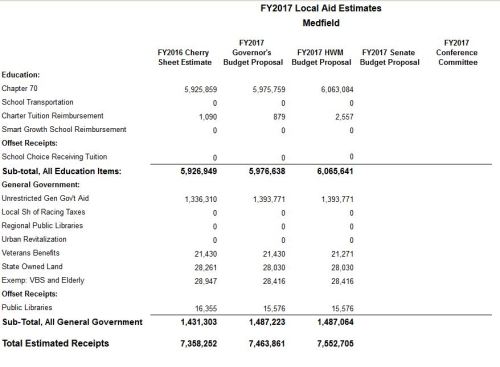
Municipality/Regional District 7061-0008 Chapter 70 Unrestricted General Government Aid Annual Formula Local Aide
FY ’15 Actual Appropriation $5,862,409.00 $1,289,875.00 $0.00
FY ’16 Actual Appropriation $5,925,859.00 $1,336,310.00
Governors FY ’17 Proposal $5,975,759.00 $1,393,771.00 $0.00
Medfield (House FY ’17 Proposed Numbers) $0.00 $0.00 $0.00
Medfield (Senate FY 17 Proposed Numbers) $0.00 $0.00 $0.00
FY ’17 Conference Committee Report           July +/- $0.00 $0.00 $0.00


John Nunnari, Assoc AIA
Executive Director, AIA MA

MMA info #5

MMA-2

Last Friday and Saturday I attended the MMA’s annual meeting at the Hynes Convention Center, where I always get good insights and gather great information.  I posted some of them while I was there.

Hynes

This morning as I heard about the Governor releasing his proposed version of the state budget for FY17, I was recalling Governor Baker telling us last Friday morning that last year he saw that municipalities got 75% of the state’s revenue increases in FY16 passed along to them via increased local aid from the state, that this year he is proposing that we get 100% of the state’s revenue increases passed along.  This sounds a lot like the revenue sharing that the MMA has been asking the state to commit to for a long time – now it just needs to be institutionalized and made permanent.

The state’s consensus revenue numbers for FY17 predict a 4.3% increase in state revenue, so our local aid should be going up 4.3% in the Governor’s proposed budget.


BoS minutes from 12/15

cropped-medfield-town-house2.jpg

Meeting Minutes
December 15, 2015

Chenery Meeting Room – draft

PRESENT: Selectmen DeSorgher, Fisher, Peterson; Town Administrator Sullivan; Assistant Town Administrator Trierweiler; Administrative Assistant Clarke

Chairman DeSorgher called the meeting to order at 7:00 PM and announced this meeting is being recorded. He asked for a moment of appreciation for our brave servicemen and women serving around the world, especially those in the Middle East.

TOWN PLANNER SARAH RAPOSA
Ms. Raposa was invited to the meeting to discuss if zoning changes are warranted due to the increasing number of more than one house being built on single lots in the downtown area. Several residents from the neighborhoods of South, Oak and Pleasant Streets were in attendance voicing their concerns that this double house building is changing the character of the area along with the character of Medfield. They would be in favor of two family dwellings being allowed.

Ms. Raposa responded that at this time it is late to be presented at spring Town Meeting; the procedure for proposed zoning changes takes time. The Planning Board needs to discuss and write the zoning change and hold public hearings. She feels the Planning Board would want to be certain that such zoning change would have full support before bringing it to Town Meeting. Similar change was brought up about five years ago but was defeated.

Selectmen DeSorgher advised the residents attending to call Planning Board members to let them know their concerns with this issue and perhaps a Special Town Meeting could be called to vote on the zoning change. A 2/3 vote is required for a zoning change.

Selectman Peterson suggested that now may be the time to appoint a design review committee to address proposed plans for dense housing particularly in the downtown area.

FY 17 BUDGETS FOR PLANNING BOARD AND BOARD OF APPEALS
Ms. Raposa remarked that the Planning Board’s budget is level funded at $91,963. This budget includes her salary. She said that the Zoning Board’s budget is again level funded as it has been for the past several years at $5,000. Ms. Raposa presented her five year plan for her goals and objectives as the Town Planner that the Selectmen very much appreciated receiving.

FY 17 HEALTH & LIFE INSURANCE BUDGET
Mr. Sullivan presented the budget explaining that health insurance rates will increase by 7% beginning July lst. There is much to plan for taking into account new enrollments; invoices from other areas for retirees; school department new hires and any retirements. A new aspect that needed to be added to this budget is the cost of complying with submitting reports under the Affordable Care Act to the IRS for fulltime employees who work in excess of 30 hours per week.

This will cost the Town about $7,500.00. In addition we have the retiree medicare plans that must be accounted for. Health Insurance budget will increase by $146,413 that is 3.8% over last year’s budget for a total of $4,051,076.

The life insurance budget reflects a slight decrease of $159.00, -1.36% for a total requested amount of $11,554.00.

ELM & PHILIP STREET BRIDGE
Resident Alec Stevens was recognized and he explained to the Board that the masonry wall and wood deck of the bridge is a very real concern as they are beginning to collapse into the stream. It could be 400-500 lbs. of stones that will block Mill Brook. Heavy truck traffic is doing damage to the wall beneath the bridge, so if the wall goes then the bridge will collapse. He continued saying that it is a historic bridge and there really should be a tonnage limit-weight restriction in place. Mr. Sullivan responded saying that he will talk with Ken to do a survey of the bridge and area.

MEETING MINUTES
VOTED unanimously to approve the November 24, 2015 meeting minutes as submitted Mr. Sullivan let the Selectmen know that we are waiting for a confirmation date for the Senator and Representatives to attend the selectmen’s January meeting.

LICENSES & PERMITS
VOTED unanimously to grant a one-day wine and malt beverage permit to the Zullo Gallery for First Thursday events January 7 through June 2, 2016

MOSQUITO CONTROL BOARD
VOTED unanimously to support the Mosquito Control Board FY17 funding and further

VOTED to authorize Chairman DeSorgher sign the declaration

EAGLE SCOUT
The Selectmen received an invitation to attend the Eagle Scout Court of Honor for Mark Lavalle Saturday January 16, 2016 at the CENTER of Medfield.

RECYCLING
VOTED unanimously to award a three-year contract for Single Stream Recycling to E.L.Harvey and Sons according to their bid and as recommended by the Medfield Transfer Station and Recycling Committee

COMMITTEE APPOINTMENT

VOTED unanimously to appoint resident Robert Sliney to the Community Preservation Act Study Committee and as recommended by Town Moderator Scott McDermott

AGREEMENT WITH OPEN SPACE LLC
VOTED unanimously to recommend Town Counsel Mark Cerel draft an agreement between the Town and Open Space LLC for the use of town owned land on Janes Avenue for a municipal public parking lot

CHAPTER 90
VOTED unanimously to sign two Chapter 90 Reimbursement Requests: $11,344.56 for Green Street Project and $42,039.82 for North Meadows, Pine, Winter, Harding Streets project and as recommended by Superintendent Feeney

SIDEWALK CONSTRUCTION
The Selectmen previously advised that School Superintendent Jeff Marsden, Superintendent Feeney and Chief Meaney submit their priority lists for new sidewalks. All three were received.
The Board will review their preferences and advised they will have further discussion at another Selectmen’s meeting.

TOWN MEETING WARRANT
VOTED unanimously to open the 2016 Annual Town Meeting Warrant It was noted that the Selectmen will close the warrant at their January 26, 2016 meeting

SELECTMEN REPORT
Mr. Fisher reported that the Medfield Lions have sold all of their Christmas trees for this season. The Lions appreciate the support of the community and extend a big thank you.
Medfield’s holiday season opened with the annual tree lighting on Friday December 4 and the first Holiday Stroll was a great event with an excellent turnout. Hopefully this will be an annual holiday event. MEMO recently held their Christmas party where resident Colleen Sullivan had a wonderful showing of her photography.

Selectmen Peterson attended the recent Medfield Energy Committee meeting and listened to a presentation of an offer for energy aggregation which means towns will offer residents energy deals at less expensive prices for large groups purchasing good energy.

Mr. DeSorgher said that he discussed the street lights with Chief Meaney and proposed a program called lights on. The Town needs to make sure that any and all lights are on for safety. The chief will have his officers note the street light locations that are out and report those to the Eversource repair site.
Selectman DeSorgher further reported that he had a meeting with several high school students to discuss solar programs at the school. Discussion included the high school principal Robert Parga. He attended the retirement of Kathy Brennan, a member of the Friends of the Library and the celebration in honor of Buck Buchanan’s goth birthday. He agrees that the Christmas Parade and Holiday Stroll were very good events; a High Street resident contacted him about a large tree branch that is on town property overhangs Route 27 creating a safety hazard. He advised that the Tree Warden take a look.
Selectman DeSorgher announced that he will not run for re-election saying that he wants to let the citizens know early to give them an opportunity to take out nomination papers. I feel that I had something to offer Medfield when I ran for selectman three years ago and am leaving feeling confident that I have accomplished the goals I set. I will continue to be accessible until the end of my term. Thank you

ADJOURNMENT
On a motion made by Selectman Fisher, seconded by Selectman Peterson it was voted unanimously to adjourn the meeting at 9:00 PM.

BoS on 1/5

cropped-medfield-town-house1.jpg

Tuesday January 5, 2016@ 7:00 PM

AGENDA (SUBJECT TO CHANGE)

7 :00 PM FY17 Budget Review

  • Town Clerk Carol Mayer
  • Building Inspector John Naff

NEW BUSINESS

  • Vote to approve change in Bay Circuit Trail
  • Discuss proposed warrant articles

Other business that may arise

Permissible spending / wrong spending

This is a good explanation from the DOR’s Division of Local Services’ e-newsletter, instructing we towns on what we can and cannot spend our town money –


budget-3

Municipal Expenditures: Proper Public Purposes
Mary Mitchell, Esq. (retired) – Municipal Finance Law Bureau


The following article, originally published in the February, 2006 edition of City & Town, is being republished(1) due to ongoing interest in the subject.

Increasingly over the past few years, DLS legal and accounting staffs are asked if certain expenditures made by cities and towns are allowable.  Many of these issues arise as the municipal accounting officer reviews departmental bills for payment. This article discusses the rules regarding the expenditure of public funds and makes recommendations for ensuring proper payment.

Authority to Spend

The authority for cities and towns to spend money arises under Section 5 of MGL c. 40. That section provides that:

“[a] town may at any town meeting appropriate money for the exercise of any of its corporate powers; provided, however, that a town shall not appropriate or expend money for any purpose, on any terms, or under any conditions inconsistent with any applicable provision of any general or special law.(2)”

Cities and towns are free to exercise any power or function, except those denied to them by their own charters or reserved to the State, that the Legislature has the power to confer on them, as long as the exercise of these powers is not inconsistent with the Constitution or laws enacted by the Legislature.(3) In general, the properties and purposes for which cities and towns are authorized to spend are not specified, but rather they include any necessary expenditures arising from the exercise of their powers or functions.

Public Purpose Limitation

Cities and towns can spend only for public purposes. Public funds cannot be used for private purposes. Thus, cities and towns have the right to spend money for any purpose where the public good will be served but not where the expenditure of money is directly for the private benefit of certain individuals. This principle is expressed in the Massachusetts constitution and in numerous cases.(4)

In some situations, however, the expenditure of public funds advances both public and private interests.  In those situations, if the dominant motive for the expenditure is a public one, incidental private benefits will not invalidate the expenditure.(5) If, however, the dominant motive is to promote a private purpose, the expenditure will be invalid even if incidentally some public purpose also is served.(6)

Prohibitions Against Certain Expenditures

In addition to the general prohibitions against spending money for any purpose or under any conditions inconsistent with any general or special law, there are two other prohibitions on municipal spending.

1.) Anti-Aid Amendment

The first is a prohibition against the giving of money or property by a city or town to or in aid of any individual, association or corporation embarking upon any private enterprise. This prohibition is referred to as the Anti-Aid Amendment.(7) It provides in pertinent part:

“No grant, appropriation or use of public money or property or loan of credit shall be made or authorized by the Commonwealth or any political subdivision thereof for the purpose of founding, maintaining or aiding any infirmary, hospital, institution, primary or secondary school, or charitable or religious undertaking which is not publicly owned and under the exclusive control, order and supervision of public officers or public agents authorized by the Commonwealth.”

This amendment prohibits the use of public money or property by cities and towns for the purpose of maintaining or aiding any institution or charitable or religious undertaking that is not publicly owned. The kinds of expenditures barred by the amendment are those that directly and substantially benefit or “aid” private organizations in a way that is unfair, economically or politically.(8)

The prohibition against using public funds for private organizations includes any grants, contributions or donations made by a city or town to an organization for the specific purpose of directly supporting or assisting its operations. However, the Anti-Aid Amendment does not preclude a city or town from purchasing specific services from private organizations in order to carry out a public purpose.(9) Further, as with the public purpose limitation discussed above, if an expenditure is for a public purpose but also incidentally benefits a private organization, the expenditure generally will not violate the Anti-Aid Amendment.(10)

2.) Wines, Liquors, Cigars

In addition to the prohibition against the use of public funds for private organizations, there is also a prohibition against the use of public funds to purchase alcohol and tobacco under Section 58 of MGL c. 44.

What Constitutes a Public Purpose?

The question of what constitutes a permissible “public purpose” has been discussed in many cases.(11) The cases “do not, however, establish any universal test.”(12) Instead, they generally stress the certainty of benefits to the community.(13) Thus, the basic test is whether the expenditure is required for the general good of the inhabitants of the city or town.(14)

Generally speaking, local government spending for the following purposes satisfies the public purpose test:

  • Wages and Benefits – Cities and towns have the right to spend reasonable amounts to execute their powers and duties.(15) This right includes the right to compensate people for services rendered.(16)  Compensation for services may include sick leave and vacations.(17) Cities and towns also have the right to settle employment or other claims that may be made upon them arising out of their administration of their municipal affairs.(18)
    .
  • Merit Awards – Cities and towns may spend reasonable amounts on awards for students.(19) Cities and towns may also spend reasonable amounts on retirement gifts, plaques, merit service payments, and other similar awards for municipal employees and officials. The expenditure of public money in recognition of services rendered, even though such expenditure of money is directly for the private benefit of certain individuals, is a public purpose where the benefit is conferred as an appropriate recognition of distinguished and exceptional service, such that the public welfare will be enhanced or the loyalty and productivity of the other employees will be promoted.(20)

By contrast, local government spending for these purposes does not satisfy the public purpose test:

  • Gifts and Gratuities – Since public money can only be expended for public purposes, cities and towns have no power to appropriate money for gifts or gratuities to persons whose situations may appeal to public sympathy.(21)
    .
  • Lobbying – Cities and towns cannot spend money to influence elections.(22)

Frequently Asked Questions

We are asked frequently whether the following expenditures are for public purposes and may be paid:

  • Alcohol purchased by a department to be served at a fundraiser or for compliance testing

The language of MGL c. 44, s. 58 is prohibitive. It reflects an explicit Legislative disapproval of spending municipal resources for alcoholic beverages and cigarettes. We have advised, however, that they can be purchased for the limited purpose of compliance testing for law enforcement or public health purposes. For example, local officials may stage purchases of alcohol or cigarettes by minors from local stores using money for anti-smoking or underage drinking campaigns. We think those expenditures would not be prohibited because they are not for consumption but to ensure compliance with local regulations and state statutes.

  • Floral arrangements for funerals of municipal employees

Funeral flowers, sympathy cards and other expenses for the customary expression of sentiments that are incidental to the social relationships that employees develop during work are not expenses made for public purposes. Those expenses are not within a municipal department’s budget simply because the relationships developed in conjunction with the conduct of departmental business. Therefore, it is not appropriate to pay for funeral flowers or sympathy cards out of municipal funds. They should be covered from private donations.

  • Plaques and gifts awarded to persons retiring from municipal government or to current employees for outstanding performance during the year

Retirement gifts, plaques, merit payments and other similar awards given to retirees or employees may be considered a proper purpose for the expenditure of municipal funds if they are not excessive and are used to (i) encourage continuity of service or to (ii) enhance efficiency and loyalty or to (iii) promote productive performance. Similarly, appreciation gifts to volunteers and unpaid interns may also be considered a proper municipal expenditure if the purpose is to promote volunteerism and they are in token amounts. The expense of holding a retirement party should be covered from private donations because it is mostly an expression of support and appreciation from colleagues. However, paying for the cost of dinner for the retiree would be appropriate. By contrast, paying for the dinners, gifts or party expenses for any attendees other than the retiree would generally be considered a mere gratuity and not for a proper municipal purpose.

  • Refreshments at public functions, such as a ribbon cutting ceremony, an opening day, a reception or banquet, or a presentation

Refreshments and meals may be served at legitimate public functions such as ribbon-cutting ceremonies, opening day events, receptions or banquets, presentations, and the like so long as they are modest and served to provide a benefit for the city or town by helping to keep the participants alert and receptive. The public function must be a department sponsored public event for authorized persons and related to the public purpose of the department sponsoring it. If the function is open only to select groups or individuals, or spouses are in attendance, it is more likely to be considered a private celebration of primarily a social character.

  • Refreshments served to employees, such as coffee made available at a staff meeting or light refreshments provided to election workers or lunch served at an all-day training program or planning meeting

Refreshments and meals may be served to officers or employees of the city or town or persons doing business with the municipality at official meetings or official events so long as they are modest and benefit the city or town by helping to keep the participants alert and receptive or by enhancing efficiency by avoiding loss of time and disruption if participants leave the premises. The official meeting or event must be a department or municipal sponsored meeting or event for authorized persons and related to the public purpose of the sponsor.

  • Reimbursement of a department head for attending retirement or department dinners or parties or for attending other events not sponsored by the department or municipality

Employees and officials may be reimbursed for the expenses of attending functions that relate to their public duties. The function must relate to and further the public purpose of the department sponsoring it. If a department head incurs an expense in the performance of official duties in the representation of his or her department, the expense is reimbursable. Thus, the cost of a department head’s attendance at a retirement dinner or department party at which he or she is the official presenter of token gifts or awards, as a representative of his or her department, would be a legitimate municipal expense. If the event is arranged and funded by department employees or others, and attendance is optional, then the event would seem to be social and for private purposes rather than for public ones. In addition, if the event is outside of the municipality and not related to the department or the community, the use of municipal funds would not be appropriate.

  • Reimbursement of purchases or expenses incurred during authorized travel or while engaged in authorized business

Employees who are out of town or working late on business or attending training programs or conferences on behalf of a city or town may be reimbursed for out-of-pocket costs of travel, meals, and other purchases incurred in furtherance of that objective and as a term or condition of employment. These types of expenses are permissible municipal expenses, provided that attendance is authorized by the municipal official or board with the authority to expend department funds. Included within the realm of reimbursable expenses are: (i) registration charges, including late fees; (ii) local surcharges and taxes on car rentals; (iii) taxes and tips on meals, and (iv) taxes on petty cash purchases, so long as these expenses are reasonable and not in conflict with the reimbursement policies of the city or town. Late registration fees are considered to be part of the contract price for the training program or conference. Similarly, surcharges, taxes and tips are a necessary and customary part of legitimate expenses incurred by employees in the course of their employment.

  • Payment of expenses associated with fundraising for departments, e.g., mailings seeking donations or door prizes and refreshments at a fundraising event.

Municipal departments, like the Parks and Recreation Department, the Library, the Historic Commission, or the schools, may want to raise money for a particular departmental project. Generally, solicitations for donations or financial support from private individuals or businesses must be conducted in accordance with MGL c. 268A, the Conflict of Interest law. In that regard, the State Ethics Commission has issued Advisory Opinion EC-COI-12-1, which provides guidance on fundraising by municipal employees. We suggest that you consult with your municipal counsel for advice before proceeding with fundraising.

Fundraising activities that go beyond applying for grants or soliciting contributions and involve expending municipal funds or receiving funds in exchange for goods are more problematic. For example, if the Recreation Department wants to sell T-shirts as a fundraiser, then it would need an appropriation from which to purchase the T-shirts(23) and proceeds from their sale would be general fund revenue, which could not be spent without an appropriation.(24) Arguably, such a transaction is more in the nature of a profit on a business transaction than a donation. We believe the better practice in such a case is to have a private entity, such as a “friends” group, sponsor and conduct the fundraising event and turn over the net proceeds to the municipal department as a grant or gift under MGL c. 40, s. 53A. Under section 53A, the funds are held by the treasurer in a separate gift account and may be spent by the department for the purposes of the gift without appropriation upon the approval of the board of selectmen, or the city manager and city council, or the mayor and city council, as appropriate.

An additional issue arises when municipal resources are used to assist a private group’s fundraising activities even if the activities will benefit the municipality. Pursuant to the Anti-aid Amendment, public funds may not be used to assist a private organization’s fundraising activities, no matter how worthy or related the cause. For example, the school department cannot pay to print and mail a flyer by the Parent-Teachers Organization to promote a car wash it is holding to raise monies for the schools.

Sharing the expenses of a community event co-sponsored by a municipal department and a private organization also raises Anti-Aid Amendment issues because the event is not under the exclusive control of public officers.

Conclusion

DLS strongly recommends that municipalities develop clear, written policies or guidelines, preferably by bylaw or ordinance, about allowable expenditures. For example, to ensure the municipality receives the maximum benefit from its sales tax exemption, there should be clear standards about when department employees can purchase necessary supplies or materials and be reimbursed. Travel expenses are often set out in collective bargaining agreements, but the municipality should also adopt a policy to cover travel expenses for nonunion employees. DLS also recommends that standards be established for merit awards, food or fundraising expenses. Finally, DLS recommends that accounting officers advise managers and employees at the beginning of each fiscal year of the municipality’s policies. This will help to avoid uncertainty or disagreements about whether certain expenditures are permissible and payable.


1.) With appropriate updating.

2.) MGL c. 40, s. 5 applies to cities under MGL c. 40, s. 1.

3.) See art. 2 of the Amendments to the Massachusetts Constitution, as appearing in art. 89, sec. 6, 7 and 8.

4.) Mass. Const., Art. XI, c. 2, s. 1 and Art. IV, c. 1, s. 1; Lowell v. City of Boston, 111 Mass. 454, (1873);Matthews v. Inhabitants of Westborough, 131 Mass. 521 (1881); Mead v. Acton, 139 Mass. 341 (1885); In re Opinion of Justices, 190 Mass. 611  (1906); Whittaker v. Salem, 216 Mass. 483 (1914); In re Opinion of Justices, 240 Mass. 616  (1922); Jones v. Inhabitants of Town of Natick, 267 Mass. 567 (1929); D.N. Kelley & Son, Inc. v. Selectmen of Fairhaven, 294 Mass. 570 (1936); Quinlan v. City of Cambridge, 320 Mass. 124 (1946); Eisenstadt v. County of Suffolk, 331 Mass. 570 (1954).

5.) See e.g., Opinion of the Justices, 313 Mass. 779 (1943) (“The fact that the owner of a way may profit by expenditures ‘for the removal of snow and ice’…does not invalidate expenditures…where the primary purpose of such removal is the benefit of the public to whose use the way is open.”).

6.) See e.g., Salisbury Land & Improvement, Co. v. Commonwealth, 215 Mass. 371 (1913) (act was unconstitutional where it authorized the condemnation of lands for a public beach and the sale or leasing to private parties of any portion not needed for the public beach).

7.) The Anti-Aid Amendment is contained in Section 2 of Article 46 of the Amendments to the Massachusetts Constitution (as amended in 1974 by Art. 103 of the Amendments).

8.) See Commonwealth v. School Committee of Springfield, 382 Mass. 665 (1981); Helmes v. Commonwealth, 406 Mass. 873 (1990).

9.) See e.g., Commonwealth v. School Committee of Springfield, 382 Mass. 665 (1981)(court held that the purchase of services by the school committee from private schools to meet the needs of special education students did not run counter to the anti-aid amendment because the purpose was to fulfill the obligation of the public school system which had chosen not to provide the services in its own schools).

10.) See e.g., Benevolent & Protective Order of Elks, Lodge No. 65 v. Planning Board of Lawrence, 403 Mass. 531 (1988) (the taking of property for urban renewal project did not violate the Anti-Aid Amendment because the taking had a public purpose to eliminate a blighted open area and any benefit to college was incidental to that purpose).

11.) See Eisenstadt v. Suffolk County, 331 Mass. 570, 573 (1954) and cases cited.

12.) Allydonn Realty Corp. v. Holyoke Housing Authority, 304 Mass. 288,  292 (1939).

13.) See e.g., Opinion of the Justices, 313 Mass. 779, 784-85 (1943) (expenditures for snow removal from private ways that were open to public were for the public purpose of accommodating the public as to means of travel and transportation); McLean v. Boston, 327 Mass. 118 (1951) (expenditure of money for the development of housing for residents made homeless by tunnel expansion was for the public purpose of addressing a local emergency caused by a public improvement); Opinion of the Justices, 349 Mass. 794 (1965) (payments by city for retirement of certain alcoholic beverage licenses was for the public purpose of cleaning up of the city).

14.) See Opinion of the Justices, 337 Mass. 777, 781 (1958).

15.) See e.g., M.G.L. c. 40, s. 4 (“A city or town may make contracts for the exercise of its corporate powers…”); Leonard v. Middleborough, 198 Mass. 221 (1908).

16.) See e.g., Curran v. Holliston, 130 Mass. 272 (1881); Attorney General v. Woburn, 317 Mass. 465 (1945).

17.) See e.g., Quinlan v. City of Cambridge, 320 Mass. 124 (1946); Wood v. Haverill, 174 Mass. 578 (1899).

18.) See Matthews v. Westborough, 131 Mass. 521 (1881); Jones v. Natick, 267 Mass. 567 (1929); George A. Fuller Co. v. Commonwealth, 303 Mass. 216 (1939).

19.) See e.g., M.G.L. c. 71, s. 47 (specifically authorizes the expenditure of municipal funds for student prizes).

20.) See e.g., Eisenstadt v. County of Suffolk, 331 Mass. 570 (1954); In re Opinion of Justices, 190 Mass. 611 (1906); see also In re Opinion of Justices, 240 Mass. 616  (1922).

21.) See e.g., Matthews v. Westborough, 131 Mass. 521, 522 (1881); Whittaker v. Salem, 216 Mass. 483(1914); Jones v. Inhabitants of Town of Natick, 267 Mass. 567 (1929).

22.) See e.g., Anderson v. Boston, 376 Mass. 178 (1978), appeal dismissed, 439 U.S. 1060, 99 S. Ct. 822 (1979).

23.) MGL c. 44, sec. 31.

24.) MGL c. 44, sec. 53.