Category Archives: Budgets

Chip seal

chip seal

None of prefer the chip seal treatment of our side streets, but given the cost differential, I have come to accept it as a cost effective solution.  Please understand that residents are free to opt at the annual town meeting (ATM) to vote to pave streets with asphalt instead of using chip seal.  All spending decision ultimately belong to us, the residents, at our ATM. –

Since I recently had a resident question me about the use of chip seal on his street and since I have historically heard the same questions, I asked our DPW Director, Maurice Goulet,  if he could quantify the cost savings to share with residents.

=========================================================

Pete,

Below is a comparison of Chip Sealing roadways vs. Pavement Overlay and/or Mill and Overlay as requested.

Consider a scenario of 1 mile of roadway that is 20 feet wide at current contractor prices:

5,280 feet long X 20 feet wide / 9 = 11,733 square yards


$24,639 – chip seal

$69,922 – pavement overlay

(65% savings)

(pavement overlay does not include raising structures such as catch basins, manholes and gates, and reconstructing driveway aprons affected by raising pavement elevation, pavement elevation changes also creates new drainage issues)


Overlaying on a distressed roadway develops reflective cracking through the new surface within a few years affecting longevity of the surface. Milling (grinding) and overlay would then be considered as the preferred method.


$24,639 – chip seal

$91,628 – mill and overlay

(73% savings)


Please let me know if you have any questions. Hope this is helpful.

Maurice G. Goulet

Director of Public Works

Medfield, Massachusetts


Department of Public Works

55 North Meadows Road

Medfield, MA 02052

(508) 359-8597 office

(508) 359-4050 fax

mgoulet@medfield.net

www.town.medfield.net

State budget status – expect less aid

This from the Massachusetts Municipal Association on the status of the state budget –

MMA-2

June 26, 2017
MMA

LEGISLATIVE CONFERENCE COMMITTEE still working on

FISCAL 2018 STATE BUDGET – LOCAL AID IS AT STAKE

DECLINING STATE TAX COLLECTIONS CLOUD BUDGET PICTURE, LEGISLATURE MAY REVISIT REVENUE ESTIMATE AND REDUCE FY 2018 SPENDING ACROSS THE BOARD
Please Call Today and Ask Your Legislators to:
• PROTECT UNRESTRICTED MUNICIPAL AID AS A TOP PRIORITY
• FUND CHAPTER 70 SCHOOL AID AT HIGHEST LEVEL
• FULLY FUND SPED CIRCUIT BREAKER
• INCREASE FUNDING FOR CHARTER SCHOOL REIMBURSEMENTS
• BRING FAIRNESS TO THE LODGING EXCISE AND SHORT-TERM RENTALS
The House and Senate passed their own versions of next year’s fiscal 2018 state budget earlier this month, and the budget conference committee has been meeting to iron out the differences and present a balanced budget for adoption by the full legislature.

However, declining state tax collections have opened a gaping hole in the current fiscal 2017 budget, and state leaders are revisiting and lowering their revenue assumptions for next year – this could lead lawmakers to make across-the-board budget cuts in next year’s budget, including to unrestricted municipal aid (UGGA), education funding, and many other vital programs. This process is taking longer than expected, which is why lawmakers have passed a temporary one-month budget to keep state government operating through the end of July.

It is imperative that you contact your Representatives and Senators as soon as possible and ask them to protect local aid as a top priority – cities and towns have balanced their budgets based on receiving the full $39.9 million expected increase in Unrestricted General Government Aid, $30 per student in minimum aid for Chapter 70, and full funding of vital accounts, including special education reimbursements. Cuts to these local aid programs would create budget shortfalls for all 351 cities and towns, and force communities to re-open their budgets to impose mid-year program cuts.

Please call your legislators today and ask them to fully protect local aid

Please click here to download a copy of MMA’s letter to House and Senate leaders detailing local aid priorities in the fiscal 2018 state budget

UNRESTRICTED GENERAL GOVERNMENT AID (UGGA)
Please ask your legislators to make it a top priority to protect the full $39.9 million increase in the Unrestricted General Government Aid (UGGA) account that was included in both the House and Senate budgets. It is important to note that the UGGA program is funded almost entirely by Lottery and gaming revenues, including $64 million from the Plainridge Park Casino. Most of the remaining amount would come from Lottery proceeds that the State Treasurer has forecast at $965 million next year. Almost all of the UGGA account is funded by gaming revenues that are supposed to go directly to cities and towns, and should not be diverted for other purposes.

CHAPTER 70 SCHOOL AID
Please ask your legislators to support an increase for Chapter 70 school aid that provides at least $30 per student in minimum aid, starts the implementation of the Foundation Budget Review Commission recommendations to increase the state’s funding commitment, and protects communities with low-income students.

SPECIAL EDUCATION “CIRCUIT BREAKER”
Please ask your legislators to support full funding of the Special Education “Circuit Breaker” Program, which would require $294.4 million, as proposed by the Senate.

CHARTER SCHOOL REIMBURSEMENTS
Both the House and Senate budgets significantly underfund the charter school reimbursements. Fixing this program in an absolute priority, because a record level of Chapter 70 aid is being diverted away from cities and towns to fund charter schools, which only serve about 4% of the students. The Senate budget would increase funding by $3 million, while the House budget level-funds the program at $80.5 million. This $3 million increase is critically important to those communities that are struggling under the deeply flawed system. Please ask your legislators to keep this $3 million increase.

BRINGING FAIRNESS TO SHORT-TERM RENTALS AND TAX POLICY
The MMA is strongly supporting the Senate language that would modernize and close loopholes in the room occupancy excise, and provide cities and towns with authority to set local rules for the industry. New technologies and business practices have changed how people book and pay for vacations, business trips and other short-term stays away from home. The Senate provision would apply the same rules across all types of occupancy, and is a complete package in that it also closes the internet reseller loophole. Industry leader Airbnb has also endorsed the Senate provision, which demonstrates that this solution offers a strong foundation to fix this issue from both the municipal and business perspective. This is an urgent issue and we ask you to call your legislators to support this proposal to allow the local hotel-motel excise to cover these short-term and seasonal rentals.

PLEASE ASK YOUR LEGISLATORS TODAY TO PROTECT THE $39.9 MILLION INCREASE IN UNRESTRICTED MUNICIPAL AID – THIS INCREASE IS VITAL TO LOCAL BUDGETS IN EVERY CORNER OF MASSACHUSETTS

AND PLEASE ASK YOUR LEGISLATORS TO FULLY FUND ALL KEY MUNICIPAL AND SCHOOL PROGRAMS, AND CLOSE LOOPHOLES FOR SHORT-TERM RENTALS UNDER THE HOTEL-MOTEL LODGING EXCISE

THANK YOU!!

MMA on Senate’s budget

This was from the Massachusetts Municipal Association on the Senate’s version of the state budget –

MMA-2

SENATE BUDGET COMMITTEE OFFERS $40.3B FY 2018 STATE BUDGET THAT MAKES KEY INVESTMENTS IN MUNICIPAL AND SCHOOL AID
 • INCLUDES THE FULL $40M INCREASE IN UNRESTRICTED MUNICIPAL AID (UGGA)

• INCREASES CHAPTER 70 TO $4.63B TO FUND MINIMUM AID AT $30 PER STUDENT

• CH. 70 INCLUDES $10M MORE THAN HOUSE FOR FOUNDATION BUDGET FUNDING

• ADDS $16.5M TO FULLY FUND SPECIAL EDUCATION CIRCUIT BREAKER

• LEVEL-FUNDS MOST OTHER MUNICIPAL AND SCHOOL ACCOUNTS


Earlier today, the Senate Ways & Means Committee reported out a lean $40.3 billion fiscal 2018 state budget plan to increase overall state expenditures by 3.3 percent.  The budget proposal makes key investments in municipal and education aid priorities.

S. 3, the Senate Ways and Means budget, includes the full $40 million increase in Unrestricted General Government Aid that the House and Governor have proposed.  Communities are counting on the full $40 million UGGA increase to balance their budgets and maintain essential services.

The Senate budget plan also increases Chapter 70 aid by $37.4 million above the Governor’s recommendation by increasing minimum aid from $20 per student to $30 per student, going farther in implementing the Foundation Budget Review Commission recommendations, and adding $12 million to hold districts harmless in the new calculation of the number of low-income students.  The House-passed budget also set minimum aid at $30 per student and includes the $12 million for low-income students.  After accounting for those changes, the Senate Ways & Means Committee’s budget provides $10 million more for Chapter 70 than the House, primarily by joining the House in increasing the calculation of employee health insurance costs, and then expanding on that by increasing the calculation of special-education-related costs.

In a major step forward for cities and towns, the Senate W&M Committee would add $16.5 million to fully fund the Special Education Circuit Breaker, an important priority for communities.

The full Senate will begin debating the fiscal 2018 state budget on Tuesday, May 23.

Please Click this Link Now to See the Chapter 70 and Unrestricted Municipal Aid Numbers for Your Community

Click this Link to See Your Community’s Local Aid and Preliminary Cherry Sheet Numbers in the Senate Ways & Means Budget, as Posted by the Division of Local Services

$40 MILLION INCREASE IN UNRESTRICTED MUNICIPAL AID
In a major victory for cities and towns, the SW&M fiscal 2018 budget plan (S. 3) would provide $1.061 billion for UGGA, a $40 million increase over current funding – the same increase proposed by Governor Baker and voted by the House. Almost all of UGGA funding comes from $985M in expected Lottery proceeds and $65M from the Plainridge gaming facility. The full $40 million UGGA increase is a top priority for cities and towns, because municipalities are counting on these funds to balance their budgets and maintain essential services for their residents.

CHAPTER 70 MINIMUM AID WOULD INCREASE TO $30 PER STUDENT
The Senate budget committee is proposing a $128.8 million increase in Chapter 70 education aid (this is $37.4 million higher than the $91.4 million increase in House One), joining the House in supporting a minimum aid increase of at least $30 per student (compared to the $20-per-student amount in the Governor’s budget). The Senate budget would continue to implement the target share provisions enacted in 2007. Further, the Senate Ways & Means Committee proposal would build on the proposals by the House and Governor to start addressing shortfalls in the foundation budget framework. In addition to increasing the cost factors for employee health insurance, the Senate budget committee would increase the cost factors for special education, which accounts for why the Senate W&M Chapter 70 proposal is $10M higher than the House.

Both the Senate and House budgets would provide $12M to hold school districts harmless from changes in the method of counting low-income students. This is similar to the Legislature’s handling of the problem in the current fiscal 2017 budget.

In the context of a very tight budget year, the Senate budget committee’s increase in Chapter 70 funding is certainly welcome progress. The MMA continues to give top priority to full funding for the Foundation Budget Review Commission’s recommendations, and over the long-term will work to build on this increase.

$16.5 MILLION INCREASE INTENDED TO FULLY FUND SPECIAL EDUCATION CIRCUIT BREAKER
In another important budget priority for cities and towns, Senate leaders have announced that they support full funding for the Special Education Circuit Breaker program. The Senate budget plan would provide $293.7 million, a $16.5 million increase above fiscal 2017 budget and the Governor’s recommendation for fiscal 2018 (he proposed level-funding). The House added $4 million during its deliberations, and the SW&M proposal goes all the way to full funding. Every city, town and school district relies on the circuit-breaker program to fund state-mandated special education services.

FUNDING FOR CHARTER SCHOOL REIMBURSEMENTS REMAINS FLAT
The SW&M budget would level-fund charter school reimbursements at $80.5 million, far below the amount necessary to fully fund the statutory formula that was originally established to offset a portion of the funding that communities are required to transfer to charter schools. The fiscal 2017 funding level is $54.6 million below what is necessary to fund the reimbursement formula that is written into state law. If this program is level funded, the shortfall will grow to an estimated $76.4 million in fiscal 2018. This would lead to the continued and growing diversion of Chapter 70 funds away from municipally operated school districts, and place greater strain on the districts that serve 96% of public school children. Solving the charter school funding problem must be a major priority during the budget debate.

REGIONAL SCHOOL TRANSPORTATION, PAYMENTS-IN-LIEU-OF-TAXES (PILOT), LIBRARY AID ACCOUNTS, METCO, McKINNEY-VENTO, AND SHANNON ANTI-GANG GRANTS
Compared to current fiscal 2017 appropriations, the Senate budget committee’s proposal would level-fund Regional School Transportation Reimbursements at $60.1M, level-fund PILOT payments at $26.77 million, add $1.25M to library grant programs, add $357K to METCO, and level-fund McKinney-Vento reimbursements at $8.35 million. However, the SW&M budget would reduce Shannon Anti-Gang Grants to $5 million, a $1 million reduction.

SENATE BUDGET PLAN INCLUDES IMPORTANT IMPROVEMENTS TO THE LOCAL AND STATE LODGING EXCISE TAX
The SW&M budget would make several long-sought improvements to close loopholes in the collection of the local and state lodging excise tax. First, the Senate budget proposes language to end the “internet reseller” loophole that allows Expedia and other internet resellers to avoid payment of the full hotel-motel tax. Second, the Senate budget closes the loophole for transient accommodations, including short-term seasonal rentals. Third, the Senate plan would begin to close the Airbnb loophole. These are important steps to bring parity and a level-playing field to the collection of lodging excise payments.

Please Call Your Senators Today to Thank Them for the Local Aid Investments in the Senate Ways and Means Committee Budget – Including the $40 Million Increase in Unrestricted Local Aid, Providing Chapter 70 Minimum Aid at $30 Per Student, and Fully Funding to the Special Education Circuit Breaker

Please Explain How the Senate Ways and Means Budget Impacts Your Community, and Ask Your Senators to Build on this Progress During Budget Debate in the Senate

Thank You!

VSO – more data

This was part of the packet of information the Board of Selectmen received for tomorrow’s meeting –

ron griffin 2

Email received from Ron Griffin on 4/27 /17, regarding appointment of a town Veteran’s Services Agent –


Hi again ….

I forgot to realize that you do not have background information on this topic.

I do not support the hiring of a full time Veteran Service Officer. This would be a waste of taxpayers money, especially knowing the veteran population is in rapid decline. However it is the law.

There are many ways that Medfield could comply with the law without hiring a full time person. Medfield has had time to even submit changes to the Law. The law ties this requirement to the towns full population not the veteran population. At the time 50+ years ago, when the law was made, the veteran population might have been a significant percentage of the towns population. Now it is perhaps 2%.
Other towns have hired full time employees whose primary function is providing veteran services but a secondary function as Chief Procurement Officer (Westwood). Others may have multiple responsibilities in the town, senior outreach, Volunteer coordinator, payroll, etc. etc. Some towns share a veteran service officer. A good example of that is Needham, Wellesley, Wayland and Weston which together hire two full time VSO’s that are shared by all four towns.

In Medfield’s situation, the towns of Sherborn, Millis, Dover and Norfolk have populations under 12,000 so they are not required to provide full time services so there is little incentive for them to share expenses. Walpole has a full time VSO providing additional services to the community and has no incentive to join with Medfield.

It is a requirement that when towns pool resources that they share a common boundary.

So for the better part of five years I have supported the idea that the town should look to hire a veteran with other credentials desirable for the town, especially when filling any  employment position in town. I have always agreed to step aside should that opportunity present itself.

So when others view this issue, they will conclude that the town has had the time but not the interest. By continuing my employment I have enabled the town to ignore the issue. ( I was already the VSO when the town was served notice that they were non-compliant) I hope this has been helpful.
Ron

Town loses stellar VSO, Ron Griffin

ron griffin 2

Ron Griffin to Retire as Veterans Service Officer

Ron Griffin emailed town officials yesterday to confirm his long planned, and much deferred, retirement as the town’s Veterans Service Officer, leaving huge shoes to be filled.

First and foremost, I want to thank Ron for his exemplary and expansive service to the Town of Medfield, its veterans, and really, by his extension of the scope of the VSO work, to all of our residents.  It has been one of my great pleasures to see how he used that VSO position to make so many things happen to honor the veterans, but also to involve so many facets of the town in the process.  Thanks to Ron the Blake Middle School students now meet annually with veterans, Medfield Foundation volunteer of the year honorees receive flags flown over the Capital, the town this year is honoring Vietnam War vets, and the town now celebrates all veterans on Veterans Day with a breakfast in their honor served by the Medfield High School students from their Warriors for Warriors club.  Also, through his Legion connections, housing for veterans is now being explored at the Legion.  Ron is clearly a leader of both vision and action.

The defeat of Ron’s motion to amend the Veterans Service Officer budget at the annual town meeting (ATM) was the low point of that meeting.  That was when I first learned that the Warrant Committee was not supporting that funding request, and the issue had not been discussed by selectmen.  In hindsight, I wish I had added a plea for support on its behalf, since the expanded position could have coordinated with Medfield Youth Outreach and the Council on Aging to serve those most in need in Medfield (see Ron’s proposal below).

Below are Ron’s email, and then Ron’s previously presented plan for the expanded VSO position.  Maybe a future town meeting, as a tribute to Ron Griffin and his extraordinary service to all Medfield residents, will enact his recommendations:

==================================================

April 27, 2017

Dear Selectman Pete Petersen, Mike Marcucci, Gus Murby and Town Manager Mike Sullivan

In October of 2015 I submitted my intention to retire at the end of that fiscal year.  I gave advance notice so as to give the town time to prepare a solution to the states full time service officer requirement and to find a suitable replacement.  When neither was accomplished by the end of that fiscal year, I agreed to continue in my position until December 2016 with the understanding that the town would be able to find a replacement and achieve state compliance by that time frame.  Now the 2018 fiscal year is approaching and to the best of my knowledge there has been no advancement by the town to fill the position nor actions planned to secure compliance to the State’s General Law.

This places me in the intolerable position to abandon my post, which I will do at the end of this fiscal year.

As the position of Veteran Service Officer carry’s with it appointments to the Memorial Day Committee and Committee to Study Memorials, I am resigning from those committees as of July 1, 2017.

As the town moves forward to find solutions to serve it’s veteran population I fear it will encounter difficulties.  If the town tries to fill the position and not also meet compliance with State law, the appointment will be rejected by the State.  In addition the state might freeze certain Veteran reimbursements through the Cherry Sheet until the town is in compliance.  The State is under some pressures to take actions on the few communities that are not in compliance with State Law in providing Veteran Services.   I fear Medfield will become the example used to prod other communities into compliance.  I also fear that the veteran community statewide along with the media, will strongly vocalize and condemn the town for its non-actions to bring the town into compliance with the state law.  I also fear the Town of Medfield will be depicted as hostile community to veterans.  This will greatly sadden me, as I know the Town of Medfield is one of the most supportive veteran communities in the state.

It is also possible that none of my fears will materialize.  However it is these undesirable real fears along with a strong concern to insure that the valuable services provided by this office continue without interruption that has motivated me to continue my duties throughout this past fiscal year.

Please understand, I regret the actions I am taking now.  I trust you can agree that I have done all that I could to insure that an orderly transition of my position was achieved.

Until then, I remain at your service.

Ron Griffin
Medfield Veteran Service Officer

=================================================================
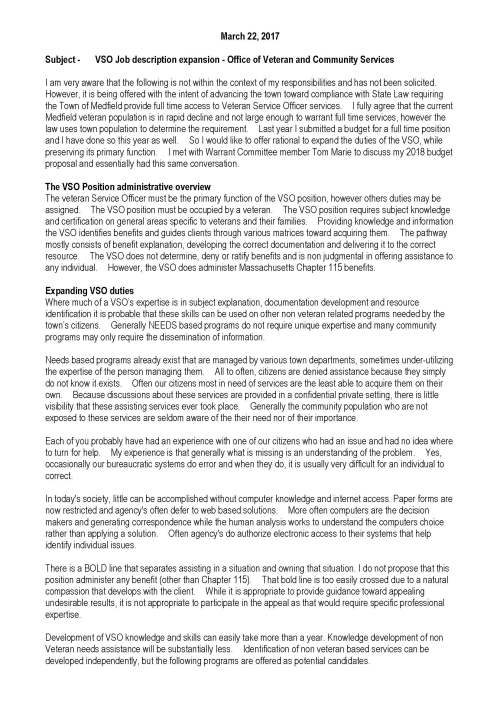
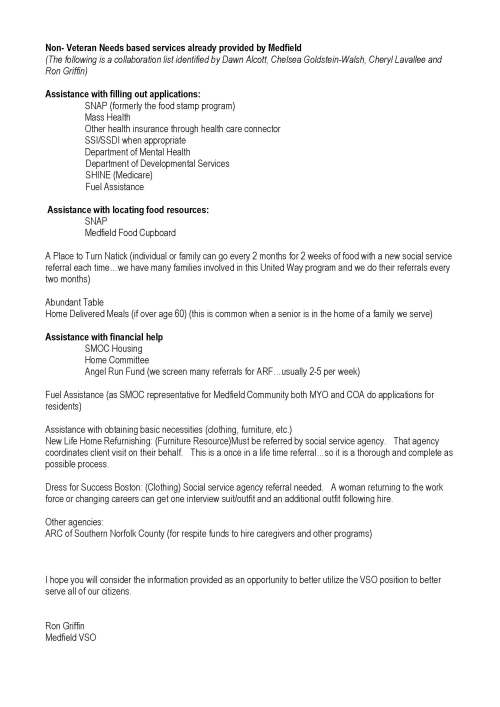
March 22, 2017 Subject - VSO Job description expansion - Office of Veteran and Community Services I am very aware that the following is not within the context of my responsibilities and has not been solicited. However, it is being offered with the intent of advancing the town toward compliance with State Law requiring the Town of Medfield provide full time access to Veteran Service Officer services. I fully agree that the current Medfield veteran population is in rapid decline and not large enough to warrant full time services, however the law uses town population to determine the requirement. Last year I submitted a budget for a full time position and I have done so this year as well. So I would like to offer rational to expand the duties of the VSO, while preserving its primary function. I met with Warrant Committee member Tom Marie to discuss my 2018 budget proposal and essentially had this same conversation. The VSO Position administrative overview The veteran Service Officer must be the primary function of the VSO position, however others duties may be assigned. The VSO position must be occupied by a veteran. The VSO position requires subject knowledge and certification on general areas specific to veterans and their families. Providing knowledge and information the VSO identifies benefits and guides clients through various matrices toward acquiring them. The pathway mostly consists of benefit explanation, developing the correct documentation and delivering it to the correct resource. The VSO does not determine, deny or ratify benefits and is non judgmental in offering assistance to any individual. However, the VSO does administer Massachusetts Chapter 115 benefits. Expanding VSO duties Where much of a VSO’s expertise is in subject explanation, documentation development and resource identification it is probable that these skills can be used on other non veteran related programs needed by the town’s citizens. Generally NEEDS based programs do not require unique expertise and many community programs may only require the dissemination of information. Needs based programs already exist that are managed by various town departments, sometimes under-utilizing the expertise of the person managing them. All to often, citizens are denied assistance because they simply do not know it exists. Often our citizens most in need of services are the least able to acquire them on their own. Because discussions about these services are provided in a confidential private setting, there is little visibility that these assisting services ever took place. Generally the community population who are not exposed to these services are seldom aware of the their need nor of their importance. Each of you probably have had an experience with one of our citizens who had an issue and had no idea where to turn for help. My experience is that generally what is missing is an understanding of the problem. Yes, occasionally our bureaucratic systems do error and when they do, it is usually very difficult for an individual to correct. In today's society, little can be accomplished without computer knowledge and internet access. Paper forms are now restricted and agency's often defer to web based solutions. More often computers are the decision makers and generating correspondence while the human analysis works to understand the computers choice rather than applying a solution. Often agency's do authorize electronic access to their systems that help identify individual issues. There is a BOLD line that separates assisting in a situation and owning that situation. I do not propose that this position administer any benefit (other than Chapter 115). That bold line is too easily crossed due to a natural compassion that develops with the client. While it is appropriate to provide guidance toward appealing undesirable results, it is not appropriate to participate in the appeal as that would require specific professional expertise. Development of VSO knowledge and skills can easily take more than a year. Knowledge development of non Veteran needs assistance will be substantially less. Identification of non veteran based services can be developed independently, but the following programs are offered as potential candidates. Non- Veteran Needs based services already provided by Medfield (The following is a collaboration list identified by Dawn Alcott, Chelsea Goldstein-Walsh, Cheryl Lavallee and Ron Griffin) Assistance with filling out applications: SNAP (formerly the food stamp program) Mass Health Other health insurance through health care connector SSI/SSDI when appropriate Department of Mental Health Department of Developmental Services SHINE (Medicare) Fuel Assistance Assistance with locating food resources: SNAP Medfield Food Cupboard A Place to Turn Natick (individual or family can go every 2 months for 2 weeks of food with a new social service referral each time…we have many families involved in this United Way program and we do their referrals every two months) Abundant Table Home Delivered Meals (if over age 60) (this is common when a senior is in the home of a family we serve) Assistance with financial help SMOC Housing Home Committee Angel Run Fund (we screen many referrals for ARF…usually 2-5 per week) Fuel Assistance (as SMOC representative for Medfield Community both MYO and COA do applications for residents) Assistance with obtaining basic necessities (clothing, furniture, etc.) New Life Home Refurnishing: (Furniture Resource)Must be referred by social service agency. That agency coordinates client visit on their behalf. This is a once in a life time referral…so it is a thorough and complete as possible process. Dress for Success Boston: (Clothing) Social service agency referral needed. A woman returning to the work force or changing careers can get one interview suit/outfit and an additional outfit following hire. Other agencies: ARC of Southern Norfolk County (for respite funds to hire caregivers and other programs) I hope you will consider the information provided as an opportunity to better utilize the VSO position to better serve all of our citizens. Ron Griffin Medfield VSO20170322-rg-veteran and community services position march 2017_Page_2

Image

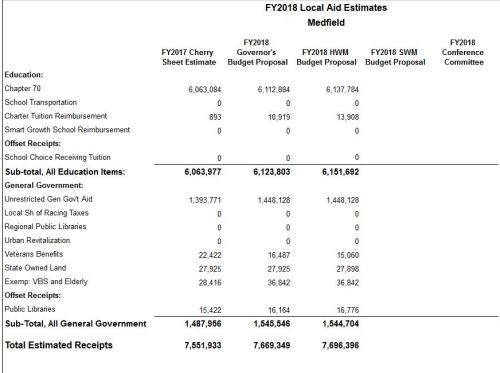
State aid for FY18, so far

20170411-state aid

ATM warrant

town meeting

Annual Town Meeting (ATM) Warrant

Kris this morning circulated the warrant for the annual town meeting (ATM).  For those of you who do not want to wait for your mailed copy, it is available in a digital format via this link – 2017 Annual Town Meeting Warrant.  Maybe in the future at the ATM we will all be following along on our tablet versions of the warrant, and voting via buttons on the screens.

For now, mark your calendars and plan to attend the ATM at 7:30PM on Monday, April 24, 2017 at the Medfield High School gym.  This is the annual time and place, open to all, when the voters of the Town of Medfield make all the town’s decisions on how we want our town to work, and how we want to spend our money to make those things happen.

State budget – step 2 (i.e. the House version)

This notice this afternoon from the Massachusetts Municipal Association about the House version of the proposed state budget. The state budget goes through the following steps each year:

  • The Governor starts the budget process with his budget proposal at the end of January,
  • the House then does its version,
  • the Senate then does its own version,
  • then the House and Senate work out the final version via a reconciliation committee,
  • the Governor can veto items, and
  • the legislature can pass what it wants over those vetos, if it has enough votes.

Our local aid monies seem to have been mainly protected in the House version of the state budget.

MMA-2


April 10, 2017
HOUSE BUDGET COMMITTEE OFFERS $40.3B FY 2018 STATE BUDGET THAT MAKES KEY INVESTMENTS IN MUNICIPAL AND SCHOOL AID

• INCLUDES THE FULL $40M INCREASE IN UNRESTRICTED MUNICIPAL AID (UGGA)

• INCREASES CHAPTER 70 BY $106M TO FUND MINIMUM AID AT $30 PER STUDENT

• ADDS $4M TO THE SPECIAL EDUCATION CIRCUIT BREAKER

• ADDS $1M MORE FOR REGIONAL SCHOOL TRANSPORTATION

• LEVEL-FUNDS MOST OTHER MUNICIPAL AND SCHOOL ACCOUNTS

Earlier this afternoon, the House Ways & Means Committee reported out a lean $40.3 billion fiscal 2018 state budget plan to increase overall state expenditures by 3.8 percent. The House Ways and Means budget is $180 million smaller than the budget filed by the Governor in January, yet it also increases Chapter 70 aid by $15 million above the Governor’s recommendation by increasing minimum aid from $20 per student to $30 per student. The full House will debate the fiscal 2018 state budget during the week of April 24.

H. 3600, the House Ways and Means budget, provides strong progress on many important local aid priorities, including the full $40 million increase in Unrestricted General Government Aid that the Governor proposed and communities are counting on. The House W&M Committee would increase funding for other major aid programs, by adding $4 million to the Special Education Circuit Breaker, adding $1 million to Regional School Transportation, and increasing Chapter 70 minimum aid to $30 per student.

Please Click this Link Now to See the Chapter 70 and Unrestricted Municipal Aid Numbers for Your Community

Later Today or Early Tomorrow – Click on this Link to See Your Community’s Local Aid and Preliminary Cherry Sheet Numbers in the House Ways & Means Budget, as Posted by the Division of Local Services

$40 MILLION INCREASE IN UNRESTRICTED MUNICIPAL AID
In a major victory for cities and towns, the HW&M fiscal 2018 budget plan (H. 3600) would provide $1.061 billion for UGGA, a $40 million increase over current funding – the same increase proposed by Governor Baker. The $40 million would increase UGGA funding by 3.9 percent, which matches the projected growth in state tax collections next year. This would be the second-largest increase in discretionary municipal aid in nearly a decade. Every city and town would see their UGGA funding increase by 3.9 percent.

CHAPTER 70 MINIMUM AID WOULD INCREASE TO $30 PER STUDENT
The House budget committee is proposing a $106.4 million increase in Chapter 70 education aid (this is $15 million higher than the $91.4 million increase in House One), with a provision that every city, town and school district receive an increase of at least $30 per student (compared to the $20-per-student amount in the Governor’s budget). The House budget would continue to implement the target share provisions enacted in 2007. Further, the House Ways & Means Committee proposal would build on the Governor’s initial proposal to start addressing shortfalls in the foundation budget framework, by increasing the cost factors for employee health insurance.

In the context of a very tight budget year, the House budget committee’s increase in Chapter 70 funding is certainly welcome progress over the House One proposal that was filed in January. The MMA continues to give top priority to full funding for the Foundation Budget Review Commission’s recommendations, and over the long-term will work to build on this increase.

$4 MILLION INCREASE INTENDED TO FULLY FUND SPECIAL EDUCATION CIRCUIT BREAKER
In another budget advancement for cities and towns, House leaders have announced that they support increased funding for the Special Education Circuit Breaker program. The House budget plan would provide $281 million, a $4 million increase above fiscal 2017, although this is still short of full funding for a vital program that every city, town and school district relies on to fund state-mandated services. The MMA will work to continue building on this welcome increase.

ADDS $1 MILLION TO REGIONAL SCHOOL TRANSPORTATION
House Ways and Means Committee budget would add $1 million to bring regional transportation reimbursements up to $62 million. The MMA will work to continue building on this welcome increase.

FUNDING FOR CHARTER SCHOOL REIMBURSEMENTS REMAINS FLAT
Both budgets filed by the Governor and the House Ways & Means Committee would level-fund charter school reimbursements at $80.5­ million, far below the amount necessary to fully fund the statutory formula that was originally established to offset a portion of the funding that communities are required to transfer to charter schools. The fiscal 2017 funding level is $54 million below what is necessary to fund the reimbursement formula that is written into state law. If this program is level funded, the shortfall will grow to an estimated $67.1 million in fiscal 2018. This would lead to the continued and growing diversion of Chapter 70 funds away from municipally operated school districts, and place greater strain on the districts that serve 96% of public school children. Solving the charter school funding problem must be a major priority during the budget debate.

PAYMENTS-IN-LIEU-OF-TAXES (PILOT), LIBRARY AID ACCOUNTS, METCO, McKINNEY-VENTO, AND SHANNON ANTI-GANG GRANTS
The House budget committee’s proposal would level-fund PILOT payments at $26.77 million, add $600K to library grant programs, add $500K to METCO, and level-fund McKinney-Vento reimbursements at $8.35 million. However, the HW&M budget would reduce Shannon Anti-Gang Grants to $5 million, a $1 million reduction.

Please Call Your Representatives Today to Thank Them for the Local Aid Investments in the House Ways and Means Committee Budget – Including the $40 Million Increase in Unrestricted Local Aid, Providing Chapter 70 Minimum Aid at $30 Per Student, and Adding Funding to the Special Education Circuit Breaker and Regional School Transportation

Please Explain How the House Ways and Means Budget Impacts Your Community, and Ask Your Representatives to Build on this Progress During Budget Debate in the House

Thank You!


Finances

Mike Sullivan’s current analysis of the financial impacts of the annual town meeting (ATM) budget and warrant articles –

===============================================================
TOWN OF MEDFIELD TAX LEVY FY15 – FY18
actual actual est 29-Mar
  all figures are in thousands (000’s) fy15 FISCAL16 FISCAL17 FISCAL18
INCOME:
     TAX REVENUE: (3% inc)
          TAX LEVY $34,026 $35,563 $36,788 $38,144
          DEBT EXCLUSIONS $3,093 $4,795 $4,580 $4,454
          2 1/2 LEVY INCREASE $860 $890 $922 $955
          NEW GROWTH $341 $379 $434 $350
          TAX LEVY OPERATING OVERRIDE $0 $0 $0 $0
         UNEXPENDED TAX LEVY $75
   SUBTOTAL TAX REVENUE $38,320 $41,627 $42,724 $43,978
     NON – TAX REVENUE:
          FEDERAL AID $0 $0 $0 $0
          STATE AID $7,264 $7,358 $7,552 $7,669
          SCHOOL BUILDING ASSISTANCE $327 $0 $0 $0
          LOCAL RECEIPTS $3,954 $4,576 $4,089 $4,300
          REVOLVING FUNDS $0 $249 $564 $358
          OTHER FREE CASH $816 $271 $500 $200
          OTHER AVAILABLE FUNDS ? $2,627 $4,470 $2,753 $2,213
          ENTERPRISE FUND REVENUES ? $3,563 $3,531 $3,885 $3,869
   SUBTOTAL NON TAX REVENUE: $18,551 $20,455 $19,343 $18,609
TOTAL INCOME FROM REVENUE $56,871 $62,082 $62,067 $62,587
EXPENDITURES:
     FIXED:
          FY15 BOND SALE COSTS -HOSP PURCHASE; FY16 COURT JUDGEMENT $174 $622 $0 $0
          SNOW DEFICIT/LAND DAMAGES/TAX TITLE $165 $235 $0 $100
          OVERLAY FOR TAX ABATEMENTS $243 $264 $251 $200
          STATE AID – CHERRY SHEET OFFSETS $25 $16 $15 $16
          STATE CHERRY SHEET ASSESSMENTS $493 $820 $833 $857
                        SUB-TOTAL FIXED EXPENDITURES: $1,100 $1,957 $1,099 $1,173
     APPROPRIATIONS:
          REVOLVING FUNDS $224 $249 $564 $358
          CAPITAL BUDGET/ OTHER ARTICLES $2,556 $4,185 $2,755 $1,690
          EMPLOYEE BENEFITS $6,420 $6,715 $7,067 $7,353
          SCHOOL BUDGET (TOWN) $29,083 $30,363 $31,577 $33,036
          SCHOOL BUDGET (VOCATIONAL) $159 $120 $131 $160
          TOWN BUDGETS $10,341 $10,528 $10,838 $11,190
          WATER & SEWER ENTERPRISE $1,871 $1,854 $1,969 $2,055
                        SUB-TOTAL OPERATING BUDGETS $50,654 $54,014 $54,901 $55,842
` `
           NON-EXCLUDED DEBT $447 $413 $247 $343
           EXCLUDED DEBT (TAX LEVY OVERRIDE) $4,534 $5,167 $5,522 $5,383
           ENTERPRISE FUND DEBT (W&S) $636 $1,159 $1,018 $938
                        SUB-TOTAL DEBT $5,617 $6,739 $6,787 $6,664
TOTAL APPROPRIATIONS & REVOLVING FUNDS: $56,271 $60,753 $61,688 $62,506
TOTAL EXPENDITURES: $57,371 $62,710 $62,787 $63,679
              DEFICIT FINANCED FROM FREE CASH ($500) ($628) ($720) ($1,092)
certified free cash – july 1 $2,671 $2,426 $2,621 $2,756

BoS review of town finances

Mike Circulated this draft of the Board of Selectmen’s annual report material this week –

budget-2

Review of Town Finances

The Warrant for the 2017 Annual Town Meeting is unusually long. This is both because of the number or articles (50) and the length of several of the articles. With the total number of pages approaching 100, it was not possible to prepare this Warrant Report in the usual booklet form without binding it at a considerable expense, similar to the way the town report is bound. The decision was made to print the Warrant Report on 8 ½” X 11” sheets.

The Message from the Moderator at the beginning of this report details the Town Meeting procedures. Please read his Message for information on these matters. Also, in order to avoid adding more pages to this Warrant Report this Review will be shorter than usual.

REVENUES

The tax levy estimate following this Review projects that the total revenues available for fy18 will be approximately $62.6 MILLION. Actual revenue amounts will not be available until well after the Town Meeting, when the State Budget for Local Aid to Cities and Towns is approved, new property tax base growth is determined and books for fy17 are closed. At present, the best estimate for increases in revenues without any new Propositions 2 ½ property tax overrides is $520,000. This, however, is somewhat misleading in that some of the changes in revenues are the results of shifting funds from one account to another, such as moving money from the OPEB Stabilization Fund to the OPEB Trust fund last year.   The main increases in new revenues for next year are $955,000 for the permitted   2 ½ annual property tax levy increase; $350,000 for new growth in the property tax base from new construction, land subdivision, etc.; $117,000 from Local Aid to Cities and Towns, mostly for Chapter 70 School Aid, $211,000 from increases in Local Receipts (Motor Vehicle Excise Tax, licenses and permits, rental income, fees and fines, transfer station stickers, etc.) Other smaller revenue sources make up the rest of the Revenue Total.

EXPENDITURES

                Within the tax levy limit

The tax levy estimate projects that expenditures for fy18 will total $63.7, an increase of about $900,000 over fy17 expenditures. Here also, as with the revenues, the increases are somewhat misleading, as some of the expenditures for special articles are transfers of funds and do not create actual expenditures.  To see what the requested  increases are you should check the expenditure categories in the tax levy estimate, which follows this Review. In addition, since operating budgets comprise about 95% of total expenditures, you can see the increases (decreases) in the individual departmental operating budgets as shown in Article 13, the Operating Budget.  Other operating expenditures are for several of the other warrant articles on this year’s warrant and include $358,500 for Chapter 53E ½ Revolving Funds (see Articles 5 and 6 for explanations and breakdowns);  $472,623 for The Capital Budget (Article 14), funding for the Other Post-Employment Benefits Trust ($400,000) (Article 30), the Iron Manganese Treatment facility ($275,000) (Article 35), to reimburse the Stabilization Fund for last year’s loan to purchase a new ambulance ($50,000) (Article 29), to transfer Sewer Betterment Funds Paid-in-Advance  to the Sewer Betterment Stabilization Fund ($158,287) (Article 28), for maintenance, security and consultants for the former state hospital site ($200,000) (Articles 18 & 19), to purchase street lights ($67,626) (Article 25), to transfer cemetery lot purchase funds to the Cemetery Perpetual Care Fund, ($43,650) (Article 3). Additional  warrant articles with funding requests includes articles for downtown improvements, downtown parking study,  maintenance of the Dwight-Derby House, beaver trapping and dam removal, design of a rail trail, naming  of the Elm Street bridge, payment of a prior year (Fy16) Police Department bill, and wetlands delineation of a potential site for senior housing. For more information on any of these articles you can check the Index of Articles at the end of the Warrant Report to locate the page and/or article number.

Over the tax levy limit

There are two funding articles on this year’s town meeting warrant that weren’t mentioned above. One of these is Article 15, which seeks funds for the Fire Department Budget in order to provide for continuation of Advanced Life Support services in conjunction with the Town’s ambulance. In recent years these services were provided as a private  intercept service (usually meets the ambulance on its way to the hospital)  with a specially equipped vehicle and highly  trained staff called, as necessary, for ambulance runs requiring such services. This past year that company notified the Fire Department that they would no longer be available to provide such services. Another intercept service was brought in but also withdrew. This article presents alternative solutions to maintain ALS service, either by adding ALS certified EMT staff to the Fire Department budget or by finding another private intercept service, perhaps on a regional basis. Either way is expensive and would require a Proposition 2 ½ operating override to provide sufficient funds. Recommendation on how to proceed will be forthcoming at the Town Meeting.

An operating override can only be voted on at an election, not at a town meeting. An operating override adds a permanent amount to the property tax base. If the Town Meeting votes to approve funding requested in this Article, the Board of Selectmen will have to call a Special Town Meeting for an override vote.

The other article not discussed above is Article 17, which calls for an appropriation of  $1 Million to be funded by a bond issue for the purpose of providing funds for affordable housing. This Article was submitted as a citizen petition.  In all likelihood, if Article 17 passes, these funds would be turned over to the Medfield Affordable Housing Trust, created under Article 16. This Trust would determine how to use these funds to best meet the Town’s affordable housing needs/requirements.  Like the ALS article discussed above, funding this appropriation /bond issue would require a Proposition 2 ½ vote at an election. In this case, however, the vote would be a debt exclusion vote, which would exclude annual principal and interest payments over the life of the bond issue from the calculation of the tax levy limit. When the bond issue was paid off, this debt exclusion would end and would not become a permanent part of the tax levy.

USE OF FREE CASH

From the above you should note that the total expenditures are greater than the total revenues, even without the override article amounts, by about $1.1 Million. In other words, the Town’s Budget, is out-of-balance. Since the Town must balance its budget each and every year in order to have its tax rate approved by the Massachusetts Department of Revenue, this difference must be made up. Some of this deficit is raised by using free cash to cover specific appropriations, such as $200,000 for the OPEB appropriation. The rest is covered at the end of Town Meeting by voting to authorize the Board of Assessors to use an amount of free cash in the Treasury. Free Cash consists of unallocated funds on the Town’s books at the end of each fiscal year. It must be certified by the MA Department of Revenue before it can be voted out by the Town Meeting (see explanation for Article 50). At the end of each fiscal year any unused free cash, in effect, disappears until the next fiscal year’s books are closed and a new free cash amount is certified. Local government accountants, auditors and financial advisors recommend that the level of free cash (think checking account) plus stabilization funds (think savings account) should equal or exceed 5% to 10% of its annual budget. In Medfield’s case, that would be between $3.1 million and $6.2 million. In addition to helping the Town maintain its excellent credit rating, free cash is used to avoid short term borrowing interest costs and to have funds on hand to cover emergency conditions. And remember, Free Cash isn’t free.

OTHER ARTICLES

There are a number of articles on this Year’s Town Meeting Warrant that don’t require an appropriation, but are significant in determining how the Town runs and what additional costs may be incurred or saved from passage of these articles. Article 16 would establish the Medfield Affordable Housing Trust, a semi-autonomous Board appointed by the Selectmen to address the needs and requirements for developing affordable housing in the Town. Articles 31 & 32 would accept streets as public ways or public right-of –ways. Article 33 would adopt a water conservation bylaw and Article 34 would authorize the Water Department to enter into private property to inspect, repair or replace water meters, Article 36 would authorize the Board of Selectmen to lease space on the new Hospital water tower for wireless communications, Articles 37 & 38 would adopt new stormwater management and water pollution abatement bylaws to bring the Town into compliance with federal stormwater management permit requirements, Articles 39 to 47 propose changes to the zoning bylaw affecting single, two family and multifamily housing and inclusionary requirements for affordable housing, Articles 48 & 49 deal with regulation of recreational marijuana.

CONCLUSION

At the beginning of this year’s budget process, it looked like the Town might need an operating budget override to cover departmental budget increase and increases in pension and health insurance costs. However, as a result of the hard work of the Warrant Committee, various Town Boards, Committees and  Department Heads, the budget can be balanced without an override and without sacrificing essential Town services. It took a lot of night meetings, deliberations and compromises to accomplish this. Medfield is fortunate to have such a dedicated group of volunteers and employees working on its behalf to keep the Town on a sound financial footing. The voters will still have to decide on the two potential overrides, one to fund the affordable housing efforts and the other to maintain ALS support services. Please do your part in helping to make all of the decisions that are on this year’s Town Meeting Warrant and on whether or not to fund the two potential tax override requests that may have to be voted at a special election, if the Town Meeting passes the corresponding Town Meeting warrant articles. It’s your Town, so please do your part.

Mark L. Fisher, Chairman

Osler L. Peterson, Clerk

Michael T. Marcucci, Third Member

Board of Selectmen