Monthly Archives: April 2017

Votes needed for MSH

From Jean Mineo – her latest thing that helps us all.

vote.2

Hello Medfield Friends,
The Cultural Alliance has submitted a video grant application and we need your vote.

If the video gets enough votes (i.e. lands in the top 10 of the category “arts and culture”), it advances to the next round of evaluation which will award one application in each category $100k and two applications $50k each. A lot of money!

The link to the 2:45 minute video is here:

http://act.usatoday.com/submit-an-idea/#/gallery/60445715

Click on the green vote button next to the video to cast your vote! You may vote once a day, every day through May 12. There are no forms to fill out. Then please share on Facebook or Twitter using the buttons under the video and help spread the word.

The grant addresses the renovation of key historic buildings at the former Medfield State Hospital into an arts and cultural center. The money would go toward hiring an expert to secure historic tax credits worth about $2 million – applicable to any project renovating the Chapel within historic guidelines, even if it doesn’t become a cultural center. This is a valuable asset to our town that does not commit us to a specific use!

Thanks for your help! Like us on Facebook for progress reports:
https://www.facebook.com/CulturalAllianceofMedfield/

Jean


C 617-877-5158

JeanMineo@aol.com

@JeanRMineo

www.LinkedIn.com/in/JeanMineo

ALS intercept clarification

John Kraus corrected my understanding of how the ALS intercept actually happens.  Thank you John.

ambulance

Good afternoon.  Just a comment / clarification on the intercept process: if our ambulance is transporting a patient to the hospital and meets up with an ALS truck (whether from a mutual aid department or a private service) the patient remains in the Medfield ambulance with our EMT and the paramedics will get on board with us (bringing along their equipment) and provide ALS care while we continue to the hospital. The patient is not moved from one ambulance to another during transport. If the patient is still at the scene and has not been loaded in the Medfield ambulance yet the mutual aid department maybe elect to transport in their truck, but I didn’t want the public to have the impression that the patient is being transferred from one truck to another on the side of the road during the intercept.  Thanks.

Image

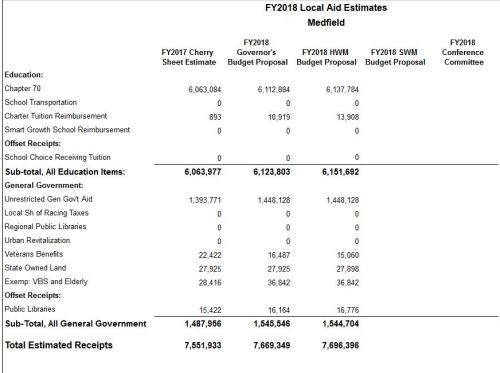
State aid for FY18, so far

20170411-state aid

WWTP

With the heavy rains, the Waste Water Treatment Plant had some issues.  Both EPA and DEP have signed off on the temporary corrective measures.

town seal

TOWN OF MEDFIELD

MASSACHUSETTS

“Department of Public Works


MAURICE G. GOULET

Director of Public Works

55 North Meadows Road

Medfield, MA 02052

(508)359-8597

Fax (508) 359-4050


TO:            Board of Selectmen

Michael Sullivan, Town Administrator

Kristine Trierweiler, Assistant Town Administrator

Water and Sewer Board


FROM:    Maurice G. Goulet. Director of Public Works

MEMORANDUM


DATE:            April 4, 2017

SUBJECT:      WWTP Issue

We experienced an influx of water at the Wastewater Treatment Plant due to excessive rains. This influx of water forced us to bypass partial treatment areas at the plant. The UV Control System at the end of the treatment areas is in need of repair. A temporary chlorine tank and feed has been set up at the final stage of treatment for disinfection. This chlorine tank is necessary for the interim until the UV Control System can be repaired and put back on-line. New controls and repair parts have been ordered and will be installed as soon as possible. When the UV Control System is running properly, the chlorine tank and feed will be removed.

ALS status

ambulance

The Warrant Committee and the Board of Selectmen held a joint 2.5 hour meeting last night with about 25-30 residents to discuss how to best proceed with the advanced life support (ALS) issue at the annual town meeting (ATM).  The collective wisdom of the all town officials (all the Warrant Committee and selectmen) was to create an ALS Study Committee to gather all the data, to figure out the best solution, and to report back on how the town should best provide ALS services.

Currently, since the private providers ceased providing our ALS intercept services several months ago on short notice, the town provides paramedic service by means of ALS intercepts with ambulances staffed by paramedics from Westwood, Walpole, and Norfolk via the mutual aid that fire departments render to one another.  ALS intercept services are the ALS ambulance from one of the other towns meeting the Medfield ambulance en route and transferring the patient to the ALS ambulance to complete the transfer to the hospital.  Medfield then splits the monies from those ALS intercept calls with the other towns.  It is expected that mutual aid will continue until the Town of Medfield solves how it will provide ALS on its own.

The Warrant Committee presented the issues as it has determined them, and unanimously recommended the creation of an ALS Study Committee to better define the best solution.  The following was the Warrant Committee’s written report:


ALS Options Overview

BoS/WC Joint Working Session, April 10th, 2017


As Is For A Very Limited Period – ATM, 2018  

Rely on mutual aid to provide ALS intercept
(while evaluating an optimal long term solution)


Financial:        Potential $25K to study committee

Service:           Same as we have been receiving for several months

Uncertainty:   Not a long term solution


Contract ALS

Hire a service to dedicate ambulance and medics to Medfield


Financial:        $600K budget

Service:           Equivalent to hiring medics

Uncertainty:   Control of resources, Potential sharing of costs & services


Hire ALS

Hire medics and equip current ambulance to accommodate ALS service


Financial:        $750K budget (Cost of hiring plus $90K to equip ambulance)

Service:           Response time fast (assuming no concurrent calls), utilization low

Uncertainty:   # of hires/level of coverage, who hires/trains,

cost may be higher due to estimates for benefits/OPEB


Regionalize ALS

Share resources (either hired or contracted ALS) with other towns locally


Financial:        Unknown – but lower than other long term options.

Potentially 1/3  to ½ of cost of other solutions – or profit center)

Service:           Response time fast (assuming no concurrent calls), utilization higher

Uncertainty:   Partners, cost sharing, location of ambulance


Selectmen Marcucci proposed asking the annual town meeting (ATM) to vote to approve about $650,000 of monies to implement the ALS services, and to just leave the form of the ALS services to be implemented in the discretion of the Board of Selectmen.   In that scenario, the Board of Selectmen would first get the ALS study results, and then implement on what is proposed.  Selectman Murby seemed to agree with that proposal.  I prefer to give the town residents the right and opportunity to vote the ALS monies once the Board of Selectmen determines and presents to the residents what the Board of Selectmen thinks is the best ALS solution.  However, if the residents opt to trust the selectmen with the monies now to make the best ALS decision later, I am happy to execute on that trust.


ATM warrant

town meeting

Annual Town Meeting (ATM) Warrant

Kris this morning circulated the warrant for the annual town meeting (ATM).  For those of you who do not want to wait for your mailed copy, it is available in a digital format via this link – 2017 Annual Town Meeting Warrant.  Maybe in the future at the ATM we will all be following along on our tablet versions of the warrant, and voting via buttons on the screens.

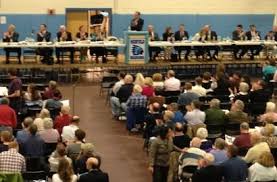
For now, mark your calendars and plan to attend the ATM at 7:30PM on Monday, April 24, 2017 at the Medfield High School gym.  This is the annual time and place, open to all, when the voters of the Town of Medfield make all the town’s decisions on how we want our town to work, and how we want to spend our money to make those things happen.

Affordable housing workshop, 7PM this evening

This today from Suzanne Siino’s Medfield Inclusion Project.

affordable-housing

YOUR TOWN, YOUR 40B

If you think our 40B issues are behind us after Mass Housing’s denial of Medfield Meadows, think again.

Since 1969, Mass Chapter 40B Law mandates that 10% of EVERY towns housing inventory be affordable.  Medfield has 4220 housing units.  Currently, we have 283 units designated as affordable.  We are short by 139 units.

Medfield’s newly approved Housing Production Plan (HPP) is a blueprint to our 40B future.  It is Medfield’s vision and commitment to the development of future subsidized housing.   Do you share this vision?   Take the time to read the document.  It’s on the towns website.

Medfield has “Safe Harbor” from future unwanted or unfriendly 40B developments  (like Medfield Meadows) ONLY if we create 0.5%  (of 4220) or 21 units of affordable housing every year until we reach the 10% goal.   Two new 40B projects, the Bike Shop rental project and the Hospital Rd ownership project will give us a one-year reprieve once they are permitted.  It’s vital we begin to plan for 2018 and beyond, or risk exposure to unwanted 40B once again.

Medfield is a bucolic town with top-ranked schools.   The cost of land and the average home prices are well above the state median.  There is very little, if any, state or federal funding for development of subsidized housing.  This presents financial challenges for towns, housing authorities and developers.

More than 80 communities in the Commonwealth have created Affordable Housing Trusts (AHT) since 2006 to address this issue. .  AHT’s have a Board of Trustees whose purpose is to create and preserve affordable housing.  More importantly, they rely on the voices of the citizens, the goals of the HPP, and the Town’s Master Plan to proactively and creatively plan 40B housing.   Long term revenue funding of the Trust can be achieved creatively in over 40 ways, including Inclusionary Zoning Funds and CPA (Community Preservation Act) funds.

At Town Meeting on April 24, you will be asked to vote on Articles 16 and 17; the creation of an Affordable Housing Trust (AHT) and its initial funding of one million dollars.  These monies will simply get the ball rolling for the first year until the Trust establishes its funding mechanisms.

There’s a lot to learn and much at stake.  In October, the High School auditorium was filled with hundreds of residents passionately protesting the mega 40B.  We need that same energy now!

Come listen to the experts from COG (Community Opportunities Group) the town’s consultants, ask questions, and let your voice be heard.  It’s your town, and it can be your 40B too!

Please attend the Affordable Housing Workshop, Tuesday, 4/11, 7 pm at The Center.


Suzanne Siino

Medfield Inclusion Project


State budget – step 2 (i.e. the House version)

This notice this afternoon from the Massachusetts Municipal Association about the House version of the proposed state budget. The state budget goes through the following steps each year:

  • The Governor starts the budget process with his budget proposal at the end of January,
  • the House then does its version,
  • the Senate then does its own version,
  • then the House and Senate work out the final version via a reconciliation committee,
  • the Governor can veto items, and
  • the legislature can pass what it wants over those vetos, if it has enough votes.

Our local aid monies seem to have been mainly protected in the House version of the state budget.

MMA-2


April 10, 2017
HOUSE BUDGET COMMITTEE OFFERS $40.3B FY 2018 STATE BUDGET THAT MAKES KEY INVESTMENTS IN MUNICIPAL AND SCHOOL AID

• INCLUDES THE FULL $40M INCREASE IN UNRESTRICTED MUNICIPAL AID (UGGA)

• INCREASES CHAPTER 70 BY $106M TO FUND MINIMUM AID AT $30 PER STUDENT

• ADDS $4M TO THE SPECIAL EDUCATION CIRCUIT BREAKER

• ADDS $1M MORE FOR REGIONAL SCHOOL TRANSPORTATION

• LEVEL-FUNDS MOST OTHER MUNICIPAL AND SCHOOL ACCOUNTS

Earlier this afternoon, the House Ways & Means Committee reported out a lean $40.3 billion fiscal 2018 state budget plan to increase overall state expenditures by 3.8 percent. The House Ways and Means budget is $180 million smaller than the budget filed by the Governor in January, yet it also increases Chapter 70 aid by $15 million above the Governor’s recommendation by increasing minimum aid from $20 per student to $30 per student. The full House will debate the fiscal 2018 state budget during the week of April 24.

H. 3600, the House Ways and Means budget, provides strong progress on many important local aid priorities, including the full $40 million increase in Unrestricted General Government Aid that the Governor proposed and communities are counting on. The House W&M Committee would increase funding for other major aid programs, by adding $4 million to the Special Education Circuit Breaker, adding $1 million to Regional School Transportation, and increasing Chapter 70 minimum aid to $30 per student.

Please Click this Link Now to See the Chapter 70 and Unrestricted Municipal Aid Numbers for Your Community

Later Today or Early Tomorrow – Click on this Link to See Your Community’s Local Aid and Preliminary Cherry Sheet Numbers in the House Ways & Means Budget, as Posted by the Division of Local Services

$40 MILLION INCREASE IN UNRESTRICTED MUNICIPAL AID
In a major victory for cities and towns, the HW&M fiscal 2018 budget plan (H. 3600) would provide $1.061 billion for UGGA, a $40 million increase over current funding – the same increase proposed by Governor Baker. The $40 million would increase UGGA funding by 3.9 percent, which matches the projected growth in state tax collections next year. This would be the second-largest increase in discretionary municipal aid in nearly a decade. Every city and town would see their UGGA funding increase by 3.9 percent.

CHAPTER 70 MINIMUM AID WOULD INCREASE TO $30 PER STUDENT
The House budget committee is proposing a $106.4 million increase in Chapter 70 education aid (this is $15 million higher than the $91.4 million increase in House One), with a provision that every city, town and school district receive an increase of at least $30 per student (compared to the $20-per-student amount in the Governor’s budget). The House budget would continue to implement the target share provisions enacted in 2007. Further, the House Ways & Means Committee proposal would build on the Governor’s initial proposal to start addressing shortfalls in the foundation budget framework, by increasing the cost factors for employee health insurance.

In the context of a very tight budget year, the House budget committee’s increase in Chapter 70 funding is certainly welcome progress over the House One proposal that was filed in January. The MMA continues to give top priority to full funding for the Foundation Budget Review Commission’s recommendations, and over the long-term will work to build on this increase.

$4 MILLION INCREASE INTENDED TO FULLY FUND SPECIAL EDUCATION CIRCUIT BREAKER
In another budget advancement for cities and towns, House leaders have announced that they support increased funding for the Special Education Circuit Breaker program. The House budget plan would provide $281 million, a $4 million increase above fiscal 2017, although this is still short of full funding for a vital program that every city, town and school district relies on to fund state-mandated services. The MMA will work to continue building on this welcome increase.

ADDS $1 MILLION TO REGIONAL SCHOOL TRANSPORTATION
House Ways and Means Committee budget would add $1 million to bring regional transportation reimbursements up to $62 million. The MMA will work to continue building on this welcome increase.

FUNDING FOR CHARTER SCHOOL REIMBURSEMENTS REMAINS FLAT
Both budgets filed by the Governor and the House Ways & Means Committee would level-fund charter school reimbursements at $80.5­ million, far below the amount necessary to fully fund the statutory formula that was originally established to offset a portion of the funding that communities are required to transfer to charter schools. The fiscal 2017 funding level is $54 million below what is necessary to fund the reimbursement formula that is written into state law. If this program is level funded, the shortfall will grow to an estimated $67.1 million in fiscal 2018. This would lead to the continued and growing diversion of Chapter 70 funds away from municipally operated school districts, and place greater strain on the districts that serve 96% of public school children. Solving the charter school funding problem must be a major priority during the budget debate.

PAYMENTS-IN-LIEU-OF-TAXES (PILOT), LIBRARY AID ACCOUNTS, METCO, McKINNEY-VENTO, AND SHANNON ANTI-GANG GRANTS
The House budget committee’s proposal would level-fund PILOT payments at $26.77 million, add $600K to library grant programs, add $500K to METCO, and level-fund McKinney-Vento reimbursements at $8.35 million. However, the HW&M budget would reduce Shannon Anti-Gang Grants to $5 million, a $1 million reduction.

Please Call Your Representatives Today to Thank Them for the Local Aid Investments in the House Ways and Means Committee Budget – Including the $40 Million Increase in Unrestricted Local Aid, Providing Chapter 70 Minimum Aid at $30 Per Student, and Adding Funding to the Special Education Circuit Breaker and Regional School Transportation

Please Explain How the House Ways and Means Budget Impacts Your Community, and Ask Your Representatives to Build on this Progress During Budget Debate in the House

Thank You!


More on DIF & TIF

DIF houses-bus

http://www.mass.gov/envir/smart_growth_toolkit/pages/mod-diftif.htmlhttp://www.mass.gov/envir/smart_growth_toolkit/pages/mod-diftif.html

Both DIF and TIF provide municipalities with innovative tools to target districts or specific projects for redevelopment. The use of tax increments is the centerpiece of both tools. A tax increment is the difference between the beginning assessed value of the targeted property in its dilapidated state and the assessed value going forward in time, as the planned improvements take shape. The tax increment, calculated by the local Assessor, is the tax on the added value of new construction, rehabilitation or new equipment or machinery. Determining the value of the tax increment is essentially the same for both DIF and TIF. How the tax increment is used as an incentive, however, is very different. Using DIF, municipalities can pledge all or a portion of tax increments to fund district improvements over time. With TIF, municipalities may grant property tax exemptions to landowners of up to 100% of the tax increment for a fixed period.

District Improvement Financing (DIF)/
Tax Increment Financing (TIF)

In Brief: District Improvement Financing (DIF) and Tax Increment Financing (TIF) are economic tools that promote redevelopment by use of public/private partnerships. TIF offers tax breaks to developers, while DIF channels tax dollars into targeted redevelopment districts.

DIF & TIF for MSH

The cultural arts center analysis recommends the use of district improvement financing (DIF) and tax increment financing (TIF) as mechanisms for financing the cultural arts center and the needed infrastructure.  A DIF allows one to raise monies by issuing bonds that are paid back only out of property tax monies derived from the lands within the DIF boundaries, so the DIF could be the former Medfield State Hospital campus, and the rest of the town would not have to pay in. A TIF sounds like a straight tax break given to stimulate a particular result.

Interestingly, the DLS newsletter this month had the following article on those –

DLS

Ask DLS: Property Tax Incentive and Financing Program Changes

This month’s Ask DLS features questions relating to changes in economic and housing development property tax incentives and financing programs under the Job Creation and Workforce Development Act, Chapter 219 of the Acts of 2016, and the Municipal Modernization Act, Chapter 218 of the Acts of 2016. A summary of the changes made by the Municipal Modernization Act can be found in the August 18, 2016 issue of City & Town. We have also compiled the questions answered in the Municipal Modernization Act series of Ask DLS for your convenience. Please let us know if you have other areas of interest or send a question to cityandtown@dor.state.ma.us. We would like to hear from you.

What is the District Improvement Financing Program?

Under MGL c. 40Q, cities and towns may create one or more improvement districts within their boundaries to promote increased residential, industrial, and commercial activity. Development districts are created by action of the mayor and council in cities, and town meeting in towns.

The centerpiece of the district improvement financing (DIF) program is the “District Development Program,” which is a statement of means and objectives designed to improve the quality of life, the physical facilities and structures and the quality of pedestrian and vehicular traffic control and transportation within a development district. Development programs may also include means and objectives to increase residential housing, both market rate and affordable. Every development program must include a financial plan, which is a statement of the costs and revenue sources needed to carry out development programs, to include (1) cost estimates for the development program; (2) the amount of indebtedness to be incurred; and (3) sources of anticipated capital. MGL c. 40Q, sec. 2.

How is municipal financing of improvements under the DIF program different than financing of other improvements?

A unique financing option involves setting aside all or a portion of the additional taxes, generated by the public improvements entailed in the development program. Districts that set aside a portion of the rise in property tax revenues (the “increment”) to finance the development program are referred to as “invested revenue districts.” General obligation or revenue bonds can be issued in anticipation of higher property tax revenues spurred by the development program in the district.

The revenue from the retained tax increment is reserved and credited to two accounts. MGL c. 40Q, sec. 3. First in priority is the “development sinking fund account” that is used to cover payment of interest and principal on debt taken out to fund the program. Second priority goes to a “project cost account” to cover separate project costs as outlined in the financial plan for the program. An amendment made by the Municipal Modernization Act provides that the requirement to reserve the increment ends when sufficient monies have been reserved to cover the full, anticipated liabilities of both these accounts. MGL c. 40Q, sec. 3(d).

How is the District Improvement Financing tax increment calculated?

The Municipal Modernization Act amended the calculation of the tax increment reserved for debt service and project costs in cities and towns with invested revenue districts under MGL c. 40Q. It will now equal the actual new growth increase added to the municipality’s levy limit under Proposition 2½ for the development activity and expanded tax base within the district. MGL c. 40Q, sec. 1. The previous formula was based on certain adjusted valuation increases that were difficult to calculate, did not correspond to the new property tax revenue generated by the program and were not fixed until the tax rate for the year was set. The amount will now be known before the rate is set since it is based on Proposition 2½ new growth. Moreover, the assessors can provide a realistic estimate of the increment for budgeting purposes. This will ensure that the revenues generated by the increment are not used to support the budget generally.

The annual increment is based on the increase in the community’s levy limit (“new growth”) attributable to real estate parcels within the district for that year, including the portion attributable to prior years with an assessment date after the base date of the program. The percentage of the increment being reserved for financing the project must be specified as part of the district financing plan.

Example
District is created April 1, 2017
Base date is January 1, 2017 (FY18)
FY19 with January 1, 2018 assessment date is first year for tax increment

$100,000 of FY19 tax base growth is attributable to parcels in district
FY19 increment = $100,000.

$150,000 of FY20 tax base growth is attributable to parcels in district
FY20 increment = $252,500 [$102,500 ($100,000 FY19 increment increased by 2.5%) PLUS $150,000 additional increment]

$100,000 of FY21 tax base growth is attributable to parcels in district
FY21 increment = [$358,813 [$258,813 ($252,500 FY20 increment increased by 2.5%) PLUS $100,000 additional increment]

Where can municipalities enter into TIF Agreements?

The Job Creation and Workforce Development Act, Chapter 219 of the Acts of 2016, made a number of changes in the economic development incentive program (EDIP), which makes state tax credits and local property tax exemptions available for certain economic development projects. MGL c. 23A, secs. 3A3G. The EDIP program is administered by the state Economic Affairs Coordinating Council (EACC), which approves the tax incentives. The Act streamlined the requirements and procedures for the two local property tax exemptions under the program, which are the tax increment financing (TIF) exemption and the special tax assessment (STA).

Municipalities may now apply to the EACC to declare an area in their city or town, or contiguous areas in neighboring cities or towns, as eligible for TIF agreements. An area can be designated as TIF-eligible if the EACC finds that there is a strong likelihood that any of the following will occur within a specific and proximate period of time: (1) a significant influx or growth in business activity; (2) creation of a significant number of new jobs—not merely replacement or relocation of current jobs within the state; or (3) a private project or investment will contribute significantly to the resiliency of the local economy. It is no longer necessary that a TIF-eligible area be within an Economic Target Area (“ETA”).

Cities and towns can enter into TIF agreements with persons or entities undertaking either (1) certified projects, or (2) real estate or facility expansion projects in a TIF-eligible area. Any project must be consistent with the municipality’s economic development objectives and likely to increase or retain employment opportunities for residents of the municipality. MGL c. 23A, sec. 3E. A certified project is a project run by a business for which the EACC has approved state tax incentives. An eligible real estate project must be construction, rehabilitation or improvement of any building or other structure on a parcel of real property which, when completed, will result in at least a 100% increase in the assessed value of the real property over the assessed value of the real property prior to the project. A facility expansion project requires relocation from one location to another in the state or expansion of an existing facility that results in a net increase in the number of full-time jobs at the relocated or expanded facility. See definitions in MGL c. 23A, sec. 3A.

What happens to a local tax incentive for a certified project when the certification is revoked?

The 2016 Act clarified the impact of an EACC revocation of a certified project for a business that is also receiving a local tax incentive. MGL c. 23A, sec. 3F. The EACC can revoke state tax credits for certified projects that are in material non-compliance with the job creation or other requirements agreed to as a condition of the credits. The local tax incentive will now terminate at the beginning of the tax year in which the material non-compliance occurred, unless the agreement between the municipality and business expressly provides otherwise. If a local tax incentive is terminated, the municipality may amend the agreement to continue it. The amended agreement must be approved by the legislative body and EACC. In addition, the municipality may recapture the previously foregone taxes by making a “special assessment” on the taxpayer in the year after the year of the EACC’s decision to revoke project certification. The recapture could go as far back as the finding of material non-compliance. The procedure for municipalities to assess and collect the recaptured amount as a property tax is also spelled out.

What is the new local option to promote creation of middle income housing? (Republished from March 2, 2017 City & Town)

Under G.L. c. 40, sec. 60B, cities and towns may, through their respective legislative bodies, provide for Workforce Housing Special Tax Assessments (WH-STA’s) as incentive to create middle-income housing. Municipal Modernization Act, Chapter 218, sec. 39 of the Acts of 2016. Unlike other property tax incentives, such as economic development tax increment finance (TIFs) agreements, no state-level approval is required. Local WH-STA plans may allow for exemptions as great as 100% of the fair cash value of the property during the first two years of construction. Over a three-year stabilization phase following construction, the exemptions are available in declining maximum percentages of the fair cash value.

To use this incentive, a city or town must designate one or more areas that present exceptional opportunities for increased development of middle income housing as WH-STA zones. The plan must describe in detail all construction activities and types of residential developments intended for the WH-STA zone. The city or town must also promulgate regulations establishing eligibility requirements for developers to enter into WH-STA agreements. The regulations must address procedures for developers to apply for a WH-STA; the minimum number of new residential units to be constructed to qualify for WH-STA tax incentives; maximum rental prices and other eligibility criteria to facilitate and encourage construction of workforce housing.

The city or town may then enter into tax agreements with property owners in WH-STA zones that will set maximum rental prices that may be charged by the owner to create middle income workforce housing.