Ransomeware 101

http://www.wired.com/2015/09/hacker-lexicon-guide-ransomware-scary-hack-thats-rise/

Hacker Lexicon: A Guide to Ransomware, the Scary Hack That’s on the Rise

RansomewareClick to Open Overlay Gallery
Then One/WIRED

Ransomware is malware that locks your keyboard or computer to prevent you from accessing your data until you pay a ransom, usually demanded in Bitcoin. The digital extortion racket is not new—it’s been around since about 2005, but attackers have greatly improved on the scheme with the development of ransom cryptware, which encrypts your files using a private key that only the attacker possesses, instead of simply locking your keyboard or computer.

TL;DR: Ransomware is malware that locks your keyboard or computer to prevent you from accessing your data until you pay a ransom—usually demanded in Bitcoin. A popular and more insidious variation of this is ransom cryptware, which encrypts your files using a private key that only the attacker possesses, instead of simply locking your keyboard or computer.

And these days ransomware doesn’t just affect desktop machines or laptops; it also targets mobile phones. Last week news broke of a piece of ransomware in the wild masquerading as a porn app. The so-called Porn Droid app targets Android users and allows attackers to lock the phone and change its PIN number while demanding a $500 ransom from victims to regain access.

Earlier this year, the FBI issued an alert warning that all types of ransomware are on the rise. Individuals, businesses, government agencies, academic institutions, and even law enforcement agents have all been victims. The malware can infect you via a malicious email or website, or attackers can deliver it straight to your computer if they’ve already infected it with a backdoor through which they can enter.
The Ransom Business Is Booming

Just how lucrative is ransomware? Very. In 2012, Symantec gained access to a command-and-control server used by the CryptoDefense malware and got a glimpse of the hackers’ haul based on transactions for two Bitcoin addresses the attackers used to receive ransoms. Out of 5,700 computers infected with the malware in a single day, about three percent of victims appeared to shell out for the ransom. At an average of $200 per victim, Symantec estimated that the attackers hauled in at least $34,000 that day (.pdf). Extrapolating from this, they would have earned more than $394,000 in a month. And this was based on data from just one command server and two Bitcoin addresses; the attackers were likely using multiple servers and Bitcoin addresses for their operation.

Symantec has estimated, conservatively, that at least $5 million is extorted from ransomware victims each year. But forking over funds to pay the ransom doesn’t guarantee attackers will be true to their word and victims will be able to access their data again. In many cases, Symantec notes, this doesn’t occur.

Ransomware has come a long way since it first showed up in Russia and other parts of Eastern Europe between 2005 and 2009. Many of these early schemes had a big drawback for perpetrators, though: a reliable way to collect money from victims. In the early days, online payment methods weren’t popular the way they are today, so some victims in Europe and the US were instructed to pay ransoms via SMS messages or with pre-paid cards. But the growth in digital payment methods, particularly Bitcoin, has greatly contributed to ransomware’s proliferation. Bitcoin has become the most popular method for demanding ransom because it helps anonymize the transactions to prevent extortionists from being tracked.

According to Symantec, some of the first versions of ransomware that struck Russia displayed a pornographic image on the victim’s machine and demanded payment to remove it. The victim was instructed to make payments either through an SMS text message or by calling a premium rate phone number that would earn the attacker revenue.

Symantec ransomware imageClick to Open Overlay Gallery
Symantec
The Evolution of Ransomware

It didn’t take long for the attacks to spread to Europe and the US, and with new targets came new techniques, including posing as local law enforcement agencies. One ransomware attack known as Reveton that is directed at US victims produces a pop-up message saying your machine has been involved in child porn activity or some other crime and has been locked by the FBI or Justice Department. Unless you pay a fine—in Bitcoin, of course, and sent to an address the attackers control—the government won’t restore access to your system. Apparently the fine for committing a federal offense involving child porn is cheap, however, because Reveton ransoms are just $500 or less. Victims are given 72 hours to pay up and an email address, fines@fbi.gov, if they have any questions. In some cases they are threatened with arrest if they don’t pay. However improbable the scheme is, victims have paid—probably because the extortionists distributed their malware through advertising networks that operated on porn sites, inducing guilt and fear in victims who had knowingly been perusing pornography, whether it was child porn or not. Symantec determined that some 500,000 people clicked on the malicious ads over a period of 18 days.

In August 2013, the world of ransomware took a big leap with the arrival of CryptoLocker, which used public and private cryptographic keys to lock and unlock a victim’s files. Created by a hacker named Slavik, reportedly the same mind behind the prolific Zeus banking trojan, CryptoLocker was initially distributed to victims via the Gameover ZeuS banking trojan botnet. The attackers would first infect a victim with Gameover Zeus in order to steal banking credentials. But if that didn’t work, they installed the Zeus backdoor on the victim’s machine to simply extort them. Later versions of CryptoLocker spread via an email purporting to come from UPS or FedEx. Victims were warned that if they didn’t pay within four days—a digital doomsday clock in the pop-up message from the attackers counted down the hours—the decryption key would be destroyed and no one would be able to help unlock their files.

In just six months, between September 2013 and May 2014, more than half a million victims were infected with CryptoLocker. The attack was highly effective, even though only about 1.3 percent of victims paid the ransom. The FBI estimated last year that the extortionists had swindled some $27 million from users who did pay.

Among CryptoLocker’s victims? A police computer in Swansea, Massachusetts. The police department decided to pay the ransom of 2 Bitcoins (about $750 at the time) rather than try to figure out how to break the lock.

“(The virus) is so complicated and successful that you have to buy these Bitcoins, which we had never heard of,” Swansea Police Lt. Gregory Ryan told the Herald News.

In June 2014, the FBI and partners were able to seize command-and-control servers used for the Gameover Zeus botnet and CryptoLocker. As a result of the seizure, the security firm FireEye was able to develop a tool called DecryptCryptoLocker to unlock victims’ machines. Victims could upload locked files to the FireEye web site and obtain a private key to decrypt them. FireEye was only able to develop the tool after obtaining access to a number of the crypto keys that had been stored on the attack servers.

Prior to the crackdown, CryptoLocker had been so successful that it spawned several copycats. Among them was one called CryptoDefense, which used aggressive tactics to strong-arm victims into paying. If they didn’t fork over the ransom within four days, it doubled. They also had to pay using the Tor network so the transactions were anonymized and not as easily traced. The attackers even provided users with a handy how-to guide for downloading and installing the Tor client. But they made one major mistake—they left the decryption key for unlocking victim files stored on the victim’s machine. The ransomware generated the key on the victim’s machine using the Windows API before sending it to the attackers so they could store it until the victim paid up. But they failed to understand that in using the victim’s own operating system to generate the key, a copy of it remained on the victim’s machine.

The “malware author’s poor implementation of the cryptographic functionality has left their hostages with the key to their own escape,” Symantec noted in a blog post.

The business of ransomware has become highly professionalized. In 2012, for example, Symantec identified some 16 different variants of ransomware, which were being used by different criminal gangs. All of the malware programs, however, could be traced back to a single individual who apparently was working full time to program ransomware for customers on request.
The Ransomware to Watch Out for Now

Recently Fox-IT catalogued what they consider to be the top three ransomware families in the wild today, which they identify as CryptoWall, CTB-Locker, and TorrentLocker. CryptoWall is an improved version of CryptoDefense minus its fatal flaw. Now, instead of using the victim’s machine to generate the key, the attackers generate it on their server. In one version of CryptoWall they use strong AES symmetric cryptography to encrypt the victim’s files and an RSA-2048 key to encrypt the AES key. Recent versions of CryptoWall host their command server on the Tor network to better hide them and also communicate with the malware on victim machines through several proxies.

CryptoWall can not only encrypt files on the victim’s computer but also any external or shared drives that connect to the computer. And the shakedown demand can range anywhere from $200 to $5,000. CryptoWall’s authors have also established an affiliate program, which gives criminals a cut of the profit if they help spread the word about the ransomware to other criminal buyers.

CTB-Locker’s name stands for curve-Tor-Bitcoin because it uses an elliptic curve encryption scheme, the Tor network for hosting its command server, and Bitcoin for ransom payments. It also has an affiliate sales program.

TorrentLocker harvests email addresses from a victim’s mail client to spam itself to other victims. Fox-IT calculated at one point that TorrentLocker had amassed some 2.6 million email addresses in this manner.

Protecting against ransomware can be difficult since attackers actively alter their programs to defeat anti-virus detection. However, antivirus is still one of the best methods to protect yourself against known ransomware in the wild. It might not be possible to completely eliminate your risk of becoming a victim of ransomware, but you can lessen the pain of being a victim by doing regular backups of your data and storing it on a device that isn’t online.

Updated (enlarged) agenda for tonight


cropped-medfield-town-house1.jpg

Board of Selectmen

Updated Agenda    February 2, 2016


Executive Session at close of meeting for the purpose of discussing pending litigation


ANNOUNCEMENTS:

This meeting is being recorded.

We want to take a moment of appreciation for our brave servicemen and servicewomen serving around the world

HOUSEHOLD HAZARDOUS WASTE DAY: April 16, 2016 9AM – 1:00 PM at the Town Garage

Norfolk County Registry of Deeds, William O’Donnell, Register will hold Office Hours on Thursday February 25, 2016, in Town Hall 2nd floor from 10 AM to 12 noon


7:00 PM Permanent Building Committee

Update Selectmen on the progress of the new safety building


7:30 PM William Comery

Discuss proposed change to Bay Circuit Trail (pending from January 5, 2016 meeting)


7:45 PM Medfield Energy Committee, member Marie Zack Nolan

Discuss proposal and application for “2016 Solarize MASS/ Medfield”


OLD BUSINESS

Pending: Community Preservation Act Study Committee mission statement and the   Economic Development Committee mission statement


Selectmen’s calendar; discuss items for next meeting


NEW BUSINESS

Town Clerk Carol Mayer requests the Selectmen vote to sign the March 1, 2016 Warrant For Presidential Primary


The Board of Selectmen is invited to Pack 200 Blue and Gold Banquet to be held Saturday February 27, 2016 at St Edward Church Parish Hall


Discuss pending 2016 warrant articles; table of use regulations; zoning; energy aggregation


LICENSES & PERMITS

Annual Wheelock and Memorial School Winter Carnival Fundraiser to be held March 12. Request is made to post sandwich boards beginning Feb 22 to March 12 promoting the event


Norfolk Hunt Club requests a one-day wine & malt beverage permit for their event on Thursday

May 26, 2016 at the Steeplechase Course and additionally request a common victualler license for the dates of May 28 and 29, 2016


Medfield High School Girls varsity softball team request permission to hold a car wash on May 1, 2016 1:30 – 3:30 PM in the parking lot behind Town Hall


Forever Home Rescue New England request permission to hold a fundraising dog walk event Saturday May 14, 2016 from 8 AM to 11 AM. Chief Meaney will confer with them to create a safe route near their Adams Street location


SELECTMEN REPORT


INFORMATIONAL

Copy of Cherry Sheet

Copy of Tri-County assessments

From Norfolk County registry of Deeds list of CPA Surcharges by Towns

Letter of appreciation from senior resident

Copy of Conservation Commission legal notices

Notice from Kleinfelder, Environmental Solutions, regarding Cumberland Farms, Main Street is in compliance with DEP requirements with their recent cleanup

From Verizon Annual Complaint Filing Report


Mike & MMA on Gov’s budget

MMA-2

First, the Governor is not signing on the the revenue sharing that the MMA has been seeking from the state, where the state commits to sharing its increased revenues with the municipalities.  At the MMA annual meeting just a week ago the Governor touted that he was increasing some component of state aid in accordance with the 4.3% projected state revenue increases, but Mike Sullivan noted that component is only a small part of our state aid, and that the same percentage increase is not applied to the major parts of our state aid, namely Chap. 70 monies for education, which Mike indicated were only going up about 1%.  Therefore,  the result is that the state is continuing to transfer the cost of delivering your local services that you get from Medfield to your property taxes, the town’s main source of revenues.

Second, this is the MMA analysis of Governor Baker’s proposed budget –


Wednesday, January 27, 2016

GOV. BAKER FILES $39.5B FY 2017 BUDGET

  • UNRESTRICTED MUNICIPAL AID WOULD INCREASE BY $42 MILLION (4.3%)
  • CHAPTER 70 AID WOULD INCREASE BY ONLY $72 MILLION (1.6%)
  • MOST OTHER MUNICIPAL AND SCHOOL ACCOUNTS LEVEL-FUNDED

Earlier this afternoon, Gov. Charlie Baker submitted a $39.55 billion fiscal 2017 state budget plan with the Legislature, proposing a spending blueprint that would increase overall state expenditures by 3.5 percent, as the new Administration seeks to close a projected $635 million structural budget deficit by restraining spending across the board.

The Governor’s budget includes a $42 million increase in Unrestricted General Government Aid, and $72 million more for Chapter 70 school aid. Most other municipal and education aid accounts in the Governor’s budget proposal would remain at fiscal 2016 levels. This includes the special education circuit breaker, payments-in-lieu of taxes, regional school transportation, Shannon anti-gang grants, McKinney-Vento reimbursements and METCO funding. Kindergarten development grants would be level funded, with language to have the state develop guidelines to have recipients focus on early literacy outcomes.

The Governor would increase funding for charter school reimbursements by $20.5 million, yet proposes to revamp the reimbursement formula so that this increase would be targeted to those cities, towns and school districts whose charter cap exceeds 9 percent of net school spending because of underperforming test scores.

• Click here to see the UGGA and Chapter 70 Aid amounts listed by community in the Governor’s budget:
http://www.mass.gov/bb/h1/fy17h1/os_17/h3.htm

• Click here to see the Division of Local Services preliminary fiscal 2017 Cherry Sheet aid amounts for your community, based on the Governor’s proposed budget (you will need to insert the name of your community and “2017” in the fiscal year field):
https://dlsgateway.dor.state.ma.us/DLSReports/DLSReportViewer.aspx?ReportName=CherrySheetBudgets&ReportTitle=Cherry+Sheet+Budgets

• Click here to see DESE’s calculation of fiscal 2017 Chapter 70 aid and Net School Spending requirements for your city, town, or regional school district, based on the Governor’s proposed budget:
http://www.doe.mass.edu/finance/chapter70/chapter-17p.html

UNRESTRICTED MUNICIPAL AID INCREASED BY $42 MILLION
In a major victory for cities and towns, House 2 (the Governor’s fiscal 2017 budget submission) would provide $1.022 billion for UGGA, a $42 million increase over current funding. This fulfills one of Gov. Baker’s major campaign promises to increase direct municipal aid by the same rate of growth as state tax revenues.

The $42 million would increase UGGA funding by 4.3 percent. This would be the largest increase in discretionary municipal aid in nearly a decade. Every city and town would see their UGGA funding increase by this 4.3 percent growth rate.

CHAPTER 70 SCHOOL AID WOULD GO UP JUST 1.6 PERCENT
The Governor’s budget submission proposes a very small 1.6 percent increase in Chapter 70 education aid of $72 million, providing every city, town and school district with a minimum increase of at least $20 per student. The Governor’s budget would continue to implement the target share provisions enacted in 2007. The overall Chapter 70 increase would be significantly smaller than in recent years. Nearly 70 percent of cities and towns would only receive an increase of $20 per student under the Governor’s budget. This below-inflation increase is far too low, and would force communities to reduce school programs or further shift funds from the municipal side of the budget.

Please ask your Legislators to support a funding increase for Chapter 70 school aid that ensures that all schools receive a suitable and appropriate increase in fiscal 2017, which the MMA believes should be at least $100 per student. The MMA also strongly supports implementation of the recommendations of the Foundation Budget Review Commission to update the Chapter 70 “foundation budget” minimum spending standards for special education and health insurance costs for school employees, and to add to the spending standard a measure of recognition for the cost of services for low-income, English Language Learner (ELL) and other students who would benefit from more intensive services. The Commission recommended phasing in the changes over a four-year period, a position the MMA supports as well. Increasing minimum aid and fixing the inadequacies in the foundation formula are essential.

It should also be noted that House 2 contains language that would continue to allow communities to count retiree health insurance toward their net school spending, but only if they have done so beginning when the school finance law first went into effect in 1994, or if they have already voted to adopt the local-option provision in section 260 of the fiscal year 2015 general appropriations act to allow a phase-in of retiree health insurance costs in their net school spending calculation.

SPECIAL EDUCATION CIRCUIT BREAKER UNDERFUNDED
The Governor’s budget would level-fund the Special Education Circuit Breaker program at $271.7 million. Because special education costs are expected to rise by 3.5 percent in fiscal 2017, this means that the Governor’s budget likely underfunds reimbursements by approximately $10 million. This is a vital account that every city, town and school district relies on to fund state-mandated services. The Legislature has fully funded the program for the past four years, and the MMA will again be asking lawmakers to ensure full funding in fiscal 2017.

$20.5 MILLION MORE FOR CHARTER SCHOOL REIMBURSEMENTS
The Governor’s budget would add $20.5 million to charter school reimbursements, bringing funding up to $101 million. In fiscal 2017, all communities would receive 100 percent reimbursement for their increased charter school tuition payments above fiscal 2016 levels. For most communities, the current 5-year reimbursement schedule would be replaced with a one-year reimbursement of increased costs compared to the previous year. For underperforming school districts that have a charter cap that is higher than 9 percent of Net School Spending, the Governor is proposing a 3-year schedule, to reimburse those communities 100 percent in the first year, 50 percent in the second year, and 25 percent in the third year. Local officials will need to examine their own enrollment and tuition costs to determine how this new formula would impact them. The estimate of both the tuition amount and the reimbursement amount for each community are available on the Division of Local Services’ preliminary Cherry Sheets at the following link: https://dlsgateway.dor.state.ma.us/DLSReports/DLSReportViewer.aspx?ReportName=CherrySheetBudgets&ReportTitle=Cherry+Sheet+Budgets

REGIONAL SCHOOL TRANSPORTATION REIMBURSEMENTS LEVEL FUNDED
Gov. Baker’s budget submission would level-fund regional transportation reimbursements at the $59 million amount. This will be a hardship for virtually all communities in regional districts.

KINDERGARTEN GRANTS & McKINNEY-VENTO REIMBURSEMENTS LEVEL FUNDED
The Governor’s budget would level fund reimbursements for the transportation of homeless students at $8.35 million. With this amount of funding, the account remains far below the full reimbursement called for under the state’s unfunded mandate law. Kindergarten development grants would be level funded at $18.6 million, with language to have the state develop guidelines to have recipients focus on early literacy outcomes.

PAYMENTS-IN-LIEU-OF-TAXES (PILOT) AND SHANNON GRANTS LEVEL FUNDED, LIBRARY AID ACCOUNTS CUT $79K
The Governor’s budget would level fund PILOT payments at $26.77 million, Shannon anti-gang grants at $7 million, and fund library grant programs at $18.9 million, a reduction of $79,000.

Singing for your supper tonight at Italian Groceria

From the Medfield Music Association –

sing off

For TONIGHT, Tuesday, Feb. 2 – if anyone is interested in a unique sit-in or takeout dinner experience, more than a dozen Medfield HS and Blake Middle School vocalists will be at Italian Groceria from about 5:45 until almost 7 p.m. tonight practicing their songs for the Sing Off event this Thursday, Feb. 4, in the high school auditorium. The Medfield Music Association receives 30 percent from all Italian Groceria sales between 5 and 8 p.m. tonight. Eligible purchases include gift cards.

For full details about Italian Groceria tonight (including the singer line up), plus the Sing Off on Thursday, check out today’s Patch:

http://patch.com/massachusetts/medfield/tonight-hear-vocalists-italian-groceria-medfield-0


Town computers ransomed

computer locked

This press release was issued by Kristine Trierweiler last night –


TOWN OF MEDFIELD
Office of BOARD OF SELECTMEN
TOWN HOUSE, 459 MAIN STREET
MEDFIELD, MASSACHUSETTS 02052-0315
(508) 906-3011

For Immediate Release

On Monday, January 25, 2016 the Town of Medfield discovered a virus had infected the
computer network at the Medfield Town Hall. A computer hacker had gained access,
apparently through an infected email, to the Town’s network and launched a Cryptoware ransomware virus which then encrypted most of the Town Hall files. The hacker demanded a ransom from the town in exchange for unlocking the files.
The Town consulted with several other towns, law enforcement agencies, and the Town’s antivirus protection firm, all of whom have experience with similar attacks against other municipalities in the Commonwealth. After numerous attempts were made to unlock the Town’s files, it was determined paying the ransom was the most expedient option for the Town. The Cryptoware virus had infected the backup system as well.

On January 26, 2016 the Town of Medfield paid the ransom of one half a bitcoin,
equivalent to three hundred dollars ($300 USD), as directed by the hackers. Once the
ransom was paid, the hackers provided the Town with a software key to begin the process of unlocking the files.

This was not a data breach and no files were removed from the system. The School
Department information and records are stored on a different server and were not affected by the virus. Payroll and employee information is stored offsite with our payroll vender.

The Town’s computer system was down until Monday, February 1, 2016 and the Town is still in the process rebuilding some areas of the network. In addition to unlocking the files, the Town’s IT department has been working around the clock to ensure future threats to the network have been diminished. The Town is removing all mapped drives, further restricting access to USB drives and taking additional measures.

Assisted living zoning article

2014 -town meeting

2014 -town meeting

When I discovered that our 2012 annual town meeting (ATM) passed a zoning change based on written materials that were not in the booklet mailed to residents, that were only knowable by reviewing the materials in the Town Clerk’s office, and hence were unknowable to we residents at the town meeting who voted that evening, I thought that was not the right way for the town to pass bylaws.  Therefore, I have worked to change what and how that happened.

I first learned about the issue months ago when neighbors of the proposed LCB assisted living facility alerted me to what had happened.  As a result, I spend time educating myself as to what transpired, and analyzing the results.  I personally concluded that:

  • the 2012 process was flawed in my mind because of the lack of information; and
  • even under the zoning changes purportedly made in 2012, that the LCB petition has no basis under existing zoning, because LCB should be applying under the part of the bylaw that covers “commercial,” not “institutional, non-profit” uses – both LCB’s attorney and Town Counsel disagree with me on this.

To follow through on what I see as correcting the 2102 ATM vote because of the insufficient material, I last Tuesday had my fellow selectmen vote to put warrant articles forward at the upcoming ATM to undo what was voted in 2012, if the residents so chose.

It turned out that drafting those warrant articles fell to me, and so yesterday I did so.  Below are those drafts as I shared them with the town administration and my selectmen colleagues.

The votes would just revert those zoning bylaws to the wording that existed before the 2012 ATM.


From: Osler Peterson
Sent: Friday, January 29, 2016 2:03 PM
To: ‘Mark Fisher’; ‘Richard DeSorgher’
Cc: Sarah Raposa; Michael Sullivan; Mark Cerel; Kristine Trierweiler
Subject: zoning articles

Richard and Mark,

FYI –

Mark Cerel asked me to draft what I am suggesting with respect to the annual town meeting (ATM) zoning warrant articles, and this is what I came up with – it reverts from what we have now back to what we had before 2012.

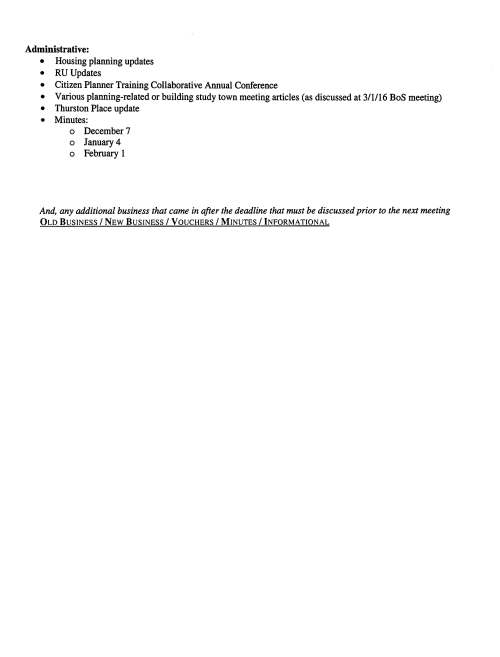
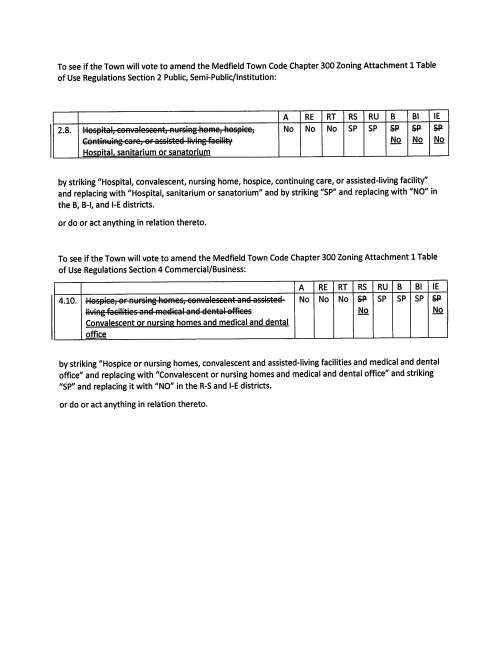
5.4.2.8             Strike “Hospital, convalescent, nursing home, Hospice, continuing care, or assisted living facility” and replace it with “Hospital, sanitarium or sanatorium” and strike “SP” and replace it with “NO” in the B, B-I, and I-E districts.

5.4.4.10         Strike “Hospice or nursing homes, convalescent and assisted living facilities and medical and dental office” and replace it with “Convalescent or nursing homes and medical and dental office” and strike “SP” and replace it with “NO” in the R-S and I-E districts.

Best,

Pete


As the final irony of this whole process, if afforded the opportunity to vote on the above warrant articles at our upcoming ATM, I will vote against them.  While I believe the 2012 process was flawed, I agree with the result, which gives our Zoning Board of Appeals the discretion to decide for the town whether any particular proposal makes sense.

Having seen the operation of the ZBA from my years serving as a member, I trust the ZBA to do what is in the best interest of the town, and also I want the town to have the flexibility to locate assisted living facilities in appropriate areas, including residential zones when it makes sense.

Candidate interviews coming

election

This from Cheryl Dunlea –


Dear Selectmen and Town Administrator,

I wish to inform you that I am not scheduling a Candidates’ Evening for the candidates in the Medfield Election this year.

Instead I have scheduled a series of interviews using Medfield High School students.  This is a joint venture with Carol Mayer, Town Clerk; Kevin Murphy, social studies teacher at Medfield High School; and Aditi Thatte and staff of Medfield TV.

The attached letter is directed to the candidates.  I hope this is a successful program.   I thought it was important for you to know the details.

The letters to those who took out papers were sent today.  I will finalize the list when the papers are submitted to Carol on February 8th.

Thank you for listening,

Cheryl Dunlea


52 Orchard Street

Medfield, MA, 02052

January 28, 2016

Dear Candidate,

Congratulations on your decision to run for elected office in Medfield!!

During these next two months I know you will be actively campaigning for your election.


As a means to introduce you to the citizens of Medfield, I would like to formally invite you to participate in a new program I have designed for candidates seeking office in Medfield.


I have coordinated with Carol Mayer, Town Clerk; Kevin Murphy, Social Studies teacher at Medfield High School; and Aditi Thatte and the staff of Medfield TV. We are scheduling a series of interviews in which High School students interested in civics would interview you about the position you are seeking, your qualifications, and the issues you are facing.


This program would be in lieu of Candidates’ Evening which I have been associated with for over forty years here in Medfield.


We are trying to schedule the interviews for Wednesday, February 10th and Thursday,

February 11th between 2:00 and 5:00 pm.   The scheduling is due to availability of the studio located at 18 North Meadows Road (Route 27).


By taping the interviews in February there will be time to edit and perfect the shows in time for March 1-27 airing on MTV. In addition the shows will be sent to various social media outlets.


I do not know if you will return your papers at this time. However, I wanted you to be aware of this program.


I hope you will join us. I will send out a schedule of the taping times as soon as I know that all the nomination papers are in.


Please be so kind as to e-mail or call me with your e-mail so I may send you the taping

schedule.


Thank you for listening!


Cheryl Dunlea

Medfield TV Board of Directors

Former third grade teacher at Wheelock School, Medfield

Former LWV President and Voter Service Chair

mrsdunlea@yahoo.com

508-359-2496

BoS on 2/2

cropped-medfield-town-house1.jpg

Tuesday February 2, 2016 @7:00 PM

AGENDA (SUBJECT TO CHANGE)

7:00 PM Permanent Building Committee
Status update on the construction of new safety building

7:30 PM William Comery
Discuss proposed change to Bay Circuit Trail (pending from January 5, 2016 meeting)

ACTION
Discuss pending 2016 warrant articles

PENDING ITEMS
Community Preservation Act Study Committee mission statement

Economic Development Committee mission statement

Other business that may rise

At the end of this meeting the Board of Selectmen will vote to close the
2016 Annual Town Meeting Warrant

Denise Garlick annual r3port

Demise Garlick is holding her annual report to the town this evening at the Town House. She is now the Chair of the Committee on Elder Affairs, so she now has a substantial staff – about six people, several of whom are here this evening. As an attorney I was glad to hear she has legal council, as well as a legislative aid.

Assisted living ATM articles

town meeting

I just finished a long phone conversation with Mike Sullivan and Mark Cerel about several topics, including the warrant articles I asked at the selectmen meeting this week to have added to the annual town meeting (ATM) warrant, to deal with the issue that the 2012 town meeting vote to permit assisted living in residential zones was based on data that was only available in the Town Clerk’s office.

I had originally proposed at the Board of Selectmen meeting two articles:

  1. One first to vote again on the 2012 zoning change, but this time with full information, and
  2. A second vote to undo the 2012 zoning change.


As we talked it through, I realized that the second article could be made to do the same thing as the first article anyway.  Town Counsel was also noting out that the former would be difficult to do at this point where the zoning change had already both passed at the town meeting and been approved by the Attorney General.

The way we left it was that Town Counsel and Mike would prepare two articles for teh upcoming annual town meeting on April 25:

  1. The first one would change the use table back to what it was before 2012 for “Public, Semi-public Institutional” uses, and
  2. The second one would do the same for “Commercial” uses.

Those two votes would effectively re-vote the 2012 town meeting vote, so those articles satisfy my goal of allowing the town residents to decide this zoning change (to permit assisted living in residential zones, upon a discretionary special permit from the ZBA) upon full information at the town meeting.