The application of the Federal M4S stormwater regulations to Medfield are being postponed a year, per the email below that Mike sent along today. Medfield joined with Franklin and other towns to seek this redress.
|
|||||||||||||||||||||
|
|||||||||||||||||||||
|
|||||||||||||||||||||
|

The application of the Federal M4S stormwater regulations to Medfield are being postponed a year, per the email below that Mike sent along today. Medfield joined with Franklin and other towns to seek this redress.
|
|||||||||||||||||||||
|
|||||||||||||||||||||
|
|||||||||||||||||||||
|
Comments Off on EPA Agrees to Our Request to Postpone MA MS4 General Permit
Posted in DPW, Environmental, Water & Sewer
| With the heavy rains, the Waste Water Treatment Plant had some issues. Both EPA and DEP have signed off on the temporary corrective measures. |

TOWN OF MEDFIELD
MASSACHUSETTS
“Department of Public Works
MAURICE G. GOULET
Director of Public Works
55 North Meadows Road
Medfield, MA 02052
(508)359-8597
Fax (508) 359-4050
TO: Board of Selectmen
Michael Sullivan, Town Administrator
Kristine Trierweiler, Assistant Town Administrator
Water and Sewer Board
FROM: Maurice G. Goulet. Director of Public Works
MEMORANDUM
DATE: April 4, 2017
SUBJECT: WWTP Issue
We experienced an influx of water at the Wastewater Treatment Plant due to excessive rains. This influx of water forced us to bypass partial treatment areas at the plant. The UV Control System at the end of the treatment areas is in need of repair. A temporary chlorine tank and feed has been set up at the final stage of treatment for disinfection. This chlorine tank is necessary for the interim until the UV Control System can be repaired and put back on-line. New controls and repair parts have been ordered and will be installed as soon as possible. When the UV Control System is running properly, the chlorine tank and feed will be removed.
Comments Off on WWTP
Posted in Water & Sewer
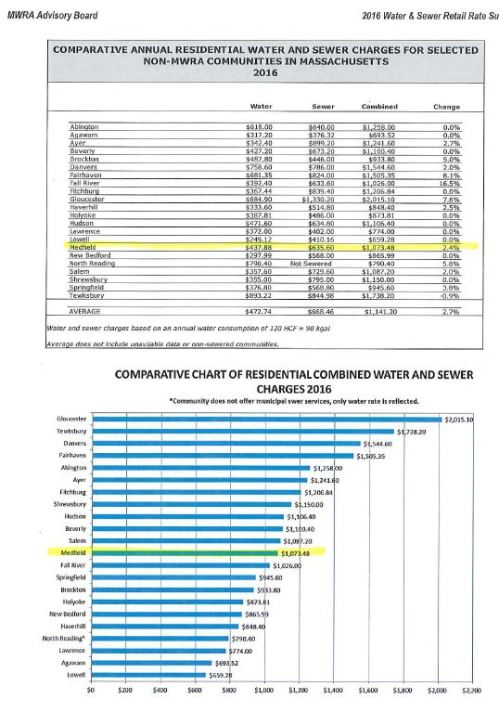
Medfield is fortunate to have Jeremy Marsette on its Water and Sewer Board, since in his day job Jeremy runs the Natick DPW. Jeremy sent along the following information that compares water and sewer rates from around greater Boston –
Hello all,
The annual survey of Water and Sewer Retail Rates performed by the Massachusetts Water Resources Authority Advisory Board was just published. They included Medfield as one of the communities surveyed. Attached are several pages of note from the survey.
Based on an AWWA standard for historical usage of 120 HCF of annual water consumption the average combined water and sewer bill for all MWRA serviced communities was found to be $1,524.84 for the calendar year 2016. For comparison, a bill from Medfield for the same usage was found to be $1,073.48. This represents that Medfield’s rate structure for combined water and sewer usage is 30% less than the average of all 60 MWRA serviced communities.
The major difference in costs is on the sewer side of the bill. The MWWTP is the key contribution in making Medfield’s sewer costs much lower than the costs seen by MWRA communities.
On average MWRA communities increased water/sewer rates by 3.4% from 2015 to 2016. Medfield increased rates by 2.4%, based on the survey’s calculations.
I have copies of the full rate survey, and it is also available on the MWRA Advisory Board’s website at http://www.mwraadvisoryboard.com . Please feel free to forward this information.
Thank you,
Jeremy
—
Jeremy Marsette, PE
Director of Public Works
Town of Natick
Comments Off on W&S rates 30% below MWRA
Posted in Uncategorized, Water & Sewer

This from Mike Sullivan this afternoon –
Date: Thu, Nov 10, 2016 at 3:50 PM
Subject: FOR IMMEDIATE RELEASE: Historic Drought Conditions Continue for Commonwealth, Cape and Islands Downgraded to Drought Advisory
To: Michael Sullivan <msullivan@medfield.net>
For your situational awareness, the Massachusetts Emergency Management Agency is sharing this press release from the Executive Office of Environmental Affairs about the continuing drought in the Commonwealth and the updated Drought Warnings and Advisory that have been issued for regions of the state. Despite the above-average precipitation in October for four of the state’s six regions, the drought conditions are not easing.
Sincerely,
Kurt Schwartz
Director
Massachusetts Emergency Management Agency
400 Worcester Road
Framingham, MA 01702
508-820-2010 (Office)
508-820-2000 (24/7 Communications Center)
617-590-3360 (Cell)
[cid:image001.jpg@01D23A93.07A78BB0]
Commonwealth of Massachusetts
Executive Office of Energy and Environmental Affairs
Governor Charles D. Baker
Lt. Governor Karyn E. Polito
Secretary Matthew A. Beaton
Press Release Contact: Katie Gronendyke – 617-626-1129 or katie.gronendyke@state.ma.us<mailto:katie.gronendyke@state.ma.us>
Historic Drought Conditions Continue for Commonwealth, Cape and Islands Downgraded to Drought Advisory
Monitoring of Water Resources to Continue, Water Conservation by Public Necessary
BOSTON – November 9, 2016 – While portions of Massachusetts have experienced measurable amounts of rainfall in the past month, large portions of the state continue to experience rainfall amounts remaining below average. As a result, Energy and Environmental Affairs (EEA) Secretary Matthew Beaton today declared the following drought levels throughout the Commonwealth: a Drought Warning for the Connecticut River Valley, Western, Central, Northeast, and Southeast Massachusetts, unchanged for the Connecticut River Valley, Central, Northeast and Southeast Regions, and up from a Drought Watch for the Western Region in October; and a Drought Advisory for the Cape and Islands, down from a Drought Watch in October. The declaration was the result of a recommendation issued from a recent meeting of the Drought Management Task Force<http://www.mass.gov/eea/waste-mgnt-recycling/water-resources/preserving-water-resources/partners-and-agencies/water-resources-commission/drought-management-task-force.html>, comprised of state, federal and local officials, and will remain in effect until water levels return to normal in the affected regions.
“While many communities throughout the Commonwealth have received rain during the month of October, it is important to remember that over 80% of the state continues to experience historic drought conditions, and several months of significant precipitation are needed for water sources to truly rebound,” said Energy and Environmental Affairs Secretary Matthew Beaton. “The Baker-Polito Administration asks that residents and communities continue to remain diligent in their efforts to conserve water in order to ensure our reservoirs, groundwater, and stream flow systems return to a more sustainable water level.”
“While we are grateful that four of the state’s six regions received above-average precipitation in October, and that the public has taken conservation requests and restrictions seriously and has significantly reduced water consumption, drought conditions continue throughout the state and the need to conserve water remains a priority,” said Massachusetts Emergency Management Agency (MEMA) Director Kurt Schwartz.
A Drought Warning, as outlined in the Massachusetts Drought Management Plan<http://www.mass.gov/eea/docs/eea/wrc/droughtplan.pdf>, indicates consecutive months of groundwater, stream flow, and reservoir levels being below normal, and initiates a much more concerted set of government responses including instating water restrictions, and more intensified monitoring and coordination between the agencies. Areas within the Drought Warning are currently experiencing precipitation levels below normal for six out of seven consecutive months. The declaration of a Drought Advisory indicates a level of dry conditions that warrants closer tracking by government agencies.
[drought_status_map2016-October conditions]
While certain sub-regions within Central Massachusetts are experiencing much more severe impacts, and areas within the Cape and Islands region are experiencing almost normal conditions, the state continues to intensely monitor and assess the drought situation, and any associated environmental and agricultural impacts. Furthermore, the state asks the public to be mindful of the amount of water they are using, and to eliminate or greatly reduce outdoor water use to ensure essential needs such as drinking water, fire protection, and crop hydration are being met.
For Regions in Drought Warning:
* Outdoor water use should be eliminated.
For Regions in Drought Advisory:
* Outdoor watering with irrigation systems and sprinklers should be limited to no more than one day per week; and
* Watering with a handheld hose should be limited to after 5pm or before 9am (to avoid evaporative losses).
The Massachusetts Department of Environmental Protection’s (MassDEP) permits exempt certain water uses from mandatory restrictions, including: for health or safety reasons; the production of food and fiber; the maintenance of livestock; and to meet the core functions of a business. MassDEP continues to provide technical assistance to communities on managing systems, including assistance on use of emergency connections and water supplies, as well as assisting towns on how to request a declaration of drought emergency.
“The month of October has experienced generally good rainfall amounts, but we are still in a significant drought that will take time to get back to normal,” said Massachusetts Department of Environmental Protection Commissioner Martin Suuberg. “People should continue to use water wisely, and in particular, as the outdoor water-use season ends, people should look to efforts within the home to conserve water. Fixing leaky faucets, toilets and showerheads is a great way to conserve water and save money.”
To aid farmers and other small businesses, the Baker-Polito Administration launched the Massachusetts Drought Emergency Loan Fund<http://www.mass.gov/governor/press-office/press-releases/fy2017/administration-launches-drought-emergency-loan-fund.html>, and continues to work closely with the United States Department of Agriculture (USDA), Farm Service Agency. As a result of USDA primary agricultural disaster designations<http://www.fsa.usda.gov/news-room/emergency-designations/2016/ed_2016_0922_rel_0120> due to losses caused by drought, all Massachusetts counties are now eligible for federal emergency loans through the Farm Service Agency to help recover from crop losses. Additionally, all Massachusetts counties are eligible for federal emergency loans as a result of a USDA primary agricultural disaster designation<http://www.mass.gov/eea/pr-2016/usda-designates-primary-natural-disaster-areas.html> due to crop losses of tree fruits like peaches that were caused by frost and freeze occurring between February and May.
“Despite having received some much needed rainfall and the fall harvest winding down, the ongoing drought conditions continue to adversely affect farmers across Massachusetts,” said Department of Agricultural Resources Commissioner John Lebeaux. “We are committed to working with farmers not only through this difficult time, but also to helping farmers adapt their operations in anticipation of future droughts and environmental challenges. We encourage residents to buy local and continue to support our hard-working farmers.”
Task Force officials noted that while reservoir levels, especially smaller systems, are low for this time of year, the Massachusetts Water Resources Authority (MWRA) water supply system is not currently experiencing drought conditions, as defined within its individual plan.
“The Quabbin Reservoir is still within normal levels,” said MWRA Executive Director Fred Laskey. “Although we still have a long way to go before we get to a drought stage, we continue to encourage residents and businesses within our service area to conserve water in their daily routines.”
The declaration of a Drought Warning and Drought Advisory requires the Drought Management Task Force to meet on a regular basis to more closely assess conditions across the state, coordinate dissemination of information to the public, and help state, federal and local agencies prepare any responses that may be needed in the future. The Task Force will next meet in December. For further information on water conservation and what you can do, visit the Executive Office of Energy and Environmental Affairs’ drought page<http://www.mass.gov/eea/drought/>, the Department of Conservation and Recreation’s drought management page<http://www.mass.gov/eea/agencies/dcr/water-res-protection/water-data-tracking/drought-status.html>, and the MassDEP Water Conservation page<http://www.mass.gov/eea/agencies/massdep/water/watersheds/water-conservation.html>.
Comments Off on Downgrade to drought advisory
Posted in State, Water & Sewer
Email from Mike today –
Hadn’t heard from postmaster since yesterday so I called him and he told me that the postcards are coming in in small batches, which he assumes means that they went to New Jersey. He said that they will go back to Brockton and Brockton will forward them to Medfield. As of this morning, he said that he had received about 200 postcards and was sending them out as soon as they were received. Could take several days. He thinks that the small batches means that a machine sorting the postcards somehow got them separated. I don’t know if that means some were destroyed and won’t be delivered. The state was supposed to meet yesterday to consider upping the water ban to a higher level but no word yet on that. Pumping is down so that most people are trying to reduce consumption. People are calling in to report violators, so that should help. That’s it for now. Have a good weekend and keep cool. Mike S
Comments Off on Postcard update
Posted in Uncategorized, Water & Sewer
Your water ban postcard was mailed to you at the Medfield Post Office on 8/3, and is still on its way to you (via parts unknown). Mike updated us (email below) today on best guesses as to where they are.
I just spoke to the acting postmaster for Medfield and this is what he tells me about the location of the 5,000 neon green postcards that were delivered to the Medfield Post Office a week ago last Wednesday (August 3). He said that they were sent out the same day to Brockton, where bulk mail is sent to be processed electronically. The Brockton postmaster has searched that facility with “a fine tooth comb” and they are not there. The Medfield acting postmaster says they are not in the Medfield Post Office. He said it is possible they were sent by mistake to a processing facility in New Jersey, which handles bulk mail for New York, New Jersey and New England. That facility has a three day turnaround and, if so, they should be coming back to Brockton today or tomorrow. If that happens, they will be sent back to Medfield for delivery, He will let me know as soon as he has any additional information as to their whereabouts. In the meantime, Maureen Anderson had to write out a personal check for $800 to the post office before they would send them out. Payment had to be by personal check or money order, as they would not take a credit card payment. If we had put it the payment on a town vendor warrant, it would have delayed the mailing by a week. That $800 turned out to be $6 short and Susan Cronin in the Treasurer/Collector’s office had to pay another $6 before they could be sent out because the total cost was $6 greater than the post office employees had calculated. The post office also said that the form, which Maureen had downloaded and filled out to be filed with the mailing, as she had been instructed to do by the post office, was the wrong form and she had to fill out another form. I will let you know of any further developments.Mike S
Comments Off on Looking for your water ban postcard?
Posted in Uncategorized, Water & Sewer
Final installment today in Bill Massaro’s account of the removal of the old water tower at the former Medfield State Hospital site.
Bill did salvage for the town a 5′ X 5′ piece of the water tower, for which I am now entertaining suggestions for its use – maybe the base for a sign for the Water Department???
For my Facebook and LinkedIn followers, please know that I restored both those links yesterday, and I do not know how many days they were down, but all posts you missed are available at the blog https://medfield02052.wordpress.com/

This will be my final daily report…
Day 7 had finished with approximately 2 full tiers of plate remaining.
As of 6:00 p.m. today–Day 8– all demo work is complete.
All the steel plates, including the bottom(floor) plates have been cut and stacked.
Four roll-offs were filled and trucked off-site today, and I estimate that no more than 3-4 additional roll-offs will be needed to remove the remaining plates.
So shipment of all the steel to the scrap facility and demobilization of the tower demo crew should still complete late Thursday or early Friday.
Bill
Comments Off on The day the thunder died
Posted in Medfield State Hospital, Uncategorized, Water & Sewer
Bill Massaro’s ongoing careful accounting of the ever shorter and quickly disappearing Medfield State Hospital water tower.

Day 6 had finished with approximately 2.5 tiers of plate remaining.
Day 7: As of 7:00 p.m. today approximately 2 full tiers still remain.
Only 1/2 of a tier was removed today. This was to facilitate access to the tank floor and the cut sections that had been dropped there over the past 6 days. Most of today was then spent dragging out these sections with the bobcat, cutting them into smaller pieces, and stacking them for loading and transport to the scrap facility in Everett. One full roll- off left the site this afternoon.
Goal is for all of the remaining standing sections to be down by end of shift tomorrow (Wed -Day 8) . Removal of the tower’s concrete base is not part of the tower demo firm’s (ALL Industrial) scope of work. Shipment of the cut plates to the scrap facility should complete Thursday or Friday at the latest.
Bill
Comments Off on Tower demo day 7
Posted in Medfield State Hospital, Uncategorized, Water & Sewer
More of Bill Massaro’s saga of the old water tower’s demise.
Bill told me last night that, thanks to his diplomatic skills, that the town can have a piece of the old tower cut to order, if we have a use for it. I thought it would make an interesting base for a sign, for something, somewhere.
Does anyone has any ideas for what the town could do with a really heavy 10-12 feet tall curved piece of steel?
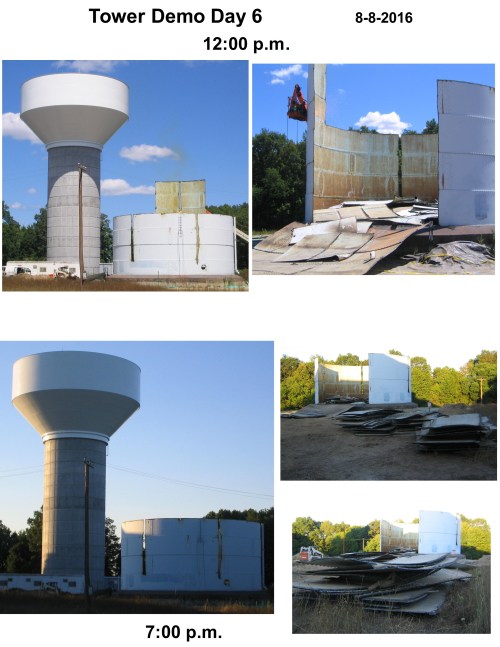
Day 5 finished with approximately 4 tiers of plate remaining.
As of 7:00 p.m. today approximately 2.5 full tiers remain.
High tier cutting requiring the crane is complete. Remaining tiers will be reached from ground level and work should go faster.
With repair of the bobcat completed at 12:00, removal and stacking of the previously cut material was restarted.
Don’t have new completion date, but will try to have one for next report..
Bill
Comments Off on Tower’s penultimate stand
Posted in Medfield State Hospital, Uncategorized, Water & Sewer
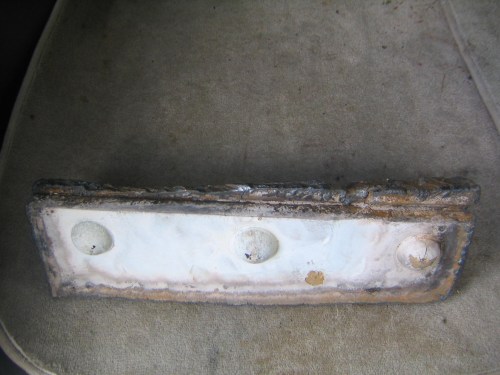
Bill Massaro salvaged a piece of the former Medfield State Hospital water tower for posterity. We were told that those rivets that held together the old water tower were the reason that it had to be replaced, because they could not withstand any more sandblasting – that and the fact that the tank was 19′ below the level of the Mt. Nebo water tower, which made for problems within the system – both combined to make the new tank the proper, albeit expensive, solution.
My Day 5 Tower Demo report will be out later today.
In the meantime I thought Medfield Historic might like a piece of the old tower.
I have a video of a vertical slice being cut this afternoon and a video of it coming down. The foto of the cutting will be in today’s report, but at 17 MB the video is too big for your home e-mails.
When I have time I will have to try to pare it down, as well as others I have taken, but for now, see below for foto of the piece of that slice the demo guys cut off for me for the Town.
Bill
Comments Off on Bill saves a piece
Posted in Medfield State Hospital, Uncategorized, Water & Sewer
Medfield Select Board member
I started this blog to share the interesting and useful information that I saw while doing my job as a Medfield select board member. I thought that my fellow Medfield residents would also find that information interesting and useful as well. This blog is my effort to assist in creating a system to push the information out from the Town House to residents. Let me know if you have any thoughts on how it can be done better.
For information on my other job as an attorney (personal injury, civil litigation, estate planning and administration, and real estate), please feel free to contact me at 617-969-1500 or Osler.Peterson@OslerPeterson.com.
 | Zach on Warrant Committee’s slid… |
 | Donna Knott on Reading for “Read Across… |
 | Lester Cohen on Town’s Buildings Require… |
 | Select Board member… on Black Out at Budget Works… |
| Lester Cohen on Black Out at Budget Works… |

 Medfield02052's Blog
