Category Archives: Transportation

Anomalous state programs – entry #1

State-House-smaller_1 (1)


This is the first time that I have heard of this particular state revenue sharing.  The state is sending the Town of Medfield our $0.20 per rides with Transportation Network Companies that originated in town.  Below is an email from Mike Sullivan and the forwarded email from the state DPU.  I see that Boston is getting about $3.5m.

=========================================================

Just received this. Medfield’s distribution amount is $734.70. this might just cover the overhead administrative costs to comply with the reporting requirements. If any left over, maybe we can use it to put 109 underground through the center. Mike


———- Forwarded message ———-
From: O’Connor, Angie (DPU) <Angie.Oconnor@massmail.state.ma.us>
Date: Fri, May 25, 2018 at 10:56 AM
Subject: Municipal Disbursement
To: “O’Connor, Angie (DPU)” <angie.oconnor@state.ma.us>
Cc: “Lubitz, Katherine (DPU)” <katherine.lubitz@state.ma.us>, “Hawkins, Ryan M (DPU)” <ryan.m.hawkins@state.ma.us>

Dear Municipal Official:

I write in regards to trips conducted by Transportation Network Companies (“TNCs”) in Massachusetts for the 2017 calendar year and the requirement of a $0.20 per‑ride assessment.  St. 2016, c. 187, § 8.  The Transportation Network Company Division (“Division”) of the Department of Public Utilities (“Department”), as the oversight authority for TNCs, has recently collected assessments from all TNCs and will be proportionately distributing the funds to municipalities.  A spreadsheet of municipal disbursements is attached to this email.  In addition, the Division has recently collected and analyzed TNC trip data across Massachusetts, and has made this information publically available.  The purpose of my writing to you is to provide information regarding municipal use of funds received from the assessment, as well as the published information on TNC trip data.

Chapter 187 of the Acts of 2016 established a Commonwealth Transportation Infrastructure Fund (“Fund”).  St. 2016, c. 187, § 8(a).  As required, each TNC has submitted to the Division the number of rides from the previous calendar year that originated within each city or town and a per‑ride assessment of $0.20, which has been credited to the Fund.  St. 2016, c. 187, § 8(a).  One‑half (½) of the amount received from the Fund will be distributed proportionately to each city and town based on the number of rides that originated in that city or town.  St. 2016, c. 187, § 8(c)(i).  In addition, one fourth (¼) will be distributed to the Massachusetts Development Finance Agency, established in G.L. c. 23G, § 2, in order to provide financial assistance to small businesses operating in the taxicab, livery, or hackney industries and to encourage the adoption of new technologies and advanced service, safety, and operational capabilities and to support workforce development; and one fourth (¼) to the Commonwealth Transportation Fund, established in G.L. c. 29, § 2ZZZ.  St. 2016, c. 187, §§ 8(c)(ii) and (iii).

We expect to disburse these funds within the coming weeks.

The distributed funds are special revenue without further appropriation.  The funds must be used “to address the impact of transportation network services on municipal roads, bridges and other transportation infrastructure or any other public purpose substantially related to the operation of transportation network services in the city or town including, but not limited to, the complete streets program established in [G.L. c. 90I, § 1] and other programs that support alternative modes of transportation.”  St. 2016, c. 187, § 8(c)(i).  Each city or town receiving distribution from the Fund must submit a report to the Division not later than December 31, 2018, detailing the projects and the amount used or planned to be used for transportation-related projects, as described above.  St. 2016, c. 187, § 8(d).  The Division is required to compile the reports and post the projects and amounts of money used on its website, located at https://www.mass.gov/orgs/department-of-public-utilities-transportation-network-company-division.  St. 2016, c. 187, § 8(d).

In addition, as required by regulation, the Division has recently collected data regarding TNC trips throughout Massachusetts, such as data on ride origination and destination, and average time and distance of trips.  220 CMR 274.12(2)(a).  The Division has published this information, along with preliminary analyses, which can be located at https://tnc.sites.digital.mass.gov/.  Lastly, the Department intends to continue working with TNCs to obtain and publish further information regarding their contribution to the Commonwealth’s transportation landscape.

I hope that you find this information beneficial.


Sincerely,

Angela M. O’Connor

Chairman

Massachusetts Department of Public Utilities

One South Station

Boston, Massachusetts 02110
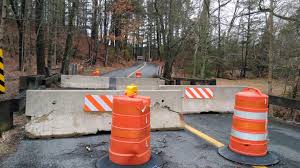


Philip Street bridge

From the Town of Medfield website –

philip st bridge

Philip Street Bridge UPDATE April 11 2018

Town of Medfield seal

Philips Street Bridge Update:

April 11 2018 UPDATE

The fabricator/manufacturer has completed the top bridge deck and will be coordinating with the installation contractor for delivery.  Final contracts for the installation contractor are scheduled to be signed on April 12th. Once the manufacturer and contractor have agreed upon a delivery date, a schedule can be determined for the work. We will update the website with the new schedule as soon as it becomes available.

Take the parking survey

From Sarah Raposa –

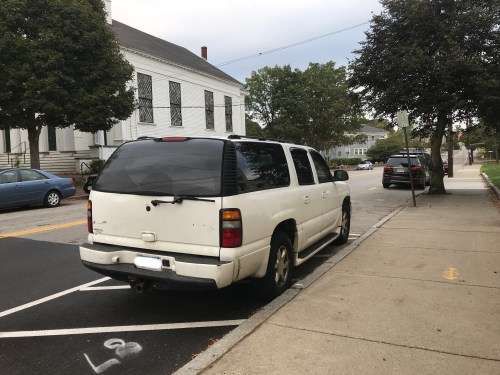
parked in no parking zone with available parking nearby

Reminder!

The Economic Development Committee (EDC) and their consultants from Nelson\Nygaard are requesting public input in formulating strategies for a parking management plan for downtown Medfield.

Please take our survey: www.surveymonkey.com/r/MedfieldParking

The survey closes Monday, March 26, 2018 at 8 am. Thank you!


Sarah Raposa, AICP

Town Planner
459 Main Street
Medfield, MA  02052
(508) 906-3027
sraposa@medfield.net

www.town.medfield.net


Weather results

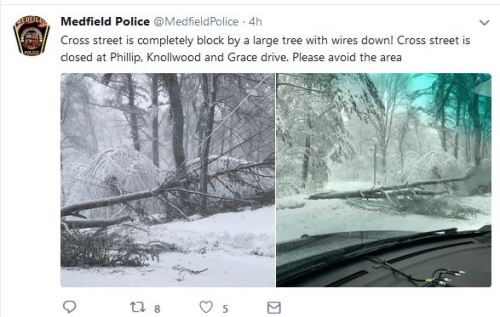
Tweet from Medfield Police Department this afternoon –

20180313-mpd


From the town website alerts I signed up to get –

This complimentary message is being sent to opt-in subscribers who might be interested in its content. If you do not wish to continue receiving these messages, please accept our apologies, and unsubscribe by following the instructions at the bottom of this message.
* * * * * * *


March 13, 2018 10:00 AM

Board and Committee Meetings Canceled on 3/13/2018

Due to the storm the Town Hall is closed today 3/13/2018. All Board and Committee meetings have been canceled for today. Read on

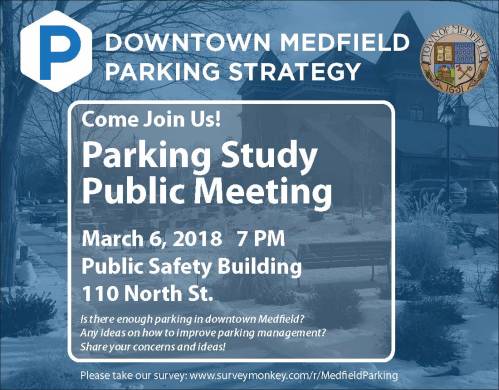
20180306-EDC-Downtown Parking Public Meeting Flyer 03-06-18

Downtown Medfield Parking Strategy Public Meeting

Tuesday, March 6, 2018

7:00 PM - 9:00 PM

Public Safety Building (First Floor Training Room)

The Economic Development Committee (EDC) and their consultants from Nelson\Nygaard will discuss and request in formulating strategies for a parking management plan for downtown Medfield. This process is funded by a grant from the Massachusetts Downtown Initiative Technical Assistance (MDI) Program. The guiding principle of the MDI is to address economic and community development needs holistically and provide a framework of interrelated activities that promote positive change in a downtown to keep it healthy and prosperous. The EDC would like to hear from property owners, business owners, residents, and users of the downtown about locations and availability of spaces, walkability, safety, and signage.


Please take our survey: www.surveymonkey.com/r/MedfieldParking 


All are welcome to share concerns as well as ideas on how to improve parking management!


Sarah Raposa, AICP

Town Planner
459 Main Street
Medfield, MA  02052
(508) 906-3027

Autonomous vehicles arrive

We need to plan for the changes autonomous vehicles will make in town, and to new developments, such as at the former MSH site.  I think this will be a boon to older residents who are no longer driving themselves, and also as a way to network various parts of town to the downtown and to one another, and, also, to link us to regional transportation hubs.  This article is from Efficient Government  –

The Driverless Taxis Are Here — This Year

Driverless Uber taxi in Pittsburgh.

Image: Flickr

They are not the future, in some cities, driverless taxis are taking riders now. Auto manufacturers are also ramping up orders and requesting Federal approvals for autonomous level four vehicle production.

Driverless taxis are already on the road in Pittsburgh, and GeekWire is covering all the details of what’s happening at the facility where 200 Volvos, equipped with LIDAR cameras, drive themselves in and out. According to Uber’s website, the test drives are collecting data with real passengers excited to take their self-driving selfiies:

We’re piloting a program now where you can get matched up with a self-driving Uber when you request uberX. When you do, you get a glimpse of the future AND access to the selfie machine. Mind. Blown.

But it’s not just Uber, and it’s not just Pittsburgh. Driverless taxis are operating in Phoenix, Arizona, and coming to Greenville County, South Carolina, and at least to the seven states that have already authorized autonomous vehicle operation.

According to the Greenville News, the Federal Highway Administration awarded the county $4 million to develop a public automated taxi system that would be the first of its kind in the nation.

These funds will help Greenville County lead the nation into a future with more driverless vehicles, which will improve mobility for some and reduce traffic congestion for all,” Acting Federal Highway Administrator Brandye L. Hendrickson said.

According to ArsTechnica, Waymo, the company conducting the first U.S. public trial of self-driving cars in Phoenix, just placed an order for an overwhelming number of Chrysler Pacifica Hybrid minivans. The Google-spawned company suggested it is moving beyond self-driving tests in Phoenix, Michigan and Atlanta and scaling up for wider autonomous vehicle operations.

With the world’s first fleet of fully self-driving vehicles on the road, we’ve moved from research and development, to operations and deployment,” said John Krafcik, CEO of Waymo.

According to NBC News, General Motors (GM) plans is asking to sweep seven states with driverless taxis by 2019.

GM asked the National Highway Traffic Safety Administration for waivers covering 16 regulations, said Kyle Vogt, the CEO of Cruise Automation, an autonomous technology company owned by GM. With Federal and state approvals, the company said it would produce 2,500 driverless Chevrolet Bolt electric vehicles per year.

In addition to driverless taxis, cities like Las Vegas are testing driverless shuttles.

London’s Driverless Shuttle ‘Harry’ Begins Taking Riders

The GATEway driverless shuttle began taking riders around the Greenwich Peninsula in the U.K.’s first public trial of autonomous electric vehicles.

Office hours issues

office hours sign

Issues that came up this AM at my selectman office hours:

First, a Castle Avenue resident told me that there is a telephone pole that was in the middle of the cul-de-sac that broke off and needs replacement, and he is hoping it can be replaced 15-16′ to the West, out of the asphalt. It is a pole that hosts a guy wire to another pole, now leaning. Also, he abuts the rear of 93-95 North Street and he said that property floods after heavy rains and it takes 3-4 days to dry out at times.

Second, I had discussions with a resident about the town buying their land, how a price might get determined, timing, and their capital gain tax issues.

Third a resident wants to create a dog park in town where dogs can run off leash. I encouraged her to get in touch with the Animal Control Study Committee, and I put her in touch with them. She also had concerns over trucks parked on North Street in front of Nosh N Grog to make deliveries.  She also suggested parking meters – I told her how happy I was that we had a parking problem, because it means things are going on, and I mentioned that a parking study is coming soon, so we will have data from which to make decisions.  I also recounted how Wellesley was always tight on parking when I would commute home at night, until Blue Ginger closed, and now they have plenty of parking.  We now have a similar restaurant effect at night downtown.

Lastly, I discussed senior housing with another resident who hopes for sale price point of $350-500K (with deeded owner profit limitations), preferences for Medfield residents, and town staff assistance in writing a warrant article for the annual town meeting.

Autominous vehicles will be our town’s future

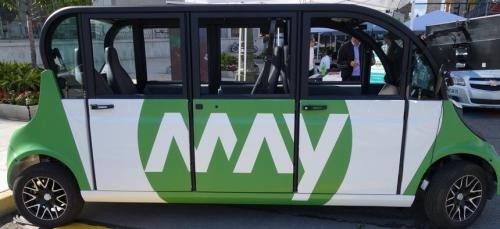
I can imagine that autominous vehicles will be in our town’s future, and will eventually be the buses we do not have now.  It could be a great way to solve linkage issues and transportation for seniors, maybe to link the remote Medfield State Hospital site to the downtown, and maybe the school buses of our future.

AV minibus

The Humble Microbus May Become the Leading Edge of the AV Revolution

http://www.routefifty.com/smart-cities/2017/10/microbus-autonomous-vehicles-maymobility/141698/

Walpole MBTA parking gone

I was contacted today about why the parking lot at the Walpole train station closed.  While I knew nothing about the situation, I was willing to reach out to the Walpole Town Administrator’s office.

I was told by the Walpole Town Administrator’s office that:

  1. the parking lot had never been properly permitted;
  2. it was shut down by the owner to be paved; and
  3. Walpole is not expecting that it will re-open as public parking, as going forward they are told that the owner will apparently be using it for parking commercial vehicles and for work to be done on his nearby building.

Rte. 27 roundabouts?

Medfield has a few intersections that could perhaps benefit from roundabouts, and I am especially thinking of ones along Rte. 27.  Click the title to see the article online.

A Chat With the Mayor of Roundabout City, USA

Why is Carmel, Indiana, planning to build as many as 40 more roundabouts on top of its existing 102?

Carmel’s 100th roundabout, opened this year. (City of Carmel)


In Carmel, driving around in circles isn’t a symptom of being lost; it’s a way of life. Despite its small size, the Indiana city has more roundabouts than any other burg in the U.S. Much of that has to do with its Republican mayor, Jim Brainard, who has seemingly waged a campaign to pave all of Carmel with these traffic-calming, accident-reducing rings.

Given that Carmel installed its hundredth roundabout this November—and has since debuted two more—CityLab thought it’d be good to query Brainard about his roundabout obsession. Here’s the (slightly condensed) interview:

What initially got you interested in roundabouts?

I first encountered roundabouts during a graduate-school trip to England. I watched how efficiently traffic flowed through the intersections. Drivers were yielding to traffic and to bikes and pedestrians. No unsightly traffic signals and no long lines or congestion. It made me wonder why the U.S. had not built more roundabouts.

Will Carmel ever have enough roundabouts?

We plan to add 28 more in 2017 and 2018 and then our long-range plans also have several more. All told, we probably have another 35 to 40 roundabouts to build before we finally are finished.

What do you think is a common misconception about roundabouts?

The most common misconception is that motorists will be so confused by the rules of roundabouts that they will make mistakes and the roundabouts will become unsafe. But the facts prove otherwise. At most all times of the day, motorists simply slow down as they approach a roundabout. They look to the left, and they yield to traffic that is already in the roundabout. It is that simple.

Studies show a 90 percent reduction in fatal accidents, 80 percent reduction in accidents with serious injury, and 40 percent reduction in all accidents at these intersections when a roundabout replaces a traffic signal. When there are accidents, they are typically low impact, at an angle (rather than a deadly T-bone crash), and result in mostly minor damage.

City of Carmel

What do you think is their most unheralded benefit?

The thing most people don’t know is how much money is saved by converting traffic signals into roundabouts. Our city engineer’s office has found that on average, roundabouts in Carmel have cost $250,000 less to build than signalized intersections and they are much less expensive to maintain than signalized intersections, saving our taxpayers $5,000 per intersection per year in electricity costs.

And because we have eliminated most all of our traffic jams, we spend much less time sitting in traffic and idling our engines, which is saving about 24,000 gallons of gas per year per roundabout, based on federal highway studies, which also leads to reduced vehicular emissions and improved air quality. With 102 roundabouts and the cost of gasoline at $2 a gallon, the public is saving about $4.9 million per year.

Do you expect the Trump administration to have an impact on Carmel in terms of infrastructure, climate change, or any other issues you’ve been passionate about?

I have heard that our president-elect is planning to boost spending in infrastructure, and that is a good thing for cities across the nation. It is important that local and state governments spend their money wisely by not building sprawl that is environmentally or financially unsustainable. The funds should be spent on repairs, safety improvements, public transit, and completing existing highway grids. Many of our roundabout projects—and other projects—have benefited from federal support over the years. We have a number of projects on our long-term plans that would be excellent candidates for that.

On climate change, I am hopeful that we continue to improve our drinking water, air quality, and work toward energy independence thereby avoiding costly involvement in maintaining the Middle East oil supply. There are multiple reasons to support the reduction of fossil fuel usage that will improve our quality of life and make our country more resilient and safer.