Posted onJune 16, 2021|Comments Off on Gov. signs extension of some COVID measures
From Division of Local Services (DLS) –
An Act Relative to Extending Certain COVID-19 Measures Adopted During the State of Emergency
On June 16th, the Governor signed into law Ch. 20 of the Acts of 2021, extending certain pandemic-related policy measures including authorizations for remote public meetings, to-go alcohol sales, eviction protections and more. Click here to view the law.
Posted onJune 10, 2021|Comments Off on Zoom meetings in danger
Email today from the Massachusetts Municipal Association –
Abrupt End of State of Emergency on June 15 Will Create Huge Challenges for Cities and Towns
Please Call Your Reps & Senators Today and Ask Them to Fast-Track an Extension of Remote Meetings and Hearings
The State of Emergency Ends at 12:01 a.m. on Tuesday, June 15. Without Enactment of an Extension BEFORE June 15, the Ability to Hold Public Meetings and Hearings Remotely Will Stop
June 10, 2021
Dear Osler Peterson,
Time is running short! While the Legislature is in the process of developing a broad package of provisions to extend important authority and flexibility put in place during the pandemic, it may take a while for the branches to reach agreement on all the details. The Senate is meeting today to debate S. 2467, which includes a number of very good provisions, yet that will leave lawmakers just a few days to reach final agreement on a complex package.
The abrupt end of the state of emergency at 12:01 a.m. on June 15 will create a number of major transition challenges for government and businesses. Clearly the most immediate and urgent issue that must be addressed is enactment of an extension of the ability to conduct public meetings and hearings remotely. Please call your Senators and Representatives and ask them to fast-track passage of the extension for remote meetings of public bodies before June 15. The other extensions are important, yet do not face the June 15 deadline.
Please share these key points with your legislators:
On March 12, 2020, the Governor used his state-of-emergency powers to issue an executive order suspending certain provisions of Section 20 of MGL Chapter 30A, allowing cities and towns to conduct meetings remotely. This was necessary because the existing state statute is woefully inadequate, does not allow remote participation in meetings unless a physical quorum is present, and reduces the ability of officials who are participating virtually to fully engage. Nearly overnight, cities and towns adopted new technology and software platforms and created a new and remarkably successful remote meeting experience for municipal leaders and the public.
Communities do not want to snap back to the overly confining pre-pandemic rules, and most are not in a position to do so quickly. Remote meetings have engaged more residents than ever before and have significantly increased transparency and insight into government operations and decision-making. Many localities have closed public buildings, repurposed meeting rooms to provide safer distancing for municipal staff or have longer-term ventilation concerns that have yet to be addressed. Further, with many residents yet to be vaccinated, and immunocompromised officials and members of the public unable to achieve full protection from the coronavirus, it is imperative that we continue the remote meeting option for local government for public health purposes.
With scores of councils, boards and commissions in place in each of our 351 cities and towns, there are nearly 10,000 municipal entities that rely on remote meetings and virtual platforms to conduct everyday business in much greater public view than ever before. If June 15 comes without an extension of the ability to continue remote meetings, there will be countless canceled meetings, delayed public hearings and widespread disruption.
MMA is supporting the temporary extensions in S. 2467 and other bills and is urging lawmakers to make these changes permanent, including the option for public bodies to conduct remote or virtual meetings, allowance for remote Town Meetings that is also extended to Open Town Meeting communities, election provisions such as the option to vote by mail and to move municipal election and caucus dates during emergencies, and expedited permitting for outdoor table service and take-out alcoholic beverages.
This is the time to act! Massachusetts can embrace the innovations and lessons learned during the past 15 months, and use them to improve government operations, transparency, and public engagement to ensure a swifter recovery for our communities.
If you or your legislators have questions, please do not hesitate to contact MMA Senior Legislative Analyst Brittney Franklin at bfranklin@mma.org or MMA Legislative Director John Robertson at jrobertson@mma.org.
Gov. Charlie Baker is filing legislation today to extend certain emergency measures currently in place by executive order that are set to expire on June 15, when the state of emergency will be rescinded. The governor’s legislation would extend measures providing for a temporary suspension of certain open meeting law requirements, special permits for expanded outside dining at restaurants, and billing protections for COVID-19 patients. Temporarily extending these measures, the governor said, would give communities and businesses time to transition, but extending them requires legislation. …
Comments Off on Gov. seeks extensions of some covid measures
Saying that the state will likely meet a key vaccination goal by early June, Gov. Charlie Baker announced today that the state will lift most remaining COVID-19 restrictions — including allowing for full capacity for industries and removing gathering limits — and adopt new federal guidance on mask wearing on May 29.
In a press conference Monday morning, Baker said that the state is now “safer, smarter and better equipped in this fight,” and is in a position to accelerate its full reopening and to rescind its current mask order. He said that the state expects to meet its goal of vaccinating 4.1 million people by the first week of June. …
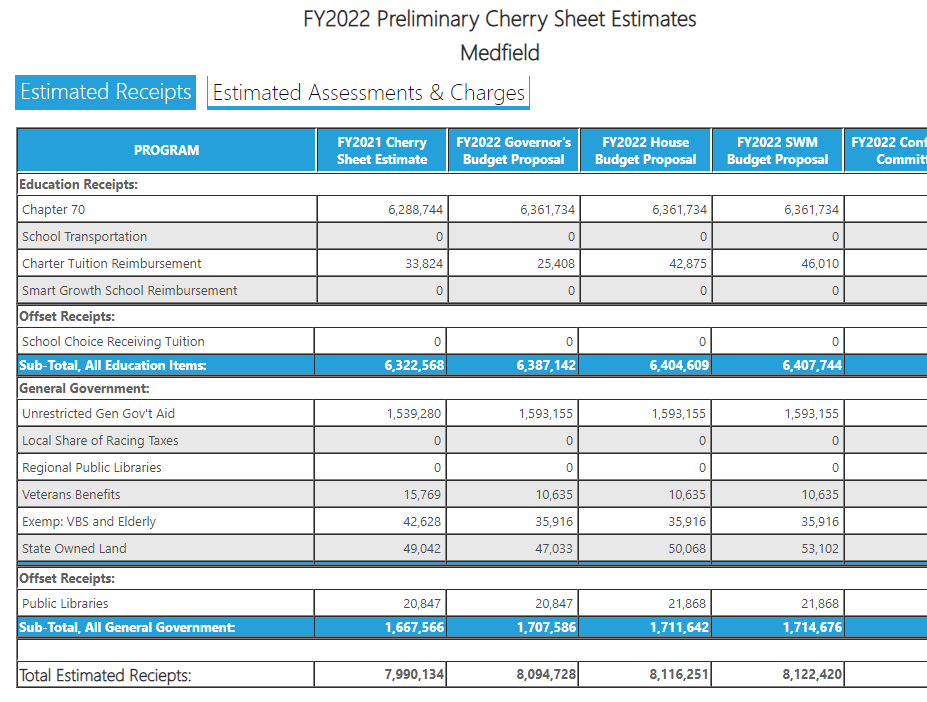
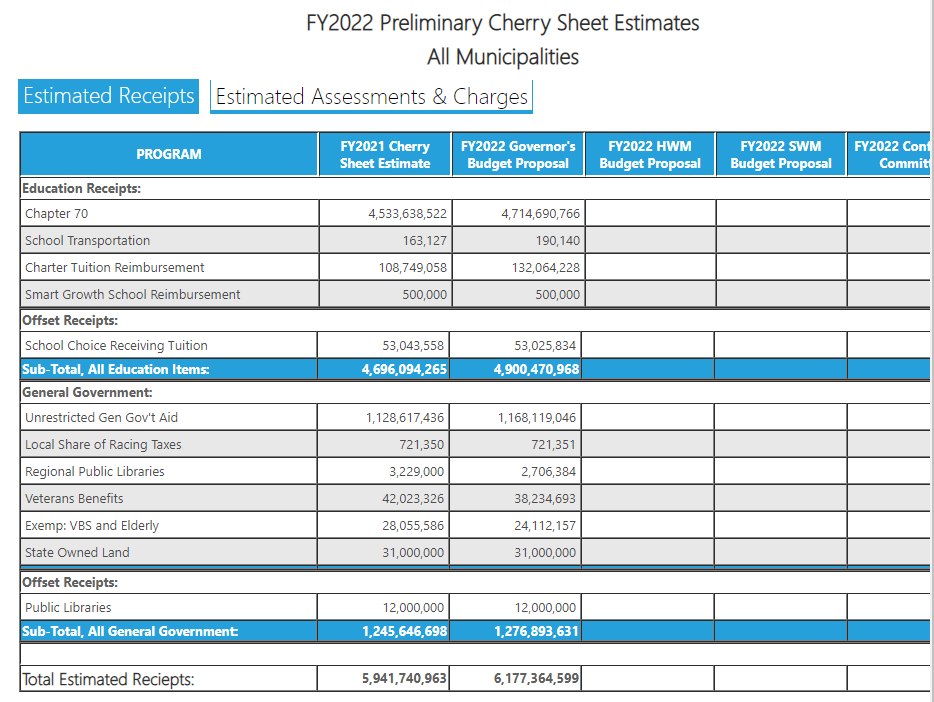
Posted onMay 13, 2021|Comments Off on Medfield’s FY2022 Preliminary Cherry Sheet Estimates show a $130K increase over last year
These state aide estimates are from the Division of Local Services (DLS) at the Massachusetts Department of Revenue. Next a conference committee has to reconcile the different amounts proposed by the legislature and the senate. –
Comments Off on Medfield’s FY2022 Preliminary Cherry Sheet Estimates show a $130K increase over last year
Posted onMay 11, 2021|Comments Off on Senate W&M budget released
SENATE W&M COMMITTEE OFFERS $47.6B FY22 BUDGET WITH KEY INVESTMENTS IN MUNICIPAL & SCHOOL AID
• INCLUDES THE FULL $39.5M INCREASE IN UGGA • INCREASES CHAPTER 70 BY $220M ABOVE FY21,FUNDING THE STUDENT OPPORTUNITY ACT ON SCHEDULE • INCREASES CHARTER SCHOOL REIMBURSEMENTS BY $31.7M• ADDS $46M FOR STUDENT ENROLLMENT AND SUMMER SCHOOL GRANTS • INCLUDES $389M TO FUND THE SPECIAL EDUCATION CIRCUIT BREAKER• ADDS $1M TO McKINNEY-VENTO REIMBURSEMENTS OVER FY21 •ADDS $4M TO PILOT
May 11, 2021
Dear Osler Peterson,
Earlier today, the Senate Ways & Means Committee advanced a $47.6 billion fiscal 2022 state budget plan to the full Senate for consideration later this month. The plan would increase overall state expenditures by 2.6% over the current year’s budget, and reflects a 4.3% increase over the Governor’s January budget proposal. The SW&M budget matches the 3.5% increase in Unrestricted General Government Aid (UGGA) in the Governor’s and House budgets, would significantly increase Chapter 70 school aid, and includes $40 million in a one-time grant program targeting student enrollment decline.
The full Senate will start debate on the FY22 budget on Tuesday, May 25, and Senate members must file all budget amendments by 2 p.m. on Friday, May 14. The Senate usually considers over 1,000 amendments during budget debate week.
The SW&M budget would increase funding for other major aid programs by adding $220 million to Chapter 70 aid over FY21; $37 million in additional funds for Charter School Mitigation payments, and an additional $1 million for McKinney-Vento transportation for homeless students. To acknowledge student enrollment declines due to the public health emergency, S. 3 would set aside $40 million in a one-time reserve account to assist districts impacted by the decline, as well as $6 million in one-time grant funding for summer school and student mental health support. The proposal would also provide an increase of $1 million for public libraries and $1 million for regional public libraries. S.3 also proposes a $4 million increase for the Payment-in-Lieu-of-Taxes (PILOT) for state-owned land account.
The Senate Ways & Means budget would increase Chapter 70 aid by $220 million over FY21, bringing the total to $5.503 billion. S. 3 would fund the “goal rates” originally set forth in the Student Opportunity Act, which set a seven-year schedule that was to begin in FY21 but was sidelined last year due to the public health emergency. To get back on track, the MMA joined with other education advocates to ask the Legislature to fund Chapter 70 at an SOA implementation rate of one-sixth rather than one-seventh in order to return to the intended schedule. The House-Senate local aid agreement included a commitment to fund the Student Opportunity Act increases at one-sixth. S. 3 includes a one-time provision, introduced in the Governor’s budget and supported by the MMA, that would allow municipalities to use a portion of their school district’s Elementary and Secondary School Emergency Relief (ESSER II) federal grant award toward the increase from last year in their required local contribution. The House did not include this language.
Rural School Aid Rural School Aid is funded at $3 million, reinserting an important account for rural school districts, especially those struggling with declining enrollment. The Governor funded this account at $1.5 million, half of the FY21 appropriation, and the House did not include the line item.
Special Education Circuit Breaker S. 3 provides $387.9 million, including approximately $15 million funds carried over from the previous year, for the Special Education Circuit Breaker, reimbursing school districts for the high cost of educating students with disabilities at the statutorily required 75% reimbursement rate. This reimbursement rate, as well as the inclusion of costs associated with out-of-district transportation, reflect obligations outlined in the Student Opportunity Act. The total appropriation is higher than the budgets offered by the Governor and the House.
Charter Schools To address charter school mitigation payments, S. 3 includes $149.1 million to reimburse school districts at 75%, the rate set forth in year one of the Student Opportunity Act implementation schedule, for costs incurred when students leave to attend charter schools, which is $5 million below the House budget. The MMA points out that charter school finance presents a major challenge to many districts, in a number of cases negating the increases districts realize in Chapter 70 aid.
School Transportation The Senate Ways and Means budget decreases regional school transportation to $78.6 million. The House budget was higher at $82 million. The Senate Ways and Means budget would increase transportation for homeless students under McKinney-Vento by $1 million over FY21, to $14.4 million. Out-of-district vocational transportation is level-funded at $250,000.
PILOT Funding Increased Recognizing the importance of Payments-in-Lieu-of-Taxes (PILOTS) for state-owned land, the Senate Ways & Means Committee increased the line item to $35 million (a $4 million increase over FY21). The Governor’s budget had recommended level-funding at $31 million; the House increased the account to $33 million. Underfunding PILOT over the years has created a significant hardship for smaller communities with large amounts of state-owned property.
Shannon Grants, Cybersecurity, and Library Aid S. 3 includes level-funding for the Shannon grants for gang violence prevention and intervention, and includes critical funding for the Mass Cybersecurity Innovation Fund, which provides important outreach and training programs for municipalities. The accounts for public libraries and regional public libraries would each see an increase of $1 million, matching the House proposal.
SUMMARY It is clear that Senate leaders are prioritizing K-12 funding, unrestricted municipal aid and other increases for cities and towns, as they advance an agenda to ensure stability during a time of uncertainty. The local funding aid agreement reached by the Joint Ways and Means Committee last month, including commitments to UGGA, Chapter 70, and the acknowledgement of school enrollment challenges, creates a more stable budget-setting process for cities and towns in the weeks and months ahead. This progress is deeply appreciated. During the budget debate and legislative session, the MMA will work to build on this progress, and will continue to advocate for full funding of the education funding priorities outlined in the Student Opportunity Act, fixing the serious problems caused by the current charter school system, securing higher Chapter 70 minimum aid increases, achieving full funding for all municipal and school reimbursement programs including transportation accounts, and providing higher PILOT funding.
Please Call Your Senators Today to Thank Them for the Local Aid Investments in the Senate Ways and Means Committee Budget.
Please Explain How the Senate Ways and Means Budget Would Impact Your Community, and Ask Your Senators to Build on this Progress During the Budget Debate.
As part of the celebration of Earth Day, I asked to have my signature as a Town of Medfield Select Board member added to the letter below, going to the MSBA tomorrow. Medfield Energy Committee members and other may join too. –
+++++++++++++++++++++++++++++++++++++++++++
April 22, 2021
Deborah Goldberg, Chair Anne Brockelman Sean R. Cronin Matt Deninger Terry Kwan Greg Sullivan Sheila Vanderhoef
Via email to ______
Dear Treasurer Goldberg and members of the MSBA Board,
We are writing to encourage the MSBA to require that all school building projects funded by MSBA be fully electrified, and climate resilient.
The MSBA is to be commended for its track record of helping cities and towns replace or renovate school buildings in an environmentally sustainable manner.
As your website notes,
The MSBA’s Green Schools Program provides incentives to a district to increase the energy efficiency and sustainability for new construction and major renovation/addition projects, by exceeding Massachusetts Energy base code by 20% for 2 additional reimbursement points. All projects are required to register for the most recent version of LEED-S or NE-CHPS and exceed Massachusetts Energy base code by 10%.
The MSBA’s updated Accelerated Repair Program provides a new opportunity to apply sustainable standards to specific building systems such as roofs, boilers and window systems. The MSBA’s green programs aim to encourage a high standard of sustainability for all MSBA-funded projects. The MSBA continues to monitor the effectiveness of its sustainable policies and make recommendations for improvement, with an emphasis on energy and cost savings, resulting in direct operational savings for school districts. [bold added]
As municipal leaders interested in speeding the transition away from fossil fuel dependency, we were particularly pleased to see the highlighted above, as it demonstrates an interest in continuous improvement in the area of sustainability and carbon emissions reduction. We are following up on your interest in improvement to encourage you to tie school building funding to the following requirements for all new or renovated schools:
Heat and cooling should be supplied by clean all-electric heating and cooling systems, not oil, propane, or gas-fueled systems.
Parking lots should offer electric vehicle (EV) charging stations for staff and/or visitors.
Schools built on or near historic wetlands or in floodplains should take into account precipitation modeling for 2070 and beyond; this may entail a raised structure or building in an alternate location.
How do these recommendations fit into the Commonwealth’s climate goals?
• Massachusetts has a greenhouse gas reduction mandate of 80% reduction of greenhouse gas emissions by 2050 and a commitment to be net zero by 2050; many cities and towns have more aggressive goals. The IPCC issued a report in 2018 noting that to keep global temperatures from rising more than 1.5 degrees Celsius — a goal of the Paris climate agreement — anthropogenic carbon dioxide emissions would have to be on a path to fall by about 45 percent by around 2030. • Massachusetts also has a goal of 300,000 EVs on the road by 2025.œ As HVAC systems are built to last for at least 20-30 years, that means we must act now to eliminate this significant source of fossil fuel energy. • The National Climate Assessment projects that the Northeast will see dramatic increases in precipitation and flooding.
Why is all-electric the more environmentally beneficial choice? Under state law, the electric grid is powered by an increasing amount of renewable energy every year. In contrast, an oil or gas boiler is running on fossil fuels from day one until the day it is retired.
School building electrification is not a new concept. In fact, schools across the state are converting to 100% clean electricity to save money, improve air quality for students, teachers and staff, and advance climate goals. • Lincoln is about to break ground on a Net Zero K-8 renovation school project. • Wellesley has one net zero ready elementary school in the design phase and is in the feasibility phase of a second. • Brookline passed a Warrant Article in May 2019 requiring that all new school buildings be fossil fuel free. • Westborough has approved and is moving forward with a net-positive energy elementary school. • Arlington is about to break ground on a new all-electric high school where heating and cooling systems will utilize heat pumps. • Several Cambridge schools have been rebuilt all-electric: Martin Luther King School, King Open School and the Cambridge Street Upper School, as well as the Valente Branch Library and a new administrative building for the entire school department; the Tobin/Vassal-lane school will be rebuilt all-electric. • Construction is underway on the new Belmont Middle and High School which will be net zero and all-electric with heating and cooling by a geothermal heat pump system. • Amherst passed a bylaw in 2017 requiring zero energy new municipal and school buildings. • Concord is at the end of Feasibility for a net zero design for a new middle school and expects to start Schematic Design in the next few months (there was a CV-related delay). • Lexington’s Select Board and School Committee adopted a building policy calling for construction of all-electric buildings, maximizing onsite renewable energy, and setting high standards for indoor air quality. Lexington’s Hastings Elementary School and Lexington Children’s Place pre-school are both expected to be net positive buildings when the solar energy systems that have been approved are completed later this year.
Energy efficient all electric schools are cost-effective to build and operate, while providing a healthier and safer learning environment for students and teachers alike.
Schools built on wetlands are more likely to suffer from mold and poor air quality, and need expensive repairs, especially as our region sees more frequent and intense rainfall.
Thank you for your consideration of our views. From the Green Communities Program to the Municipal Vulnerability Preparedness Program to the Complete Streets grants and more, we are so appreciative of the Commonwealth’s partnership in supporting cities and towns efforts to advance our transition to a clean economy and make our communities more resilient as we face a changing climate. We would welcome the opportunity to speak with you in more detail about these recommendations and help you build support to enact them.
Sincerely,
Amherst Darcy Dumont, Town Council, District 5 Dorothy S. Pam, Town Council, District 3 Patricia De Angelis, Town Councilor
Andover Maria Bartlett, Member of Green Advisory Board
Arlington Joseph A. Curro, Jr., Select Board Member Adam Chapdelaine, Town Manager
Ashland Robert Scherer, Select Board Member
Barnstable Gordon Starr, Town Councilor, Precinct 1
Becket Alvin Blake, Planning Board
Bolton Jonathan Keep, Select Board Member
Boston Kenzie Bok, City Councilor Annissa Essaibi-George, City Councilor (At-Large) Ed Flynn, City Councilor Matt O’Malley, City Councilor
Braintree Julia Flaherty, Town Council, District 1 Kelly J. Cobb-Lemire, School Committee Member
Brookline Raul Fernandez, Select Board Member Werner Lohe, Climate Action Committee (co-chair)
Burlington Martha Simon, School Committee Member
Cambridge Patricia Nolan, City Councilor Quinton Zondervan, City Councilor
Concord Charles Parker, Middle School Building Committee Member
Dalton Robert Bishop, Select Board Chair Cheryl Rose, Conservation Commission Henry Rose, Commissioner, Conservation Commission Joseph Fish, Chair, Green Dalton Committee
Dedham Jessica Portee, Planning Board Member
Framingham Geoff Epstein, School Committee Member, District 6
Gloucester Jennifer Holmgren, Councilor-at-Large
Hopkinton Jeffrey S Barnes, Conservation Commission (Chair) Lakeville Jesse L. Medford, Open Space Committee (Chair)
Lawrence Jonathan Guzman, School Committee Member – District F
Lexington Mark Sandeen, Select Board Member
Marlborough Samantha Perlman, City Councilor
Medford Zac Bears, City Councilor Nicole Morell, City Councilor Paul Ruseau, School Committee Member Jenny Graham, School Committee
Newton Susan Albright, City Council President Alicia Bowman, City Councilor Deb Crossley, City Councilor Andreae Downs, City Councilor Maria Scibelli Greenberg, City Councilor Bill Humphrey, City Councilor David Kalis, City Councilor Josh Krintzman, City Councilor Marc Laredo, City Councilor Rick Lipof, City Council Vice President Julia Malakie, City Councilor Chris Markiewicz, City Councilor Emily Norton, City Councilor John Oliver, City Councilor Holly Ryan, City Councilor
Northampton Bill Dwight, City Councilor at Large Alex Jarrett, City Councilor Karen Foster, City Councilor, Ward 2 Susan Voss, School Committee Member Chris Mason, Energy & Sustainability Officer
Pittsfield Mary Stucklen, Commissioner – Green Commission
Reading Vanessa Alvarado, Select Board Member
Somerville Will Mbah, City Councilor Ben Ewen-Campen, City Councilor Katjana Ballantyne, City Councilor Kristen Strezo, City Councilor-at-Large
Taunton Phillip Duarte, City Councilor
Wakefield Mehreen N. Butt, Town Councilor Julie Smith-Galvin, Town Councilor Susan Veilleux, School Committee Member Rob Darnell, Environmental Sustainability Committee (Chair) Mary Hajjar, Environmental Sustainability Committee (Vice Chair) Robin Greenberg, Environmental Sustainability Committee Jennifer Kallay, Gas & Light Board Commissioner Elizabeth Sheridan, ESC Student Liaison
Watertown Caroline Bays, Town Councilor Angeline B. Kounelis, Town Councilor Tony Palomba, Councilor-at-Large
Wellesley Lise Olney, Select Board Member
Williamstown Anne O’Connor, Select Board Member
Winchester Michael Bettencourt, Select Board (Chair)
Posted onApril 14, 2021|Comments Off on State budget clears House
Medfield’s #s in the budget proposal –
Contact Your Legislator Today!
HOUSE W&M COMMITTEE OFFERS $47.65B FY22 BUDGET WITH KEY INVESTMENTS IN MUNICIPAL & SCHOOL AID• INCLUDES THE FULL $39.5M INCREASE IN UGGA• INCREASES CHAPTER 70 BY $21M ABOVE GOV’S BUDGET TO FUND THE STUDENT OPPORTUNITY ACT ON SCHEDULE• INCREASES CHARTER SCHOOL REIMBURSEMENTS BY $37M• ADDS $55M FOR STUDENT ENROLLMENT AND SUMMER SCHOOL GRANTS• INCLUDES $367M TO FUND THE SPECIAL EDUCATION CIRCUIT BREAKER• RESTORES $6M TO LEVEL FUND REGIONAL SCHOOL TRANS. AT FY21 LEVEL• ADDS $1M TO McKINNEY-VENTO REIMBURSEMENTS OVER FY21•ADDS $2M TO PILOT
April 14, 2021
Dear Osler Peterson,
Earlier today, the House Ways & Means Committee advanced a $47.65 billion fiscal 2022 state budget plan to the full House for consideration later this month. The plan would increase overall state expenditures by 2.6 percent over the current year’s budget, and reflects a 3.9 percent increase over the Governor’s January budget proposal. The HW&M budget matches the 3.5% increase in Unrestricted General Government Aid (UGGA) in the Gov’s budget, adds a significant increase to Chapter 70 school aid and Charter School reimbursements, and includes $55 million in important new grant programs.
The full House will start debate on the FY22 budget on April 26, and House members must file all budget amendments by 5:00 p.m. on Friday, April 16. The House usually considers over 1000 amendments during budget debate week.
H. 4000, the House Ways & Means budget, provides progress on many important local aid priorities, including the full $39.5 million increase in Unrestricted General Government Aid that the Governor proposed and communities are counting on. The House Ways & Means budget also mirrors the Governor’s proposed increase for Special Education Circuit Breaker, with an increase over FY 2021 of $22.5 million.
The HW&M budget would increase funding for other major aid programs, by adding $21 million to Chapter 70 aid above the House One recommendation, for a total increase of $219 million; $37 million in additional funds for Charter School Mitigation payments, and an additional $1 million for McKinney-Vento transportation for homeless students. To acknowledge student enrollment declines due to the public health emergency, H. 4000 would set aside $40 million in a one-time reserve account to assist districts impacted by the decline, as well as $15 million in one-time grant funding for summer school and student mental health support. The proposal would also provide an increase of $1 million for public libraries and $1 million for regional public libraries. H. 4000 also proposes a $2 million increase for the Payment-in-Lieu of Taxes (PILOT) for state-owned land account.
$39.5 MILLION INCREASE IN UNRESTRICTED MUNICIPAL AID
In January, the Administration kept its commitment to cities and towns to tie the increase in Unrestricted General Government Aid to the projected rate of growth in state tax revenues. This year, that increase was 3.5%, representing an increase of $39.5 million. The House Ways and Means FY 2022 plan would provide $1.168 billion for UGGA, reflecting the same increase proposed by Governor Baker. In a statement released by the Chairs of the Joint Ways and Means Committee last week, the two chambers have reached an agreement on this amount and every city and town will see their UGGA funding increase by 3.5%. This is welcome news to provide stability and predictability in municipal budgeting.
CHAPTER 70 AID RETURNS TO ORIGINAL STUDENT OPPORTUNITY ACT SCHEDULE
The House budget committee is proposing a $219 million increase in Chapter 70 education aid ($21 million higher than the $197.7 million increase in H. 1), which would fund the “goal rates” originally set forth in the Student Opportunity Act. The SOA schedule set a 7-year schedule beginning in FY 2021, but that was sidelined last year due to the public health emergency. To get back on track, the MMA joined with other education advocates to ask the Legislature to fund Chapter 70 at an SOA implementation rate of 1/6th rather than 1/7th in order to return to the intended schedule. Last week, House and Senate leaders reached a local aid funding agreement, which included this commitment to fund the increases in the SOA at 1/6th, funding Chapter 70 at a total of $5.503 billion. While this is important progress for districts, most districts remain at minimum aid.
CHARTER SCHOOL MITIGATION PAYMENTS WOULD INCREASE BY $37 MILLION
House Ways & Means is proposing a total of $154 million for Charter School Mitigation Payments, which reflects an increase of $37 million over the current fiscal year. In keeping with the first year of a 3-year phase-in funding schedule outlined in the Student Opportunity Act, this investment meets the Legislature’s statutory obligation to fund charter school reimbursements at 75%. Charter school finance still presents a major challenge to many districts, in a number of cases negating the increases districts realize in Chapter 70 aid.
$367 MILLION FOR SPECIAL EDUCATION CIRCUIT BREAKER
In line with the Governor’s budget recommendation in January, the House Ways & Means Committee’s budget includes the Governor’s recommendation of $367 million for Special Education Circuit Breaker, a $22.5 million increase over FY 2021. The Student Opportunity Act expanded the circuit breaker by including out-of-district transportation, an important enhancement for cities and towns.
HW&M PROVIDES MIXED FUNDING FOR SCHOOL TRANSPORTATION ACCOUNTS
The House Ways & Means budget level funds regional transportation at $82 million. The budget would increase transportation for homeless students under McKinney-Vento by $1million to $14.4 million. There is no line item for out-of-district vocational transportation, which last year was funded at $250,000.
PAYMENTS-IN-LIEU-OF-TAXES (PILOT) AND LIBRARY AID
Recognizing the importance of Payments-in-Lieu-of-Taxes (PILOTS) for state-owned land, the House Ways & Means Committee increased the line-item by $2 million to $33 million. The Governor’s budget had recommended level-funding at $31 million. Underfunding PILOT over the years has created a significant hardship for smaller communities with large amounts of state-owned property. The accounts for public libraries and regional public libraries would each see an increase of $1 million.
SUMMARY
It is clear that House leaders are prioritizing K-12 funding and other increases for cities and towns, as they advance an agenda to ensure stability during a time of uncertainty. The local funding aid agreement reached by the Joint Ways and Means Committee last week, including commitments to UGGA, Chapter 70, and the acknowledgement of school enrollment challenges, will create a more stable budget-setting process for cities and towns in the weeks and months ahead. This progress is deeply appreciated. During the budget debate and legislative session, the MMA will work to build on this progress, and will continue to advocate for full funding of the education funding priorities outlined in the Student Opportunity Act, fixing the serious problems caused by the current charter school system, securing higher Chapter 70 minimum aid increases, achieving full funding for all municipal and school reimbursement programs, and providing higher PILOT funding.
Please Call Your Representatives Today to Thank Them for the Local Aid Investments in the House Ways and Means Committee BudgetPlease Explain How the House Ways and Means Budget Would Impact Your Community, and Ask Your Representatives to Build on this Progress During the Budget DebateThank You!
Posted onApril 12, 2021|Comments Off on Federal covid monies for Medfield
This email today from the Division of Local Services (DLS) contains a link to a spreadsheet that details the Federal covid related monies the Town of Medfield and the 350 other Massachusetts cities and towns have been allocated and have received – by clicking here;
COVID-Related Federal Funding Information
On behalf of Governor Baker, Lieutenant Governor Polito, and Secretary Heffernan, please find information about COVID-related federal funding that is available to or has already been claimed by the municipalities. The goal of these documents is to consolidate existing information and present it in a format that can be a resource for you.
Please be advised that this information changes regularly as the federal government provides updates and additional guidance.
The information provided, which is current as of April 1, 2021, includes: An excel spreadsheet with information broken down by municipality available by clicking here; A companion document, entitled “Municipality Program Descriptions”, which explains each source of funding and their eligible uses as determined by the federal government available here.For additional details on general Covid-19 Federal Funds, you can also refer to this website: http://www.mass.gov/federalfunds.
Posted onApril 5, 2021|Comments Off on Town gets $160,500 state grant
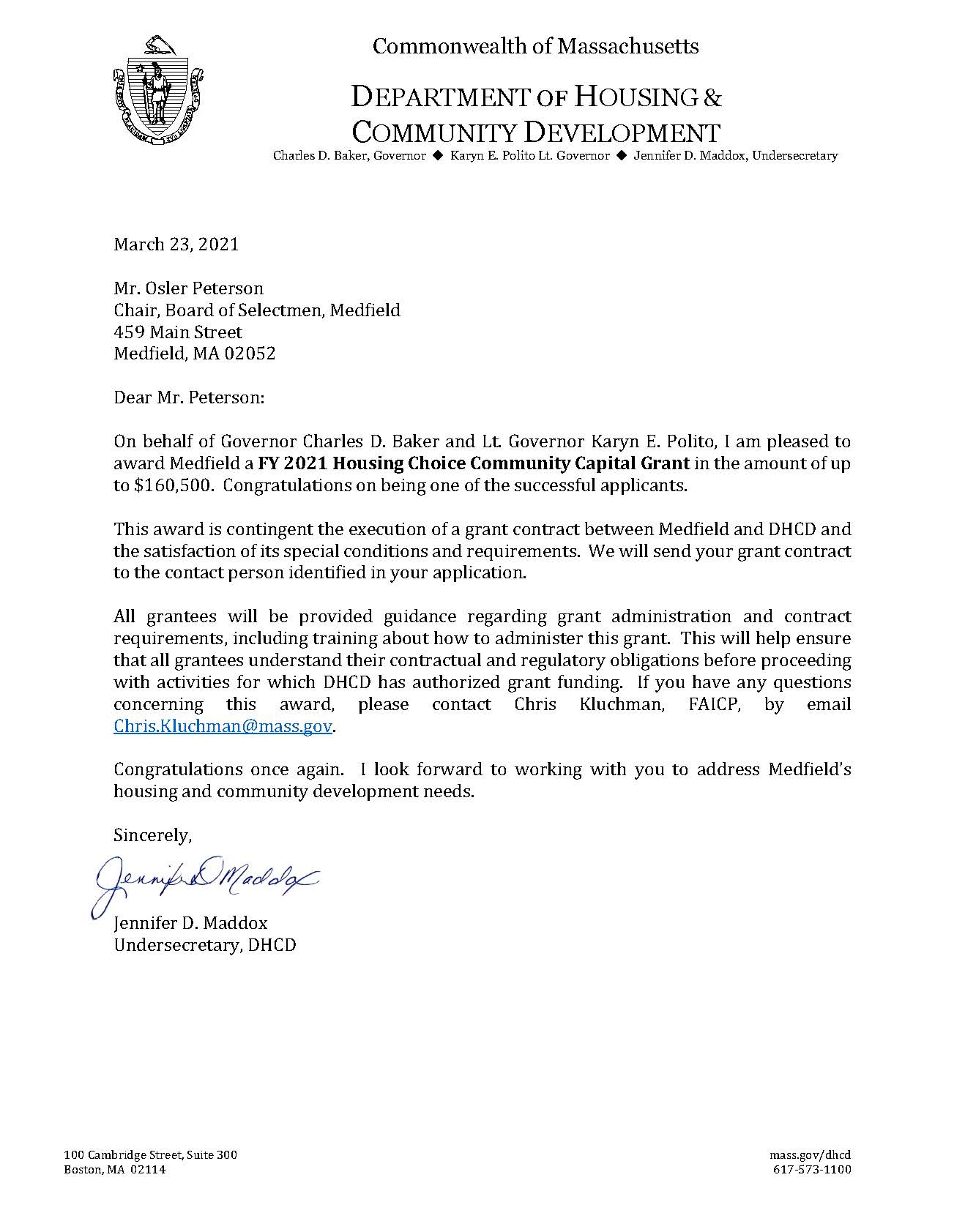
The email below came this afternoon from the Department of Housing and Community Development about the Town of Medfield being awarded a $160,500 state grant towards engineering and design of intersection improvements at West Street and Rte. 27 – which needs a better traffic signal.
Medfield
The Town of Medfield will direct funding toward engineering and design of intersection improvements at the Route 27 (North Meadows Road) and West Street intersection.
$160,500
Assistant Town Administrator, Nick Milano tells me that credit is mainly due to Town Planner, Sarah Raposa, qualifying the Town of Medfield under the Choice Community program.
Dear Chair Peterson – Please find attached a copy of the award letter for your community’s FY 21 Housing Choice Community Capital grant. Congratulations, and thank you for all the work you are doing to promote housing production in Massachusetts. Please keep this digital letter, no hard copy will be sent. Here is a link to the Commonwealth’s press release about the grant awards. I expect the grant contract will be sent to you and your staff in the next few weeks. Sincerely, Chris Kluchman______________________________
Chris Kluchman, FAICP
Deputy Director, Community Services Division
DHCD, 100 Cambridge Street, Ste 300
Boston, MA 02114
cell: 857-288-9141 *please use this number until further notice*
I started this blog to share the interesting and useful information that I saw while doing my job as a Medfield select board member. I thought that my fellow Medfield residents would also find that information interesting and useful as well. This blog is my effort to assist in creating a system to push the information out from the Town House to residents. Let me know if you have any thoughts on how it can be done better.
For information on my other job as an attorney (personal injury, civil litigation, estate planning and administration, and real estate), please feel free to contact me at 617-969-1500 or Osler.Peterson@OslerPeterson.com.








 Medfield02052's Blog