Category Archives: State

Downgrade to drought advisory

water ban-2

This from Mike Sullivan this afternoon –


Date: Thu, Nov 10, 2016 at 3:50 PM
Subject: FOR IMMEDIATE RELEASE: Historic Drought Conditions Continue for Commonwealth, Cape and Islands Downgraded to Drought Advisory
To: Michael Sullivan <msullivan@medfield.net>

For your situational awareness, the Massachusetts Emergency Management Agency is sharing this press release from the Executive Office of Environmental Affairs about the continuing drought in the Commonwealth and the updated Drought Warnings and Advisory that have been issued for regions of the state.  Despite the above-average precipitation in October for four of the state’s six regions, the drought conditions are not easing.

Sincerely,

Kurt Schwartz
Director
Massachusetts Emergency Management Agency
400 Worcester Road
Framingham, MA  01702
508-820-2010 (Office)
508-820-2000 (24/7 Communications Center)
617-590-3360 (Cell)

[cid:image001.jpg@01D23A93.07A78BB0]

Commonwealth of Massachusetts
Executive Office of Energy and Environmental Affairs

Governor Charles D. Baker
Lt. Governor Karyn E. Polito
Secretary Matthew A. Beaton

Press Release Contact: Katie Gronendyke – 617-626-1129 or katie.gronendyke@state.ma.us<mailto:katie.gronendyke@state.ma.us>

Historic Drought Conditions Continue for Commonwealth, Cape and Islands Downgraded to Drought Advisory
Monitoring of Water Resources to Continue, Water Conservation by Public Necessary

BOSTON – November 9, 2016 – While portions of Massachusetts have experienced measurable amounts of rainfall in the past month, large portions of the state continue to experience rainfall amounts remaining below average. As a result, Energy and Environmental Affairs (EEA) Secretary Matthew Beaton today declared the following drought levels throughout the Commonwealth: a Drought Warning for the Connecticut River Valley, Western, Central, Northeast, and Southeast Massachusetts, unchanged for the Connecticut River Valley, Central, Northeast and Southeast Regions, and up from a Drought Watch for the Western Region in October; and a Drought Advisory for the Cape and Islands, down from a Drought Watch in October. The declaration was the result of a recommendation issued from a recent meeting of the Drought Management Task Force<http://www.mass.gov/eea/waste-mgnt-recycling/water-resources/preserving-water-resources/partners-and-agencies/water-resources-commission/drought-management-task-force.html>, comprised of state, federal and local officials, and will remain in effect until water levels return to normal in the affected regions.

“While many communities throughout the Commonwealth have received rain during the month of October, it is important to remember that over 80% of the state continues to experience historic drought conditions, and several months of significant precipitation are needed for water sources to truly rebound,” said Energy and Environmental Affairs Secretary Matthew Beaton. “The Baker-Polito Administration asks that residents and communities continue to remain diligent in their efforts to conserve water in order to ensure our reservoirs, groundwater, and stream flow systems return to a more sustainable water level.”

“While we are grateful that four of the state’s six regions received above-average precipitation in October, and that the public has taken conservation requests and restrictions seriously and has significantly reduced water consumption, drought conditions continue throughout the state and the need to conserve water remains a priority,” said Massachusetts Emergency Management Agency (MEMA) Director Kurt Schwartz.

A Drought Warning, as outlined in the Massachusetts Drought Management Plan<http://www.mass.gov/eea/docs/eea/wrc/droughtplan.pdf>, indicates consecutive months of groundwater, stream flow, and reservoir levels being below normal, and initiates a much more concerted set of government responses including instating water restrictions, and more intensified monitoring and coordination between the agencies. Areas within the Drought Warning are currently experiencing precipitation levels below normal for six out of seven consecutive months. The declaration of a Drought Advisory indicates a level of dry conditions that warrants closer tracking by government agencies.

[drought_status_map2016-October conditions]

While certain sub-regions within Central Massachusetts are experiencing much more severe impacts, and areas within the Cape and Islands region are experiencing almost normal conditions, the state continues to intensely monitor and assess the drought situation, and any associated environmental and agricultural impacts. Furthermore, the state asks the public to be mindful of the amount of water they are using, and to eliminate or greatly reduce outdoor water use to ensure essential needs such as drinking water, fire protection, and crop hydration are being met.

For Regions in Drought Warning:

*         Outdoor water use should be eliminated.

For Regions in Drought Advisory:

*         Outdoor watering with irrigation systems and sprinklers should be limited to no more than one day per week; and

*         Watering with a handheld hose should be limited to after 5pm or before 9am (to avoid evaporative losses).

The Massachusetts Department of Environmental Protection’s (MassDEP) permits exempt certain water uses from mandatory restrictions, including: for health or safety reasons; the production of food and fiber; the maintenance of livestock; and to meet the core functions of a business. MassDEP continues to provide technical assistance to communities on managing systems, including assistance on use of emergency connections and water supplies, as well as assisting towns on how to request a declaration of drought emergency.

“The month of October has experienced generally good rainfall amounts, but we are still in a significant drought that will take time to get back to normal,” said Massachusetts Department of Environmental Protection Commissioner Martin Suuberg. “People should continue to use water wisely, and in particular, as the outdoor water-use season ends, people should look to efforts within the home to conserve water. Fixing leaky faucets, toilets and showerheads is a great way to conserve water and save money.”

To aid farmers and other small businesses, the Baker-Polito Administration launched the Massachusetts Drought Emergency Loan Fund<http://www.mass.gov/governor/press-office/press-releases/fy2017/administration-launches-drought-emergency-loan-fund.html>, and continues to work closely with the United States Department of Agriculture (USDA), Farm Service Agency. As a result of USDA primary agricultural disaster designations<http://www.fsa.usda.gov/news-room/emergency-designations/2016/ed_2016_0922_rel_0120> due to losses caused by drought, all Massachusetts counties are now eligible for federal emergency loans through the Farm Service Agency to help recover from crop losses. Additionally, all Massachusetts counties are eligible for federal emergency loans as a result of a USDA primary agricultural disaster designation<http://www.mass.gov/eea/pr-2016/usda-designates-primary-natural-disaster-areas.html> due to crop losses of tree fruits like peaches that were caused by frost and freeze occurring between February and May.

“Despite having received some much needed rainfall and the fall harvest winding down, the ongoing drought conditions continue to adversely affect farmers across Massachusetts,” said Department of Agricultural Resources Commissioner John Lebeaux. “We are committed to working with farmers not only through this difficult time, but also to helping farmers adapt their operations in anticipation of future droughts and environmental challenges. We encourage residents to buy local and continue to support our hard-working farmers.”

Task Force officials noted that while reservoir levels, especially smaller systems, are low for this time of year, the Massachusetts Water Resources Authority (MWRA) water supply system is not currently experiencing drought conditions, as defined within its individual plan.

“The Quabbin Reservoir is still within normal levels,” said MWRA Executive Director Fred Laskey. “Although we still have a long way to go before we get to a drought stage, we continue to encourage residents and businesses within our service area to conserve water in their daily routines.”

The declaration of a Drought Warning and Drought Advisory requires the Drought Management Task Force to meet on a regular basis to more closely assess conditions across the state, coordinate dissemination of information to the public, and help state, federal and local agencies prepare any responses that may be needed in the future. The Task Force will next meet in December. For further information on water conservation and what you can do, visit the Executive Office of Energy and Environmental Affairs’ drought page<http://www.mass.gov/eea/drought/>, the Department of Conservation and Recreation’s drought management page<http://www.mass.gov/eea/agencies/dcr/water-res-protection/water-data-tracking/drought-status.html>, and the MassDEP Water Conservation page<http://www.mass.gov/eea/agencies/massdep/water/watersheds/water-conservation.html>.


CPA for affordable housing

This article is from my EfficientGov.com newsletter – see it on-line here

The Massachusetts Community Preservation Act (CPA) in my analysis is all about the town being smart enough to pick up the matching state monies, because we know that in the future we will be spending  on the three CPA categories: affordable housing, historic preservation, and open spaces/recreation.

Medfield is currently getting a double whammy, because (1) our residents are paying in to the state the funds that are distributed to other towns, but (2) we just are not sharing any of the state CPA matching monies that others are getting.  Medway gets about a 40% state match.


budget-bowl of money

Community Preservation Funds & Affordable Housing

See how some Massachusetts’ towns are managing community preservation funds for affordable housing projects and requests.

In Massachusetts towns that have adopted the state’s Community Preservation Act, appointed committees make recommendations to town councils on how to spend the money. The community preservation funds are often used for open space, historic preservation or recreation projects, but they can also be applied to community housing projects.

Community housing is defined in the law as “low and moderate income housing for individuals and families, including low or moderate income senior housing.”

Gatehouse Media reporters took a close look at how several Massachusetts towns are handling their community preservation spending. While a lot of the money is dedicated to open spaces and historic preservation of town properties, some affordable housing projects are funded. For example, the town of Chelmsford has spent $2.1 million in community preservation funds on the 116-unit Chelmsford Woods complex, a property of the Chelmsford Housing Authority.

The town of Belmont, west of Boston, and two current affordable housing projects offer a dichotomy in how effective community preservation funds are for improving or increasing affordable housing.

In the first case, Belmont Village, 25 four-family buildings with 100 total units, had outdated electrical wiring with only one outlet per room. Most people were using extension cords, according to Margaret Velie, chairwoman of the Belmont Community Preservation Committee.

Belmont Village, originally built in 1950, is a state-aided housing project of the Belmont Housing Authority that is home to families and veterans. There are 50 two-bedroom and 50 three-bedroom apartments. Belmont earmarked more than $522,000 in its community preservation funding in 2015. Interior wiring upgrades, and additional electrical outlets, are being completed this summer.

According to Gatehouse Media, the town also previously set aside $375,000 of community preservation funds for a first-time homeowners assistance program to procure three more affordable housing units. But the program has not been very effective. A lottery gave three residents earning below 80 percent of median average income a chance to use a portion of the earmark to help them purchase condominiums, in exchange for the three properties becoming part of the housing authority’s affordable housing portfolio.

According to Velie, all three residents have not been able to find affordable condos in the Belmont housing market.

How are Community Preservation Funding Requests Made?

Local groups and town agencies are typically allowed to seek community preservation funds. But it’s usually a town committee or official working with a community organization making the request, Evan Belansky, director of community development in Chelmsford, told Gatehouse Media.

Chelmsford Housing Authority requests come through the authority’s executive director, for example. Small projects may also receive community preservation funding through capital improvements cycles.

But there are also ways to get approved without having to make a request through the community preservation committee and then have it recommended and approved at a town meeting.

“What we do in Chelmsford over the years, is we have learned some lessons on how to expedite the process,” Belansky said. “For example, we have an open space and recreation account, whereby the community preservation committee can approve smaller-dollar figure projects, so it is direct, without town meeting approval.”

Read the original story on the Arlington Advocate website.

Note in other states, there is similar funding for historic preservation designations. But, the historic preservation designation can play the double agent in local affordable housing battles, as EfficientGov has reported on previously.

http://efficientgov.com/blog/2016/02/18/historic-preservationist-rails-against-designation-opponents/embed/#?secret=nqpDAZKlWk

MSH road $ veto was overridden, after all

Charles River Gateway

Bill Massaro post #2 of the day – this email below from Bill just now – Bill was one of the individuals who requested that the $150,000 earmark be inserted into the state budget to fund the work on the new state road to the Charles River Gateway overlook.  Once the Town of Medfield gives the state the required notice under the Land Disposition Agreement for the former Medfield State Hospital site, the state will then be required to construct a new access road to its Charles River Gateway overlook park on its own state land, so that the town land will no longer be required to provide that access to the public.  Although the town may ultimately want to provide some such access, we will not be required to do so.  We negotiated that term to require the new road to add more value to the town land.

BTW, Representative Dooley can be seen in one of my photos yesterday from the Ken and Bob retirement party, traveling incognito in shorts, a tee shirt, and a beard.

BTW #2, today is Ken Feeney Day in Medfield!


FYI-

Thanks to Sen. Timilty and Rep. Dooley,  to paraphrase Mark Twain I am happy to say:

“The reports of our earmark’s death have been greatly exaggerated!”

In conversation with Shawn Dooley yesterday, I asked if the House had also failed to get the Access earmark into the override budget.  He seemed surprised and said that it was definitely in the House bundle;  and unless something happened in the Senate at the last minute, it should have been included in the combined package sent back to the Governor.  He did say it was a single item in the middle of a large bundle…. He  promised to check it out  and let me know what happened…

I got  an  e-mail from Rep. Dooley and an apologetic call from  Molly in  Sen. Timilty’s office this a.m. confirming that the combined  budget with the Access earmark for $150K sponsored by Sen. Timilty did go back to the Governor.  (She did caution that there is always the potential of  subsequent budget cuts by the Governor  in the fall and spring, but for now it’s in!)

As I had stated when we thought the override had failed,  Town and DCAMM obligations under the LDA  do not change…  Having the earmark, however, should help at least to expedite  completion of a  favorable  engineering design …

Getting the  Town’s “build it on State land” letter out  sooner, rather than waiting for the  LDA’s Dec 1  deadline and risking  new budget cuts,  would seem to be the prudent next step.  This would also give us the opportunity to work  with current DCAMM engineering who are familiar with the Mediated cleanup/restoration and the unique features of the property.

Bill

Vetoed MSH road money

charles river overlook

Current access to the Charles River Overlook is via the Town of Medfield land, but the Land Disposition Agreement that the town negotiated with the state gives the town the option to require the state to build a new access road to the park area across the land the state kept to the west of the Medfield State Hospital site, if the town feels continuing the easement would depress the value of the town land, and so notifies the state.

Some worked to have Senator Timilty add $150,000 to the budget this year to go towards that new road, but the Governor vetoed that earmark and it was not one that was overridden.  Below is an explanation in an email exchange by Bill Massaro and Senator Timilty’s staff person.


The Governor’s veto of the $150K earmark intended for DCAMM design/construction of the Overlook Parking Lot access was not overridden.

As I had stated in my previous  background info e-mail on the Governor’s veto, loss of the earmark does not change DCAMM’s obligations under the LDA, and does not affect the Town’s deadline to notify DCAMM by 1 Dec 2016 if the town wants the permanent general public access to the State-owned Overlook on State-owned land and not on Town-owned MSH land.

Given the loss of the earmark and given their 3 year (by 1 Dec 2019) construction window  under the LDA , there is no immediate incentive for DCAMM to begin design/engineering and construction in FY 2017… but likely  pushing it out closer to the end of into  the 3-year window and  uncertainties of 2019’s  budget

Accordingly, I  have asked that the Senator’s office consider trying again when the FY 2018 budget process starts..

Bill

———————————————————————————————————————————————————————————————————-

From: “Molly Sullivan (SEN)” <Molly.Sullivan@masenate.gov>
Sent: Monday, August 1, 2016 4:59:21 PM
Subject: RE: Override Status– Medfield Access Earmark

Hi Bill,

Sorry it took me a bit to get back to you. The Senate was in very late last night, as you saw in the Globe, so I took today off, but I wanted to get you an answer!

Unfortunately, the veto by the Governor was not overridden. Senator Timilty did file a similar amendment in for the roadway in the Senate’s Economic Development bill as well. We got it in the Senate bill but it looks like it did not survive the conference committee.

Senator Timilty and I know how important this is, and we will keep trying to get some funding anyway we can! But of course we can keep it on the radar for FY18 as well. Even though we didn’t get the funding this year, its great for it to be on the legislature’s radar.

Let me know if I can do anything else for you all! Hope you are all having a great summer!!

Best,

Molly

From: wmassaro@comcast.net [wmassaro@comcast.net]
Sent: Monday, August 01, 2016 12:35 PM
To: Sullivan, Molly (SEN)
Cc: Harney, John; Thompson, John
Subject: Re: Override Status– Medfield Access Earmark
Hi Molly,


Saw in the Globe that the FY 17  budget veto override efforts completed late last night and that several earmarks had been re-instated.  I would like to be able to tell the Medfield Selectmen and the Hospital Reuse Committee what happened to Medfield’s $150K for the Overlook Access road.


With or without the earmark the Town ‘s & DCAMM’s responsibilities under the December 2,  2014 Land Disposition Agreement are unchanged:

–  The Town must notify DCAMM by 1 December 2016 if it wants the permanent access road built on State Land

–  If notified DCAMM must construct the road by 1 December 2019


If the override has failed for FY 2017,  I suspect that when the Town makes the Dec 2016  “relocate the road” notification DCAMM will likely  delay design/construction as far into 2019 as they can.  Keeping an FY 2018 earmark on the radar would still be beneficial


Thanks,


Bill

DEP requires more restrictive water ban

water ban-2

PRESS RELEASE

The Town of Medfield has received notice from the Massachusetts Department of Environmental Protection (MA DEP) to increase the level of outdoor watering restrictions due to increasing drought conditions.

Therefore, the Town of Medfield is declaring a mandatory one day a week outdoor watering program.

  • Houses with odd numbers may perform outdoor watering on Monday evenings
  • Houses with even numbers may perform outdoor watering on Thursday evenings.
  • THERE IS ABSOLUTELY NO OUTSIDE WATERING ALLOWED BETWEEN THE HOURS OF 9 A.M. AND 5 P.M.

Daily handheld watering of vegetable gardens and flowers is permitted.   If you have further questions, please contact the Medfield
Water Department at 508-906-3004.

Medfield’s one earmark vetoed by Governor

State-House-smaller_1 (1)

Medfield was scheduled to get only one earmark in the FY17 state budget, $150,000 for the state to build a new road to the Charles River Overlook on state land, so that the easement over the town’s former MSH property could be eliminated.  Per John Nunnari’s email this morning, Governor Baker vetoed that money.  Many such vetoes are overridden by the legislature.

John closely follows the legislature for the architects, and always knows what is happening.


All,

Just fyi, but as part of the Governor’s veto message, the following has been eliminated:

 2810-0100 For the operation of the division of state parks and recreation;…. provided further, that not less than $150,000 shall be expended for the creation of a roadway at the former Medfield State Hospital property in the town of Medfield

 I’m hearing that the House/Senate intend to take up the Governors vetoes during Formal Sessions on Thursday  – with the potential for it to extend into a rare Friday Formal Session.

House and Senate leadership are upset with the Gov’s $256M in reductions over 303 line items (which included approx.. $60M in earmarks – which the Medfield State Hospital roadway project would be considered).

More to come.

john

Medfield $ in state budget

budget-2

John Nunnari provided the final Medfield money in the state budget, which includes money for the state to build its own road to the Charles River Overlook, so Medfield does not have to encumber our MSH land with that access, if we decide it is not in our best interest.


Municipality/Regional District 7061-0008 Chapter 70 Unrestricted General Government Aid Annual Formula Local Aide
FY ’15 Actual Appropriation $5,862,409.00 $1,289,875.00 $0.00
FY ’16 Actual Appropriation $5,925,859.00 $1,336,310.00
Governors FY ’17 Proposal $5,975,759.00 $1,393,771.00 $0.00
Medfield (House FY ’17 Proposed Numbers) $6,063,084.00 $1,393,771.00 $0.00
Medfield (Senate FY 17 Proposed Numbers) $6,063,084.00 $1,393,771.00 $0.00
FY ’17 Conference Committee Report           July +/- $6,063,084.00 $1,393,771.00 $0.00


2810-0100 For the operation of the division of state parks and recreation;…. provided further, that not less than $150,000 shall be expended for the creation of a roadway at the former Medfield State Hospital property in the town of Medfield


John Nunnari, Assoc AIA
Executive Director, AIA MA

State budget protects Medfield

State-House-smaller_1 (1)

The state economic downturn will effect our state services, but not the state aid to education or local state aid for Medfield (see text I put in red below), as the state cuts monies for programs and cancels an income tax cut in order to balance its FY17 budget.

This Statehouse News Service article was shared by John Nunnari.


BUDGET CONFEREES CHOP $413 MIL, COUNT ON INCOME TAX CUT CANCELLATION

By Matt Murphy
STATE HOUSE NEWS SERVICE

STATE HOUSE, BOSTON, JUNE 29, 2016…..House and Senate leaders on Thursday will seek passage of a $39.15 billion budget accord for the fiscal year that begins on Friday, crafting a compromise in the face of unstable economic conditions that cuts $750 million in projected revenue and $413 million in proposed spending from previous plans.

The deal, reached on Wednesday by six negotiators from both branches, preserves increases to local aid and school funding for cities and towns, as well as substance abuse programs, but made tradeoffs that will result in many agencies and programs receiving level funding as the page turns Thursday night from fiscal 2016 to fiscal 2017.

The compromise plan would increase Chapter 70 school aid by $116 million and unrestricted local aid by $42 million, Dempsey told reporters.

House Ways and Means Chairman Brian Dempsey said the compromise cuts $260 million from the roughly $39.5 billion spending plans approved by the House and Senate in April and May, including $142 million from Medicaid by deferring some payments until fiscal 2018 and reducing caseload estimates in public assistance and health insurance programs.

The budget bill, which will be put before House and Senate lawmakers Thursday for passage, also cancels a proposed $200 million deposit in the state’s reserves due to lower than anticipated capital gains taxes, which have taken a hit from the volatility in the stock market.

Dempsey said the budget conferees, with the help of the Baker administration, identified $100 million in savings through “procurement efficiencies,” and are no longer assuming a reduction in the income tax rate from 5.1 percent to 5.05 percent in January, freeing up $80 million in taxes for spending.

“I think that this action on the part of the House and Senate, the conferees that have worked very, very hard over the last several weeks, shows that we are taking strong action that will certainly deal with the challenges and adjustments that we see with respect to revenue,” Dempsey said.

As a result of the lower anticipated revenues in fiscal 2017, automatic transfers to the School Building Authority and the MBTA from sales taxes will occur at lower levels, reducing the amount delivered to each entity by about $30 million, Dempsey said.

Senate budget chief Karen Spilka plans a 5 p.m. budget briefing.

[The News Service will have further budget coverage as more details become available]

END
06/29/2016

Serving the working press since 1910
http://www.statehousenews.com

Image

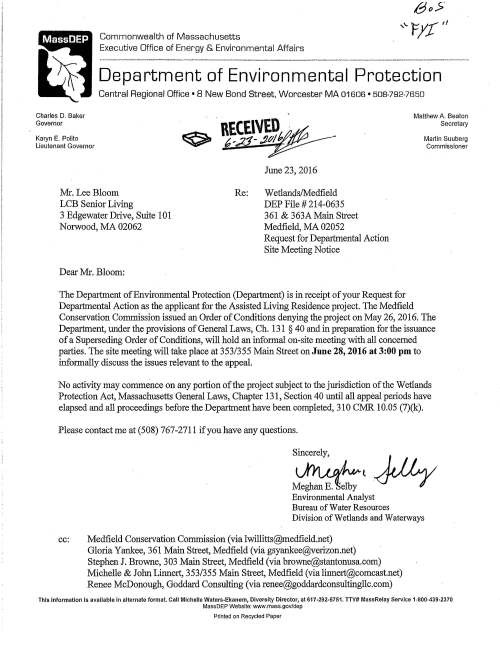
DEP site walk at LCB

Commonwealth of Massachusetts Executive Office of Energy & Environmental Affairs Department of Environmental Protection Central Regional Office • 8 New Bond Street, Worcester MA 01606 • 508-782-7650 Charles D. Baker Governor Karyn E. Polito Lieutenant Governor Mr. Lee Bloom LCB Senior Living 3 Edgewater Drive, Suite 101 Norwood, MA 02062 Dear Mr. Bloom: June 23, 2016 Re: Wetlands/Medfield DEP File# 214-0635 361 & 363A Main Street Medfield, MA 02052 Request for Depruirnental Action Site Meeting Notice Matthew A. Beaton Secretary Martin Suuberg Commissioner The Department of Environmental Protection (Depruiment) is in receipt of your Request for Departmental Action as the applicant for the Assisted Living Residence project. The Medfield Conservation Commission issued an Order of Conditions denying the project on May 26, 2016. The Deprutment, under the provisions of General Laws, Ch. 131 § 40 and in prepru·ation for the issuance of a Superseding Order of Conditions, will hold an informal on-site meeting with all concerned patties. The site meeting will take place at 353/355 Main Street on June 28, 2016 at 3:00 pm to informally discuss the issues relevant to the appeal. No activity may commence on any portion of the project subject to the jurisdiction of the Wetlands Protection Act, Massachusetts General Laws, Chapter 131, Section 40 until all appeal periods have elapsed and all proceedings before the Depruirnent have been completed, 310 CMR 10.05 (7)(k). Please contact me at (508) 767-2711 if you have any questions. Sincerely, ~t.Jlly Environmental Analyst Bureau of Water Resources Division of Wetlands and Waterways cc: Medfield Conservation Commission (via lwillitts@rnedfield.net) Gloria Yankee, 361 Main Street, Medfield (via gsyankee@verizon.net) Stephen J. Browne, 303 Main Street, Medfield (via browne@stantonusa.com) Michelle & John Linnert, 353/355 Main Street, Medfield (via linnert@comcast.net) Renee McDonough, Goddard Consulting (via renee@goddardconsultingllc.com) This Information Is available in alternate format. Call Michelle Waters-Ekanem, Diversity Director, at 617-292-5751. TTY# MassRelay Service 1-800-439-2370 MassDEP Website: www.mass.gov/dep Printed on Recycled Paper

MMA on new public records law

MMA-2

The MMA sent this second alert this afternoon, on the public records law that has now come out of a conference committee. I find myself torn on this one, as i feel there should be easy access to all public records, but I have heard Goeff Beckwith, Executive Director of the MMA say that the House version was preferred due to the House including more reasonable payments to the towns for responding, and thereby avoiding potential costs for towns from unreasonable public records requests.


Monday, May 23, 2016

LEGISLATURE TO VOTE ON FINAL PUBLIC RECORDS BILL

Conference Committee Report Would Limit Fees and Expose Communities to Attorneys’ Fees & Court Costs in Litigation

House Vote Scheduled for Wednesday

At 4:00 p.m. on Monday, May 23, the six members of the House-Senate conference committee on legislation to update the public records law reached agreement on a compromise bill, and reported it out to the full Legislature for an up-or-down vote later this week.

The Conference Committee bill differs in many important respects from H. 3858, the measure passed by the House of Representatives in November, and appears generally closer to S. 2127, the bill passed by the Senate in February. The bill would limit or set conditions on the fees that cities and towns can charge, and would create a more litigious process that could require the courts to award attorneys’ fees to plaintiffs in many circumstances.

Local officials and the MMA are not opposed to passage of legislation updating the public records laws. Rather, we have been calling for balanced and realistic changes to prevent the imposition of unfunded mandates on cities and towns, and to ensure that local officials have enough time and flexibility to comply with the act without diverting resources and time from their other important public services and duties on behalf of local residents and taxpayers.

However, the MMA’s analysis concludes that the Conference Committee’s bill would limit the ability of cities and towns to be reimbursed for responding to records requests by requiring communities to receive special permission from the Supervisor of Records every time they wish to reimbursed for time spent segregating or redacting records. Further, communities would need to receive special permission to charge more than $25/hour, which is quite common when department heads and attorneys need to participate in the process. Thus, the MMA believes that the bill has the potential to impose significant new financial burdens on cities and towns.

The MMA is also concerned that the bill could expose public entities and taxpayers to threats of expensive litigation by creating a presumption that courts should award attorneys’ fees and court costs in all but a narrow list of circumstances if the plaintiff receives any relief through a judicial order, consent decree, or if the municipality provides any of the requested documents after the complaint is filed. This provision could create an incentive for plaintiff attorneys to excessively litigate.

In general, the bill creates a more detailed set of statutory requirements that must be fulfilled under the state’s public records act, including new timelines, fee structures, administrative and judicial appeals processes, and new requirements for the administration of the law at the local level. The major changes as they impact cities and towns are outlined below.

Please review the draft of the Conference Committee’s public records legislation by clicking HERE (redraft of H. 3858 and S. 2127)

MAJOR PROVISIONS OF THE CONFERENCE COMMITTEE’S PUBLIC RECORDS BILL INCLUDE:       

Enforceable Timelines:

  • Cities, towns and state agencies would have 10 business days to respond to every public records request, with an itemized “good faith” estimate of the fee to be charged, an explanation of the time necessary to fully comply with the request if it will take longer than 10 days (cities and towns would have up to 25 business days from the day the request is received), and a listing of the documents or categories of requested documents that will be withheld by the municipality or agency under existing state and federal law (there is no change to the current list of excluded documents that may be withheld).
  • Cities, towns and state agencies could appeal to the Supervisor of Public Records for more time to comply with a public records request if the magnitude or difficulty of the request is too burdensome to complete in 25 business days, or if they believe the request has been submitted to harass the municipality.
  • The Supervisor of Records could grant communities up to 30 additional business days to comply with a request, based on a petition submitted by a municipal records officer, or could grant a longer extension if the request is deemed to be frivolous or harassing in nature.
  • Requestors could appeal to Superior Court to challenge the fee estimate, to reduce the time that municipalities could take to comply, or to challenge whether a requested document could be withheld under state or federal law.

Limits on Fees:

  • Copying charges would be limited to 5 cents per page, and the charge for electronic storage devices would be capped at actual cost.
  • The Conference Committee bill would place limits on the reimbursements that cities and towns could receive for the time spent by employees and necessary vendors (outside counsel, technology and payroll consultants, e.g.) as follows:
    • First, cities and towns would be prohibited from charging any fees if they do not adequately respond to the records request within 10 business days of receipt;
    • Second, reimbursement for employees and necessary vendors would be capped at the rate of the lowest paid employee who has the skill to search for, segregate, redact or reproduce the requested records, or $25 per hour, whichever is lower. Communities could only be reimbursed at a higher rate if they petition and receive special permission from the Supervisor of Records;
    • Third, cities and towns could only be reimbursed for time spent segregating or redacting records if the segregation and redaction is required by law, or the community petitions and receives special permission from the Supervisor of Records. This will impose a very cumbersome and bureaucratic process on municipalities, and it is unclear whether the final outcome would be full reimbursement, as the Supervisor of Records would have the power to deny adequate rates, and apparently would not be required to approve reimbursement for segregation and redaction of records that are allowed under the many exemptions in the law, but are not mandated by the law; and
    • Fourth, communities with a population over 20,000 would be required to waive any fee for the first two hours of employee or vendor time spent complying with a request.
  • Requestors could appeal to the Superior Court to challenge the fee estimate or any fee approved by the Supervisor of Records.

Litigation and Enforcement:

  • Requestors could appeal to the Supervisor of Records or the Superior Court at any time for non-compliance, to challenge fee amounts, or to challenge whether a requested record could be withheld.
  • The bill could expose public entities and taxpayers to threats of expensive litigation because it creates a presumption that courts should award attorneys’ fees and court costs in all but a narrow list of circumstances if the plaintiff receives any relief through a judicial order, consent decree, or if the municipality provides any of the requested documents after a complaint is filed. This provision constrains judicial discretion, and could create an incentive for plaintiff attorneys to excessively litigate.
  • Courts would have to provide a written explanation if they choose not to award attorneys’ fees or court costs.
  • If attorneys’ fees or court costs are awarded, municipalities and state agencies would be required to waive all fees for responding to the request.
  • Courts could assess punitive damages of up to $5,000 if it is determined that a municipality or state agency did not act in good faith.
  • The Attorney General would be given enhanced power to enforce the public records act, and the AG’s intervention could also result in similar punitive damages and fee waivers.

Other New Requirements:

  • Cities, towns and state agencies would be required to appoint at least one records access officer to assist with all public records requests, to facilitate compliance, to publicize the public records request process, and, beginning on July 1, 2017, begin posting commonly requested records on the municipal website.
  • If feasible, future upgrades to databases and computer systems should include enhancements to make it easier to comply with public records requests.
  • If the record(s) exist in an electronic format, municipalities and state agencies would be required to provide the record(s) in that format or in a commonly used electronic format if so requested by the person filing the records request.
  • If passed by the Legislature and signed by the Governor, the new public records law would take effect on January 1, 2017. The Secretary of State would be required to promulgate new regulations on the law by January 1, 2017 at the latest.

Please Call Your Legislators Today to Discuss the Public Records Legislation and Express Your Concerns.

Thank You Very Much.