Category Archives: State

State budget – step 2 (i.e. the House version)

This notice this afternoon from the Massachusetts Municipal Association about the House version of the proposed state budget. The state budget goes through the following steps each year:

  • The Governor starts the budget process with his budget proposal at the end of January,
  • the House then does its version,
  • the Senate then does its own version,
  • then the House and Senate work out the final version via a reconciliation committee,
  • the Governor can veto items, and
  • the legislature can pass what it wants over those vetos, if it has enough votes.

Our local aid monies seem to have been mainly protected in the House version of the state budget.

MMA-2


April 10, 2017
HOUSE BUDGET COMMITTEE OFFERS $40.3B FY 2018 STATE BUDGET THAT MAKES KEY INVESTMENTS IN MUNICIPAL AND SCHOOL AID

• INCLUDES THE FULL $40M INCREASE IN UNRESTRICTED MUNICIPAL AID (UGGA)

• INCREASES CHAPTER 70 BY $106M TO FUND MINIMUM AID AT $30 PER STUDENT

• ADDS $4M TO THE SPECIAL EDUCATION CIRCUIT BREAKER

• ADDS $1M MORE FOR REGIONAL SCHOOL TRANSPORTATION

• LEVEL-FUNDS MOST OTHER MUNICIPAL AND SCHOOL ACCOUNTS

Earlier this afternoon, the House Ways & Means Committee reported out a lean $40.3 billion fiscal 2018 state budget plan to increase overall state expenditures by 3.8 percent. The House Ways and Means budget is $180 million smaller than the budget filed by the Governor in January, yet it also increases Chapter 70 aid by $15 million above the Governor’s recommendation by increasing minimum aid from $20 per student to $30 per student. The full House will debate the fiscal 2018 state budget during the week of April 24.

H. 3600, the House Ways and Means budget, provides strong progress on many important local aid priorities, including the full $40 million increase in Unrestricted General Government Aid that the Governor proposed and communities are counting on. The House W&M Committee would increase funding for other major aid programs, by adding $4 million to the Special Education Circuit Breaker, adding $1 million to Regional School Transportation, and increasing Chapter 70 minimum aid to $30 per student.

Please Click this Link Now to See the Chapter 70 and Unrestricted Municipal Aid Numbers for Your Community

Later Today or Early Tomorrow – Click on this Link to See Your Community’s Local Aid and Preliminary Cherry Sheet Numbers in the House Ways & Means Budget, as Posted by the Division of Local Services

$40 MILLION INCREASE IN UNRESTRICTED MUNICIPAL AID
In a major victory for cities and towns, the HW&M fiscal 2018 budget plan (H. 3600) would provide $1.061 billion for UGGA, a $40 million increase over current funding – the same increase proposed by Governor Baker. The $40 million would increase UGGA funding by 3.9 percent, which matches the projected growth in state tax collections next year. This would be the second-largest increase in discretionary municipal aid in nearly a decade. Every city and town would see their UGGA funding increase by 3.9 percent.

CHAPTER 70 MINIMUM AID WOULD INCREASE TO $30 PER STUDENT
The House budget committee is proposing a $106.4 million increase in Chapter 70 education aid (this is $15 million higher than the $91.4 million increase in House One), with a provision that every city, town and school district receive an increase of at least $30 per student (compared to the $20-per-student amount in the Governor’s budget). The House budget would continue to implement the target share provisions enacted in 2007. Further, the House Ways & Means Committee proposal would build on the Governor’s initial proposal to start addressing shortfalls in the foundation budget framework, by increasing the cost factors for employee health insurance.

In the context of a very tight budget year, the House budget committee’s increase in Chapter 70 funding is certainly welcome progress over the House One proposal that was filed in January. The MMA continues to give top priority to full funding for the Foundation Budget Review Commission’s recommendations, and over the long-term will work to build on this increase.

$4 MILLION INCREASE INTENDED TO FULLY FUND SPECIAL EDUCATION CIRCUIT BREAKER
In another budget advancement for cities and towns, House leaders have announced that they support increased funding for the Special Education Circuit Breaker program. The House budget plan would provide $281 million, a $4 million increase above fiscal 2017, although this is still short of full funding for a vital program that every city, town and school district relies on to fund state-mandated services. The MMA will work to continue building on this welcome increase.

ADDS $1 MILLION TO REGIONAL SCHOOL TRANSPORTATION
House Ways and Means Committee budget would add $1 million to bring regional transportation reimbursements up to $62 million. The MMA will work to continue building on this welcome increase.

FUNDING FOR CHARTER SCHOOL REIMBURSEMENTS REMAINS FLAT
Both budgets filed by the Governor and the House Ways & Means Committee would level-fund charter school reimbursements at $80.5­ million, far below the amount necessary to fully fund the statutory formula that was originally established to offset a portion of the funding that communities are required to transfer to charter schools. The fiscal 2017 funding level is $54 million below what is necessary to fund the reimbursement formula that is written into state law. If this program is level funded, the shortfall will grow to an estimated $67.1 million in fiscal 2018. This would lead to the continued and growing diversion of Chapter 70 funds away from municipally operated school districts, and place greater strain on the districts that serve 96% of public school children. Solving the charter school funding problem must be a major priority during the budget debate.

PAYMENTS-IN-LIEU-OF-TAXES (PILOT), LIBRARY AID ACCOUNTS, METCO, McKINNEY-VENTO, AND SHANNON ANTI-GANG GRANTS
The House budget committee’s proposal would level-fund PILOT payments at $26.77 million, add $600K to library grant programs, add $500K to METCO, and level-fund McKinney-Vento reimbursements at $8.35 million. However, the HW&M budget would reduce Shannon Anti-Gang Grants to $5 million, a $1 million reduction.

Please Call Your Representatives Today to Thank Them for the Local Aid Investments in the House Ways and Means Committee Budget – Including the $40 Million Increase in Unrestricted Local Aid, Providing Chapter 70 Minimum Aid at $30 Per Student, and Adding Funding to the Special Education Circuit Breaker and Regional School Transportation

Please Explain How the House Ways and Means Budget Impacts Your Community, and Ask Your Representatives to Build on this Progress During Budget Debate in the House

Thank You!


As a Green Community, Medfield gets DOER grant of $146,815

doer


Commonwealth of Massachusetts

Executive Office of Energy and Environmental Affairs

Department of Energy Resources

Governor Charles D. Baker

Lt. Governor Karyn E. Polito

Secretary Matthew A. Beaton

Commissioner Judith F. Judson


Press Release Contact: Kevin O’Shea — 617-626-7362 or Kevin.O’Shea@state.ma.us


Baker-Polito Administration Designates 30 Cities and Towns as Green Communities

64% of Massachusetts Residents Live In Green Community


BOSTON – February 2, 2017 – The Baker-Polito Administration today announced that an additional 30 Massachusetts cities and towns have been designated by the Department of Energy Resources (DOER) as Green Communities, committing to an ambitious renewable energy agenda to reduce energy consumption and emissions. With today’s designation, over half of the Commonwealth’s municipalities have earned their Green Communities designation and 64 percent of residents live in a Green Community. The 30 new Green Communities are now eligible for grants totaling $6,460,385 to complete renewable energy and energy efficiency projects in their communities. Since the program began in 2010, DOER’s Green Communities division has awarded over $65 million in grant funding to the Commonwealth’s cities and town through designation and competitive grant rounds.


“The Green Communities program is an excellent example of how state and local governments can work together to save taxpayer money and promote responsible energy policies,” said Governor Charlie Baker. “The thirty new Green Communities named today will now have additional resources to invest in energy efficiency and renewable energy, locking in energy savings for residents and reducing their carbon footprints.”


“Our municipal partners continue to help lead the way on renewable energy by adopting practices that reduce their energy consumption, while channeling savings toward vital municipal functions, like public safety and education,” said Lieutenant Governor Karyn Polito. “We will continue to provide cities and towns across the Commonwealth the tools they need to reduce energy costs, usage and emissions.”


The Commonwealth’s 185 Green Communities range from the Berkshires to Cape Cod and are home to 64 percent of Massachusetts’ population in municipalities as large as Boston and as small as Rowe. Under the Green Communities Act, cities and towns must meet five criteria to be designated a Green Community and receive funding, including reducing municipal energy consumption by 20 percent over five years. The newly designated Green Communities have committed to reducing their energy consumption amounting to savings of $6,241,862 of energy costs and 2,234,090 MMBtu in five years, energy use equivalent to heating and powering nearly 2,718 homes, and reducing greenhouse gas (GHG) emissions by 27,641 metric tons, equivalent to taking 5,819 cars off the roads.


“When Massachusetts’ cities and towns invest in renewable energy and energy efficiency programs everyone wins, from taxpayers savings to a statewide reduction in emissions,” said Energy and Environmental Affairs Secretary Beaton. “With today’s designation, DOER’s Green Communities program continues to prove an effective tool in building a clean, renewable energy future for the Commonwealth.”


“DOER is proud to work with cities and towns across Massachusetts as they take important steps in embracing renewable energy and energy efficiency at the local level,” said Department of Energy Resources Commissioner Judson. “Today’s designations are simply the beginning of an important relationship between the Commonwealth and our municipal partners as we work towards our shared clean energy goals.”


DOER awarded funding for projects in these newly designated Green Communities include:


Municipality                        Award


Agawam                               $207,970

Blandford                            $138,425

Bolton                                  $141,060

Brockton                              $526,000

Charlton                               $166,570

Chelsea                                 $312,460

Chicopee                              $367,160

Clarksburg                            $141,590

Dartmouth                            $223,750

Dover                                   $137,145

Erving                                  $142,905

Fitchburg                              $306,265

Granville                              $139,280

Hawley                                 $136,920

Malden                                 $332,540

Marshfield                            $182,720

Medfield                              $146,815

New Bedford                       $604,305

North Adams                       $194,580

North Andover                    $169,390

Northbridge                         $176,515

Plainfield                              $137,575

Rockport                              $148,670

Salisbury                              $160,695

Southborough                      $142,865

Southbridge                         $206,130

Ware                                     $169,535

Warren                                 $157,740

Westfield                             $266,565

Winchendon                         $176,245


A full description of projects funded by today’s Green Communities designation grants can be found here.


“Congratulations to the people of Erving for their designation as a Green Community.  Reducing our carbon footprint and energy consumption is critical to fighting climate change and preserving our environment for future generations,” said Senate President Stan Rosenberg (D-Amherst). “This grant funding will help build out future clean energy infrastructure to protect our environment and increase energy efficiency.”


“Leadership and action at the municipal level are essential to our state’s success in conserving resources and capturing renewable energy,” said Senate Minority Leader Bruce Tarr (R-Gloucester). “Rockport and North Andover are making an important commitment to our future by becoming Green Communities, and receiving significant grant funding to propel initiatives that work for people in each town and will make a difference for our Commonwealth.”


“North Andover and Salisbury join two other communities in the First Essex Senate District, Newburyport and Amesbury, which have earned the Green Communities designation,” said State Senator Kathleen O’Connor Ives (D-Newburyport).  “The grant funding that accompanies this designation will strengthen the ability of North Andover and Salisbury to continue their energy efficiency initiatives, including upgrades to heating and cooling systems in municipal buildings, installation of LED street lighting, and investment in electronic vehicles.”

“I’m thrilled that Blandford, Clarksburg, Hawley, North Adams and Plainfield are now designated as Green Communities,” said State Senator Adam G. Hinds (D- Pittsfield). “Taking this step to improve their collective efforts to advance energy efficiency and renewable energy is good news for the entire Commonwealth.”

“As our Commonwealth continues moving towards clean and renewable energy sources, the Green Communities Grant program has played a vital role in helping municipalities achieve their individual sustainability goals and reduce energy consumption,” said State Senator Sal DiDomenico (D-Everett). “I commend the City of Chelsea for their impressive efforts and hope that this award will help to further advance the great work already underway.”


“Our office is thrilled that Salisbury is moving towards finding cleaner energy solutions to reduce long term energy costs in the community,” said State Representative James Kelcourse (R-Amesbury). “We are looking forward to working with the town to qualify for important grant funding as a result of the designation.”

“I want to thank the Baker-Polito administration for providing the City of Chelsea with a Green Community Grant,” said State Representative RoseLee Vincent (D-Revere).  “Through their generosity, the City of Chelsea will be able to use this funding to work with the DOER to find clean energy solutions that will, over time, reduce long-term energy costs and help the City’s local economy.”


“This is a win-win for our region. Through the Green Communities Program, Erving has an opportunity to reduce its long-term energy costs and support clean, renewable energy,” said State Representative Susannah Whipps (R-Athol). “It’s such an honor when our smaller communities are recognized for forward thinking when it comes to sustainability.”

“The small rural town of Plainfield has worked hard to earn the Green Community designation, and I commend its citizens for their vision to use energy more efficiently and for making this commitment to transition toward a cleaner and greener energy future,” said State Representative Stephen Kulik (D-Worthington). “The community, its people, and the entire planet will benefit from Plainfield’s dedication to strong environmental values.”


“This is very exciting news for the small town of Blandford in my district. With new leadership in the community with a vision for the future this is welcome news,” said State Representative William Smitty Pignatelli (D-Lenox). “I want to thank DOER for recognizing the impacts, even in our smallest towns, of investing in renewable energy.” 


“I want to congratulate the City of Chelsea for all their work toward this Green Communities designation and the Department of Energy Resources for their guidance,” said State Representative Daniel Ryan (D-Boston). “The Green Communities program is great example of state and local partnerships lessening the impact on our environment while helping to run our cities and towns more efficiently.”


Under the Green Communities Act, DOER’s Green Communities Designation and Grant Program can provide up to $20 million annually to qualified cities and towns.  The goal of the Designation Grant Program is support communities’ investments in energy efficiency and renewable energy projects that further the clean energy goals determined by the designated communities.  Initial Designation Grants are based on a $125,000 base for each designated Green Community, plus additional amounts tied to per capita income and population, and for municipalities that provide as-of-right siting for renewable energy generation.


“The Green Communities Program is an outstanding example of the strong partnership that the Baker-Polito Administration and the Legislature have forged with cities and towns,” said Geoffrey C. Beckwith, the Executive Director of the Massachusetts Municipal Association. “Communities all across the state will use these grant funds for innovative programs to reduce energy usage and invest in renewable energy projects, and the benefits will flow to taxpayers and the environment.”


Funding for these grants is available through proceeds from carbon allowance auctions under the Regional Greenhouse Gas Initiative (RGGI) and Alternative Compliance Payments (ACP) paid by retail electric suppliers that do not meet their Renewable Portfolio Standard compliance obligations through the purchase of Renewable Energy Certificates.


Mega-death

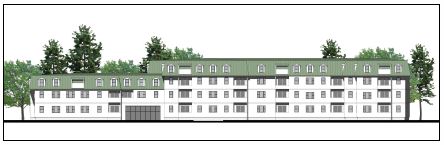
Mike Sullivan just called to relate that Representative Denise Garlick reported to him that she was informed by MassHousing at her meeting with MassHousing this morning that MassHousing is denying the Mega-B.  The denial is reportedly based on the original proposal not being appropriate for the site, and the revised proposal still not being appropriate for the site.  Mike says that at this point MassHousing will require any revision to start from scratch.

20170105-mega-b

Representative Denise Garlick will attempt to attend the Board of Selectmen meeting this evening at 7PM to personally deliver the word to the town – any weather cancellations will be post here.

State property taxes

This article was circulated with the DOR’s Division of Local Services newsletter I get.  I did not include all its charts, hence the holes you will see.   I thought the two maps were the most interesting.  Medfield is part of the over $10K/year tax belt of red in MetroWest.-

FY2017 Single-Family Residential Tax Bill Andrew Nelson, Supervisor, Bureau of Accounts (BOA) Tony Rassias, Deputy Director, BOA

The State Total single-family residential tax bill for FY2017 is $5,621, an increase of $202 or 3.7 percent from FY2016, according to data captured from 332 of the Commonwealth’s 351 cities and towns in the DLS Muncipal Databank.

In addition, the average value of a single-family residential home was $399,413, the highest value since the FY2008 average value of $403,705, which was set as values were starting to drop in the real estate market.

So far in FY2017, with 345 communities reporting valuation data to the Division of Local Services (DLS), single-family residential parcels statewide represent:

  • 66% of all residential class property assessed values;
  • 54% of all property assessed values;
  • 64% of all residential class parcels; and
  • 56% of all class parcels and articles of personal property

Analysis of data for this article is limited to single-family residential parcels, class code 101, and does not include condominiums, multifamily homes or apartment buildings.

This analysis and all charts and graphs included with the exception of Chart 5 do not include communities for which a residential exemption was adopted in any fiscal year, but later in this article presents the impact on their average bill if the property was eligible for the exemption For FY2017 only, the analysis does not include data for six communities for which no tax rate has yet to be certified by the Bureau of Accounts.

This article begins with a review of the State Total single-family residential property tax bill, a calculation performed by DLS for many years. The article then continues with a review of the statewide median of community averages since FY2008 followed by community averages. The article then reviews how both the State Total and statewide median of community averages have fared over time relative to inflation and finally takes a special look at the residential exemption’s impact on the 13 communities that had it in FY2017.

The State Total

Calculation of the State Total presumes that Massachusetts is one local governmental entity for which such a bill would be determined.  While not a median of all community averages, the State Total is presented and may be measured against itself from a prior fiscal year.

Chart 1 presents the calculation of the State Total from FY2008 to FY2017. Note that the State Total has annually increased over this period of time, yet not by more than 4%.

In addition, Chart 1 presents the average value for all single-family residential properties.  The average value decreased from FY2008 to FY2013 by 12.2%, but from FY2013 to FY2017 increased 12.7%.  Overall for the time period shown, the average value decreased by 1%.

Chart 1


The Median of Community Averages

Chart 2 shows the median or midpoint of all community averages for each fiscal year since FY2008.  For FY2017, this median tax bill of $4,745 represents an increase over FY2016’s by $202 or 4.4%


Note: For the six communities without an FY2017 tax rate and not represented in Chart 2, five have historically averaged below and one above the $4,745 median tax bill shown above. If history proves true once again for these communities, the FY2017 median amount shown would drop by less than $50.

The Average by Community

DLS calculates a community’s average single-family residential property tax bill by:

  • dividing the total class code 101 assessed property values in the community by the number of parcels in that community’s class code to establish an average property value for the class; and
  • multiplying that average property value by the community’s residential class tax rate as certified by the Bureau of Accounts for that fiscal year.

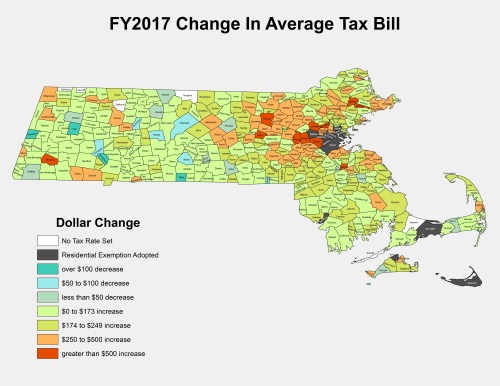
The following color-coded maps provide visual representations of the FY2017 community averages around the State as well as their dollar changes from FY2016.

fy17-dor-average-tax-bill-map


This map shows how most of the communities in the western and central parts of Massachusetts have average tax bills at or less than the median of community averages, $4,745. The map also shows a cluster of communities with average tax bills over $10,000 just to the west of Boston.

For a larger version of this map, including community names, click here.


fy17-DOT-tax change map of Massachusetts.jpg

This map, in conjunction with the previous map, shows that although many communities in the western and central parts of Massachusetts had lesser than median average tax bills, a number of them had greater than median average increases from FY2016. The median for all communities that increased their average tax bill was $174.

Statewide, 311 communities increased their average tax bill from FY2016 ranging from $1 in Hampden to $998 in Winchester.

Also seen is that a number of communities actually decreased their average tax bill from FY2016. Statewide, 21 communities did so, ranging from $2 in Sheffield to $305 in Peru. The median for all communities that decreased their average tax bill was $43.

For a larger version of this map, including community names, click here. 


 The Range of Averages

Graph 1 shows that more communities (81) have FY2017 community average single-family property tax bills in the $3,000 to $3,999 range followed by 78 in the $4,000 to $4,999 range category.


Graph 2 shows the number of communities increasing and decreasing their average tax bills from FY2016 to FY2017 on a percentage basis. For example, seven communities decreased their average bill anywhere from greater than1% to 2%. Also, 84 communities increased their average bill anywhere from greater than3% to 4%.

For the 21 communities that decreased their bill, their median percentage decrease was 1.1%. For the 311 communities that increased their average bill, their median percentage increase was 3.5%.

Communities that decreased their average bill ranged from .05% in Sheffield to 8.4% in Peru.  Communities that increased their average bill ranged from .02% in Hampden to 24.4% in Hancock


 The Highest and Lowest Averages

Chart 3 shows the communities having the 10 highest and lowest FY2017 average bills in descending order.


The Statewide Trend in Current and Constant Dollars

Chart 4 shows the State Total and Median of Community Averages in current dollars as presented earlier in this article in relation to a constant dollar, which controls for inflation.

The Chart shows that both the State Total and the Median of Community Averages dollar amounts have outpaced the rate of inflation over the time period shown.

For example, the Median of Community Averages FY2008 current dollar figure of $3,470 adjusted for inflation represents a constant dollar figure of $3,900 in FY2017.  FY2017 in current dollars is $4,745. As of FY2017 then, the current dollar figure has outpaced the constant dollar figure by $845 or 18%.

Note that the State Total is always in excess of the Median. As was stated earlier in this article, these two dollar amounts may be compared to themselves from a prior fiscal year but are not comparable to each other.


The Residential Exemption Communities

Thirteen communities that adopted a residential exemption are not included in either the State Total or Median Averages as the Bureau of Accounts does not receive sufficient information as to how many class code 101 residential properties are eligible for the exemption in those communities.

For those 13 communities, however, Chart 5 shows the FY2017 dollar impact of the residential exemption on single-family residential properties (1) assessed at the community’s median value and (2) deemed qualified to receive the exemption.  More information on this exemption can be found in the October 16, 2014 edition of City & Town.


For More Information

For more information on the State Total, Average Bills for Communities and Statewide Rankings, please visit the DLS Databank.

The authors would like to thank Theo Kalivas of DLS’ Technical Assistance Bureau for his assistance in creating the color-coded maps used in this analysis.

First state local aid

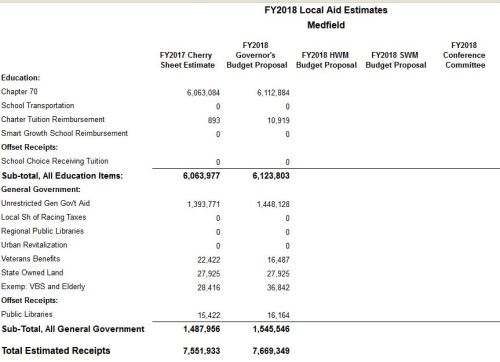
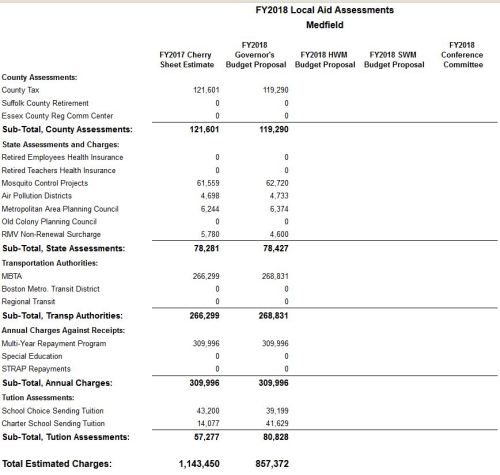
DOR is providing us these local aid figures for Medfield based on the Governor’s budget proposal (NB, the sum appears to be incorrect on the assessments):

fy18-local-aid-medfield


fy18-local-aid-assessments-medfield

State budget

The state budget starts with the Governor’s proposal, moves on to the House’s proposal, to the Senate’s proposal, and then finally a House-Senate reconciliation committee to iron out the differences.  The Governor has just filed his proposed budget, and he is keeping to his plan to have municipal aid track the percentage revenue increases.  The analysis of the Governor’s proposed budget that follows was provided to me by the Massachusetts Municipal Association.

MMA-2


January 25, 2017
GOV. BAKER FILES $40.5 BILLION FY 2018 BUDGET PROPOSAL

• UNRESTRICTED MUNICIPAL AID WOULD INCREASE BY $39.9 MILLION (3.9%)

• CHAPTER 70 AID WOULD INCREASE BY ONLY $91.4 MILLION (2%)

• MOST OTHER MUNICIPAL AND SCHOOL ACCOUNTS LEVEL-FUNDED


Earlier this afternoon, Gov. Charlie Baker submitted a $40.5 billion fiscal 2018 state budget plan with the Legislature, proposing a spending blueprint that would increase overall state expenditures by 4.3 percent, as the new Administration seeks to close an ongoing structural budget deficit by restraining spending across the board and placing an estimated $98 million into the state’s rainy day fund. The budget relies on $95 million in one-time revenues.

As Gov. Baker pledged to local officials on Jan. 21 at the MMA’s Annual Meeting, his budget includes a $39.9 million increase in Unrestricted General Government Aid, and $91.4 million more for Chapter 70 school aid. The Gov.’s proposal for Chapter 70 aid includes a minimum aid increase of $20-per- student, full funding of the foundation budget requirements, and continued implementation of the “target share” equity provisions. The foundation budget calculation would partially implement the Foundation Budget Review Commission’s recommendation to use a more realistic factor for the cost of employee health insurance in school systems.

Most other municipal and education aid accounts in the Governor’s budget proposal would remain at fiscal 2017 levels. This includes the special education circuit breaker, payments-in- lieu of taxes, regional school transportation, Shannon anti-gang grants, McKinney-Vento reimbursements and METCO funding.

The Governor would level-fund charter school reimbursements at $80.5 million, far below the amount necessary to fully fund the statutory formula that is designed to offset a portion of the amount that communities are required to transfer to charter schools. Level-funding this account would lead to the continued and growing diversion of Chapter 70 funds away from municipally operated school districts, and place greater strain on the districts that serve 96% of public school children.


Click here to see the UGGA and Chapter 70 Aid amounts listed by community in the

Governor’s budget


• Click below to see the Division of Local Services preliminary fiscal 2018 Cherry Sheet

aid amounts for your community, based on the Governor’s proposed budget (you will

need to insert the name of your community in the field):

Municipal Aid

Regional School District Aid


Click here to see DESE’s calculation of fiscal 2018 Chapter 70 aid and Net School

Spending requirements for your city, town, or regional school district, based on the

Governor’s proposed budget


UNRESTRICTED MUNICIPAL AID INCREASED BY $39.9 MILLION

In a major victory for cities and towns, House One (the Governor’s fiscal 2018 budget submission) would provide $1.062 billion for UGGA, a $39.9 million increase over current funding. This fulfills one of Gov. Baker’s major campaign promises to increase direct municipal aid by the same rate of growth as state tax revenues.

The $39.9 million would increase UGGA funding by 3.9 percent, the same rate of growth projected for state tax revenues. Every city and town would see their UGGA funding increase by this 3.9 percent growth rate.

CHAPTER 70 SCHOOL AID WOULD GO UP JUST 2 PERCENT

The Governor’s budget submission proposes a small 2 percent increase in Chapter 70 education aid of $91.4 million, providing every city, town and school district with a minimum increase of $20 per student. The Governor’s budget would continue to implement the target share provisions enacted in 2007. The overall Chapter 70 increase would be significantly smaller than in recent years. The Governor’s budget includes a partial reflection of one of the Foundation Budget Review Commission’s key recommendations, which is updating the foundation budget to reflect the cost of employee health insurance. But this adjustment in the foundation budget is not enough to increase aid to many districts. 237 cities and towns (74% of all operating districts) would only receive an increase of $20 per student under the Governor’s budget. This below-inflation increase is too low, and would force communities to reduce school programs or further shift funds from the municipal side of the budget.

Please ask your Legislators to support a funding increase for Chapter 70 school aid that ensures that all schools receive a suitable and appropriate increase in fiscal 2018, which the MMA believes should be at least $100 per student. The MMA also strongly supports implementation of all of the recommendations of the Foundation Budget Review Commission to update the Chapter 70 “foundation budget” minimum spending standards for special education and employee health insurance, and to add to the spending standard a measure of recognition for the cost of services for low-income, English Language Learner (ELL) and other students who would benefit from more intensive services. The Commission recommended phasing in the changes over a four-year period, a position the MMA supports as well. Increasing minimum aid and fixing the inadequacies in the foundation formula are essential.

It should also be noted that House One contains language that would continue to allow communities to count retiree health insurance toward their net school spending, but only if they have done so beginning when the school finance law first went into effect in 1994, or if they have previously voted to adopt the local-option provision in section 260 of the fiscal year 2015 general appropriations act to allow a phase-in of retiree health insurance costs in their net school spending calculation.

Further, House One would use the same methodology that was used in this year’s fiscal 2017 budget to estimate the number of low-income students used in the foundation budget calculation.

SPECIAL EDUCATION CIRCUIT BREAKER UNDERFUNDED

The Governor’s budget would level-fund the Special Education Circuit Breaker program at $277 million. Because special education costs are expected to rise in fiscal 2018, this means that the Governor’s budget likely underfunds reimbursements by as much as $10 million. This is a vital account that every city, town and school district relies on to fund state-mandated services. The Legislature has intended to fully fund the program for the past five years, and the MMA will again be asking lawmakers to ensure full funding in fiscal 2018.

CHARTER SCHOOL REIMBURSEMENTS LEVEL FUNDED AT $80.5 MILLION

As noted above, the Governor would level-fund charter school reimbursements at $80.5 million, far below the amount necessary to fully fund the statutory formula that was originally established to offset a portion of the funding that communities are required to transfer to charter schools. The fiscal 2017 funding level is $54 million BELOW what is necessary to fund the reimbursement formula that is written into state law, so it is clear that the shortfall will grow significantly in fiscal 2018. Even though the reimbursement formula is level-funded at $80.5 million, the Governor’s fiscal 2018 budget would INCREASE charter school assessments by $60 million. This would lead to the continued and growing diversion of Chapter 70 funds away from municipally operated school districts, and place greater strain on the districts that serve 96% of public school children. Solving the charter school funding problem must be a major priority during the budget debate.

REGIONAL SCHOOL TRANSPORTATION REIMBURSEMENTS LEVEL FUNDED

Gov. Baker’s budget submission would level-fund regional transportation reimbursements at the $61 million amount. This will be a hardship for virtually all communities in regional districts. Reimbursements for transportation of out-of- district vocational students remains significantly underfunded at $250K. Increasing these accounts is a priority for cities and towns.

McKINNEY-VENTO REIMBURSEMENTS LEVEL FUNDED

The Governor’s budget would level-fund reimbursements for the transportation of homeless students at $8.35 million. The impact of this funding level will vary from community-to- community depending on the number of homeless families that remain sheltered in local hotels and motels. The Administration has been successful in reducing the number of homeless students who are dislocated from their original district, but those communities that continue to provide transportation to many students may continue to see shortfalls.

PAYMENTS-IN- LIEU-OF- TAXES (PILOT) AND SHANNON GRANTS LEVEL FUNDED, AND LIBRARY AID UP $189K

The Governor’s budget would level fund PILOT payments at $26.77 million, Shannon anti-gang grants at $6 million, and fund library grant programs at $19.07 million (up $189K).

GOV. PROPOSES APPLYING HOTEL-MOTEL TAX TO AIRBNB AND OTHER SHORT-TERM RENTALS, BUT ONLY IF RENTED FOR 150 DAYS

House One includes an outside section that would subject Airbnb and other short-term rentals to the local room occupancy excise tax. However, this would only apply in cases where the property is rented for 150 days or more. The MMA strongly supports extending the room occupancy excise to ALL short-term rentals. The 150-day threshold would continue to shield almost all seasonal and short-term rentals from taxation, and would not close the loophole that exists now.

GOV. PROPOSES FUNDS TO BEGIN PROCESS OF HAVING DEP TAKE THE LEAD IN OVERSEEING FEDERAL STORMWATER PERMITS

The Governor’s budget proposes $1.4 million to begin the process of having the Department of Environmental Protection assume “delegated authority” from the U.S. EPA to oversee the NPDES Stormwater Permit process (also referred to as MS4 permits). The MMA supports having DEP as the lead agency for stormwater permits. The $1.4 million would fund 12 DEP staff positions to begin the transition to becoming the lead agency. Full funding would take approximately $4.7 million. The Governor will be filing separate legislation to allow DEP to petition the EPA for this authority.


PLEASE CONTACT YOUR LEGISLATORS TODAY AND CALL ON THEM TO PUBLICLY SUPPORT THE GOVERNOR’S PROPOSAL TO INCREASE UNRESTRICTED MUNICIPAL AID BY $39.9 MILLION – THIS  INCREASE IS VITAL TO LOCAL BUDGETS IN EVERY CORNER OF MASSACHUSETTS


AND PLEASE ASK YOUR LEGISLATORS TO COMMIT TO INCREASING CHAPTER 70 EDUCATION AID, FIXING THE FLAWS IN CHARTER SCHOOL FUNDING, AND FULLY FUNDING KEY MUNICIPAL AND SCHOOL PROGRAMS

 
Massachusetts Municipal Association
One Winthrop Square, Boston, MA 02110
(617) 426-7272
All contents copyright 2015, Massachusetts Municipal Association

Unsubscribe from MMA Legislative Alerts.


MMA on marijuana law problems

MMA-2

MMA letter to governor and legislative leaders calls for changes to recreational marijuana law

Printer-friendly versionSend by email

His Excellency Charles D. Baker
Governor of the Commonwealth
State House, Boston

The Hon. Robert A. DeLeo
Speaker of the House
State House, Boston

The Hon. Stanley C. Rosenberg
Senate President
State House, Boston

Dear Governor Baker, Speaker DeLeo, and President Rosenberg,

With the passage of Question 4, Massachusetts became one of just eight states that have legalized the recreational use of marijuana. Because of our population and our prime location in the center of a compact geographic region, our state will soon become the commercial marijuana industry’s East Coast base. The growing industry will certainly use Massachusetts as the retail platform for Rhode Island, Connecticut, New York, Vermont and New Hampshire.

Cities and towns have a responsibility to ensure that the new law is implemented locally in a manner that protects the public interest, including addressing public health and public safety concerns, and ensuring that the roll-out does not negatively impact residents, other businesses, neighborhoods, economic development plans, or other important considerations. As such, municipal officials are scrambling to get information and plan their own policy responses. This will be very difficult in the short term, as there are many unanswered questions and many significant flaws in the new law.

It is important to recognize that Question 4 prevailed and the issue of whether to legalize the recreational use of marijuana has been settled. Yet it is also clear that the new law has several significant drafting flaws that require fixing in order to prevent negative outcomes. Just as the Legislature and governor acted in 1981 to amend Proposition 2½ to make it workable, we believe it is both appropriate and necessary for state lawmakers to take action to address the shortcomings in Question 4. Doing so would benefit the public interest and every community.

While there are many smaller details that warrant attention, the major problems that must be fixed are: 1) deadlines that are too short to give state and local officials enough time to prepare for and administer the law; 2) the preemption and loss of local control; 3) the unregulated “home grow” provisions that could foster a new black market for marijuana sales; and 4) the inadequate tax revenues written into the statute.

An Unrealistic Timeline
Question 4 sets an unrealistic deadline, instructing the state to construct the entire regulatory framework for the commercial marijuana industry by January 1, 2018. That is too little time to recruit and appoint a first-ever, three-person Cannabis Control Commission (CCC) and give the rookie commissioners the time to build a brand-new state agency, recruit and hire agency staff, draft initial versions of all regulations, solicit input from all stakeholders, promulgate final regulations, and provide enough lead-time for a rational roll-out that protects the public interest. If the state fails to meet the January 1 deadline, the industry has written Question 4 in such a way that the commercial industry would arise in a mostly unregulated environment, because medical marijuana operators would automatically be licensed as commercial agents for recreational marijuana, giving them a near-monopoly in the marketplace.

We respectfully ask you to act swiftly to extend these deadlines and give the state and municipalities more time to get the regulatory framework in place and adopt reasonable rules to govern this new commercial industry.

In the meantime, we request passage of statutory authority to allow cities and towns to enact a moratorium on new commercial marijuana facilities until the Cannabis Control Commission has promulgated regulations governing the industry. Because the deadline for regulations comes after the CCC is instructed to begin processing applications and licenses for commercial facilities, local governments will begin to see applications for commercial facilities before they know the full extent of the regulations under which those facilities will be operating.

Unwise Preemption of Local Control
A second major concern is the preemption of local control. The new law prevents cities and towns from making local decisions on whether to allow commercial retail sales in their municipalities. Here it is clear that the marijuana industry lobbyists learned a lesson from Colorado, the first state to legalize recreational use. The Colorado law allows local governing bodies to ban retail sales in their communities – and 70 percent of their cities and towns have enacted such a ban. Question 4 makes it impossible for selectmen, mayors, councils or town meetings to make this decision. Instead, communities are only allowed to enact a ban if 10 percent of local residents who voted in the last state election sign a petition to place a question on the ballot, and voters approve the question at a state general election in 2018 or later. This means the earliest that communities can even consider a ban will be nearly a year after commercial sales become legal – it is hard to imagine that this industry-friendly loophole was unintentional.

Further, Question 4 includes language that would allow the CCC to preempt or disallow any local zoning rule, ordinance or regulation that is inconsistent with their wishes – a concern made even more serious because the “advisory board” in the law is actually a pro-industry panel dominated by commercial marijuana interests.

We respectfully ask you to act swiftly to restore decision-making authority to municipal governing bodies on the question of commercial bans, and clarify that the CCC cannot override local zoning decisions and ordinances on the location and operation of locally permitted commercial facilities, including recreational marijuana. The broad preemption language must be eliminated.

An Unregulated Non-Commercial Market
Starting on December 15, the home cultivation of marijuana will be allowed through a totally unregulated “home grow” provision, which will allow individuals to cultivate up to 12 plants at any one time. Calculating the street value, that’s $60,000 worth of marijuana, and based on reasonable processing estimates, the 12 plants could yield approximately 12,000 joints, or thousands of “servings” of marijuana-infused edibles.

Local and state law enforcement officials are gravely concerned about the home grow language in the new law. The sheer volume of home grown marijuana will certainly incentivize a burgeoning black market that will hit the street at least a year before official, regulated commercial sales become lawful, creating a source of sales that could easily reach school-aged children and teenagers.

We respectfully ask you to delay the home grow provisions, and develop a structure to appropriately regulate and monitor this activity to safeguard public safety and health, and protect neighborhoods, residents and youth.

Inadequate Revenues
Another major concern is the rock-bottom excise revenue that would be generated by Question 4, where it is again clear that the marijuana industry learned a lesson from earlier experiences in Colorado and Washington state. In addition to state sales taxes, the Colorado law imposes a 25 percent tax on marijuana, and cities and towns can enact their own local sales taxes of up to 8 percent. The state of Washington imposes a 37 percent excise tax, and cities and towns can collect their own local sales tax of up to 3.4 percent.

Here in Massachusetts, the commercial interests behind Question 4 set the state marijuana excise tax at just 3.75 percent, and capped the local-option marijuana excise tax at only 2 percent. These would be the lowest rates in the nation.

Given the significant new burden of regulating and monitoring a new commercial industry (which will deal in a controlled substance that is still illegal under federal law), the state and local revenue rates are unreasonably low and damaging to public budgets. The state excise will clearly fall short, and we urge you to increase the state tax so that, at a minimum, resources will be available to provide statewide training of police officers and fund the CCC and other state agency needs. Further, cities and towns will have new responsibilities in areas of public safety, public health, zoning, permitting and licensing. At 2 percent, the local revenue in Question 4 will fall far short of local needs.

We respectfully ask you to increase the allowable state and local tax rates to bring them in line with Colorado and Washington and other “first-wave” legalization states. We recommend that cities and towns be authorized to implement, on a local-option basis, an excise of between 2 to 6 percent, to be determined by vote of the local governing body.

An Independent Advisory Board is Necessary
We urge you to improve the makeup of the Cannabis Advisory Board to make it a truly independent entity, instead of the industry-dominated panel that it is under Question 4. It is striking that the ballot question was written to give commercial marijuana interests control of a board that will be so heavily involved in regulating the industry. We respectfully ask that a municipal representative be added to the board, as well as a representative from municipal police chiefs and a seat representing local boards of health. We believe the addition of these perspectives is vital to ensure that local public safety and health concerns are considered when crafting the regulations.

Summary
Cities and towns have a responsibility to implement the new law in a manner that protects the public interest, yet communities will not be able to fulfill this responsibility unless the significant flaws detailed in this letter are addressed. Just as the Legislature and governor acted in 1981 to amend Proposition 2½ to make it workable, we respectfully ask the Commonwealth to take action to address the shortcomings in Question 4. Doing so would benefit the public interest and every community.
Thank you very much for your consideration. If you have any questions or wish to receive additional information, please do not hesitate to have your offices contact me or MMA Legislative Director John Robertson at (617) 426-7272 at any time.

Sincerely,

Geoffrey C. Beckwith
MMA Executive Director & CEO

DHCD corrects HPP date

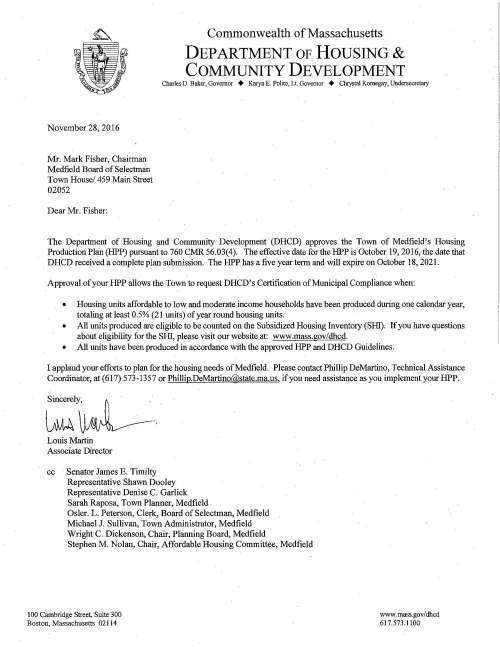
When the Department of Housing and Community Development(DHCD) approved the Town’s Housing Production Plan this past month, it incorrectly stated the effective date in it approval.  Today the DHCD corrected that error with a new letter (copy attached below) noting the correct date.

Commonwealth of Massachusetts DEPARTMENT OF HOUSING & COMMUNITY DEVELOPMENT Charles D. Baker, Governor + Karyn E. Polito, Lt. Governor + Chrystal Kornegay, Undersecretary November 28, 2016 Mr. Mark Fisher, Chairman Medfield Board of Selectman Town House/ 459 Main Street 02052 Dear Mr. Fisher: The Department of Housing and Community Development (DHCD) approves the Town of Medfield's Housing Production Plan (HPP) pursuant to 760 CMR 56.03(4). The effective date forthe HPP is October 19, 2016, the date that DHCD received a complete plan submission. The HPP has a five year term and will expire on October 18, 2021. Approval of your HPP allows the Town to request DHCD's Certification of Municipal Compliance when: • Housing units affordable to low and moderate income households have been produced during one calendar year, totaling at least 0.5% (21 units) of year round housing units. • All units produced are eligible to be counted on the Subsidized Housing Inventory (SHl). If you have questions about eligibility for the SHl, please visit our website at: www.mass.gov/dhcd. • All units have been produced in accordance with the approved HPP and DHCD Guidelines. I applaud your efforts to plan for the housing needs of Medfield. Please contact Phillip DeMartino, Technical Assistance Coordinator, at (617) 573-1357 or Phillip.DeMartino@state.ma.us, if you need assistance as you implement your HPP. Sincerely, Louis Martin Associate Director cc Senator James E. Timilty Representative Shawn Dooley Representative Denise C. Garlick Sarah Raposa, Town Plarmer, Medfield Osler. L. Peterson, Clerk, Board of Selectman, Medfield Michael J. Sullivan, Town Administrator, Medfield Wright C. Dickenson, Chair, Planning Board, Medfield Stephen M. Nolan, Chair, Affordable Housing Committee, Medfield 100 Cambridge Street, Suite 300 Boston, Massachusetts 02114 www.mass.gov/dhcd 617.573.1100

HHP approved by DHCD

dhcd

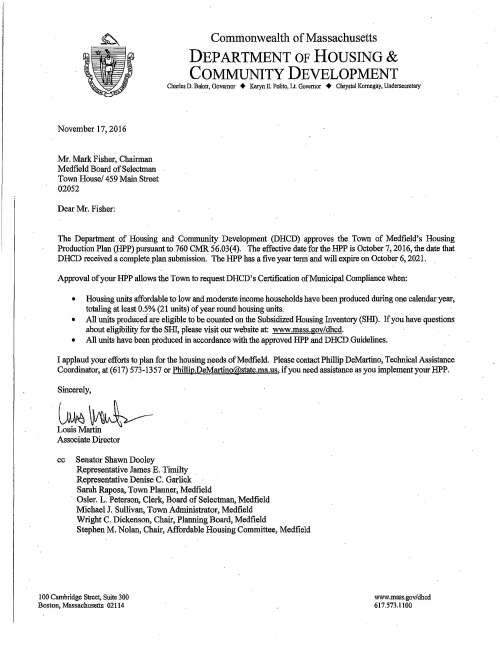
Step #1 completed:  The Town of Medfield today received the letter below from the Department of Housing and Community Development (DHCD) announcing that our Housing Production Plan had been approved.

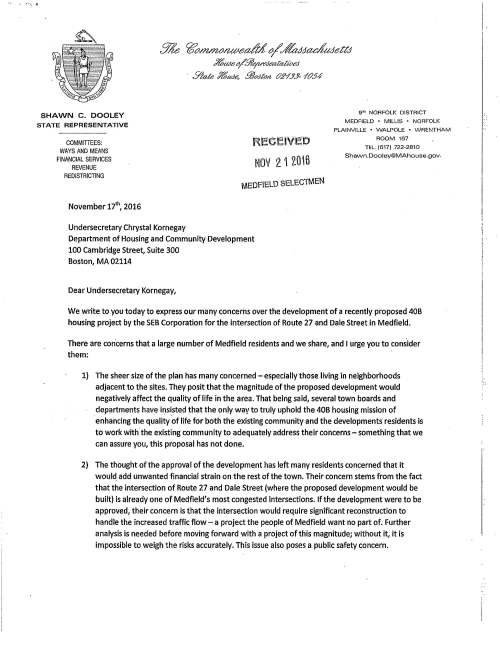
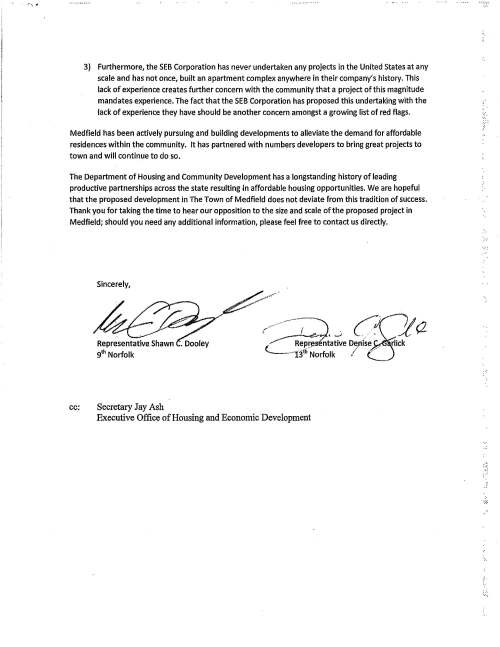
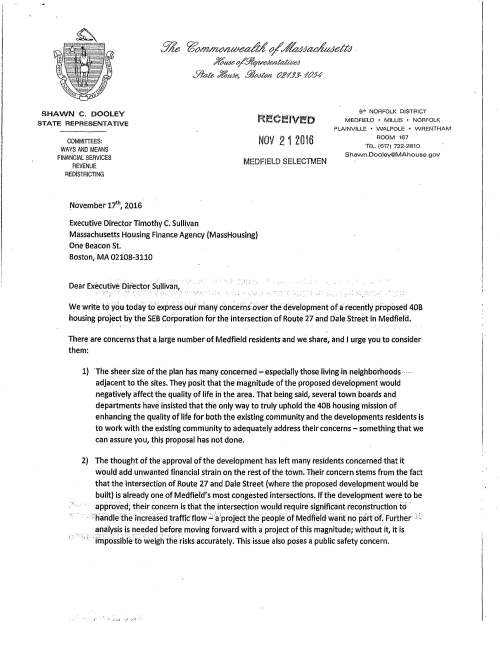
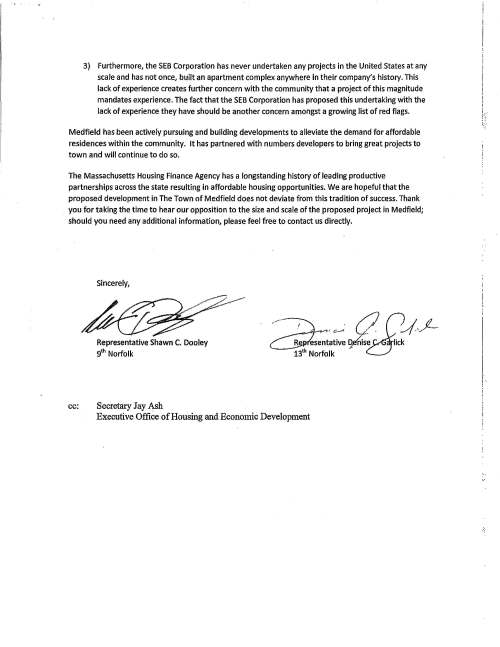
Also attached are the two letters from our Representatives, Denise Garlick and Shawn Dooley to DHCD and MassHousing citing issues with respect to the Dale Street 40B proposal.

Commonwealth of Massachusetts DEPARTMENT OF HOUSING & COMMUNITY DEVELOPMENT Charles D. Baker, Governor + Karyn E. Polito, Lt. Governor + Chrystal Kornegay, Undersecretary November 17; 2016 Mr. Mark Fisher, Chairman Medfield Board of Selectman Town House/ 459 Main Street 02052 Dear Mr. Fisher: The Department of Housing and Community Development (DHCD) approves the Town of Medfield's Housing Production Plan (HPP) pursuant to 760 CMR 56.03(4). The effective date for the HPP is October 7, 2016, the date that DHCD received a complete plan submission. The HPP has a five year term and will expire on October 6, 2021. Approval of your HPP allows the Town to request DHCD's Certification of Municipal Compliance when: • Housing units affordable to low and moderate income households have been produced during one calendar year, totaling at least 0.5% (21 units) of year round housing wiits. • All units produced are eligible to be counted on the Subsidized Housing Inventory (SIIl). If you have questions about eligibility for the SHI, please visit our website at: www.mass.gov/dhcd. • All units have been produced in accordance with the approved HPP and DHCD Guidelines. I applaud your efforts to plan for the housing needs of Medfield. Please contact Phillip DeMartino, Technical Assistance Coordinator, at (617) 573-1357 or Phillip.DeMartino@state.ma.us, if you need assistance as you implement your BPP. Sincerely, ~~ Associate Director cc Senator Shawn Dooley Representative James E. Timilty Representative Denise C. Garlick Sarah Raposa, Town Planner, Medfield Osler. L. Peterson, Clerk, Board of Selectman, Medfield Michael J. Sullivan, Town Administrator, Medfield Wright C. Dickenson, Chair, Planning Board, Medfield Stephen M. Nolan, Chair, Affordable Housing Committee, Medfield 100 Cambridge Street., Suite 300 Boston, Massachusetts 02114 www.mass.gov/dhcd 617.573.1100 ' ' '· • ~' 1' ~ ~mmo/u,1,1.ealhf oj1 /lt:M:Ja,c,,{u-Jett:J J'd~tcle- q/.!Jt/21"C.Je1itat/t0.1 · ,9late .7'tb1.t120161117-dhcd-ltr-from_page_220161117-dhcd-ltr-from_page_320161117-dhcd-ltr-from_page_420161117-dhcd-ltr-from_page_5

GCA completed

gca

Today the Town of Medfield completed its submissions to DOER to qualify as a green community under the state’s Green Communities Act, as per the attached email from the town’s consultant at the Metropolitan Area Planning Council (MAPC) –  interestingly, our main MAPC consultant is in Morocco this moment at a conference.  There was a last minute flurry of activity to locate all the required town actions.


11/21/2016 3:34PM
Green Communities Application Complete and Submitted: Medfield
MEC
akrishnan@mapc.org
fbunger@verizon.net; aseaman@medfield.net; msullivan@medfield.net; ktrierweiler@medfield.net; eclarke@medfield.net; mlafrancesca@email.medfield.net; osler.peterson@verizon.net, ATeferra@mapc.org,
===========================================================
All of the required documents for Medfield’s Green Communities application have
been submitted through DOER’s online portal. We have received confirmation from
DOER that they have marked Medfield’s application ‘Complete’. Congratulations to
everyone involved!

DOER will follow up with MAPC directly during the review process if there are
items that require further clarification. Axum is back in the office tomorrow
(11/22). Please do not hesitate to follow up with either of us if you have any
questions regarding the process moving forward.

Regards,
Ani

Ani Krishnan
Interim Manager of Clean Energy
Metropolitan Area Planning Council
60 Temple Place, Boston, MA 02111
617-933-0715 | akrishnan@mapc.org

Please be advised that the Massachusetts Secretary of State considers e-mail
to be a public record, and therefore subject to the Massachusetts Public Records
Law, M.G.L. c. 66 § 10.