Category Archives: Schools

My first letter to the editor

Hi Pete – I was one of several music parents that signed a letter to the editor that appeared in the paper today. But for some reason, this fact: that 1/3 to 1/2 of Dale Street music students are missing from ensembles, was removed from the letter prior to publication (real data exists to back the statement up). Members of our Medfield community need to know how that the Dale Street music program – which feeds into our award-winning Blake and MHS music program — has already been negatively impacted by the pilot that was hastily rolled out this year. If the rate of music students missing from Dale Street ensembles continues, the future of our award-winning Medfield Music Program is at risk. If you can help with setting the record straight, I’d appreciate it. Thanks, Chris McCue Potts


Preserving our musical legacy – a letter to the editor: 

Since the days of Lowell Mason, the father of music education born in Medfield, generations of music educators, performers and professionals have followed him and called Medfield home.

In addition to our award-winning school ensembles, today Medfield has alumni and residents associated with prominent institutions like Metropolitan Opera, American Repertory Theater, Boston Symphony Orchestra, The Boston Conservatory, Berklee College of Music, New England Conservatory and Boston Ballet.

One can compare Medfield’s rich musical legacy to a historically significant home that needs to be protected from neglect so that it continues to contribute to town pride and character. But that’s easier said than done. Our music program was decimated about 25 years ago after music was pulled out of the school day – to the point that our MHS marching band had just 18 students (vs. 70 today). It took a Herculean effort to put music back in the school day, followed by 12-15 years of teacher dedication, volunteer efforts and community fundraising to restore the program to an acceptable level.

It’s not coincidental that Medfield’s high academic rankings and musical success have been on parallel paths since the full rollout of MCAS in 1999. The combination of strong academics, the arts, athletics, citizenship and cultural initiatives, has been providing the well-rounded education that families want, and is sought after by top colleges and employers.

But surprisingly, history is beginning to repeat itself. This past September, a pilot was launched under the radar that pulled 4th and 5th grade band, chorus and orchestra ensembles out of the school day impacting more than 320 children. The students now need to show up at 7:30 a.m. 1-2x a week placing a burden on many children and parents. On any given day, 1/2 to 1/3 of students are missing from their ensembles, and many children have dropped out entirely from the music program because of the early-morning start.

If Medfield continues to lose music students at the current accelerated rate, five years from now we will not have a sufficient number of children in the program to justify current levels of staffing, and future generations will be deprived of all the benefits that a Medfield music education now provides. Parents who only have elementary school-aged children (or younger) don’t know what’s truly at stake.

We know from research and alumni feedback that ensemble practices give children a greater sense of acceptance and community, help to relieve stress, teach students critical thinking, and improve students’ ability to focus and retain information. The ensembles also allow students to see that music could be a serious endeavor – even something they might pursue professionally one day – just like Lowell Mason, and everyone else who has followed after him.

A Boston College emeritus professor and three consultants (all associated with Sudbury schools) have been hired to conduct an evaluation of the Dale Street music pilot at a cost of $6,000, but the evaluation plan does not include capturing input from the community at large.

Town leaders, long-time residents, veterans, realtors, and many others have all said that the Medfield Music Program is a source of great community pride, yet it will continue to decay if something isn’t done soon to address the loss of student participation from music ensembles. Please join us in helping to protect Medfield’s rich music heritage at the very place where it takes root:  Dale Street School.

The easiest way to voice your support is by sending a note to mail@medfieldmusicassociation.com by May 20 and it will be forwarded to school administrators, staff and consultants involved with evaluating the music pilot.

Respectfully,

Medfield Music Parents:

Chris McCue Potts

Maria Baler

Sherri Goldman

Fran Pericles

Kathy Loranger

Marybeth Wagenseller

Barb FitzPatrick

Holly Mahoney
House budget passed

The Mass. Municipal Association has analyzed and sent out an alert on the House budget, and its inadequacies.  The main MMA issues continue to be the lack of proper financial support by the state for the towns, and mainly education funding.  The Governor’s budget proposed a $20/child increase in education funding, the House proposes a $25/child increase, and the MMA says it really should be $100/child, but at the very least a $50/child increase.

This was the MMA alert yesterday analyzing the House budget –


Thursday, April 30, 2015

HOUSE PASSES $38.1B FY 2016 STATE BUDGET THAT INCLUDES FUNDING FOR KEY MUNICIPAL AND SCHOOL AID PROGRAMS

BUDGET AND LOCAL AID ACTION NOW GOES TO THE SENATE:
PLEASE CALL YOUR SENATORS TODAY AND URGE THEM TO INVEST IN CITIES AND TOWNS

Late yesterday afternoon, after 3 days of deliberation on 1096 amendments, the members of the House of Representatives unanimously adopted a trim $38.1 billion fiscal 2016 state budget plan that is nearly identical to the House Ways and Means draft (H. 3400) that was unveiled 2 weeks ago.

The House-passed budget would increase overall state expenditures by less than 3 percent, as the state seeks to close a projected $1.8 billion structural budget deficit by restraining spending and eliminating 4,500 state jobs through an early retirement program. The final House budget is several million dollars smaller than the budget filed by Governor Baker in March.

The action now turns to the state Senate. The Senate Ways & Means Committee is expected to release its proposed budget by mid-May, and the full Senate will pass its version before the end of the month.

The House budget provides strong progress on many important local aid priorities, while there are still a number of issues where further action or additional funding is needed.

Here is a summary and status of the key municipal and school funding issues in the fiscal 2016 state budget as adopted by House of Representatives on Wednesday:

$34 MILLION INCREASE IN UNRESTRICTED MUNICIPAL AID
In a major win for cities and towns, the House budget supports $979.8 million for UGGA, a $34 million increase over current funding – the same increase proposed by Governor Baker.  This would be the largest increase in discretionary municipal aid in nearly a decade.  Every city and town would see their UGGA funding increase by 3.6 percent.

$8.3 MILLION INCREASE INTENDED TO FULLY FUND SPECIAL EDUCATION CIRCUIT BREAKER
In another victory for cities and towns, House members supported full funding for the Special Education Circuit Breaker program.  Their budget plan would provide $261.7 million, an $8.3 million increase above fiscal 2015, with the intention of fully funding the account.  This is a vital program that every city, town and school district relies on to fund state-mandated services.

RESTORES $5 MILLION TO REGIONAL SCHOOL TRANSPORTATION
Last November, former Gov. Patrick used his 9C budget powers to eliminate the $18.7 million increase regional school transportation reimbursements that the Legislature originally enacted for fiscal 2015, reducing the final amount to $51.5 million.  The Governor proposed level funding at $51.5.  Recognizing the importance of this funding, the final House budget would restore $5 million to bring regional transportation reimbursements up to $56.5 million.  A proposed amendment to increase funding by another $4 million did not pass during the House budget debate.

RESTORES $18.6 MILLION TO KINDERGARTEN DEVELOPMENT GRANTS
The House budget would restore $18.6 million to the Kindergarten Development Grant program.  The Governor’s budget would have eliminated all funding, and House members want to level-fund the current appropriation, at least for the next year.  This is an important account, because eliminating the $18.6 million would have jeopardized expanded kindergarten programs all throughout the state.

CHAPTER 70 MINIMUM AID WOULD INCREASE TO $25 PER STUDENT
The House budget supports a $108.2 million increase in Chapter 70 education aid, with a provision providing every city, town and school district an increase of at least $25 per student.  This is $2.9 million more than the recommendation in the Governor’s budget submission, which included minimum aid of only $20 per student.  During the debate, the House did not adopt an amendment to raise minimum aid to $50 per student. Because most cities and towns only receive minimum aid, the MMA is calling for at least $50 per student minimum aid in the Legislature’s final budget.

McKINNEY-VENTO REIMBURSEMENTS WOULD INCREASE BY $1 MILLION
The final House budget would add $1 million to increase fiscal 2016 reimbursements for the transportation of homeless students to $8.4 million.  While the account remains below the full reimbursement called for under the state’s unfunded mandate law, it would be the first increase since fiscal 2013.  The House did not pass a proposed amendment to fully fund the account.

CHARTER SCHOOL REIMBURSEMENTS REMAIN SERIOUSLY UNDERFUNDED
Under state law, cities and towns that host or send students to charter schools are entitled to be reimbursed for a portion of their lost Chapter 70 aid.  The state fully funded the reimbursement program in fiscal 2013 and 2014, but is underfunding reimbursements by approximately $34 million this year.  Both the Governor and the House Ways and Means budgets would level-fund charter school reimbursements at $76.8 million, which would guarantee another major shortfall in fiscal 2016, and result in cutbacks for the majority of students who remain in the traditional school setting.  Increasing this account was a top priority for municipalities and school districts during the budget debate, but House members rejected an amendment that would have raised funding up to $130.5 million.  This will continue to be a major budget issue as debate turns to the Senate.

PAYMENTS-IN-LIEU-OF-TAXES (PILOT), LIBRARY AID ACCOUNTS, METCO, AND SHANNON ANTI-GANG GRANTS
The House budget would level fund PILOT payments at $26.77 million, continue to fund library grant programs at $18.5 million, and restore funding for METCO to $20.14 million. During debate, the House adopted an amendment to add $1 million to the Shannon anti-gang grant program, providing a final appropriation of $6 million, which is still $1 million below current fiscal 2015 (post-9C) funding.

PROTECTION OF MUNICIPAL EMERGENCY MEDICAL SERVICES
During the budget debate, Representatives approved an amendment adding an outside section that would prevent the practice of “pay the patient” by insurance companies, which undermines the ability of cities and towns to fund and operate effective and efficient ambulance services that are at the core of emergency medical response in Massachusetts. “Pay the patient” would force communities to pursue their own residents to recoup thousands of dollars in ambulance expenses, a system that is inefficient and subject to abuse.  The amendment would also clarify that municipalities are authorized to set a fair rate for ambulance services, preventing insurance companies from shifting costs to local property taxpayers through below-cost reimbursements.

COMMUNITY PRESERVATION ACT FUNDING COULD RECEIVE $10 MILLION
During fiscal 2015, 156 cities and towns collected the local Community Preservation Act (CPA) surcharge and are eligible for state matching grants in fiscal 2016.  The Division of Local Services (DLS) estimates that the balance in the state trust fund will be sufficient to provide a first round match of only 18 percent of the surcharge levied by each city and town.  This would be the lowest state match in the program’s history.  Knowing this, House members voted to dedicate up to $10 million of any fiscal 2015 year-end state budget surplus to supplement the fiscal 2016 state match.

Please Call Your Senators Today and Urge them to Support Essential Funding for Municipal and Education Aid – Including the $34 Million Increase in Unrestricted Local Aid, Full Funding for the Special Education Circuit Breaker, Restoring Kindergarten Grants, and Adding Funds to Regional School Transportation

Please Explain How the House Budget Impacts Your Community, and Ask Your Senators to Build on this Progress with Further Increases for Charter School Reimbursements, Chapter 70 Minimum Aid, Regional School Transportation and Other Key Accounts

Thank You!

MCPE auction

The Medfield Coalition for Public Education’s online auction is on, with very personal items sure to please and interest Medfield kids, but act fast as the auction is over next Thursday –


MCPE’s Online Auction of Treasured Experiences opens TODAY, Thursday, March 26th, and runs through April 2nd!

Back by popular demand, MCPE is offering its most popular treasured experiences from auctions and raffles past.  Kids and parents alike love these one-of-a-kind items, and our teachers and administrators love to give back!  Please bid high on the items and allow MCPE to continue funding future grants that benefit Medfield schools! To bid on our great auction items, please visit our website

MSBA grant for Wheelock boiler

Letter this afternoon from the Massachusetts School Building Authority approving a grant to the town for the boiler replacement at the Wheelock School in the amount of $179,137 to $187,565 –


Massachusetts School Building Authority
Deborah B. Goldberg John K. McCarthy
Chairman, State Treasurer Executive Director

March 25, 2015

Mr. Michael J. Sullivan, Town Administrator
Town of Medfield
459 Main Street
Medfield, MA 02052

Re: Town of Medfield, Ralph Wheelock School

Dear Mr. Sullivan:

I am pleased to report that the Board of the Massachusetts School Building Authority (the
“MSBA”) voted to approve the Proposed Accelerated Repair Project (the “Proposed
Project”) for the Town of Medfield (the “Town”) for a boiler replacement project at the
Ralph Wheelock School.
The Board approved an estimated maximum Total Facilities Grant of $179,137, which
does not include any funds for potentially eligible owner’s or construction contingency
expenditures. In the event that the MSBA determines that any owner’s and/or
construction contingency expenditures are eligible for reimbursement, the maximum
Total Facilities Grant for the Proposed Project may increase to $187,565. The final grant
amount will be determined by the MSBA based on a review and audit of all project costs
incurred by the Town, in accordance with the MSBA’s regulations, policies, and
guidelines and the Project Funding Agreement. The final grant amount may be an
amount less than $179,137.
Pursuant to the terms of the MSBA’s Accelerated Repair Program, the Town has 90 days
to acquire and certify local approval for an appropriation and all other necessary local
votes or approvals showing acceptance of the cost, site, type, scope and timeline for the
Proposed Project. Upon receipt of the certified votes demonstrating local approval, the
MSBA and the Town will execute a Project Funding Agreement which will set forth the
terms and conditions pursuant to which the Town will receive its grant from the MSBA.
Once the Project Funding Agreement has been executed by both parties, the Town will be
eligible to submit requests for reimbursement for Proposed Project costs to the MSBA.
We will be contacting you soon to discuss these next steps in more detail, but in the
meantime, I wanted to share with you the Board’s approval of the Proposed Project for
the Town of Medfield for a boiler replacement project at the Ralph Wheelock School,
40 Broad Street, Suite 500 •Boston, MA 02109 •Tel: 617-720-4466 •Fax: 617-720-5260 • http://www.MassSchoolBuildings.org
~··
Page2
March 25, 2015
Town of Medfield PF A Board Action Letter
and the Board’s authorization to execute a Project Funding Agreement for this Proposed
Project.
Sincerely,

Cc: Legislative Delegation
Osler L. Peterson, Chair, Medfield Board of Selectmen
Christopher Morrison, Chair, Medfield School Committee
Dr. Jeffrey J. Marsden, Superintendent, Medfield Public Schools
Michael LaFrancesca, Director of Finance and Operations, Medfield Public
Schools
Alexandra Vresilovic, Owner’s Project Manager, Skanska USA Building, Inc.
Mike Trzcinski, Designer, Hesnor Engineering Associates, PLLC
File: 10.2 Letters

BAKER PLANS $105 MILLION INCREASE IN SCHOOL AID

John Nunnari regularly emails town officials news from the legislature, and this story by the State House News Service is a preview of a fairly rosy municipal and school aid proposal in the budget for next year –


STATE HOUSE, BOSTON, MARCH 3, 2015….State aid for public schools would rise by 2.4 percent next fiscal year and unrestricted local aid would increase by 3.6 percent in Gov. Charlie Baker’s budget proposal, which is set to be fully released on Wednesday.

Lt. Gov. Karyn Polito said the increases fulfill the governor’s pledge during the campaign to boost state aid in concert with rising state revenues – state tax collections are due to rise 4.8 percent in the next fiscal year, which begins on July 1.

The Chapter 70 school aid account in Baker’s budget will feature a $105 million increase, which means a minimum increase of $20 per student, Polito told the News Service during an interview Tuesday prior to a meeting with mayors and other municipal officials.

Unrestricted local aid, which is predominantly generated by Lottery profits, would increase to $980 million in Baker’s budget plan, which will undergo review and redrafting in the Legislature in the coming months.

Specific information about levels recommended for other local aid accounts – regional school transportation, payments in lieu of taxes, and special education, for example – was not available.

“We felt the focus should be on Chapter 70 school aid and on the unrestricted aid, and let the school districts and the municipal managers determine how best to utilize those dollars,” said Polito, a former state representative and local official.

The extra state aid will help cities and towns cope with rising health care costs, school enrollment increases and snow management costs, Polito said.

“Level funding is a cut,” she said. “And we felt that it was necessary to increase the percentage for both school aid and unrestricted aid in order to help our communities perform the services to the quality they need to help our families and our hardworking taxpayers.”

Baker budget aides say his spending plan will also restore fiscal 2015 budget levels for the METCO program, which enables students from Boston and Springfield to attend schools outside those cities.

Baker and Gov. Deval Patrick cut METCO funding in recent months as part of efforts to address a deficit in this year’s state budget.

A Baker budget aide said the governor’s spending plan would include “a lot of level funding.” The Massachusetts Taxpayers Foundation has estimated a $1.5 billion gap between expected revenues and expenses next year.

Baker is tackling that budget gap without recommending any tax hikes and does not plan to draw money from the state’s stabilization fund, which lawmakers have regularly used to support spending plans.

The governor’s budget bill, which will be the subject of hearings starting next week, also won’t include any “one-time gimmicks,” Polito said. “It’s a straight-forward budget that reflects the priorities that we have, which are helping our cities and towns succeed,” she said.

END
03/03/2015
Serving the working press since 1910
http://www.statehousenews.com


School budget & OPEB

This exchange took place under the comments to the post about the MMA annual meeting, and are worthy of more people seeing them –


  1. Pete-

    I find it absolutely stunning that there is no coverage of school budgets, in particular the relationship of cost to rising and falling student populations. School spending represents, far and away, the largest item in any town or city budget, yet no one seems to want to deal with the issue. Also, I see nothing on the agenda that addresses the massive shortfall in the funding of employee benefits. I note that there’s a session on “Lessons and land mines”. Is this a tutorial to help public officials avoid facing the really important fiscal issues? Very disappointing.

    Sent from my iPad

  2. Selectman Osler “Pete” Peterson

    Charlie,
    Thanks for your comments. i am catching up,so please excuse my delay.

    First, town officials have absolutely no say or control over school budgets, so I would guess that is the reason that there are no MMA seminars on school budgets. The town as a whole can only approve or not the total school budget at the town meeting, but once a budget amount is approved by the town meeting it is then up to the superintendent as to how those monies get spent. While I am exceedingly interested in the school budget issues you raise, please know that i already probably spend about 20 hours a week already just trying to do my volunteer job as a selectman (and i also have a full time job as an attorney), so I have yet to find the extra time to study the school budget issues. Also, those issues really are the purview of the school committee, not the selectmen, despite my interest.

    I see that the school committee meeting to discuss the budget got postponed by the storm, and so i encourage you to go to the re-scheduled meeting to raise your school budget issues with them.

    Second, I certainly did hear about OPEB liabilities again this year at the MMA annual meeting, although I did hear more about it last year. The MMA is seeking to be part of the solution, crafting legislation to improve the OPEB situation. Governor Patrick’s commission on the OPEB issue made recommendations over a year ago, but the MMA opposed them on the basis that they both did not do enough and also what id did do would make things worse for towns. Look at the MMA’s website (www.mma.org) and you should find the action item that the membership voted on this past Saturday morning to ask the legislature to enact OPEB reforms.


School Committee cancelled tonight

This from the Superintendent –


Tonight’s School Committee meeting scheduled for 7:30 has been cancelled. The meeting is rescheduled for Tuesday, February 3rd  at 7:30 in the Lowell Mason Auditorium located at MHS. The 2015-2016 Budget Hearing will take place during this meeting.

Sincerely,

Jeff Marsden


Mike Sullivan just called and got my vote to declare an emergency, which allows departments to spend in excess of their budgets he tells me.

Superintendent’s blog

The Superintendent of Schools, Jeffrey Marsden, has started a monthly blog, which is now into its second month, and which I highly recommend.  This month Jeff explains the issues behind the changes in the music program at the Dale Street School, which gave me the information I needed to appreciate the issues of the situation and to better understand the solution that has been crafted. I also liked the solution of appointing a citizen and schools committee to study whether the current solution is the right one.

I do not usually get to see the School Committee meetings on Medfield.TV, so I greatly appreciate having Jeff write about what is going on and pushing that information out to me to read on my own schedule, when I am able.  This is exactly how the town should be delivering information to its residents on how their town is being run.

The town government should exist to get its residents the services that they want and are willing to pay to have, but in the process of doing that, those running the town government must figure out exactly which services those are and in which amounts the residents both want the services and are willing to pay for them.  The first step towards accomplishing that goal is by making sure the residents have full information on which to make their decisions, and Jeff’s blog is a great step towards making information available to we residents.

To me this blog is a huge step in getting me the type of information that I, as both a resident and a parent, want about the schools, delivered in a format that works well for me, and so I applaud Jeff for starting the blog.  Thanks Jeff!  You have made me one happy reader

Boys State & Girls State

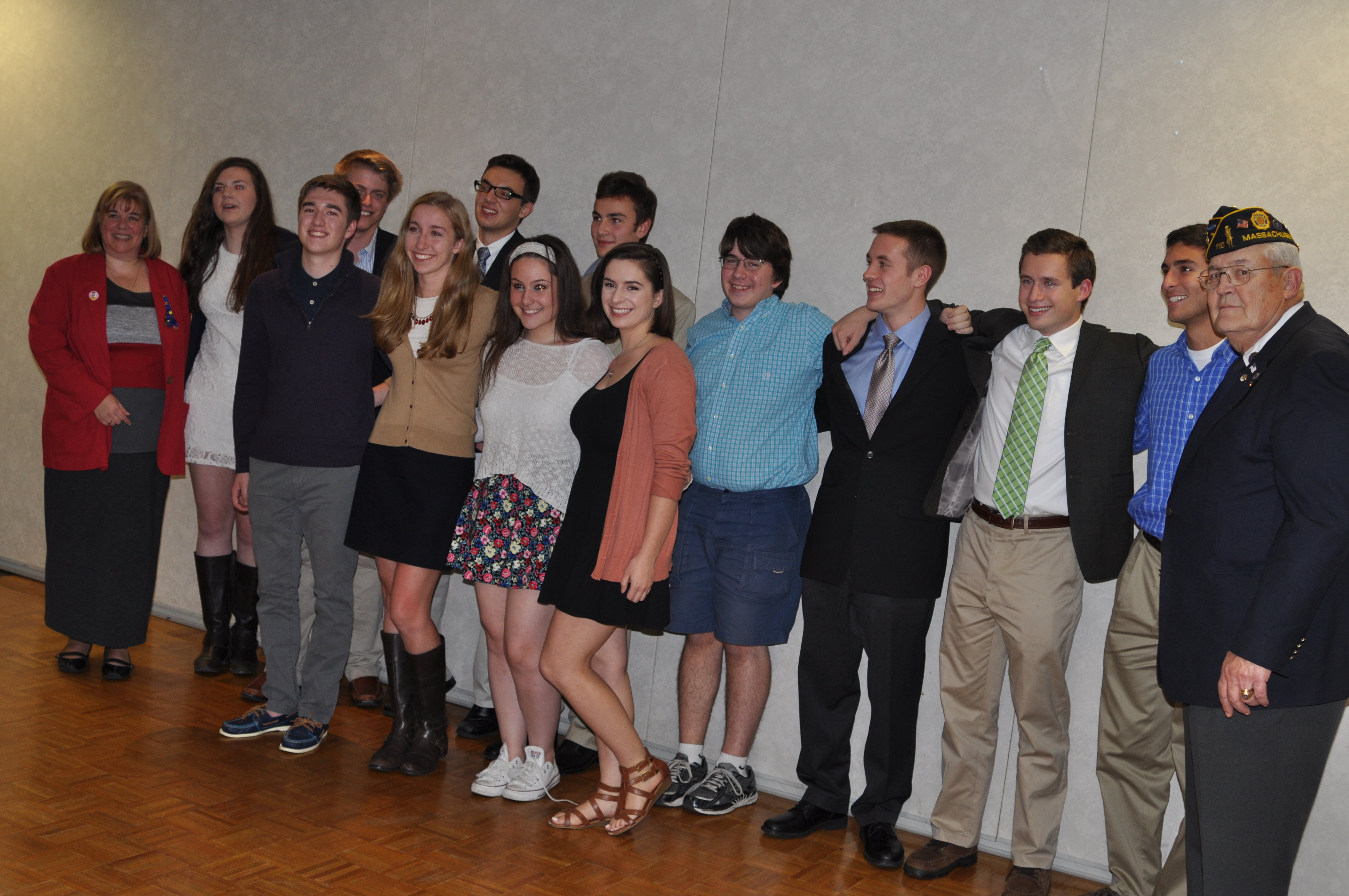
20141030-legion-boys & girls state At the Legion last night twelve of the seventeen MHS seniors who spent a week last summer at the Legion run Boys State and Girls State, held at Stonehill College in Easton, recounted their experiences to the crowd of over a hundred in attendance at the Legion’s monthly dinner meeting. Each of the dozen students spoke about what the experience had meant to them, and each was remarkably eloquent, poignant, or in turn funny.  The experience had clearly made strong positive impressions on each student, and for some it had been life changing.  More than one student recounted the benefits to them from meeting others from backgrounds so disparate from what they have know in Medfield.

Boys State and Girls State are the Legion run opportunity for high school students to learn about the American political and governing processes by actually taking part in mock government elections and functions, as well as taking courses.  The students are divided amongst separate towns, elect their own leaders from amongst their own members, and deal with legislation.

20141039-Legion-Boys & Girls State-2Last summer the students also got to participate in the actual political process, as some researched and took a position against the then pending legislation in the Massachusetts legislature that would have allowed cell antennae to be located virtually anywhere regardless of local zoning.  The students submitted letters against the legislation to the legislature that Representative Shawn Dooley said last night helped to put a face on the opposition and to defeat that legislation.

Medfield’s Legion sends more students to Boys State and Girls State than any other city or town in the state.    Around 700 students in all participate.  Karl Schwartz, past Legion Commander, recounted that when he took the program on 17 years ago no students were being sent by the Legion to participate, and that the program has been gradually built up over the years.  Today the students compete for the slots, as the demand to participate exceeds the monies  available to send students. 20141039-Legion-Boys & Girls State-3

MAHS on 11/10 at MHS

Notice today to MHS parents regarding the MetroWest Adolescent Health Survey coming on 11/10.  Extremely useful data is derived from this long running survey –


October 27, 2014
Dear Parent or Guardian,

To make sure we continue to give the best possible education and services to children in Medfield, we want to learn about their attitudes and behaviors with regard to a variety of health-related topics. Inorder to accomplish this, students at Medfield High School are being asked to participate in the MetroWest Adolescent Health Survey. The questions on the survey cover many topics including alcohol, tobacco and other drug use; violence and safety; nutrition and physical activity; sexual behaviors; and mental health.  This project will continue to help our district develop and enhance its health education and prevention services. We will be giving this survey to students in grades 9-12 on Monday, November 10th.

The survey is anonymous, meaning your child will not put his or her name on the survey and no one will know what he or she writes.  There will be no identifying information on any of the surveys.

Completing this survey is volnntary.   Your child’s grades in school will not be affected by whether or not he or she participates.   Your child can also decide not to take the survey or skip any question he or she does not wish to answer.

The Protection of Pupil Rights Amendment is a Federal Law that requires us to notify you ahead of time about the survey, and give you the chance to look at it, so you can let us know if you do not want your child to take part. Ifyou would like to see the survey before deciding, a copy will be available in the main office from Thursday, October 30, 2014 through Thursday, November 6, 2014.

If you DO NOT want your child to take part in the survey, please complete the form below return it to the main office secretary by Friday, November 7, 2014.

If you have any questions, please feel free to contact Susan Cowell, Wellness Content Specialist.

Robert Parga