This from the Massachusetts Municipal Association this week with its agenda items:
| January 30, 2017 | ||
|

This from the Massachusetts Municipal Association this week with its agenda items:
| January 30, 2017 | ||
|
Comments Off on MMA’s agenda
Posted in Legislature, Massachusetts Municipal Association, Uncategorized

Bill Massaro post #2 of the day – this email below from Bill just now – Bill was one of the individuals who requested that the $150,000 earmark be inserted into the state budget to fund the work on the new state road to the Charles River Gateway overlook. Once the Town of Medfield gives the state the required notice under the Land Disposition Agreement for the former Medfield State Hospital site, the state will then be required to construct a new access road to its Charles River Gateway overlook park on its own state land, so that the town land will no longer be required to provide that access to the public. Although the town may ultimately want to provide some such access, we will not be required to do so. We negotiated that term to require the new road to add more value to the town land.
BTW, Representative Dooley can be seen in one of my photos yesterday from the Ken and Bob retirement party, traveling incognito in shorts, a tee shirt, and a beard.
BTW #2, today is Ken Feeney Day in Medfield!
FYI-
Thanks to Sen. Timilty and Rep. Dooley, to paraphrase Mark Twain I am happy to say:
“The reports of our earmark’s death have been greatly exaggerated!”
In conversation with Shawn Dooley yesterday, I asked if the House had also failed to get the Access earmark into the override budget. He seemed surprised and said that it was definitely in the House bundle; and unless something happened in the Senate at the last minute, it should have been included in the combined package sent back to the Governor. He did say it was a single item in the middle of a large bundle…. He promised to check it out and let me know what happened…
I got an e-mail from Rep. Dooley and an apologetic call from Molly in Sen. Timilty’s office this a.m. confirming that the combined budget with the Access earmark for $150K sponsored by Sen. Timilty did go back to the Governor. (She did caution that there is always the potential of subsequent budget cuts by the Governor in the fall and spring, but for now it’s in!)
As I had stated when we thought the override had failed, Town and DCAMM obligations under the LDA do not change… Having the earmark, however, should help at least to expedite completion of a favorable engineering design …
Getting the Town’s “build it on State land” letter out sooner, rather than waiting for the LDA’s Dec 1 deadline and risking new budget cuts, would seem to be the prudent next step. This would also give us the opportunity to work with current DCAMM engineering who are familiar with the Mediated cleanup/restoration and the unique features of the property.
Bill
Comments Off on MSH road $ veto was overridden, after all
Posted in Legislature, Medfield State Hospital, State, Uncategorized

Medfield was scheduled to get only one earmark in the FY17 state budget, $150,000 for the state to build a new road to the Charles River Overlook on state land, so that the easement over the town’s former MSH property could be eliminated. Per John Nunnari’s email this morning, Governor Baker vetoed that money. Many such vetoes are overridden by the legislature.
John closely follows the legislature for the architects, and always knows what is happening.
All,
Just fyi, but as part of the Governor’s veto message, the following has been eliminated:
2810-0100 For the operation of the division of state parks and recreation;…. provided further, that not less than $150,000 shall be expended for the creation of a roadway at the former Medfield State Hospital property in the town of Medfield
I’m hearing that the House/Senate intend to take up the Governors vetoes during Formal Sessions on Thursday – with the potential for it to extend into a rare Friday Formal Session.
House and Senate leadership are upset with the Gov’s $256M in reductions over 303 line items (which included approx.. $60M in earmarks – which the Medfield State Hospital roadway project would be considered).
More to come.
john
Comments Off on Medfield’s one earmark vetoed by Governor
Posted in Budgets, Financial, Legislature, Medfield State Hospital, State, Uncategorized

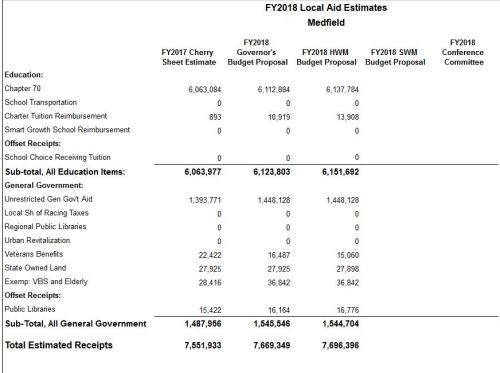
John Nunnari provided the final Medfield money in the state budget, which includes money for the state to build its own road to the Charles River Overlook, so Medfield does not have to encumber our MSH land with that access, if we decide it is not in our best interest.
| Municipality/Regional District | 7061-0008 Chapter 70 | Unrestricted General Government Aid | Annual Formula Local Aide |
| FY ’15 Actual Appropriation | $5,862,409.00 | $1,289,875.00 | $0.00 |
| FY ’16 Actual Appropriation | $5,925,859.00 | $1,336,310.00 | |
| Governors FY ’17 Proposal | $5,975,759.00 | $1,393,771.00 | $0.00 |
| Medfield (House FY ’17 Proposed Numbers) | $6,063,084.00 | $1,393,771.00 | $0.00 |
| Medfield (Senate FY 17 Proposed Numbers) | $6,063,084.00 | $1,393,771.00 | $0.00 |
| FY ’17 Conference Committee Report July +/- | $6,063,084.00 | $1,393,771.00 | $0.00 |
2810-0100 For the operation of the division of state parks and recreation;…. provided further, that not less than $150,000 shall be expended for the creation of a roadway at the former Medfield State Hospital property in the town of Medfield
John Nunnari, Assoc AIA
Executive Director, AIA MA
Comments Off on Medfield $ in state budget
Posted in Budgets, Legislature, State, Uncategorized

The MMA sent this second alert this afternoon, on the public records law that has now come out of a conference committee. I find myself torn on this one, as i feel there should be easy access to all public records, but I have heard Goeff Beckwith, Executive Director of the MMA say that the House version was preferred due to the House including more reasonable payments to the towns for responding, and thereby avoiding potential costs for towns from unreasonable public records requests.
Monday, May 23, 2016
LEGISLATURE TO VOTE ON FINAL PUBLIC RECORDS BILL
Conference Committee Report Would Limit Fees and Expose Communities to Attorneys’ Fees & Court Costs in Litigation
House Vote Scheduled for Wednesday
At 4:00 p.m. on Monday, May 23, the six members of the House-Senate conference committee on legislation to update the public records law reached agreement on a compromise bill, and reported it out to the full Legislature for an up-or-down vote later this week.
The Conference Committee bill differs in many important respects from H. 3858, the measure passed by the House of Representatives in November, and appears generally closer to S. 2127, the bill passed by the Senate in February. The bill would limit or set conditions on the fees that cities and towns can charge, and would create a more litigious process that could require the courts to award attorneys’ fees to plaintiffs in many circumstances.
Local officials and the MMA are not opposed to passage of legislation updating the public records laws. Rather, we have been calling for balanced and realistic changes to prevent the imposition of unfunded mandates on cities and towns, and to ensure that local officials have enough time and flexibility to comply with the act without diverting resources and time from their other important public services and duties on behalf of local residents and taxpayers.
However, the MMA’s analysis concludes that the Conference Committee’s bill would limit the ability of cities and towns to be reimbursed for responding to records requests by requiring communities to receive special permission from the Supervisor of Records every time they wish to reimbursed for time spent segregating or redacting records. Further, communities would need to receive special permission to charge more than $25/hour, which is quite common when department heads and attorneys need to participate in the process. Thus, the MMA believes that the bill has the potential to impose significant new financial burdens on cities and towns.
The MMA is also concerned that the bill could expose public entities and taxpayers to threats of expensive litigation by creating a presumption that courts should award attorneys’ fees and court costs in all but a narrow list of circumstances if the plaintiff receives any relief through a judicial order, consent decree, or if the municipality provides any of the requested documents after the complaint is filed. This provision could create an incentive for plaintiff attorneys to excessively litigate.
In general, the bill creates a more detailed set of statutory requirements that must be fulfilled under the state’s public records act, including new timelines, fee structures, administrative and judicial appeals processes, and new requirements for the administration of the law at the local level. The major changes as they impact cities and towns are outlined below.
MAJOR PROVISIONS OF THE CONFERENCE COMMITTEE’S PUBLIC RECORDS BILL INCLUDE:
Enforceable Timelines:
Limits on Fees:
Litigation and Enforcement:
Other New Requirements:
Please Call Your Legislators Today to Discuss the Public Records Legislation and Express Your Concerns.
Thank You Very Much.
Comments Off on MMA on new public records law
Posted in Legislature, Massachusetts Municipal Association, State, Uncategorized

This was my email this afternoon to Senator Timilty to support the MMA’s analysis of where the state budget discussions that are happening this week in the State Senate should lead:
Jim,
As a Town of Medfield selectman, I ask that you support the Massachusetts Municipal Association’s stated interests in the budget discussions. Thanks in advance. I have copied in below the MMA’s stated interests:
Monday May 23, 2016
SENATORS SET TO DEBATE FISCAL 2017 BUDGET
DEBATE WILL BEGIN ON TUESDAY, MAY 24
1,167 AMENDMENTS FILED
PLEASE CALL YOUR SENATORS TODAY TO SUPPORT KEY FUNDING
ASK YOUR SENATORS TO OPPOSE AMENDMENT 91, WHICH WOULD TO LIMIT MUNICIPAL AUTHORITY ON RETIREE HEALTH INSURANCE
Beginning on Tuesday, May 24, the Senate will debate the Senate Ways & Means Committee’s proposed fiscal 2017 state budget plan. With 1,167 amendments filed, it is critically important for you to call your Senators now to discuss key budget and funding issues that will impact your community.
S. 4, the Senate Ways & Means budget, provides progress on many important local aid priorities, including the full $42 million increase in Unrestricted General Government Aid that the Governor and House have agreed on. The SW&M Committee would increase funding for several major aid programs, by adding $9.3 million to the Special Education Circuit Breaker, increasing Chapter 70 minimum aid to $55 per student, and by adding funds in the Chapter 70 distribution to help address the low-income student calculation and to accelerate implementation of the so-called target share provisions in Chapter 70.
However, the proposed Senate budget would also cut nearly 90% from kindergarten development grants, cutting $16.6 million from key kindergarten grant assistance that goes to 164 cities, towns and school districts. There are several amendments to restore these funds.
Another issue is the need to defeat a harmful amendment (Amendment #91), which would interfere with local officials’ decision-making authority to act on behalf of taxpayers on the basic issue of contribution levels for retiree health insurance. Amendment 91 would extend a state-mandated freeze on adjusting retiree health contributions in any community that has used the municipal health insurance reform law to implement health insurance savings measures. Details on this issue are available in the MMA’s budget letter to Senators – just click on the link below.
There are many budget amendments to discuss with your Senators, including:
• Increasing Chapter 70 minimum aid up to $100 per student;
• Restoring $16.6 million to Kindergarten Development Grants;
• Increasing funding for Charter School Reimbursements;
• Creating a reserve account to help with extraordinary Special Education Costs;
• Increasing reimbursements for the McKinney-Vento unfunded mandate;
• Increasing reimbursements for Regional School Transportation and Out-of-District Vocational School Transportation;
• Opposing Amendment 91, which would interfere with local decisions on retiree health insurance;
• Adding a municipal seat on the State Retiree Benefits Trust Fund;
• Increasing funding for the Shannon Anti-Gang grant program;
• Increasing funding for the Safe and Successful Youth Initiative;
• Increasing funding for Summer Jobs for At-Risk Youth;
• Banning “Pay the Patient” in ambulance insurance payments;
• Supporting Chapter 40S payments for communities with Smart Growth Districts;
• Adding funds for Brownfield redevelopments;
• Allowing communities to levy fines for delays in removing double poles; and
• Increasing the state match for the CPA program.
Please Call Your Senators Today Discuss the Key Budget Issues that Impact Your Community
Click the Link Above to Read the MMA’s Detailed Letter to Senators
THANK YOU
Comments Off on MMA to Senate on budget
Posted in Budgets, Legislature, State, Uncategorized

John Nunnari follows the legislature closely for the architects, and kindly also keeps the town administration informed about happenings that affect Medfield. This from John this morning about:
See below for all amendments filed to the Senate budget dealing directly with Medfield.
Debate begins tomorrow.
John
Amendment #116
West Street Bridge in Medfield and Millis
Mr. Ross moved that the proposed new text be amended, in Section 2, in item 1599-0026, by adding at the end thereof the following:- “provided that not less than $1,000,000 shall be expended for the maintenance of the West Street Bridge in the towns of Medfield and Millis”; and in said item, by striking out the figures “$5,000,000” and inserting in place thereof the figures “$6,000,000”
Amendment #883
Accessibility to Open Space
Mr. Timilty moved that the proposed new text be amended, in Section 2, in item 2810-0100, by inserting the following:- “provided further, that not less than $200,000 shall be expended for the creation of a roadway at the property formally known as the Medfield State Hospital in the town of Medfield.”
Amendment #1154
Framingham Secondary Line
Mr. Timilty moved that the proposed new text be amended by adding at the end thereof the following new section:-
SECTION X. No funds shall be disbursed to the Massachusetts Bay Transportation Authority under section 35T of chapter 10 of the General Laws for the extension of services on the Framingham Secondary line in the towns of Framingham, Sherborn, Medfield, Walpole, Foxborough, and Mansfield including, but not limited to, for the addition of new line service through the creation of a new line, extension of a current line or increasing the service area of a current line until the authority receives legislative approval for a plan, specifically detailing:
(i) how the authority will pay for the proposed expansion
(ii) certification that such expansion and diversion of funding will not adversely affect existing services already offered by the authority and
(iii) certification that the state of the Framingham Secondary line’s real property, including but not limited to the physical track, at-grade crossings, and safety features to protect abutters, have been upgraded, repaired, or replaced to meet any increase in service
The plan shall be submitted to the clerks of the senate and house of representatives, the joint committee on transportation and the chairs of the senate and house committees on ways and means
John Nunnari, Assoc AIA
Executive Director, AIA MA
Comments Off on Senate’s Medfield amendments in budget
Posted in Legislature, State, Uncategorized

The State Senate is now actively considering changes and reforms to the state land use statutes that have been under consideration for years, and it appears that action may happen soon. At the moment, the MMA ask the Senate to let us know what they intend to do, before they actually do it. However, last week, this was the MMA letter to the Senate that itemizes what the MMA suggests is needed.
May 11, 2016
The Honorable Karen Spilka, Chair
Senate Committee on Ways and Means
State House, Boston
Dear Senator Spilka and Distinguished Members of the Committee,
On behalf of the cities and towns of the Commonwealth, the Massachusetts Municipal Association appreciates the opportunity to offer comments on S. 2144, An Act Promoting the Planning and Development of Sustainable Communities. The MMA’s Municipal and Regional Policy Committee completed a careful and extensive evaluation of the bill as written in its previous form (S. 122), with a focus on the impact that the proposed zoning and land use law changes would have on our cities and towns. We have also had a chance to review the issues raised by the Home Builders & Remodelers of Massachusetts, the Massachusetts Association of Realtors, NAIOP and others, and must express our grave concerns with their proposed changes to S. 2144.
Any amendments to existing zoning and land use law in Massachusetts will have profound and long-lasting effects on our communities and residents, and will impact the quality of life in cities and towns for generations to come. For this reason, any and all proposed changes demand very careful consideration.
The MMA’s comments and suggested language changes, presented below by topic, would strengthen and improve the bill by preserving local authority, grandfathering existing local practices, and, in the case of local options, employing an opt-in rather than an opt-out model. The MMA would have very serious reservations regarding S. 2144 if these comments and recommended improvements are not incorporated into the bill.
A. MMA COMMENTS ON S. 2144 AND RESPONSES TO THE DEVELOPER AND REAL ESTATE LOBBYISTS
Vested Rights
Sections 6 through 12
The MMA supports the conceptual changes made in the sections pertaining to vested rights. The language should be clarified to indicate that the date of the first notice of a public hearing on proposed changes to zoning ordinances and bylaws is the time at which a property shall be subject to subsequently enacted zoning amendments. In practical terms, this language is necessary to prevent a flood of applications intended to avoid new zoning requirements and bylaws.
Special Permit Vote and Length
Sections 15 and 16
The MMA requests a language change in Section 15, pertaining to the vote required for issuance of a special permit, to make it a local-option decision (by a supermajority vote) as to whether the required vote is changed from a supermajority to a simple majority. As written, a municipality’s special permit granting authority would require only a simple majority vote to issue a special permit, unless a greater threshold is specified in a local ordinance or bylaw. The MMA does not support a state-mandated change in the threshold without express acceptance of that change at the local level, because many communities do not have specific language regarding the necessary vote in their local ordinances or bylaws, and thus they would have no voice in changing the vote threshold to a simple majority. The MMA requests a change the language in Section 16, regarding the term of special permits, to allow a special permit to be issued for a term of up to three years, not the three-year minimum currently written in the bill. Additionally, any extension of the permit should require notice and a public hearing. If the permit granting authority does not approve an extension within 65 days, the new permit should require a new application, notice, and public hearing.
Site Plan Review
Section 19
The MMA can support this section, regarding site plan review, if modifications are made to avoid onerous evidentiary requirements and eliminate language triggering constructive approval of applications if time thresholds are not met. Constructive approval is a highly controversial process, especially when time periods are not adequate, such as the 95-day provision in S. 2144, as this may be too short for an appropriate and thorough review process. The language in this section should be clarified to indicate that an application will not be approved if submission requirements are not met. Mitigation for adverse impacts directly attributable to projects should extend to nearby properties, and not only those that are adjacent to the developments.
Development Impact Fees
Section 20
The MMA supports the statutory authorization of development impact fees. We ask that the language be clarified to clearly authorize communities to use the impact fees to conduct mitigation impact studies on a project-by-project basis, including the use of consultants as needed and financed by the project applicant under section 53G of chapter 44. The language proposed in the bill appears to allow a project-responsive fee, but the language should be carefully reviewed to ensure that it does so.
Inclusionary Zoning
Section 21
The MMA strongly supports inclusionary zoning. It is critically important that the bill include language expressly allowing inclusionary zoning provisions in local ordinances and by-laws. Inclusionary zoning is a vital and powerful tool that will actually result in the construction of affordable housing. Zoning reform without inclusionary zoning will do nothing to address issues of profitability and availability of affordable housing. We know the for-profit development community does not support inclusionary zoning, but this is the only tangible way that cities and towns can ensure that housing remains or becomes more affordable at the local level. Inclusionary zoning will actually benefit developers because future projects will become more attractive if cities and towns can be assured that affordable units will result.
Variances
Section 23
The MMA opposes the proposed language in section 23 regarding variances. Our members are deeply concerned that this section offers too much latitude in granting variances, specifically the language stipulating that “substantial hardship … financial or otherwise” would be an acceptable standard for a variance. This is not the case, as this overly broad, liberal and loose language would invite costly litigation and appeals, an undesirable result, to say the least. The MMA asks that this wording be removed.
Consolidated Permitting
Section 25
The MMA supports language authorizing consolidated permitting, but the section must not be a mandate and should instead be a local option. Further, there should be no “constructive approval” provisions, and we strongly oppose the last sentence in Section 3 of the new Chapter 40X (in lines 684-686), as this would strip many local boards of their lawful review authority in the event of a scheduling conflict or last-minute absence from the consolidated hearing. The threshold for an “eligible project” must be appropriate for all municipalities, and the MMA supports a higher threshold or providing cities and towns with the ability to choose their own thresholds, as we believe the current language would trigger consolidated permitting on a routine basis, which would be impractical given the scheduling demands and conflict that would arise. In addition, consolidated permitting provisions should require that applications be fully complete in advance of the process. Further, the 45-day time period as written is too short to accommodate the difficulties involved in coordinating scheduling among multiple boards, almost all of which are served by volunteers. Thus the timeframe should be changed to 90 days (a timeframe that is shorter than the combined timeframes it would take to apply for each permit serially).
Planning Ahead for Growth
Section 26
As drafted, the Planning Ahead for Growth section is a local option, but we believe that the programmatic objectives would be more broadly advanced by opening up some or all of the planning tools presented as incentives to those municipalities that adopt this section, to all municipalities statewide. Otherwise, municipalities that do not have the capacity to meet the requirements enumerated in this section would fall behind their neighbors in the areas of planning and economic development. The language should include a provision to fund local planning to promote the success of the objectives of this section.
Master Plans
Section 27
This section would restructure local master plans, and should be carefully reviewed to ensure that the newly required master plan components would be realistic for municipalities to complete, otherwise the provisions would impose an undue burden on communities. The language in section 27 should be amended to indicate that any master plan in effect at the passage of this act shall remain in effect and would not be subject to this Act for up to 15 years. Adoption of a master plan, or extension or revision, should be by a two-thirds vote of the legislative body of the municipality. However, municipalities should have the option to change that threshold (via a two-thirds vote) to a range anywhere between a simple majority and a two-thirds majority, with any change taking effect 6 months after the vote is taken.
Approval Not Required (ANR)
Section 31
The language of this section, as written, includes a presumption that requirements for travel lane widths in excess of 22 feet in a residential minor subdivision serve no valid purpose. The MMA opposes this restriction. That language should be removed from the bill, so that municipalities can continue to set travel lane width standards consistent with contextual design and local needs. These needs may vary from municipality to municipality and cannot be met by a width specified in state statute.
Subdivision Roadway Standards
Section 32
This section, pertaining to subdivision roadway standards, includes language establishing a presumption that design and dimensional requirements for total travel lane widths no greater than 24 feet shall be presumed to be not excessive. The MMA requests that this language be removed from the bill because, as previously noted, municipalities must be able to set travel lane width standards based on local needs, and the section 32 language implies that widths greater than 24 feet could be considered excessive.
Parks and Playgrounds
Section 33
The MMA supports the language regarding parks and playgrounds in subdivisions, as written. This section would allow municipalities to require the designation of up to 5 percent of the land in new subdivisions for park or playground use.
Appeals
Sections 40 through 42
We do not understand the intent or impacts of sections 40, 41 and 42. These sections, which pertain to appeals of an approved subdivision plan, jurisdiction over appeals relating to the development of real property, and the transference of qualified cases to the permit session of the land court, should be clarified, and the impacts on municipalities should be explained before adoption of the language.
Master Planning Incentive/Presumption
Section 43
The MMA strongly opposes language that would remove or alter the current legal presumption that existing zoning ordinances and bylaws are valid and “serve a public purpose.” Section 43 would allow courts to invalidate municipal ordinances or bylaws that are inconsistent with new master plans, even though these master plans could be adopted by a majority vote, and amendments to zoning ordinances and bylaws would require a two-thirds vote. Thus, it will be difficult for many communities to bring their master plan and their ordinances and bylaws into harmony, which would lead to significant confusion and uncertainty regarding the legal status of their local zoning provisions, and invite litigation and delays at the local level. As municipalities already have absolute presumption, section 43 would actually create a disincentive to adopt new, updated master plans. Section 43 should be amended to strike language that would allow courts to invalidate ordinances and bylaws that do not comply with master plans.
B. MMA COMMENTS IN OPPOSITION TO H. 4140
In addition to reviewing S. 2144, the MMA has had a chance the closely examine H. 4140, An Act to Expedite Multifamily Housing Construction and Cluster Development. The MMA strongly opposes allowing “by-right” development, as local zoning decisions should be carefully reviewed and made by local legislative bodies and the appropriate legal authorities and boards in municipalities. As many of these provisions would simply grant additional rights to developers without addressing many of the factors that have led to the scarcity of affordable housing in the Commonwealth, the MMA strongly opposes incorporating H. 4140 or any of its provisions into S. 2144. We have detailed some of our concerns below.
“By-Right” Language
The MMA is gravely concerned by the “by-right” language in the bill. Eastern Massachusetts is one of the most densely populated areas in the United States, whose citizens care deeply about sustainable, environmentally friendly communities and land use, and this language is antithetical to many of those goals. Currently, zoning is controlled by the citizens of the municipality, not state-level bureaucrats or other officials. H. 4140 would take these decisions out of the hands of those who know their communities best. Additionally, “by-right” legislation does nothing to address actual affordable housing or the profit motivations that drive developers to build multi-million dollar condominiums and luxury apartments rather than increase the affordable housing stock. The MMA opposes zoning reform legislation that features “by-right” language. The negative impact on neighborhoods would be significant, and there are no provisions that would require or increase the amount of affordable housing in municipalities. Rather, we predict that H. 4140 would actually raise the overall cost of housing, as developers, incentivized by understandable profit motivations, would focus on high-end housing – this is exactly what we have been seeing in Massachusetts over the past several years.
Additional Bureaucracy
The MMA believes local zoning decisions are best made by local officials, not state or federal agencies. H. 4140 would give the Department of Housing and Community Development approval authority over local multi-family zoning districts, and allow the agency to develop and impose further bureaucratic and programmatic requirements on cities and towns. This is highly inadvisable, as state agency control has the potential to politicize zoning policy and impose one-size-fits-all standards on communities, ignoring the diverse nature of localities across the Commonwealth.
Inclusionary Zoning is a Much Better Tool for Affordable Housing
The goal of increasing the supply of affordable housing in the Commonwealth is a laudable one, but we are forced to conclude that very little in H. 4140 would actually lead to affordable housing. The bill gives developers and land owners the ability to develop more land and at greater density, but does nothing to address the profit motives that lead to the development of multi-million dollar condos and luxury apartments over affordable multi-family housing. In our comments above, we strongly advocate for inclusionary zoning authority at the local level, as this would be a much more effective tool to address local housing needs.
C. ACCESSORY APARTMENTS
Following up on our discussion with Senate staff on May 10, we are also offering further input on the question of accessory apartments.
The MMA opposes a state mandate allowing accessory apartments “as of right,” as this would create significant building code and enforcement issues at the local level. Communities already have the authority to adopt accessory apartment provisions in their local zoning ordinances and bylaws, making these decisions based on local needs and conditions. Because of limited resources at the local level, there are likely thousands of unapproved accessory apartments throughout the state. There is no way that the Commonwealth could have enough information to know whether the legalization of these dwellings would be safe, advisable, or consistent with health, safety and building codes. We are very interested in working with you in the future to explore and advance possible frameworks or incentives that could lead to an increase in the number of legally acceptable accessory apartments. In the meantime, though, accessory apartments should continue to be a local option, not a mandate.
SUMMARY
Once again, on behalf of cities and towns across the state, we thank you for your consideration of our comments and recommendations.
S. 2144 is far-reaching and complex, and proposes enormous changes that would have dramatic and widespread impacts on municipalities and local residents and businesses for generations to come. We strongly urge you to adopt the language changes identified above in order to preserve the local control of land use that must remain in place, and ensure that this legislation is balanced enough to protect the nature and quality of neighborhoods and communities throughout the state.
Local officials and the citizens of Massachusetts rightly expect all legislation to honor these important principles. We look forward to continuing to work with you throughout this important process. Thank you very much for devoting your time and energy to these vitally important policy matters. If you have any questions, please do not hesitate to have your staff contact me, John Robertson or David Lakeman at (617) 426-7272 at any time.
Again, thank you.
Sincerely,
Geoffrey C. Beckwith
MMA Executive Director & CEO
CC: The Honorable Daniel Wolf, State Senator
Mr. David Sullivan, Office of the Senate President
The alert below from the MMA – I just called Senator Timilty’s office, and also thanked him for sponsoring the pending legislation to make work spaces handicap accessible.

Wednesday, May 11, 2016
URGENT: YOUR LEGISLATOR WILL VOTE NEXT WEEK ON IMPORTANT ENVIRONMENTAL LEGISLATION FILED BY GOV. BAKER
THE JOINT COMMITTEE ON ENVIRONMENT, NATURAL RESOURCES AND AGRICULTURE EXPECTED TO HOLD PUBLIC HEARING ON H. 4254 NEXT WEEK…
…AND YOUR LEGISLATOR IS ON THE COMMITTEE THAT WILL DECIDE WHETHER THE BILL MOVES FORWARD
PLEASE CALL TODAY AND ASK YOUR LEGISLATOR TO SUPPORT AND VOTE IN FAVOR OF H. 4254 IN COMMITTEE
The Legislation is Necessary to Allow MassDEP to have “Delegated Authority” over Federal Water Quality Regulatory Programs
Over the past year, the Massachusetts Department of Environmental Protection (MassDEP) has been examining the possibility of obtaining authority from the U.S. Environmental Protection Agency over the National Pollutants Discharge Elimination System (NPDES) program. Governor Baker recently filed H. 4254, An Act to Enable the Commonwealth’s Administration of the Massachusetts Pollutant Discharge Elimination System. Please click here to see Governor Baker’s press release and a link to the bill text.
The bill is expected to have a hearing before the Joint Committee on Environment, Natural Resources and Agriculture early next week. MMA is urging local officials in the districts of committee members to contact your legislators right away and ask them to support this important legislation. Please see the contact information for your legislators at the end of this alert.
NPDES is the federal regulatory program, currently administered by the EPA, that includes permits, compliance, inspection, and enforcement activities for facilities that discharge effluent into surface waters (such as municipal wastewater treatment plants), as well as stormwater systems managed by over 250 cities and towns.
The MMA has been very involved in this discussion over the past few months, through participation in MassDEP’s NPDES advisory group and conversations with the Administration. The MMA will testify in support of this legislation at the public hearing, but it is very important that legislators on the committee hear from their local officials on this issue.
The Governor’s legislation is an essential step in MassDEP’s obtaining delegation over this program. The bill would make technical changes to the state’s Clean Waters Act to make it consistent with federal law. The bill also specifically authorizes MassDEP to begin to process of applying to the EPA for delegation.
There are many advantages to having MassDEP manage and oversee the NPDES and MS4 stormwater permit process, including:
This bill will not change the new MS4 stormwater regulations recently released by the EPA, but MMA believes that MassDEP’s greater understanding of our cities and towns would lead to greater flexibility and responsiveness as the permits are implemented. And MassDEP would have a greater role in shaping future permit requirements. If DEP does not have delegated authority over NPDES programs, a more removed federal agency (U.S. EPA) will continue to develop and enforce the regulations for Massachusetts.
If you are receiving this action alert, your community is in the district of one or more members of the Joint Committee on Environment, Natural Resources and Agriculture. Please look for your legislator’s name and phone number below and contact them right away to ask them to support H. 4254. It is very important that your legislators hear from local officials BEFORE the public hearing, which is expected to be early next week, which is why we are asking you to call today.
Senate Committee Members:
Anne M. Gobi, Senate Chair, 617-722-1540
Michael F. Rush, Senate Vice Chair, 617-722-1348
James B. Eldridge, 617-722-1120
James E. Timilty, 617 722-1222
Thomas M. McGee, 617-722-1350
Ryan C. Fattman, 617-722-1420
House Committee Members:
Paul A. Schmid, House Chair, 617-722-2210
Brian R. Mannal, House Vice Chair, 617-722-2210
Robert M. Koczera, 617-722-2582
Carolyn C. Dykema, 617-722-2680
Mary S. Keefe, 617-722-2210
Christine P. Barber, 617-722-2430
James M. Kelcourse, 617-722-2130
James M. Cantwell, 617-722-2140
Josh S. Cutler, 617-722-2210
Jay D. Livingstone, 617-722-2396
Donald R. Berthiaume, 617-722-2090
Please Contact your Legislators Today and Ask Them to Support H. 4254 at the Public Hearing Next Week
Thank You Very Much!
Comments Off on Warning -wonky material
Posted in Environmental, Legislature, Uncategorized

I spoke with Representative Shawn Dooley at the ribbon cutting this morning for the Waste Water Treatment Plant’s solar PV installation, about the two earmarks he included in the House version of the state budget for Medfield
and learned that both had effectively been defeated. They are still there, just without any money assigned to them. It is possible the Senate could fund them, but not likely.
This email today from Medfield’s man at the legislature, John Nunnari, with the excruciating details about how the legislature does things –
An update on the proposed amendments noted below.
For consideration, the amendments were respectively wrapped into Consolidated Amendments “H” and “I”.
In order to speed up the process of considering amendments, leadership bundled most of the 1307 amendments into nine categories; Education and Local Aid; Constitutional Officers, State Administration, and Transportation; Energy and Environmental Affairs; Social Services and Veterans; Housing, Mental Health and Disability Services; Public Health; Health and Human Services and Elder Affairs; Public Safety and Judiciary; Labor and Economic Development
Amendment 306 was bundled into Consolidated Amendments “H” – Public Safety and Judiciary and Amendment 310 was bundled into Consolidated Amendments “I” – Labor and Economic Development.
While both consolidated amendments did pass today, through a parliamentary procedure designed to shield members votes, Amendments 306 (and 166 other amendments included in “H”) and 310 (and 178 other amendment included in “I”) did not pass.
I’m sorry to say that the money proposed via these amendment will not be forthcoming.
John
From: John Nunnari
Sent: Tuesday, April 19, 2016 4:46 PM
Subject: State Budget – Medfield Amendments
Two amendments filed to the House budget and up for consideration during next weeks debate.
john
| AmdID | Amd# | Sponsor | Sponsor Title | Amending | DEP | Description | InstaTrac Summary | Amount | Requested | Increase | Earmark | HFY16 | Comment |
| 2017H0306 | 306 | Shawn Dooley | Medfield Fire Department Purchase | 8324-0000 | DFS | Department of Fire Services Administration | Earmarks $15,000 to the Medfield Fire Department for the purchase of an automatic chest compression device and/or associated materials, and increases the item by the same amount. | $20,799,781 | $20,814,781 | $15,000 | $15,000 | 2016H0486 | Amendment #486 in FY16, this item was excluded from a bundle in last year’s budget. |
| 2017H0310 | 310 | Shawn Dooley | Maintenance of the West Street Bridge in the towns of Medfield and Millis | 1599-0026 | ANF | Municipal Regionalization and Efficiencies Incentive Reserve | Earmarks $1,000,000 for the maintenance of the West Street Bridge in the towns of Medfield and Millis, and increases the item by the same amount. | $5,240,000 | $6,240,000 | $1,000,000 | $1,000,000 |
Comments Off on Medfield state budget earmarks out
Posted in Budgets, Legislature, State, Uncategorized