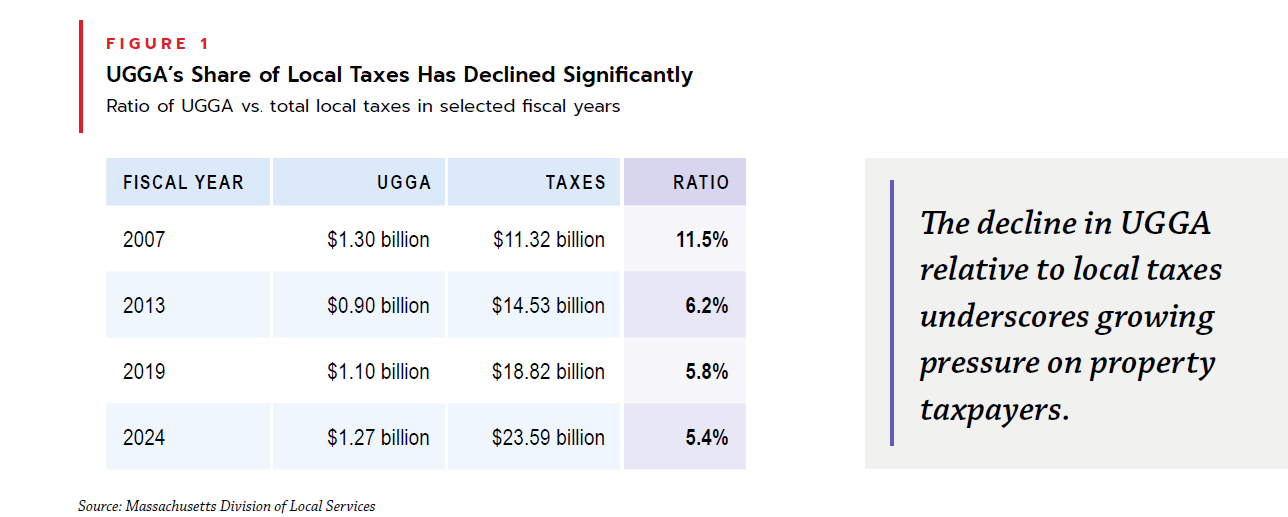
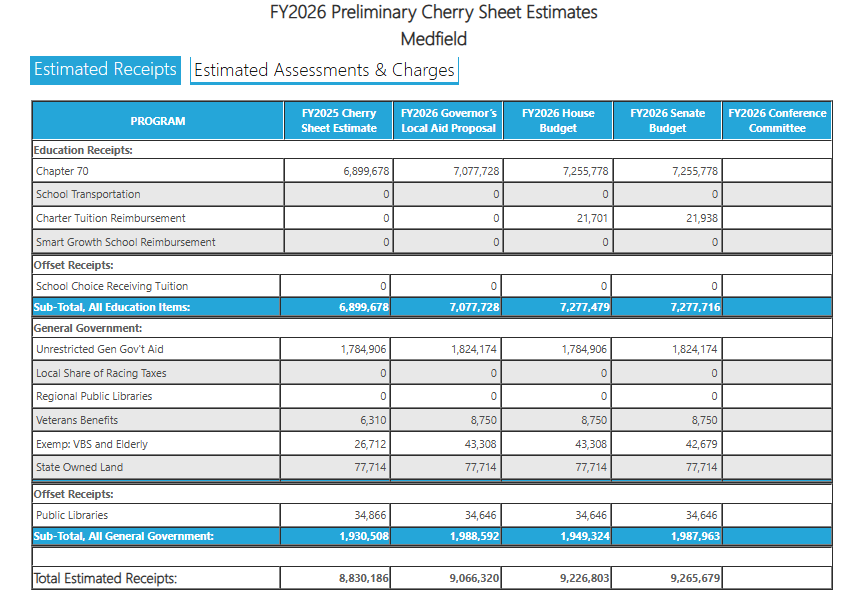
State aid – Unrestricted General Government Aid, or UGGA – to Medfield has declined for decades, and today is at less than half the level of our real estate property tax revenue that it was in 2007. The declining state aid has increasingly moved municipal services from being funded by the state income tax to the local property tax.
Thanks to Steve Callahan, Chair of the Warrant Committee for circulating the link to the Massachusetts Municipal Association piece that Assistant Town Administrator, Brittney Franklin shared with him.
Thanks too to the Massachusetts Municipal Association for focusing on this issue of inadequate and declining state funding.
Comments Off on MMA Suggests Solutions to Declining State Aid
Just three months into the new fiscal year, lawmakers learned about a new wrinkle caused by the One Big Beautiful Bill: federal tax law changes within the new law that could remove $650 million in state tax revenue supports that are holding up the $61 billion annual budget.
The sweeping federal legislation, signed the same day as the state budget, could siphon hundreds of millions from Beacon Hill’s coffers, a development disclosed at an economic roundtable. The news is forcing lawmakers to rethink core assumptions and scramble for possible fiscal workarounds. Add a full-blown federal government shutdown to the mix, and the state’s economic footing looks shakier by the day.
The shutdown became official on Wednesday. Federal offices closed. Economic data streams went dark. Gov. Maura Healey didn’t mince words: “It’s terrible for our country.”
She blasted Congressional Republicans for “driving us over a cliff.”
Roughly 45,000 federal workers who live in Massachusetts could be facing furloughs, and state officials began preliminary planning last week to keep key programs afloat while federal dollars are paused.
The U.S. Department of Labor also confirmed that Friday’s national jobs report would be shelved, sidelining data that influences economic, government and business decisions.
On Tuesday, Revenue Commissioner Geoffrey Snyder dropped the news about the $650 million exposure that occurs because the state is “coupled” with many federal tax provisions, creating ripple effects.
“This is one of the more challenging times that we’ve faced from a fiscal perspective,” said House Ways and Means Chair Aaron Michlewitz, noting that while several options are on the table, few are ideal.
Budget leaders are now weighing, at a minimum, whether to dip into reserves, revise revenue forecasts mid-year (a decision due by Oct. 15), or decouple state tax law from specific parts of the federal code.
Administration and Finance Secretary Matt Gorzkowicz was blunt: “There’s a lot of uncertainty, and there’s a lot of things we have to consider in managing that.”
Pressed on whether midyear budget cuts might be necessary, Gorzkowicz said simply: “I don’t know.”
The state does $860 million in unallocated funds built into the budget, perhaps with some foresight of what was coming but possibly also due to the common legislative tendency to pass supplemental budgets.
Sen. Michael Rodrigues, however, signaled restraint around the state’s over-$8 billion reserve fund: “We have other tools available. I’d be hard-pressed to suggest dipping into the Stabilization Fund right now.”
Posted onJune 7, 2025|Comments Off on State Flush with $, but not Sharing
From the Statehouse News Service Weekly Roundup (that former Medfield resident John Nunnari faithfully continues to share with me weekly, despite being gone 5+ years) –
“State tax collections continue to cruise, putting the total haul with just one month left in the fiscal year more than $2.8 billion ahead of last year’s pace”
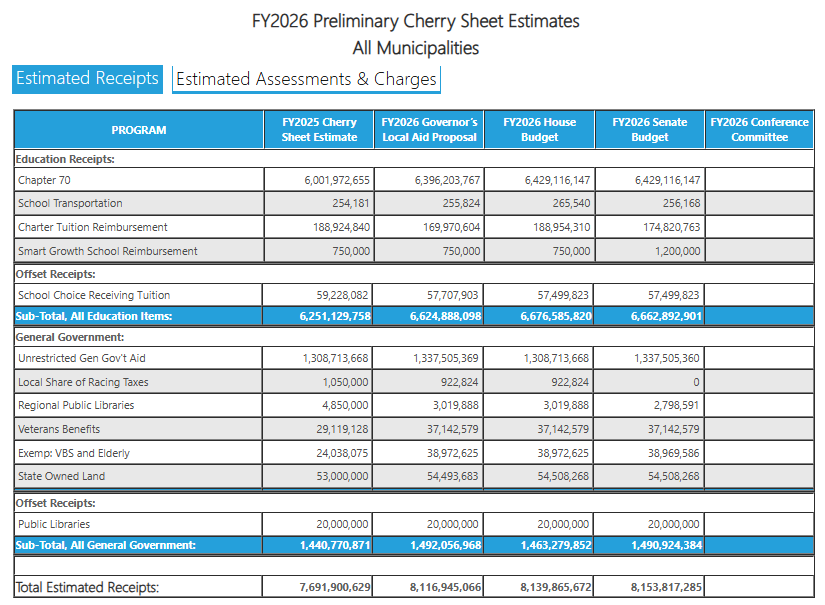
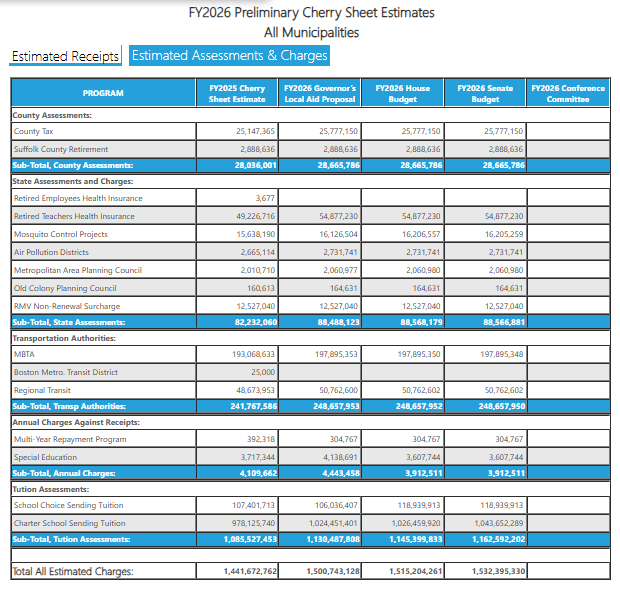
Yet the state is not sharing so much with Medfield this year. Current Cherry Sheet estimated increases for state revenue sharing with towns over last year are modest.
Comments Off on State Flush with $, but not Sharing
Posted onMay 29, 2025|Comments Off on Senate Budget #s – similar to House & Gov
The Senate released its cherry sheet budget numbers today, and the Senate’s money for Medfield tracks the House and Governor’s budget amounts fairly closely – meaning that the town will not likely see much increase in state aid next year.
Comments Off on Senate Budget #s – similar to House & Gov
Posted onMay 6, 2025|Comments Off on Senate Ways & Means adds less than $40K for Medfield
Looks to be a lean year for Medfield’s state aid, as the Senate Ways & Means Committee added less than $40K to the House budget numbers for Medfield, which were already only small increases. All the state $ must be going for the $25m. parking garage in the Speaker’s district:
Comments Off on Senate Ways & Means adds less than $40K for Medfield
Having met with Kevin several times over the last two years, I’ve found him to be well aware of our municipal issues, knowledgeable about the roadblocks we face to address them, and insightful in his rationale for tangible solutions. His experience as a Select Board Chair in Norfolk as well as his body of work on the Planning Board, County Advisory Board, and MBTA Advisory Board all contribute to his locally-focused approach to public service. Most importantly, I have come to understand that Kevin truly cares about making our towns work better for our residents. He’s approachable, he listens, and makes himself available whenever asked. Based on all this, I am confident that he would represent Medfield’s interests well in the legislature and I hope you will join me in supporting Kevin Kalkut for 9th Norfolk State Representative. – Osler Peterson, Medfield Select Board
Posted onAugust 24, 2024|Comments Off on ADU’s – coming to a Medfield yard near you in February
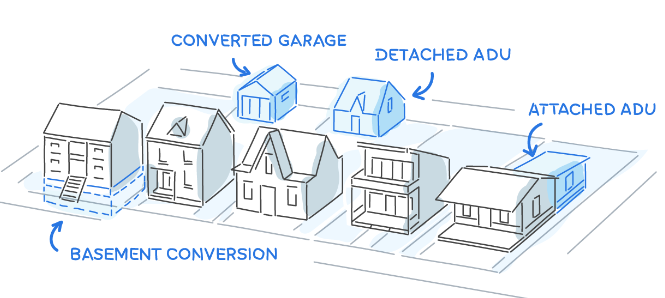
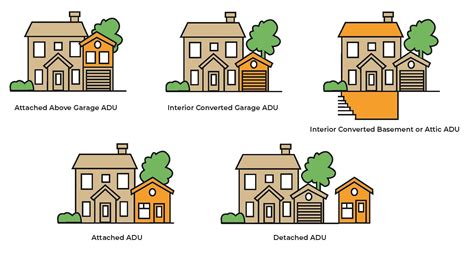
Accessory Dwelling Units (ADU’s), or small homes of up to 900 sq. ft., become permitted as of right in Massachusetts starting 2/2/2025 on any single family lot, subject only to “reasonable regulations.” The recently enacted Affordable Homes Act (AHA) stated the new rules, adding ADU’s onto the exemptions from local zoning that already exist for educational, religious, and agricultural uses. The permitted reasonable regulations cited are “dimensional setbacks and the bulk and height of structures and . . . short-term rental.”
STATUTE
The Affordable Homes Act, Chapter 150 of the Acts 2024
SECTION 7. Section 1A of chapter 40A of the General Laws, as appearing in the 2022 Official Edition, is hereby amended by striking out the definition “Accessory dwelling unit” and inserting in place thereof the following definition:- “Accessory dwelling unit”, a self-contained housing unit, inclusive of sleeping, cooking and sanitary facilities on the same lot as a principal dwelling, subject to otherwise applicable dimensional and parking requirements, that: (i) maintains a separate entrance, either directly from the outside or through an entry hall or corridor shared with the principal dwelling sufficient to meet the requirements of the state building code for safe egress; (ii) is not larger in gross floor area than 1/2 the gross floor area of the principal dwelling or 900 square feet, whichever is smaller; and (iii) is subject to such additional restrictions as may be imposed by a municipality, including, but not limited to, additional size restrictions and restrictions or prohibitions on short-term rental, as defined in section 1 of chapter 64G; provided, however, that no municipality shall unreasonably restrict the creation or rental of an accessory dwelling unit that is not a short-term rental. SECTION 8. Section 3 of said chapter 40A, as so appearing, is hereby amended by adding the following paragraph:- No zoning ordinance or by-law shall prohibit, unreasonably restrict or require a special permit or other discretionary zoning approval for the use of land or structures for a single accessory dwelling unit, or the rental thereof, in a single-family residential zoning district; provided, that the use of land or structures for such accessory dwelling unit under this paragraph may be subject to reasonable regulations, including, but not limited to, 310 CMR 15.000 et seq., if applicable, site plan review, regulations concerning dimensional setbacks and the bulk and height of structures and may be subject to restrictions and prohibitions on short-term rental, as defined in section 1 of chapter 64G. The use of land or structures for an accessory dwelling unit under this paragraph shall not require owner occupancy of either the accessory dwelling unit or the principal dwelling; provided, that not more than 1 additional parking space shall be required for an accessory dwelling unit; and provided further, that no additional parking space shall be required for an accessory dwelling located not more than 0.5 miles from a commuter rail station, subway station, ferry terminal or bus station. For more than 1 accessory dwelling unit, or rental thereof, in a single-family residential zoning district there shall be a special permit for the use of land or structures for an accessory dwelling unit. The executive office of housing and livable communities may issue guidelines or promulgate regulations to administer this paragraph.
ANALYSIS
The law firm Mirrick O’Connell last week sent out an emailed update that summarized the legislative change that permits ADU’s as follows:
Accessory Dwelling Units Permitted By-Right (Sections 7 and 8)
The AHA amends the Zoning Act by prohibiting towns and cities from restricting accessory dwelling units (ADUs) in single-family zoning districts. ADUs, sometimes known as in-law apartments, now fall under the protection of M.G.L. c. 40A, Section 3, which exempts religious, educational, and other uses from local zoning.
One ADU is now allowed by-right on each lot in a single-family zoning district, subject to “reasonable regulations”, which may include non-discretionary site plan review, certain dimensional controls, Title 5 septic regulations, and restrictions on short-term rentals.
The AHA provides that an accessory dwelling unit must have a separate entrance (interior or exterior) that complies with the State Building Code and may not be larger than half the gross floor area of the principal dwelling or 900 square feet, whichever is smaller. The AHA prohibits restrictions on owner-occupancy and rentals of ADUs, eliminating the requirement in many towns and cities that in-law apartments may only be used by an owner’s close relative.
In addition, towns and cities must allow additional ADUs in single-family zones through a special permit process.
The ADU provisions take effect on February 2, 2025, so municipalities have a few months to consider zoning amendments consistent with the AHA.
Comments Off on ADU’s – coming to a Medfield yard near you in February
The legislature’s earmarks process of doling out state monies in the annual state budget to good projects in each municipality is manifestly unfair and shortchanges most, yet it persists because our legislators annually adopt legislative rules that cede all power to the legislative leadership. Our legislative leadership then award/take home millions of dollars via earmarks in the annual state budget for admittedly good projects in their districts, while the bulk of districts are shortchange by getting little $$$ for their admittedly good projects.
People are silhouetted behind closed doors inside a lawmakers-only hallway off the House chamber.JESSICA RINALDI/GLOBE STAFF
| STATE SECRETS |
After months of preaching fiscal restraint, five of the Massachusetts House’s highest-ranking Democrats slipped at least $5 million in earmarks into the chamber’s spending plan in late April, fattening their own districts’ haul far beyond that of most others and almost entirely out of public view.
Posted onJuly 17, 2024|Comments Off on Democrats State Rep Debate – recording available
You can listen to yesterday’s debate by the three Democratic candidates seeking to replace Denise Garlick as our State Representative via this link. The debate was organized by the Charles River Regional Chamber and its President and CEO Greg Reibman did an excellent job of moderating the debate and getting information from the candidates.
Bill Dermody of Needham is also running as an unenrolled candidate. Bill attended our Select Board meeting last night and introduced himself to us at the end. Bill will face the winner of the Democratic primary in the November election.
Comments Off on Democrats State Rep Debate – recording available
Posted onJuly 12, 2024|Comments Off on State Rep debate is 7/16
The Charles River Regional Chamber noticed that I published the wrong date for its debate for the Democratic candidates seeking to replace Rep. Denise Garlick, and was kind enough to alert me.
Meet the candidates for the 13th Norfolk House seat: Patrick A. Gatto, Kenneth Ruetenik, and Joshua Tarsky
July 16, 2024 12:00 PM – 1:00 PM (EDT)
Description
Join us for the virtual debate between the three candidates — Patrick A. Gatto, Kenneth Ruetenik, and Joshua Tarsky — competing in the Sept. 3 Democratic primary for the open state representative seat in the 13th Norfolk district currently held by Rep. Garlick, representing Needham, Dover and part of Medfield.
Our focus will be issues related to economic development, housing, workforce, and the environment. Other general topics may be discussed as well. Questions from the business community in advance are welcome. This event will be recorded and shared later.
Pricing
Free, open to members & nonmembers
Contact Information
Name: Charles River Regional Chamber Phone: (617) 244-5300 Email: info@charlesriverchamber.comr newsletter
I started this blog to share the interesting and useful information that I saw while doing my job as a Medfield select board member. I thought that my fellow Medfield residents would also find that information interesting and useful as well. This blog is my effort to assist in creating a system to push the information out from the Town House to residents. Let me know if you have any thoughts on how it can be done better.
For information on my other job as an attorney (personal injury, civil litigation, estate planning and administration, and real estate), please feel free to contact me at 617-969-1500 or Osler.Peterson@OslerPeterson.com.






 Medfield02052's Blog