Category Archives: Downtown

Volunteers Needed for the 2018 Holiday Stroll

From Diane Borrelli of the Medfield Cultural Alliance –

camfinal26001

Volunteers Needed for the 2018 Holiday Stroll


The Cultural Alliance of Medfield is seeking volunteers for the 4th annual Holiday StrollFriday December 7, between 3:30 and 9:30pm, we’ll need volunteer ‘greeters’ in 2 hour shifts.

Greeting duties include smiling, welcoming visitors, tallying head counts, helping some artists set up/break down booths, and providing general event information to visitors. It’s fun, social, and easy, and you work in pairs, so sign up with a spouse or friend!

Click here for information on time slots, and the link to “Sign Up Genius”. And, visit www.medfieldculture.org and check out the “2018 Holiday Stroll” tab to learn more about this annual Medfield event!

Thank you,

Diane Borrelli
D.frances@verizon.net
MedfieldCulture.org

2018 Holiday Stroll Medfield

From Diane Borrelli of the MedfieldCulture.org –

Holiday Stroll 2018

2018 Holiday Stroll Medfield

(Medfield MA): The Cultural Alliance of Medfield (CAM) announces its fourth annual Holiday Stroll on Dec. 7, 2018 from 4 – 9 pm. This is a festive family event that takes place at seventeen venues along Main Street (Route 109), North Meadows Road (Route 27), North Street and the Dwight Derby House on Frairy Street. Included are 40 juried artisans at three main locations, an outdoor ice sculpture demonstration, food vendors, carolers, photos with Santa and M.E.M.O.’s outdoor tree lighting ceremony. All events are within walking distance, FREE admission and parking nearby. For more information visit https://medfieldculture.org/holiday-stroll-2018/

DHCD OK’s Medfield Meadows

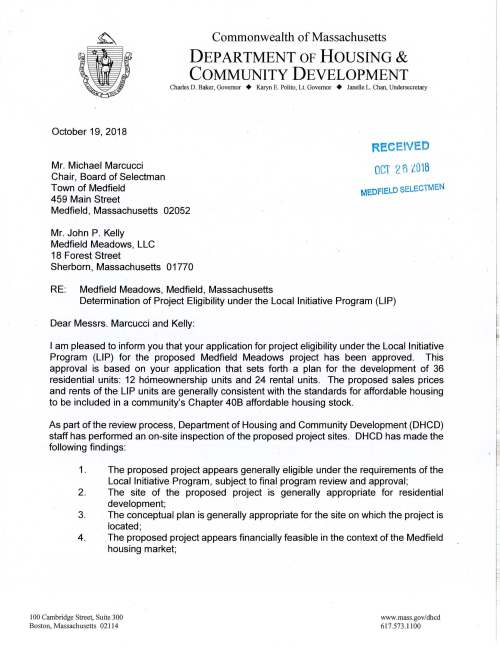
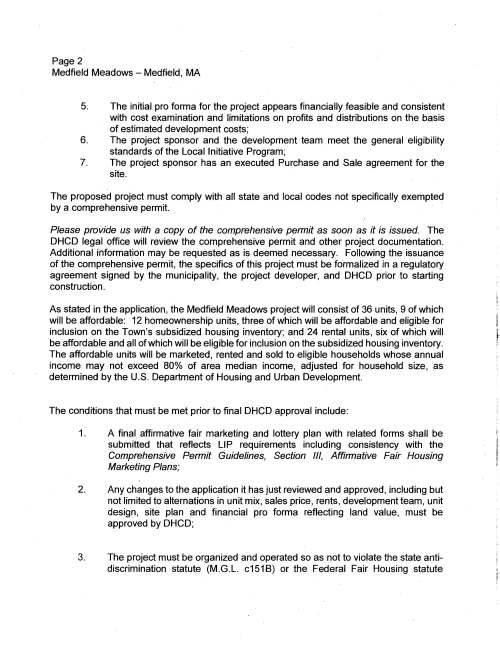
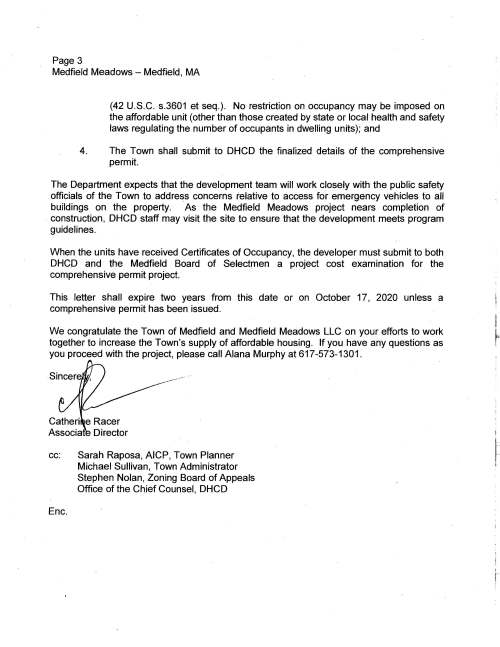
The following letter was received by the Board of Selectmen today, wherein Department of Housing and Community Development approved the John Kelly 40B at the corner of Dale Street and Route 27.  –

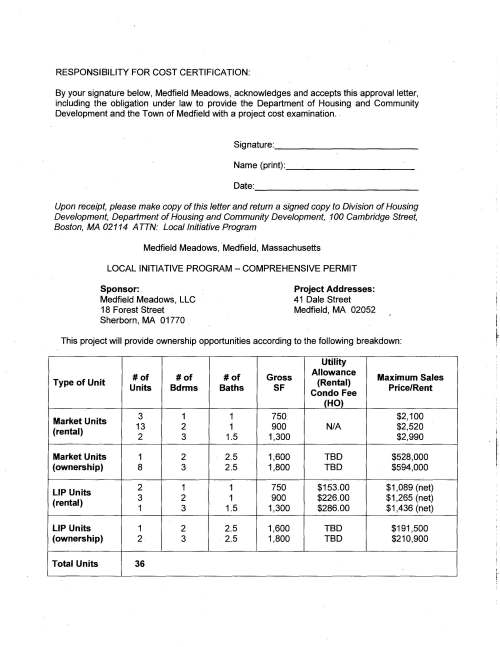
Commonwealth of Massachusetts DEPARTMENT OF HOUSING & COMMUNITY DEVELOPMENT Charles D. Baker, Governor + Karyn E. Polito, Lt. Governor + Janelle L. Chan, Undersecretary October 19, 2018 Mr. Michael Marcucci Chair, Board of Selectman Town of Medfield 459 Main Street Medfield, Massachusetts 02052 Mr. John P. Kelly Medfield Meadows, LLC 18 Forest Street Sherborn, Massachusetts 01770 RE: Medfield Meadows, Medfield, Massachusetts REeEIVEO OCT 2 fl l0 1B MEDFIELD SELECTMEN Determination of Project Eligibility under the Local Initiative Program (LIP) Dear Messrs. Marcucci and Kelly: I am pleased to inform you that your application for project eligibility under the Local Initiative Program (LIP) for the proposed Medfield Meadows project has been approved. This approval is based on your application that sets forth a plan for the development of 36 residential units: 12 homeownership units and 24 rental units. The proposed sales prices and rents of the LIP units are generally consistent with the standards for affordable housing to be included in a community's Chapter 408 affordable housing stock. As part of the review process, Department of Housing and Community Development (DHCD) staff has performed an on-site inspection of the proposed project sites. DHCD has made the following findings: 1. The proposed project appears generally eligible under the requirements of the Local Initiative Program, subject to final program review and approval; 2. The site of the proposed project is generally appropriate for residential development; 3. The conceptual plan is generally appropriate for the site on which the project is located; 4. . The proposed project appears financially feasible in the context of the Medfield housing market; I 00 Cambridge Street, Suite 300 Boston, Massachusetts 02 11 4 www.mass.gov/dhcd 617.573.1100 Page 2 Medfield Meadows - Medfield, MA 5. The initial proforma for the project appears financially feasible and consistent with cost examination and limitations on profits and distributions on the basis of estimated development costs; 6. The project sponsor and the development team meet the general eligibility standards of the Local Initiative Program; 7. The project sponsor has an executed Purchase and Sale agreement for the site. The proposed project must comply with all state and local codes not specifically exempted by a comprehensive permit. Please provide us with a copy of the comprehensive permit as soon as it is issued. The DHCD legal office will review the comprehensive permit and other project documentation. Additional information may be requested as is deemed necessary. Following the issuance of the comprehensive permit, the specifics of this project must be formalized in a regulatory agreement signed by the municipality, the project developer, and DHCD prior to starting construction. As stated in the application, the Medfield Meadows project will consist of 36 units, 9 of which will be affordable: 12 homeownership units, three of which will be affordable and eligible for inclusion on the Town's subsidized housing inventory; and 24 rental units, six of which will be affordable and all of which will be eligible for inclusion on the subsidized housing inventory. The affordable units will be marketed, rented and sold to eligible households whose annual income may not exceed 80% of area median income, adjusted for household size, as determined by the U.S. Department of Housing and Urban Development. The conditions that must be met prior to final DHCD approval include: 1 . A final affirmative fair marketing and lottery plan with related forms shall be submitted that reflects LIP requirements including consistency with the Comprehensive Permit Guidelines, Section Ill, Affirmative Fair Housing Marketing Plans; 2. Any changes to the application it has just reviewed and approved, including but not limited to alternations in unit mix, sales price, rents, development team, unit design, site plan and financial pro forma reflecting land value, must be approved by DHCD; 3. The project must be organized and operated so as not to violate the state antidiscrimination statute (M.G.L. c1518) or the Federal Fair Housing statute I ~ i t ! Page 3 Medfield Meadows - Medfield, MA (42 U.S.C. s.3601 et seq.). No restriction on occupancy may be imposed on the affordable unit (other than those created by state or local health and safety laws regulating the number of occupants in dwelling units); and 4. The Town shall submit to DHCD the finalized details of the comprehensive permit. The Department expects that the development team will work closely with the public safety officials of the Town to address concerns relative to access for emergency vehicles fo all buildings on the property. As the Medfield Meadows project nears completion of construction, DHCD staff may visit the site to ensure that the development meets program guidelines. When the units have received Certificates of Occupancy, the developer must submit to both DHCD and the Medfield Board of Selectmen a project cost examination for the comprehensive permit project. This letter shall expire two years from this date or on October 17, 2020 unless a comprehensive permit has been issued. We congratulate the Town of Medfield and Medfield Meadows LLC on your efforts to work together to increase the Town's supply of affordable housing. If you have any questions as you proceed with the project, please call Alana Murphy at 617-573-1301. Catheri e Racer Associat Director cc: Sarah Raposa, AICP, Town Planner Michael Sullivan, Town Administrator Stephen Nolan, Zoning Board of Appeals Office of the Chief Counsel, DHCD Enc. RESPONSIBILITY FOR COST CERTIFICATION: By your signature below, Medfield Meadows, acknowledges and accepts this approval letter, including the obligation under law to provide the Department of Housing and Community Development and the Town of Medfield with a project cost examination .. Signature: ___________ _ Name (print): __________ _ Date: ---~--~------~ Upon receipt, please make copy of this letter and return a signed copy to Division of Housing Development, Department of Housing and Community Development, 100 Cambridge Street, Boston, MA 02114 ATTN: Local Initiative Program Medfield Meadows, ·Medfield, Massachusetts LOCAL INITIATIVE PROGRAM-COMPREHENSIVE PERMIT Sponsor: Medfield Meadows, LLC 18 Forest Street Sherborn, MA 01770 Project Addresses: 41 Dale Street Medfield, MA 02052 This project will provide ownership opportunities according to the following breakdown: Utility #of #of #of Gross Allowance Type of Unit Maximum Sales Units Bdrms Baths SF (Rental) Price/Rent Condo Fee (HO) Market Units 3 1 1 750. $2, 100 (rental) 13 2 1 900 N/A $2,520 2 3 1.5 1,300 $2,990 Market Units 1 2 2.5 1,600 TBD $528,000 (ownership) 8 3 2.5 1,800 TBD $594,000 LIP Units 2 1 1 750 $153.00 $1,089 (net) (rental) 3 2 1 900 $226.00 $1,265 (net) 1 3 1.5 1,300 $286.00 $1,436 (net) LIP Units 1 2 2.5 1,600 TBD $191,500 (ownership) 2 3 2.5 1,800 TBD $210,900 Total Units 3620181019-DHCD-ltr from_Page_220181019-DHCD-ltr from_Page_320181019-DHCD-ltr from_Page_4


Status of Rosebay

Rosebay

Town Status on the Rosebay Project

I have been asked enough about the status of the Rosebay project that I thought I would share what I know.  Rosebay is the private development proposal for 45 units of senior affordable housing on Medfield Housing Authority land that is directly adjacent to Tilden Village on Pound Street.  Rosebay would be all seniors, all rental, and all affordable.  The developer is Brian McMillin of NewGate Housing LLC of Westwood, who was selected by the Medfield Housing Authority.  Brian McMillin previously worked for Gatehouse, at the time Gatehouse built The Parc in Medfield.

In general, the Board of Selectmen have been pushing to have more affordable housing, especially for seniors, so conceptually I support the Rosebay project.

The town’s active and effective Affordable Housing Trust has been meeting with the Rosebay developer and I understand that the Affordable Housing Trust has been advancing the Rosebay project as part of the town’s solution to our affordable housing needs.  I also believe that the Affordable Housing Trust even provided some monies for fees to that developer to advance the project.

The Town of Medfield is in a good spot at the moment with respect to unfriendly 40B proposals because we are currently in a safe harbor, meaning that:

  1. we have a Housing Production Plan that the Department of Housing and Community Development (DHCD) has accepted, and
  2. we are currently building 21 SHI units per year.

I believe that we have about another year and a half of safe harbor remaining, but we also have several irons in the fire that could extend that time frame.

So as long as we remain in that safe harbor, the Zoning Board of Appeals of the Town of Medfield can turn down any 40B that it does not like on the basis that we are in that safe harbor, and the developer cannot end run the town by appealing for state approval to the Housing Appeals Committee (HAC) at the DHCD for an approval.  The HAC routinely approves any developer’s 40B developments turned down by towns, but the HAC will not overturn a ZBA denial based on our being in a safe harbor, while we continue to be in that safe harbor.

The Board of Selectmen will soon send a letter to Department of Housing and Community Development opining about the suitability of the Rosebay project in general, and we would welcome citizen input as part of our formulation of that letter.

The project is not looking to be a Local Initiative Project (LIP), which is a town endorsed 40B.  The need for that town endorsement of a LIP gives the Board of Selectmen a high level of control over any LIP.  The Board of Selectmen therefore does not have that same high level of input and control over Rosebay that we would have if it were a LIP.

In this instance the Zoning Board of Appeals will be the main town entity that will deal with the nuts and bolts issues of the Rosebay project, and that will seek to ameliorate the proposed project and its impacts on both the neighbors and the town.  The ZBA has even greater than usual control over the Rosebay proposal, because of the fact that we are in a 40B safe harbor, and any ZBA denial should be supported by the HAC.

I am trusting the Zoning Board of Appeals to see that the details are worked out as well as they can be so as to minimize the impacts and effects of the project on the neighbors.

The Rosebay at Medfield

Today I got this email follow up, below, from the developer that the Medfield Housing Authority selected for the proposed project on Medfield Housing Authority land next to Tilden Village.  I also met with the Legion and its developers this week about their plans, and the issue of how their timing fits in to the town’s safe harbor needs, so I asked Brain McMillin about the timing of his plan, and he reported  “it’s not out of the question that it could take until 2022 or 2023 until these units are ready to be leased up.”  –


Rosebay


I should probably point out that The Rosebay at Medfield is not public housing, so it is technically not an expansion of Tilden Village.  It will be a privately-owned development located on land leased from the Medfield Housing Authority under a long-term ground lease.

Although it will not be public housing like Tilden Village, all of the units in the proposed development would still be affordable and age-restricted (62+) to meet the Housing Authority’s requirements.  For the Town of Medfield, all 45 of the proposed units would count toward its Chapter 40B Subsidized Housing Inventory and further goals stated under its Housing Production Plan.

The basic structure we have proposed is fairly common and has been used around the country for privately-owned developments built on housing authority land.  We are aware, however, that that it may require some explanation and we plan to provide that detail during our Comprehensive Permit hearing before the Zoning Board.


Regards,


Brian J. McMillin | NewGate Housing LLC

Tilden expansion filed at DHCD

Rosebay

Tilden Village expansion – The Rosebay at Medfield

This email yesterday from Sarah Raposa about the Medfield Housing Authority’s planned expansion adjacent to its Tilden Village site having taken its first step by means of a filing with the Department of Housing and Community Development –

===========================================================

We haven’t received the hard copy from DHCD but Mike was cc’d on the submission to DHCD.

Here is the link to the application on the Town’s website:

http://ma-medfield.civicplus.com/CivicAlerts.aspx?AID=59

Best,  Sarah

Sarah Raposa, AICP

Town Planner

===========================================================

The developer, Brian McMillin of NewGate Housing LLC, Westwood, MA stated to me that while the plans are “available on the Town’s website. . . they are a required step in preparing to file for a Comprehensive Permit for The Rosebay at Medfield, and they contain only basic preliminary information.  More detailed information regarding the proposed development will be provided in the Comprehensive Permit application.”

ZBA says no to LCB

LCB

The Zoning Board of Appeals of the Town of Medfield voted to deny a special permit to the proposed LCB assisted living facility on Main Street, whose application has been pending for two and a half years.  The entire decision is available here 20180621-ZBA.LCBdecision), and the essential excerpts appear below.

=========================================================

TOWN OF MEDFIELD
Office of the Board of Appeals on Zoning

NOTICE OF DECISION

APPLICANT: LCB Senior Living
DECISION DATE: June 21, 2018
DATE OF FILING DECISION: June 27,2018
DECISION NUMBER: 1339

  • While the Applicant has provided sufficient evidence to warrant a number of positive findings, the Board has concluded that it cannot make one of the key findings. Section 14.1 O.E(3) requires that we determine that the proposed use is architecturally and aesthetically consistent with other structures in the neighborhood.
  • Section 14.10.E(l) requires that we determine that the proposed use will not result in a public hazard due to substantially increased vehicular traffic or parking in the neighborhood. While the proposed project would provide 51 parking spaces, we are concerned that that level of parking may not be adequate. . . Section 14.10.E(l) requires that we determine that the proposed use will not result in a public hazard due to substantially increased vehicular traffic or parking in the neighborhood. While the proposed project would provide 51 parking spaces, we are concerned that that level of parking may not be adequate.
  • Section 14.1 O.E(2) requires that we determine that the proposed use will have no adverse effect upon property values in the neighborhood. . . we do not believe that we can make the required finding that the proposed use will have no adverse effect on property values in the neighborhood.


LCB restart

LCB

The permitting for the proposed LCB assisted living facility behind the Clark Tavern on Main Street with the Zoning Board of Appeals and the Planning Board is starting up again with a Zoning Board of Appeals hearing on 5/23 at 7PM at the Blake Middle School auditorium.  In advance of that ZBA hearing Town Planner, Sarah Raposa circulated the most recent peer review by the town’s engineering consultants, BETA Engineering, dated 4/19/2016, which gives a summary of where things stand.

20160419-BETA-Medfield Senior Living Peer Review (002)


Also, I believe that there are still two outstanding and as yet unresolved apeals by LCB of the wetlands determination issues by the Town of Medfield Conservation Commission.  I understand those appeals are pending with the state DEP and at the Norfolk Superior Court.  The ConCom determined that Vine Brook is a “perennial stream” (i.e. it flows year round) and as a result that building setbacks are subject to the 200′ Rivers Act requirements.  I believe that LCB takes the position that Vine Brook is only “intermittent,” and that therefore the Rivers Act setback do not control.


Below is Sarah’s transmission email to town department heads –

===============================================================

LCB is coming back from continuance-hiatus next Wednesday night (5/23) with the ZBA. I wanted to refresh your memories on the project and where Beta is at with the reviews. The application and plans may be viewed here: Dropbox Link

Attached is the most recent civil and traffic engineering review from Beta.


For some departments, your predecessors submitted comments on the project. Previously submitted comments are HERE. You may wish to update departmental comments, if so, please provide written comments by next Wednesday at 10 am.


Looking closely, I don’t having anything from the Fire Department (though I know Chief Kingsbury reviewed the plan).


I did not include the COA and School Dept. in 2015 but feel free to submit if you have any comments for the ZBA.


I do have several documents from the Historical Commission that I didn’t attach here but are online. I know you’ll be at the meeting on Wednesday to submit comments in person.


All are welcome to the public hearing session: Wednesday, May 23, 2017 at 7:00 pm at the Blake Middle School Auditorium.


Thank you,

Sarah


Sarah Raposa, AICP

Town Planner
459 Main Street
Medfield, MA  02052
(508) 906-3027
sraposa@medfield.net


Take the parking survey

From Sarah Raposa –

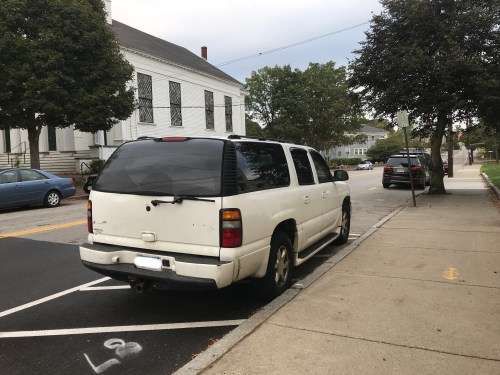
parked in no parking zone with available parking nearby

Reminder!

The Economic Development Committee (EDC) and their consultants from Nelson\Nygaard are requesting public input in formulating strategies for a parking management plan for downtown Medfield.

Please take our survey: www.surveymonkey.com/r/MedfieldParking

The survey closes Monday, March 26, 2018 at 8 am. Thank you!


Sarah Raposa, AICP

Town Planner
459 Main Street
Medfield, MA  02052
(508) 906-3027
sraposa@medfield.net

www.town.medfield.net


5G may look different in Medfield

Medfield already has one Verizon permitted antennae on a light pole, in front of Palumbo Liquors, and according to this article, we may be seeing many more.  The Board of Selectmen were told when presented with that pole antennae application, that in Massachusetts Verizon had the right to install on an existing pole.  The town gets no revenue from that antennae.  By contrast, the antennae on our two water towers pay, from memory, about $30K/year /antennae).


Why Cities Should Jump at the Chance to Add Cell Towers to Streetlights

COMMENTARY | In a contributed piece, the authors suggest compromises and efficiencies to ensure cities do not get left behind in the 5G revolution.

This is the first in two contributed articles on broadband access and local government’s role in building better connectivity for its citizens. Read the second one here.

NEWPORT BEACH, Calif. —  Numerous state lawmakers are filing bills to encourage or even compel large cities to incorporate cell towers into existing municipal infrastructures. Not everyone is sold on the proposition.

Wireless carriers want to install miniature cell towers on utility poles and streetlights to keep up with fifth-generation—commonly known as 5G—cell phone technology. Carriers plan to install more than 250,000 small cell sites across the U.S. in the next few years, but they require broad access to public property in order to proceed. Legislators have introduced wireless siting bills in 25 states so far this year, with hopes to begin work on installations in 2018.

In Illinois, for instance, legislation intended to streamline this process has enjoyed a cold reception. The Small Cell Wireless Bill passed the Illinois House and Senate during the 2017 veto session, though State Senate President John Cullerton decided to hold the legislation after public outcry from area communities. Policymakers said they hoped to negotiate with local officials who have called on Gov. Bruce Rauner to veto the bill.


Meanwhile, both sides of this ongoing debate have been clashing in California Gov. Jerry Brown late last year vetoed a bill that would have made it easier for telecommunications companies to install the small transmitters on public property. Brown argued the permitting process for new technology must be weighed against the right of local governments to manage public property under their jurisdiction.

Skeptics claim these small cell sites will be more of an eyesore than an asset, but city dwellers should welcome this beneficial blend of private tech and public property.


A Rising Tide Lifts All Ships

Opponents argue that this integration of street furniture and tech will harm community aesthetics and historical preservation. Local and state representatives who oppose the legislation, however, will cause self-inflicted wounds to the long-term prosperity of their communities.

By attaching small cell antennas to streetlights and other street furniture, carriers will be able to use 5G technology to deliver wireless data much more effectively. Wireless customers in affected areas will enjoy improved coverage, fewer dropped calls, and faster download speeds.


5G technology saw an informal test in Minneapolis during Super Bowl LII, after Verizon crews installed 250 of the small cell sites throughout downtown Minneapolis to accommodate the hundreds of thousands of out-of-town visitors for the big game. The stadium itself was blanketed in wireless signals, with antennas hidden in everything from handrails to small boxes scattered among the stadium’s seats.

As 5G technology gains traction, wireless carriers hope to eventually supplant cable as the primary provider of home internet service. Speeds on 5G networks are better than traditional cable internet, and the wireless service can compete with high-end fiber networks. Homes within reach of these small cell sites would no longer require wired connections, but the infrastructure for this sort of network does not exist in many communities. As a solution, carriers want to pepper small cell antennas on existing street furniture.

Critics contend the wireless industry’s initiative will roll back public efforts to expand broadband access to underserved and rural areas. In truth, the push to install cell antennas on public furniture would actually support these efforts by forcing cable providers to bolster their infrastructure and reduce their rates in order to remain competitive.

According to Deloitte, the U.S. must spend more than $100 billion over the next five to seven years to support fiber infrastructure demands. Wireless providers can ease this burden by densifying their networks, increasing consumer access along the way. Carriers would partner with municipalities to design, permit, and construct saturated wireless networks, benefitting all parties involved.

Residents want improved connectivity, but they fear unsightly additions to city structures. To mitigate this aesthetic issue, cities should require companies to shroud antennas and install non-transmitting equipment below ground.

In exchange, cities should agree to give wireless carriers and cable companies a free market in which to solve the digital divide. To build seamless networks, wireless companies will need to serve all high-density areas — including impoverished districts. By simplifying the installation and permitting processes, cities will be able to facilitate better services for their citizens with minimal effort.

Leaping from Legislation to Implementation

Before this technology can change things for the better, local leaders must modify municipal policies and procedures. Steep lease rates for cell towers on private property inflate the operating expenses of wireless carriers. Low-cost access to public street furniture would remedy this issue, reducing operating expenses for carriers and freeing up capital for infrastructure improvements and denser networks.

Many municipalities lack defined fee structures and approval processes for the corporate use of public property. By creating straightforward licensing procedures, cities can help carriers plan ahead for new networks. Public works departments should interfere as little as possible, only stopping proposals that overstep the common sense of aesthetics and function. If cities keep rates fair and permitting reasonable, carriers can pass their savings on to customers.

Communities that oppose the installation of 5G technology on their assets risk falling behind other municipalities that cooperate with carriers. Technology-fueled startups and participants in the gig economy prefer areas with better technology. If one city is saturated with high-speed wireless service while another avoids upgrades, startups are more likely to flock to the city with the better technological offering.

Fast internet service is the lifeblood of the global economy. In nations with fewer regulations on wireless infrastructure, carriers provide denser networks with better service at lower costs. Without reliable, affordable access to these advanced systems, American communities will trail behind their global counterparts.

To remain globally competitive, government officials must work with the wireless industry to rethink commercial access to public assets. By cooperating with carriers on permitting and reasonable use rates, municipalities can create room for compromise on the shrouding and location of new equipment. Opening city hall for business will create new economic opportunities for wireless generations to come