Bay Colony Rail Trail report

BCRT

Photo above is of the Bay Colony Rail Trail in Needham.

Bay Colony Rail Trail committee reports to the Board of Selectmen tonight

Read the Bay Colony Rail Trail report to the Town of Medfield that the study committee will present to the Board of Selectmen this evening.  It calls for approval at the 2017 annual town meeting (ATM) and completion of the construction by 2018.  The report is a remarkably thorough and detailed document.

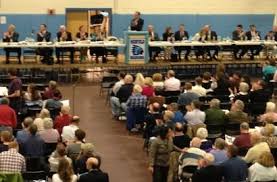
Selectmen 11/15/16

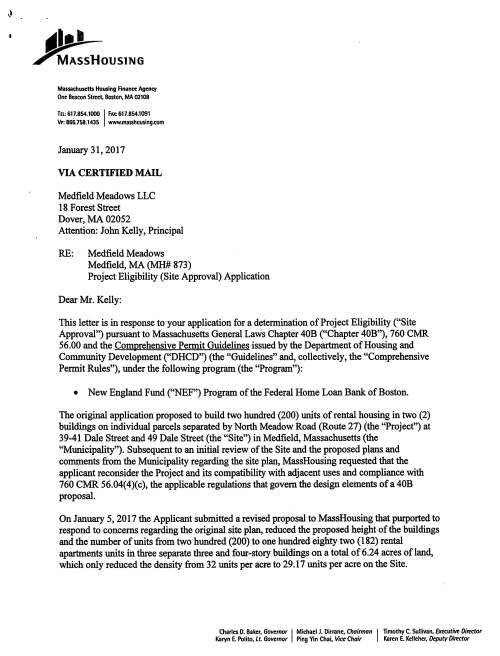
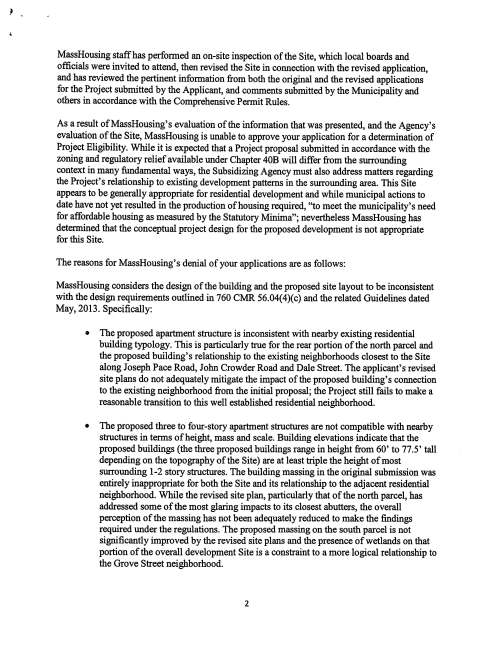
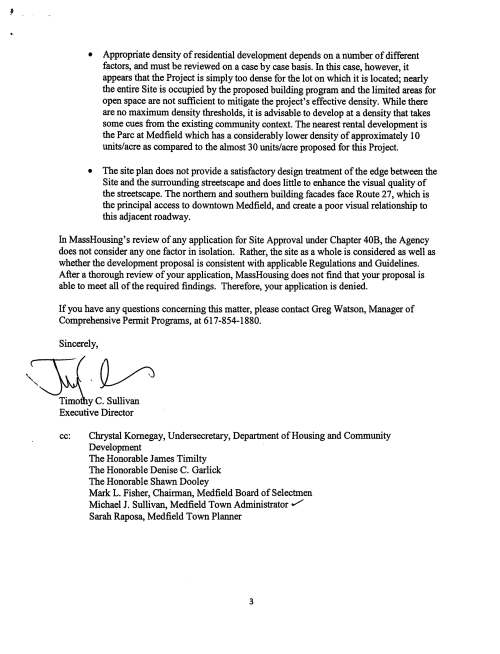
Meeting Minutes November 15, 2016 Chenery Meeting Room draft PRESENT: Selectmen Fisher, Peterson, Marcucci; Town Administrator Sullivan; Assistant; Town Counsel Cerel; Administrative Assistant Clarke Chairman Fisher called the meeting to order at 7:00 PM. He announced this meeting is being recorded and we want to take a moment of appreciation for our Troops serving in the Middle East and around the world Executive Session at the close of meeting for the purpose of discussing pending litigation filed against Medfield Conservation Commission and to discuss potential land acquisition SPECIAL ELECTION MEDFIELD HOUSING AUTHORI1Y Members Lisa Donovan, Eldred Whyte, Robert Canavan and Brent Nelson are present this evening to vote jointly with the Selectmen a new member to fill the vacancy created by the resignation of member Neil Duross. The newly elected candidate will fill the vacancy until the Town Election in March. The only candidate is Eileen DeSorgher. According to General Laws Chapter 41, Section 11 election is by roll call vote. Selectman Peterson, Clerk of the Board asked for the roll call vote. The Board of Selectmen and the members of the Housing Authority voted unanimously to elect Eileen DeSorgher. The Selectmen offered congratulations to Ms. DeSorgher. POLICE DEPAITTMENT Chief Meaney explained that he is here this evening to request the Selectmen vote to appoint Kim Belskis as a Medfield Police Officer. She is a member of the Army National Guard and is a suicide and prevention officer. Ms. Belskis is an exceptional fit for the Town and will be a great asset to the department. She expects to enter the Academy in February. VOTED unanimously to appoint Kim Belskis as a Police Officer with the Medfield Police Department Chief Meaney continued saying that several weeks ago the Board voted Sergeant John Wilhelmi as Deputy Police Chief. Tonight I would like to present Deputy Chief Wilhelmi with his badge and he will have the honor of being pinned by his wife. The Selectmen extended congratulations to Deputy Chief Wilhelmi. MEDFIELD ENERGY COMMITIEE Fred Bunger, Committee Chair and Axum Teferra from the Metropolitan Area Planning Committee presented information about a five year plan that will reduce Medfield's energy consumption by 20% by the end of fiscal year 2020. Mr. Bunger explained that the Selectmen and Energy Committee have been working to qualify Medfield as a Green Community since November 15, 2016 Page two 2011. The Town has completed four of the criteria necessary for the designation leaving only one more, the energy reduction plan. The plan's goal will be to save us $250,000 per year. Proposed projects will focus on lighting replacement in town buildings, water usage and building insulation. Included in the school's plan to reduce energy is to teach students to turn off computers, electronics and lights when not in use. Any projects that may cost the town to institute may be done by applying for state grants. Mr. Bunger explained that Medfield's application must be sent to the Department of Energy by November 21. The Selectmen were impressed by the remarkable data presented as they know it was a lot of work. VOTED unanimously to adopt the Energy Reduction Plan as presented by the Medfield Energy Committee and further vote to authorize Town Administrator to sign letters that will be included in the package for the Department of Energy Resources Mfit?~~~&Rt'MFi~qW~'~z~;a~,tf~!lrg Toyii),,,qgyh~el,~~r~Lt~ro'.~t~~~i that the Town's draft letter was submitted to Jay Talerman for his review and comments. Selectman Marcucci advises that the letter should emphasize the developer's financial history at the beginning of the letter; the bullet points regarding the applicants names seem to be confusing. That should be made clearer. MASS Housing must be made aware of the applicants financial backgrounds; specifically request they conduct an investigation. Discussion ensued regarding plans to reach the goal of 21 units per year to keep the Town at safe harbor. Mr. Sullivan reported on discussions he has had with a few developers regarding housing plans. Resident Suzanne Siino was in the audience and a discussion took place regarding group homes as a way to add units to affordable housing; locations for them will be ongoing matter. The Board is requested to vote to submit a reserve fund transfer for $40,000 to hire a housing specialist to assist the Town with the various regulations of 40B and it was so voted. STATE HOSPITAL MASTER PLAN COMMITIEE Discussion ensued with Steve Nolan, Chairman regarding the committee's decision to end their contract with VHB Consulting. Another RFP has been published for consultants to assist the Town with the strategic reuse plan for the site. The Selectmen are requested to vote to approve a request for funds in the amount of $150,000 for this work and it was so voted. November 15, 2016 Page three ROAD SALT AGREEMENT At their previous meeting the Board was requested to award the road salt bid for the 2016- 2017 winter season to Eastern Minerals, Inc. DPW Director Maurice Goulet requests the Selectmen vote to sign the Agreement with Eastern Minerals and it was so voted. PHASE II DOWNTOWN PARKING VOTED unanimously to sign a grant application, amount up to $15,000 for Medfield Phase II Parking Study and as recommended by the Economic Development Committee CHIEF PROCUREMENT OFFICER VOTED unanimously to authorize Chairman Fisher sign Inspector General Appointment Notice naming Kristine Trierweiler as Medfield's Chief Procurement Officer WATER TREATMENT PROJECT VOTED unanimously to award the contract to Environmental Partners Group, Quincy, MA for Consulting and Engineering Services pertaining to the study and design of magnesium and iron from Wells 3 and 4 and as recommended by the Board of Water and Sewerage LICENSES AND PERMITS VOTED unanimously to grant Council on Aging a one-day wine and malt beverage permit for two events; December 1, Challenge Paint Night and January 11, 2017 Supper Club VOTED unanimously to grant the Medfield Music Association permission to post signs promoting Spaghetti with Santa on December 7; Jazz Band Cuba fundraising event on February 3, 2017; Orchestra event with Berklee Strings Group on February 15 and Jazz Night to be held May 5, 2017 VOTED to grant Basil Restaurant a time extension on their liquor permit to 1:00 AM Wednesday November 23, Thanksgiving Eve VOTED unanimously to grant permission to hold the 2nd annual SK and 1 mile Fun Run to honor Hunter Williams an 8 year old double lung transplant VOTED unanimously to grant Medfield Junior Girl Scout Troop 88192 permission to hold a Pet Parade in May 2017 November 15, 2016 Page four SELECTMEN REPORT Mr. Peterson extended compliments to John Thompson for his recent tour at the state hospital site; great opening ceremony of the new Public Safety Building; great group of friends and neighbors planted over 1000 spring bulbs at Straw Hat Park; Richard DeSorgher presented a terrific program for the Historical Society's anniversary. He attended the Veterans' Day Breakfast at the CENTER and gave kudos to Veterans' Service Agent Ron Griffin who did a wonderful job with arrangements. Mr. Marcucci enjoyed the Veterans' Day evening event at Baxter Park and received good information at a meeting arranged by Michael Sullivan and Mark Cerel on Friday afternoon Discussing 40B. Mr. Fisher attended the Veterans' Day Breakfast enjoyed listening to singer Dan Clark. He is happy to report that Medfield High School graduate Matthew Aucoin is assisting with the high school music program. EXECUTIVE SESSION The Board of Selectmen will be going into executive session for the purpose for the purpose of discussing pending litigation filed against the Medfield Conservation Commission and to discuss potential land acquisition with the expressed intent not to reconvene in open session. By positive roll call vote the Selectmen went into Executive Session at 9:15 PM.20161115_page_220161115_page_320161115_page_4

Selectmen 12/20

TOWN OF MEDFIELD MEETING NOTICE POSTED: 'd.-/fo--/0 0/Q,20161220-agenda_page_2

Mfi OPENS NOMINATIONS FOR VOLUNTEER AWARDS


2015-voty-nominees
GOT THE HOLIDAY SHOPPING DONE, MAKE A NOMINATION –

MEDFIELD FOUNDATION OPENS NOMINATIONS FOR 2017 VOLUNTEER AWARDS

Do you know someone in Medfield who volunteers countless time and energy to a worthy community cause or initiative?  If so, now is your chance to recognize that person as part of the Medfield Foundation volunteer awards.

Anyone interested in submitting a nomination for one of the 2017 Medfield Foundation volunteer awards can download the form at www.MedfieldFoundation.org.  Completed forms should be e-mailed to “MfiVolunteerAward@gmail.com” no later than January 31, 2017.

The  MFi’s 2017 volunteer recognition reception is scheduled for 3 -5 PM on Sunday, March 19, 2017 at The Center.

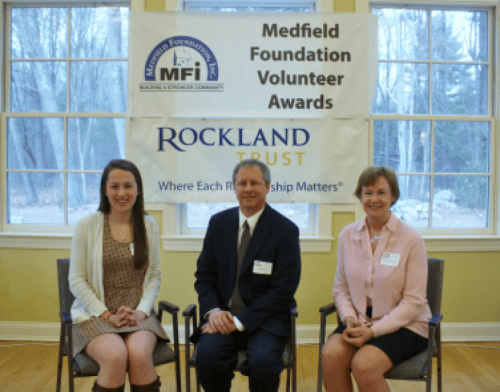
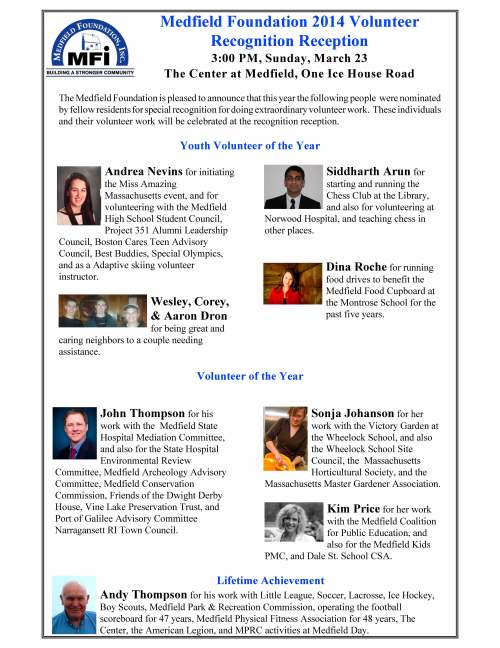
  • Chris McCue Potts was the 2015 Volunteer of the Year for her work with the Medfield Music Association, and also with Zullo Gallery, Medfield Afterschool Program (MAP), Skate Park Committee, Bay Colony Rail Trail Committee, Medfield Cares About Prevention, and the Mfi volunteer awards.
  • Binit Shah was the 2015 Youth Volunteer of the Year for his initiation of the Tech Club at the Medfield Memorial Library, and also for Medfield.TV, MFi Youth Leader program, and Great Strides Cystic Fibrosis Foundation.
  • Jeanne Bastanier Sullivan received a Lifetime Achievement Award for almost three decades volunteering in many roles at the Medfield Food Cupboard, the Church of the Advent, the schools, and the Medfield Animal Shelter.
  • Mike and Caroline Stanley received a 2015 Lifetime Achievement Award for six decades of volunteering for Medfield.  Between the two of them, they have served on the Library Board, Planning Board, Historical Commission, Historical Society, Historic District Commission, Master Plan Implementation Committee, Medfield State Hospital Reuse Committee, Medfield State Hospital Preservation Committee, Town Hall Renovation Committee, Conservation Commission, Open Space Planning Committee, Long Range Planning Committee, Committee to Evaluate Senior Tax Work Off Program, and Zoning Board of Appeals.

Eight Medfield volunteers received recognition in 2015.

The Medfield Foundation, Inc. is a volunteer-run private nonprofit, tax deductible 501(c)(3) corporation created in 2001 to raises private monies for public purposes in the Town of Medfield.  The MFi allows donors to designate their donations for particular purposes.  The MFi also allows motivated groups to raise monies for Medfield purposes under the rubric of the Medfield Foundation.  To date, the MFi has raised over $1,800,000.00 for the Town of Medfield and celebrated over one hundred volunteers.

MMA on marijuana law problems

MMA-2

MMA letter to governor and legislative leaders calls for changes to recreational marijuana law

Printer-friendly versionSend by email

His Excellency Charles D. Baker
Governor of the Commonwealth
State House, Boston

The Hon. Robert A. DeLeo
Speaker of the House
State House, Boston

The Hon. Stanley C. Rosenberg
Senate President
State House, Boston

Dear Governor Baker, Speaker DeLeo, and President Rosenberg,

With the passage of Question 4, Massachusetts became one of just eight states that have legalized the recreational use of marijuana. Because of our population and our prime location in the center of a compact geographic region, our state will soon become the commercial marijuana industry’s East Coast base. The growing industry will certainly use Massachusetts as the retail platform for Rhode Island, Connecticut, New York, Vermont and New Hampshire.

Cities and towns have a responsibility to ensure that the new law is implemented locally in a manner that protects the public interest, including addressing public health and public safety concerns, and ensuring that the roll-out does not negatively impact residents, other businesses, neighborhoods, economic development plans, or other important considerations. As such, municipal officials are scrambling to get information and plan their own policy responses. This will be very difficult in the short term, as there are many unanswered questions and many significant flaws in the new law.

It is important to recognize that Question 4 prevailed and the issue of whether to legalize the recreational use of marijuana has been settled. Yet it is also clear that the new law has several significant drafting flaws that require fixing in order to prevent negative outcomes. Just as the Legislature and governor acted in 1981 to amend Proposition 2½ to make it workable, we believe it is both appropriate and necessary for state lawmakers to take action to address the shortcomings in Question 4. Doing so would benefit the public interest and every community.

While there are many smaller details that warrant attention, the major problems that must be fixed are: 1) deadlines that are too short to give state and local officials enough time to prepare for and administer the law; 2) the preemption and loss of local control; 3) the unregulated “home grow” provisions that could foster a new black market for marijuana sales; and 4) the inadequate tax revenues written into the statute.

An Unrealistic Timeline
Question 4 sets an unrealistic deadline, instructing the state to construct the entire regulatory framework for the commercial marijuana industry by January 1, 2018. That is too little time to recruit and appoint a first-ever, three-person Cannabis Control Commission (CCC) and give the rookie commissioners the time to build a brand-new state agency, recruit and hire agency staff, draft initial versions of all regulations, solicit input from all stakeholders, promulgate final regulations, and provide enough lead-time for a rational roll-out that protects the public interest. If the state fails to meet the January 1 deadline, the industry has written Question 4 in such a way that the commercial industry would arise in a mostly unregulated environment, because medical marijuana operators would automatically be licensed as commercial agents for recreational marijuana, giving them a near-monopoly in the marketplace.

We respectfully ask you to act swiftly to extend these deadlines and give the state and municipalities more time to get the regulatory framework in place and adopt reasonable rules to govern this new commercial industry.

In the meantime, we request passage of statutory authority to allow cities and towns to enact a moratorium on new commercial marijuana facilities until the Cannabis Control Commission has promulgated regulations governing the industry. Because the deadline for regulations comes after the CCC is instructed to begin processing applications and licenses for commercial facilities, local governments will begin to see applications for commercial facilities before they know the full extent of the regulations under which those facilities will be operating.

Unwise Preemption of Local Control
A second major concern is the preemption of local control. The new law prevents cities and towns from making local decisions on whether to allow commercial retail sales in their municipalities. Here it is clear that the marijuana industry lobbyists learned a lesson from Colorado, the first state to legalize recreational use. The Colorado law allows local governing bodies to ban retail sales in their communities – and 70 percent of their cities and towns have enacted such a ban. Question 4 makes it impossible for selectmen, mayors, councils or town meetings to make this decision. Instead, communities are only allowed to enact a ban if 10 percent of local residents who voted in the last state election sign a petition to place a question on the ballot, and voters approve the question at a state general election in 2018 or later. This means the earliest that communities can even consider a ban will be nearly a year after commercial sales become legal – it is hard to imagine that this industry-friendly loophole was unintentional.

Further, Question 4 includes language that would allow the CCC to preempt or disallow any local zoning rule, ordinance or regulation that is inconsistent with their wishes – a concern made even more serious because the “advisory board” in the law is actually a pro-industry panel dominated by commercial marijuana interests.

We respectfully ask you to act swiftly to restore decision-making authority to municipal governing bodies on the question of commercial bans, and clarify that the CCC cannot override local zoning decisions and ordinances on the location and operation of locally permitted commercial facilities, including recreational marijuana. The broad preemption language must be eliminated.

An Unregulated Non-Commercial Market
Starting on December 15, the home cultivation of marijuana will be allowed through a totally unregulated “home grow” provision, which will allow individuals to cultivate up to 12 plants at any one time. Calculating the street value, that’s $60,000 worth of marijuana, and based on reasonable processing estimates, the 12 plants could yield approximately 12,000 joints, or thousands of “servings” of marijuana-infused edibles.

Local and state law enforcement officials are gravely concerned about the home grow language in the new law. The sheer volume of home grown marijuana will certainly incentivize a burgeoning black market that will hit the street at least a year before official, regulated commercial sales become lawful, creating a source of sales that could easily reach school-aged children and teenagers.

We respectfully ask you to delay the home grow provisions, and develop a structure to appropriately regulate and monitor this activity to safeguard public safety and health, and protect neighborhoods, residents and youth.

Inadequate Revenues
Another major concern is the rock-bottom excise revenue that would be generated by Question 4, where it is again clear that the marijuana industry learned a lesson from earlier experiences in Colorado and Washington state. In addition to state sales taxes, the Colorado law imposes a 25 percent tax on marijuana, and cities and towns can enact their own local sales taxes of up to 8 percent. The state of Washington imposes a 37 percent excise tax, and cities and towns can collect their own local sales tax of up to 3.4 percent.

Here in Massachusetts, the commercial interests behind Question 4 set the state marijuana excise tax at just 3.75 percent, and capped the local-option marijuana excise tax at only 2 percent. These would be the lowest rates in the nation.

Given the significant new burden of regulating and monitoring a new commercial industry (which will deal in a controlled substance that is still illegal under federal law), the state and local revenue rates are unreasonably low and damaging to public budgets. The state excise will clearly fall short, and we urge you to increase the state tax so that, at a minimum, resources will be available to provide statewide training of police officers and fund the CCC and other state agency needs. Further, cities and towns will have new responsibilities in areas of public safety, public health, zoning, permitting and licensing. At 2 percent, the local revenue in Question 4 will fall far short of local needs.

We respectfully ask you to increase the allowable state and local tax rates to bring them in line with Colorado and Washington and other “first-wave” legalization states. We recommend that cities and towns be authorized to implement, on a local-option basis, an excise of between 2 to 6 percent, to be determined by vote of the local governing body.

An Independent Advisory Board is Necessary
We urge you to improve the makeup of the Cannabis Advisory Board to make it a truly independent entity, instead of the industry-dominated panel that it is under Question 4. It is striking that the ballot question was written to give commercial marijuana interests control of a board that will be so heavily involved in regulating the industry. We respectfully ask that a municipal representative be added to the board, as well as a representative from municipal police chiefs and a seat representing local boards of health. We believe the addition of these perspectives is vital to ensure that local public safety and health concerns are considered when crafting the regulations.

Summary
Cities and towns have a responsibility to implement the new law in a manner that protects the public interest, yet communities will not be able to fulfill this responsibility unless the significant flaws detailed in this letter are addressed. Just as the Legislature and governor acted in 1981 to amend Proposition 2½ to make it workable, we respectfully ask the Commonwealth to take action to address the shortcomings in Question 4. Doing so would benefit the public interest and every community.
Thank you very much for your consideration. If you have any questions or wish to receive additional information, please do not hesitate to have your offices contact me or MMA Legislative Director John Robertson at (617) 426-7272 at any time.

Sincerely,

Geoffrey C. Beckwith
MMA Executive Director & CEO

NFL legal news

This today from my American Association for Justice update.  Interestingly the real problem, CTE is not covered, because it can only be diagnosed after death. That analysis may generate a new field, post-mortem litigation planning, to follow the already existing legal area of post-mortem estate planning.  Soon our after lives will be so scheduled that we will be marveling at how we ever had time to get things done while we were alive. –

AAJ-2

Supreme Court declines to review settlement between NFL and retired players.

USA Today (12/12, Perez, 5.28M) reports the Supreme Court declined to review a settlement reached between the NFL and retired NFL players, which will “allow payments to be made to those covered in a deal first reached more than three years ago.” Under the settlement, the “NFL agreed to cover more than 20,000 retired players at a cost that could surpass $1 billion in a reworked settlement approved by a federal judge in April 2015.”

The AP (12/12, Golen) reports Christopher Seeger, one of the attorneys representing the retired NFL players, said, “This decision means that, finally, retired NFL players will receive much-needed care and support for the serious neurocognitive injuries they are facing.” Under the settlement, players suffering from some neurological conditions are eligible to receive millions of dollars, but the average payment for the players is expected to be around $190,000.

Reuters (12/12, Hurley) reports some have criticized the settlement for not awarding payments to players suffering from CTE, which has been linked to concussions.

The New York Daily News (12/12, Red, 4.45M) reports the class-action lawsuit that preceded the settlement claimed the NFL covered up its knowledge of the long-term dangers “caused by football-related head injuries.”

Additional coverage is provided by: the Los Angeles Times (12/12, Fenno, 4.52M), NPR (12/12, Hersher, 1.92M), and the Washington Examiner (12/12, Weaver, 400K).

Lowell Mason challenge

LMH Hi Res Logo.jpg

Lowell Mason House donations to double via $25,000 Challenge Grant


MEDFIELD, MA—Lowell Mason House President Thomas Reynolds and Treasurer Thomas Scotti announced today that the non-profit received a $25,000 challenge grant from an anonymous donor that  will match dollar-for-dollar all donations made from Nov. 15, 2016 to Feb. 1, 2017, doubling the impact of contributions.


“The Lowell Mason House has been making tremendous progress with construction getting the house available for music students of all ages –all of which has been made possible by our loyal supporters,” said Reynolds. “Whether through time or dollars, the generosity of Lowell Mason House supporters is bringing us closer to preserving Lowell Mason’s birthplace and transforming it into an active space for music making. We are grateful to our anonymous donor for investing in a way that encourages both current and new donors to help preserve Lowell Mason’s Medfield legacy.” Scotti explained that the  next phase of construction will encompass installing new windows, exterior doors and re-side the entire house, at an estimated cost of about $50,000.


To make a tax-deductible donation, checks can be made payable to the Lowell Mason House and mailed to PO Box 913, Medfield, MA 02052.  Donations can also be made online at www.lowellmasonhouse.org.  “Thanks to the match, donors large and small will allow us to proceed with the next round of construction and then move forward more quickly on the interior of the house.”


Lowell Mason was born in Medfield in 1792, and is considered the Father of Music Education in America due his efforts in teaching both students and teachers of music. In 1838, he became  the first music superintendent in the Boston public schools, and was instrumental in making music a part of the regular school curriculum in America.


Through the work of a team of volunteers, the Lowell Mason House was saved from demolition in 2011 and moved from its original location on Adams Street.


“We’re one step closer to making the House  a major cultural hub in Medfield where it will serve as a living museum that not only honors the father of music education, but also provides practice and performance space to further encourage artistic expression, and strengthen the value of the arts in the community,” noted Reynolds. For more information, please contact either Tom Reynolds at treynold@worldpath.net or Tom Scotti at tscotti@lowellmasonhouse.org.

Affordable housing doings

affordable-housing

The Town of Medfield is currently actively engaged in trying to meet its affordable housing needs, one benefit of which will be to preclude developers from forcing unfriendly 40B developments onto the town.

To be protected from such unfriendly 40B’s, the town needs 10% of its housing to be affordable units (Subsidized Housing Inventory, or SHI) as defined by the Department of Housing and Community Development (DHCD).  We are currently at about 7% and need about 150 additional SHI units to be over 10%.  Where the Town of Medfield is not yet at the 10% threshold, to be protected from unfriendly 40B developments int he interim, the town must have a Housing Production Plan (we recently adopted one first proposed about five years ago, which was subsequently approved by DHCD last month), and actually be constructing 21 units of SHI per year.

The Zoning Board of Appeals is currently hearing an application from the Larkin Brothers to build a 40B on Hospital Road consisting of 48 units of single family home condos, 12 of which were to be affordable units, and the remainder market rate units.  At the town’s request,  the Larkins have agreed to amend the project to add one extra affordable unit, so that it will be 49 total units, with 13 affordable units.

Additionally, Bob Borrelli had been permitting the Jacob Cushman house on North Street, across from my office, that he bought from Montrose School for commercial and retail on the first two floors, with two apartments on the third floor, but approached the town about changing the project to be eight rental units under a Local Initiative Program (LIP), with two affordable units.  The Board of Selectmen voted last week to approve that LIP.  Where the LIP is a rental project, under 40B rules, the entire eight units count as affordable (SHI) units.

Thus, the town currently has 21 SHI units in development, which if they get permitted before any other 40B proposal applies to the ZBA for a comprehensive permit, would allow the ZBA to safely decline to approve any 40B applications for the year following the approval of the 21 SHI units.  At the moment, there is somewhat of a race going on between the Mega-B process and the two other 40B projects noted above – if the latter two are permitted first by the ZBA before the Mega-B can apply to the ZBA, then the town will have a one year safe harbor, and the ZBA can say “no” to the Mega-B.

Additionally, I have been meeting and working with Riverside Community Care and The Price Center to see if we could get some group homes built in town, as group homes for disable individuals has the advantage of providing one SHI for each bed, such that a group home for four people gives the town credit for four SHI units..

With that background in mind, Mike Sullivan circulated an email late last week about the status of the Borrelli LIP and the hearing postponement requested by the Larkins.


Kristine Trierweiler has hired a company to do the marketing on Borrelli’s North St. project. She said it would take about two weeks, once they get started. She has been trying to reach Atty Murphy to go over what else Borelli has to do the complete the application to DHCD for a LIP project and will keep trying.

I spoke to the Larkins last night and they said they would have everything ready for the ZBA continued hearing in January. They also told me that the had asked the ZBA for an additional affordable unit and the ZBA was supportive.

Mark Cerel called and said that he had received a response to the neighbors’ appeal of the Conservation Commission’s decision on the Dale St. land. It was from an Attorney Peter Freeman of the Freeman Law Group.

Will update you as more information is available. Mike S

My newsletter

Having trouble viewing this email? Click here to view newsletter online +SUBSCRIBE
December 2016
Associate Photo
Osler “Pete” Peterson
617-969-1500 – Newton
508-359-9190 – Medfield
Dear Subscriber,In keeping with the December spirit of reflection, we reviewed a year’s worth of headlines for a list of the top safety and justice stories from 2016. Progress was made, but there are still many challenges ahead. Thanks for supporting civil justice!

Information that makes us safer
These newsletters are based on a simple idea – the more each one of us knows, the better off each us will be. Each newsletter focuses on a topic that relates to the health, wellness, and safety of each of us, our families, and our friends. I hope that you will find the information both interesting and informative, and that each month you can take away at least some nugget, that can make you or your family more secure.

Remember, the safer you remain, the less likely is that you will need the courts, as legal claims are generally only needed when proper safety measures were missing.

Pete

U.S. Civil Justice: The Gift That Keeps on Giving

2016 Top Safety and Justice Stories

It was a busy year for those who fight for the health, safety and legal rights of all Americans. Here are some of the top stories we were watching in 2016:

Forced Arbitration Two St. Jude Medical defibrillators recalled due to battery defects.

1> Faulty Medical Devices: Recalls Double
According the the FDA, medical device recalls doubled from 2003 to 2012, and new data shows that the numbers keep climbing. While the FDA approves medical devices before release, they do not do any testing and instead rely on the manufacturers to provide accurate and comprehensive testing data.

Two examples of faulty medical devices now on the market include the Essure birth control coil and the St. Jude defibrillator. The FDA has received over 10,000 complaints from women suffering painful side effects due to the Essure birth control device. Countless lawsuits against Essure’s manufacturer, Bayer, have sprung up across the country. Rep. Mike Fitzpatrick (R-PA) has since introduced a bill to pull Essure off the market. Meanwhile, more than 400,000 defibrillation devices made by St. Jude medical were the subject of a recent recall due to a faulty battery. To learn more about medical device recalls, click here.

2> Forced Arbitration: Sign a Contract, Lose Your Rights
There’s always a holiday gift year that’s a dud. Maybe you’ve received an ugly sweater three times too big, or a candle that smells so terrible it gives you a headache. Unfortunately, many corporations are now giving you those ugly sweaters (and forcing you to wear them), hiding “forced arbitration” clauses in consumer and employment contracts.

This loophole prohibits Americans from taking companies to court and instead forces them into secretive arbitrations, which are typically stacked in favor of the company. An investigation by The New York Times has focused renewed scrutiny on the harm caused by forced arbitrations in claims of medical malpractice, sexual harassment, hate crimes, discrimination, theft, fraud, elder abuse and wrongful death. You can join others in petitioning Congress to ban forced arbitration right here.

Exploding AirbagLead found in the Flint water supply has poisoned thousands, including 27,000 children.

3> Flint, Michigan: Lead In Water Sickens Thousands
Residents of Flint, Michigan were exposed to dangerous levels of lead in their drinking water ever since a decision was made to switch the source of the city water supply from Lake Huron to the Flint River.

Dr. Mona Hanna-Attisha, a young pediatrician known affectionately in Flint as Dr. Mona, discovered the problem when she noted an increase in the symptoms of lead poisoning in her young patients. Knowing that it was her moral and ethical duty to share her discovery with the public as soon as possible, Dr. Mona held a press conference. Michigan officials and lawmakers denounced her findings at first, only to relent when Dr. Mona wouldn’t back down. Dr. Mona continues to lead the recovery efforts today.

Nursing Home AbuseHead injuries in the NFL are down 25 percent since the concussion lawsuit.

4> Concussions and Brain Disease: NFL Settles Lawsuit
If you’re a movie fan, you probably saw the film Concussion, starring Will Smith. This movie is based on the true story of Dr. Bennet Omalu and his discovery of chronic traumatic encephalopathy in NFL football players. CTE is a disease of the brain tissue and is caused by repetitive brain trauma. CTE is associated with dementia, aggression, memory loss and depression.

Subsequent research has prompted athletic organizations to make concussion prevention and recovery a priority. This includes many “When in Doubt, Sit Them Out” laws, which mandate that any youth athlete suspected of suffering a concussion be cleared by a medical professional before returning to practice or competition. Earlier this year an appeals court upheld a settlement by the NFL with former players, setting aside almost $1 billion for medical care due to repeated head trauma. Since this lawsuit, head injuries have decreased for NFL athletes.

5> Asbestos: Still a Widespread Hazard
Asbestos may seem like a thing of the past, but any building built in the United States before 1981 is presumed to contain asbestos. And in fact, asbestos-related diseases still kill about 15,000 Americans a year. Even though asbestos is known to be extremely dangerous, the substance has not been banned in the United States. President Obama recently signed the Frank R. Lautenberg Chemical Safety for the 21st Century Act, a bipartisan bill that strengthens ways to regulate and restrict chemical substances. Because of this bill, the EPA can officially work to ban asbestos in the U.S.

SamsungOver 1 million Samsung Galaxy 7 phones have been recalled due to defective and explosive batteries.

6> Exploding Devices: Faulty Lithium-Ion Batteries
From e-cigarettes to hoverboards to smartphones, reports continue of everyday devices posing an unsafe explosion hazard. The culprit is lithium-ion batteries, which include unstable and flammable liquids. When improperly made devices include these batteries, the liquid can overheat and burst through the battery, igniting the device itself. These explosions have caused burns as well as property damage from subsequent fires. The Consumer Product Safety Commission (CPSC) recently issued a recall of all one million Samsung Galaxy 7 phones, including replacement models thought to fix the problem.

7> Prescription Drug Addiction: A National Epidemic
Prescription opiate deaths have quadrupled since 1999, killing an estimated 165,000 Americans. During the same time period, profits recorded by the drug companies that manufacture prescription painkillers have also skyrocketed. Meanwhile, a coalition of opioid manufactueres and their lobbyists have fought legislative measures introduced to stem the tide of overdose deaths.

8> Dangerous Toys: Still On Store Shelves
Nearly 260,000 kids visit emergency rooms each year for toy-related injuries, according to the CPSC. And sadly, 11 children under the age of 12 died while playing with toys in 2014. The most common injuries include poisoning, choking, ingesting magnets or falling from riding toys. While regulators, safety advocates and the parents of injured children have succeeded in ridding store shelves of many unsafe toys, too many still get through. Learn more.

What Concerns You the Most?

Browse the 2016 top safety and justice issues, and then tell us which one keeps you up at night. You could win an iPod shuffle for participating.

Add your thoughts here

Forced Arbitration: The Threat Continues

Forced arbitration continues to threaten the safety and legal rights of all Americans. Tia shares her story of sexual harassment and Circuit City.

Listen now

You Should Know is a copyrighted publication of Voice2News, LLC, and is made possible by the attorney shown above. This newsletter is intended for the interest of past and present clients and other friends of this lawyer. It is not intended as a substitute for specific legal advice. If you no longer wish to receive these emails, click here to unsubscribe from this newsletter, and your request will be honored immediately. You may also submit your request in writing to: Steven L. Miller, Editor, 4907 Woodland Ave., Des Moines, IA 50312. Be sure to include your email address.
Click here to unsubscribe from this newsletter.

Angel Run funds relief to families in need

Medfield Youth Outreach and Pastor Phil of the UCC explained why the Medfield Foundation’s Angel Run has become so important to Medfield families in need – this was MYO and Pastor Phil’s letter to the editor before the race –

angel-run-2016

Medfield Youth Outreach urges residents to participate in the 2016 Angel Run! Whether through running the race or the many facets of volunteer help needed, your participation makes a difference.  What other event in town so seamlessly builds community? The MFI took the Angel Run on in 2012 as they saw a community event that was slated to end, that met a critical need for residents.  The majority of the proceeds from the Angel Run serve residents who have come upon hard times.

The Angel Run is so much more than just a 5K race.  It is a joyous event that fills so many community needs. Whether finding an opportunity to give back and volunteer, running a race that builds one’s running statistics, or enjoying a family fun event close to the holidays, participants may be unaware that this is just the beginning of how this race blesses members of the community. From its inception, a large portion of the race’s proceeds have met the needs of residents who have hit hard times through the Angel Run Fund.   All of this is done confidentially through Medfield Youth Outreach (MYO) and in partnership with Pastor Phil and the staff of The United Church of Christ in Medfield.  While MYO provides the screening for the Angel Run Fund requests, the UCC-Medfield distributes the funds and provides as a secondary screening source for accountability purposes.  MYO is uniquely poised to field the requests for financial assistance, and form ongoing relationships with residents, through their requests, opening them up to additional services and supports that benefit their home and family. The following is a few examples of how the funds raised by the race benefitted residents over the past year.  The stories have been altered to preserve confidentiality.

Merry Jo contacted the MYO office in late February.  She could not pay her whole rent as so much of her income had been going to afford the child care that helps her sustain her job. “When my husband left, I went back to work.  It has been impossible to find a job that pays as well as my job did before I left the workforce to raise my children. The costs of child care, my rent, utilities, and car expenses often surpass what I am bringing home.  My kids have been through so much. They have lost their house, moved to an apartment and are grieving the loss of the breakdown of my marriage. I had to use part of my rent money to cover a car repair.  I was issued a letter that the land lord will take me to court if I can’t pay my rent in full soon.”  The Angel Run Fund stepped in to cover the portion of missing rent.  MYO then met with Merry Jo to apply for fuel assistance, food resources, and child care resources that took some of the financial pressure off of the family. A thank you letter appeared a few weeks later: “Dear Angels, You all have no idea what the rental help meant to me.  Beyond helping me and my kids keep our apartment, I felt less alone for the first time in a very long while. I feel like things might actually get better. Thank you again and again…thank you.”

The Hardees are long term Medfield residents.  Both parents were employed and the family enjoyed a comfortable middle class life.  When Mrs. Hardee got sick, she eventually had to leave her job.  The care -giving demands placed on her husband forced him to step down from his job and take a lower paying position with less responsibility.  The family was barely making ends meet when they came to MYO for help.  They had amassed a large utility bill, that during the winter could not be shut off, but as spring arrived came the new shut off threats from the utility company. The stress from the fear of shut off was too much for Mr. Hardee to carry.  “I am humbled.  I never thought this could happen to us.  We were just one illness away from practically losing everything. Between the medical bills, less income, and so many demands on our income as the kids get older…I never owed anybody anything and now I can’t pay for my utilities and my credit cards are to the max!” MYO reached out to Pastor Phil at UCC with an Angel Run Fund Request toward the Hardee’s utility bill.  The request was met in full so that the family could divert its resources elsewhere. MYO then referred the family to Medfield Angels/Neighbor Brigade to provide meals for the family during the medical crisis and sports organizations to help with scholarships for the children.  Through the Angel Run Fund’s giving significant stress was reduced for this family.

The Angel Run keeps our most vulnerable residents connected to the community and reminds them that even though times are tough, they still are valuable and thought of.  Be a part of bringing this joy to the community, both through the run this December 4th, and through the year via the Angel Run Fund.

Wishing you and yours a blessed holiday season,

Dawn Alcott, LICSW, Director, Medfield Youth Outreach

Pastor Phil Bauman, United Church of Christ Medfield