Category Archives: Financial

State explains Gov’s first budget

This came today in my e-newletter from the Division of Local Services (DLS) at the Massachusetts Department of Revenue to explain what the Gov’s administration thinks are the highlights of her first budget.

Partnering with our Cities and Towns – FY24 Funding Updates
Secretary Matthew J. Gorzkowicz – Executive Office for Administration & Finance

FY24 Budget

On Wednesday, August 9, Governor Healey signed the FY24 budget, representing $55.98 billion in historic investments in schools, child care, workforce development, public transit, housing, climate resiliency and other key areas that will help make Massachusetts more affordable, competitive, and equitable.

In collaboration with our partners in the Legislature, the budget includes hallmark proposals from Governor Healey, including making community college free for students aged 25 and older through MassReconnect, expanding Commonwealth Cares for Children (C3) grants for early education and care providers, increasing funding for Early College, Innovation Career Pathways, apprenticeships and other workforce development programs, and dedicating 1 percent of the budget to energy and the environment for the first time.

Through the FY24 budget, the Healey-Driscoll Administration is reaffirming our commitment to the state’s partnership with cities and towns, making historic investments in Chapter 70 school aid, unrestricted government aid, and student transportation. This spending plan fully funds another year of the Student Opportunity Act and dedicates resources to help cities and towns redevelop and revitalize their downtowns.

In total, cherry sheet aid to municipalities across the Commonwealth is increasing $648 million, or 8.4%, over FY23, totaling $8.37 billion.

With this being the administration’s first budget, we are excited to share some of the details on our support for cities and towns.

Unrestricted General Government Aid (UGGA)

A cornerstone of the administration’s commitment to partnering with municipalities is the expansion of Unrestricted General Government Aid, supporting essential local government services, including public safety, public works, and economic development. In FY24, UGGA is increasing by $39 million, or 3.2%, over FY23, totaling $1.27 billion.

Education: Fully Funding the Student Opportunity Act

The administration is focused on ensuring that all students have access to a high-quality public education. In FY24, Chapter 70 aid is increasing by $594 million, or 9.9%, over FY23, totaling $6.59 billion. This represents full funding of the Student Opportunity Act, the largest nominal increase in the history of the program, and the largest percentage increase in more than two decades.

The budget also funds major increases in school transportation reimbursement ($21.3 million, 20%) and rural school aid ($9.5 million, 173%). It includes full funding for Special Education Circuit Breaker.

FY24 also includes funding to make universal school meals permanent, ensuring every student across the Commonwealth has access to healthy nutrition during the school day.

For school buildings, the FY24 budget includes $50 million for the new Green School Works program, providing grants to school districts for clean energy infrastructure, $100 million in supplemental grants to mitigate cost increases at school construction projects previously funded by the MSBA and an increase in the MSBA’s statutory cap to $1.2 billion.

Municipal Partnerships

The FY24 budget also includes funding for critical partnership programs between municipalities and the state. Some examples include: Increasing payments in lieu of taxes (PILOT) for state-owned land by $6.5 M (14%).
  Increasing funding for public libraries by $3.8 million (12%).
  $100 million in supplemental aid for municipal road and bridges, funded by Fair Share surtax revenues.
  $16.3 million in funding for the Municipal Regionalization and Efficiencies Incentive Reserve, which funds programs including the Community Compact’s Best Practice ($2.1 million) and Efficiency and Regionalization Grant ($600,000) programs.
  $600,000 for the Massachusetts Downtown Initiative for municipalities looking to revitalize their downtowns. FY24-FY28 Capital Investment Plan

On June 22, the Healey-Driscoll Administration released its first five-year Capital Investment Plan (CIP), outlining more than $14 billion in investments over five years to build a more affordable, competitive, and equitable future for Massachusetts.

The investments in the FY24-FY28 CIP complement and build on the funding proposed in the administration’s inaugural operating budget, with a particular emphasis on advancing climate, economic development, and housing goals – including the creation of a new $97 million HousingWorks program.

For municipalities, the CIP includes significant funding for transportation, economic development, climate initiatives, technology infrastructure, and more.

Transportation

FY24 investments in transportation infrastructure across our cities and towns include: $200 million for Chapter 90 local transportation projects
  $25 million for the Municipal Pavement Program
  $15 million for the Municipal Small Bridge Program
  $15 million for the Complete Streets Program
  $8.5 million for the Shared Streets and Spaces Program
  $6 million for the Local Bottleneck Reduction Program Economic Development

The Healey-Driscoll Administration is committed to working with local leaders to build vibrant communities, revitalize downtowns, and create economic opportunity for all Massachusetts residents. In FY24, investments through the CIP include: $96 million for MassWorks infrastructure grants
  $16.6 million for Revitalizing Underutilized Properties
  $5 million for the Rural and Small Town Development Fund Climate

Withstanding the climate crisis and protecting our environment requires a strong partnership between the state and local communities. The FY24 CIP continues investments in EEA’s programs that support communities as they plan for the future, including: $41.2 million for the Clean Water Trust Revolving Fund
  $23.7 million for the Municipal Vulnerability Program (MVP)
  $21 million for Community Investment Grants
  $12 million for Inland Dams and Seawalls
  $10 million for MassTrails grants to municipalities Technology

Ensuring that all municipalities have the necessary technological infrastructure is critical for growth throughout Massachusetts. The FY24 CIP invests: $6.5 million for the Broadband Middle Mile Program
  $5 million for the Community Compact Municipal Fiber Grant Program
  $5 million for Community Compact Information Technology Grants
  $1 million for the Broadband Last Mile Program Other Municipal Funding $25 million for Library Construction Grants
  $10 million for Cultural Facilities Fund Grants
  $4 million for Municipal ADA Improvement Grants
  $1.6 million for Historic Preservation Grants We remain committed to working with our municipal partners in support of your efforts to make our Commonwealth stronger for all. Thank you for your dedication and hard work!

For more information on the FY24 budget, please visit www.mass.gov/gaa.

For more information on the FY24-FY28 Capital Investment Plan, please visit www.mass.gov/capital.   Register Today for the 2023 “What’s New in Municipal Law” Seminars

The Division of Local Services Municipal Finance Law Bureau will offer its annual “What’s New in Municipal Law” seminars for local officials on Thursday, September 21, 2023 at the Bentley University Conference Center in Waltham and Thursday, September 28, 2023 at the Log Cabin Banquet & Meeting House in Holyoke. The seminars will be held in-person and run from 9am to 3pm.

The registration fee is $100. Payment must be received by Friday, September 15th. Event check-in opens at 8:15am. Lunch will be provided.

To view the registration form, please click here. Any questions regarding the seminars should be directed to dlsregistration@dor.state.ma.us.   Highly Recommended: Formal Financial Policies

The DLS Financial Management Resource Bureau (FMRB) provides tailored consultative services to municipalities across the state. Articles in this series highlight a particular financial management best practice that we frequently recommend.

The adoption of formal financial policies is a best practice that serves many important purposes. Among the most crucial of these is the directive guidance that fiscally prudent policies provide for achieving sound, long-term budgeting practices. Along with a capital improvement plan and long-range forecast, financial policies constitute one of the three key tools that DLS encourages all communities to employ to shape the development of annual budgets that are balanced and sustainable into the future.


At a basic level, a policy constitutes a high-level plan for achieving certain goals within a defined topic area. In municipal government, financial policies can be divided into two broad categories. Fiscal planning policies present a roadmap to guide short- and long-term budget decisions. When they are well-reasoned, such policies help mitigate the risk of developing any structural imbalances while also providing a framework for sustaining and enhancing services. As the other category, financial operations policies promote accountability and enhanced coordination of services by defining procedural objectives and the related responsibilities assigned to applicable municipal officials and employees.

Financial policies should be understood as a foundational component of the government’s larger system of internal controls and are themselves a form of internal control of the directive variety. It is because of this vital function that credit rating agencies such as Moody’s and Standard & Poor’s look favorably upon the presence of strong formalized policies when determining a community’s bond rating, which has a significant impact on the cost of borrowing.

The effort to research, discuss, write, review, and finally adopt policies can seem a daunting task. As a result, many communities, especially smaller towns, have only informal and often unwritten guidelines that might only be passed along in an ad hoc fashion as local officeholders enter and leave municipal service. Such municipalities have a more tenuous hold on institutional knowledge and are also liable to be relatively myopic or disjointed in the pursuit of their goals. Hence, a prime objective for adopting formal, written policies is to serve as an educational tool that can foster long-term consistency and continuity in operational and budgeting practices.

Furthermore, enhanced transparency in fiscal governance can be achieved through policy adoption, and we encourage cities and towns to incorporate fiscal policy text into their budget documents and presentations. While remaining more flexible and easier to modify than bylaws and ordinances, policies should provide instructive guidance to steer officials and employees toward objectives. To assure effectiveness, city and town officials must be thoughtful and proactive in promoting policy awareness within the organization. We also recommend communities to periodically review and revise their policies to address evolving goals and circumstances.

From the financial management reviews and other municipal project work that FMRB has done over the years, the bureau has identified a minimum set of core policies we believe every city or town should adopt to manage the most significant areas of budgetary and operational risk. These are listed in the table below.


FMRB has drafted 30+ policy manuals for cities and towns, each of which incorporates the above topics, as well as others desired by the client community. Any municipality that is conducting research to create or revise a policy manual may access them here.
 

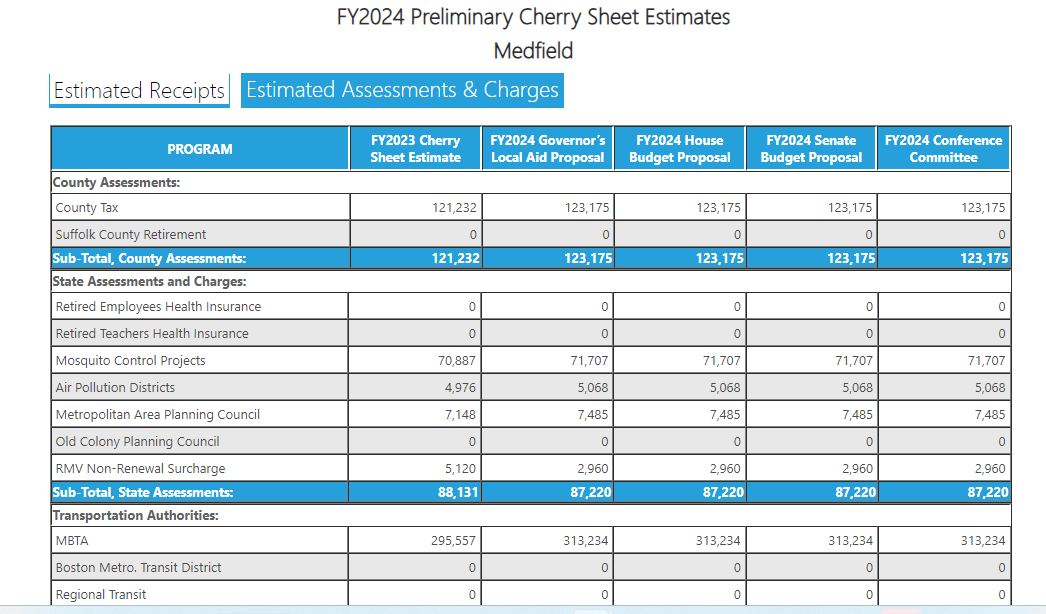
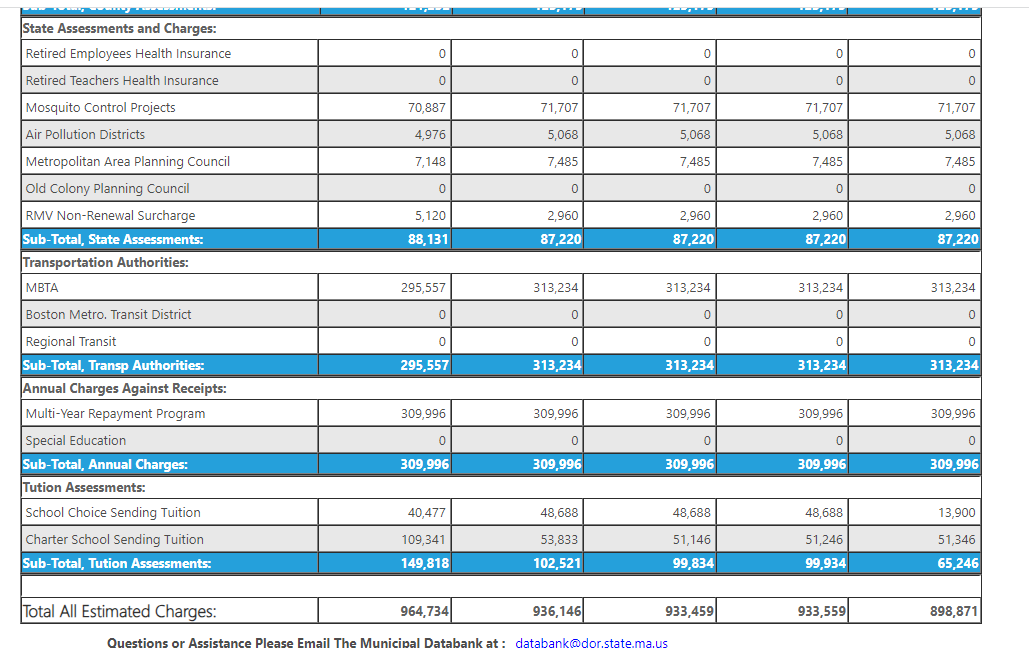
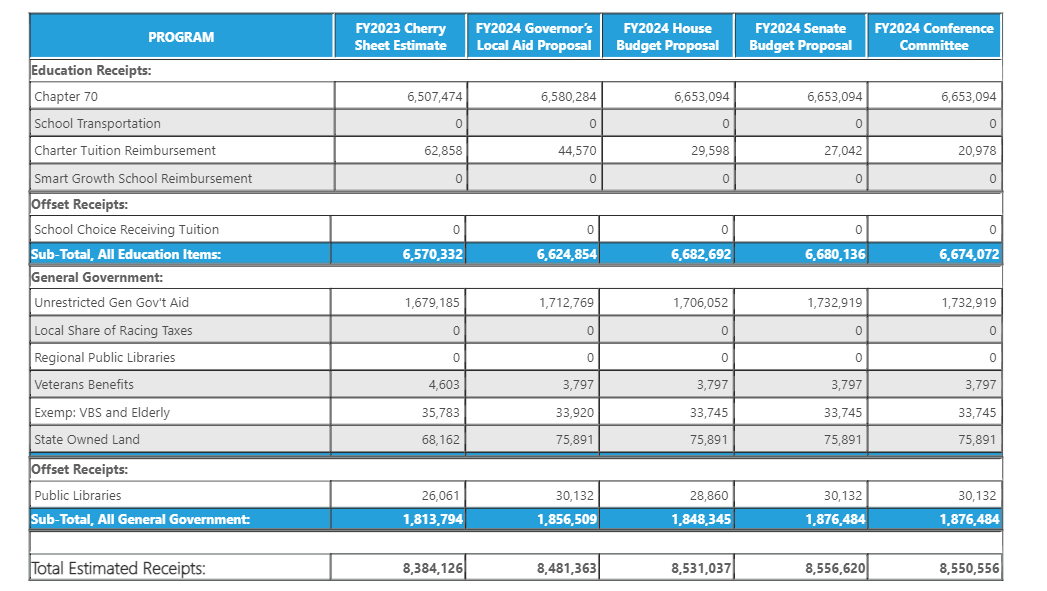
State updated our FY24 aid by $2K

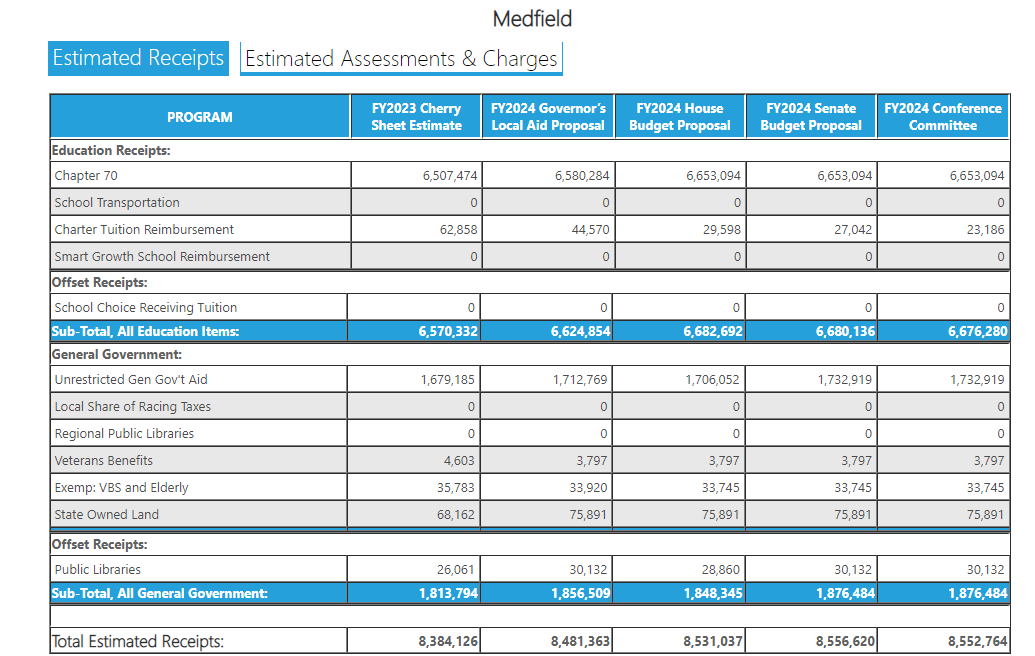
Revised cherry sheet figures today on the Town of Medfield state aid:

State aid to Medfield up $166K (2%)

The state budget was finally agreed upon by the legislature this week (a month into the fiscal year and long after the town had to set its own budgets at the annual town meeting (ATM) at the beginning of May).

The following are the Town of Medfield state aid amounts for FY24 that were just released – our state aid is $8,550,556, up $166,430 over FY23 (the last fiscal year):

FY23 Budget

Email this afternoon from Town Administrator, Kristine Trierweiler –

We have submitted the FY2023 budget to GFOA  (Government Finance Officers Association) today seeking a distinguished budget award. The document has also been posted on the Town’s website:

https://www.town.medfield.net/DocumentCenter/View/6594/Medfield-FY2023-Annual-Budget

Kristine Trierweiler Town Administrator

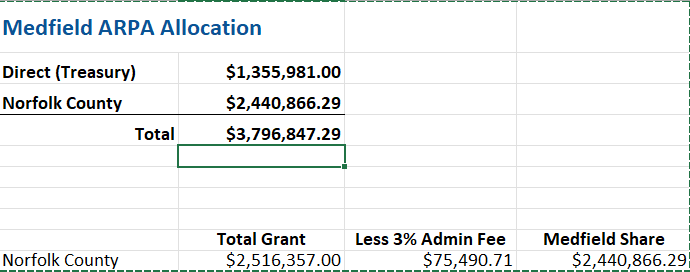
Medfield’s ARPA Allocation = $3.796m.

Medfield ARPA Allocation 

Direct (Treasury) $1,355,981.00 

Norfolk County $2,440,866.29 

                 Total $3,796,847.29 

                          Total Grant          Less 3% Admin Fee        Medfield Share 

Norfolk County $2,516,357.00     $75,490.71                       $2,440,866.29

Gov signs budget – town looks to get $267K more this year from state

See the town Cherry Sheet for FY2023 here – https://dlsgateway.dor.state.ma.us/reports/rdPage.aspx?rdReport=CherrySheets.CSbyProgMunis.MuniBudgFinal

FY2022 we got $8,116,943 from the state

FY2023 we will get $8,384,126, or $267,183 more (a 3.2% increase).

This alert below came this afternoon from the Massachusetts Municipal Association –

Governor Signs FY23 Budget  

Supports Key Municipal Aid and School Funding   

And Offers Amendment to Important Retiree COLA Language   

Please Thank Your Legislators and Ask Them to Accept  the Governor’s Amended COLA Language  
July 28, 2022  

Dear Osler L. Peterson,  

This morning, Governor Baker signed a $52.7 billion budget, including each of the increases in municipal and school aid accounts for which the MMA has prioritized throughout the process.   

The Governor also signed 153 of 194 of the outside sections of the budget and has returned a key section with an amendment for the Legislature’s consideration.   

As enacted by the Legislature, Outside Section 134 would allow retirement boards that have accepted Section 103 of Chapter 32 to award a cost-of-living-adjustment of up to 5% to retirees, rather than the current limit of up to 3%.   

In response to concerns voiced by the MMA, specifically related to the lack of decision-making authority on a potentially large expense for municipal budgets, the Governor returned this section with amended language (for the full language, see Attachment S, Returned with Amendments, Section 134). The amended language provides that if a local or regional retirement board chooses to adopt this provision, municipalities would have the authority to accept or reject its decision. There is further clarifying language regarding situations that involve a county retirement board with more than one participating municipality. For those regional systems, 2/3rds of the participating municipalities would need to approve the higher COLA. In addition, the Governor’s amended language would provide important clarification that the potential 3-5% increase would apply only on the approved base, not the entire pension. This would eliminate some lack of clarity in the current language. The Governor’s amendments would provide critical municipal oversight for this costly provision.    

The provision now returns to the Legislature, which can accept the Governor’s proposed amendment, insist on its original language, or propose different language. If the Legislature insists on its own language, or proposes different language, the provision would return to the Governor, who would have 10 days to sign or veto the provision. With formal legislative sessions ending on July 31, a veto after that date would kill the provision, an outcome that is unlikely, since the Governor is likely to support a 5% COLA for state retirees.

Please contact your legislators and ask them to accept the Governor’s amendments to Section 134 (via Attachment S).  

Please also be sure to thank your legislators again for the important and significant increases in key accounts for municipal and school funding, all of which were included in the budget signed by the Governor:  

$63 million (5.4%) increase in Unrestricted General Government Aid, for a total of $1.23B, which is $31.5 million more than originally proposed Nearly $6B for Chapter 70 School Aid, Including doubling the increase for minimum aid districts from $30 per pupil to $60 per pupil

$440M for Special Education Circuit Breaker, an increase of $67M from FY22

$5.5M for Rural School Aid

$45M for PILOT for state-owned land, a 29% increase from FY22

$20M transfer from FY22 surplus for the Community Preservation Trust Fund

If you have any questions, please contact MMA Legislative Director Dave Koffman at dkoffman@mma.org or MMA Senior Legislative Analyst Jackie Lavender Bird at jlavenderbird@mma.org.  

Please Call Your Legislators Today to  Thank Them for their Support of Key Local Accounts and Ask Them  to Accept the Governor’s Proposed Language Regarding the Retiree COLA Provision   

Thank You!!
twitter linkedin   Massachusetts Municipal Association 3 Center Plaza Suite 610 Boston, MA 02108 (617) 426-7272 | Email Us | View our website       Unsubscribe from MMA Legislative Alert Emails  
Higher Logic

MMA on state budget – more for Medfield

Email today from the Massachusetts Municipal Association –

LEGISLATURE SET TO APPROVE $52.7B FY23 BUDGET,
WITH MAJOR INVESTMENTS IN MUNICIPAL & SCHOOL AID

• LEGISLATURE’S BUDGET INCREASES UNRESTRICTED GENERAL GOVERNMENT AID BY $63M (5.4%) – A WIN FOR CITIES AND TOWNS!
• INCREASES CHAPTER 70 BY $485.2M ABOVE FY22, FUNDING THE STUDENT OPPORTUNITY ACT ON ITS ORIGINAL (PRE-COVID) SCHEDULE
• DOUBLES NEW FUNDING TO MINIMUM AID DISTRICTS TO $60 PER STUDENT
• INCREASES CHARTER SCHOOL REIMBURSEMENTS BY $89.2M
• INCLUDES $441M TO FUND THE SPECIAL EDUCATION CIRCUIT BREAKER
• ADDS $10M TO PILOT, BRINGING THE PROGRAM TO $45M
• INCLUDES $5.5M FOR RURAL SCHOOL AID
• INCLUDES $82.1M FOR REGIONAL SCHOOL TRANSPORTATION
• ADDS $20M TO STATE’S COMMUNITY PRESERVATION ACT MATCH

OTHER BREAKING NEWS: REMOTE MEETING EXTENSION BILL SIGNED INTO LAW BY LT. GOV. POLITO ON SATURDAY – Cities and towns now retain the option to hold public meetings remotely through March 31, 2023, following the same guidelines that have been in place since the COVID public health emergency was first declared. With Gov. Baker out of state over the weekend, Lt. Gov. Polito (as Acting Governor) signed the bill, which took effect immediately. MMA pushed hard for this extension, and successfully advocated against attempted amendments that would have burdened communities with unfunded mandates.

July 18, 2022

Dear Osler L. Peterson,

Last night, Sunday, July 17, the fiscal 2023 state budget conference committee released H. 5050, the House-Senate compromise budget bill. The House and Senate have scheduled formal sessions for Monday, July 18, and both chambers are expected to pass the measure at that time. The Governor will then have 10 days to approve the spending appropriations and proposed law changes, veto, or return any items with amendments. That will give lawmakers several days to consider overriding any vetoes before formal sessions end on July 31.

Following months of state tax collections exceeding expectations, the $52.7 billion fiscal year 2023 state budget plan reflects an agreement between Senate and House leaders to increase tax collection estimates for fiscal year 2023 by $2.66 billion, with $1.9 billion available for the general budget after statutorily required transfers. As a result, all key local aid accounts received the higher funding levels in areas where the Senate and House needed to resolve differences.

In a major win for cities and towns, the Legislature’s budget bill increases Unrestricted General Government Aid (UGGA) by $63 million (5.4%), a major priority pushed by MMA throughout the budget deliberations. This will double the municipal aid increase originally proposed by the Governor in January. In addition, the budget would also significantly increase Chapter 70 school aid over fiscal year 2022, bringing the total to nearly $6 billion. The budget includes a $67 million increase for Special Education Circuit Breaker, an additional $89 million for Charter School Mitigation payments, and an increase of $10 million for Payments-in-Lieu-of-Taxes for state-owned land (PILOT).

You can find the Chapter 70 and UGGA amounts for your community in Section 3 of H. 5050, beginning on page 302 of the downloadable PDF (see the link below this line).

Click Here for a Link to the Legislature’s Budget

Unrestricted General Government Aid (UGGA)
In a major win for local government, the conference committee report includes $1.23 billion for Unrestricted General Government Aid (line item 1233-2350 and section 3), an increase of $63 million, or 5.4%, over the fiscal 2022 level of funding, which is double the $31.5 million increase originally proposed by the Governor in January. Increasing UGGA has been a key MMA priority throughout the process. With property taxes tightly capped by Proposition 2½, cities and towns rely on state revenue sharing to provide municipal and school services, ensure safe streets and neighborhoods, and maintain vital infrastructure. These services are fundamental to our state’s economic recovery, success and competitiveness. Unrestricted General Government Aid is the revenue sharing program that cities and towns receive to fund essential municipal services.

Chapter 70
The Legislature’s budget would fund Chapter 70 aid at nearly $6 billion, representing a commitment to fund the Student Opportunity Act (SOA) according to the original intended schedule, a solid achievement given the initial disruption caused by COVID’s economic disruption. In addition to keeping the commitment to fund the SOA, the Legislature recognized the challenges facing 135 “minimum aid” districts that would have received only a $30 per student increase over the previous year under the budget filed by the Governor in January. MMA applauds the Legislature for doubling the minimum aid increase to $60 per student.

Special Education Circuit Breaker
H. 5050 provides $441 million for Special Education Circuit Breaker (7061-0012), which reimburses school districts for the high cost of educating students with disabilities. This amount reflects an increase of $67 million over the current fiscal year. The Student Opportunity Act expanded the circuit breaker by including out-of-district transportation, to be phased in over three years. The fiscal 2023 budget reflects years two and three of the schedule in the Student Opportunity Act, achieving full funding one year ahead of schedule.

Charter School Mitigation Payments
To address charter school mitigation payments, H. 5050 includes $243 million for charter school mitigation payments (7061-9010), which represents an increase of $89.2 million over the current fiscal year. This funds the state’s statutory obligation for charter school mitigation payments as outlined in the Student Opportunity Act, pushing the state to phase in the plan by fiscal 2023, a full year ahead of schedule.

School Transportation
The Legislature’s budget level funds regional school transportation at $82.1 million, representing a reimbursement rate of 85% of DESE’s estimated costs for FY23. H. 5050 fully funds the McKinney-Vento account for transportation of homeless students at $22.9 million, and level funds out-of-district vocational transportation at $250,000.

PILOT Funding
Recognizing the importance of Payments-in-Lieu-of-Taxes (PILOT) for state-owned land, H. 5050 increases the line item to $45 million (a $10 million increase over fiscal year 2022). This has been a key priority for many years. Low PILOT funding has created a significant hardship for smaller communities with large amounts of state-owned property, and this 29% increase is very welcome news, and will provide an important boost.

Rural School Aid
Rural School Aid (7061-9813) is funded at $5.5 million in H. 5050, providing rural school assistance to eligible towns and regional school districts. These grants will help schools facing the challenge of declining enrollment to identify ways to form regional school districts or regionalize certain school services to create efficiencies.

Outside Section – Retiree COLA Provision
Section 134 of the budget would allow retirement boards that have accepted Section 103 of Chapter 32 to award a cost-of-living-adjustment of up to 5% to retirees, rather than the current limit of up to 3%. While MMA appreciates the concern driving this provision, we opposed this section due to the potential negative impact on unfunded pension liabilities. Most communities in the state participate in regional pension systems, and do not have direct decision-making authority regarding adoption of a higher COLA. Adoption of a higher COLA, even if limited to one year, would permanently increase the pension obligations for all participating communities, requiring increased annual appropriations to fund the cost. We encourage local officials to contact their retirement boards to discuss the financial implications of adopting a higher COLA for fiscal 2023.

Outside Section – Community Preservation Act
Section 174 of H. 5050 directs the comptroller to transfer $20 million of the fiscal year 2022 budget surplus to the Massachusetts Community Preservation Trust Fund. This provision would increase the state’s match from an estimated 35% to 43%, approximately the same state match percentage as fiscal year 2022. The number of CPA communities has reached 187, and this budget item will benefit cities and towns that have adopted higher local property taxes to address environmental and housing challenges.

THE LEGISLATURE’S BUDGET IS GOOD NEWS FOR CITIES AND TOWNS
Please call your Representatives and Senators and thank them for the important and much-appreciated municipal and school investments that are included in the Legislature’s budget bill. This has been a tumultuous time for state and municipal finances, and the Legislature is advancing a spending plan that invests in communities, which is much appreciated.

If you have any questions or need additional information on any municipal aid priority, please contact MMA Senior Legislative Analyst Jackie Lavender Bird at 617-426-7272 ext. 123 or jlavenderbird@mma.org.

Massachusetts Municipal Association
3 Center Plaza
Suite 610
Boston, MA 02108
(617) 426-7272 | Email Us | View our website

Unsubscribe from MMA Legislative Alert Emails

Cherry sheet budget #s – Senate’s #s yet to come

FY2023 Preliminary Cherry Sheet Estimates
All Municipalities

State budget – Gov.’s version – town share up $96K

From the Massachusetts Municipal Association this afternoon –


GOV. BAKER FILES $48.5 BILLION FY23 SPENDING PLAN
FILES A COMPANION $693M TAX RELIEF BILL
• $31.5M INCREASE IN UNRESTRICTED MUNICIPAL AID (2.7%)
• CH. 70 PLAN WOULD INCREASE FY23 SCHOOL AID BY $485M (8.8%)
• 43% OF SCHOOL DISTRICTS WOULD RECEIVE NEW AID OF ONLY $30/STUDENT
• CHARTER SCHOOL & SPECIAL ED REIMBURSEMENTS INCREASE
• MIXED RESULTS FOR OTHER MUNICIPAL AND SCHOOL ACCOUNTS
 
At 2 p.m. today, Gov. Charlie Baker submitted a $48.5 billion fiscal 2023 state budget plan, House 2, with the Legislature.
 
UNRESTRICTED GENERAL GOVERNMENT AID WOULD INCREASE BY $31.5 MILLION
Gov. Baker’s budget includes a $31.5 million increase in the Unrestricted General Government Aid account, a 2.7% increase over fiscal 2022 levels. As the MMA stated during our Annual Meeting this past weekend, a 2.7% increase is too low, and we will be working with local leaders and lawmakers to advocate for an increase that reflects the actual growth in revenues that the state is receiving. With capped property taxes and inflation running higher than 2.7%, cities and towns need a much higher level of UGGA aid to maintain essential services.
 
The Administration is calculating revenue growth using a methodology that omits a large portion of the record-setting revenue collections that the state has experienced during the past year. This way of benchmarking growth works to the disadvantage of cities and towns, and minimizes revenue sharing amounts. Fiscal 2023 state tax collections will be $2.5 billion higher (7.3%) than the tax base that was used to pass the fiscal 2022 budget last July, and $6.8 billion higher (22%) than the original FY22 projection from a year ago. The Administration is using the highest possible revenue estimate for fiscal 2022 ($35.95 billion, set less than two weeks ago), which would tie UGGA to an artificially low growth projection, even though actual growth will be much higher.
 
Click here to see the Division of Local Services preliminary fiscal 2023 Cherry Sheet aid amounts for your city or town
 
Click here to see the Division of Local Services preliminary fiscal 2023 Cherry Sheet aid amounts for regional school districts
 
OVERALL CHAPTER 70 SCHOOL AID WOULD GO UP BY $485 MILLION, AN 8.8% INCREASE – ALTHOUGH 43% OF DISTRICTS WOUD REMAIN AT MINIMUM AID ONLY
The Governor’s budget recommendation continues implementation of the funding schedules in the 2019 Student Opportunity Act (SOA) that were delayed in fiscal 2021 and then funded at a rate of one-sixth, rather than one-seventh, in fiscal 2022 to stay on track with the law’s intended implementation schedule. House 2 represents funding the Student Opportunity Act at a rate of two-sixths.
 
Fulfilling the commitments in the Student Opportunity Act, the Governor’s fiscal 2023 budget submission would bring Chapter 70 school aid up to $5.98 billion, a $485 million increase in school aid. The majority of the funds would implement the improvements to the foundation budget, adding weight for low-income students, English Language Learners, special education costs, and school employee health benefits. While this is important progress, an initial examination of the budget indicates that 136 of 318 operating districts (43%) would remain minimum-aid-only, and receive the minimum $30 per-student increase in the Act. These 136 districts would receive a total increase of $9.3 million, and the remaining districts would receive $475.8 million more. The MMA will continue to strongly advocate for minimum aid of $100 per student to ensure that all districts can at least keep pace with inflation and maintain their school services.
 
Click here to see DESE’s calculation of fiscal 2023 Chapter 70 aid and Net School Spending requirements for your city, town, or regional school district,
based on the Governor’s proposed budget and legislation.
 
This landing page will also include the preliminary fiscal 2023 charter school assessments and reimbursements.
 
CHARTER SCHOOL REIMBURSEMENTS WOULD INCREASE TO $219M – CHARTER FUNDING REMAINS A SERIOUS PROBLEM TO BE SOLVED
The Governor’s budget would increase the charter school reimbursement account up to $219 million, intended to meet the commitment in the Student Opportunity Act to fund 90% of the state’s 100-60-40 statutory obligation to mitigate Chapter 70 losses to charter schools. A portion of this $64.8 million increase would simply be a pass-through to charter schools by funding an increase in the per-student facilities amount that charter schools receive.
 
The Student Opportunity Act pledges to phase in full funding of the statutory reimbursement formula over three years, and while this plan may continue to meet that requirement, it would not fix the serious flaws in the charter school finance system. Charter schools will continue to divert a high percentage of Chapter 70 funds away from many municipally operated school districts, and place greater strain on the districts that serve the vast majority of public school children. Major problems will continue unless a true resolution of the charter school funding problem is achieved, which is a top MMA priority.
 
SPECIAL EDUCATION CIRCUIT BREAKER INCREASED TO $414M
The Governor’s budget would add $41.2 million to fund the Special Education Circuit Breaker program at $414 million, an increase of 11%. The Student Opportunity Act expanded the special education circuit breaker by including out-of-district transportation, an important enhancement for cities and towns.
 
REGIONAL SCHOOL TRANSPORTATION REIMBURSEMENTS CUT BY 5.3%
Gov. Baker’s budget submission would reduce funding for regional transportation reimbursements from $82.1 million this fiscal year to $77.8 million. This would be a hardship for virtually all communities in regional districts. Reimbursements for transportation of out-of-district vocational students remains significantly underfunded at $250,000. Increasing these accounts is a priority for cities and towns and the MMA.
 
McKINNEY-VENTO REIMBURSEMENTS INCREASED
The Governor’s budget would increase reimbursements for the transportation of homeless students from $14.4 million this year to $22.9 million in fiscal 2023. The impact of this funding level will vary from community-to-community depending on the number of homeless families that remain sheltered in local hotels and motels. The Administration has been successful in reducing the number of homeless students who are dislocated from their original district, but those communities that continue to provide transportation to many students rely on this account.
 
PAYMENTS-IN-LIEU-OF-TAXES (PILOT) LEVEL-FUNDED
The Governor’s budget would level-fund PILOT payments at $35 million, which would be a significant hardship for many smaller, rural communities with large amounts of state-owned land. This is a key account due to the major impact that PILOT payments have on budgets in very small communities, and level-funding falls short of the Legislature’s goal of phasing in full funding by fiscal 2024.
 
THE GOVERNOR IS PROPOSING APPROXIMATELY $700 MILLION TO FUND TAX CUTS
As Gov. Baker announced at his State of the Commonwealth address last night, and when he released his budget proposal today, he is proposing a series of tax cuts, many targeted for struggling residents, and others targeted toward wealthier individuals. These provisions would permanently reduce state revenues, essentially opting for tax reductions over funding for existing or new state programs. The Legislature is expected to examine these closely before making commitments. These are the main items (cost estimates are very preliminary):
 
– Doubling the tax credits for dependent care ($167 million)
– Increasing the cap on the income tax deduction for rent from $3,000 to $5,000 ($77 million)
– Doubling the maximum Senior Property Tax Circuit Breaker tax credit ($60 million)
– Reducing the estate tax ($277 million)
– Reducing the short-term capital gains tax rate to 5% ($117 million)
– Increasing the no-tax threshold for lower-wage taxpayers ($41 million)
 
PLEASE CONTACT YOUR LEGISLATORS TODAY AND LET THEM KNOW THAT CITIES AND TOWNS NEED UNRESTRICTED GENERAL GOVERNMENT AID TO INCREASE BY MORE THAN 2.7%. WITH RECORD STATE REVENUE COLLECTIONS, LOCAL AID NEEDS A HIGHER INCREASE TO FUND ESSENTIAL SERVICES IN OUR COMMUNITIES.
 
WHEN TALKING WITH YOUR LEGISLATORS, EXPLAIN THE NEED FOR ADEQUATE FUNDING FOR KEY ACCOUNTS, INCLUDING HIGHER MINIMUM EDUCATION AID AND FULL FUNDING FOR REGIONAL SCHOOL TRANSPORTATION, PAYMENTS-IN-LIEU-OF-TAXES, AND CHARTER SCHOOL REIMBURSEMENTS
 
THANK YOU!


Massachusetts Municipal Association
3 Center Plaza
Suite 610
Boston, MA 02108
(617) 426-7272 | Email Us | View our website


Unsubscribe from MMA Legislative Alert Emails


State local aid to go up 2.7%

The Lt. Gov. was giving her last speech to the municipal leaders this morning at the Massachusetts Municipal Association’s annual meeting. She got emotionally choked up at the end as she said goodbye to us for the last time. Tomorrow we hear from Gov. Baker, Sen. Markey, and Sen. Warren. The MMA annual meeting went from being in person to virtual (and free) in about a week. Both Polito and Baker are former Select Board members, so they are especially liked.

From the Massachusetts Municipal Association –

  Breaking News from the MMA  


At MMA Annual Meeting, Lt. Gov. Polito announces 2.7% local aid increase in FY23 budget proposal

Speaking to 500 local leaders from across the state this morning during the virtual MMA Annual Meeting, Lt. Gov. Karyn Polito announced that the fiscal 2023 state budget the administration plans to file next week proposes to increase Unrestricted General Government Aid by $35.1 million, or 2.7%.

The increase would match the consensus state revenue growth forecast announced last week, but the MMA is pointing out that the forecast fails to account for record-breaking tax collections in fiscal 2021 and so far in fiscal 2022. …