Category Archives: Federal Government

Meetings yesterday

The Board of Selectmen held a meeting yesterday afternoon with seniors at The Center, for a no holds barred discussion of the options, status, and timing for senior housing.  I learned a lot.  Selectmen were supported by members of the Medfield State Hospital Master Planning Committee, who did the heavy carrying about explaining the status of that committee’s huge amount of work with respect to the redevelopment of the former MSH site.

Then Gus and I attended an evening regional selectmen meeting in Millis, attended by selectmen from six towns (see Medfield Press article below), where we discussed how each town is dealing with 40B, marijuana, and the new Federal stormwater rules.  I learned a lot there too.
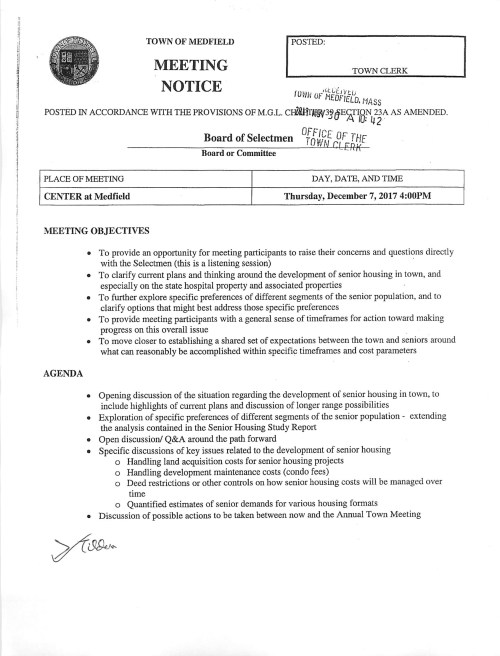
20171207-BoS-Senior housing meeting

Region’s selectmen convene

MILLIS – Local officials from several towns led a discussion Thursday on the deficiencies and possible reform of affordable housing rules.

Selectmen from Medway, Ashland, Hopkinton, Holliston, Medfield and Millis – convened in Millis to discuss a number of issues of regional importance, such as stormwater management, retail marijuana regulation and the voting process at town meetings. The towns have met several times over the past year.

Medway Town Administrator Michael Boynton noted that the “40B” affordable housing legislation – which allows developers to circumvent certain local zoning bylaws if their project has an affordable housing component and the town falls below a 10 percent affordable housing threshold – first went into effect in 1969.

“It’s not going anywhere,” he said, noting that a ballot initiative to repeal the rule in 2010 had failed. He added that many towns, when they reach the 10 percent threshold, lose interest in reform.

Boynton said the town had experienced – in the last 18 months – both friendly and unfriendly 40B developments.

Medway Selectman Glenn Trindade said the legislation, as currently written, does not solve the affordable housing problem in the most efficient way. He said apartments are most in demand, but developers want to build houses. With apartments, he noted, the residents’ incomes are reviewed after a period of time to ensure they still quality; the same does not occur with houses or condos.

“What we’ve got with this system is someone hits the lottery (and is awarded an affordable house or condo), and you help one person,” he said.

Fellow Selectman Dennis Crowley said he was concerned about what happened to affordable housing units. He said the town had seen instances in which condo owners had bought their units, refinanced at the market value of the condo, pocketed the difference and left. He also cited incidents in which people owned the units, but moved out and rented them to other people.

“Nobody’s monitoring these units,” he said.

Boynton suggested several reforms to the law. One change would allow towns to prioritize senior housing, while another would tie developments to a municipality’s master plan.

State Rep. Shawn Dooley, R-Norfolk, noted the difficulty of changing the legislation. He said he was pursuing reforms that would allow a slightly higher-priced unit to count as a percentage of an affordable housing unity. He pointed at his hometown of Norfolk as an example of where such housing is needed.

“We’re losing teachers, firefighters and police officers – they can’t afford to live in town,” he said. “We have (affordable housing) at $130,000, and the next house up is $500,000.”

Mike Gleason can be reached at 508-634-7546 or mgleason@wickedlocal.com. For news throughout the day, follow him on Twitter @MGleason_MDN.

Problems for Medfield in the proposed tax legislation, per MMA

This alert from the Massachusetts Municipal Association on the proposed federal tax changes.  Current Medfield State Hospital plans would be DOA if the historic tax credits are eliminated, as plans are not viable without those HTC’s.  See other issues that are bad for towns.

MMA-2

Dear Osler,

The tax reform debate on Capitol Hill will have real implications for local taxpayers and municipal finance in Massachusetts – the current version that the U.S. House of Representatives will be debating next week contains provisions that would increase the tax burden on middle-class taxpayers in our state, and remove important municipal finance tools to build local economies.

Please call your Members of Congress today and ask them to protect local taxpayers by preserving the State and Local Tax (SALT) deductions, the Historic Tax Credit, and all tax-exempt bonds.

Click here for the contact information

for U.S. Representatives and Senators from Massachusetts

In coming days, both chambers of Congress are preparing to take initial votes on a wide-ranging federal tax reform bill. As currently drafted, the bill would have a negative impact on cities and towns through four major policy changes: it eliminates State and Local Tax Deductions (SALT), caps property tax deductions, eliminates deductibility of key municipal bonds, and axes the Historic Tax Credit.

Ending SALT deductions would violate a 104-year promise by the Federal Government against double taxation. This provision would have a drastic impact on taxpayers and municipal governments across the Commonwealth. Over half of Massachusetts’ taxpayers deduct state and local taxes, and all would see a painful increase in their tax burden should this bill become law. This would make it much harder for municipal and state officials to fund key services, due to the higher effective tax rate on households in Massachusetts.

Eliminating the Historic Tax Credit would harm investments in our communities. This is especially important for states such as Massachusetts, with many older buildings and factories in need of preservation and redevelopment.

Capping the property tax deduction at $10,000 would be especially painful for citizens of the Commonwealth, where there are already over two dozen communities in which the average property tax bill is higher than that limit today. Capping this deduction will make it harder for communities to fund vital services such as public schools, police and fire services, and infrastructure.

Provisions revoking the tax-exempt status of Private Activity Bonds (PABs) and eliminating Advanced Bond Refunding would damage local finances and economic development. PABs are an essential tool used to leverage private investment in much-needed local housing and economic development projects, while Advanced Bond Refunding allows taxpayers to refinance and save money on municipal bonds during economic downturns.

The MMA opposed these provisions in a press conference with Senator Edward Markey after Congressional leaders released their plan last week, because of the negative impact this bill would have on cities and towns in the Commonwealth.

Click here to read the National League of Cities’ statement opposing the elimination of SALT deductions.

Also, click here to read a letter to Congress on this issue from the NLC, signed by the MMA and 21 other state municipal associations from across the country.


It is critically important that our Congressional delegation hear from you on this issue. This bill would lead to an unprecedented double taxation of Massachusetts citizens, harm investments in local communities, and cost taxpayers more to finance municipal obligations.

A broad nonpartisan coalition is working to protect municipal concerns. Changes to tax policy should be balanced and well thought out, which is why the MMA has joined with a wide range of nonpartisan groups to protect cities and towns, including the National League of Cities, the National Governors Association, the National Conference of State Legislatures, the International City/County Management Association, the US Conference of Mayors, and the Government Finance Officers Association. US Senators Markey and Warren, and Governor Baker have all voiced opposition to eliminating key taxpayer protections, such as the State and Local Tax Deduction (SALT).

Also, the MMA would like to thank Congressman Richard Neal (1st Congressional District in Western Mass.), the Ranking member of the House Ways & Means Committee for his steadfast support of municipal concerns during the committee deliberations this week.

If you have any questions about the bill or its impacts, please do not hesitate to call or email MMA Legislative Analyst David Lakeman at 617-426-7272 at any time.


PLEASE CALL YOUR REPRESENTATIVES AND SENATORS TODAY

MS4, stormwater regulations, appeal status

ms4

MS4 Appeal Status

This email was forwarded by Mike Sullivan this afternoon, which email explains that the coalition of towns appealing the new federal stormwater regulations is entering a  litigation phase.


Dear MS4 Contributors,


The following update was provided to MCWRS members via our newsletter. I also wanted to share the latest information with those of you who have contributed to the appeal or plan to.


On August 24, 2016, MCWRS and the Town of Franklin jointly filed a Petition for Review of the U.S. Environmental Protection Agency’s (EPA’s) Final MA Small Municipal Separate Storm Sewer Systems (MS4) General Permit with the First Circuit Court of Appeals in Boston. Prior to the MCWRS/Franklin appeal, the Center for Regulatory Reasonableness (CRR) filed an appeal in the Court of Appeals for the D.C. Circuit, in Washington, D.C. Several events have occurred since these two initial filings. Three additional appeals were filed in the First Circuit – by the City of Lowell, the National Association of Home Builders/Home Builders Association of MA, and the Conservation Law Foundation/Charles River Watershed Association (CLF/CRWA).

The U.S. Department of Justice (on behalf of EPA) has filed a motion to transfer the appeals filed by MCWRS, Lowell, National Association of Home Builders, and CLF to the D.C. Circuit. The transfer request was triggered by the CRR appeal first filed in the D.C. Circuit, and EPA’s submittal of the Administrative Record Index to that court. The appeals are expected to be transferred. Meanwhile, in the First Circuit, MCWRS/Franklin filed a motion to intervene in the CLF/CRWA appeal on the ground that other parties in that case (i.e. EPA) would not protect the municipalities’ interests in that case. CLF/CRWA’s position is that the MS4 Permit does not go far enough. CLF/CRWA have filed motions to intervene in all of the pending appeals.

Our attorneys are prepared to submit briefs and oral arguments in the Court of Appeals for the D.C. Circuit. We will continue to keep you apprised of events related to this critically important action to protect Massachusetts communities’ interests. Read the full press release on the MCWRS website for complete details on the announcement.


Going forward, now that the appeal is filed all communications between MCWRS and its attorneys are privileged and confidential. Additionally, since as public agencies you are all subject to public records laws, we do not want to supply updates via email that may include sensitive information and strategies. Instead, we think a periodic conference call may be the safest and best way to provide our supporters with updates. Of course, we would also not want you to share details of the call content via email with anyone else in your department or other town staff as they would be subject to the same public records regulations. Please let us know if you have any questions or concerns about our planned approach to keeping you updated.


As always, we greatly appreciate your support in this important matter!


Best regards,

Kate


Kate Barrett

Vice President for Public Involvement

Regina Villa Associates, Inc.

51 Franklin Street, Suite 400

Boston, MA 02110

MS4 from EPA

EPA

This month the EPA will release its new stormwater permit rules and regulations, which are termed “MS4.”  Selectmen had a presentation on MS4 this past month by people from the Neponset River Watershed Association (NRWA), who explained the expected regulation and  shared the planning other towns are doing to respond.  Most disturbing was their representation that some towns, such as Dedham, are expecting it to cost them upwards of $1m./year to respond to those MS4 regulations.

Mike Sullivan says Medfield is fortunate to have planned ahead and has already instituted all the matters he expects will be required by the MS4 permit and its regulations, such that Mike did not think that we need to budget anything for next year to be in compliance.

The NRWA representatives indicated that many towns will be implementing fees to residents for the amount of impervious surface on their lots. Again, since Mike says we will not have extra costs, we will not need to look at such fees to cover the cost of compliance.