These state aide estimates are from the Division of Local Services (DLS) at the Massachusetts Department of Revenue. Next a conference committee has to reconcile the different amounts proposed by the legislature and the senate. –
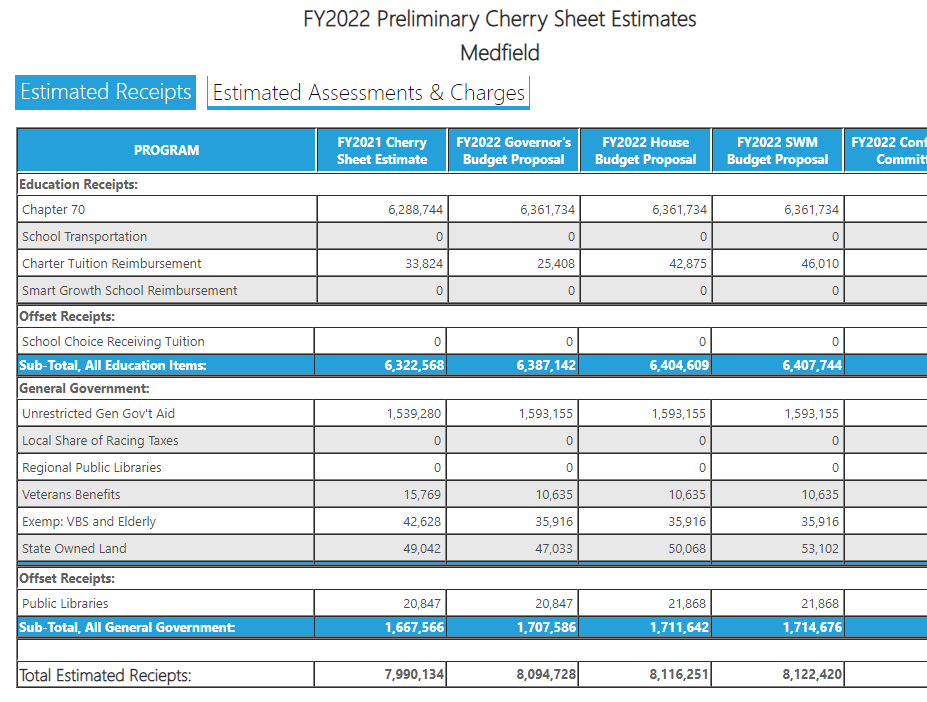

These state aide estimates are from the Division of Local Services (DLS) at the Massachusetts Department of Revenue. Next a conference committee has to reconcile the different amounts proposed by the legislature and the senate. –
Comments Off on Medfield’s FY2022 Preliminary Cherry Sheet Estimates show a $130K increase over last year
Posted in Budgets, Financial, Legislature, State
 |
| SENATE W&M COMMITTEE OFFERS $47.6B FY22 BUDGET WITH KEY INVESTMENTS IN MUNICIPAL & SCHOOL AID • INCLUDES THE FULL $39.5M INCREASE IN UGGA • INCREASES CHAPTER 70 BY $220M ABOVE FY21,FUNDING THE STUDENT OPPORTUNITY ACT ON SCHEDULE • INCREASES CHARTER SCHOOL REIMBURSEMENTS BY $31.7M• ADDS $46M FOR STUDENT ENROLLMENT AND SUMMER SCHOOL GRANTS • INCLUDES $389M TO FUND THE SPECIAL EDUCATION CIRCUIT BREAKER• ADDS $1M TO McKINNEY-VENTO REIMBURSEMENTS OVER FY21 •ADDS $4M TO PILOT May 11, 2021 Dear Osler Peterson, Earlier today, the Senate Ways & Means Committee advanced a $47.6 billion fiscal 2022 state budget plan to the full Senate for consideration later this month. The plan would increase overall state expenditures by 2.6% over the current year’s budget, and reflects a 4.3% increase over the Governor’s January budget proposal. The SW&M budget matches the 3.5% increase in Unrestricted General Government Aid (UGGA) in the Governor’s and House budgets, would significantly increase Chapter 70 school aid, and includes $40 million in a one-time grant program targeting student enrollment decline. The full Senate will start debate on the FY22 budget on Tuesday, May 25, and Senate members must file all budget amendments by 2 p.m. on Friday, May 14. The Senate usually considers over 1,000 amendments during budget debate week. The SW&M budget would increase funding for other major aid programs by adding $220 million to Chapter 70 aid over FY21; $37 million in additional funds for Charter School Mitigation payments, and an additional $1 million for McKinney-Vento transportation for homeless students. To acknowledge student enrollment declines due to the public health emergency, S. 3 would set aside $40 million in a one-time reserve account to assist districts impacted by the decline, as well as $6 million in one-time grant funding for summer school and student mental health support. The proposal would also provide an increase of $1 million for public libraries and $1 million for regional public libraries. S.3 also proposes a $4 million increase for the Payment-in-Lieu-of-Taxes (PILOT) for state-owned land account. Later Today or by the End of the Week, You Can Use This Link to See Your Community’s Local Aid and Preliminary Cherry Sheet Numbers in the Senate Ways & Means Budget, as Posted by the Division of Local Services You Can Link to the SW&M Committee’s Budget Here Chapter 70 The Senate Ways & Means budget would increase Chapter 70 aid by $220 million over FY21, bringing the total to $5.503 billion. S. 3 would fund the “goal rates” originally set forth in the Student Opportunity Act, which set a seven-year schedule that was to begin in FY21 but was sidelined last year due to the public health emergency. To get back on track, the MMA joined with other education advocates to ask the Legislature to fund Chapter 70 at an SOA implementation rate of one-sixth rather than one-seventh in order to return to the intended schedule. The House-Senate local aid agreement included a commitment to fund the Student Opportunity Act increases at one-sixth. S. 3 includes a one-time provision, introduced in the Governor’s budget and supported by the MMA, that would allow municipalities to use a portion of their school district’s Elementary and Secondary School Emergency Relief (ESSER II) federal grant award toward the increase from last year in their required local contribution. The House did not include this language. Rural School Aid Rural School Aid is funded at $3 million, reinserting an important account for rural school districts, especially those struggling with declining enrollment. The Governor funded this account at $1.5 million, half of the FY21 appropriation, and the House did not include the line item. Special Education Circuit Breaker S. 3 provides $387.9 million, including approximately $15 million funds carried over from the previous year, for the Special Education Circuit Breaker, reimbursing school districts for the high cost of educating students with disabilities at the statutorily required 75% reimbursement rate. This reimbursement rate, as well as the inclusion of costs associated with out-of-district transportation, reflect obligations outlined in the Student Opportunity Act. The total appropriation is higher than the budgets offered by the Governor and the House. Charter Schools To address charter school mitigation payments, S. 3 includes $149.1 million to reimburse school districts at 75%, the rate set forth in year one of the Student Opportunity Act implementation schedule, for costs incurred when students leave to attend charter schools, which is $5 million below the House budget. The MMA points out that charter school finance presents a major challenge to many districts, in a number of cases negating the increases districts realize in Chapter 70 aid. School Transportation The Senate Ways and Means budget decreases regional school transportation to $78.6 million. The House budget was higher at $82 million. The Senate Ways and Means budget would increase transportation for homeless students under McKinney-Vento by $1 million over FY21, to $14.4 million. Out-of-district vocational transportation is level-funded at $250,000. PILOT Funding Increased Recognizing the importance of Payments-in-Lieu-of-Taxes (PILOTS) for state-owned land, the Senate Ways & Means Committee increased the line item to $35 million (a $4 million increase over FY21). The Governor’s budget had recommended level-funding at $31 million; the House increased the account to $33 million. Underfunding PILOT over the years has created a significant hardship for smaller communities with large amounts of state-owned property. Shannon Grants, Cybersecurity, and Library Aid S. 3 includes level-funding for the Shannon grants for gang violence prevention and intervention, and includes critical funding for the Mass Cybersecurity Innovation Fund, which provides important outreach and training programs for municipalities. The accounts for public libraries and regional public libraries would each see an increase of $1 million, matching the House proposal. SUMMARY It is clear that Senate leaders are prioritizing K-12 funding, unrestricted municipal aid and other increases for cities and towns, as they advance an agenda to ensure stability during a time of uncertainty. The local funding aid agreement reached by the Joint Ways and Means Committee last month, including commitments to UGGA, Chapter 70, and the acknowledgement of school enrollment challenges, creates a more stable budget-setting process for cities and towns in the weeks and months ahead. This progress is deeply appreciated. During the budget debate and legislative session, the MMA will work to build on this progress, and will continue to advocate for full funding of the education funding priorities outlined in the Student Opportunity Act, fixing the serious problems caused by the current charter school system, securing higher Chapter 70 minimum aid increases, achieving full funding for all municipal and school reimbursement programs including transportation accounts, and providing higher PILOT funding. Please Call Your Senators Today to Thank Them for the Local Aid Investments in the Senate Ways and Means Committee Budget. Please Explain How the Senate Ways and Means Budget Would Impact Your Community, and Ask Your Senators to Build on this Progress During the Budget Debate. |
Comments Off on Senate W&M budget released
Posted in Budgets, Financial, Legislature, State
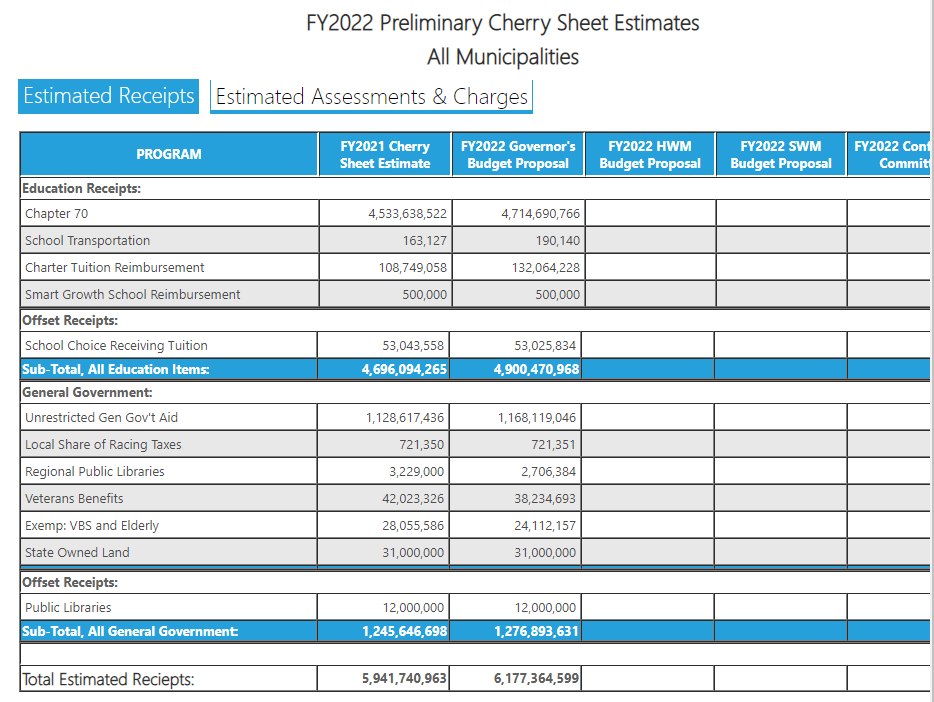
Medfield’s #s in the budget proposal –
| Contact Your Legislator Today! |
 |
| HOUSE W&M COMMITTEE OFFERS $47.65B FY22 BUDGET WITH KEY INVESTMENTS IN MUNICIPAL & SCHOOL AID • INCLUDES THE FULL $39.5M INCREASE IN UGGA • INCREASES CHAPTER 70 BY $21M ABOVE GOV’S BUDGET TO FUND THE STUDENT OPPORTUNITY ACT ON SCHEDULE • INCREASES CHARTER SCHOOL REIMBURSEMENTS BY $37M • ADDS $55M FOR STUDENT ENROLLMENT AND SUMMER SCHOOL GRANTS • INCLUDES $367M TO FUND THE SPECIAL EDUCATION CIRCUIT BREAKER • RESTORES $6M TO LEVEL FUND REGIONAL SCHOOL TRANS. AT FY21 LEVEL • ADDS $1M TO McKINNEY-VENTO REIMBURSEMENTS OVER FY21 •ADDS $2M TO PILOT April 14, 2021 Dear Osler Peterson, Earlier today, the House Ways & Means Committee advanced a $47.65 billion fiscal 2022 state budget plan to the full House for consideration later this month. The plan would increase overall state expenditures by 2.6 percent over the current year’s budget, and reflects a 3.9 percent increase over the Governor’s January budget proposal. The HW&M budget matches the 3.5% increase in Unrestricted General Government Aid (UGGA) in the Gov’s budget, adds a significant increase to Chapter 70 school aid and Charter School reimbursements, and includes $55 million in important new grant programs. The full House will start debate on the FY22 budget on April 26, and House members must file all budget amendments by 5:00 p.m. on Friday, April 16. The House usually considers over 1000 amendments during budget debate week. H. 4000, the House Ways & Means budget, provides progress on many important local aid priorities, including the full $39.5 million increase in Unrestricted General Government Aid that the Governor proposed and communities are counting on. The House Ways & Means budget also mirrors the Governor’s proposed increase for Special Education Circuit Breaker, with an increase over FY 2021 of $22.5 million. The HW&M budget would increase funding for other major aid programs, by adding $21 million to Chapter 70 aid above the House One recommendation, for a total increase of $219 million; $37 million in additional funds for Charter School Mitigation payments, and an additional $1 million for McKinney-Vento transportation for homeless students. To acknowledge student enrollment declines due to the public health emergency, H. 4000 would set aside $40 million in a one-time reserve account to assist districts impacted by the decline, as well as $15 million in one-time grant funding for summer school and student mental health support. The proposal would also provide an increase of $1 million for public libraries and $1 million for regional public libraries. H. 4000 also proposes a $2 million increase for the Payment-in-Lieu of Taxes (PILOT) for state-owned land account. Later Today or By the End of the Week You Can Use this Link to See Your Community’s Local Aid and Preliminary Cherry Sheet Numbers in the House Ways & Means Budget, as Posted by the Division of Local Services You Can Link to the HW&M Committee’s Budget Here $39.5 MILLION INCREASE IN UNRESTRICTED MUNICIPAL AID In January, the Administration kept its commitment to cities and towns to tie the increase in Unrestricted General Government Aid to the projected rate of growth in state tax revenues. This year, that increase was 3.5%, representing an increase of $39.5 million. The House Ways and Means FY 2022 plan would provide $1.168 billion for UGGA, reflecting the same increase proposed by Governor Baker. In a statement released by the Chairs of the Joint Ways and Means Committee last week, the two chambers have reached an agreement on this amount and every city and town will see their UGGA funding increase by 3.5%. This is welcome news to provide stability and predictability in municipal budgeting. CHAPTER 70 AID RETURNS TO ORIGINAL STUDENT OPPORTUNITY ACT SCHEDULE The House budget committee is proposing a $219 million increase in Chapter 70 education aid ($21 million higher than the $197.7 million increase in H. 1), which would fund the “goal rates” originally set forth in the Student Opportunity Act. The SOA schedule set a 7-year schedule beginning in FY 2021, but that was sidelined last year due to the public health emergency. To get back on track, the MMA joined with other education advocates to ask the Legislature to fund Chapter 70 at an SOA implementation rate of 1/6th rather than 1/7th in order to return to the intended schedule. Last week, House and Senate leaders reached a local aid funding agreement, which included this commitment to fund the increases in the SOA at 1/6th, funding Chapter 70 at a total of $5.503 billion. While this is important progress for districts, most districts remain at minimum aid. CHARTER SCHOOL MITIGATION PAYMENTS WOULD INCREASE BY $37 MILLION House Ways & Means is proposing a total of $154 million for Charter School Mitigation Payments, which reflects an increase of $37 million over the current fiscal year. In keeping with the first year of a 3-year phase-in funding schedule outlined in the Student Opportunity Act, this investment meets the Legislature’s statutory obligation to fund charter school reimbursements at 75%. Charter school finance still presents a major challenge to many districts, in a number of cases negating the increases districts realize in Chapter 70 aid. $367 MILLION FOR SPECIAL EDUCATION CIRCUIT BREAKER In line with the Governor’s budget recommendation in January, the House Ways & Means Committee’s budget includes the Governor’s recommendation of $367 million for Special Education Circuit Breaker, a $22.5 million increase over FY 2021. The Student Opportunity Act expanded the circuit breaker by including out-of-district transportation, an important enhancement for cities and towns. HW&M PROVIDES MIXED FUNDING FOR SCHOOL TRANSPORTATION ACCOUNTS The House Ways & Means budget level funds regional transportation at $82 million. The budget would increase transportation for homeless students under McKinney-Vento by $1million to $14.4 million. There is no line item for out-of-district vocational transportation, which last year was funded at $250,000. PAYMENTS-IN-LIEU-OF-TAXES (PILOT) AND LIBRARY AID Recognizing the importance of Payments-in-Lieu-of-Taxes (PILOTS) for state-owned land, the House Ways & Means Committee increased the line-item by $2 million to $33 million. The Governor’s budget had recommended level-funding at $31 million. Underfunding PILOT over the years has created a significant hardship for smaller communities with large amounts of state-owned property. The accounts for public libraries and regional public libraries would each see an increase of $1 million. SUMMARY It is clear that House leaders are prioritizing K-12 funding and other increases for cities and towns, as they advance an agenda to ensure stability during a time of uncertainty. The local funding aid agreement reached by the Joint Ways and Means Committee last week, including commitments to UGGA, Chapter 70, and the acknowledgement of school enrollment challenges, will create a more stable budget-setting process for cities and towns in the weeks and months ahead. This progress is deeply appreciated. During the budget debate and legislative session, the MMA will work to build on this progress, and will continue to advocate for full funding of the education funding priorities outlined in the Student Opportunity Act, fixing the serious problems caused by the current charter school system, securing higher Chapter 70 minimum aid increases, achieving full funding for all municipal and school reimbursement programs, and providing higher PILOT funding. Please Call Your Representatives Today to Thank Them for the Local Aid Investments in the House Ways and Means Committee Budget Please Explain How the House Ways and Means Budget Would Impact Your Community, and Ask Your Representatives to Build on this Progress During the Budget Debate Thank You! |
 |
The Town of Medfield appears in line to get the American Recovery Plan Federal monies in three separate pools:
++++++++++++++++++++++++++++++++++++++++++++++++++++++++++++++++++++++++++++++++++++++++++
This is from the Massachusetts Municipal Association chart about the first two items:
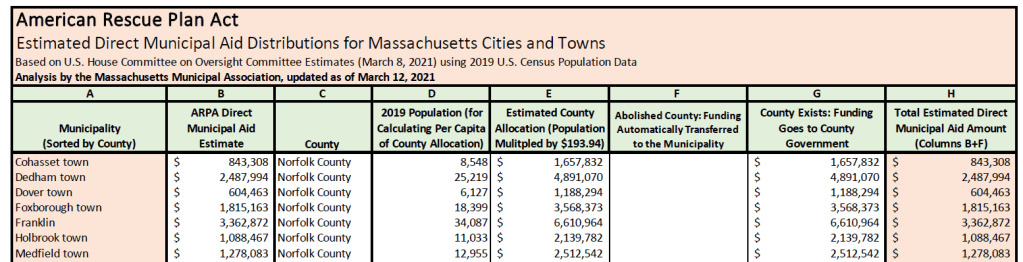
Town Administrator, Kristine Trierweiler, reports that the County has not determined what the County will do with their share and how it will be distributed.
+++++++++++++++++++++++++++++++++++++++++++++++++++++++++++++++++++++++++++++++++++++++++++
This email is from Congressman Auchincloss’ office about the third item:
From: O’Neil, Kevin
Date: Fri, Mar 19, 2021 at 12:29 PM
Subject: FW: American Rescue Plan- Estimated ESSER Funds
To:
Good morning Superintendent, State Senator, State Representatives, and Town Administrator,
The Congressional Research Service recently released estimates for grants expected to be issued to Local Education Agencies under the Elementary and Secondary School Emergency Relief (ESSER) Fund included in the American Rescue Plan. Below is the estimated amount your school district can expect to receive, along with information on how funds can be used. As the Department of Education and Department of Elementary and Secondary Education (DESE) release further guidance, our office will continue to update you all and answer any outstanding questions.
Medfield School District estimated funds under the ESSER Fund – $414,000
How funds can be used (please note this list is not exhaustive and will be subject to further agency guidance)-
Additionally, school districts must solicit public input on and publish plans for the safe return to in-person instruction within 30 days after receipt of funds.
Please reach out if you have any questions or concerns.
Best,
Kevin O’Neil
Kevin O’Neil | District Representative
Office of Congressman Jake Auchincloss, MA-4
29 Crafts Street, Suite 375 Newton, MA 02458
Office: (617) 332-3333
++++++++++++++++++++++++++++++++++++++++++++++++++++++++++++++++++++++
Details will follow on how the monies can be used.
Comments Off on Medfield share of Federal $$$ = $1.28m. (to town), $2.4m. (to Norfolk County), & $414K (to schools)
Posted in Budgets, Federal Government, Financial
From:
===============================================
From: Richard DeSorgher
Sent: Monday, February 1, 2021 5:03 PM
To: Osler Peterson
Subject: Community Preservation Funds
Hi Pete,
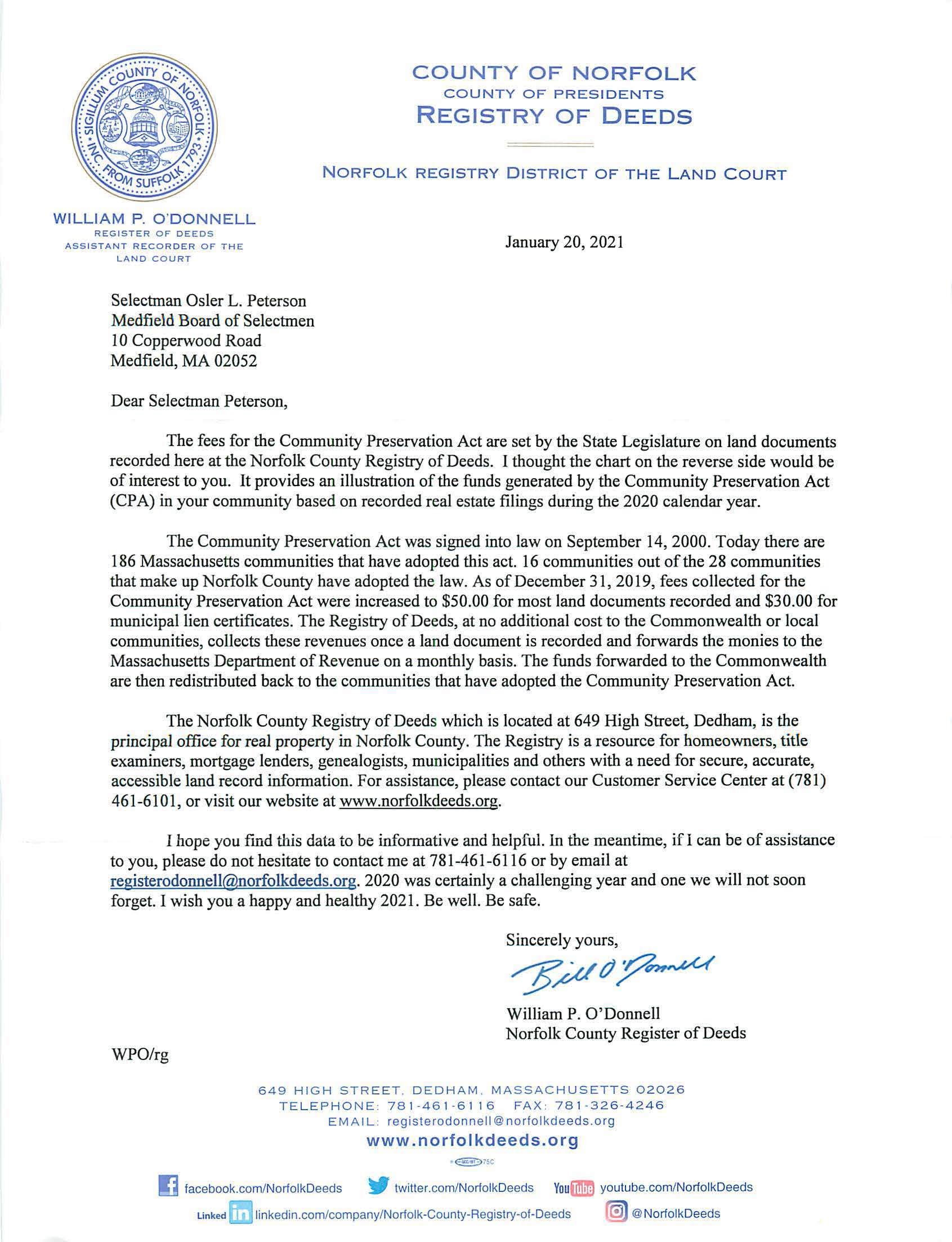
Hope you are well and staying safe during this most trying of times, especially as a town selectmen. I know you and I talked about the importance and common sense tax-saving ability adopting the Community Preservation Act would be for Medfield, so I am attaching the notice sent to me from the Registry of Deeds about the land document surcharges Medfield has forwarded to the Community Preservation fund; that sadly Medfield is missing out on but of which 186 other communities are taking advantage.
I was appointed to the Historical Committee down here in Mashpee and I have seen the advantage of those funds. Mashpee originally contributed 3% to the CPC funds. We have since reduced it by one percent, having a one percent surcharge instead go towards waste-water treatment in the town.
We have approved through the Community Preservation funds a new war memorial for the town veterans, a community garden, a playground, a dog park, a pickleball court (a sport I had never heard of before moving here),funding for low-income housing, money to preserve the Mashpee Parsonage, one of the oldest structures in town, preserving early town records, purchasing conservation land (a former bog), just to name a few in the short time I have been down here.
It is such an important and money saving act that the town has adapted.
Towns, like Medfield, are contributing to the system but are not receiving any of the benefits and instead must fund town projects at 100% instead of having the CPC funds to help lessen the taxpayers’ load.
I know I am preaching to the choir but just wanted to send along the Registry of Deeds letter in case you did not receive one and to give some re-enforcing support now that I have actually seen it in action.
Stay well and thanks for all you and the town government does for the citizens of Medfield.
Richard
![WILLIAM P. O 'DONNELL
REGISTER OF DEEDS
ASSISTANT RECORDER OF THE
LAND COURT
Selectman Osler L. Peterson
Medfield Board of Selectmen
10 Copperwood Road
Medfield, MA 02052
Dear Selectman Peterson,
COUNTY OF NORFOLK
COUNTY O F PRESIDENTS
REGISTRY OF DEEDS
NORFOLK REGISTRY DISTRICT OF THE LAND COURT
January 20, 2021
The fees for the Community Preservation Act are set by the State Legislature on land documents
recorded here at the Norfolk County Registry of Deeds. I thought the chart on the reverse side would be
of interest to you. It provides an illustration of the funds generated by the Community Preservation Act
(CPA) in your community based on recorded real estate filings during the 2020 calendar year.
The Community Preservation Act was signed into law on September 14, 2000. Today there are
186 Massachusetts communities that have adopted this act. 16 communities out of the 28 communities
that make up Norfolk County have adopted the law. As of December 31, 2019, fees collected for the
Community Preservation Act were increased to $50.00 for most land documents recorded and $30.00 for
municipal lien certificates. The Registry of Deeds, at no additional cost to the Commonwealth or local
communities, collects these revenues once a land document is recorded and forwards the monies to the
Massachusetts Department of Revenue on a monthly basis. The funds forwarded to the Commonwealth
are then redistributed back to the communities that have adopted the Community Preservation Act.
The Norfolk County Registry of Deeds which is located at 649 High Street, Dedham, is the
principal office for real property in Norfolk County. The Registry is a resource for homeowners, title
examiners, mortgage lenders, genealogists, municipalities and others with a need for secure, accurate,
accessible land record information. For assistance, please contact our Customer Service Center at (781)
461-6101 , or visit our website at www .norfolkdeeds.org.
1 hope you find this data to be informative and helpful. In the meantime, if I can be of assistance
to you, please do not hesitate to contact me at 781-461-6116 or by email at
registerodonnell@norfolkdeeds.org. 2020 was certainly a challenging year and one we will not soon
forget. I wish you a happy and healthy 2021. Be well. Be safe.
WPO/rg
Sincerely yours,
~//frJP~
William P. O'Donnell
Norfolk County Register of Deeds
649 HIGH STREET. DEDHAM . MASSACHUSETTS 02026
TE L EPHONE : 781 -461-6 11 6 FAX : 781-326-4246
EM Al L : registerodonnell@norfolkdeeds.org
www.norfolkdeeds.org
I] facebook.com/NorfolkDeeds ~ twitter.com/NorfolkDeeds You(g youtube.com/NorfolkDeeds
linked fm linkedin.com/company/Norfolk-County-Registry-of-Deeds ~ @NorfolkDeeds
NORFOLK COUNTY REGISTRY OF DEEDS
COMMUNITY PRESERVATION ACT (CPA)
SURCHARGES BY TOWN FOR CALENDAR YEAR 2020
TOWN TOTAL
AVON $60,260.00
BELLINGHAM $219,660.00
BRAINTREE $400,235.00
BROOKLINE $478,050.00
CANTON $269,455.00
COHASSET $147,775.00
DEDHAM $288,320.00
DOVER $86,525.00
FOXBOROUGH $199,605.00
FRANKLIN $393,210.00
HOLBROOK $125,170.00
MEDFIELD $166,440.00
MEDWAY $158,550.00
MIUJS $117,615.00
MILTON $329,310.00
NEEDHAM $389,610.00
NORFOLK $155,295.00
NORWOOD $266,565.00
PIAINVILLE $102,095.00
QUINCY $731,850.00
RANDOLPH $279,160.00
SHARON $230,840.00
STOUGHTON $288,795.00
WALPOLE $314,670.00
WELLESLEY $312,495.00
WESTWOOD $189,110.00
WEYMOUTH $620,970.00
WRENTHAM $171,120.00](https://medfield02052.blog/wp-content/uploads/2021/02/20210120-norfolk-registry-of-deeds-ltr-from_page_2.jpg)
===============================================
Ask DLS: Community Preservation Act – Part 8
This month’s Ask DLS features Part 8 of frequently asked questions concerning the Community Preservation Act (CPA) and CPA funding for eligible open space projects. Additional questions about the CPA will be featured in future editions of City & Town. For Part 7 of the series, see the January 7, 2021 edition of City & Town. For additional information on the Community Preservation Act see Informational Guideline Release (IGR) 19-14. Please let us know if you have other areas of interest or send a question to cityandtown@dor.state.ma.us. We would like to hear from you.
In general, what community preservation projects are eligible for funding under the CPA?
There are three community preservation project or asset categories: (1) open space (including land for recreational use); (2) historic resources; and (3) community housing. These FAQs will discuss CPA funding for projects relating to open space.
What is the definition of “open space?”
“Open space” is defined in G.L. c. 44B, § 2 to “include, but not be limited to, land to protect existing and future well fields, aquifers and recharge areas, watershed land, agricultural land, grasslands, fields, forest land, fresh and salt water marshes and other wetlands, ocean, river, stream, lake and pond frontage, beaches, dunes and other coastal lands, lands to protect scenic vistas, land for wildlife or nature preserve and land for recreational use.”
For what purposes may CPA funds be spent regarding open space?
The CPA clarifies allowable community preservation project expenditures through its definitions which are found in G.L. c. 44B, § 2. As a result, the CPA definitions should always be reviewed when determining if an expenditure is allowable.
Acquisition, creation, and preservation – CPA funds may be spent for the acquisition, creation, and preservation of open space.
“Acquisition” is defined in G.L. c. 44B, § 2 as “obtain[ing] by gift, purchase, devise, grant, rental, rental purchase, lease or otherwise.” ”Acquire” does not include a taking by eminent domain, except as provided under c. 44B.
“Creation” – There is not a specific definition of “creation” under the CPA; however, “creation” was defined by the court for CPA purposes in the case of Seideman v. City of Newton, 452 Mass. 472 (2008) to mean “to bring into being or to cause to exist.”
“Preservation” is defined under G.L. c. 44B, § 2 as “protection of personal or real property from injury, harm or destruction.”
Rehabilitation or restoration of open space – CPA funds may also be spent for the rehabilitation or restoration of open space; provided the open space was acquired or created with community preservation funds.
”Rehabilitation” is defined under G.L. c. 44B, § 2 as “capital improvements, or the making of extraordinary repairs, to historic resources, open spaces, lands for recreational use and community housing for the purpose of making such historic resources, open spaces, lands for recreational use and community housing functional for their intended uses including, but not limited to, improvements to comply with the Americans with Disabilities Act and other federal, state or local building or access codes; provided, that with respect to historic resources, ”rehabilitation” shall comply with the Standards for Rehabilitation stated in the United States Secretary of the Interior’s Standards for the Treatment of Historic Properties codified in 36 C.P.R. Part 68; and provided further, that with respect to land for recreational use, ”rehabilitation” shall include the replacement of playground equipment and other capital improvements to the land or the facilities thereon which make the land or the related facilities more functional for the intended recreational use.
“Restoration” is not defined under the CPA and we are not aware of any cases defining “restoration” in the CPA context. In the absence of such an interpretation, we look to the usual and generally understood meaning of words from sources known to the legislature, such as use in other legal contexts and dictionary definitions. See Seideman v. Newton, 452 Mass. 472, 477-478 (2008). At webster-dictionary.org, “restoration” is defined as “the act of restoring or bringing back to a former place, station, or condition.”
What are some examples of allowable CPA open space projects?
Acquisition of open space – Acquisition of real property or an interest in real property is allowable for open space purposes, including the acquisition of agricultural land, grasslands, fields, forest land, watershed land, fresh and salt water marshes and other wetlands, ocean, river, stream, lake and pond frontage, beaches, dunes and other coastal lands, land to protect scenic vistas, land for wildlife or a nature preserve, land for recreational use and land to protect existing and future well fields, aquifers and recharge areas. Again, one must look to G.L. c. 44B, § 2, to determine the definitions of “real property” and “real property interest” for CPA expenditure purposes. Under G.L. c. 44B, § 5(f), the price of an acquisition must not exceed the value of the property as determined through “procedures customarily accepted by the appraising profession as valid.” And, under G.L. c. 44B, § 12, real property interests financed in whole or in part with CP Fund monies must be bound by a permanent restriction which conforms to the requirements of G.L. c. 184, §§ 31-34 and the city or town must own any real property interest acquired with community preservation monies. Management of the properties may be delegated by the legislative body to the conservation commission, park commission or to a nonprofit corporation created under G.L. c. 180 or nonprofit trust created under G.L. c. 203.
Acquisition of open space – Appropriation of CP funds to a conservation fund established by G.L. c. 40 § 8C is allowable; however, any expenditure of such funds remains subject to the restrictions imposed by the CPA, including the requirement that any land acquired must be bound by the restriction described in G.L. c. 44B, § 12. Therefore, the conservation commission may spend CPA funds only for those purposes that are authorized by both G.L. c. 40 § 8C and the CPA, for example, acquisition of land for open space purposes. To ensure that these requirements are carried out, the CPC recommendation and any legislative body appropriation vote should expressly include these conditions.
Rehabilitation of open space – Expenditures for rehabilitation and restoration of open space (not including lands for recreational use) are not allowable unless the open space was acquired or created using CPA funds pursuant to G.L. c. 44B, § 5(b)(2). For example, funding is allowable for “rehabilitation” of municipal forest land only if the forest land was acquired with community preservation funds. CP funds cannot be used, however, to fund any expenditure that would fall within the CPA definition of “maintenance,” even if the expenditure is required by a forest management plan. G.L. c. 44B, §§ 2 and 5(b)(2). See Part 6 of these FAQs for more information on prohibited CPA expenditures, published in the December 3, 2020 edition of City & Town.
Stay tuned for next month’s City & Town for Part 9 in our FAQ series on the CPA when we will discuss allowable CPA land for recreational use projects. For more information, see Informational Guideline Release (IGR) 19-14.
Comments Off on Massachusetts Community Preservation Act (CPA)
Posted in Budgets, Community Preservation Act (CPA), Financial, State
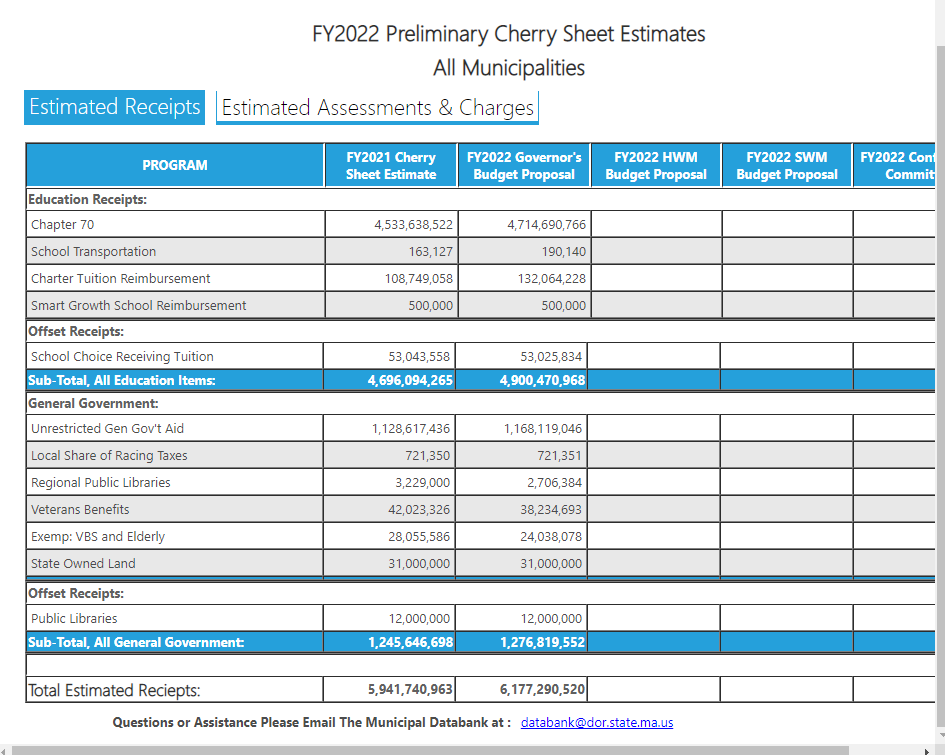
Below are Medfield’s cherry sheet numbers in the Governor’s budget released by Division of Local Services (DLS) this week. The town’s state monies will be up $335K or 3.96% over last year per these numbers.
The town’s state revenue numbers are called “cherry sheet” numbers because historically these budget numbers were issued on red paper – back when things were still done on paper.
Next in the annual state budget process the House will produce its budget numbers, followed by the Senate version, the consensus version of the two, the Governor’s vetos, any legislative veto overrides, which is what will then be next year’s budget. That process usually takes until April.

January 27, 2021
Today at noon, Gov. Charlie Baker submitted a $45.6 billion fiscal 2022 state budget plan with the Legislature, proposing to reduce overall state expenditures by almost 1 percent next year as the Administration plans a sustainable recovery from the fiscal and service delivery disruptions caused by the ongoing coronavirus public health emergency and the related economic recession. Similar to the recently finalized fiscal 2021 budget, the Governor’s spending plan for next year relies on temporary and one-time revenues, including emergency federal funds related to the pandemic and up to $1.6 billion from the state’s Stabilization Fund.
UNRESTRICTED MUNICIPAL AID INCREASED BY $31.6 MILLION
As Gov. Baker pledged to local officials at the beginning of his administration, his budget includes a $39.5 million increase in Unrestricted General Government Aid, tracking the expected 3.5% increase in state tax revenues. Implementing this state-local revenue sharing framework is good news in a very challenging time for state and local finances.
OVERALL CHAPTER 70 SCHOOL AID WOULD GO UP BY $197.7 MILLION, A 3.7% INCREASE – ALTHOUGH A LARGE NUMBER OF DISTRICTS ARE EXPECTED TO REMAIN AT MINIMUM AID ONLY
The Governor’s budget recommendation re-starts implementation of the funding schedules in the 2019 Student Opportunity Act (SOA) that were delayed last year after the coronavirus recession upset the original first year funding plan.
Fulfilling the commitments in the new Student Opportunity Act, the Governor’s fiscal 2022 budget submission would bring Chapter 70 school aid up to $5.48 billion, a $197.7 million increase in school aid. This would fund the first year of the 7-year plan to add $1.5 billion in new state funding for K-12 education. The majority of the funds would implement the improvements to the foundation budget, adding weight for low-income students, English Language Learners, special education costs, and school employee health benefits. While this is important progress, an initial look at the budget indicates that a large percentage of cities, towns and school districts would remain minimum-aid-only, and receive the minimum $30 per-student increase in the Act. The MMA will continue to strongly advocate for significantly higher minimum aid throughout the budget process.
The Governor’s Chapter 70 recommendation would make a significant change in how cities and towns can meet their required local contributions for fiscal 2022. Municipalities may use up to 75% of the total grant awarded to the local school district through the Elementary and Secondary Education Emergency Relief (ESSER) program enacted by Congress last month (also known as ESSER II) to fund a part of the increase in its local contribution requirement under Chapter 70, but not more than the increase in required local contribution in FY2022 relative to FY2021. This is a new temporary provision that is explained in the narrative and slides on the DESE school finance website provided below.
This landing page will also include the preliminary fiscal 2022 charter school assessments and reimbursements.
CHARTER SCHOOL REIMBURSEMENTS WOULD INCREASE TO $143.5M – CHARTER FUNDING REMAINS A SERIOUS PROBLEM TO BE SOLVED
The Governor’s budget would increase the charter school reimbursement account up to $143.5 million, intended to meet the commitment in the Student Opportunity Act to fund 75% of the state’s 100-60-40 statutory obligation to mitigate Chapter 70 losses to charter schools.
The Student Opportunity Act pledges to phase in full funding of the statutory reimbursement formula over three years, and while this plan may meet that requirement, it would not fix the serious flaws in the charter school finance system. Charter schools will continue to divert a high percentage of Chapter 70 funds away from many municipally operated school districts, and place greater strain on the districts that serve the vast majority of public school children. Major problems will continue unless a true resolution of the charter school funding problem is achieved, a top MMA priority.
SPECIAL EDUCATION CIRCUIT BREAKER INCREASED TO $367.7M
The Governor’s budget would add $22.5 million to fund the Special Education Circuit Breaker program at $367.7 million, an increase of 6.5%. The Student Opportunity Act expanded the special education circuit breaker by including out-of-district transportation, an important enhancement for cities and towns.
REGIONAL SCHOOL TRANSPORTATION REIMBURSEMENTS REDUCED
Gov. Baker’s budget submission would reduce funding for regional transportation reimbursements from $82.2 million this year to $75.9 million. This will be a hardship for virtually all communities in regional districts. Reimbursements for transportation of out-of-district vocational students remains significantly underfunded at $250K. Increasing these accounts is a priority for cities and towns and the MMA.
McKINNEY-VENTO REIMBURSEMENTS REDUCED
The Governor’s budget would reduce reimbursements for the transportation of homeless students from $13.5 million this year to $11.1 million in fiscal 2022. The impact of this funding level will vary from community-to-community depending on the number of homeless families that remain sheltered in local hotels and motels. The Administration has been successful in reducing the number of homeless students who are dislocated from their original district, but those communities that continue to provide transportation to many students may continue to see shortfalls.
PAYMENTS-IN-LIEU-OF-TAXES (PILOT) LEVEL FUNDED
The Governor’s budget would level fund PILOT payments at $31 million, which would be a significant hardship for many smaller, rural communities with large amounts of state-owned land. This is a key account due to the major impact that PILOT payments have on budgets in very small communities.
Please contact your legislators today and ask them to support the $39.5M increase in municipal aid and the $197.7M increase in Chapter 70 aid.
Please ask your legislators to address the serious flaws in charter school funding, increase minimum Ch. 70 aid to $100 per student, and increase funding for school transportation, PILOT payments, and ensure full funding for the Special Education Circuit Breaker
The Division of Local Services (DLS) newsletter had the following article about the Massachusetts Community Preservation Act (CPA) base state matching monies coming in this year at 28.6% for the 3% CPA communities.
Medfield residents continue to pay in to fund the state payments to other towns, because Medfield has not adopted the CPA – i.e Medfield is leaving free state monies on the table. See https://www.communitypreservation.org/ for information.
=================================================
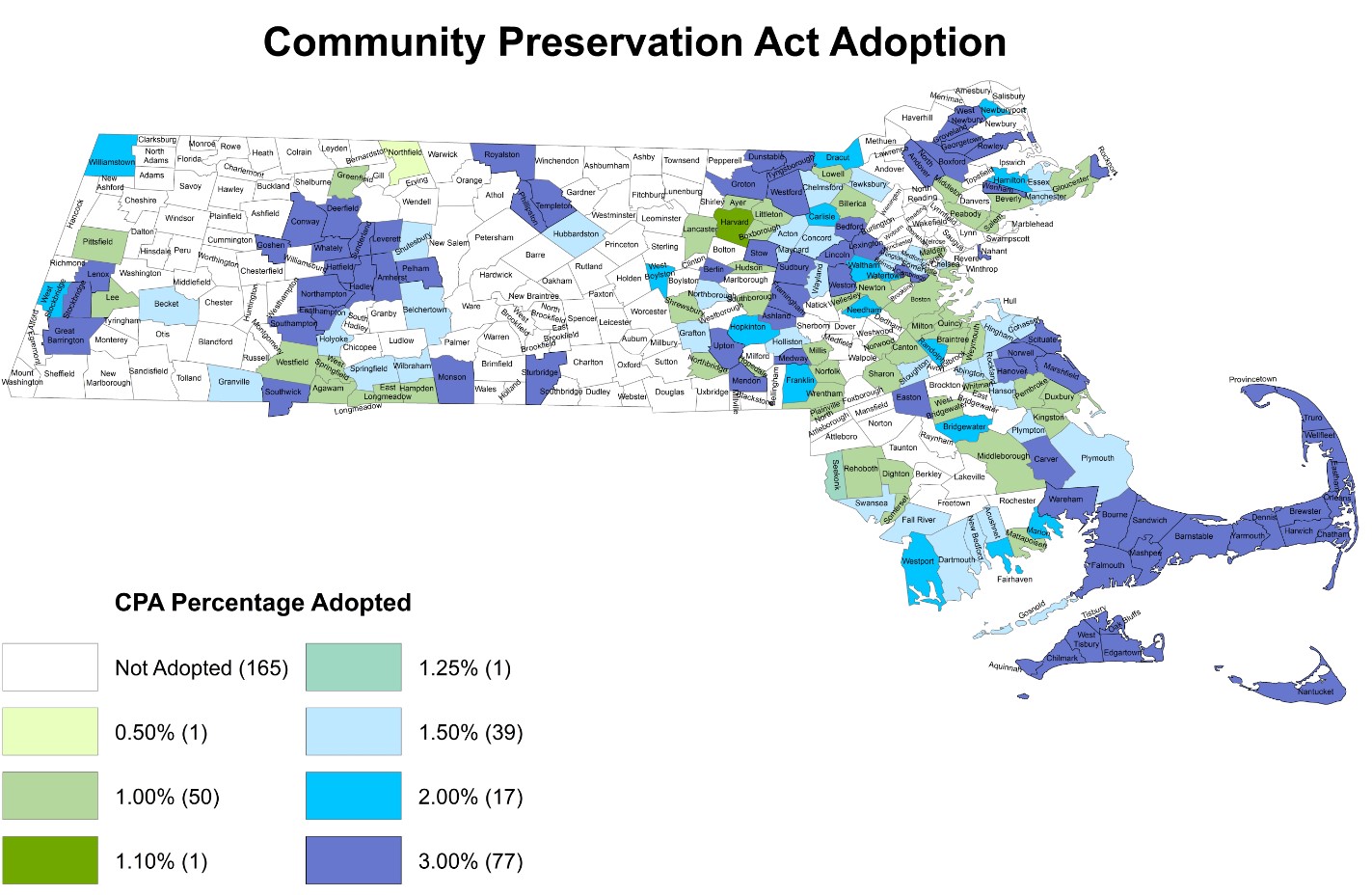
The map below shows all the communities that have adopted the Community Preservation Act, including those recently adopted.
FY2021 Community Preservation State Match Distributed
Donnette Benvenuto and Lisa Krzywicki – Data Analytics and Resources Bureau
On November 13th, the Data Analytics and Resources Bureau (DARB) distributed the FY2021 state match of Community Preservation (CPA) funds. The CPA trust fund receives revenues from surcharges on documents filed at the Registry of Deeds. Effective January 1, 2020 the registry of deeds increased fees on most documents from $20 to $50 and on municipal lien certificates from $10 to $25. In FY2021, there are 176 communities eligible for the CPA state match and as of November, the CPA state trust fund recorded revenues totaling $61.1 million.
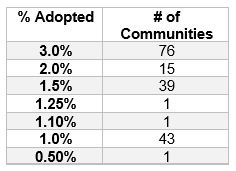
Of the 176 communities eligible, 76 have adopted the surcharge at the maximum 3% making them eligible for base distribution match of 28.6% of the local CPA surcharge committed. They are also eligible for the 2nd round distribution (equity) and 3rd round distribution (surplus), which can result in an increased percentage match, up to 100%. The remaining 100 communities that did not adopt the CPA at 3% are only eligible for the first-round match of 28.6% of the local CPA surcharge committed.
Number of communities eligible for the FY2021 state match by percentage adopted:
The full distribution breakdown and decile ranking by community can be found here on the DLS website.
On the November 3rd ballot an additional 9 communities voted and approved the CPA and West Stockbridge adopted it earlier in the year. Municipal Clerks in these communities are reminded to send in the Specimen ballot, results and notification of acceptance form to DARB at databank@dor.state.ma.us as soon as possible.
List of additional communities and percentage adopted eligible for the FY2022 CPA state match in November of 2022:
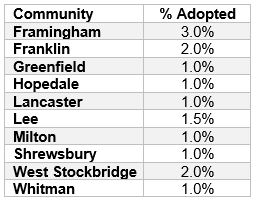
For questions about the distribution or to notify us of local adoption, please email databank@dor.state.ma.us.
Comments Off on CPA base state match at 28.6%
Posted in Affordable housing / 40B, Budgets, Community Preservation Act (CPA), History, Medfield Rail Trail, Peak House Heritage Center, Recreation
Division of Local Services (DLS) emailed today with the preliminary cherry sheet numbers for the Town of Medfield, which basically mirror last year –

Comments Off on FY21 cherry sheet for Medfield
Posted in Budgets, Select Board matters, State
The follow up public forum by the School Building Committee, requested by the Select Board at its meeting last Tuesday, has been scheduled for 6 PM on October 14, 2020. The purpose of this additional public forum is to provide the additional “process” the Select Board requested happen before the Select Board votes on the siting decision for the new Dale Street School. Some residents stated that they felt that the process had been rushed.
To date, the Wheelock location is the unanimous choice of all member of all involved town committees – the SBC, the School Committee, and the Select Board.
Mike Quinlan, chair of the SBC, reported this past week that the MSBA indicated that it will not financially punish the town for not having voted to proceed last Tuesday. That fear was a stated concern of the SBC for asking the Select Board to vote last Tuesday.
Below is the SBC’s last email about the project, on 9/21/2020, with links to the data it developed.
 DALE STREET SCHOOL PROJECT UPDATE September 2020 Edition DALE STREET SCHOOL PROJECT UPDATE September 2020 Edition  Grades 4-5 Alternative G1 New Construction Wheelock Site PRIORITY DECISIONS MADE Grades 4-5 Alternative G1 New Construction Wheelock Site PRIORITY DECISIONS MADE On August 27, 2020, the School Committee voted unanimously to select the 4-5 grade configuration. It was ultimately decided that the 4-5 grade configuration was the most viable option for the current economic climate. On September 16, 2020, the School Building Committee voted to recommend the selection of the Wheelock site for the location of the new school. Of the alternatives presented on the Wheelock site, the committee selected G1 Alternative as the Preferred Schematic Option. The School Building Committee will now recommend the Preferred Schematic Option to the Board of Selectmen on September 22, 2020 at 7PM.  View from Elm Street Entrance View from Elm Street Entrance  View from Wheelock School Parking Lot TOP REASONS FOR WHEELOCK CAMPUS View from Wheelock School Parking Lot TOP REASONS FOR WHEELOCK CAMPUSContinuity of educational programming of a grades 2-5 campus Share resources and staff between Wheelock and a new Dale Street school Allows for future flexibility with enrollment or consolidation Avoids temporary displacement and disruption of students during construction WHEELOCK CAMPUS CHALLENGES Potential Traffic impacts on surrounding neighborhood Overall Property Tax impacts ADDITIONAL OUTREACH Grade Configuration Information Site Selection Information Frequently Asked Questions Project Schedule Sustainability  Upcoming Project Milestones SEPTEMBER 22 – BOARD OF SELECTMEN MEETING (Vote on Preferred Solution) Upcoming Project Milestones SEPTEMBER 22 – BOARD OF SELECTMEN MEETING (Vote on Preferred Solution)OCTOBER 14 – DRAFT PSR Submission to Building Committee Members for Review OCTOBER 21 – SCHOOL BUILDING COMMITTEE MEETING (Vote on PSR Submission) OCTOBER 27 – SUBMIT PSR TO MSBA DECEMBER 16 – MSBA BOARD MEETING (Approval of PSR) Project Resources Link to PROJECT SCHEDULE Link to FREQUENTLY ASKED QUESTIONS Link to SUSTAINABILITY INFORMATION Link to PROJECT WEBSITE Link to PROJECT FACEBOOK PAGE Questions contact us DaleStreetSchoolProject@gmail.com     Copyright © 2020 Dale Street School Project, All rights reserved. Copyright © 2020 Dale Street School Project, All rights reserved.You are receiving this email because you opted in via our website. Our mailing address is: Dale Street School Project 459 Main St Medfield, MA 02052-2009 Add us to your address book Want to change how you receive these emails? You can update your preferences or unsubscribe from this list. |
Posted in Budgets, Schools, Select Board matters
Medfield Select Board member
I started this blog to share the interesting and useful information that I saw while doing my job as a Medfield select board member. I thought that my fellow Medfield residents would also find that information interesting and useful as well. This blog is my effort to assist in creating a system to push the information out from the Town House to residents. Let me know if you have any thoughts on how it can be done better.
For information on my other job as an attorney (personal injury, civil litigation, estate planning and administration, and real estate), please feel free to contact me at 617-969-1500 or Osler.Peterson@OslerPeterson.com.
 | Lester Cohen on Town’s Buildings Require… |
 | Select Board member… on Black Out at Budget Works… |
| Lester Cohen on Black Out at Budget Works… |
 | The Sullivans on Thank you Linda Thompson! |
 | cherryblossomcasuall… on Roundabouts both safer & b… |

 Medfield02052's Blog