Received today from Division of Local Services (DLS) at Massachusetts Department of Revenue. The Senate Ways and Means Committee added about $20K to the Governor and House budget version for Medfield (copy attached below) –


Received today from Division of Local Services (DLS) at Massachusetts Department of Revenue. The Senate Ways and Means Committee added about $20K to the Governor and House budget version for Medfield (copy attached below) –
Comments Off on Senate adds about $20K to Medfield’s state budget $
Posted in Budgets, Legislature, State
From Division of Local Services (DLS) –
 |
| FY2024 Preliminary Cherry Sheet Estimates On Wednesday April 12th the House Ways & Means Committee (HWM) released their version of the FY2024 budget proposal. The Division has posted updated preliminary cherry sheets on the DLS website. Click here for Preliminary Municipal Cherry Sheet Estimates or here for Preliminary Regional Cherry Sheet Estimates. Cherry sheet estimates for charter school tuition and reimbursements are based on estimated tuition rates and projected enrollments under charters previously issued by the Board of Elementary and Secondary Education. Please be advised that charter school assessments and reimbursements will change as updated tuition rates and enrollments become available. Estimates for the school choice assessments may also change significantly when updated to reflect final tuition rates and enrollments. It is important for local officials to remember that these estimates are preliminary and are subject to change as the legislative process unfolds. If you have any questions about the preliminary estimates, please contact the Data Analytics and Resources Bureau at databank@dor.state.ma.us. |
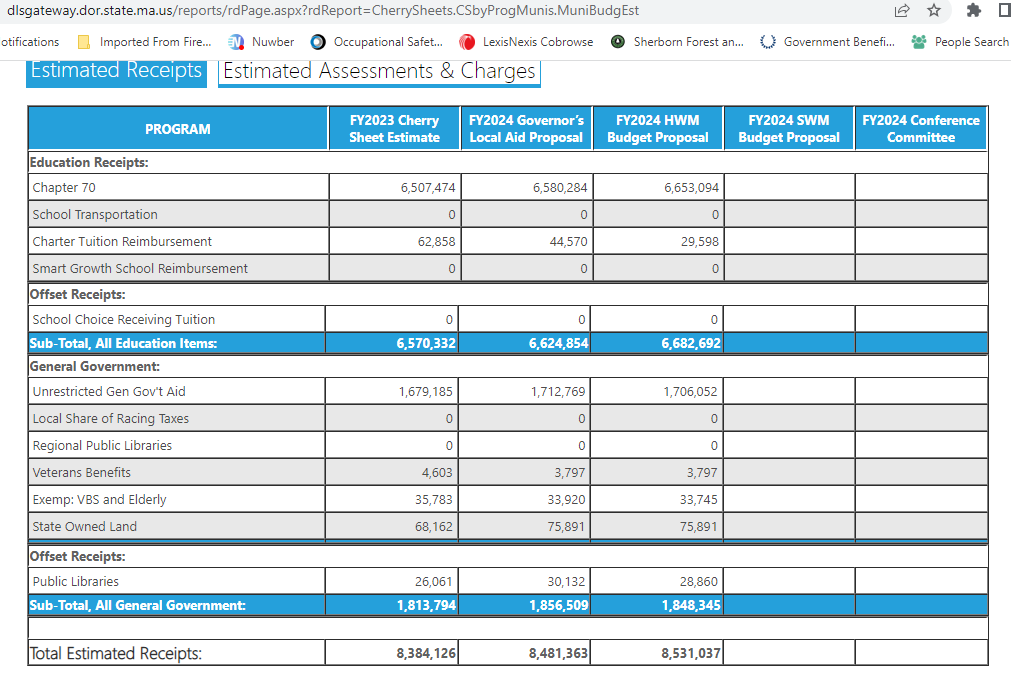
Comments Off on Initial Cherry Sheet estimates have our state $ up about $147K
Posted in Budgets, Legislature, State
From the Massachusetts Municipal Association. A detailed analysis is usually released, so expect that soon. –
 Breaking News from the MMA Breaking News from the MMA |
 Gov. Healey releases FY2024 budget proposal Today Gov. Maura Healey filed her $55.5 billion state budget plan for fiscal 2024, which includes funding for local accounts that she announced last week. Healey’s proposal, known as House 1, would increase the main discretionary local aid account by 2% over fiscal 2023, while increasing Chapter 70 school aid by $586 million, which would fund commitments made in the 2019 Student Opportunity Act. The governor also proposed increases for regional school transportation, vocational school transportation, special education reimbursements, payments-in-lieu-of-taxes (PILOT), transportation of students in temporary housing, library aid, and rural school aid. |
Comments Off on Gov’s budget released
Posted in Budgets
From the Massachusetts Municipal Association. NB, the state budget process will likely be slower to unfold this year due to the gubernatorial change –
| View this email in your browser Breaking News from the MMA  State budget writers announce consensus revenue growth forecast of 1.6% for FY24 The state’s budget writers announced yesterday that state tax collections are expected to grow by 1.6% in fiscal 2024 over a recently adjusted projection for fiscal 2023 revenue. Administration and Finance Secretary Matthew Gorzkowicz, Senate Ways and Means Chair Michael Rodrigues and House Ways and Means Chair Aaron Michlewitz announced a consensus state tax revenue forecast of $40.41 billion for the fiscal year that will begin on July 1. The increase does not include an additional $1 billion in projected revenue from the state’s new surtax on annual incomes over $1 million, which was adopted by voters in November. Dispensing funds generated from the surtax will be subject to appropriation, but the ballot measure stipulated that funds must be spent only in areas of transportation and education. Including the surtax, estimated revenue would increase the total budget projection for fiscal 2024 by 4.1% over the adjusted fiscal 2023 revenue estimate.    Copyright © 2023 Massachusetts Municipal Association, All rights reserved. You are receiving this email because you opted in via our website. Our mailing address is: Massachusetts Municipal Association 3 Center Plaza Suite 610 Boston, MA 02108 Add us to your address book Want to change how you receive these emails? You can update your preferences or unsubscribe from this list. |

In this week’s Hometown Weekly, Richard DeSorgher’s This Old Town column describes the Town of Medfield budget from 100 years ago in 1923. The total annual budget was $67,965 and your town, like today, spent the most on education, $24,000 that year. What surprised me was that the town spent $3K on streetlights. That latter is the same amount spent that year on snow removal, and $1K more than was spent on either the police or fire.
From memory the streetlight budget today is about $27,000. Interesting that streetlights were seen then as such a high priority.
Email this afternoon from Town Administrator, Kristine Trierweiler –
We have submitted the FY2023 budget to GFOA (Government Finance Officers Association) today seeking a distinguished budget award. The document has also been posted on the Town’s website:
https://www.town.medfield.net/DocumentCenter/View/6594/Medfield-FY2023-Annual-Budget
—
Kristine Trierweiler Town Administrator
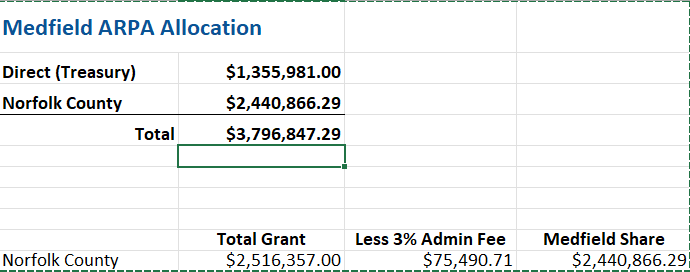

Comments Off on Medfield’s ARPA Allocation = $3.796m.
Posted in Budgets, COVID-19, Federal Government, Financial
See the town Cherry Sheet for FY2023 here – https://dlsgateway.dor.state.ma.us/reports/rdPage.aspx?rdReport=CherrySheets.CSbyProgMunis.MuniBudgFinal
FY2022 we got $8,116,943 from the state
FY2023 we will get $8,384,126, or $267,183 more (a 3.2% increase).
This alert below came this afternoon from the Massachusetts Municipal Association –
 |
| Governor Signs FY23 Budget Supports Key Municipal Aid and School Funding And Offers Amendment to Important Retiree COLA Language Please Thank Your Legislators and Ask Them to Accept the Governor’s Amended COLA Language July 28, 2022 Dear Osler L. Peterson, This morning, Governor Baker signed a $52.7 billion budget, including each of the increases in municipal and school aid accounts for which the MMA has prioritized throughout the process. The Governor also signed 153 of 194 of the outside sections of the budget and has returned a key section with an amendment for the Legislature’s consideration. As enacted by the Legislature, Outside Section 134 would allow retirement boards that have accepted Section 103 of Chapter 32 to award a cost-of-living-adjustment of up to 5% to retirees, rather than the current limit of up to 3%. In response to concerns voiced by the MMA, specifically related to the lack of decision-making authority on a potentially large expense for municipal budgets, the Governor returned this section with amended language (for the full language, see Attachment S, Returned with Amendments, Section 134). The amended language provides that if a local or regional retirement board chooses to adopt this provision, municipalities would have the authority to accept or reject its decision. There is further clarifying language regarding situations that involve a county retirement board with more than one participating municipality. For those regional systems, 2/3rds of the participating municipalities would need to approve the higher COLA. In addition, the Governor’s amended language would provide important clarification that the potential 3-5% increase would apply only on the approved base, not the entire pension. This would eliminate some lack of clarity in the current language. The Governor’s amendments would provide critical municipal oversight for this costly provision. The provision now returns to the Legislature, which can accept the Governor’s proposed amendment, insist on its original language, or propose different language. If the Legislature insists on its own language, or proposes different language, the provision would return to the Governor, who would have 10 days to sign or veto the provision. With formal legislative sessions ending on July 31, a veto after that date would kill the provision, an outcome that is unlikely, since the Governor is likely to support a 5% COLA for state retirees. Please contact your legislators and ask them to accept the Governor’s amendments to Section 134 (via Attachment S). Please also be sure to thank your legislators again for the important and significant increases in key accounts for municipal and school funding, all of which were included in the budget signed by the Governor: $63 million (5.4%) increase in Unrestricted General Government Aid, for a total of $1.23B, which is $31.5 million more than originally proposed Nearly $6B for Chapter 70 School Aid, Including doubling the increase for minimum aid districts from $30 per pupil to $60 per pupil $440M for Special Education Circuit Breaker, an increase of $67M from FY22 $5.5M for Rural School Aid $45M for PILOT for state-owned land, a 29% increase from FY22 $20M transfer from FY22 surplus for the Community Preservation Trust Fund If you have any questions, please contact MMA Legislative Director Dave Koffman at dkoffman@mma.org or MMA Senior Legislative Analyst Jackie Lavender Bird at jlavenderbird@mma.org. Please Call Your Legislators Today to Thank Them for their Support of Key Local Accounts and Ask Them to Accept the Governor’s Proposed Language Regarding the Retiree COLA Provision Thank You!! |
    Massachusetts Municipal Association 3 Center Plaza Suite 610 Boston, MA 02108 (617) 426-7272 | Email Us | View our website Unsubscribe from MMA Legislative Alert Emails Massachusetts Municipal Association 3 Center Plaza Suite 610 Boston, MA 02108 (617) 426-7272 | Email Us | View our website Unsubscribe from MMA Legislative Alert Emails |
Email today from the Massachusetts Municipal Association –

• LEGISLATURE’S BUDGET INCREASES UNRESTRICTED GENERAL GOVERNMENT AID BY $63M (5.4%) – A WIN FOR CITIES AND TOWNS!
• INCREASES CHAPTER 70 BY $485.2M ABOVE FY22, FUNDING THE STUDENT OPPORTUNITY ACT ON ITS ORIGINAL (PRE-COVID) SCHEDULE
• DOUBLES NEW FUNDING TO MINIMUM AID DISTRICTS TO $60 PER STUDENT
• INCREASES CHARTER SCHOOL REIMBURSEMENTS BY $89.2M
• INCLUDES $441M TO FUND THE SPECIAL EDUCATION CIRCUIT BREAKER
• ADDS $10M TO PILOT, BRINGING THE PROGRAM TO $45M
• INCLUDES $5.5M FOR RURAL SCHOOL AID
• INCLUDES $82.1M FOR REGIONAL SCHOOL TRANSPORTATION
• ADDS $20M TO STATE’S COMMUNITY PRESERVATION ACT MATCH
OTHER BREAKING NEWS: REMOTE MEETING EXTENSION BILL SIGNED INTO LAW BY LT. GOV. POLITO ON SATURDAY – Cities and towns now retain the option to hold public meetings remotely through March 31, 2023, following the same guidelines that have been in place since the COVID public health emergency was first declared. With Gov. Baker out of state over the weekend, Lt. Gov. Polito (as Acting Governor) signed the bill, which took effect immediately. MMA pushed hard for this extension, and successfully advocated against attempted amendments that would have burdened communities with unfunded mandates.
July 18, 2022
Dear Osler L. Peterson,
Last night, Sunday, July 17, the fiscal 2023 state budget conference committee released H. 5050, the House-Senate compromise budget bill. The House and Senate have scheduled formal sessions for Monday, July 18, and both chambers are expected to pass the measure at that time. The Governor will then have 10 days to approve the spending appropriations and proposed law changes, veto, or return any items with amendments. That will give lawmakers several days to consider overriding any vetoes before formal sessions end on July 31.
Following months of state tax collections exceeding expectations, the $52.7 billion fiscal year 2023 state budget plan reflects an agreement between Senate and House leaders to increase tax collection estimates for fiscal year 2023 by $2.66 billion, with $1.9 billion available for the general budget after statutorily required transfers. As a result, all key local aid accounts received the higher funding levels in areas where the Senate and House needed to resolve differences.
In a major win for cities and towns, the Legislature’s budget bill increases Unrestricted General Government Aid (UGGA) by $63 million (5.4%), a major priority pushed by MMA throughout the budget deliberations. This will double the municipal aid increase originally proposed by the Governor in January. In addition, the budget would also significantly increase Chapter 70 school aid over fiscal year 2022, bringing the total to nearly $6 billion. The budget includes a $67 million increase for Special Education Circuit Breaker, an additional $89 million for Charter School Mitigation payments, and an increase of $10 million for Payments-in-Lieu-of-Taxes for state-owned land (PILOT).
You can find the Chapter 70 and UGGA amounts for your community in Section 3 of H. 5050, beginning on page 302 of the downloadable PDF (see the link below this line).
Click Here for a Link to the Legislature’s Budget
Unrestricted General Government Aid (UGGA)
In a major win for local government, the conference committee report includes $1.23 billion for Unrestricted General Government Aid (line item 1233-2350 and section 3), an increase of $63 million, or 5.4%, over the fiscal 2022 level of funding, which is double the $31.5 million increase originally proposed by the Governor in January. Increasing UGGA has been a key MMA priority throughout the process. With property taxes tightly capped by Proposition 2½, cities and towns rely on state revenue sharing to provide municipal and school services, ensure safe streets and neighborhoods, and maintain vital infrastructure. These services are fundamental to our state’s economic recovery, success and competitiveness. Unrestricted General Government Aid is the revenue sharing program that cities and towns receive to fund essential municipal services.
Chapter 70
The Legislature’s budget would fund Chapter 70 aid at nearly $6 billion, representing a commitment to fund the Student Opportunity Act (SOA) according to the original intended schedule, a solid achievement given the initial disruption caused by COVID’s economic disruption. In addition to keeping the commitment to fund the SOA, the Legislature recognized the challenges facing 135 “minimum aid” districts that would have received only a $30 per student increase over the previous year under the budget filed by the Governor in January. MMA applauds the Legislature for doubling the minimum aid increase to $60 per student.
Special Education Circuit Breaker
H. 5050 provides $441 million for Special Education Circuit Breaker (7061-0012), which reimburses school districts for the high cost of educating students with disabilities. This amount reflects an increase of $67 million over the current fiscal year. The Student Opportunity Act expanded the circuit breaker by including out-of-district transportation, to be phased in over three years. The fiscal 2023 budget reflects years two and three of the schedule in the Student Opportunity Act, achieving full funding one year ahead of schedule.
Charter School Mitigation Payments
To address charter school mitigation payments, H. 5050 includes $243 million for charter school mitigation payments (7061-9010), which represents an increase of $89.2 million over the current fiscal year. This funds the state’s statutory obligation for charter school mitigation payments as outlined in the Student Opportunity Act, pushing the state to phase in the plan by fiscal 2023, a full year ahead of schedule.
School Transportation
The Legislature’s budget level funds regional school transportation at $82.1 million, representing a reimbursement rate of 85% of DESE’s estimated costs for FY23. H. 5050 fully funds the McKinney-Vento account for transportation of homeless students at $22.9 million, and level funds out-of-district vocational transportation at $250,000.
PILOT Funding
Recognizing the importance of Payments-in-Lieu-of-Taxes (PILOT) for state-owned land, H. 5050 increases the line item to $45 million (a $10 million increase over fiscal year 2022). This has been a key priority for many years. Low PILOT funding has created a significant hardship for smaller communities with large amounts of state-owned property, and this 29% increase is very welcome news, and will provide an important boost.
Rural School Aid
Rural School Aid (7061-9813) is funded at $5.5 million in H. 5050, providing rural school assistance to eligible towns and regional school districts. These grants will help schools facing the challenge of declining enrollment to identify ways to form regional school districts or regionalize certain school services to create efficiencies.
Outside Section – Retiree COLA Provision
Section 134 of the budget would allow retirement boards that have accepted Section 103 of Chapter 32 to award a cost-of-living-adjustment of up to 5% to retirees, rather than the current limit of up to 3%. While MMA appreciates the concern driving this provision, we opposed this section due to the potential negative impact on unfunded pension liabilities. Most communities in the state participate in regional pension systems, and do not have direct decision-making authority regarding adoption of a higher COLA. Adoption of a higher COLA, even if limited to one year, would permanently increase the pension obligations for all participating communities, requiring increased annual appropriations to fund the cost. We encourage local officials to contact their retirement boards to discuss the financial implications of adopting a higher COLA for fiscal 2023.
Outside Section – Community Preservation Act
Section 174 of H. 5050 directs the comptroller to transfer $20 million of the fiscal year 2022 budget surplus to the Massachusetts Community Preservation Trust Fund. This provision would increase the state’s match from an estimated 35% to 43%, approximately the same state match percentage as fiscal year 2022. The number of CPA communities has reached 187, and this budget item will benefit cities and towns that have adopted higher local property taxes to address environmental and housing challenges.
THE LEGISLATURE’S BUDGET IS GOOD NEWS FOR CITIES AND TOWNS
Please call your Representatives and Senators and thank them for the important and much-appreciated municipal and school investments that are included in the Legislature’s budget bill. This has been a tumultuous time for state and municipal finances, and the Legislature is advancing a spending plan that invests in communities, which is much appreciated.
If you have any questions or need additional information on any municipal aid priority, please contact MMA Senior Legislative Analyst Jackie Lavender Bird at 617-426-7272 ext. 123 or jlavenderbird@mma.org.
Massachusetts Municipal Association
3 Center Plaza
Suite 610
Boston, MA 02108
(617) 426-7272 | Email Us | View our website
Unsubscribe from MMA Legislative Alert Emails
Comments Off on MMA on state budget – more for Medfield
Posted in Budgets, Financial, Legislature, State
From the Massachusetts Municipal Association (MMA) with respect to the Senate taking up the state budget next week. 0
The Senate has already announced some increases in the budget as was proposed by the Governor and House. I especially hope that the legislature votes to continue remote municipal meetings, at least through 2023, and to eventually make them permanent.
+++++++++++++++++++++++++++++++++++++++++++
|
| Senate to Begin FY23 State Budget Debate on Tuesday, 5/24 Lawmakers Will Decide All Municipal and School Amendments Next Week Please Thank your Senators for Increases to UGGA, Charter School Mitigation Payments, PILOT, and Other Key Priorities and Ask for Their Support to Build on Impressive Investments May 19, 2022 Dear Osler, On Tuesday, May 24, the Senate is scheduled to start debating its version of the fiscal 2023 state budget (S. 4). During their deliberations, Senate members will consider more than 1,100 amendments, including many issues important to municipalities and school districts. Debate is expected to conclude by the end of next week. It is critically important that you connect with your Senators as soon as possible and ask them to support and co-sponsor key budget amendments to support municipalities. When you talk with your legislators, please thank them for the many strong investments in the Senate Ways & Means budget, including doubling the increase in Unrestricted General Government Aid, doubling Chapter 70 minimum aid to $60 per student, fully funding the Student Opportunity Act, accelerating funding to fully implement the Student Opportunity Act’s charter school reimbursements a full year ahead of schedule, and increasing PILOT payments by 29%. The MMA has sent a detailed letter to all Senators, advocating on all major local government amendments. Please click here to download MMA’s letter as a PDF A copy of the Senate Ways & Means budget (S. 4) and all proposed amendments can be found on the Legislature’s website: https://malegislature.gov/Budget/SenateDebate Please review the MMA’s Senate budget letter and call your Senators as soon as possible to let them know how these amendments would impact your community. This is the best time to influence their support for the issues and amendments that matter most. Please thank them for their important investments and encourage support for amendments that would further aid municipalities. This is a quick reference to some of the many amendments highlighted in the MMA’s letter to all Senate members: Regional School Transportation 100% Reimbursement (Amendment #647) – Please ask your Senators to support an increase to the Regional School Transportation account (7035-0006), which is critical to rural and smaller communities. Amendment #647, would fund 100% of the Department of Elementary and Secondary Education’s fiscal 2023 projected claims, at $97 million. Remote Meeting Extensions (Amendment #1114) – Please ask your Senators to support Amendment #1114, to extend provisions allowing for remote participation in open public meetings, as well as remote notarization, and remote town meetings, among others, from July 15, 2022, to December 15, 2023. Massachusetts is in the middle of another rise in COVID transmissions, and extending the option for remote meetings will provide resiliency for government operations during a time of ongoing uncertainty and public health concern. This is a highly time-sensitive measure, and it makes perfect sense to include it in legislation that will get to the Governor’s Desk before the current extension expires on July 15. Rural School Aid and Regionalization Grant Program (Amendments #743, #704) – Please ask your Senators to support funding the Rural School Aid account (7010-0005) at $20 million, providing rural school assistance grants, with priority given to proposals that support schools and districts that have experienced significant enrollment losses, and Amendment #704, which provides $500,000 for school district regionalization grants to regional school districts, or school districts considering forming a regional school district or regionalizing services. Early Voting Reimbursement (Amendment #127) – Please ask your Senators to support an appropriation to reimburse municipalities for the costs of implementing early voting for state elections. Amendment #127 includes a $6 million appropriation to fund this state mandate. Local Opt-In for Permanent Outdoor Dining (Amendments #332) – Please ask your Senators to support this amendment to give municipalities the option to permanently extend outdoor dining options. Amendment #332 would allow restaurants to apply for local approval to expand outdoor table service. Chapter 70 Minimum Aid (Amendments #630, 631) – The MMA deeply appreciates the Senate Ways & Means proposal to double per-pupil minimum aid to $60 per student. This was real progress for the 135 districts that are minimum-aid-only. As you know, the MMA has consistently advocated for $100 per-pupil minimum aid, and thus we certainly support consideration of Amendments #630 and #631, which would increase Chapter 70 minimum aid to $75 per pupil and $100 per pupil, respectively. Please talk to your Senators about minimum aid. Community Preservation Act Surplus Funding (Amendment #834) – Please ask your Senators to support Amendment #834, which directs the Comptroller to transfer $20 million to the Massachusetts Community Preservation Trust Fund prior to sending the net surplus for fiscal 2022 to the Commonwealth’s stabilization fund. The number of CPA communities has reached 187, and this amendment would increase the state’s match from approximately 35% to 43%, about the same state match percentage as last year. Flexibility in Municipal Broadband Spending (Amendment #856) – Please ask your Senators to support Amendment #856, which would allow funds appropriated for closing the digital divide to be granted to municipalities seeking relief from debt incurred for the construction of broadband networks. These communities were forced to step in when the private carriers ignored their regions and left their households and businesses behind in the broadband buildout, adding costly burdens on local taxpayers. Shannon Grants (Amendments #942, #951) – Please ask your Senators to support Amendment #942 and Amendment #951, to increase funding for the Shannon Grant program (8100-0111). This anti-gang grant program helps cities and towns respond to and suppress gang-related activities. Finally, the MMA has very strong concerns regarding Amendment #810, relative to retiree cost-of-living-adjustments, or COLAs. The amendment would authorize local and regional pension boards to award a COLA adjustment of up to 5.9% to retirees in fiscal 2023, above the current 3% cap. This would very likely increase the local unfunded pension liability, and drive up costs for taxpayers. Most communities in the state participate in regional pension systems, and do not have direct decision-making authority regarding adoption of a higher COLA, and we are aware of no system that has incorporated higher COLAs into their unfunded pension liability calculations. Adoption of a higher COLA, even if limited to one year, would permanently increase the pension obligations for all participating communities, requiring increased annual appropriations to fund the cost. Please reach out to your Senators to share what the financial impact would be to your municipality. If you have any questions regarding any of these amendments, please contact MMA Legislative Director Dave Koffman at dkoffman@mma.org or MMA Senior Legislative Analyst Jackie Lavender Bird at jlavenderbird@mma.org. Please Call Your Senators Today to Thank Them for the Municipal and School Funding in the Senator Ways & Means Budget, and Ask Them to Build on This Progress by Supporting Key Amendments for Cities and Towns. Thank You!! |
| Massachusetts Municipal Association 3 Center Plaza Suite 610 Boston, MA 02108 (617) 426-7272 | Email Us | View our website MMA Legislative Alert Emails |
Comments Off on MMA on the Senate budget
Posted in Budgets, Massachusetts Municipal Association
Medfield Select Board member
I started this blog to share the interesting and useful information that I saw while doing my job as a Medfield select board member. I thought that my fellow Medfield residents would also find that information interesting and useful as well. This blog is my effort to assist in creating a system to push the information out from the Town House to residents. Let me know if you have any thoughts on how it can be done better.
For information on my other job as an attorney (personal injury, civil litigation, estate planning and administration, and real estate), please feel free to contact me at 617-969-1500 or Osler.Peterson@OslerPeterson.com.
 | pmdunner on Crosswalks & Sidewalks at… |
 | EILEEN DESORGHER on Vote Djuna Perkins for DA |
 | Amy Cohen on Delineator Flexposts – t… |
 | Zach on Warrant Committee’s slid… |


