Category Archives: Affordable housing / 40B

Mega-B ConCom applications

These are the two Cheney Engineering applications dated 7/25/16 to the ConCom for the mega-B site parcel that is to the West of Rte. 27, that I just scanned and uploaded:

  • Request for Determination of Applicability (RDA); and
  • Abbreviated Notice of Resource Area Delineation (ANRAD)

20160725-Cheney Engineering-ANRAD

20160725-Cheney Engineering-RDA

This parcel has one big hole – there is up to a 30′ elevation difference from the edge of the property at the intersection of Grove and Dale Streets to the bottom, and a 15-20′ differential along the Rte. 27 side.

Housing Production Plan

40b

Town Planner, Sarah Raposa, sent along last week

  • the final draft of the town’s Housing Production Plan  Final Draft HPP – 02-05-15,
  • some 40B data put together by Planning Board member Sarah Lemke, and
  • the planned adoption schedule for the Housing Production Plan.

In light of yesterday’s 40B news, I thought it might be useful to pass along some information prepared by PB member, Sarah Lemke, on the status of the Town’s SHI and the first draft of the Housing Production Plan. A second draft with more refined sites and strategies for consideration will be available at the end of September and the Board anticipates having a public meeting on the draft HPP on October 17th. Both the Planning Board and Board of Selectmen must vote to adopt/endorse the plan (scheduled for November) before it is sent to DHCD for approval (scheduled for December).

Thanks and best,

Sarah


40B / Subsidized Housing Inventory (SHI)

Medfield has 4,220 units of housing, with 283 units of Affordable Housing., leaving us 139 units short of the 10% test, at 6.7%.


If a Comp Permit application is submitted, the Town can deny the application only if:

  • The town has met the 10% test- 422 units (10% of the total number of housing units in the Town) – We are at 6.7%
  • The Town has 1.5% of its developable land area dedicated to affordable housing (not addressed here) – We are at approximately 0.8%
  • The Town has an approved Housing Production Plan (HPP) and has a current certificate of compliance from DHCD (which lasts 1 to 2 years)(more below)
  • The Town has, within the 12 months preceding the application, approved 2% of its housing units (84.4 units)(the test is whether these units are “occupied, available for occupancy or under permit as of the date of the application”
  • The proposed project is greater than 200 units (for a town the size of Medfield)

Housing Production Plan (HPP)

  • Term of 5 years from date of approval by DHCD, may be updated and renewed
  • A town is in compliance with its HPP (and can deny an unfriendly 40B application per above) if during a single calendar year the town has increased its SHI units by the number required in the HPP (which must be at least .5%).  Units are counted on the SHI at the earliest of: a) where zoning approval is required (e.g. 40B, 40A or 40R) the approval is filed with the Town Clerk, notwithstanding any appeal of that approval that may be filed subsequently, or the resolution of any appeal, or c) where no zoning approval is required, when the building permit or certificate of occupancy is issued, or when the unit is occupied.  HOWEVER, in the event zoning approval is required, if more than 12 months elapses between the issuance of the zoning approval and the issuance of a building permit for the project, the units come off the SHI until the building permit issues.  If more than 18 months elapses between the approval and the issuance of a building permit, then the units come off of the SHI until the certificate of occupancy is issued.  Additionally, note that the units have to been created in the year the certification is sought to count (there’s no rolling units into the next year for credit)
  • DHCD must certify the Town’s compliance- if the SHI units are increased .5% of the total housing units in Town (i.e. 21 units using 2010 census), the DHCD certificate lasts for 1 year from the date the units were eligible for inclusion on SHI.  If the units are increased 1.0% (42 units using 2010 census), then the DHCD certificate lasts for 2 years from the date the units were eligible for inclusion on the SHI.
  • The town can only deny a 40B is the town has a valid DHCD certificate before the application is filed, and follows the procedural requirements of the regulations.


Sarah Raposa, AICP

Town Planner

More on the mega-40B

Chris McCue just asked:

More questions for Pete Peterson, Sarah Raposa or someone else in the know:…if we approve the Building Production Plan before this project gets permitted (and/or reach our requirement for # of units), will it stop or delay this Dale Street 40B project? Also, if we need far fewer than 200 units to meet our affordable housing quota, does that mean this project is automatically capped at that number (which I believe to be significantly lower)? Does the housing production plan need to be voted on by residents at a town meeting, or just approved by Selectmen and/or Planning Board? There also looks to be a historic home that may be affected by the project — with a 40B is the town allowed to impose its 18-month demolition delay if the home is found to be historically significant, or do we lose that power to protect historic structures too?

I do not claim to be “in the know,” which is reflected in how few of the questions I can answer, but I am at least available:

  • I do not know the answer to the Housing Production Plan timing issue, but rest assured it is on my mind, as the Housing Production Plan is virtually ready to be filed.
  • I understand that the Housing Production Plan only needs the approval of the Board of Selectmen and the planning board, not town meeting approval. 
  • I also do not know how a demolition delay of a historic home effects a 40B application.

Mega-40B update

Rendering

I have seen much more discussion about the mega-40B and questions have been posed to me, so while not a 40B expert, I will try to share what I do know and have learned in my readings.  Plus I own a copy of Mark Brobowski’s Handbook of Massachusetts Land Use and Planning Law, from which I can reference things.

Christian Donner asked about the infrastructure impacts and whether the state, in the form of the Housing Appeals Committee (HAC), which would review any permit denial by our ZBA and/or any conditional approval that allegedly made the project uneconomic, would take those into account.  Brobrowski states in his book:

“Boards of appeals denying or approving comprehensive permits with conditions almost invariably fall back on well-worn planning arguments as a justification.  Almost invariably, the HAC rejects such contentions.  Some of the local concerns that have been repeatedly adjudicated before the HAC include:
•    school crowding
•    drainage
•    traffic
•    sewers
•    water provisions
•    noise
•    site accessibility
•    inconsistency with local plans
•    environmental degradation
•    open space
•    density
For all practical purposes, the burden of proof for the board of appeals is set forth in 760 CMR 31.07(2)(b).  The natural environment must be “endangered”; design of the site or the proposed housing must be “seriously deficient”; and open spaces must be “critically needed.”  Only in the rare case will the local planning concerns outweigh the regional housing need.  In such cases, the board’s decision to deny or approve a comprehensive permit with conditions that render the project uneconomic will be upheld by the HAC.”

In Bobrowski’s book, each of these items has a footnote to the cases that underlie those statements, and as with all legal issues, one must know both the statues, the regulations, and the cases interpreting both, to really know the law.  One case that I read that indicates the level of expense the town in expected to absorb, stated that it is not a reason to deny a 40B development because the town has to build a new waste water treatment plant – indicating the high level of expense that the state is willing to impose on the community hosting the 40B.

Karen Scotti questioned the water supply to service the new housing, and I do not know the answer to that question, except that I do see that Bobrowski seems to indicate that is not a basis, citing Groton Hous. Auth. v. Groton Zoning Board of Appeals, HAC Dec. at 5-6  (Sept. 19, 1991).   What I have been told by Mike Sullivan is that our aquifer actually has a plenty of water, but the still DEP limits the amount that we can take out via permits because of various regional factors, such as wanting greater water flow in the Charles River.  One of my first ideas on how to reduce our property taxes was actually for the town to sell our water, where we had so much – Mike said the town cannot go into such businesses, and that was before I knew the DEP limited what we pumped out of the ground.  I attended a meeting of municipal officials about 10-15 years ago, hosted by the DEP and the Charles River Water Shed Association, at which both groups advocated for towns to limit resident water usage to 60 gallons per person per day (we were at 90, and as I understand the issue would basically have to forego lawn watering to get to 60) because the Charles River had pond fish in it instead of river fish – they were saying because the river needed greater flow, that we should use less water.  Those in attendance, with greater knowledge than I pointed to the dams on the river, the years of recorded data on water flows in the Charles showing no lessening in the amount of that flow, and a study that had been done in Connecticut on the issue that pointed to the dams as the reason the river fish had disappeared.

Shawn Collins questioned infrastructure improvements installed by The Parc, and it is my understanding, as Shawn said, that the developer did pay for the off site school bus stop and the new sidewalk.  It is also my understanding from discussions with town counsel that such extractions must be closely connected with the site itself for the extractions to be legally upheld.  I did hear Chief Kingsbury make the point that his ladders could not reach the tops of the proposed buildings at The Parc, but I never learned how that issue was resolved.

I had once suggested that the town should make any new developments basically pay for the existing town infrastructure, essentially to buy in for what prior residents have already paid, and I learned that was constitutionally prohibited in Massachusetts – I have been told that other state do allow such a buy in requirement.  The City of Boston seems to have linkage payment requirements that require developers to contribute monies.

If there is interest, I will try to arrange for the town to hold an information meeting to inform residents about the mega-40B and the town’s options.

40B follow up

Rendering

There has been tremendous reaction and interest to the 200 unit 40B that has been proposed, and I have been asked how it can be stopped and/or what the town can do.

The 200 unit proposal will have to go through a rigorous permitting process with the Zoning Board of Appeals of the Town of Medfield, at which time public input is accepted, peer review will likely be required, and reasonable health and safety conditions can be imposed.

In addition to Zoning Board of Appeals approval, the 200 unit proposal has to get ComCon approval, however, the owner was already in before the ConCom within the past month to seek a wetlands delineation, so the project as laid out may well probably comply with the wetland regulations.  When the owner was recently before the ConCom they were not required and did not tell the ConCom the reason for seeking the wetland delineation.

The Zoning Board of Appeals cannot safely turn the 200 unit proposal down, as the applicant then just appeals to the state Housing Appeals Committee and, traditionally, the HAC will just approve the project, perhaps without any of the conditions that the ZBA might impose.  Therefore, the ZBA strategy needs to be to approve the proposal with reasonable conditions related to health and safety sorts of issues, that modify and mitigate its impact, without making it in the terms of the 40B statute “uneconomic.”

Massachusetts General Laws c. 40B creates a conundrum for towns that do not have 10% affordable housing and/or a safe harbor via some other mechanism, namely having either an approved Housing Production Plan and/or devote 1.5% of available land in town to affordable housing.  Even if the town had an approved Housing Production Plan, then the town would still need to build 22 units of affordable housing a year to keep the protection.

Medfield is currently short about 139 units of affordable housing to get to the 10% level, and only about a little more than half way to the 1.5% safe harbor.  Ironically, with the Hospital Road 40B 48 unit condo ownership proposal and the new 200 unit rental proposal, the town would add 212 affordable units, so the town would be way over the 10% level.  For ownership 40B’s the town gets credit only for the actual 25% of the units that are affordable, whereas in a rental projects such as the 200 unit proposal, one gets credit for all the units, even though only 25% are affordable and 75% are market rate units.

A draft Housing Production Plan was prepared a  couple of years ago, and after it left the selectmen with general positive comments it went to the planning board.  I was told the planning board did not like it, although I was never learned why.  The draft Housing Production Plan was then set aside, and only just recently addressed anew.  The planning board started meeting to push forward on both the Housing Production Plan and the necessary plans on how to meet the 10% affordable housing levels – I just attended on 8/8/16 a kickoff and really productive planning board meeting on those topics, at which both the Housing Production Plan and possible affordable housing sites and strategies were discussed in depth.

Interestingly, the main property on the East side of Rte. 27 that is part of the 200 unit proposal had been the  subject of town purchase discussions between the town and the then owner, Mary Solari, after her husband had died, as that site was suggested as a better location for the new public safety building, one that would have saved the town over $500,000 in construction costs because the project would not have to have been phased.  I am informed that at that time, the town was told that Mrs. Solari was not interested in selling, and I am also told that she has since died.


New 200 unit 40B

Rendering

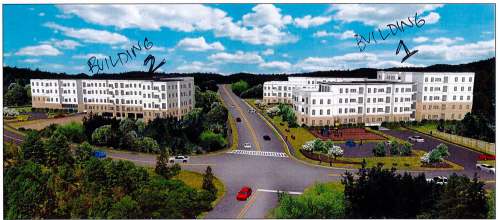
Yikes!  The newly proposed 40B  on both sides of Rte. 27 at Dale Street is 200 rental units, in buildings 3-5 stories tall – this from Sarah Raposa after her meeting this morning with the developers.  Click here for the plans


Planning Board and Board of Selectmen members –

I met with the development team for the proposed 40B at Dale St/Rt 27 this morning. The developers also did Leland Farm in Sherborn. Attached please find the plans for a 200 unit rental project. As proposed:
  • 25% affordable and 75% market rate
  • Two buildings
    • Building 1 – 110 units would be located at 39/41 Dale Street (3.285 ac)
    • Building 2 – 90 Units would be located at 49 Dale Street (2.957 ac)
  • 3-5 stories with underground and surface parking
  • Building 1 access/egress from North Meadows & Dale, with additional egress on North Meadows (plus two pedestrian connections to John Crowder and Joseph Pace)
  • Building 2 access/egress from Dale St
Obviously this density is shocking and there is a lot to review. I will be setting up a meeting with town departments for September so everyone has an opportunity to review and provide early comments on this. I’ll keep you posted.
Best,
Sarah


Sarah Raposa, AICP

Town Planner

Hospital Road 40B documents

40b

To review the documents related to the Larkins’ proposed 40B project on Hospital Road, see the link provided below in an email this morning from Sarah Raposa.


Kristine is in the process of making a page on the town website. In the meanwhile here is a link to a Dropbox folder containing the submission to MassHousing.

https://www.dropbox.com/sh/fb96y2sphx3g6ht/AABEyorFXzg5edO7fTk920uTa?dl=0


Sarah Raposa, AICP

Town Planner

Hospital Road 40B

40b

Hospital Road 40B filed with State

The Larkin Brothers of Reading and Fred Santucci of Needham filed with the state to start their permitting process for their planned 40B development off Hospital Road adjacent to the former Medfield State Hospital site.  Below is a draft of the current town response, which the selectmen will seek to finalize at the meeting tonight.

The Larkins shared with me last Thursday that they were willing to start meeting with the town representatives again, meetings they broke off to focus on their state filing.  The real question will be whether they will be willing to make real changes to their project to make it more acceptable to the town, to the point that the town would be willing to seek to help them facilitate their permitting.

The big sticking points are the current density, the costs, and the target buyers not matching town needs.


July 23, 2016

Mr. Gregory P. Watson, AICP
Manager of Comprehensive Permit Programs
Massachusetts Housing Finance Agency
One Beacon Street
Boston, MA 02108-3110

Re:     Application for Project Eligibility Determination/Site Approval Country Estates
Municipal Comment Letter; Due July 29, 2016

Dear Mr. Watson:
In response to an application for Project Eligibility Determination/Site Approval (the “Application”) submitted to the Massachusetts Housing Finance Agency (MassHousing) by Country Estates of Medfield, LLC for a proposed development of forty-eight (48) units on Hospital Road in Medfield pursuant to Massachusetts General Laws, Chapter 40B, Sections 20-23 (Chapter 40B), the Medfield Board of Selectmen submits the enclosed material as written comment pursuant to 760 CMR 56.04 (3). The correspondence contains comments from Town department heads and officials. It is our understanding that some Medfield residents will be submitting their own comments.

I.    Introduction
The proposed project (the project) would include forty-eight (48) units on 7.34 acres, 0.02 acres of which are wetlands. The breakdown of the development is proposed as follows: twenty-eight (28) three bedroom units and twenty (20) four bedroom units; 24 single family units with attached two-car garages (24 buildings) and 24 duplex units with attached one- or two-car garages (12 buildings). The existing property is adjacent to conservation land owned by the Town of Medfield and open space land owned by the Commonwealth of Massachusetts. The property fronts on Hospital Road, a well-traveled public way that connects North Meadows Road (Route 27) to Harding Street.

II.    Previous communication with developers
Prior to submittal to MassHousing the Applicants had a series of meetings with town staff, officials, and residents on the general concept and layout of the project.
•    December 1, 2015 – Applicants, Michael Larkin and Patrick Larkin, expressed their intent to submit a 40B on Hospital Road to Sarah Raposa, Town Planner.
•    February 3, 2016 – Applicants, Michael Larkin, Patrick Larkin, and Fred Santucci, met with Michael Sullivan, Town Administrator, and Sarah Raposa, Town Planner, to discuss the proposed project. The Applicants were informed of the Town’s draft Housing Production Plan and were recommended to meet with the Council on Aging to understand the needs of the Medfield’s aging population.
•    March 14, 2016 – Applicants, Michael Larkin, Patrick Larkin, and Fred Santucci, met with Osler Peterson, Selectman, Michael Sullivan, Town Administrator, Sarah Raposa, Town Planner, Frank Perry Member, Board of Assessors, and Ralph Costello, Resident. The Applicants proposed sixty (60) units with a mix of duplexes, triplexes, and quadplexes. The Applicants were provided feedback about density, price points, site design, and connection to open spaces. The Applicants were also queried on their ability to provide “reasonably” priced homes suitable for seniors.
•    April 4, 2016 – Applicants, Michael Larkin, Patrick Larkin, and Fred Santucci, met with Osler Peterson, Selectman, Michael Sullivan, Town Administrator, Kristine Trierweiler, Assistant Town Administrator, Sarah Raposa, Town Planner, Frank Perry, Member, Board of Assessors, and Ralph Costello, Resident. The plan was reduced to forty-eight units comprised of singles and duplexes all with the ability to have first floor master bedrooms.
•    April 20, 2016 – Applicants, Michael Larkin, Patrick Larkin, and Fred Santucci, Jon Studebaker, Architect, and Bradley McKenzie, PE, met with Osler Peterson, Selectman, Michael Sullivan, Town Administrator, Kristine Trierweiler, Assistant Town Administrator, Sarah Raposa, Town Planner, Frank Perry, Member, Board of Assessors, and Ralph Costello, Resident. The elements of the site plan and design elements were presented by Studebaker and McKenzie. Feedback was given on utilities, infrastructure, stormwater, mature trees, stone walls, and open space connections. Town staff remained concerned about the proposed unit size and affordability.
While the Town was assured there would be an additional meeting to better understand the pro forma prior to submission to MassHousing for Project Eligibility, we were disappointed when communication ceased.

III.    Comments from Town Staff and Officials
Based on the conceptual, un-dimensioned, un-detailed plan that was submitted with the Application, the Town offers the following comments, hopefully useful in developing the plan set for application to the Medfield Zoning Board of Appeals:
A.    Environmental, Historical, and Archeological:
•    The former use of part of the subject property was a gas station/garage, Ford dealership, and a small business making street sweeping brooms in the back of the garage.
•    A large portion of the property is shown to contain Prime Farmland Soils
•    Add vegetation to property boundary – do not rely on State-owned fields as buffer
•    Keep large trees (and protect during construction). Any loss of significant vegetation within 10 years of project completion will require replacement (same location, substantial height and caliper size).
•    Add additional substantial vegetation along Hospital Road to buffer new construction.
•    About half of the property is in the Well Protection District, Aquifer Overlay Zone
•    Retain and enhance the stone wall along Hospital Road.
•    Retain any historical site features (gates, fences, stone walls).
•    Use drought tolerant lawn grasses and vegetation throughout the site.
•    The proposed project is not in an Archeological Protection District.
•    The proposed project not in Hospital Farm Historical District.
•    Hospital Road is not a Scenic Road.

B.    Infrastructure:
•    Water and Sewer connections were made as a courtesy to the former residents who sold their land to the developers. Otherwise, a 5-year moratorium would be in effect.
•    The Board of Water and Sewerage agrees with the Fire Chief’s proposed hydrant locations as sketched on concept plan.
•    Mega lugs will be necessary at all hydrants.
•    Six (6) inch ductile iron pipe and six (6) inch gates must be used at all hydrants.
•    The Medfield Water Department requires a looped water system with eight (8) inch ductile iron pipe.
•    It will be necessary to place one gate valve at each roadway and one gate valve at approximately halfway into the subdivision circle. All valves will be eight (8) inch.
•    One (1) inch Type K, copper service, piping will be required at each house.
•    The Medfield Sewer Department requires manholes to be installed 300 feet apart and at all turns.
•    Provide four (4) foot sumps and catch basins.
•    Proposed infiltration basin design to the standards of the July 1, 2017 EPA standards (PE stamps required).
•    Ensure that the detention area appropriately sized to handle run-off; not too sloped so that it may appear as an amenity rather than necessary infrastructure. Alternatively, provide adequate safety provisions to prevent residents from entering/accessing the drainage structures.
•    Provide operations and maintenance agreement for stormwater system
•    Inclusion of LID Best Management Practices (bioretention, rain gardens)
•    Provide draft homeowners association agreement with submission for maintenance of stormwater system (roadways, common areas, vegetation)
•    Provide operations and maintenance agreements
•    Provide dark sky compliant site lighting / street lights (include photometric plan with cut-sheets for submission)
•    Provide traffic impact report with submission
•    Provide estimated water and sewer usages for proposed units
•    Natural gas service exists in road, in front of 21 Hospital Road
•    Upgrade sidewalks, ADA compliance
•    Provide underground utilities
•    Snow storage areas have not been designated. Lack of planning for this could result in reduced visibility for drivers and pedestrians in the development.
•    Provide earth importing, movement, and removal information that will be required to establish grades that will accommodate the dense development in this site.

C.    Fire Protection and Life Safety:
•    Building setbacks should be at least 8-10 feet apart
•    20’ wide one-way road circulation with Cape Cod Berm instead of vertical granite curbing
•    Use vertical curbing on Hospital Road and at curved radii.
•    No parking on street (with enforcement via Homeowners Covenant) or provide wider streets
•    Install three (3) fire hydrants on loop around Road A (locate at access points and mid-way around Road A)
•    Ensure ability to flush hydrants but locate hydrants so they are useful in fighting fires
•    Shaft liner for duplex units

D.    Overall Site Plan:
•    The site plan is aggressively dense.
•    The density and alignment of the units around the ring road does not respect the street view or country road.
•    Provide more differentiation in the unit design and face them in a purposeful direction not just vehicular (the way the decks and backs of the houses face the center circle does not create much of a neighborhood).
•    Eliminate one of the structures at the end of Road C in order to free up space for visitor parking (also removes Conservation Commission jurisdiction).
•    Eliminate one of the structures in the northwest area in order to free up space for visitor parking.
•    Create bus stop and mail locations.
•    Include fully dimensioned detailed site plans showing setbacks, FARs, lot coverages, etc.
•    No further expansion of dwellings allowed.
•    Provide for third party building inspection.
•    Provide for third party road and infrastructure construction inspection.

E.    Municipal Planning and Affordable Housing Comments:
•    Housing goals articulated in Medfield’s 1997 Master Plan Goals & Policies Statement  remain applicable today:
o    Protect Medfield’s environmental quality, town character and fiscal condition as growth continues. (LU-2)
    Decisions affecting land use should be guided by an understanding of the environmental, social, and fiscal implications of development.
o    Medfield will accommodate residential development that is consistent with the Town’s character and its ability to provide high quality services. (H-1)
    Residential development should be concentrated in areas that can accommodate development without jeopardizing the environment and town character.
    Ensure that densities reflect infrastructure and natural resource constraints.
o    New housing development will include the variety of lot sizes, unit sizes and housing costs that contribute to Medfield’s diverse community. (H-2)
    Plan for and support development of a wide range of housing options in order to accommodate households with diverse housing needs, as well as changing family structures.
    The Town should take a direct role in provision of affordable housing in order to protect the character of the community while meeting identified needs and targets.
o    These goals formed the basis for the housing vision stated in Medfield’s 2004 Community Development Plan:
    Medfield will accommodate residential development that is consistent with the Town’s character and its ability to provide high quality services while ensuring that units that are affordable to a range of incomes are also developed.
•    The Town has completed a draft Housing Production Plan and intends to submit it to DHCD by the end of the year. One of the promising strategies for providing broader types and affordabilities of housing in Medfield is in the redevelopment of the nearby former Medfield State Hospital. The Town purchased the property from the State in December 2014 and is currently undergoing a master planning process.
o    The size and price of the of units do not meet the needs of the community as evidenced by the following key findings for the HPP:
    Medfield’s housing stock is relatively homogenous, and there is a need for more diverse housing options in town suitable for households of all ages, sizes, and incomes. Increasing the diversity of housing options in Medfield will enable seniors, younger adults, and extended family households to establish and maintain long-term residence in the community.
    There is a need for affordable rental units suitable for families, including single parents. Medfield has a large population of families and large family sizes. Even though most families are homeowners, there is a population of families in town who rent. Medfield’s existing rental units are very small – the median number of rooms is only 3.4 – which suggests a need for larger units suitable for families.
    Medfield’s homes are large, and there are few options for seniors and empty-nesters to downsize and remain in the community. Smaller single family homes or condominiums would allow residents an opportunity to stay in Medfield as they age.
    Single family homes in Medfield are very expensive. There is a need for more affordable homeownership opportunities for younger adults, people who work in town, and care providers. Medfield will have an increasingly difficult time recruiting quality candidates for municipal, school department, service, or other private sector jobs as employees cannot afford to live within a reasonable commuting distance.
    Demand for the existing rental properties in town is high, suggesting a surplus demand for rentals in town. Conversations with social service providers in the region suggests that there is a need for rental housing for all types of households, including young adult households, single parents, traditional families, seniors, and single individuals.
•    Medfield’s Subsidized Housing Inventory is approximately 6.7%
•    Provide potential school impact estimates

IV.    Conclusion
Overall, our suggestions about this project relate to the density and unit sizes proposed which seem to be somewhat excessive given the surrounding residential neighborhoods and the interest in providing affordable housing for families of modest means. The variation of pricing between the affordable units and the market units appears to be excessive. The Town would like to see some of the market units priced at a more reasonable level to accommodate the needs of residents who are being priced out of the local housing market as prices skyrocket. In addition, it would seem that the disparity in price between affordable units ($200,000) and market units ($500,000 to $720,000) may not be the most advantageous arrangement. The site has water and sewer in the adjacent street, substantially reducing development costs, which should permit unit housing costs to be reduced to a more reasonable level for the market units. We have discussed this with the developers and suggested scaling back the size and the amenities in the market units to put them within the price range of moderate income families, e.g., reduce square footage of the units, eliminate granite countertops and high end appliances, offer lower priced options in flooring and bathroom fixtures, etc. Medfield currently has six 40B developments, including a recently completed 92–unit rental complex. It has never turned down a 40B project and is proud of its track record of welcoming a variety of housing types. Three of these developments are for families, two for senior housing and one for developmentally disabled individuals. Recent housing surveys have indicated a strong demand for affordable housing for older individuals, whose children have left home, who would like to downsize and would like to stay in the town where they have lived for all or most of their lives. Presently, we have seen an outflow of older residents to surrounding communities because the type of housing they would like to purchase or rent is not priced within their means. The vast majority of Medfield’s housing stock consists of large single family homes, not suitable for an aging household. In supporting a 40B project we would hope that it would serve people of modest means, both low and moderate incomes. We do not consider the purpose of a 40b development is to maximize a developer’s profit margin.  Given your mission we are confident that you will concur with this position by requiring that both the affordable and market units be reasonably priced and not be priced at levels well beyond the reach of average citizens. We would also ask that, given the diversity of our existing 40B projects, that the need in Medfield for housing options for aging families be incorporated into this project.
In addition to the above observations, we do have some concerns about the lack or suitable parking spaces proposed within the development. Given the number of bedrooms and of dens, and family rooms suitable for conversion to bedrooms, as well as the proposed street widths of 20 feet, we do not feel that the proposed parking is adequate. Keep in mind that this is a somewhat rural site with no public transportation and that Medfield, with a population of just over 12,000 issues some 12,000 motor vehicle excise tax bills each year. Finally, we are concerned that the building designs seem to be based more on how many units can be configured than on how the development will look and function as a neighborhood. When we made suggestions about placement of garages and decks, we were told that the design was based on minimizing the asphalt surfaces. A well-designed neighborhood should be based more on how it works for the residents than on how asphalt is measured. A little creativity in design could do wonders for both.

Signed,
____________________
Chairman, Board of Selectmen

cc: Jessica L. Malcolm, 40B Specialist, MassHousing

Town data comparisons

I am always interested in how we in Medfield do things relative to other towns, and therefore found this data below instructive.  Lexington has clearly worked at getting to 10% affordable housing.

Data Year Town Wellesley Lexington Southborough Medfield
2014 Population 28,858 32,306 9,869 12,236
2014 Median Income 145,280 139,561 140,184 128,446
2014 % Elderly (65+) 14 12 12 12
2016 # Housing Units 9,090 11,946 2,310 4,220
2016 # Subsidized Units 560 1,329 44 191
2016 % Subsidized 6 11 2 5
2014 Median House Price 1,180,000 950,000 580,000 568,250
2012 # Businesses 4,364 4,284 1,115 1,384
2013 # Millionaires 726 344 93 101
2013 # Millionaires per 1000 25.47 10.79 9.48 8.32
2013 Square Miles of Town 10.20 16.43 14.20 14.50
2013 # Millionaires per sq mile 71.18 20.94 6.55 6.97

Many of our other fellow Metrowest towns are over 10% as well. Look at this map to see how we compare on affordable housing http://www.massaffordablehomes.org/mahamap.html

40B site walk

The Larkin Brothers are doing a 48 unit 40B condo development on Hospital Road, and have now filed with the state to proceed.  It will be like their Grover Place development on North street.  As part of their state filing, there will be a site walk on 6/22/16 at 10AM.

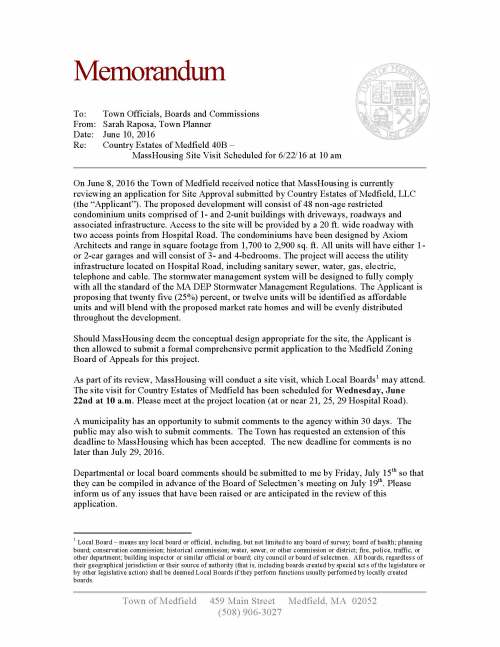
Town of Medfield 459 Main Street Medfield, MA 02052 (508) 906-3027 Memorandum To: Town Officials, Boards and Commissions From: Sarah Raposa, Town Planner Date: June 10, 2016 Re: Country Estates of Medfield 40B – MassHousing Site Visit Scheduled for 6/22/16 at 10 am On June 8, 2016 the Town of Medfield received notice that MassHousing is currently reviewing an application for Site Approval submitted by Country Estates of Medfield, LLC (the “Applicant”). The proposed development will consist of 48 non-age restricted condominium units comprised of 1- and 2-unit buildings with driveways, roadways and associated infrastructure. Access to the site will be provided by a 20 ft. wide roadway with two access points from Hospital Road. The condominiums have been designed by Axiom Architects and range in square footage from 1,700 to 2,900 sq. ft. All units will have either 1- or 2-car garages and will consist of 3- and 4-bedrooms. The project will access the utility infrastructure located on Hospital Road, including sanitary sewer, water, gas, electric, telephone and cable. The stormwater management system will be designed to fully comply with all the standard of the MA DEP Stormwater Management Regulations. The Applicant is proposing that twenty five (25%) percent, or twelve units will be identified as affordable units and will blend with the proposed market rate homes and will be evenly distributed throughout the development. Should MassHousing deem the conceptual design appropriate for the site, the Applicant is then allowed to submit a formal comprehensive permit application to the Medfield Zoning Board of Appeals for this project. As part of its review, MassHousing will conduct a site visit, which Local Boards1 may attend. The site visit for Country Estates of Medfield has been scheduled for Wednesday, June 22nd at 10 a.m. Please meet at the project location (at or near 21, 25, 29 Hospital Road). A municipality has an opportunity to submit comments to the agency within 30 days. The public may also wish to submit comments. The Town has requested an extension of this deadline to MassHousing which has been accepted. The new deadline for comments is no later than July 29, 2016. Departmental or local board comments should be submitted to me by Friday, July 15th so that they can be compiled in advance of the Board of Selectmen’s meeting on July 19th. Please inform us of any issues that have been raised or are anticipated in the review of this application. 1 Local Board – means any local board or official, including, but not limited to any board of survey; board of health; planning board; conservation commission; historical commission; water, sewer, or other commission or district; fire, police, traffic, or other department; building inspector or similar official or board; city council or board of selectmen. All boards, regardless of their geographical jurisdiction or their source of authority (that is, including boards created by special acts of the legislature or by other legislative action) shall be deemed Local Boards if they perform functions usually performed by locally created boards.